Prevod
There was once a queen whose womb the Lord God had closed, so that she bore no children. Every morning she went into the garden and prayed to God in heaven to grant her a son or a daughter. Then an angel came down from heaven and said, “Be content: you shall have a son whose wishes will come true, for whatever he wishes for in this world, he shall receive.” She went to the king and told him the joyful news, and when her time had come, she bore a son, and the king rejoiced greatly.
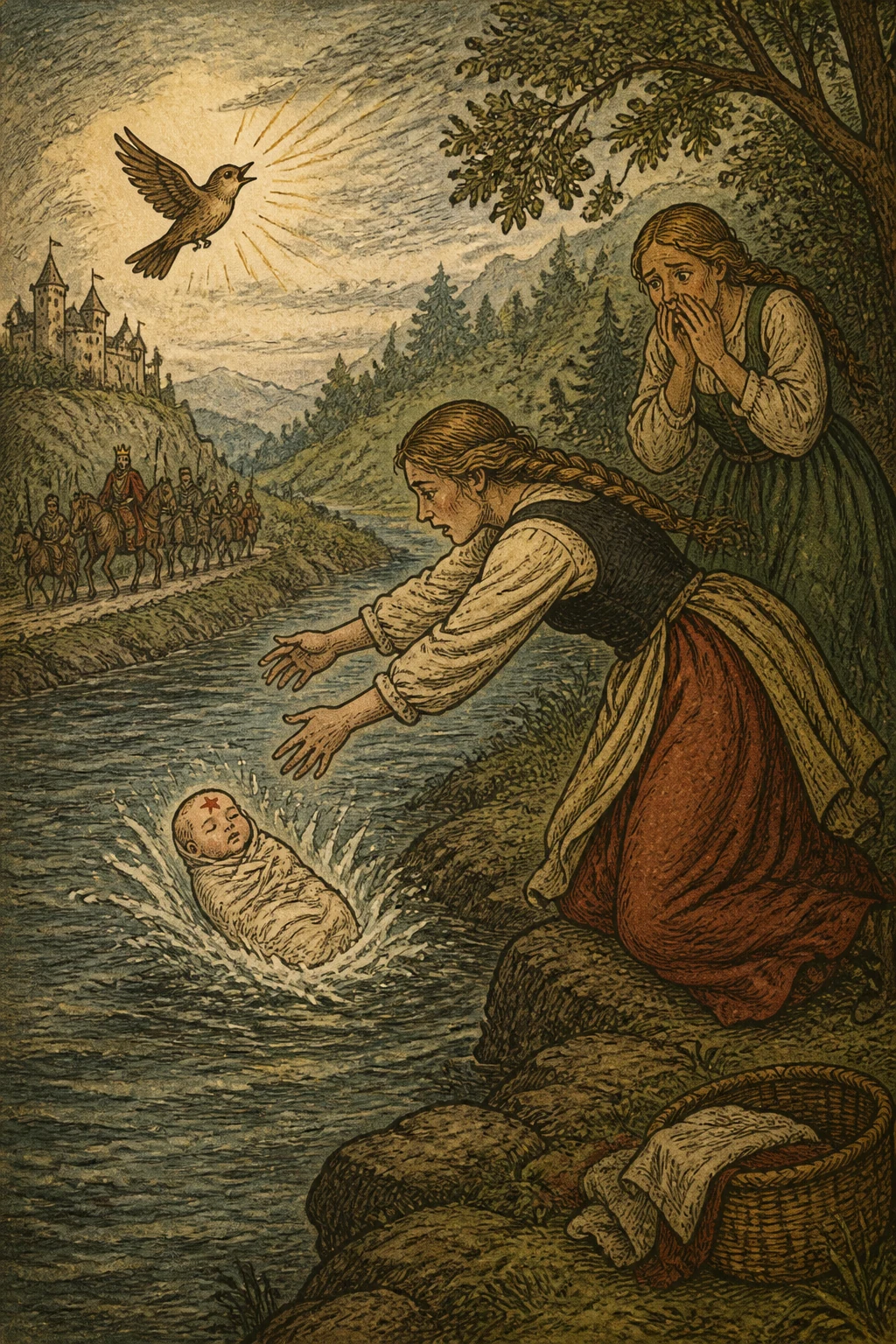
Now every morning she took the child into the park, where she washed herself at a clear spring. One day, when the child was a little older, he was lying in her lap, and she fell asleep. Then the old cook, who knew that the child’s wishes came true, came and stole him away. He took a chicken, tore it apart, and dripped its blood onto her apron and gown. He carried the child off to a secret place, where a wet nurse was made to suckle him, then ran to the king and accused the queen of letting wild beasts carry off her child. When the king saw the blood on her apron, he believed the story and flew into such a rage that he had a deep tower built, into which neither sun nor moon could shine, and had his wife shut inside and the entrance walled up. There she was to remain for seven years without food or drink, and waste away. But God sent two angels down from heaven in the shape of white doves, who flew to her twice each day and brought her food until the seven years were over.
But the cook thought to himself, “If the child’s wishes come true and I stay here, he could easily bring about my ruin.” So he left the palace and went to the boy, who was now old enough to speak, and said to him, “Wish for a splendid castle with a garden and everything that belongs to it.” Scarcely had the words left the boy’s mouth when everything he had wished for stood before him. After a time the cook said to him, “It is not good for you to be so alone. Wish for a beautiful maiden to keep you company.” So the king’s son wished her there, and at once she stood before him, more beautiful than any painter could paint. The two played together and loved each other with all their hearts, while the old cook went hunting like a nobleman. But the thought came to him that one day the king’s son might wish to be with his father, and so bring him into great trouble. He went out, took the girl aside, and said, “Tonight, when the boy is asleep, go to his bed and drive this knife into his heart, and bring me his heart and tongue. If you do not, you shall lose your life.” Then he went away, and when he returned the next day, she had not done it. “Why should I take an innocent life,” she said, “when he has never harmed anyone?” The cook said again, “If you do not do it, it will cost you your own life.” When he had gone, she had a young doe brought to her and slaughtered, then took its heart and tongue and laid them on a plate. When she saw the old man coming, she said to the boy, “Lie down in bed and pull the covers over you.”
Then the villain came in and said, “Where are the boy’s heart and tongue?” The girl handed him the plate, but the king’s son threw off the covers and said, “You old sinner, why did you mean to kill me? Now I shall pronounce your sentence. You shall become a black poodle with a golden chain around your neck, and you shall eat glowing coals until flames leap from your throat.” As soon as he had spoken these words, the old man was turned into a poodle with a golden chain around his neck, and the cooks had to bring up live coals, which he ate until flames leapt from his throat. The king’s son stayed there a little longer, thinking of his mother and wondering whether she was still alive. At last he said to the girl, “I mean to go home to my own country. If you will come with me, I will provide for you.” “Ah,” she answered, “the way is so long, and what am I to do in a foreign land where no one knows me?” Since she was not truly willing to go, and yet neither wished to part from the other, he wished her into a beautiful carnation and tucked it into his clothes.
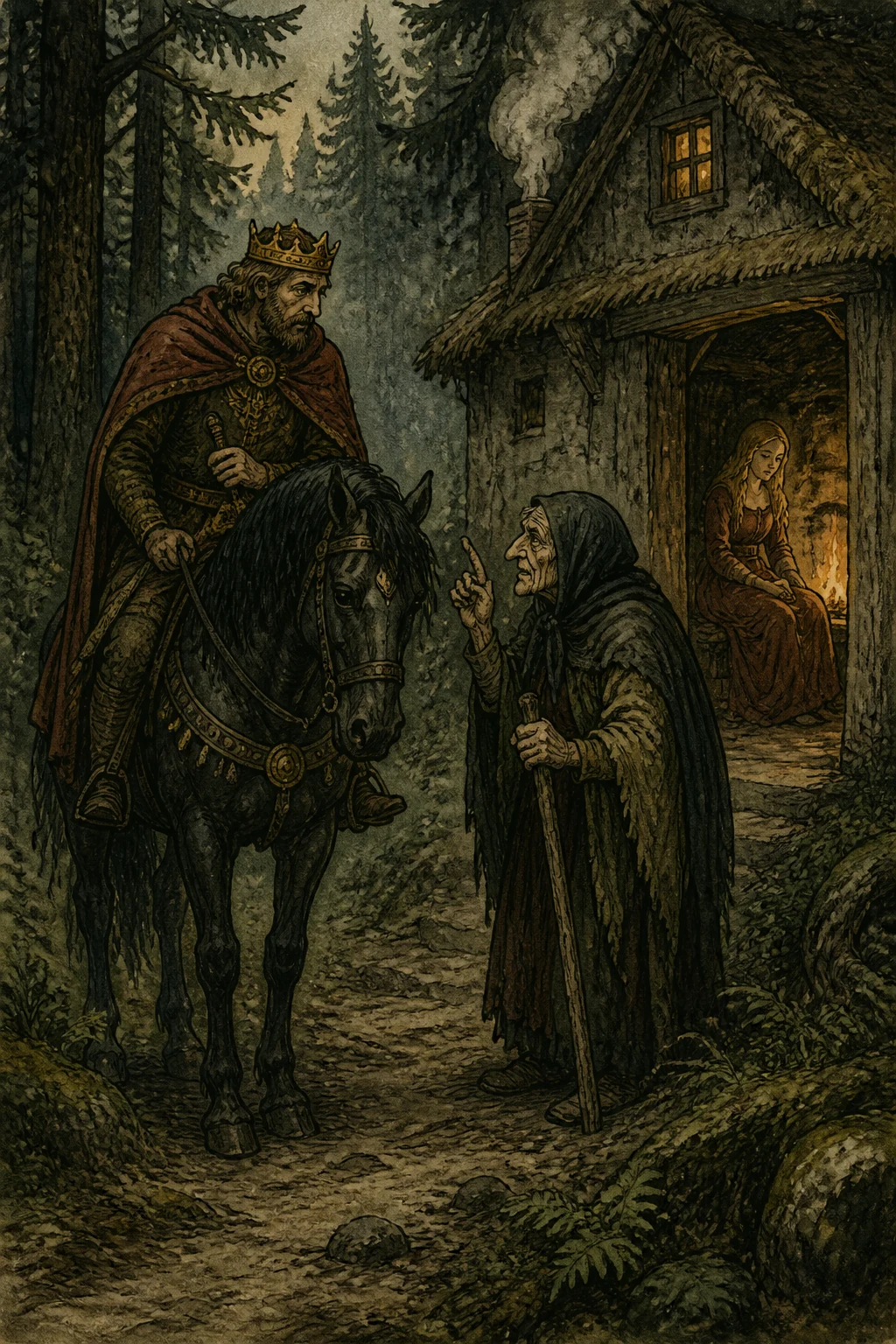
Then he set out for his native land, and the poodle had to run along with him. He went to the tower where his mother was imprisoned, and because it was so high, he wished for a ladder that reached all the way to the top. He climbed up, looked inside, and called, “Dearest mother, my lady queen, are you still alive, or are you dead?” She answered, “I have only just eaten, and I am still full,” thinking the angels had come. He said, “I am your dear son, whom the wild beasts are said to have stolen from your lap. But I am still alive, and I shall soon set you free.” Then he climbed down and went to his father the king, announcing himself as a huntsman from a foreign land and asking whether he might enter his service. The king replied that if he knew his trade and could supply him with game, he might come. Yet no game had ever been found anywhere in the surrounding country or along its borders. The huntsman said he would bring him as much game as he could possibly need for the royal table. Then he summoned all the huntsmen and told them to go out into the forest with him. They went along, and once there he told them to form a large circle, leaving it open at one end. He took his place inside it and began to wish. At once, more than two hundred head of game came running into the circle, and the huntsmen had to shoot them. They loaded it all onto sixty farm wagons and drove it home to the king, who could at last furnish his table with game, after having had none for many years.
The king was greatly delighted and ordered his entire court to dine with him the following day, and he gave a grand feast. When they were all gathered, he said to the huntsman, “Since you are so skilful, you shall sit beside me.” He answered, “Your Majesty, graciously pardon me, but I am only a humble huntsman.” The king insisted, however, saying, “You shall sit beside me,” until he did so. As he sat there, he thought of his beloved mother and wished that one of the king’s chief servants would speak of her and ask how the queen was faring in the tower, and whether she was still alive or had wasted away. Scarcely had he made the wish when the marshal spoke up and said, “Your Majesty, here we live in joy, but how fares the queen in the tower? Is she still alive, or has she wasted away?” But the king answered, “She let the wild beasts tear my dear son to pieces. I will hear no more of her.” Then the huntsman rose and said, “My most gracious father, she is still alive, and I am her son. The wild beasts did not carry him off: that villain, the old cook, did it. He took me from her lap while she slept and spattered her apron with a chicken’s blood.” Then he took hold of the dog with the golden collar and said, “Here is the villain,” and had glowing coals brought in, which the dog had to eat before them all until flames leapt from his throat. Then he asked the king whether he wished to see him in his true shape, and wished him back into a cook. At once he stood there in his white apron, with a knife at his side. When the king saw him, he grew furious and ordered him thrown into the deepest dungeon. Then the huntsman went on, “Father, would you also like to see the girl who cared for me so tenderly, and who was later ordered to kill me, but would not do it, though her own life was at stake?” The king answered, “Yes, I would gladly see her.” His son said, “My most gracious father, I will show her to you in the shape of a beautiful flower.” He reached into his pocket, took out the carnation, and set it on the royal table. It was more beautiful than any the king had ever seen. Then his son said, “Now I will show her in her true shape as well,” and wished her into a maiden. There she stood, so beautiful that no painter could have painted her more beautifully.
The king sent two ladies-in-waiting and two servants down to the tower to fetch the queen and bring her to the royal table. But when she was led there, she would eat no more, and said, “The gracious and merciful God who sustained me in the tower will soon deliver me.” She lived for three more days, then died in peace. When she was buried, the two white doves that had brought her food in the tower, and were angels from heaven, followed her and settled on her grave. The old king had the cook torn into four pieces, but grief gnawed at his heart, and he soon died. His son married the beautiful maiden he had brought home as a flower in his pocket, and whether they are still alive, God alone knows.