Prevod
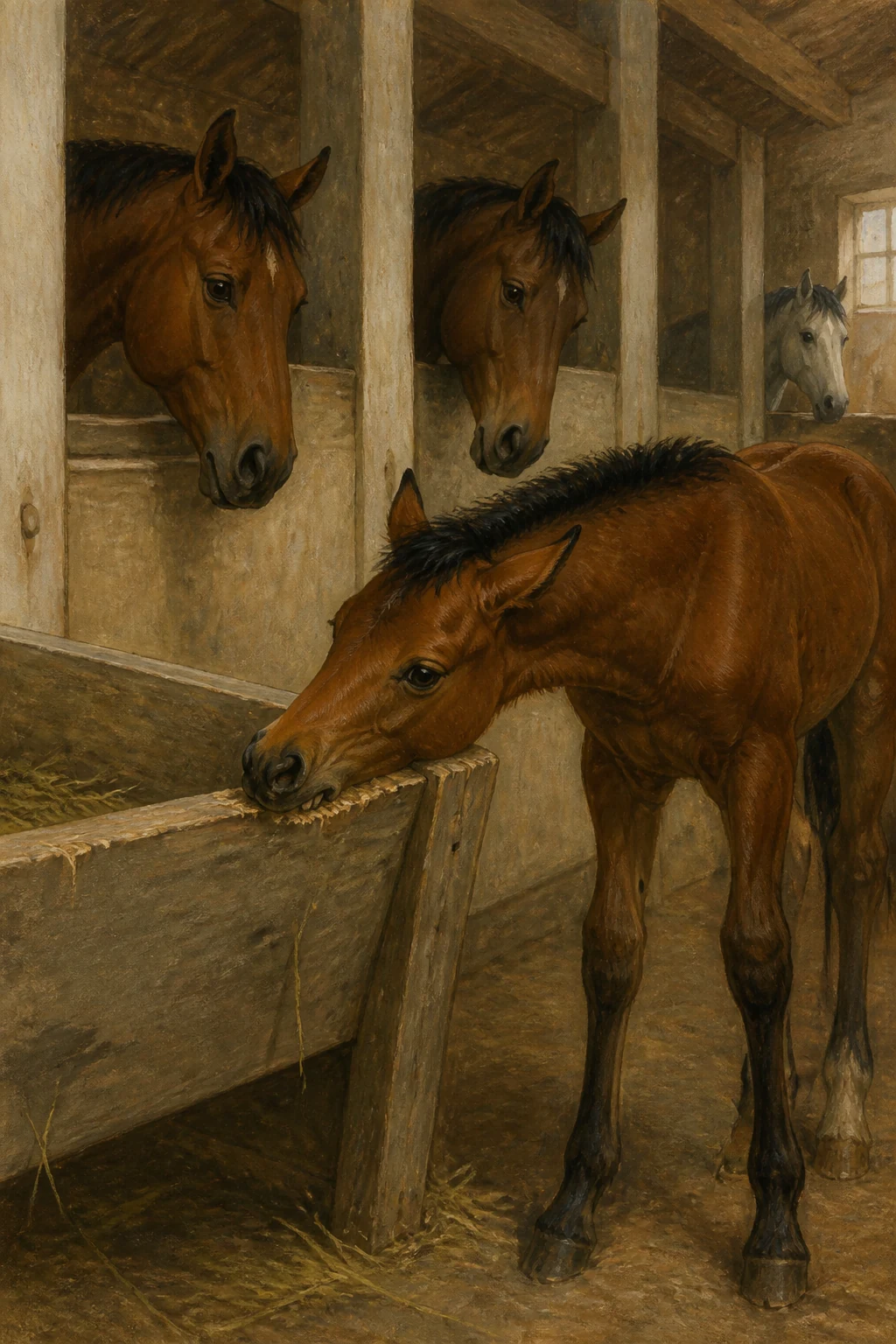
»Mislim,« je rekel Slepi Konj, »da je nekaj narobe z mojimi ušesi.« Z Lisastim Sivcem sta vse dopoldne delala na polju, zdaj pa sta v svojih stojiščih jedla obilno kosilo. Bila sta edina prebivalca v pritličju hleva. Celo golobi, ki so po naključju zašli skozi odprta vrata, so bili spet zunaj na soncu. Tu in tam je šumenje kril naznanilo, da je kaka lastovka švignila skozi okno na senik nad njima in odletela v svoje gnezdo pod streho. V od sonca ogretem zraku je vladala globoka, pomirjujoča tišina, pa vendar se je zdelo, da Slepi Konj posluša nekaj, česar njegov tovariš ni slišal.
Lisasti Sivec je takoj nehal jesti. »Tvojimi ušesi?« je vprašal. »Kaj pa je narobe z njimi? Mislil sem, da zelo dobro slišiš.« »Vedno sem dobro slišal,« se je glasil odgovor, »odkar sem izgubil vid, pa še bolje kot prej. Saj veš, da je pri nas slepih vedno tako. Naučimo se slišati bolje, kot smo slišali, preden smo izgubili vid. Toda odkar sva prišla s polja, mi v ušesih zveni neki čuden zvok in mislim, da je nekaj narobe z njimi.«
Lisasti Sivec je nehal jesti in obstal povsem pri miru, da bi prisluhnil. Niti z repom ni zamahnil, čeprav so bile tisti hip na njegovem levem boku tri muhe, na vratu pa še ena. Na vso moč se je trudil, da bi tudi sam zaslišal nenavadni zvok, saj bi to dokazalo, da je zvok resničen in da je s sluhom Slepega Konja vse v redu.
Ničesar ni slišal. »Kakšen pa je ta zvok?« je vprašal. »Kakor glasno mačje predenje,« je odgovoril Slepi Konj, »ampak vsi vemo, da Mačka ne prede nikjer tu v bližini.«
»Morda pa le,« je rekel Lisasti Sivec. »Od kod se ti zdi, da prihaja zvok?« »Iznad moje glave,« je rekel Slepi Konj, »in tam zgoraj ob tem času prav gotovo ne bi predla. Ali bi trdno spala ali bi bila na lovu ali pa zunaj na soncu, kjer tako rada poseda.«
Lisasti Sivec je vedel, da je res tako, in ni mogel reči niti besede. Prijatelj se mu je zelo smilil. Pomislil je, kako strašno bi bilo biti slep in gluh obenem, in oves, ki ga je požiral, se mu je zataknil v grlu.
»Nikar ne skrbi,« je rekel Slepi Konj. »Tudi če bi oglušel, bi še vedno čutil nežno božanje sapice na koži, okušal dobro hrano in se s prijatelji podrgnil s smrčki. Sploh ne bi nič rekel, le upal sem, da boš tudi ti slišal ta zvok, pa bi vedel, da je resničen.« To mu je bilo povsem podobno. Vedno je bil potrpežljiv in dobrodušen. V vseh letih, odkar je bil slep, se ni niti enkrat pritožil nad tem, in velikokrat so se drugi konji, ko so hoteli reči ali storiti kaj neprijaznega, spomnili nanj in se ustavili. Sram jih je bilo biti nestrpen, ko pa jim je šlo toliko bolje kakor njemu.
Konja sta še naprej jedla oves in počivala po napornem delu. Na seniku nad njunima glavama je ležala Mačka in predla in predla in predla, ne da bi slutila, da s tem povzroča skrbi prijateljema spodaj.
Vso prejšnjo noč je lovila, se tiho plazila po hlevu ter se skrivala za vrečami in zaboji, kjer je prežala na neprevidne miši in mlade podgane. Tudi te so kakor ona ponoči tekale naokrog in v hlevu ter na dvorišču se je marsikaj zgodilo, medtem ko so večji štirinožni prebivalci trdno spali, perutnina pa je sanjala z glavami, zataknjenimi pod peruti. Včasih je bilo zjutraj manj miši kakor prejšnji večer, in kadar je bilo tako, se je Mačka počasi sprehodila po hlevu ter si poiskala udobno počivališče. Ko ga je našla, se je trikrat zavrtela, kakor je nekoč počela njena pra-pra-pra-pra-pra-prababica, da si je v džungli poteptala ležišče, potem pa legla k dolgemu dremežu. Govorila je, da s polnim želodcem vedno bolje spi in da je to navada vseh mačk.
Včasih je lovila na poljih in marsikatero jutro so jo krave ob sončnem vzhodu videle, kako po vrhu ograj stopa proti hlevu. Ni si rada zmočila tačk v rosni travi, če se je temu le lahko izognila; zato je takoj, ko je končala lov, skočila na najbližjo ograjo in se po njej odpravila domov.
Da, prejšnjo noč je lovila, vendar zdaj ni mislila na to. Pa tudi spala ni. Blizu nje je podgana glodala deske, a je komaj obrnila glavo. Miš je stekla po tleh tik pred njenimi očmi in Mačka jo je opazovala, ne da bi se premaknila. Kaj ji je bilo zdaj mar zanje? Ob njej so na senu ležali njeni prvi mladički in na ta prvi dan njihovega življenja jih ne bi zapustila, razen če bi bilo zares nujno.
Seveda je že prej videla majhne mucke — mucke drugih mačk — vendar je bila prepričana, da nobeden od njih ni bil niti malo podoben njenim trem ljubkim otročičkom. Nikakor se ni mogla odločiti, kateri je najlepši. Sama je bila želvovinasta mačka in njen kožuh je bil lisast, bel, črn in rumen. Tudi mladički so imeli na mehkih kožuščkih iste barve, le da so bile razporejene drugače kakor pri njej.
Sprva je menila, da je njena večja hčerka družinska lepotica; bila je tako lepo rumena, brez ene same dlake drugačne barve. »Rumene mačke so mi bile od nekdaj všeč,« je rekla mlada mati, »in pravijo, da so zelo krepke.«
Potem je pogledala manjšo hčerko, ki je bila bela, z drobnimi rumenimi in črnimi lisami na vratu in glavi. »Kako čist je videti ta otročiček!« je vzkliknila. »In prepričana sem, da bo imela, ko bo odprla oči, modre kakor jaz.«
Prav tedaj se je topli, temni klobčič dlake med njenima sprednjima tačkama premaknil in ljubeče je pogledala svojega edinega sina. »Ta je prav gotovo nekaj posebnega,« je rekla. »Še nikoli nisem videla tako lepe mešanice rumene in črne: najprej dlaka ene barve, potem dlaka druge, tako da je od daleč videti čudovito rjav. In šele njegove tačke!« S sprednjo tačko ga je nežno dregnila in ga obrnila na hrbet. Zamahljal je z drobcenimi tačkami po zraku. Debele kožne blazinice na njih so bile črne, da bolj črne ne bi mogle biti, in to je zelo redko. Navadno so rožnate kakor pri njegovih sestricah.
Malček je ležal tam in se prav slabotno zvijal, dokler ga mati ni še enkrat dregnila in ga obrnila nazaj. Tedaj se je pretegnil in se splazil proti njej, pri tem pa obračal glavico zdaj na eno, zdaj na drugo stran. Bil je tako šibak, da ni mogel dvigniti telesa s sena, temveč ga je vlekel za seboj s kratkimi, negotovimi koraki svojih štirih tresočih se nožic. Šele pred kratkim je odkril, da ima noge, in niti sanjalo se mu ni, kako naj jih uporablja. Premaknil je pač tisto, ki mu je bila najbolj napoti.
Ni vedel, kam gre ali po kaj gre, toda njegov želodček je bil prazen in zeblo ga je. Nekaj, sam ni vedel kaj, ga je gnalo, da se je vlekel proti velikemu, toplemu bitju v bližini. Ko se je s črnim smrčkom dotaknil dlake na njenem telesu, se je nehal pomikati naprej in začel tipati sem in tja. Tudi zdaj ni vedel, kaj išče, a ko je nekaj našel, so se drobcena usteca sklenila okoli tega in po grlu mu je v prazni želodček stekel curek sladkega, toplega mleka. Ni vedel, da je to mleko. Vedel je samo, da je dobro, potem pa je zaspal. Njegovi sestrici sta storili enako in srečna mati je kmalu lahko pogledala navzdol ter videla svoje tri mladičke v vrsti ob sebi, vse trdno speče. Njihovi koničasti repki so ležali naravnost za njimi, mehka ušesca pa so bila upognjena naprej, tesno h glavam.
»Le kdo ve,« je rekla, »ali sem bila tudi jaz kdaj tako majhna in ali me je moja mati ljubila tako, kot jaz ljubim njih.« Iztegnila je eno sprednjo tačko in si jo ogledala. Bila je toliko večja, tako zelo večja od tačk njenih mladičkov. Kako mehka in nežna je bila, pa tako brezhibno čista. Še bolj jo je iztegnila in zagledala pet dolgih, ukrivljenih, ostrih krempljev, ki so zdrsnili iz svojih nožnic oziroma tulcev. Hitro jih je potegnila nazaj v nožnice, saj se je bala, da bi se po naključju dotaknili njenih mladičkov in jih ranili.
Lastoviček je poletel iz svojega gnezda, ji preletel glavo in švignil skozi odprto okno. »Mucki!« je rekel. »Mucki!« Letel je nad polji in zagledal konja, ki sta stala ob ograji, medtem ko je kmet mazal svoj stroj. »V hlevu imamo nove sosede,« je rekel, »in Mačka prede glasneje kot kdaj prej.«
»Kdo pa so ti sosedje?« je vprašal Lisasti Sivec. »Mucki!« je zapel Lastoviček. »O, čiri-viri-viri-vi!« Slepi Konj je globoko vzdihnil. »Torej sem res slišal njeno predenje,« je rekel. »Tako sem vesel.« Nikoli ni delal velikega hrupa okoli svojih težav, saj je bil pogumen in nesebičen, vendar je Lisasti Sivec tudi brez besed vedel, koliko lažje mu je bilo pri srcu, odkar je izvedel, da je Mačka res predla nad njegovo glavo.
Dnevi so minevali in mucki so lepo rasli. Odprli so oči, najprej le v ozke špranjice, nato pa vse bolj in bolj, dokler niso bile okrogle in široko razprte. Bela Mucka je imela modre, druga dva pa rjave. Podnevi so imeli sredi oči dolge, ozke črne pege, ko pa je močna svetloba pojemala, so se te črne pege širile vstran, dokler niso postale povsem okrogle. Kadar je bilo zelo temno, so se svetile kakor velike kresnice v noči. Tedaj so miši, ki so pogosto švigale po seniku, kadar Mačke ni bilo, zagledale tri pare oči, ki so se svetile v senu, in zacvilile druga drugi: »Poglejte! Mucki nas opazujejo.«
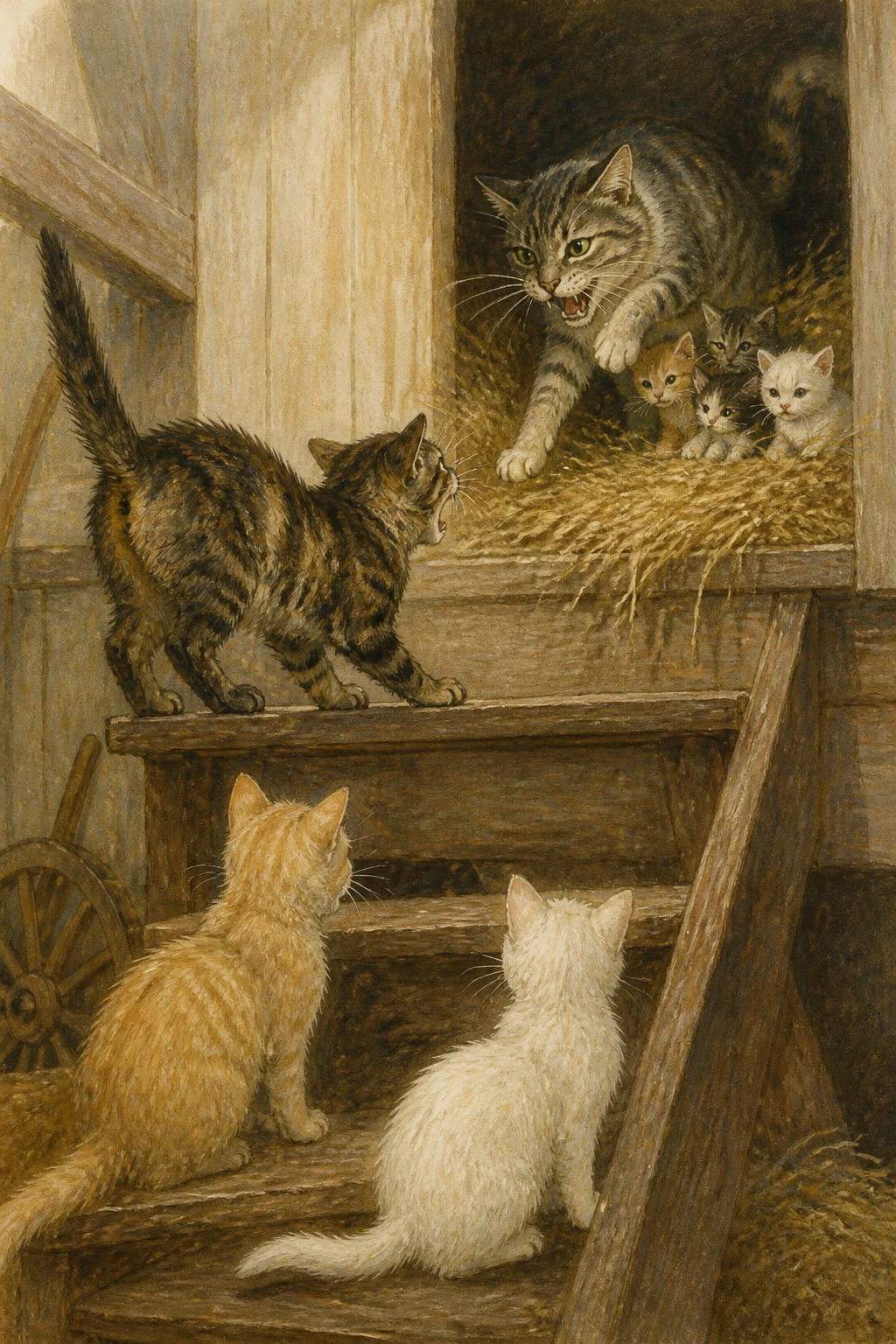
Mucki pa, ki še niso bili dovolj veliki, da bi hodili na lov, in so se bali vsega, kar se je premaknilo, so se stisnili drug k drugemu, usločili hrbtke, dvignili koničaste repke, nasršili dlako in rekli: »Pst! Haa-a!«
Včasih so to počeli, ko ni bilo nikogar na spregled in jih je prestrašil le šop sena, ki ga je odnesel veter. Pozneje pa so na vse, kar se je premaknilo, planili, to pridržali z ostrimi krempeljčki in grizli s koničastimi belimi zobki. Ko so se naveličali te igre, so se igrali skrivalnice, ko so se naveličali še teh, pa so lovili svoje repke. Kako lepo je bilo imeti igrače vedno pri sebi! Včasih so lovili tudi repke drug drugega, jih ujeli in močno ugriznili, dokler ni mucek, ki mu je repek pripadal, zavpil: »Mijav!« in prekucnil tistega, ki ga je ugriznil.
Igrali so se lahko po vsem seniku, le nad jaslimi ne. Njihovo mater je bilo strah, da bi tam padli skozi odprtine, ki so jih pustili v tleh. Pozimi je kmet skoznje metal seno lačnim konjem. Ko je Mačka videla, da se njeni otročički približujejo tem mestom, jih je poklicala nazaj in jih okregala. Včasih jih je s sprednjo tačko narahlo udarila po ušesih. »Nerada to počnem,« je rekla, »ampak naučiti se morajo, da ne smejo tja. Tam zanje ni varno.«
Nekega jutra, ko je ni bilo doma, so se igrali skrivalnice in Bela Mucka je iskala dobro skrivališče. »Skrila se bom blizu ene od teh lukenj,« je rekla, »pa si me ne bosta upala priti iskat. Potem, ko me bosta iskala že zelo, zelo dolgo, se bom skrila drugam in pustila, da me najdeta.« Res se je skrila tja in čez dolgo, dolgo časa, ko sta bila bratec in sestrica na drugem koncu senika, je hotela steči v drug temen kot. Toda seno pod njo je začelo drseti in polzeti in padala je dol, dol, dol skozi dolg, temen zaboj, dokler ni s trdim udarcem pristala na dnu.
Tako se je prestrašila, da ne bi znala povedati, koliko prstkov ima na sprednjih tačkah. Seveda jih je imela na vsaki pet, kakor vsi mucki, na vsaki zadnji tački pa štiri, toda če bi jo takrat kdo vprašal, bi prav lahko rekla: »Tri.«
Tudi bolelo jo je, in ko je na sebi začutila toplo sapo ter odprla oči, je zagledala neko veliko bitje, ki je pomolilo nos skozi odprtino v stranici temnega zaboja. »To mora biti konj,« je pomislila, »in mama pravi, da so konji prijazni do mačk. Mislim, da bo najbolje, če mu povem, kdo sem. Nočem, da bi me imel za prašička, saj mogoče ne mara prašičev.« Veste, pozabila je, da konji že dolgo živijo v širnem svetu in znajo takoj, ko koga prvič vidijo, povedati, kateri družini pripada. Sama je dotlej videla le lastovke in miši.
»Če — če dovolite, gospod,« je rekla, »jaz sem Bela Mucka in pravkar sem padla s senika, ampak nisem hotela.« »Jaz pa sem Slepi Konj,« je zunaj odgovoril močan in nežen glas, »in upam, da se nisi poškodovala.«
»Ne preveč,« je odgovorila Mucka. »Samo hrbet me malo boli in vsa sem prestrašena.« »Pridi ven v jasli, Bela Mucka,« je rekel Slepi Konj, »pa te morda ne bo več tako strah. Ne bom se te dotaknil, čeprav bi se te rad. Veš, slep sem, in če se drugih ne morem dotakniti, ne vem, kakšni so videti.«
Bela Mucka je zlezla ven in ga zagledala, in tedaj je ni bilo prav nič več strah. Tako se ji je smilil, da se ga ni mogla bati. Spomnila se je časa, preden je odprla oči, ko je morala vse, kar si je želela, poiskati s tipanjem. Takrat ni bilo tako težko, ker ni poznala ničesar drugega, zdaj pa ni mogla prenesti misli, da ne bi videla vsega okoli sebe. »Če spustiš nos na drugi konec jasli,« je rekla, »se bom podrgnila obenj in boš bolje vedel, kakšna sem.«
Slepi Konj je storil tako, in kdo bi lahko povedal, kako srečen je bil, ko se je njen topli, kosmati hrbet podrgnil ob njegov nos? »Hvala,« je zarezgetal, »zelo si prijazna.«
»Bi vedel, da sem mucka, tudi če ti ne bi povedala?« je vprašala. »Seveda bi,« je odgovoril. »In ne bi mislil, da sem prašiček?« je vprašala.
»Nikoli!« je rekel. »Še verjel ti ne bi, če bi mi rekla, da si.« Slepi Konj in Bela Mucka sta postala dobra prijatelja, in ko je skušala s kožuščka umiti umazanijo, ki se je ujela vanj, je sedela prav na sredi jasli ter mu pripovedovala o vsem tem.
»Doslej me je vedno umivala mama,« je rekla, »ampak zdaj je moj jeziček že dovolj velik, da se lahko umivam sama. Tudi bolj hrapav postaja, in to je dobro. Mama pravi, da so vse bodičke na mačjih jezikih obrnjene nazaj zato, da lahko z njimi poližemo vse meso s kosti. Zdaj sem že skoraj dovolj velika, da bi jedla meso. Po vrhu glave pa se ne morem umiti. Za to moraš zmočiti tačko in se podrgniti z njo. Ali si ti lahko umiješ vrh glave?«
Tedaj ji je Slepi Konj povedal, kako ljudje skrbijo za njegovo čistočo; medtem ko ji je to pripovedoval, pa je v njegovo stojišče prišla Mačka, ki je mijavkala in iskala svojega otročička.
»O, mama,« je zavpila Bela Mucka, »padla sem dol, ampak nisem hotela, in žal mi je, ker te nisem ubogala, in Slepi Konj si ne more umiti vrha glave, in vedel je, da nisem prašiček.«
Mačka je bila tako vesela, da je našla Belo Mucko, da je sploh ni okregala, temveč je skočila v jasli in jo umila do čistega, potem pa z zobmi prijela ohlapno kožo na njenem vratu ter jo odnesla mimo stojišč, čez hlevska tla in po stopnicah navzgor v njihov dom. Mucko je bilo zaradi tega zelo sram, saj je menila, da je že dovolj velika, da bi šla sama.
Še cela dva dneva po tem je bila Bela Mucka zaradi padca tako razbolena, da je lahko le mirno ležala na senu, in opazila je, da mati z njo ne ravna več tako kot prej. »Nikoli več ne bom šla blizu tistih mest,« je rekla. »Res nikoli.«
»Že prej si mi obljubila, da ne boš hodila tja,« je rekla mati, »pa si prelomila obljubo.« Bele Mucke ni kaznovala, vendar je bila zelo žalostna in tega ni mogla skriti. V drobnem mačjem srčku njenega otročička je tiščala strašna bolečina, veliko hujša od bolečin v hrbtu, vratu ali nogah.
Naposled je prišel dan, ko se je vsa družina odpravila po stopnicah navzdol in je Mačka svoje tri otroke pokazala prebivalcem dvorišča ter o vsakem povedala nekaj besed. »Rumena Mucka, moja velika hči,« je rekla, »bo, kot kaže, najboljša lovka: čudovito skače in njeni kremplji so že skoraj tako dolgi kot moji. Moj sin, rjavček, ima izjemen glas. Tale Bela Mucka, moja mala hči, pa je najbolj ubogljiva od vseh. Od dne, ko je padla v jasli, me ni niti enkrat več preslišala in lahko ji popolnoma zaupam.«
Tedaj je Bela Mucka vedela, da ji je povsem odpuščeno, in bila je najsrečnejše bitje na kmetiji.
Izvirnik
"I think," said the Blind Horse, "that something is the matter with my ears." He and the Dappled Gray had been doing field-work all the morning, and were now eating a hearty dinner in their stalls. They were the only people on the first floor of the barn. Even the stray Doves who had wandered in the open door were out in the sunshine once more. Once in a while the whirr of wings told that some Swallow darted through the window into the loft above and flew to her nest under the roof. There was a deep and restful quiet in the sun-warmed air, and yet the Blind Horse had seemed to be listening to something which the other did not hear.
The Dappled Gray stopped eating at once. "Your ears?" said he. "What is wrong with them? I thought your hearing was very good."
"It always has been," was the answer, "and finer than ever since I lost my sight. You know it is always so with us blind people. We learn to hear better than we could before losing our sight. But ever since we came in from the field I have had a queer sound in my ears, and I think there is something the matter with them."
The Dappled Gray stopped eating and stood perfectly still to listen. He did not even switch his tail, although at that minute there were three Flies on his left side and one on his neck. He was trying as hard as he could to hear the queer sound also, for if he did, it would prove that the noise was real and that the Blind Horse's hearing was all right.
He could not hear a thing. "What is it like?" he asked.
"Like the loud purring of a Cat," was the answer, "but everybody knows that the Cat is not purring anywhere around here."
"She might be," said the Dappled Gray. "Where does the sound seem to be?"
"Above my head," said the Blind Horse; "and she certainly would not be purring up there at this time. She would either be sound asleep, or off hunting, or else out in the sunshine, where she loves to sit."
The Dappled Gray felt that this was so, and he could not say a word. He was very sorry for his friend. He thought how dreadful it would seem to be both blind and deaf, and he choked on the oats he was swallowing.
"Now don't worry," said the Blind Horse; "if I should be deaf, I could still feel the soft touch of the breeze on my skin, and could taste my good food, and rub noses with my friends. I wouldn't have spoken of it, only I hoped that you could hear the noise also, and then I would know that it was real." That was just like him. He was always patient and sweet-tempered. In all the years he had been blind, he had never once complained of it, and many times when the other Horses were about to say or do some ill-natured thing, they thought of him and stopped. They were ashamed to be impatient when they were so much better off than he.
The Horses kept on eating their oats and resting from their hard work. In the hay-loft above their heads, the Cat lay and purred and purred and purred, never dreaming that her doing so made trouble for her friends downstairs.
She had been hunting all the night before, creeping softly through the barn and hiding behind bags and boxes to watch for careless Mice and young Rats. They were night-runners as well as she, and many things happened in the barn and farmyard while the larger four-legged people were sound asleep and the fowls were dreaming with their heads tucked under their wings. Sometimes there were not so many Mice in the morning as there had been the evening before, and when this was so, the Cat would walk slowly through the barn and look for a comfortable resting-place. When she found it, she would turn around three times, as her great-great-great-great-great-great-grandmother used to do to trample a bed in the jungle, and then lie down for a long nap. She said she always slept better when her stomach was full, and that was the habit of all Cats.
Sometimes she hunted in the fields, and many a morning at sunrise the Cows had seen her walking toward the barn on the top of the fences. She did not like to wet her feet on the dewy grass when it could be helped; so, as soon as she was through hunting, she jumped on to the nearest fence and went home in that way.
Yes, last night she had been hunting, yet she was not thinking of it now. Neither was she asleep. A Rat gnawed at the boards near her, and she hardly turned her head. A Mouse ran across the floor in plain sight, and she watched him without moving. What did she care about them now? Her first Kittens lay on the hay beside her, and she would not leave them on this first day of their lives unless she really had to.
Of course she had seen little Kittens before--Kittens that belonged to other Cats--but she was certain that none of them had looked at all like her three charming babies. She could not decide which one of them was the most beautiful. She was a Tortoise-shell Cat herself, and her fur was spotted with white, black, and yellow. The babies had the same colors on their soft coats, but not in just the same way as hers.
At first she thought her largest daughter was the beauty of the family; she was such a clear yellow, with not a hair of any other color on her. "I always did like yellow Cats," said the young mother, "and they are said to be very strong."
Then she looked at her smaller daughter, who was white with tiny yellow and black spots on neck and head. "Such a clean-looking baby," she exclaimed, "and I am sure that when her eyes are open I shall find them blue like my own."
Just at this moment, the warm, dark little bunch of fur between her forepaws moved, and she looked lovingly down upon him, her only son. "He is certainly a very remarkable one," she said. "I never before saw such a fine mixture of yellow and black, first a hair of one and then a hair of the other, so that, unless one is very close to him it looks like a rich brown. And then his feet!" She gave him a loving little poke with one forefoot and turned him onto his back. This made him wave his tiny paws in the air. The thick cushions of skin on each were as black as black could be, and that is very uncommon. They are usually pink, like those of his sisters.
The little fellow lay there, wriggling very feebly, until his mother gave him another poke that turned him over. Then he stretched and crawled toward her, reaching his head first one way and then another. He was so weak that he could not raise his body from the hay, but dragged it along by taking short and uncertain steps with his four shaking legs. It was only a short time since he found that he had legs, and he hadn't any idea how to use them. He just moved whichever one seemed most in his way.
He didn't know where he was going, or what he was going for, but his little stomach was empty and he was cold. Something, he didn't know what, made him drag himself toward the big, warm creature near by. When his black nose touched the fur of her body, he stopped pushing ahead and began to feel from side to side. He did not know now for what he was feeling, yet when he found something his tiny mouth closed around it and a stream of sweet warm milk began to flow down his throat and into his empty stomach. He did not know that it was milk. He did not know anything except that it was good, and then he fell asleep. His sisters did in the same way, and soon the happy mother could look down and see her three babies in a row beside her, all sound asleep. Their pointed little tails lay straight out behind them, and their soft ears were bent forward close to their heads.
"I wonder," said she, "if I was ever as small as they are, and if my mother loved me as I love them." She stretched out one of her forepaws and looked at it. It was so much larger, so very much larger, than the paws of the Kittens. Such a soft and dainty paw as it was, and so perfectly clean. She stretched it even more, and saw five long, curved, sharp claws slide out of their sheaths or cases. She quickly slid them back into their sheaths, for fear that in some way they might happen to touch and hurt her babies.
A Swallow flew down from his nest and passed over her head, then out of the open window. "Kittens!" said he. "Kittens!" He flew over the fields and saw two Horses standing by the fence while the farmer was oiling his machine. "We have new neighbors in the barn," said he, "and the Cat is purring louder than ever."
"Who are the neighbors?" asked the Dappled Gray.
"Kittens!" sang the Swallow. "Oh, tittle-ittle-ittle-ee."
The Blind Horse drew a long breath. "Then I did hear her purr," said he; "I am so glad." He never made a fuss about his troubles, for he was brave and unselfish, yet the Dappled Gray knew without being told how much lighter his heart was since he heard that the Cat had really been purring above his head.
The days passed by, and the Kittens grew finely. They got their eyes open, first in narrow cracks, and then wider and wider, until they were round and staring. The White Kitten had blue ones, the others brown. In the daytime, they had long, narrow black spots in the middle of their eyes, and as the bright light faded, these black spots spread out sideways until they were quite round. When it was very dark, these spots glowed like great Fireflies in the night. Then the Mice, who often scampered through the loft when the Cat was away, would see three pairs of eyes glowing in the hay, and they would squeak to each other: "See! The Kittens are watching us."
And the Kittens, who were not yet old enough to go hunting, and who were afraid of everything that stirred, would crowd up against each other, arch their little backs, raise their pointed tails, stand their fur on end, and say, "Pst! Ha-a-ah!"
Sometimes they did this when there was not a person in sight and what frightened them was nothing but a wisp of hay, blown down by the wind. Afterward, when anything moved, they sprang at it, held it down with their sharp little claws, and chewed on it with their pointed white teeth. When they were tired of this game, they played hide-and-seek, and when they were tired of that they chased their tails. It was so nice always to have playthings with them. Sometimes, too, they chased each other's tails, and caught them and bit them hard, until the Kitten who owned the tail cried, "Mieow!" and tumbled the biter over.
They were allowed to play all through the loft except over the mangers. Their mother was afraid that if they went there they would fall through the holes which had been left in the floor. During the winter, the farmer used to throw hay down through these to the hungry Horses. When the Cat saw her children going toward these places, she called them back and scolded them. Sometimes she struck them lightly on the ears with her forepaw. "I don't like to," said she, "but they must learn to keep away. It is not safe for them to go there."
One morning when she was away, they were playing hide-and-seek, and the White Kitten was hunting for a good hiding-place. "I'll hide near one of these holes," she said, "and they won't dare come there to look. Then, after they have hunted a long, long time, I'll get another place and let them find me." She did hide there, and after a long, long time, when her brother and sister were in the farther end of the loft, she tried to run over to another dark corner. Instead of that, the hay began to slip and slide under her and she went down, down, down, through a long dark box, and hit with a hard thud at the bottom.
She was so scared that she couldn't have told how many toes she had on her forefeet. Of course, she had five on each, like all Kittens, and four on each hind-foot, but if anybody had asked her then, she would have been quite likely to say "three."
She was sore, too, and when she felt a warm breath on her and opened her eyes, she saw that some great creature had thrust his nose through a hole in the side of the dark box. "It must be a Horse," she thought, "and my mother says that they are kind to Cats. I think I'd better tell him who I am. I don't want him to take me for a Pig, because he may not like Pigs." You see, she forgot that Horses had been living in the great world and could tell to what family a person belonged the very first time they saw him. The only people she had ever seen were Swallows and Mice.
"If--if you please, sir," she said, "I am the White Kitten, and I just tumbled down from the hay-loft, but I didn't mean to."
"I am the Blind Horse," answered a strong and gentle voice outside, "and I hope you are not hurt."
"Not very much," answered the Kitten. "I just feel ache-y in my back and scared all over."
"Come out into the manger, White Kitten," said the Blind Horse, "and perhaps you won't be so scared. I won't touch you, although I should like to. You know I am blind, and so, unless I can touch people I don't know how they look."
The White Kitten crawled out and saw him, and then she wasn't afraid at all. She was so sorry for him that she couldn't be afraid. She remembered the time before her eyes opened when she had to feel for everything she wanted. It was not so hard then, because she did not know anything different, but now she could not bear to think of not being able to see all that was around her. "If you will put your nose down in the other end of the manger," she said, "I will rub up against it, and you will know more how I look."
The Blind Horse did this, and who can tell how happy it made him when her warm and furry back rubbed up against his nose? "Thank you," he whinnied; "you are very good."
"Would you know I was a Kitten if I hadn't told you?" she said.
"Indeed I would," he answered.
"And you wouldn't have thought me a Pig?" she asked.
"Never!" said he; "I wouldn't even have believed you if you had told me that you were one."
The Blind Horse and the White Kitten became firm friends, and when she tried to wash off the dirt that got into her fur she sat in the very middle of the manger and told him all about it.
"My mother always has washed me," she said, "but my tongue is getting big enough to wash with now. It is getting rougher, too, and that is a good thing. My mother says that the reason why all the prickles on Cats' tongues point backward is because then we can lick all the meat off from bones with them. I'm 'most old enough to eat meat now. I can't wash the top of my head though. You have to wet your paw and scrub it with that. Can you wash the top of your head?"
Then the Blind Horse told her how the men kept him clean; and while he was telling this the Cat came into his stall, crying and looking for her child.
"Oh, mother," cried the White Kitten, "I tumbled down, but I didn't mean to, and I'm sorry I didn't mind you, and the Blind Horse can't wash the top of his head, and he knew that I wasn't a Pig."
The Cat was so glad to find the White Kitten that she didn't scold at all, but jumped into the manger and washed her clean, and then caught the loose skin of the Kitten's neck between her teeth and carried her through the stalls, across the barn-floor, and up the stairs to their home. That made the Kitten much ashamed, for she thought that she was old enough to go alone.
For two whole days after this the White Kitten was so lame from her fall that she could only lie still on the hay, and she could see that her mother did not treat her as before. "I won't ever go near those places again," she said. "I never will."
"You promised me before that you would stay away," said her mother, "and you broke your promise." She did not punish the White Kitten, but she felt very sad and she could not help showing it. There was a dreadful ache in her child's little Kitten-heart that was a great deal worse than the lameness in her back or in her neck or in her legs.
At last there came a day when the whole family walked downstairs, and the Cat showed her three children to the farmyard people and spoke a few words about each. "The yellow Kitten, my big daughter," said she, "promises to be the best hunter: she is a wonderful jumper, and her claws are already nearly as long as mine. My son, the brown one, has a remarkable voice. And this White Kitten, my little daughter, is the most obedient of all. She has never disobeyed me since the day she fell into the manger, and I can trust her perfectly."
Then the White Kitten knew that she was quite forgiven, and she was the happiest person on the farm.