O besedilu
Minijeve hčere
- Vir
- Ovidove preobrazbe
- Avtor
- Ovid
- Jezik branja
- English
- Jezik izvirnika
- Latin
- Čas branja
- 3 min branja
- Obseg
- 3 strani
- Naslov izvirnika
- The Daughters of Minyas
O izvirniku
Ovidove preobrazbe
Pesniški tok antičnih preobrazb, kjer bogovi, ljudje in narava stalno menjavajo obliko. Bralni jezik je English, izvirnik pa prihaja iz vira Ovidove preobrazbe v jeziku Latin.
Besedilo
Minijeve hčere
But Alcithoe, daughter of Minyas, will not accept the god’s rites; still recklessly she denies that Bacchus is the son of Jove, and her sisters share her impiety. The priest had ordered them to celebrate the festival, mistresses and maids alike released from work, to cover their breasts with animal skins, untie their hairbands, wreathe their hair, and take leafy thyrsi in their hands; and he had foretold the savage wrath of the god if slighted. Mothers and young wives obey: they put aside their weaving, baskets, and unfinished wool, offer incense, and invoke Bacchus, Bromius, Lyaeus, the Fire-born, the Twice-born, the only god with two mothers.
To these they add Nyseus and long-haired Thyoneus, Lenaeus, the joyful planter of the grape, Nyctelius, Father Eleleus, Iacchus, Euhan, and all the countless other names you bear among the peoples of Greece, O Liber. For your youth never fades: you are the eternal boy, the fairest to be seen in the heights of heaven; when you stand without your horns, your face is a maiden’s. The East is conquered by you, as far as dusky India, washed by the remotest Ganges.
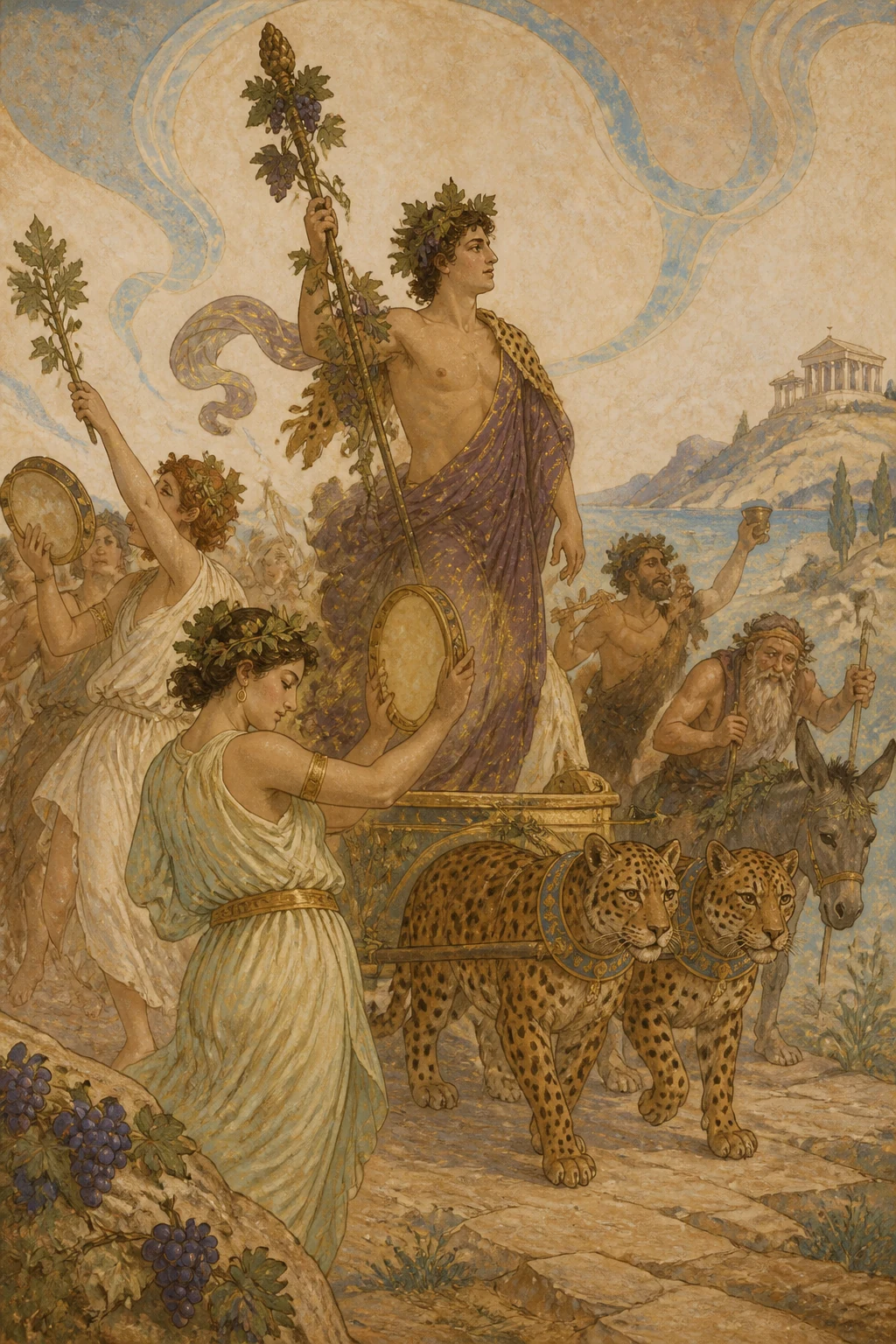
You, revered god, slay the sacrilegious Pentheus and axe-wielding Lycurgus, and hurl the Tyrrhenians into the sea. You harness a pair of lynxes, their necks adorned with bright reins; Bacchants and satyrs follow, and the drunken old man who props his swaying limbs on a staff and clings unsteadily to his swaybacked ass. Wherever you go, the cries of young men mingle with women’s voices, tambourines beaten by palms, the clang of hollow bronze, and the long-bored boxwood flute.
“Be gracious and gentle among us,” the women of Ismenus pray, and perform the appointed rites. Only the daughters of Minyas remain indoors, profaning the festival with Minerva’s untimely tasks: drawing out wool, twisting thread beneath their thumbs, or intent upon the loom, urging their maids to work. One of them, drawing out a thread with a light touch, said, “While the others leave their work to attend these invented rites, let us, whom Pallas, a better goddess, keeps at our tasks, lighten the useful labour of our hands with varied talk.
Let each in turn tell something for the others’ listening ears, so that the hours will not seem long.” Her sisters approve and ask her to tell the first tale. She considers which of the many she knows to tell, uncertain whether to speak of you, Babylonian Dercetis, whose limbs, the Palestinians believe, were clothed in scales as you changed shape and swam through their pools; or rather how your daughter took wing and spent her final years in white towers; or how a naiad, with spells and all-too-potent herbs, changed young men’s bodies into silent fish, until she suffered the same fate; or how a tree that once
bore white fruit now bears it black, stained by blood. This pleases her; and since the tale is not widely known, she begins it in these words, spinning the wool into thread:
Izvirnik
The Daughters of Minyas
Naslednje strani prikazujejo izvirno besedilo za primerjavo.
Source ID: ovid_metamorphoses_story_024 Citation: Ovid, Metamorphoses 4.1-4.54 Original language: Latin Source: PerseusDL canonical-latinLit Source URL: https://github.com/PerseusDL/canonical-latinLit/blob/master/data/phi0959/phi006/phi0959.phi006.perseus-lat2.xml Segmentation certainty: medium 1: At non Alcithoe Minyeias orgia censet 2: accipienda dei, sed adhuc temeraria Bacchum 3: progeniem negat esse Iovis, sociasque sorores 4: inpietatis habet. Festum celebrare sacerdos 5: inmunesque operum famulas dominasque suorum 6: pectora pelle tegi, crinales solvere vittas,
7: serta coma, manibus frondentes sumere thyrsos 8: iusserat, et saevam laesi fore numinis iram 9: vaticinatus erat. Parent matresque nurusque 10: telasque calathosque infectaque pensa reponunt, 11: turaque dant Bacchumque vocant Bromiumque Lyaeumque 12: ignigenamque satumque iterum solumque bimatrem: 13: additur his Nyseus indetonsusque Thyoneus, 14: et cum Lenaeo genialis consitor uvae, 15: Nycteliusque Eleleusque parens et Iacchus et Euhan, 16: et quae praeterea per Graias plurima gentes 17: nomina, Liber, habes. Tibi enim inconsumpta iuventa est, 18: tu puer aeternus, tu formosissimus alto
19: conspiceris caelo, tibi, cum sine cornibus adstas, 20: virgineum caput est. Oriens tibi victus, adusque 21: decolor extremo qua tingitur India Gange: 22: Penthea tu, venerande, bipenniferumque Lycurgum 23: sacrilegos mactas, Tyrrhenaque mittis in aequor 24: corpora, tu biiugum pictis insignia frenis 25: colla premis lyncum; bacchae satyrique sequuntur, 26: quique senex ferula titubantes ebrius artus 27: sustinet et pando non fortiter haeret asello.
28: Quacumque ingrederis, clamor iuvenalis et una 29: femineae voces inpulsaque tympana palmis 30: concavaque aera sonant longoque foramine buxus. 31: “Placatus mitisque” rogant Ismenides “adsis,” 32: iussaque sacra colunt. Solae Minyeides intus 33: intempestiva turbantes festa Minerva 34: aut ducunt lanas, aut stamina pollice versant, 35: aut haerent telae famulasque laboribus urgent.
36: E quibus una levi deducens pollice filum 37: “dum cessant aliae commentaque sacra frequentant, 38: nos quoque, quas Pallas, melior dea, detinet” inquit, 39: “utile opus manuum vario sermone levemus: 40: perque vices aliquid, quod tempora longa videri 41: non sinat, in medium vacuas referamus ad aures.” 42: Dicta probant primamque iubent narrare sorores. 43: Illa, quid e multis referat (nam plurima norat), 44: cogitat et dubia est, de te, Babylonia, narret, 45: Derceti, quam versa squamis velantibus artus 46: stagna Palaestini credunt motasse figura; 47: an magis, ut sumptis illius filia pennis
48: extremos albis in turribus egerit annos; 49: nais an ut cantu nimiumque potentibus herbis 50: verterit in tacitos iuvenalia corpora pisces, 51: donec idem passa est; an, quae poma alba ferebat, 52: ut nunc nigra ferat contactu sanguinis arbor. 53: Hoc placet, hanc, quoniam vulgaris fabula non est, 54: talibus orsa modis, lana sua fila sequente:
Nadaljuj z branjem