Waltey
Mestni godci
034 The Town Musicians
Mother's Nursery Tales · Katharine PyleO besedilu
Mestni godci
- Vir
- Mother's Nursery Tales
- Avtor
- Katharine Pyle
- Jezik branja
- Slovenščina
- Jezik izvirnika
- English
- Čas branja
- 7 min branja
- Obseg
- 6 strani
- Naslov izvirnika
- 034 The Town Musicians
O izvirniku
Mother's Nursery Tales
Štiriintrideset zgodovinskih literarnih priredb starejših pravljic, ki jih je Pyle tudi ilustrirala. Bralni jezik je Slovenščina, izvirnik pa prihaja iz vira Mother's Nursery Tales v jeziku English.
Besedilo
Mestni godci
Neki osel je postal tako star in slaboten, da gospodarju ni bil več v nobeno korist. Neke noči je slišal, kako sta se gospodar in gospodinja pogovarjala. »Čudim se, da še vedno rediš tega osla,« je rekla žena. »Prav nič ti ne koristi in samo zapravljaš denar za njegovo hrano.«
»Res je,« je odgovoril mož. »Najbolje bi bilo, da se ga znebim. Njegovo kožo bi lahko prodal strojarju.« Ko je osel to slišal, je vedel, da je čas za odhod, če hoče ohraniti svojo kožo. S smrčkom je odrinil hlevska vrata in jo ubral po cesti, ne da bi se od kogar koli poslovil. »Morda sem res prešibak za delo,« si je rekel, »a moj glas je še vedno močan. V veliko mesto bom šel in postal godbenik.«
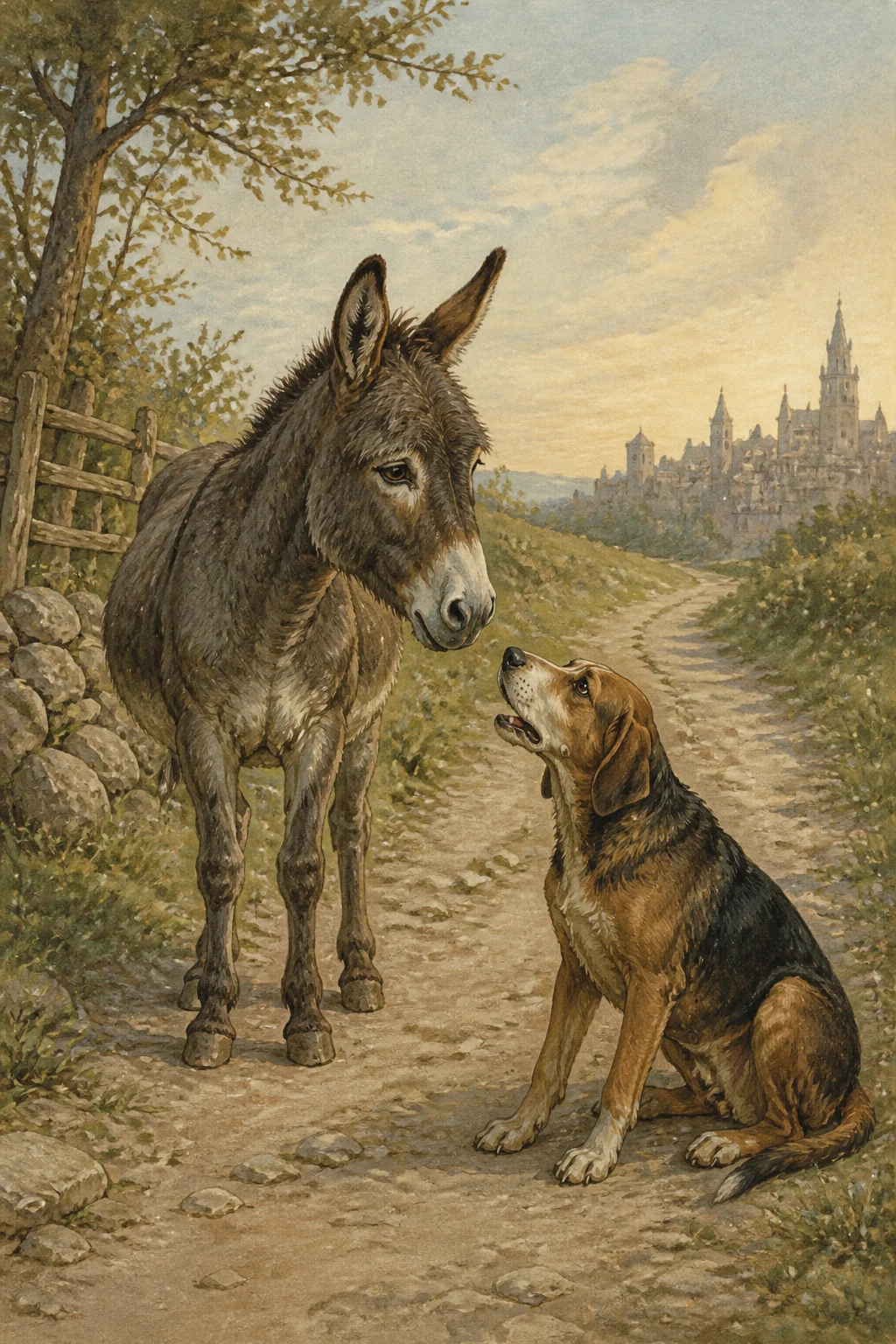
Ni še prišel daleč, ko je ob cesti zagledal starega lovskega psa, ki je ležal in cvilil. »No, stari Bellmouth,« je rekel osel, »kaj te tare? Videti je, da si v težavah.«
»Pa še v kakšnih,« je odgovoril pes. »Tako star in okoren sem postal, da ne morem več teči s krdelom, zato gospodarju nisem bil več v korist. Nagnal me je in za menoj metal kamenje. Kaj bo zdaj z menoj, ne vem. Če me niti gospodar ni hotel obdržati, me gotovo ne bo nihče drug.«
»Nikar si s tem ne beli glave,« je rekel osel. »V mesto grem, da bi postal godbenik, in če želiš, lahko greš z menoj in skupaj bova pela. Vem, da imaš lep glas, in morda si bova skupaj prislužila bogastvo.«
Psu je bila zamisel všeč. Postavil se je na noge in z oslom sta skupaj nadaljevala pot. Kmalu zatem sta prišla do mačka, ki je sedel v travi ob cesti in bil videti žalosten in otožen kakor deževen jesenski dan.
»Kaj pa je s teboj, Whiskers?« je vprašal osel. »Tak si, kakor da bi se vsa smetana skisala in bi vse podgane poginile.« »Dandanes zame ni več smetane,« je rekel maček, »in čeprav je podgan na pretek, sem prestar, da bi jih lovil. Nisem več hiter in spreten in raje sedim ob ognju in predem. Zato me je gospodinja z metlo nagnala iz hiše in zdaj nimam kam. Kaj bi mi svetoval v takem položaju?«
»Pojdi z nama,« je rekel osel. »Z bratom Bellmouthom greva v mesto, da bi postala godbenika. Če se nama želiš pridružiti in združiti svoj glas z najinima, te bova vesela.«
Maček je bil navdušen. Skočil je na cesto in oddrobencljal ob njiju. Kmalu so prišli do kmečkega dvorišča, kjer je petelin zletel na steber ob vratih. Iztegnil je vrat in zakikirikal, pa še enkrat zakikirikal.
»Dovolj! Dovolj!« je zavpil osel. »Nam hočeš s svojim kikirikanjem razparati ušesa?« »Kikirikati moram, dokler še lahko,« je rekel petelin, »saj je to moje delo. Vsako jutro kikirikam, da zbudim ljudi, pa tudi zato, da naznanim, kakšno vreme nas čaka. Toda slišal sem gospodinjo reči, da jutri dobijo goste in da mora iz mene skuhati juho, zato so moji dnevi kikirikanja skoraj pri kraju.«
»To pa ni nič dobrega,« je rekel osel. »Najbolje, da greš z nami. V mesto gremo, da bi postali godbeniki, in tak glas, kot je tvoj, bi nam bil v veliko pomoč.«
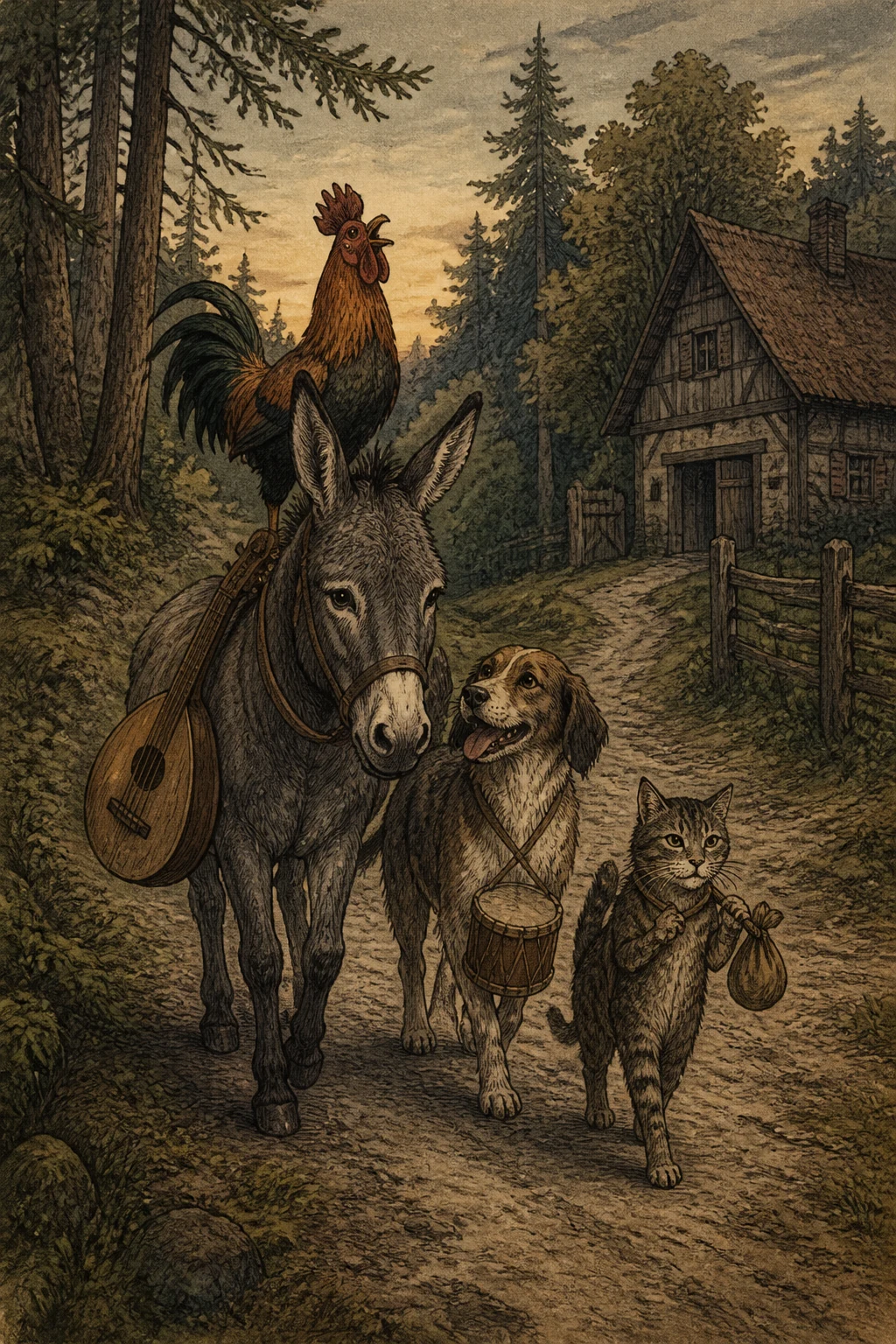
Petelinu ni bilo treba dvakrat reči. Zletel je s stebra in se s prhutanjem pomikal ob njih, a ker je bilo to naporno, mu je osel rekel, naj mu zleti na hrbet. Odtlej se je gospod Red-head udobno vozil z njimi.
Kmalu se je začelo temniti, velikega mesta pa godbeniki še vedno niso uzrli. Namesto tega so prišli v globok gozd. Nekaj časa so tavali po njem, nato pa so bili že tako utrujeni, da so sklenili tisto noč ostati tam. Osel in pes sta legla pod veliko drevo, maček je splezal v rogovilo med vejami, petelin pa se ni hotel namestiti nikjer drugje kot prav na vrhu drevesa.
Ni še dolgo sedel tam, ko je rekel: »Bratje, nedaleč stran vidim luč. Tam mora biti hiša.« »To je dobra novica,« je rekel osel. »Meni prav nič ne diši spanje na golih tleh. Če gremo tja in zapojemo, nam bodo morda dali prenočišče.«
Načrt je bil všeč tudi drugim. Maček in petelin sta se spustila z drevesa in štirje godbeniki so se skupaj odpravili proti luči.
Kmalu so prišli do hiše in luč, ki jo je videl petelin, je svetila skozi pritlično okno. Ker je bil osel največji, so ga izbrali, da pogleda skozi okno in drugim pove, kaj vidi.
Osel je gledal tako dolgo in tako molče, da so drugi postali nestrpni. »No, brat Greycoat, kaj vidiš?« je vprašal pes. »Bratje,« je tiho rekel osel, »prav dobro vidim, da ta hiša pripada tolpi razbojnikov. V enem kotu sobe imajo nakopičenega veliko zaklada, sami pa sedijo za mizo, jedo in pijejo.«
»Oh, ko bi jih le lahko prestrašili in pregnali ter si prilastili zaklad! Razbojniki so zmeraj strahopetci,« je rekel pes. Štirje tovariši so se posvetovali in skovali načrt, kako pregnati razbojnike. Osel je postavil sprednji nogi na okensko polico, pes mu je splezal na hrbet, maček je splezal na pasji hrbet, petelin pa je zletel na mačka. Nato so na dogovorjeni znak vsi hkrati zapeli. Osel je rigal, pes tulil, maček mijavkal in petelin kikirikal. Hrup, ki so ga zagnali, je bil strašen. Razbojniki so prestrašeno poskočili, in brž ko so živali videle, da jih je strah, so razbile šipo in planile v sobo.
Razbojniki so se v divji zmedi pognali skozi vrata in zbežali v gozd, ne da bi se enkrat samkrat ozrli. »To je pa šlo zlahka,« je rekel osel. Živali so nato sedle za mizo ter jedle in pile, kolikor jim je srce poželelo. Potem so ugasnile luči in se pripravile k počitku, vsaka na najudobnejšem mestu, ki ga je našla. Osel je legel na kup slame zunaj, pes se je zvil za vrati, maček se je namestil na toplem pepelu, petelin pa je zletel pod streho in se usedel na tram. Nato so vsi zaspali.
Razbojniki so nekaj časa tavali po gozdu, potem pa so se zbrali in se pogovorili. »Prav neumni smo bili, da smo se tako zlahka prestrašili,« je rekel poglavar. »Poslušal sem in opazoval; okoli hiše je vse tiho in luči so ugasnjene. Vrnimo se in poglejmo, ali je kdo tam.«
Drugi so se strinjali. Pritihotapili so se nazaj do hiše in poglavar je poslal enega od mož noter, da bi pogledal, kaj se dogaja. Mož je vstopil, se ozrl naokrog in zagledal mačkove oči, ki so se svetile v temi. Mislil je, da je to žerjavica, in ker je potreboval luč, je pristopil in proti njej pomolil paličico, da bi jo prižgal.
Maček je pri priči vrešče planil pokonci in mu opraskal obraz. Moža je obšla groza. Stekel je proti vratom, pes pa je planil izza njih in ga ugriznil. Opotekel se je na dvorišče in osel ga je brcnil. Hrup je zbudil petelina, ki je iztegnil vrat in zakikirikal: »Kikiriki!«
Razbojnik je ves tresoč pritekel nazaj k poglavarju. »Bežimo!« je zavpil. »Ob ognjišču sedi strašna čarovnica, ki se je vrešče zakadila vame ter me grizla in praskala. Mož za vrati mi je zasadil nož v nogo. Zunaj me je neka ostudna črna pošast udarila s kijem, na strehi pa sedi sodnik, ki je zavpil: ‘Pripeljite tega lopova sem!’«
Razbojniki niso čakali, da bi slišali še kaj; vzeli so noge pod pazduhe in zbežali, in če se niso ustavili, gotovo še danes tečejo. Štirim tovarišem pa je bilo v razbojniški hiši tako udobno, da so ostali tam in uživali v razbojniškem zakladu, v veliko mesto, kjer naj bi postali godbeniki, pa nazadnje nikoli niso šli.
Izvirnik
034 The Town Musicians
Naslednje strani prikazujejo izvirno besedilo za primerjavo.
A donkey had grown so old and feeble that he was of no more use to his master.
One night he heard his master and mistress talking together. “I wonder you still keep that donkey,” said the woman; “he is of no use to you, and you only waste your money buying food for him.”
“That is true,” answered the man. “I would do well to get rid of him. I might sell his hide to the tanner.”
When the donkey heard this he knew it was time for him to be going, if he wished to keep his skin for his own use. He pushed the stable-door open with his nose, and made off down the road without saying good-by to anyone. “I may be too weak to work,” said he, “but my voice is still strong. I will go to the big city and become a musician.”
He had not gone far when he saw an old hound lying beside the road and whining. “Well, old Bellmouth,” said the donkey, “what ails you? You seem to be in trouble.”
“Trouble indeed,” answered the hound. “I have grown so old and stiff that I am no longer able to run with the pack, so my master had no more use for me. He drove me away and threw stones after me. What is to become of me now I do not know. If my master would not keep me I am sure no one else will.”
“Do not trouble yourself over that,” said the donkey. “I am going to the city to be a musician, and if you like you shall come along and sing with me. I know you have a fine voice, and we two together may make our fortunes.”
The hound was pleased with this idea. He got to his feet, and he and the donkey went on together in company.
A little while after they came to where a cat sat in the grass by the roadside, looking as sad and doleful as a rainy day in fall.
“What is the matter with you, Whiskers?” asked the donkey. “You look as though all the cream were sour and all the rats were dead.”
“There is no cream for me nowadays,” said the cat, “and though there are plenty of rats I am too old to catch them. I am no longer quick and active, and I would rather sit by the fire and purr. For this reason my mistress has driven me out of the house with a broom, and I have no place to go. What would you advise me to do in such a case?”
“Come with us,” said the donkey. “Brother Bellmouth and I are going to the city to be musicians, and if you choose to come along and join your voice with ours we shall be glad to have you.”
The cat was delighted, and leaping out into the road it trotted along beside the others.
Presently they came to a farmyard, and a cock had flown up on the gate post. It stretched its neck and crowed, and crowed again.
“Enough! Enough!” cried the donkey. “Do you want to split our ears with your crowing?”
“I must crow while I can,” said the cock, “for that is my business. Every morning I crow to wake the men, and I also crow to tell what weather we will have. But I heard the mistress say that company was coming to-morrow and that she must make me into soup, so my crowing days are almost over.”
“That is a bad business,” said the donkey. “You had better come with us. We are going to the city to become musicians, and such a voice as yours would be a great help.”
The cock did not wait to be asked twice. He flew down from the gatepost and flapped along beside them, but this was tiresome, so the donkey bade the cock fly up on to his back, and after that Master Red-head rode along in comfort.
Presently it began to grow dark, and still the musicians had not come within sight of the big city. Instead they came to a deep wood, and after wandering about in it for some time they grew so weary that they decided to go no farther that night. The donkey and the hound lay down under a large tree, the cat climbed up to a crotch of the branches, while the cock was not content to roost anywhere but at the top of the tree.
He had not been sitting there long when he said, “Brothers, I see a light not far off. There must be a house there.”
“That is good news,” said the donkey. “I for one have no liking for sleeping on the bare ground. Perhaps if we go there and sing they may give us a night’s lodging.”
This plan suited the others. The cat and the cock came down from the tree, and the four musicians set out together in the direction of the light.
It was not long before they came to a house and the light the cock had seen shone through a lower window. The donkey, being the largest, was chosen to look in through the window and tell the others what he saw.
The donkey looked so long and so silently that the others grew impatient. “Well, Brother Greycoat, what do you see?” asked the hound.
“Brothers,” said the donkey in a low voice, “I can easily see that this house belongs to a band of robbers. They have a quantity of treasure piled up in one corner of the room, and they are sitting around the table eating and drinking.”
“Oh, if we could only scare them away and take the treasure for ourselves! Robbers are always cowards,” said the dog.
The four companions consulted together and laid out a plan for frightening the robbers away. The donkey put his front feet up on the windowsill, the dog mounted on his back, the cat mounted on the dog’s back, and the cock flew up on to the cat. Then at a certain signal they all began to sing together. The donkey brayed, the dog howled, the cat miaued, and the cock crowed. The noise they made was terrible. The robbers jumped up in a fright, and as soon as the animals saw they were frightened they smashed the glass and sprang into the room.
The robbers fled out of the door pell-mell and into the woods without stopping to look behind them.
“That was easily done,” said the donkey. The animals then sat down at the table and ate and drank to their hearts’ content. After that they put out the lights, and then they settled down for the night, each one in the most comfortable place it could find. The donkey lay down on a heap of straw outside, the dog curled up behind the door, the cat settled down on the warm ashes, and the cock flew up and perched on the rafters. Then they all went to sleep.
Out in the forest the robbers wandered about for awhile, and then they all got together and talked things over.
“We were very foolish to be so easily frightened,” said the captain. “I have been listening and watching, and everything is quiet around the house and the lights are out. Let us go back there and see if anyone is there.”
To this the others agreed. They crept back to the house, and the captain sent one of the men inside to see what was doing.
The man went in and looked about, and saw the cat’s eyes shining in the dark. He thought they were live coals, and as he needed a light he went up and stuck a stick toward them, meaning to light it.
At once the cat sprang up with a yowl and scratched his face. The man was terrified. He ran to the door and the dog sprang out and bit him. He tumbled out into the courtyard and the donkey kicked him. The noise wakened the cock and it stretched its neck and crowed “Cock-a-doodle-doo!”
The robber ran back to his captain trembling. “Let us get away!” he cried. “A horrible witch sits by the hearth, and she flew at me screaming, and bit and scratched me. A man back of the door stuck a knife in my leg. Outside a hideous black thing hit me with a club, and on the roof sits a judge who cried, ‘Bring the rascal here!’”
The robbers waited to hear no more; they took to their heels and ran away, and if they have not stopped they must be running still.
But the four comrades found it so comfortable in the robbers’ house that they stayed there and enjoyed the robbers’ treasure, and never went to the big city to become musicians after all.
Nadaljuj z branjem