Prevod
When the servants had set before them all they needed for their meal, and they themselves had refreshed themselves with warm baths, they gladly satisfied their hearts with food and drink. Then Aeetes questioned his daughter’s sons, addressing them in these words: “Sons of my daughter and of Phrixus, whom I honoured above all strangers in my halls, how is it that you have returned to Aea? Did some disaster interrupt your voyage home? You would not listen when I warned you of the boundless length of the journey.
“I knew it, for I once travelled in the chariot of my father Helios, when he carried my sister Circe into the western land. We reached the coast of the Tyrrhenian mainland, where she still lives, far indeed from the land of Colchis.
“But what pleasure is there in talking of that? Tell me plainly what trouble has befallen you, who these men are who accompany you, and where you left your hollow ship.” So he questioned them, and Argus, the eldest, spoke gently before his brothers, anxious about the mission of Aeson’s son: “Aeetes, fierce storms soon shattered our ship. Clinging to its timbers in the black night, we were cast ashore by the waves on the island of Enyalius. Some god must have saved us.
“For even the birds of Ares, which once roosted on that deserted island, were nowhere to be found. These men had driven them away, landing from their ship the day before. The will of Zeus, in pity for us, or perhaps some turn of fate, kept them there: for they at once gave us food in plenty and clothing when they heard the renowned name of Phrixus and your own, since it is to your city that they are bound.
“If you wish to learn their purpose, I shall not hide it from you. A certain king, eager above all to drive this man far from his country and possessions, because his courage made him pre-eminent among all the descendants of Aeolus, has sent him here on this desperate voyage. He declares that the race of Aeolus will never escape the bitter wrath and anger of implacable Zeus, nor the unbearable pollution and vengeance for Phrixus, until the fleece has come to Greece.
“Pallas Athena built their ship, and it is nothing like the vessels of the Colchians, of which the very worst fell to our lot. For the raging water and wind utterly tore ours apart, but theirs holds fast upon its bolts, though every storm should bear down on it.
“It runs as swiftly before the wind as when the men themselves ply their oars tirelessly with their hands. In this ship he gathered the finest heroes in all Achaea and came to your city, wandering through many cities and over wide stretches of the hateful sea, in the hope that you would grant him the fleece.
“Yet everything shall be as you yourself wish, for he has not come to use force against you. He is resolved to repay you worthily for the gift: hearing from me how bitterly hostile the Sauromatae are to you, he will bring them beneath your sceptre.
“And if you also wish to know their names and lineage, I can tell you each in turn. This man, for whose sake the others gathered from Greece, is called Jason, son of Aeson, son of Cretheus.
“If he is indeed descended from Cretheus, he must be our kinsman on our father’s side. For Cretheus and Athamas were both sons of Aeolus, and Phrixus was the son of Athamas, Aeolus’ son.
“And here you see Augeas, whom you may have heard named as a son of Helios; this is Telamon, born of glorious Aeacus, whose father was Zeus himself.
“So too all the others who accompany them are sons or grandsons of the immortals.” Thus Argus spoke, but the king grew angry as he listened, and fury swelled high within his heart.
He cried out in indignation, raging most of all against the sons of Chalciope, for he believed the strangers had come because of them. His eyes flashed beneath his brows as his anger broke loose. “Will you not be gone from my sight at once, you villains, and take your treachery back out of my country, before any of you sees the cursed fleece or Phrixus?
“You have joined forces in Greece and come here not for the fleece, but for my sceptre and my royal honour. Had you not already eaten at my table, I would have cut out your tongues and lopped off both your hands, and sent you away with only your feet to carry you. That would have checked you from setting out on such a venture again—and you have even dared to lie about the blessed gods!”
So he spoke in fury. Deep within Telamon’s breast his heart swelled fiercely, and his spirit longed to answer with a deadly challenge. But Aeson’s son restrained him, speaking first himself in gentle words: “Aeetes, bear with us in this undertaking. We have not come to your city and your house for the purpose you suppose, nor have we come willingly. Who would choose to cross so vast a sea for another man’s possessions? A god and the cruel command of a reckless king have driven me here.
“Show kindness to us in our supplication, and I shall carry the glorious fame of your name throughout all Greece. We are ready even now to repay you promptly in war, whether you wish to bring the Sauromatae beneath your sceptre or any other people.”
Thus he sought to soothe him with his gentle voice. But in Aeetes’ breast his heart pondered two courses: whether to fall upon them and kill them there and then, or put their strength to the test. On reflection the latter seemed better, and he answered with guile: “Stranger, why should you speak of everything at such length?
“If you truly are descended from gods, or if in any case you have come after another man’s property as men no weaker than myself, I shall let you take the golden fleece, if you wish, once I have tested you. For I bear no grudge against brave men, as you say the ruler in Greece does.
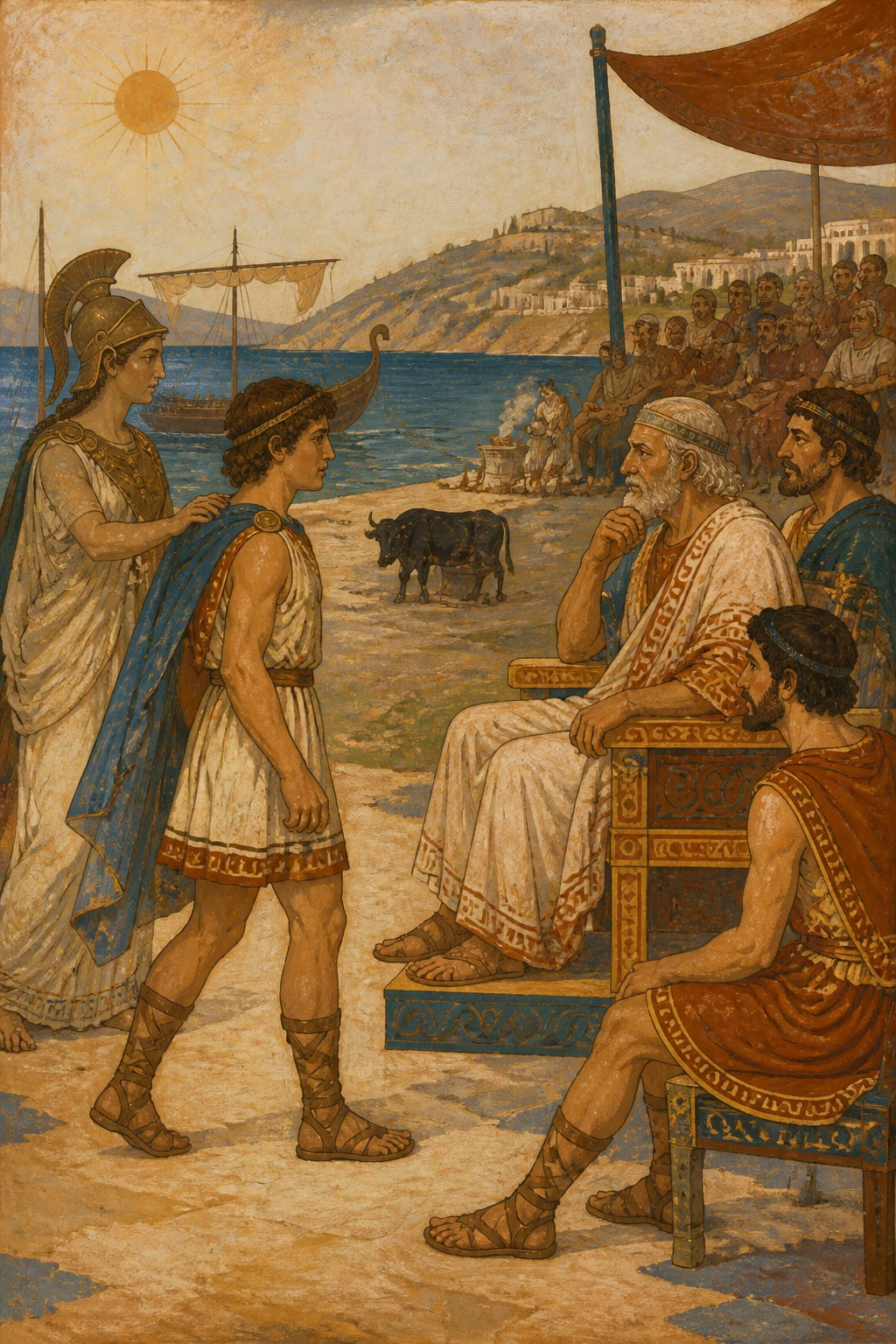
“The test of your courage and strength shall be a task that I myself accomplish with my own hands, deadly though it is. Two bronze-footed bulls graze on the plain of Ares, breathing flame from their mouths. I yoke them and drive them over the hard fallow field of Ares, four acres wide. When I have swiftly ploughed it from end to end, I cast into the furrows not the grain of Deo for seed, but the teeth of a dreadful serpent, which spring up in the form of armed men. These I cut down with my spear as they rise against me on every side.
“At dawn I yoke the oxen, and by evening I have finished my harvest. If you accomplish these same things, that very day you may carry the fleece away to your king. Before then I will not give it to you—do not hope for it. For it would be shameful for a brave man to yield to one less worthy.”
So he spoke. Jason sat silent, his eyes fixed on the ground before his feet, speechless in the face of this impossible ordeal. For a long time he turned plans over in his mind, but could find no way to accept with confidence, so tremendous did the task appear. At last he answered cautiously: “Aeetes, you hem me in hard indeed, though you claim to act justly.
“Yet I shall endure this monstrous trial, even if my fate is to die. For nothing more dreadful can fall upon mankind than cruel necessity, which drove me here at my king’s command.”
So he spoke, stricken with helplessness; and Aeetes answered his distress with terrible words: “Go now to your company, since you are eager for the labour. But if you shrink in fear from laying the yoke upon the bulls, or recoil from the deadly harvest, I shall see to all the rest myself, so that another man may shudder to approach his better.”
Thus he spoke pitilessly. Jason rose from his seat, with Augeas and Telamon beside him. Argus alone followed, for he had meanwhile signalled to his brothers to remain where they were; and they went out of the hall.
Among them all Aeson’s son shone wondrously in beauty and grace. From beside her shining veil the maiden watched him with sidelong eyes, her heart smouldering with anguish; and her mind, stealing after his departing footsteps, fluttered as though in a dream.
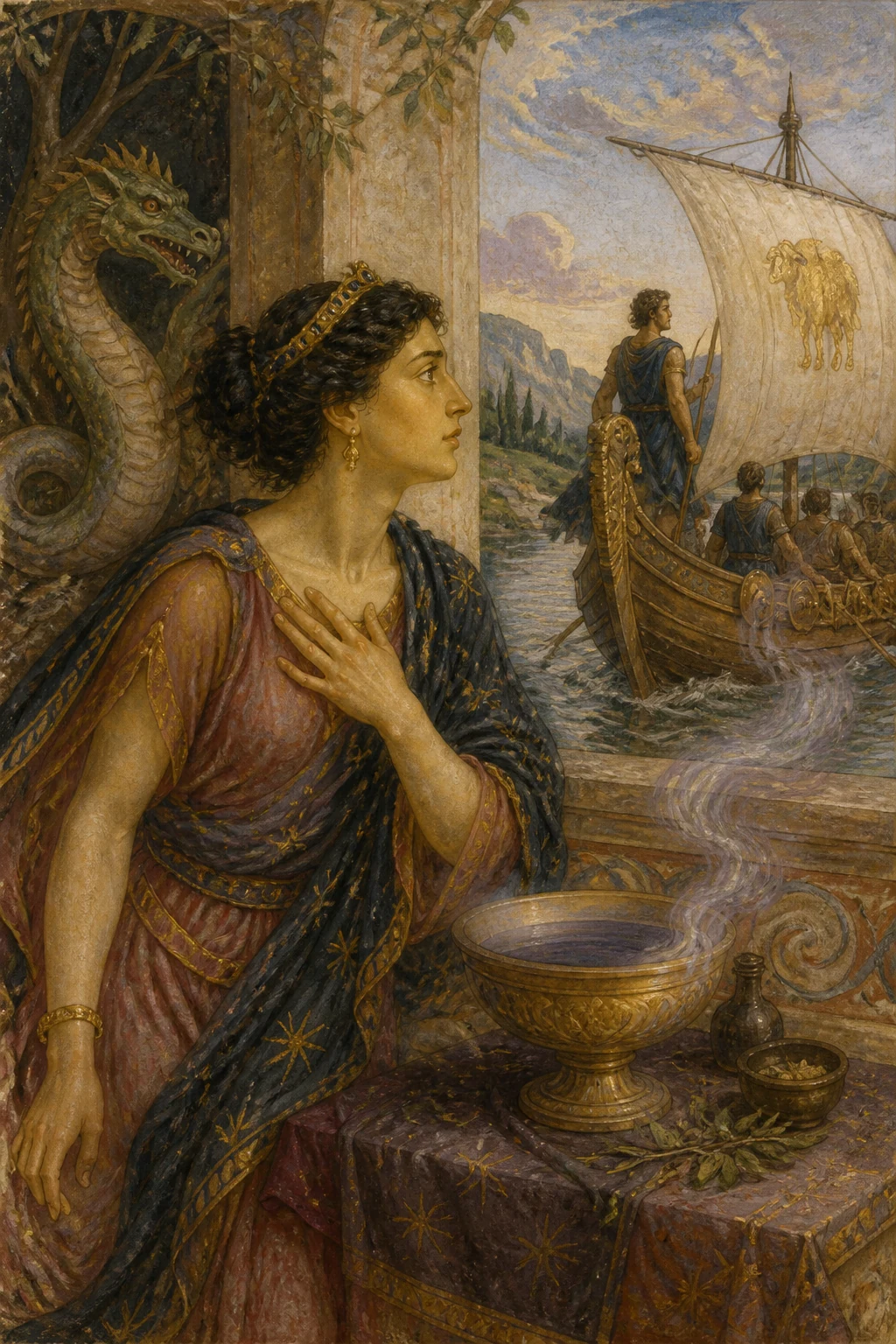
So they left the palace in distress. Chalciope, wary of Aeetes’ anger, hurried to her chamber with her sons. Medea too went to her own room, turning over in her heart all the thoughts that the Loves stir to life.
Everything still appeared before her eyes: the man himself, the clothes he wore, the things he had said, how he had sat upon his chair, and how he had gone out through the doors. As she brooded, she thought there could be no other man like him. His voice and the honey-sweet words he had spoken rang continually in her ears.
She feared for him, lest the bulls or Aeetes himself should kill him; she mourned him as though he were already dead, and soft tears flowed down her cheeks in the anguish of her pity. Weeping softly, she lifted her voice in lament: “Why does this grief possess me, wretched as I am? Whether he dies the greatest of all heroes or a lesser man, let him go! And yet I wish he might escape unharmed.
“Yes, let that be so, sovereign goddess, daughter of Perses: may he escape his doom and return home. But if it is his fate to be overcome by the bulls, may he at least learn before he dies that I take no joy in his cruel misfortune.”
Thus the maiden’s mind was tossed by care. Meanwhile, when the men had passed beyond the people and the city along the road by which they had earlier come up from the plain, Argus addressed Jason in these words: “Son of Aeson, you may scorn the plan I am about to tell you, but in our distress it would be wrong to leave any means untried.
“You have already heard me speak of a maiden who practises magic under the guidance of Hecate, daughter of Perses. If we could win her over, I believe you would no longer need to fear defeat in the trial. But I am terribly afraid that my mother may refuse to undertake this for me.
“Still, I shall go back and plead with her, since destruction hangs over us all alike.” Thus he spoke with kindly intent, and Jason answered: “My friend, if you yourself approve of it, I have no objection.
“Go, then, and with persuasive words entreat your mother to help us. A poor hope is left to us indeed, when we have entrusted our return to women.” So he spoke, and soon they reached the marsh. Their comrades greeted them joyfully and questioned them as soon as they appeared. Then Aeson’s son spoke in sorrow: “Friends, the heart of ruthless Aeetes is wholly enraged against us. But to tell you every detail would profit neither me nor you who question me.
“He says that two bronze-footed bulls graze upon the plain of Ares, breathing flame from their mouths. With these he ordered me to plough a four-acre field. He will give me seed from a serpent’s jaws, which sends up earthborn men in bronze armour; and I must kill them that same day. This I have firmly promised him, for there was no better course to devise.”
So he spoke. To them all the task seemed impossible, and for a long time they gazed at one another in speechless silence, downcast with dismay and helplessness. At last Peleus spoke boldly among all the heroes: “It is time to consider what we shall do. Yet I believe we shall gain less from counsel than from the strength of our hands.
“If you, heroic son of Aeson, intend to yoke Aeetes’ bulls and are eager for the labour, then make ready to fulfil your promise. But if your heart does not wholly trust in your own prowess, neither urge yourself on nor sit looking about for another of these men. I, for one, will not hold back, since death is the worst that can befall me.”
So spoke the son of Aeacus, and Telamon’s spirit was stirred. He sprang swiftly to his feet; proud Idas rose third, and after him the two sons of Tyndareus. The son of Oeneus also stood among those eager warriors, though the down had scarcely begun to bloom upon his cheeks: with such strength did his spirit rise within him.
The others gave way and remained silent. At once Argus addressed those who were eager for the trial: “Friends, that must be our last resort. But I believe my mother may be able to bring you timely help.
“Eager though you are, remain here in the ship a little longer, as before. It is better to wait a while than recklessly choose a cruel death. A maiden has grown up in Aeetes’ halls whom the goddess Hecate has taught beyond all others to work with the herbs that grow on land and in the flowing waters. With these she can quench the blast of tireless fire, halt rivers in their roaring course, and bind the paths of the stars and the sacred moon.
“As we came here along the road from the palace, we spoke of whether our mother, who is her sister, might persuade her to help us in the trial. If you too approve, I shall return to Aeetes’ house this very day and make the attempt. Perhaps, with a god’s help, I may succeed.”
So he spoke, and the gods in their goodwill sent them a sign. A trembling dove, fleeing the violence of a hawk, fell from above into the lap of Aeson’s son, while the hawk dropped upon the stern ornament. At once Mopsus interpreted the omen before them all: “Friends, this sign has come to you by the gods’ will. There is no better way to understand it than that we should approach the maiden with words and seek her help by every possible means. I believe she will not refuse us, if Phineus truly foretold that our return would depend upon the Cyprian goddess. Her gentle bird has escaped death; and as my heart foresees our fortune in this omen, so may it come to pass.
“But, friends, call upon Cytherea to defend us, and now follow Argus’ advice.” So he spoke, and the young men approved, remembering the counsel of Phineus. Only Idas, son of Aphareus, sprang up against it and cried in a great voice of angry scorn: “Shame on us! Have we come here as shipmates of women, who call upon Cypris to help us rather than the mighty strength of Enyalius? Do you watch doves and hawks and hold back from the trial?
“Away with you! Let deeds of war be none of your concern, but only the wooing of feeble girls with prayers.” Thus he spoke in his fury. Many of his comrades murmured very softly, but no one answered him to his face.
Then he sat down in anger, and Jason at once urged his own plan upon them: “Let Argus leave the ship, since that has pleased us all. As for ourselves, let us now bring her out of the river and fasten her openly to the shore. It is surely time to stop lurking in hiding, as though we feared a battle.”
So he spoke, and at once sent Argus hurrying back to the city. The others, obeying Aeson’s son, hauled up the ship’s anchors and rowed a little way out of the marsh, bringing her in to the dry shore.
Meanwhile Aeetes called an assembly of the Colchians away from his palace, at the place where they had met before, devising intolerable treachery and suffering for the Minyans. He declared that as soon as the bulls had torn apart the man who had undertaken the grievous trial, he would cut down the woodland on the thickly wooded hill above and burn the ship and all her crew, so that they might purge away their grievous insolence in plotting such outrageous deeds.
“For I would not even have received Phrixus, the descendant of Aeolus, as a suppliant at my hearth, sorely in need though he was, and surpassing all strangers in gentleness and reverence for the gods, had Zeus himself not sent Hermes down from heaven to tell me to welcome him as a kinsman. These pirates who have come into my country will not remain unharmed for long—men intent on laying hands upon another’s possessions, devising secret treachery, and ravaging the shepherds’ folds with their clamorous raids.”
He said that he would reward Phrixus’ sons separately, as they deserved, for returning in the company of evil men, heedless of him, to drive him from his honour and his throne. For once he had heard a dreadful warning from his father Helios: he must beware the subtle treachery and plotting of his own offspring, and the ruin they might contrive in many ways. That was why he had sent them willingly on the long journey to Achaea, in obedience to their father’s wishes. He had no fear at all that his daughters would devise some hateful scheme, nor his son Apsyrtus: these evils had been contrived among the children of Chalciope.
Thus in his anger he declared his savage purposes to the people, fiercely charging them to keep watch over the ship and the men, so that no one should escape destruction. Meanwhile Argus, having returned to Aeetes’ house, was urging his mother with every persuasive word to beg Medea for help. She herself had already been considering it, but fear restrained her: either she might plead in vain, against all hope, with one terrified of her father’s deadly wrath, or, if Medea yielded to her prayers, their actions might become plain and open to all.
As for the maiden, deep sleep had eased her grief as she lay upon her bed. But soon deceitful, deadly dreams began to trouble her, as they do those burdened with sorrow. She dreamed that the stranger had undertaken the trial not because he truly wished to carry off the ram’s fleece, nor had he come to Aeetes’ city for that purpose, but to take her to his own home as his wedded wife. She thought that she herself contended with the bulls and performed the task with the greatest ease. But her parents disregarded their promise, because they had required not the maiden but the stranger himself to yoke the bulls. From this arose a bitter quarrel between her father and the strangers, and both sides entrusted the decision to her, to be settled as her heart directed.
Suddenly she chose the stranger, without regard for her parents. They were seized by immeasurable grief and cried out in anger; and with their cry sleep released her. Trembling with fear, she sprang up and looked about her at the walls of her chamber. Only with difficulty did she gather her spirit back into her breast, and she cried in anguish: “Wretched me! What dreadful dreams have frightened me!
“I fear this voyage of the heroes will bring some great misfortune. My heart is all astir over the stranger. Let him woo an Achaean maiden far away among his own people; let me care for my maidenhood and my parents’ house.
“Yet I shall harden my heart and no longer keep apart from my sister. I shall see whether, in her distress for her sons, she will ask me to help in the trial. That might quench this bitter anguish in my heart.”
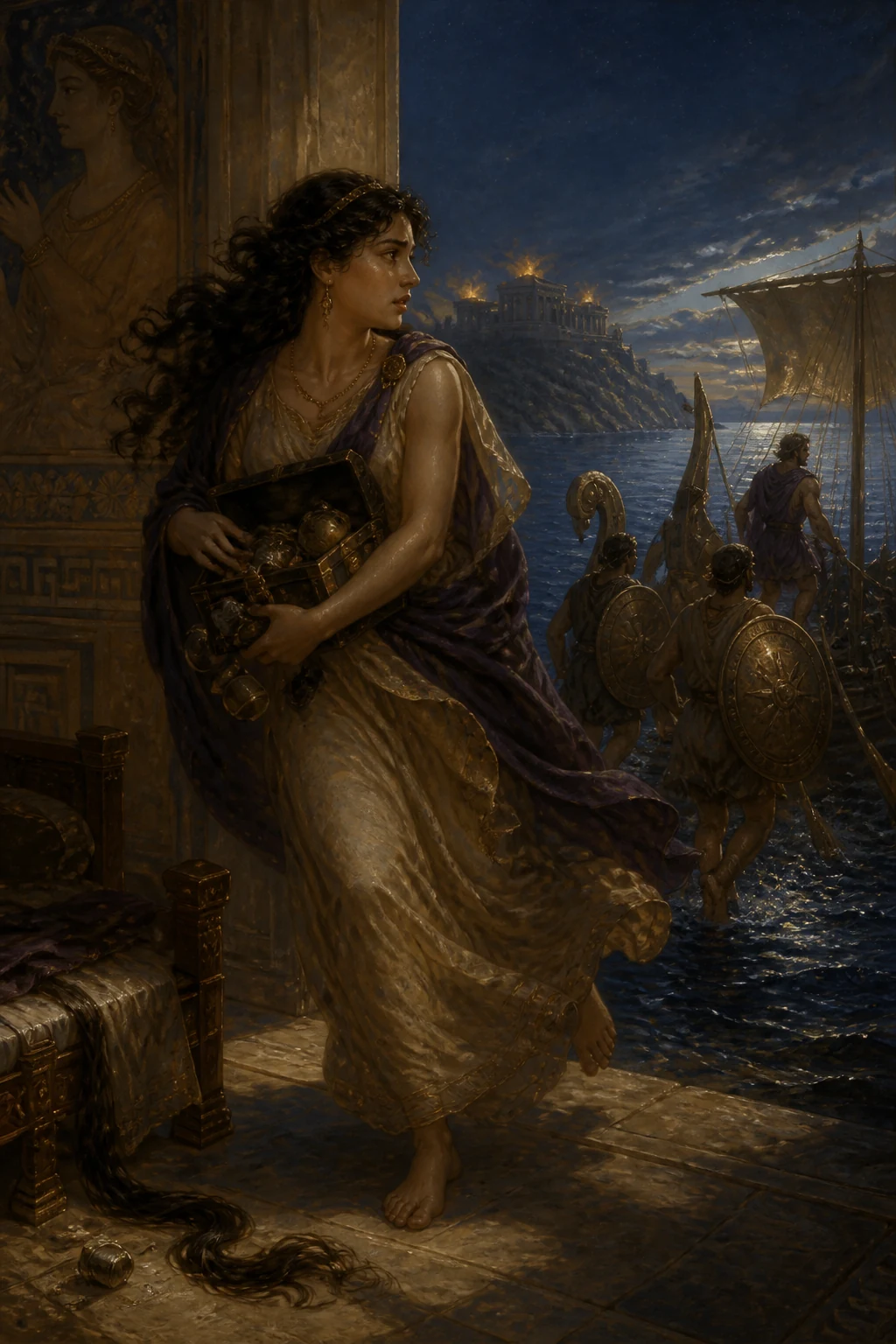
So she spoke, and rose barefoot, wearing only her tunic, and opened the doors of her chamber. Already she longed to go to her sister, and crossed the threshold. But she remained a long time in the antechamber, held back by shame. Then she turned and went back inside; once more she came out, and once more shrank within. In vain her feet carried her to and fro. Whenever she started forward, shame checked her from within; and when shame held her back, bold desire urged her on.
Three times she tried, and three times she restrained herself. The fourth time she turned and fell face down upon her bed. As a young bride mourns in her chamber for the husband whom her brothers and parents have given her, a husband in the bloom of youth—she has not yet mingled with all the serving women, held back by modesty and discretion, but sits grieving in an inner room; some fate has taken him before the two could delight in one another’s love, and though she burns with grief within, she weeps very softly as she looks upon the widowed bed, lest the women mock her with cruel taunts—so Medea lamented. Suddenly one of the servants, a young girl who attended her, came upon her as she wept and told Chalciope nearby. Chalciope was sitting with her sons, considering how to win her sister over.
When she heard the servant’s unexpected news, she did not neglect it. In alarm she hurried straight from her own chamber to the room where the maiden lay in grief, tearing at both her cheeks. When she saw Medea’s eyes swimming with tears, she said: “Oh, Medea, why are you shedding these tears?
“What has happened? What terrible grief has entered your heart? Has some illness sent by heaven taken hold of your limbs, or have you heard some deadly threat from our father against me and my sons? Would that I had never seen this house of our parents, or this city, but lived at the ends of the earth, where even the name of the Colchians is unknown.”
So she spoke, and Medea’s cheeks grew red. For a long time maidenly shame restrained her, eager though she was to answer. Now the words rose to the very tip of her tongue, now fluttered deep within her breast.
Often they rushed sweetly to her lips, ready to be spoken, yet her voice would go no further. At last she spoke deceitfully, for the bold Loves were driving her on: “Chalciope, my heart is troubled for your sons, lest our father should kill them at once along with the strangers.
“I have just seen such dreadful dreams in my brief sleep. May some god keep them from fulfilment, and may you never suffer bitter grief for your sons.” So she spoke, testing her sister to see whether she herself would first ask Medea to help her children.
At what she heard, unbearable anguish flooded Chalciope’s heart with fear, and she answered in these words: “I myself came here turning all these things over in my mind, to see whether you might help devise and provide some means of rescue.
“But swear by Earth and Heaven that you will keep in your heart whatever I tell you, and lend me your aid. By the blessed gods, by your own life and by our parents, I beg you: do not let me see my sons cruelly destroyed by an evil fate. Otherwise, dying with my dear children, I shall return from Hades as a hateful Fury to haunt you.”
So she spoke, and at once the tears poured freely down. She clasped Medea’s knees with both hands and laid her head in her lap. Then the two of them raised a piteous lament over one another, and the thin sound of their grieving passed through the house.
Medea was the first to speak, in distress: “Unhappy sister, what remedy can I offer you, when you speak of dreadful curses and Furies? Would that it lay surely in my power to save your sons!
“Let the mighty oath of the Colchians, which you yourself bid me swear, bear witness: great Heaven and Earth beneath, the mother of the gods. As far as my strength reaches, you shall not lack my help, if what you ask can be accomplished.”
So she spoke, and Chalciope answered: “Could you not bring yourself to devise some trick or plan to help the stranger himself in his need during the trial, for my children’s sake? Argus has come from him and urges me to seek your help. I left him in the house just now when I came here.”
So she spoke. Medea’s spirit soared within her for joy, and at the same moment her lovely skin flushed crimson. A mist came over her in her delight, and she answered: “Chalciope, I shall do whatever brings you pleasure and happiness. May dawn never shine before my eyes, nor may you see me alive much longer, if I hold anything dearer than your life or your children, who have become my brothers, my dear protectors and companions of my age. Indeed, I call myself both your sister and your daughter, since you raised me at your breast when I was little, just as you did them; so I have always heard from our mother.
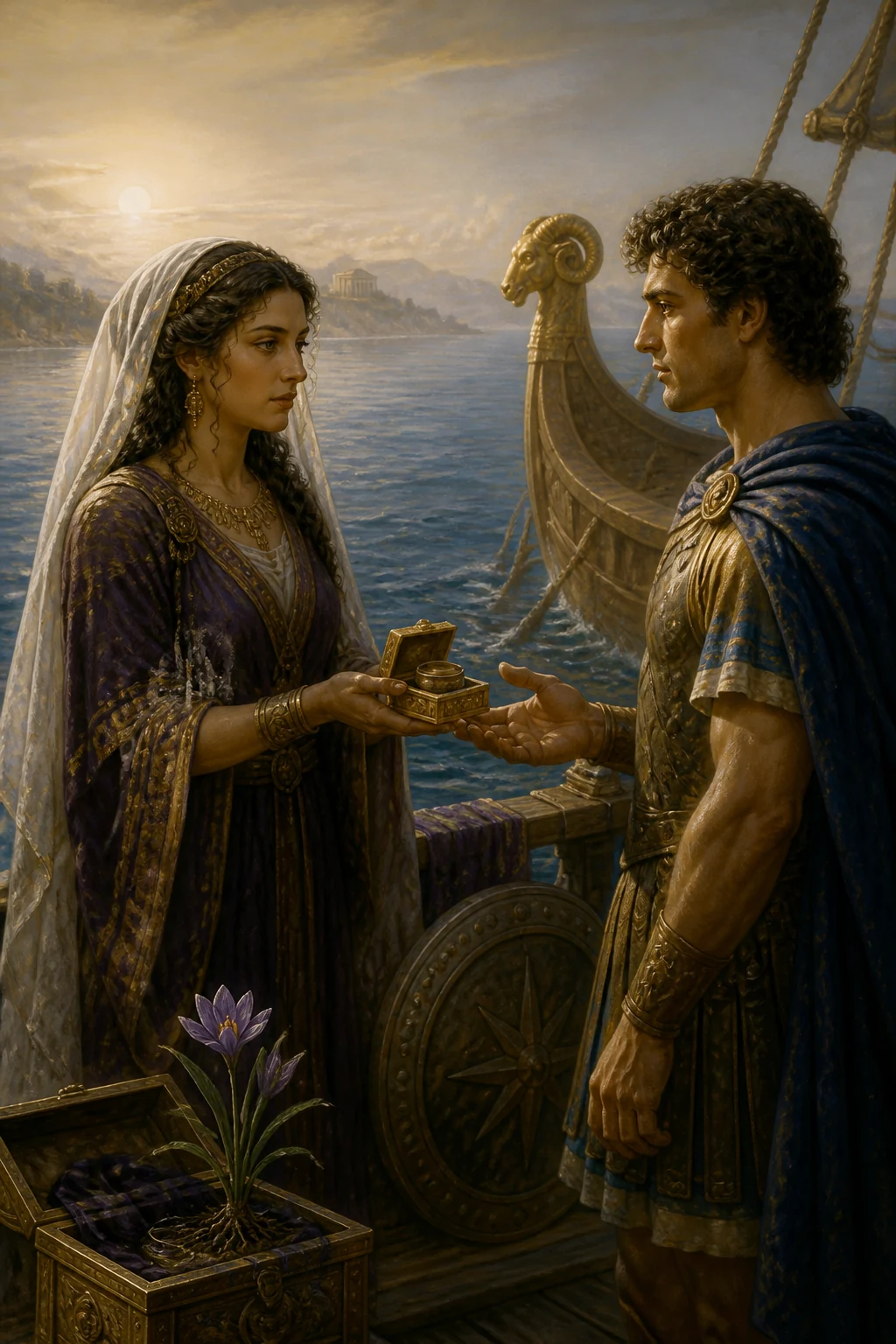
“But go, and keep my kindness secret, so that I may fulfil my promise without our parents knowing. At dawn I shall take to Hecate’s temple the drugs that will charm the bulls.” So Chalciope went back from the chamber and told her sons of her sister’s help. But once Medea was alone again, shame and dreadful fear took hold of her, because she was plotting such things for a man against her father’s will.
Then night drew darkness over the earth. At sea, sailors looked from their ships towards Helice and the stars of Orion. By now the traveller and the gatekeeper longed for sleep, and deep slumber enfolded even the mother whose children were dead. No barking of dogs, no ringing clamour sounded through the city. Silence held the darkening night.
But sweet sleep did not take Medea. In her longing for Aeson’s son, many cares kept her awake, as she feared the terrible strength of the bulls that were to bring him to a shameful death in the fallow field of Ares.
Her heart beat wildly within her breast, like a gleam of sunlight dancing through a house, reflected from water freshly poured into a basin or a pail: it darts and quivers here and there in a swift, circling motion. So the maiden’s heart fluttered within her breast.
Tears flowed from her eyes in pity, and within her the smouldering pain tormented her continually, piercing through her flesh, along the delicate sinews and up to the very base of her skull, where anguish strikes most keenly when the tireless Loves drive sorrow into the heart.
Now she thought she would give him the drugs to charm the bulls, now that she would not, but would die herself. Then again she would neither die nor give the drugs, but quietly endure her misery as she was.
At last she sat wavering and spoke: “Wretched me! Which way shall I turn among these evils? Everywhere my mind is helpless; there is no defence against my suffering, which burns on without end. Would that I had fallen to Artemis’ swift arrows before I saw him, before Chalciope’s sons reached the land of Achaea. Some god or Fury brought them back from there to cause us grief and endless tears.
“Let him perish in the trial, if it is his fate to die upon the fallow field. How could I prepare the drugs without my parents knowing? What excuse could I offer? What trick, what secret scheme could help him?
“Shall I see him alone, apart from his companions, and speak to him? Unhappy me! Yet I do not believe that even if he dies my grief will cease. Then indeed sorrow will be mine, when he is robbed of life. Away with shame, away with honour! Let him be saved unharmed through my help, and go wherever his heart desires.
“But on the very day he completes the trial, let me die, either hanging by the neck from a beam or taking poison to destroy my life. Yet even when I am dead, they will cast their taunts after me. The whole city will cry my fate abroad, and the women of Colchis, passing my name from mouth to mouth, will shamefully revile me: ‘She cared so much for a foreign man that she died; she disgraced her house and her parents, yielding to a mad desire.’ What shame will not be mine?
“Alas for my ruin! Far better to leave life in my chamber this very night, by a death no one expects, escaping all reproach before I accomplish these disgraceful and unutterable things.”
So she spoke and went to fetch the chest in which she kept her many drugs, some healing, others deadly. She set it on her knees and wept. Her tears soaked the folds of her dress without ceasing, pouring unchecked as she bitterly lamented her fate. She longed to choose the poison that would destroy her life and swallow it.
Already the unhappy girl was loosening the fastenings of the chest, eager to take it out, when suddenly a dreadful fear of hateful Hades entered her heart. For a long time she remained struck speechless, and all the sweet cares of life rose before her.
She remembered all the pleasures of the living; she remembered the delightful company of girls her own age, as a maiden will. And the sunlight grew sweeter to her eyes than ever before, as she considered each thing in her mind.
Then, her purpose changed by Hera’s prompting, she set the chest down from her knees. No longer did she waver between her plans, but longed for the rising dawn to appear, so that she might give him the promised drugs and meet him face to face.
Again and again she slid back the bolts of her door, looking for the light. At last the Dawn-born goddess cast her welcome radiance before her, and everyone began to stir throughout the city.