Prevod
Come now, Erato, stand beside me and tell how Jason brought the fleece from that land to Iolcus through Medea’s love. For you too have a share in the power of Cypris, and with your enchantments you beguile unwed maidens; hence the lovely name you bear.
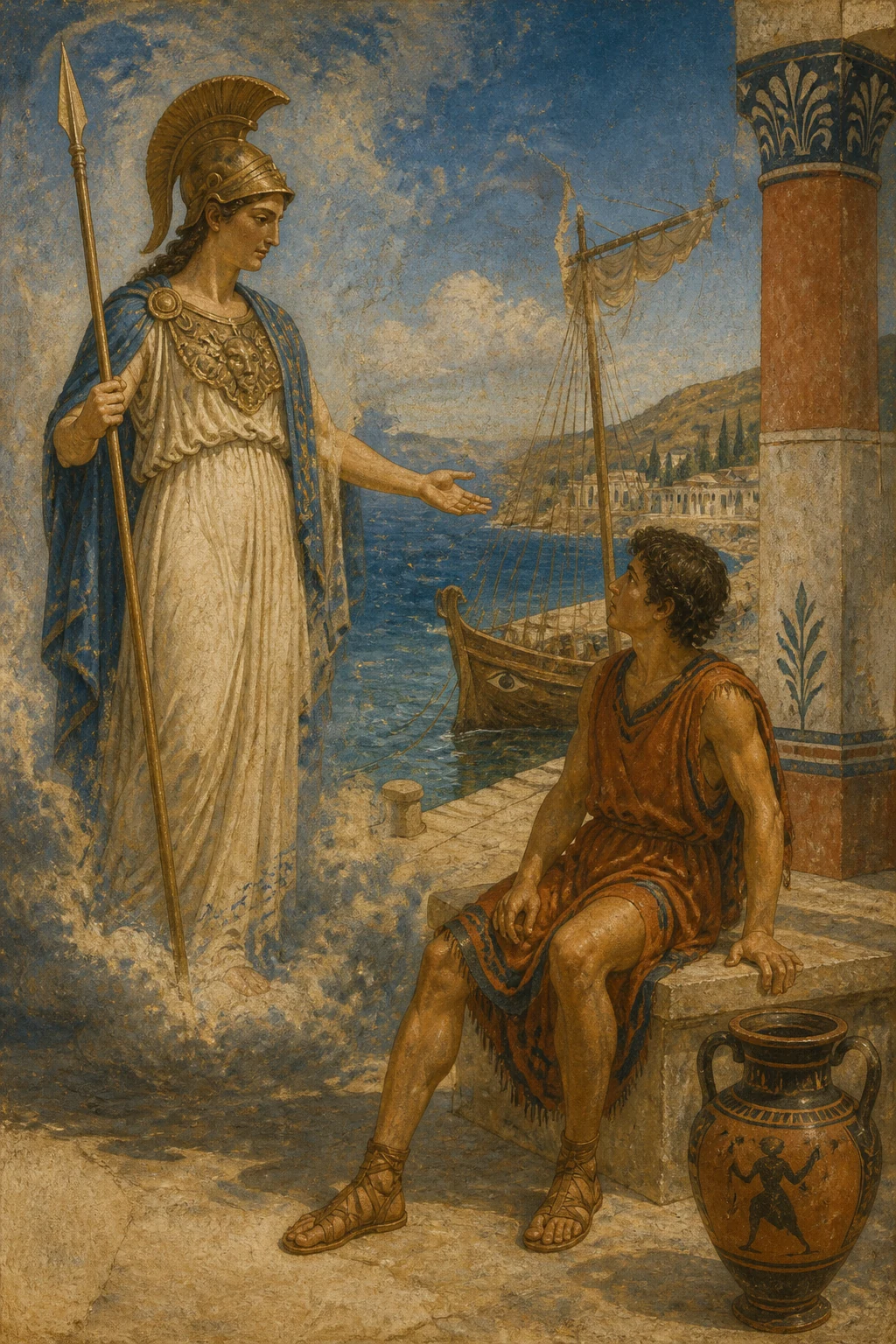
So the heroes waited, hidden unsuspected among the thick reeds. But Hera and Athena took notice, and withdrew to a chamber apart from Zeus himself and the other immortal gods to take counsel. Hera first sounded Athena: “Begin the counsel yourself now, daughter of Zeus.
“What must we do? Will you devise some trick by which they may seize Aeetes’ golden fleece and carry it to Greece, or might they win him over with gentle, persuasive words? For he is terribly arrogant.
“Still, we ought to shrink from no attempt.” So she spoke, and Athena beside her answered: “Hera, you question me plainly on the very thoughts I too have been turning over in my mind. But I have not yet conceived a scheme that will help the heroes, though I have weighed many plans.”
She spoke, and both fixed their eyes on the ground before their feet, each pondering within herself. Presently Hera was first to voice this thought: “Come, let us go to Cypris. Together we will ask her to speak to her son, and perhaps he will consent to shoot his arrows at Aeetes’ daughter, skilled in many drugs, and bewitch her with love for Jason. With her counsel, I believe, he would bring the fleece back to Greece.”
So she spoke, and the shrewd plan pleased Athena, who answered her again with gentle words: “Hera, my father brought me into the world knowing nothing of those arrows, and I have no knowledge of any charm that awakens desire.
“But if this proposal pleases you, I will gladly go with you. You may speak when we meet her.” She spoke, and they rose and went to the great house of Cypris, which her lame husband had built for her when he first took her from Zeus to be his wife.
Entering the courtyard, they stood beneath the porch of the chamber where the goddess made Hephaestus’ bed. He himself had gone early to his forge and anvils, in the broad hollow of a floating island, where he fashioned all his intricate works in the blast of the fire; πυρός` corrected typographical error (πυρός`) in the source text. But she sat alone in the house, on a carved chair facing the doors.
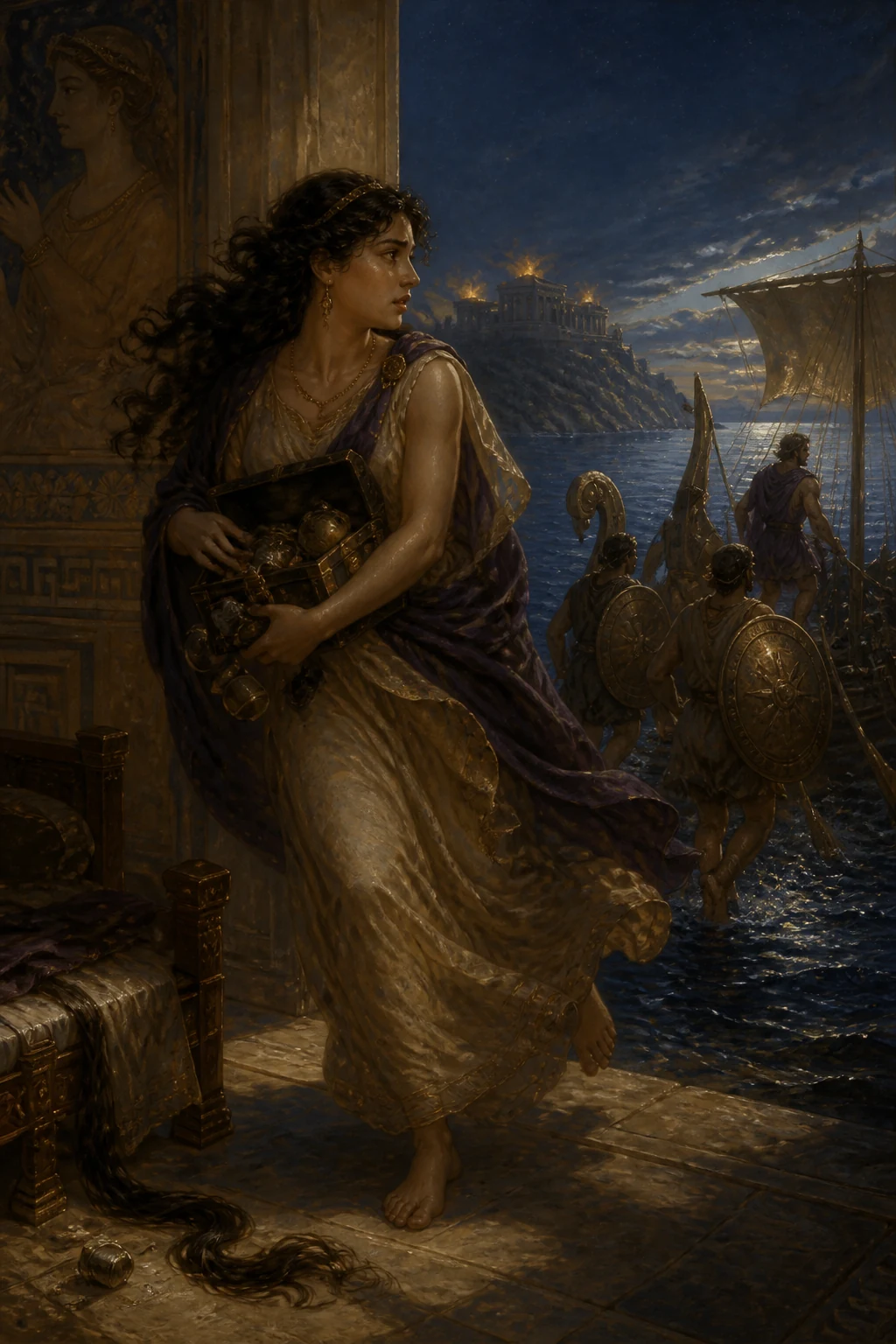
Her hair fell over her white shoulders on either side, and she was drawing a golden comb through it, about to braid its long tresses. When she saw the goddesses before her, she stopped, invited them inside, rose from her chair, and seated them on couches. Then she too sat down, gathering up her uncombed hair in her hands.
Smiling, she addressed them with coaxing words: “Dear friends, what purpose or need has brought you here after so long? Why have you come, you who seldom visited before, since you stand above the other goddesses?”
Hera answered her: “You are teasing us, but our hearts are troubled by misfortune. For already the son of Aeson has moored his ship in the river Phasis, with all those who have followed him in quest of the fleece.
“Now that the trial is close at hand, we fear terribly for them all, but most of all for Aeson’s son. Even if he should sail to Hades to release Ixion from his bronze fetters below, I will save him with all the strength my limbs possess, so that Pelias may not escape his evil fate and laugh at me—Pelias, who in his arrogance denied me the honour of sacrifice.
“Besides, Jason was already very dear to me, ever since he met me beside the swollen waters of the Anaurus as he was returning from the hunt. I was testing men’s regard for righteousness. Snow lay thick on all the mountains and their lofty peaks, and torrents rolled roaring down their slopes.
“I had taken the likeness of an old woman, and he pitied me, lifted me onto his own shoulders, and carried me through the rushing water. For that he holds an unfailing place in my esteem. Nor will Pelias pay for his outrage unless you grant Jason his return.”
So she spoke, and Cypris was struck with wonder at her words. Awed to see Hera pleading with her, she answered gently: “Revered goddess, may nothing worse befall you than Cypris, if, when you ask me, I should slight either a word or a deed that these weak hands of mine could accomplish. And let there be no talk of any favour in return.”
So she spoke, and Hera answered thoughtfully: “We have not come in need of strength or of your hands. Only speak quietly to your son and bid him enchant Aeetes’ maiden daughter with longing for Aeson’s son.
“For if she gives him kindly counsel, I believe he will easily take the golden fleece and return to Iolcus, so resourceful is she.” So she spoke, and Cypris addressed them both: “Hera and Athena, he would be more likely to obey you than me. Shameless though he is, he may show some little respect before you. But he pays no heed to me, and is always quarrelling and defying me.
“Indeed, in my distress at his wickedness, I have thought of breaking his ill-omened arrows and his bow before his very eyes. For in his anger he threatened that unless I kept my hands away while he still restrained his temper, I would have only myself to blame for what came next.”
So she spoke, and the goddesses smiled and exchanged a glance. Then, aggrieved, she spoke again: “My sorrows are a joke to others. I ought not to tell them to everyone; it is enough that I know them myself.
“But now, since this is what you both desire, I will try. I will coax him, and he will not refuse.” So she spoke, and Hera touched her slender hand and, smiling softly, said beside her: “Then, Cytherea, do this service at once, as you promise. And do not be angry or quarrel with your child in your resentment. He will change in time.”
With these words she left her seat, and Athena followed. Together they went back the way they had come. Cypris herself set off through the folds of Olympus to see whether she could find her son.
She found him far away in Zeus’ luxuriant orchard, not alone, but with μετα corrected diacritic error (μετα) in the source text. Ganymede, whom Zeus, desiring his beauty, had once taken up to heaven to dwell among the immortals. The two were playing with golden knucklebones, like boys of the same age.
Greedy Eros was standing upright, holding his left hand beneath his breast, its palm already brimming with his winnings, and a lovely blush glowed on his cheeks. The other sat crouched nearby, silent and downcast. He had only two left, and kept throwing one after the other, angry at his companion’s laughter.
Soon he lost these too after all the rest, and went away empty-handed in despair, without noticing Cypris as she approached. She stood before her son, took him by the chin, and said: “What are you grinning at, you unspeakable little mischief? Did you cheat him, then, and beat him unfairly because he knew no better?
“Come now, willingly perform the task I give you, and I will give you that beautiful toy of Zeus, which his dear nurse Adrasteia made for him in the Idaean cave when he was still a little child: a perfectly rounded ball. No finer plaything could you gain, even from the hands of Hephaestus.
“Its circles are made of gold, and round each run two curved bands. The seams are hidden, and a dark-blue spiral winds over them all. When you toss it from your hands, it leaves a fiery trail through the air, like a star.
“I will give it to you. Only shoot your arrow at Aeetes’ daughter and enchant her with love for Jason. Let there be no delay, for then your service would be worth less.” So she spoke, and her words delighted him.
He threw down all his toys and clung with both hands to the goddess’s dress, tugging at her on either side. He begged her to give it to him at once. She answered his entreaties gently, drew his face towards her, held him close, and kissed him, then replied with a smile: “Let your own dear head and mine bear witness: I will indeed give you the gift and will not deceive you, if you plant your arrow in Aeetes’ daughter.”
So she spoke, and he gathered up his knucklebones, counted them all carefully, and dropped them into the shining fold of his mother’s dress. At once he fastened round him with a golden belt the quiver that had been leaning against a tree trunk, and took up his curved bow.
He went through Zeus’ fruitful orchard and then passed out through the airy gates of Olympus. From there a heavenly path leads down, and the towering peaks of mountains, the summits of the earth, uphold the sky’s two poles, where the rising sun first reddens with its rays.
As he travelled through the vast air, now the life-giving earth appeared beneath him, with the cities of men and the sacred streams of rivers, and now the mountain ridges, with the sea all around.
Far away, the heroes were holding council on the benches of their ship, hidden in the marsh beside the river. Aeson’s son himself addressed them, and they listened quietly, seated in rows, each in his place: “Friends, I will tell you what seems best to me, but it is for you to bring the plan to fulfilment.
“For our need is shared, and all alike have a voice in counsel. Let any man who silently withholds his thoughts and advice know that he alone is robbing this expedition of its homecoming. The rest of you remain quietly aboard the ship with your weapons, while I go to Aeetes’ palace, taking Phrixus’ sons and two companions besides.
“First I will approach him and test him with words, to see whether he will willingly give us the golden fleece in friendship, or whether, trusting in his strength, he will scorn our request. Thus, once we have learned his hostility from his own lips, we can consider whether to meet him in battle or whether some other plan will help us avoid the fighting.
“Let us not simply use force to rob him of his possession before we have tried words. It is better first to approach him and win him over by speech. Often a word, by soothing a man as the occasion requires, has easily accomplished what courage could scarcely achieve. After all, he once welcomed blameless Phrixus, when he fled his stepmother’s treachery and the sacrifice his father would have made of him.
“For everywhere all men, even the most shameless, respect and honour the law of Zeus, protector of strangers.” So he spoke, and the young men unanimously approved the words of Aeson’s son; not one urged any other course.
Then he summoned Phrixus’ sons, Telamon, and Augeias to accompany him, and himself took up the staff of Hermes. At once they left the ship, crossed the reeds and water, and stepped ashore onto a rise in the plain.
This place is called the Circaean Plain. There many pollarded trees and willows grow in rows, and from their highest branches corpses hang, bound with ropes. For even now the Colchians consider it a sacrilege to burn their dead men with fire; nor is it lawful to lay them in the earth and heap a mound above them. Instead, they wrap them in untanned oxhides and suspend them from trees far from the city. Yet earth receives an equal share with air, for they bury their women in the ground: such is the custom’s ordinance.
As they went, Hera, intent on helping them, spread a thick mist through the city, so that they might pass unnoticed among the countless Colchians on their way to Aeetes’ palace. When they had swiftly crossed the plain and reached the city and the house of Aeetes, Hera dispersed the cloud again.
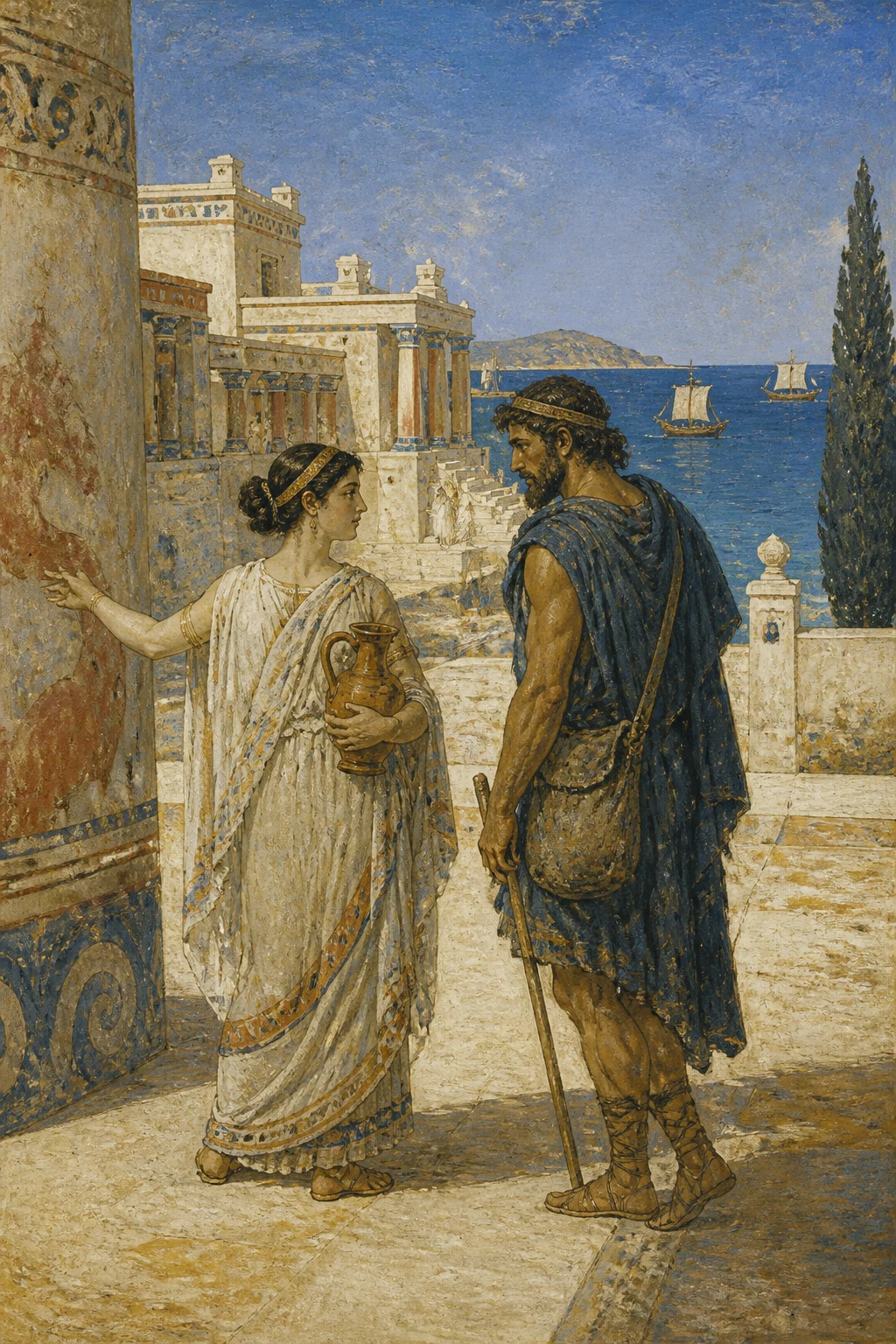
They stood at the entrance, marvelling at the king’s courtyard, the broad gates, and the columns that rose in rows about the walls. Above the house, a stone cornice rested on bronze triglyphs.
Then, undisturbed, they crossed the threshold. Nearby, cultivated vines, crowned with green leaves, climbed high in luxuriant growth. Beneath them flowed four ever-running fountains, which Hephaestus had fashioned. One gushed with milk, another with wine, and the third flowed with fragrant oil. The fourth poured out water, warm when the Pleiades set, but when they rose it welled from the hollow rock as cold as ice.
Such were the marvellous works that skilful Hephaestus had devised in the palace of Cytaean Aeetes. He had also made him bulls with bronze feet and bronze mouths, which breathed a terrible blaze of fire. And he had forged a plough of unyielding adamant, all in one piece, in gratitude to Helios, who had taken him into his chariot when he was exhausted by the battle on the plain of Phlegra.
Within lay an inner court, with many well-fitted folding doors and chambers on either side, and an ornate colonnade running along both flanks. Beyond, loftier buildings rose on either hand.
In one of these, the tallest, mighty Aeetes lived with his wife; in another lived his son Apsyrtus. The Caucasian nymph Asterodeia had borne him before Aeetes took as his lawful wife Eidyia, the youngest daughter of Tethys and Oceanus.
The sons of the Colchians called him Phaethon, because he outshone all the young men. The other buildings housed the serving women and Aeetes’ two daughters, Chalciope and Medea. The visitors encountered Medea as she was going from her own chamber to her sister’s—for Hera had kept her at home; before this she seldom stayed in the palace, but spent all day attending the temple of Hecate, whose priestess she was. As soon as she saw them near her, she cried out. Chalciope heard the shrill cry, and all the maids threw down their yarn and spindles before their feet and rushed outside together. When Chalciope saw her sons among the newcomers, she raised her hands high in joy. They too welcomed their mother, delighted at the sight of her, and clasped her in their arms. Then, weeping, she said: “So you were not, after all, to leave me uncared for and wander far away. Fate has turned you back.
“Unhappy that I am! What disastrous madness made you conceive such a longing for Greece, at the bidding of your father Phrixus? As he lay dying, he laid bitter grief upon my heart. Why should you go to the city of Orchomenus—wherever this Orchomenus may be—for the sake of Athamas’ wealth, leaving your mother far behind in sorrow?”
So she spoke. Last of all Aeetes came out, and his wife Eidyia herself emerged on hearing Chalciope’s voice. Soon the whole courtyard was filled with bustle. Servants in a crowd attended to a great bull; others chopped dry wood with bronze axes, while others heated bathwater over the fire. Not one of those serving the king was idle.
Meanwhile Eros came unseen through the grey air, turbulent as the gadfly that descends upon young heifers—the fly that herdsmen call the cattle’s tormentor. Quickly, beneath the lintel in the porch, he strung his bow and drew from his quiver an arrow, still unused, that would bring much sorrow.
With swift, unseen footsteps he crossed the threshold, glancing sharply about him. Crouching low beside Aeson’s son, he fitted the arrow’s notches to the middle of the string, drew his hands apart, and shot straight at Medea. Speechlessness seized her soul.
Laughing, he darted back out of the high-roofed hall. But the arrow burned in the maiden deep beneath her heart, like a flame. Again and again she cast bright glances towards Aeson’s son, and in her breast her steadfast mind was scattered by anguish. She remembered nothing else, and her spirit melted with sweet pain.
As a poor woman who lives by the labour of her hands and whose work is spinning heaps dry twigs about a blazing brand, so that she may have light beneath her roof at night when she wakes early, and from the little brand a boundless flame leaps up and consumes all the twigs together: so, coiled beneath her heart, destructive Love burned secretly. And with the turmoil of her thoughts, her tender cheeks turned now pale, now crimson.