Prevod
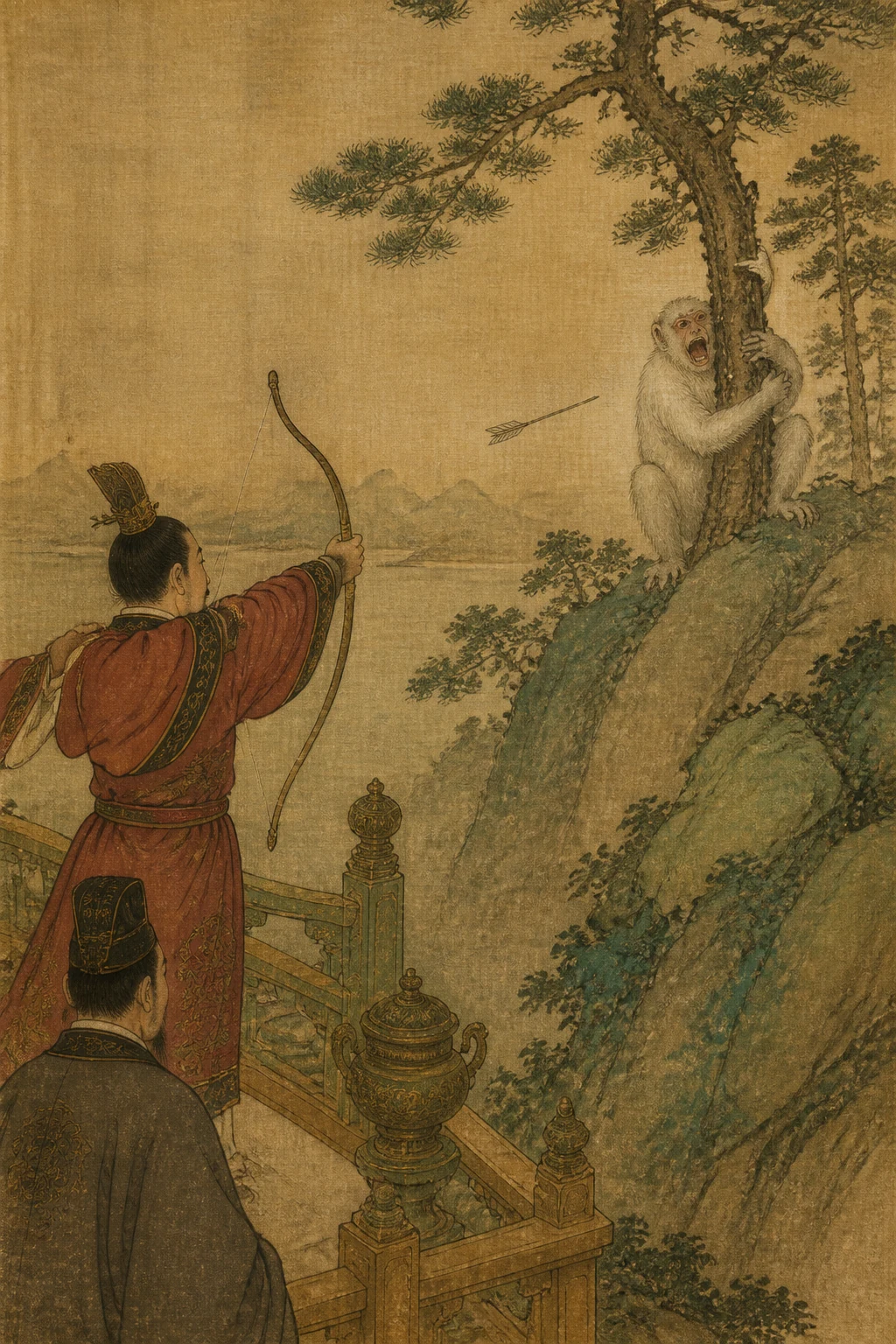
This, too, happened long ago. There was a palace attendant called Kadobe no Fushō. He was young and poor, but he loved shooting at targets. He practiced even at night, pulling boards from the roof of his humble house and burning them for light. His wife disapproved, and the neighbors said, “What a pity to do such a foolish thing!” But he replied, “If I lose my house and have to wander about, what trouble is that to any of you?” And he went on burning his roof boards to light his shooting. There was not a soul who did not know about it. In time all the roofing boards were gone. Then he split up the rafters and laths for fuel, and after that he burned the ridgepole and the great beams. Next he chopped up all the crossbeams and pillars. While people were saying to one another, “What an appalling business!” he split up even the floorboards and the joists beneath them, until at last he had to lodge with a neighbor. Watching his habits, the owner of the house thought, “He will pull this house apart and burn it too,” and wanted him gone. But Kadobe would say, “Just bear with me a little longer,” and so he stayed. Meanwhile, word of his skill with the bow reached the court, and he was summoned to take part in an archery contest. His shooting was so splendid that the emperor was deeply impressed, and in the end he was sent out to the provinces to recruit wrestlers for the court. He gathered many fine wrestlers and acquired untold wealth besides. On his journey back to the capital, he passed a place called Kawane Island, where pirates congregated. One of his companions said, “Look over there, sir! Those boats must be pirate boats. What are you going to do?” Kadobe no Fushō replied, “Men, do not make a fuss. Even if there were ten million pirates, just watch me now.” He took from a leather chest the robes he had worn at the archery contest and dressed himself with great care, setting his court cap and its fastening cords in proper order. His attendants cried out to one another, “Has he lost his senses? Even if we have no hope, he might at least have us put up shields!” Having finished dressing, he bared one shoulder, looked carefully about him, and stood on the roof of the boat’s cabin. “Have they come within forty-six paces yet?” he asked. His attendants were too busy retching bile to give him a proper answer. “Well, have they come close enough?” he asked again. “They must be within forty-six paces by now,” someone replied. He went out onto the cabin roof, planted his feet in the proper stance, and held his bow poised for a while. Then he raised it. The pirate chief, dressed in dark clothing and waving an open red fan, was shouting, “Row closer! Quickly! Board them and take everything!” But Fushō remained quite untroubled. He drew his bow steadily to the full, loosed the arrow with an easy motion, and lowered the bow to watch. The arrow flew too swiftly to be seen and struck where the pirate chief was sitting: its target point had pierced his left eye. With a cry, the pirate flung away his fan and fell backward. When the others pulled out the arrow and examined it, they found that it was nothing like a proper arrow for battle, but a mere little thing. At the sight of it, the pirates cried, “Why, this is no ordinary arrow! It is an arrow of the gods! Quick, every man of you—row back!” And they fled. Kadobe no Fushō smiled faintly. “What fools, to stand so heedlessly before the likes of me!” he said. He let his sleeve fall back into place and sat down, chuckling. In their frantic flight the pirates dropped a sack and a few other things into the sea. Fushō had these floating spoils picked up and sat there laughing—or so the story goes.