Prevod
Once upon a time, as never before, there lived a boy. Ever since he could remember, his body had been covered in sores. What had he not tried to rid himself of them? But all in vain. The lads at their games and the girls at the village dance jeered at him and fled from him as though he were a leper. There was nothing he could do but swallow his bitterness and endure it. No dancing for him, no merriment, no loving caress. He gazed longingly at the other lads and young men, at some trying to outdo one another in the dance and others frolicking with the girls, and wished he could be one of them. Every day he went to a well to fetch water for his mother. Now, his way led past the imperial palace. One day, as he was drawing water, he saw a ruffe in the bucket. How pleased he was to think he would have something special to eat that day! But what should happen next? The fish began to speak to him: “Young fellow, throw me back into the well, and do not burden your soul with the sin of killing me, for someday I may be of great help to you.” The boy marvelled at this. How could a fish speak? Sensing that some enchantment must be at work, he let it go back into the well. Now, the emperor’s daughter would not marry on any account. What had her poor father not done, what schemes had he not devised, to see his daughter settled in a home of her own? But persuade her he could not. Her heart would not let her bind herself to any of the suitors who came to ask for her hand, though among them were emperors and emperors’ sons. Yet whenever the boy with the sores passed on his way to fetch water, or returned with his bucket full, and the princess happened to be at the window, he saw her looking at him and smiling. It never occurred to him that she came to the window on his account, or that she watched for him until he passed; he merely supposed that she was naturally cheerful, with a smile always on her lips. As it happened, either the emperor’s daughter had guessed that he would one day be a handsome man, or some unseen thread was drawing her towards her destined husband. So it went, day after day, until one day she called him over to speak to her. The boy nearly died of embarrassment when he saw that it was he she was calling! He turned red as a beet and grew so flustered that at first he could not put two words together. So utterly tongue-tied was he! Then he recovered himself and, taking his courage in both hands, gave answers that went straight to the girl’s heart. For his words, like hers, had a charm about them, my dear fellow; whether her heart was fluttering I cannot say, but his, I know, was beating as though it would leap out of his breast. And from that moment, whatever he did, whatever he busied himself with, he would find himself, quite against his will, passing the imperial palace, just for the sake of passing it. He had forgotten the fish. Now he remembered it, and one day he went to the well, peered down into it, and said: “Fish, little fish, dear Ghigorț, you told me that someday, someday, you would help me. Please rid me of these greasy, foul-smelling sores.” Scarcely had he finished speaking when—what do you think?—all his sores fell away at once, and he stood there clean and radiant, straight as a young fir tree. When the emperor’s daughter saw him looking so fine and handsome, she could no longer restrain herself, and kissed him. You see, her heart urged her towards him, and she was overjoyed to have set her sights on such a fine young fellow. She was breathtakingly beautiful, and he as handsome as a peony in bloom; seeing that they were made for one another, she went to her father, the emperor, and said: “Father, I have found my bridegroom. I do not know whether you will like him or not, but my heart yearns for him.” “How can you bring such shame upon me, my daughter? Where have you ever heard,” the poor man went on, wringing his hands,
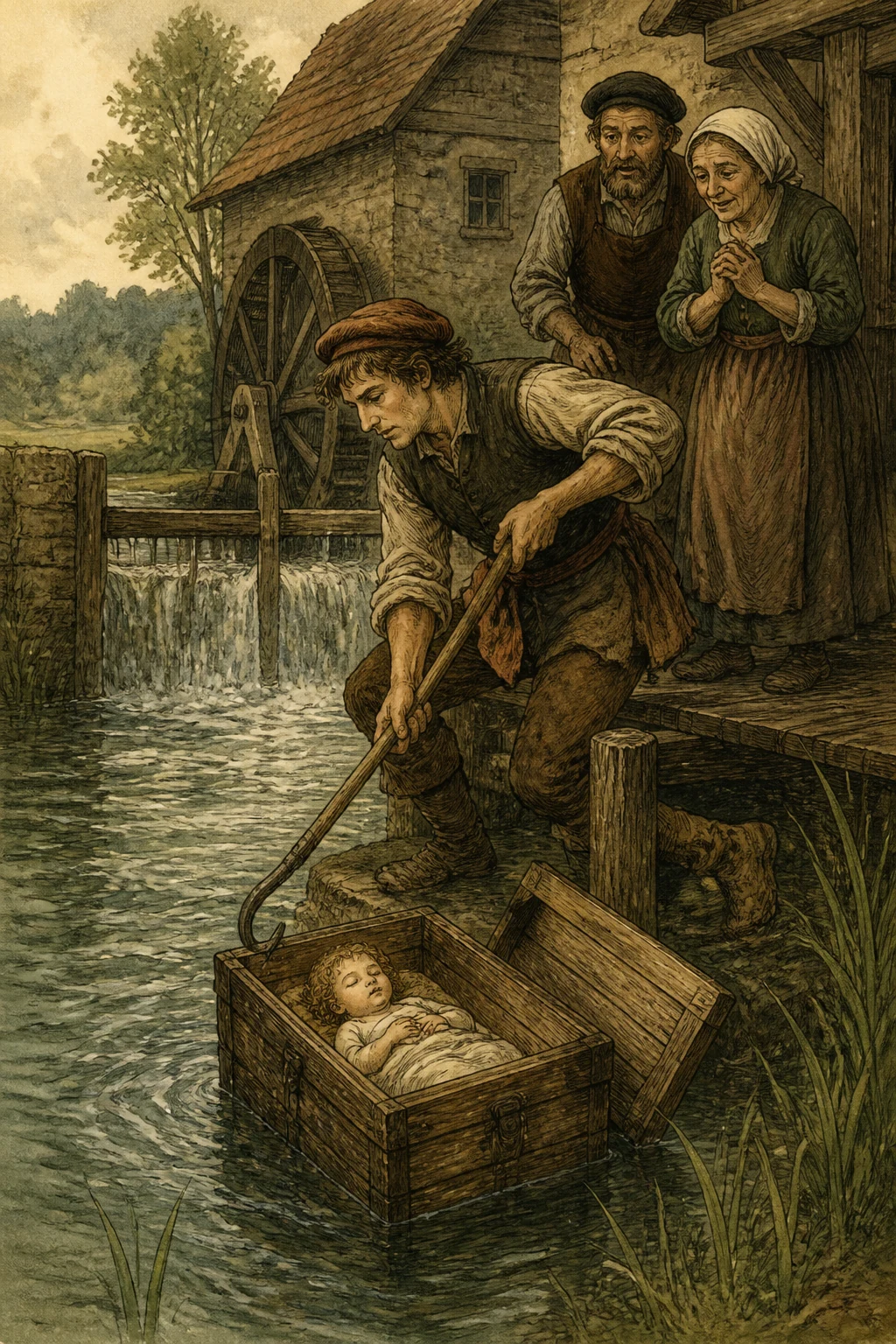
“of an emperor’s daughter taking some penniless vagabond for a husband, a ragged fellow with nothing to his name?” “Father, he may be poor, he may be a ragged fellow, as you say, but he is an honourable man, and clever, and besides, I love him. It is I who must live with him. My heart tells me to marry him. If you will not let me wed him, know this for certain: I shall take no other, not if it costs me my head.” When the emperor saw that his daughter had planted her foot firmly and would not, for anything in the world, take another man for her husband, he took the pair of them, put them in a barrel, and cast it upon the waters. They began to wail and weep so bitterly that it would have torn your heart in two. The poor, innocent lad was suffering on account of the emperor’s daughter, though he had never sought her out, nor even dreamed that he might marry her. But when he saw that weeping would get him nowhere, he grew ashamed of himself: how could a strapping young fellow like him show so little courage when trouble came upon him? And he began to think what he might do to escape their peril. All at once, Ghigorț came into his mind. “Dear little Ghigorț, now let us see what you can do! You have already given me proof of your magic powers. I know there is much you can accomplish. Save me from the plight I have fallen into.” Barely had the last word left his mouth when—what do you think?—that wretched barrel became a palace, richer and more splendidly adorned with all the beauties of the world than any palace belonging to the girl’s father, the emperor. Only, by then the barrel had reached the sea, and that was where the palace appeared. The boy who had once been covered in sores thought of Ghigorț again and wished for the palace to be moved into a forest. His wish was granted in the twinkling of an eye. And such a marvellous palace had never been seen, I tell you! Every little thing within it stood in its proper place, and all could speak, as enchanted things do. There they held their wedding. The beasts of the forest, the mighty trees, the lovely little flowers, the birds of the air, and the stars of heaven together with the holy Moon all attended the feast. They lived there as snugly as children in their mother’s arms. Never was a quarrel heard between them; heaven forbid that you should have found any discord there! For the devil of strife did not dare thrust his tail between them. And as they lived thus, their marriage was blessed with a little boy, born clad in a breastplate of gold. The moment his mother, the emperor’s daughter, saw him so, she took fright and conceived an evil purpose against him. Yet, since he was the fruit of her own womb, she pitied him too much to kill him. So she carried him away, placed him high in a tree, and abandoned him there. When the Fates came, they foretold that the child would become a great man; that he would raise his mother’s lineage to high renown; that a bird would bring him food; that he would suffer cruel treatment at the hands of his provider’s kin, but would emerge from it unscathed; and that afterwards another bird would guide him. And indeed, from the very next day an eagle began to come daily and bring him food. Meanwhile, the emperor, the girl’s father, had gone hunting with a great company of courtiers, servants, and huntsmen. Hunting here and there, he had strayed from his people without noticing. Somehow or other he lost his way, with only his faithful servant left beside him. And now what was he to do? Evening was drawing near, there was nowhere to rest, and no lodging to be heard of. As they groped their way through the dusk, they came upon the palace of the boy who had once been covered in sores. On arriving, they dismounted, and were about to tie their horses’ reins to the gatepost when it rebuked them, saying: “Hey, you fools! Is this where you tie your horses? Horses belong in the stable.” The emperor stood rooted to the spot in astonishment. And then he felt ashamed that he, an emperor, should be scolded by a gatepost. Clenching his fists and grinding his teeth in vexation, he paced to and fro before the gate to cool himself a little and quiet his anger. Seeing from his window some men walking back and forth outside the gate—something he had not seen since he had entered the barrel—the master of the palace came downstairs and went to invite the travellers in. He welcomed and entertained them as decent folk who had lost their way. The lord and lady of the palace recognized the emperor, but he did not recognize them; you see, it never crossed his mind that they might still be alive. The emperor scarcely had time to marvel at everything he saw in that palace. No sooner did he begin to examine the objects that moved about by themselves and performed their duties than he would stop to listen to others talking and encouraging one another in their work. The table was laid quietly and in good order. Everything had its own overseer: the tableware, the kitchen utensils, the bedding, the brooms for the house and yard, the stables, the courtyard—everything was properly ordered. After enjoying their hosts’ hospitality, the lost hunters set out the next day. Finding a path that brought them to a clearing from which they knew the way, the emperor returned to his court, firmly resolved to send men to discover who owned that palace within his dominions, of which no one had ever told him a word. Afterwards, he intended to order its owners to be brought before him. The eagle continued feeding the little boy whom his mother had abandoned in the tree, and the child grew swiftly, like a flower, until one day the eagle’s mate followed him to see where he kept going. When she saw what he was doing, her feathers bristled and she resolved to harm the child. She hid and waited there until the eagle flew away. As soon as he was gone, she came up to the boy and began pecking at his breast, meaning to eat his heart. But his breast was hard, being, as I have told you, made of gold, and she could not break through it easily. Feeling her pecks, the child stretched out his little hands, as though someone had taught him what to do, caught the eagle’s mate by the throat, and squeezed and squeezed until he strangled her and she fell dead to the ground.
Then the child climbed down from the tree and wandered away across the fields. On his way he met a crane. As soon as he saw it, he made friends with it. Finding so sweet and lovely a child, the crane could no longer bear to part with him, and they lived together in its nest. One day, in the course of its wanderings, the crane found a book and brought it to the boy, who learned to read and write. When the boy had grown a little older, the crane taught him to make a boat in which to travel upon the water. He took people out in his boat and learned from them how to handle it. In time he surpassed them in the art of boating, and took the crane out for rides as well. While travelling on the water in this way, he caught sight of his father’s palace. He made inquiries about it and learned that a man and his wife lived there. He went to make their acquaintance. There, as they talked of one thing and another, the conversation turned to their child, and he discovered that he was their son. His parents then begged him to stay with them. But he would not; you see, his destiny was drawing him elsewhere. He got into his boat and went out into the world. In time he came upon the palace of the emperor, his mother’s father. As soon as the emperor saw him, something seemed to urge him to look kindly upon this young man. And the young man’s heart, without his knowing why, beat joyfully. For blood, my friend, will not turn to water, and kin are drawn to kin as a needle to a magnet. He entered the emperor’s service, and the good he did the empire through his cleverness led the emperor to keep the young man close to him. Being always near the emperor, he often saw the emperor’s daughter—for after banishing his elder daughter, the emperor had had another girl—and began to cherish hopes of winning her. Nor was he mistaken, for she too had set her heart on him. One day he ventured to twirl his moustache at her, while she, shyly, cast tender glances his way. So it went, day after day, until at last they both came before the emperor, fell on their knees, confessed their love, and begged him to let them marry.
The emperor, remembering what had happened with his first daughter, did not oppose them for a moment. Knowing the young man to be clever and quick-witted, he gave them such a splendid wedding that its fame spread far and wide. Then, being old, he stepped down from the imperial throne and raised them to it, and they ruled with kindness all the days of their lives. And I mounted a saddle, and so on.