Prevod
Every key has its story, and there are many keys: the chamberlain’s key, the watch key, Saint Peter’s key. We could tell you about them all, but just now we shall tell you only about the Councillor’s gate key.
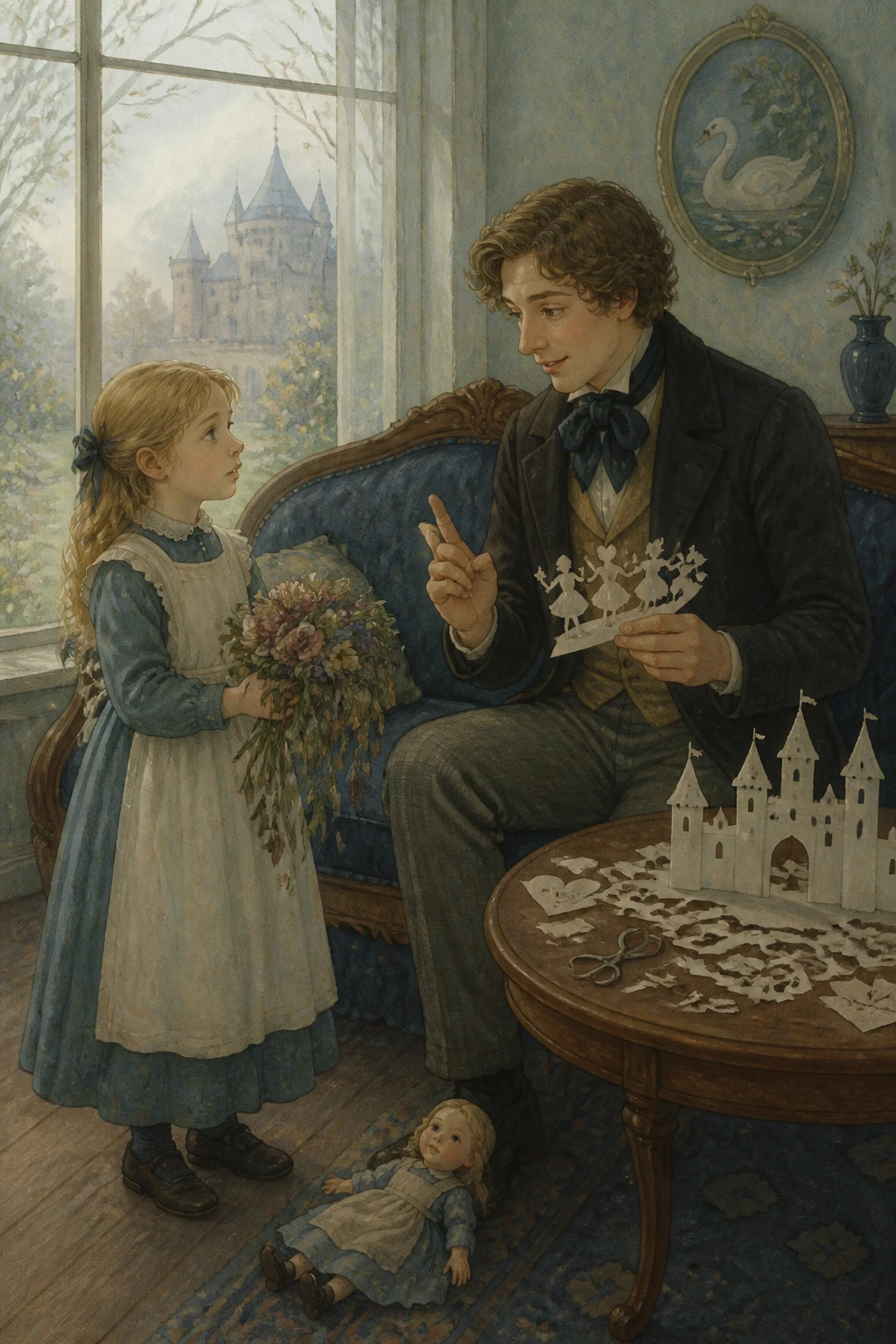
It had been made by a locksmith, though it might well have thought its maker was a blacksmith, so roughly had the man handled it, hammering and filing away. It was too big for a trouser pocket, so it had to go into a coat pocket. There it often lay in darkness, but otherwise it had its appointed place on the wall, beside the Councillor’s childhood silhouette, in which he looked like a bread roll wearing a frill.
They say that everyone takes something of the sign under which he was born into his character and conduct: Taurus, Virgo, Scorpio, as they are called in the almanac. The Councillor’s wife mentioned none of these; she said her husband had been born under “the Sign of the Wheelbarrow”—he always had to be pushed along.
His father pushed him into an office, his mother pushed him into marriage, and his wife pushed him up to the rank of Councillor; but this last she did not say. She was a sensible, good-hearted woman, who knew when to keep quiet, when to speak, and when to push.
He was now getting on in years, “well proportioned,” as he put it himself, a well-read, good-natured man, and wise in the ways of keys as well, which we shall come to understand more fully. He was always in good spirits, liked everyone, and was glad to talk to anyone. Once he went out into town, it was hard to get him home again unless Mother was there to push him along. He had to speak to every acquaintance he met. He had many acquaintances, and dinner suffered for it.
His wife kept watch from the window. “Here he comes!” she would say to the maid. “Put the pot on!—Now he’s stopped to talk to someone. Take the pot off, or the food will be overcooked!—Now he really is coming! Yes, put the pot on again!”
But that did not bring him home. He might be standing right beneath the window, nodding up at her, but if an acquaintance came by, he could not help himself: he had to exchange a few words. And if, while he was talking to this one, another acquaintance appeared, he would hold the first by the buttonhole and take the second by the hand, while calling out to a third who was trying to pass.
It was a trial of his wife’s patience. “Councillor! Councillor!” she would call. “Yes, that man was born under the Sign of the Wheelbarrow! He can’t get moving unless he’s pushed!”
He was very fond of visiting bookshops and looking through books and journals. He paid his bookseller a small fee for the privilege of reading new books at home—that is to say, he was allowed to cut the pages lengthwise, but not across, for then the books could no longer be sold as new. He was a living newspaper, in the most respectable way, knowing all about engagements, weddings, and funerals, literary gossip and town gossip; indeed, he would drop mysterious hints of knowing things nobody else knew. He had it all from the gate key.
Even as young newlyweds, the Councillor and his wife had lived in their own property, and they had had the same gate key ever since; but in those days they knew nothing of its marvellous powers. They only discovered them later.
It was in the days of King Frederik VI. Copenhagen had no gaslight then; it had whale-oil lamps. There was no Tivoli or Casino, no trams and no railways. Amusements were few compared with what they are now. On Sundays people would take a walk out through the city gate to Assistens Cemetery, read the inscriptions on the graves, sit down on the grass, eat from their picnic baskets, and drink a glass of schnapps. Or they would go to Frederiksberg, where a regimental band played in front of the palace, and crowds gathered to watch the royal family rowing about on the little narrow canals. The old king steered the boat, and he and the queen greeted everyone without distinction of rank. Well-to-do families came out from town to take their evening tea. They could get hot water at a little farmhouse in the field outside the gardens, but they had to bring their own tea urn.
There the Councillor and his wife went one sunny Sunday afternoon, with the maid walking ahead, carrying the tea urn, a basket of provisions, and “a bottle of Spendrup’s finest.”
“Take the gate key!” said his wife. “So we can get into our own home when we return. You know the gate is shut at dusk, and the bell rope broke this morning!—We shall be home late! After Frederiksberg we’re going to Casorti’s theatre in Vesterbro to see the pantomime, ‘Harlequin, Foreman of the Threshers.’ They come down in a cloud; it costs two marks a person!”
And so they went to Frederiksberg, heard the music, saw the royal boats with their fluttering flags, the old king, and the white swans. After a good cup of tea they hurried away, but still did not reach the theatre in time.
The tightrope dancing was over, the stilt dancing was over, and the pantomime had begun. They were late, as always, and it was the Councillor’s fault: every few moments along the way he had stopped to talk to acquaintances. Inside the theatre he found good friends too, and when the performance was over, he and his wife simply had to go along to a family’s house in Vesterbro for a glass of punch. They were to stay only ten minutes, but those minutes stretched into a whole hour. There was talk and more talk. A Swedish baron was particularly entertaining—or was he German? The Councillor had not quite retained that detail. But the trick with the key that the baron taught him, he retained for the rest of his life. It was extraordinarily interesting! He could make the key answer any question put to it, even the most secret.
The Councillor’s gate key was particularly well suited to this, for its bit was heavy, and that was the part that had to hang down. The baron rested the bow of the key on the forefinger of his right hand. It hung there lightly and loosely; every beat of the pulse in his fingertip could set it moving and make it turn, and if it did not, the baron knew how to make it turn as he wished without anyone noticing. Each turn stood for a letter, beginning with A and going as far through the alphabet as required. Once the first letter had been found, the key turned in the opposite direction; then they looked for the next letter, and in this way obtained whole words, whole sentences, answers to their questions. It was all deception, but always amusing. That was more or less the Councillor’s first thought too, but he did not hold to it; he became wholly absorbed in the key.
“Husband! Husband!” cried his wife. “The West Gate closes at twelve! We shan’t get in! We have only a quarter of an hour to hurry there.” They had to make haste; several other people heading into town soon overtook them. At last they were approaching the outer guardhouse when the clock struck twelve and the gate slammed shut. Quite a crowd stood locked outside, among them the Councillor and his wife, with the maid, the tea urn, and the empty picnic basket. Some were greatly alarmed, others annoyed; each took it in their own way. What was to be done?
Fortunately, a recent decree had ruled that one of the city gates, the North Gate, should not be locked; pedestrians could pass through the guardhouse there and enter the city.
It was no short walk, but the weather was fine, the sky clear and full of stars and shooting stars, and the frogs were croaking in ditch and marsh. The company themselves began to sing one song after another, but the Councillor did not sing, nor did he look at the stars, nor even watch his own feet. He fell full length right at the edge of the ditch. One might have thought he had drunk too much, but it was not the punch: it was the key that had gone to his head and was turning round inside it.
At last they reached the guardhouse at Nørrebro, crossed the bridge, and entered the city. “Now I’m happy again!” said the Councillor’s wife. “Here is our gate!” “But where is the gate key?” said the Councillor. It was not in his back pocket, nor in his side pocket.
“Heaven preserve us!” cried his wife. “Haven’t you got the key? You must have lost it doing those key tricks with the baron. How are we to get in now? You know the bell rope broke this morning, and the watchman has no key to the house. This is a desperate business!”
The maid began to wail; the Councillor alone kept his composure. “We must break a pane in the provision dealer’s window!” he said. “Wake him up, and then we can get in.”
He broke one pane, then another. “Petersen!” he shouted, thrusting the handle of his umbrella through the window. At that, the basement shopkeeper’s daughter screamed aloud inside. The shopkeeper flung open his door, crying, “Watchman!” Before he had properly caught sight of the Councillor’s family, recognised them, and let them in, the watchman had blown his whistle, and another watchman in the next street answered with his. People appeared at their windows. “Where’s the fire? What’s the trouble?” they asked, and were still asking when the Councillor was already upstairs in his sitting room, taking off his coat—and there lay the gate key, not in a pocket, but in the lining. It had slipped down through a hole that ought not to have been in the pocket.
From that evening on, the gate key acquired a very special importance, not only when they went out at night, but when they sat at home and the Councillor displayed his cleverness by making the key answer questions.
He would think of the likeliest answer and then make the key give it; in the end he believed it himself. But the apothecary did not—a young man closely related to the Councillor’s wife.
This apothecary had a good head, a critical head. Ever since his schooldays he had been writing reviews of books and plays, though without putting his name to them, which makes such a difference. He was what is called a man of fine sensibilities, but he did not believe in spirits at all, least of all key spirits.
“Oh, I believe, I believe!” he said. “My dear Councillor, I believe in the gate key and all key spirits just as firmly as I believe in the new science that is beginning to make itself known: table-turning and spirits in furniture, old and new. Have you heard about it? I have! I have doubted—you know I am a doubter—but I was converted by reading a dreadful story in a thoroughly reliable foreign newspaper. Councillor! Can you imagine it? Well, I give you the story just as I found it. Two clever children had seen their parents awaken the spirit in a large dining table. The little ones were alone, and now they wanted to try rubbing life into an old chest of drawers in the same way. Life came into it, the spirit awoke, but it would not take orders from children. It rose up, the chest creaked, it thrust out its drawers, and with its wooden legs it put each child into a drawer. Then the chest ran with them out through the open door, down the stairs and into the street, all the way to the canal, where it plunged into the water and drowned both children. Their little bodies were given Christian burial, but the chest of drawers was taken to the town hall, convicted of child murder, and burnt alive in the marketplace. I have read it!” said the apothecary. “Read it in a foreign newspaper; it is not something I made up myself. May the key strike me dead if it isn’t true! There, I’ve sworn a mighty oath!”
The Councillor thought such talk was far too coarse a joke; the two of them could never discuss the key. The apothecary was key-ignorant. The Councillor advanced in key-knowledge; the key was his amusement and his wisdom.
One evening, as the Councillor was preparing for bed and stood half undressed, there was a knock at the door to the passage. It was the basement shopkeeper, calling at this late hour. He too was half undressed, but a thought had suddenly occurred to him, he said, and he was afraid he might not be able to hold on to it overnight.
“It’s my daughter, Lotte-Lene, I must speak about. She’s a pretty girl, she’s been confirmed, and now I should like to see her well settled!” “I’m not a widower yet!” said the Councillor with a chuckle, “and I have no son to offer her!”
“You understand me well enough, Councillor!” said the shopkeeper. “She can play the piano, she can sing; you must be able to hear that up here in the house. You don’t know all the things that girl can do. She can imitate anyone’s voice and walk. She was made for the stage, and that’s a fine path for nice girls from good families: they can marry themselves into a count’s estate. Not that either Lotte-Lene or I have any such thought. She can sing, she can play the piano! So the other day I took her to the singing school. She sang, but she hasn’t got what I call a woman’s beer-cellar bass, nor that canary shriek up in the highest notes that they demand of singers nowadays, and so they strongly advised her against that line. Well, I thought, if she can’t be a singer, she can always become an actress; all you need for that is a voice. Today I spoke about it to the director, as they call him. ‘Is she well read?’ he asked. ‘No,’ I said, ‘not at all!’—‘An actress must be well read!’ he said. I thought she could still become that, and off I went home. She can join a lending library and read whatever they have, I thought. But then tonight, as I sat undressing, it struck me: why pay for books when you can borrow them? The Councillor has books in plenty. Let her read those; there’s reading enough, and she can have it for nothing!”
“Lotte-Lene is a nice girl!” said the Councillor. “A pretty girl! She shall have books to read. But has she got what they call the spark of inspiration, the gift, the genius? And has she something just as important in this business: has she luck on her side?”
“She’s won twice in the prize lottery,” said the shopkeeper. “Once she won a wardrobe, and once six pairs of sheets. I call that luck, and she has it!”
“I shall ask the key!” said the Councillor. And he placed the key on his own right forefinger and the shopkeeper’s right forefinger, and let it turn and give them letter after letter.
The key said, “Triumph and good fortune!” And so Lotte-Lene’s future was settled. The Councillor immediately gave her two books to read: “Dyveke” and Knigge’s “On Human Relations.”
From that evening a closer acquaintance began between Lotte-Lene and the Councillor’s household. She came upstairs to visit them, and the Councillor found her a sensible girl: she believed in him and the key. His wife saw something childlike and innocent in the frankness with which she revealed her profound ignorance at every turn. Husband and wife each liked her in their own way, and she liked them.
“It smells so lovely up there!” said Lotte-Lene. There was a smell, a fragrance, an apple fragrance in the passage, where the Councillor’s wife had stored a whole barrel of Gravenstein apples. And through all the rooms there was a sweet, incense-like scent of roses and lavender.
“It makes everything seem so refined!” said Lotte-Lene. Her eyes delighted, too, in the many beautiful flowers the Councillor’s wife always had there. Even in the depths of winter, lilac and cherry branches blossomed in those rooms. The bare cut branches were put in water, and in the warm room they soon brought forth flowers and leaves.
“You would think all life had gone from those bare branches, but just look how it rises from the dead.” “That never occurred to me before!” said Lotte-Lene. “Nature really is lovely!”
And the Councillor showed her his “key book,” in which he had written down remarkable things the key had said, even about half an apple cake that had disappeared from the cupboard on the very evening the maid’s sweetheart came to visit.
The Councillor had asked his key, “Who ate the apple cake, the cat or the sweetheart?” And the gate key answered, “The sweetheart!” The Councillor had thought so even before he asked, and the maid confessed: that cursed key knew everything.
“Now, isn’t that remarkable?” said the Councillor. “That key, that key! And of Lotte-Lene it has said, ‘Triumph and good fortune!’—We shall see!—I’ll answer for it.”
“It’s lovely!” said Lotte-Lene. The Councillor’s wife was not so confident, but she did not voice her doubts within her husband’s hearing. Later, however, she confided to Lotte-Lene that when the Councillor was a young man he had been utterly stage-struck. Had anyone given him a push in those days, he would certainly have become an actor, but his family had pushed him away. He was determined to get onto the stage, and to do so he wrote a comedy.
“I am telling you a great secret, my dear Lotte-Lene. The comedy was not bad; it was accepted at the Royal Theatre and hissed off the stage, so that nothing has ever been heard of it since, and I am glad of that. I am his wife, and I know him. Now you mean to follow the same path. I wish you every success, but I don’t believe it will work out. I don’t believe in the gate key!”
Lotte-Lene did believe in it, and in that belief she and the Councillor were united. Their hearts understood each other in all propriety and honour. Besides, the girl had several accomplishments that the Councillor’s wife appreciated. Lotte-Lene knew how to make starch from potatoes, sew silk gloves from old silk stockings, and re-cover her silk dancing shoes, though she could afford to buy all her clothes new. She had what the provision dealer called shillings in the drawer and bonds in the safe. She would really make a wife for the apothecary, thought the Councillor’s wife; but she did not say so, nor did she let the key say it. The apothecary was soon to set up for himself, with his own shop in one of the nearest large provincial towns.
Lotte-Lene kept reading “Dyveke” and Knigge’s “On Human Relations.” She kept the two books for two years, but by then she knew one of them by heart: “Dyveke,” every part in it. Yet she wanted to play only one part, Dyveke herself, and not in the capital, where there was so much envy and where they would not have her. She would begin her artistic career, as the Councillor called it, in one of the country’s larger provincial towns.
Now, as a most remarkable coincidence would have it, this was the very place where the young apothecary had established himself as the town’s newest, if not its only, apothecary.
The great, eagerly awaited evening came. Lotte-Lene was to make her appearance, to win triumph and good fortune, as the key had foretold. The Councillor was not there; he was ill in bed, and his wife was nursing him. He needed hot napkins and camomile tea: the napkins round his middle, and the tea inside it.
The couple did not attend the performance of “Dyveke,” but the apothecary was there and wrote about it to his relative, the Councillor’s wife. “Dyveke’s collar was the best thing in it!” he wrote. “Had the Councillor’s gate key been in my pocket, I would have taken it out and whistled through it. She deserved that, and so did the key, which lied so disgracefully to her with its ‘Triumph and good fortune.’”
The Councillor read the letter. It was all malice, he said, hatred of the key visited upon the innocent girl. And as soon as he was out of bed and himself again, he sent a short but venomous letter to the apothecary, who replied as though he had found nothing in the entire epistle but jokes and good humour.
He thanked him for this, as for every future kindly contribution towards making known the key’s incomparable worth and importance. He then confided to the Councillor that, besides his work as an apothecary, he was writing a great key novel, in which all the characters were keys, nothing but keys. “The gate key” was naturally the principal character, and the Councillor’s gate key was his model, endowed with second sight and the gift of prophecy. All the other keys must revolve around it: the old chamberlain’s key, which knew the splendour and festivities of court; the watch key, small, delicate, and distinguished, four shillings at the ironmonger’s; the key to the church pew, which counted itself among the clergy and had seen spirits after spending a night in a church keyhole; the pantry key, the woodshed key, and the wine-cellar key. All came forward, bowed, and turned about the gate key. “The sunbeams light it into silver; the wind, the spirit of the world, rushes into it and makes it whistle. It is the key of all keys. Once it was the Councillor’s gate key; now it is the key to the gates of heaven, it is the papal key, it is infallible!”
“Malice!” said the Councillor. “Monumental malice!” He and the apothecary never saw each other again.—Yes, they did, at the Councillor’s wife’s funeral. She died first.
There was grief and emptiness in the house. Even the cut cherry branches, which had put out fresh shoots and flowers, mourned and withered away. They stood forgotten; she no longer tended them.
The Councillor and the apothecary walked side by side behind her coffin as her two closest relatives. This was neither the time nor the mood for quarrelling.
Lotte-Lene tied a band of mourning crape round the Councillor’s hat. She was there in the house, having long since returned without triumph or good fortune in the arts. But they might still come; Lotte-Lene had a future. The key had said so, and the Councillor had said so.
She came upstairs to see him. They spoke of the dead woman and wept; Lotte-Lene was tender-hearted. They spoke of art, and Lotte-Lene was resolute. “The life of the theatre is lovely!” she said. “But there is so much nonsense and envy! I would rather go my own way. Myself first, then art!”
Knigge had spoken the truth in his chapter on actors; she saw that now. The key had not spoken the truth, but she did not mention that to the Councillor; she was fond of him.
Throughout the year of mourning, the gate key was his comfort and encouragement. He put questions to it, and it gave him answers. And when the year was over, and he and Lotte-Lene were sitting together one evening in a tender mood, he asked the key:
“Shall I marry, and whom shall I marry?” There was no one to push him; he pushed the key, and it said, “Lotte-Lene!” So it was spoken, and Lotte-Lene became the Councillor’s wife.
“Triumph and good fortune!” Those words had been spoken beforehand—by the gate key.