Prevod
You have surely heard of the girl who trod on the loaf so as not to dirty her shoes, and how badly things turned out for her. It has all been written down and printed.
She was a poor child, proud and conceited, with a bad streak in her, as people say. Even as a tiny girl, she delighted in catching flies, pulling off their wings, and making them crawl. She would take a cockchafer or a dung beetle, stick a pin through it, then hold a green leaf or a little scrap of paper against its feet. The poor creature would cling to it, twisting and turning it in its efforts to get off the pin.
“Now the cockchafer is reading!” little Inger would say. “Look how it turns the page!” As she grew older, she grew worse rather than better; but she was pretty, and that was her misfortune, for otherwise she would certainly have been dealt with more sharply than she was.
“That head needs a good scrubbing with strong lye!” her own mother said. “As a child, you have often trodden on my apron. I am afraid that when you are older, you will often tread on my heart!”
And so she did indeed. She went into service in the country with some wealthy people, who treated her as though she were their own child. They dressed her accordingly; she looked very fine, and her pride grew.
She had been away about a year when her employers said to her, “You really ought to visit your parents sometime, little Inger!” She set off, but only to show herself off: they were to see how grand she had become. Yet when she reached the village gate and saw the girls and young men gossiping by the village pond, and her own mother sitting on a stone nearby, resting with a bundle of firewood she had gathered in the forest, Inger turned back. She was ashamed that she, so finely dressed, should have for a mother such a ragged creature who gathered sticks. She felt no remorse at turning back; she was merely annoyed.
Another six months passed. “You really ought to go home one day and see your old parents, little Inger!” said her mistress. “Here is a large wheaten loaf you can take them. They will be glad to see you!”
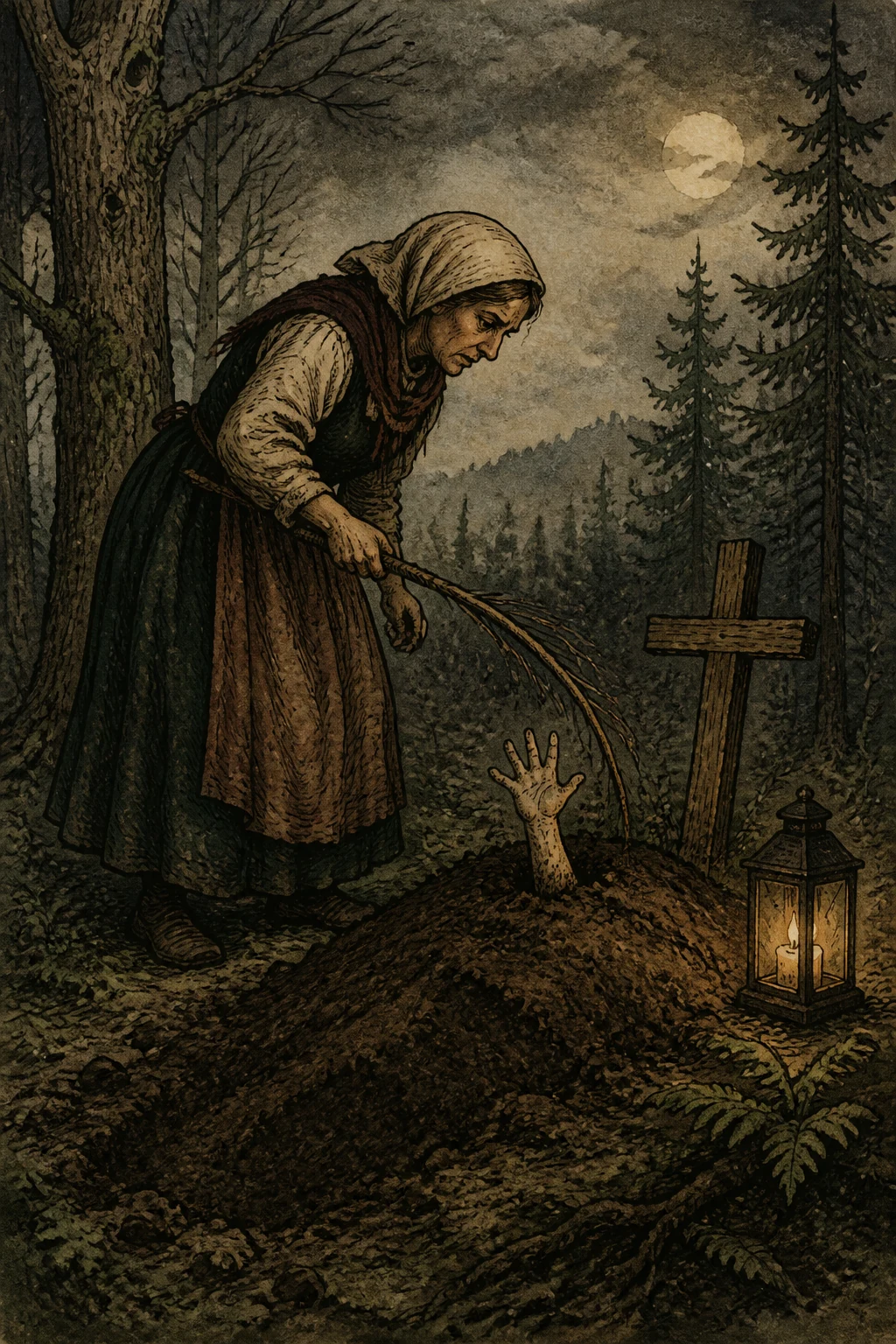
So Inger put on her finest clothes and her new shoes, and, lifting her skirts, walked very carefully to keep her feet clean and neat. There was surely nothing to blame her for in that! But when she came to where the path crossed boggy ground, with water and mud stretching a long way ahead, she threw the loaf into the mire to step on it and cross dry-shod. Yet just as she stood with one foot on the loaf and lifted the other, the loaf sank with her, deeper and deeper. She vanished altogether, and nothing remained to be seen but a black, bubbling pool.
That is the story. Where did she go? She went down to the Marsh Woman, who brews. The Marsh Woman is the aunt of the elf maidens. They are well known; songs have been written about them, and their pictures painted. But all people know about the Marsh Woman is that when the meadows steam in summer, it is the Marsh Woman brewing. It was into her brewery that Inger sank, and no one could bear to stay there long. A cesspit is a bright and splendid chamber beside the Marsh Woman’s brewery! Every vat stinks enough to make a person faint, and the vats are crammed one on top of another. If there happens to be a little opening between them where one might squeeze through, one cannot do so for all the wet toads and fat grass snakes tangled together there. Down into this little Inger sank. The whole loathsome, living tangle was so icy cold that she shuddered in every limb; indeed, she grew stiffer and stiffer from it. She was stuck fast to the loaf, which drew her down as an amber button draws a wisp of straw.
The Marsh Woman was at home. That day the Devil and his great-grandmother were inspecting the brewery, and she is a very old, venomous woman who is never idle. She never goes out without taking her needlework, and she had brought it here too! She was sewing restless leather to put into people’s shoes so that they could never be at peace. She embroidered lies and crocheted thoughtless words that had fallen to the ground, all for harm and ruin. Oh yes, old Great-grandmother knew how to sew, embroider, and crochet.
She saw Inger, held her eyeglass to her eye, and looked at her again. “There is a girl with promise!” she said. “I should like to have her as a memento of my visit here! She will make a suitable pedestal in my great-grandson’s antechamber!”
And she was given her. That was how little Inger came to Hell. People do not always go straight down there, but they can arrive by a roundabout way if they have the talent for it.
It was an antechamber that stretched on for ever. It made one dizzy to look ahead, and dizzy to look back. Here stood a host of languishing souls, waiting for the door of mercy to open. They might wait a long time! Great fat, waddling spiders spun thousand-year webs over their feet, and these webs pinched like foot screws and held like copper chains. Besides all this, there was an eternal unrest in every soul, the unrest of torment. The miser stood there having forgotten the key to his money chest, and he knew he had left it in the lock. Indeed, it would take far too long to list all the pains and sufferings felt there. Inger found it * dreadful to stand as a pedestal; it was as though she were clamped to the loaf from beneath.
“This is what comes of wanting to keep one’s feet clean!” she said to herself. “Look how they stare at me!” And indeed, they were all looking at her. Their evil desires shone from their eyes and spoke soundlessly from the corners of their mouths. They were terrible to see.
“I must be a pleasure to look at!” thought little Inger. “I have a pretty face and fine clothes!” Then she turned her eyes, for her neck was too stiff to turn. Oh, how filthy she had become in the Marsh Woman’s brewery! She had not thought of that. Her clothes looked as though one great blob of slime had been poured over them. A grass snake had caught itself in her hair and dangled down the back of her neck, and from every fold of her dress a toad peered out, barking like a wheezing pug. It was most unpleasant. “But the others down here look dreadful too!” she said to console herself.
Worst of all, though, was the terrible hunger she felt. Could she not bend down and break a piece from the loaf she stood on? No, her back had stiffened, her arms and hands had stiffened, her whole body was like a pillar of stone. Only her eyes could she move in her head, turning them right round to look behind her, and that was a dreadful sight. Then the flies came, crawling back and forth across her eyes. She blinked, but the flies did not fly away, for they could not: their wings had been pulled off, and they had been made into crawling creatures. It was a torment—and then there was the hunger! At last she felt that her entrails were eating themselves up, and she grew so empty inside, so horribly empty.
“If this goes on much longer, I cannot bear it!” she said. But she had to bear it, and it went on and on. Then a burning tear fell upon her head and rolled down her face and breast to the loaf. Another tear fell, and then many more. Who was weeping for little Inger? Had she not a mother up on earth? The tears of sorrow a mother sheds for her child always reach it, but they do not release it; they burn, and only make its torment greater. And now this unbearable hunger, and to be unable to reach the bread beneath her foot! At last she felt that everything inside her must have eaten itself up. She was like a thin, hollow reed that drew every sound into itself. She heard distinctly everything said about her up on earth, and what she heard was harsh and cruel. Her mother wept in deep sorrow, it was true, but she also said, “Pride goes before a fall! That was your misfortune, Inger! How you have grieved your mother!”
Her mother and everyone up there knew of her sin: that she had trodden on the loaf, sunk through, and disappeared. The cowherd had told them; he had seen it himself from the hillside.
“How you have grieved your mother, Inger!” her mother said. “Yes, I feared as much!” “I wish I had never been born!” Inger thought at this. “That would have been far better for me. My mother’s whimpering cannot help me now!”
She heard her employers, those worthy people who had been like parents to her, speaking of her. “She was a sinful child!” they said. “She did not value Our Lord’s gifts, but trampled them underfoot. She will find it hard to open the door of mercy!”
“They should have brought me up better!” thought Inger. “Knocked the whims out of me, if I had any.” She heard that a whole ballad had been made about her, “the proud girl who trod on the loaf to keep her shoes clean,” and it was sung throughout the country.
“To have to hear so much about it! And suffer so much for it!” thought Inger. “The others ought to be punished for what they have done too! Yes, then there would be plenty to punish! Oh, how I suffer!”
And her heart grew even harder than her shell. “One can hardly grow better down here in this company! And I do not want to be better! Look how they stare!”
Her heart was angry and bitter towards all mankind. “Now they have something to talk about up there! Oh, how I suffer!” And she heard them telling her story to the children, and the little ones called her wicked Inger. “She was so horrid!” they said. “So dreadful! She deserved to suffer!”
There were always harsh words for her on children’s lips. Yet one day, as anger and hunger gnawed inside her hollow shell, and she heard her name mentioned and her story told to an innocent child, a little girl, she heard the little one burst into tears at the tale of proud, finery-loving Inger.
“But will she never come up again?” the little girl asked. And the answer came, “She will never come up again!” “But what if she asks to be forgiven and never does it again?”
“But she will not ask to be forgiven!” they said. “I do so wish she would!” said the little girl, quite inconsolable. “I will give away my doll’s house if only she may come up! It is so dreadful for poor Inger!”
Those words went straight down into Inger’s heart, and seemed to do her good. It was the first time anyone had said “poor Inger” without adding the least word about her faults. A little innocent child was weeping and praying for her. It gave her a strange feeling; she would gladly have wept herself, but she could not weep, and that too was a torment.
As the years passed up above—down below nothing changed—she heard fewer sounds from the world above; people spoke less of her. Then one day she heard a sigh. “Inger! Inger! How you have grieved me! I feared as much!” It was her mother, dying.
Sometimes she heard her old employers mention her name, and the gentlest words were those her mistress spoke: “I wonder whether I shall ever see you again, Inger! We do not know where we shall go!”
But Inger understood well enough that her worthy mistress could never come where she was. So another long and bitter time passed. Then Inger heard her name spoken again and saw what seemed to be two bright stars shining above her. They were two gentle eyes closing on earth. So many years had passed since the little girl had wept inconsolably for “poor Inger” that the child had become an old woman, whom Our Lord was now calling to Him. And at that very moment, as the memories of a whole lifetime rose in her thoughts, she remembered how, as a little child, she had wept bitterly on hearing Inger’s story. That time and that impression were so vivid to the old woman in her dying hour that she cried aloud, “Lord, my God, have I not often, like Inger, trodden thoughtlessly upon the gifts of Thy blessing? Have I not also walked with pride in my heart? Yet in Thy mercy Thou hast not let me sink, but hast upheld me! Do not let me go in my last hour!”
The old woman’s eyes closed, and the eyes of her soul opened to hidden things. And because Inger had been so vivid in her last thoughts, she saw her, saw how far down she had been drawn. At the sight, the good woman burst into tears. In the kingdom of heaven she stood, as she had stood as a child, weeping for poor Inger! Those tears and prayers rang like an echo down into the hollow, empty shell that enclosed the imprisoned, tormented soul, and it was overwhelmed by all that love from above, love it had never imagined. An angel of God was weeping for her! Why had this been granted her? The tormented soul seemed to gather into its thoughts every deed it had done in its earthly life, and it trembled with a weeping such as Inger had never been able to weep. Sorrow for herself filled her. It seemed to her that the gate of mercy could never be opened for her, and at the very moment when she acknowledged this in her contrition, a beam of light shone down into the abyss. It came with a power stronger than the sunbeam that thaws the snowman the boys have built in the yard. And then, far faster than a snowflake falling on a child’s warm lips melts into a drop, Inger’s petrified form dissolved away. A little bird darted up towards the world of men, zigzagging like lightning, but it was fearful and shy of everything around it. Ashamed before itself and every living creature, it hurried to hide in a dark hole it found in a crumbling wall. There it sat huddled up, trembling all over. It could not utter a sound, for it had no voice. It sat a long while before it could look calmly at all the splendour outside and take it in. And splendid it was: the air was so fresh and mild, the moon shone so clearly, the trees and bushes were fragrant. How snug it was where it sat, and how clean and fine its coat of feathers! Oh, how all created things were brought forth in love and splendour! All the thoughts stirring in the bird’s breast longed to pour out in song, but the bird had not the power. Gladly would it have sung like the cuckoo and the nightingale in spring. Our Lord, who hears even the worm’s soundless hymn of praise, heard the praise rising here in chords of thought, as the psalm rang in David’s breast before it found words and melody.
For * days and weeks these soundless songs grew and swelled. They must burst forth with the first beat of wings in a good deed. Such a deed must be done!
Now came the holy feast of Christmas. The farmer set up a pole close to the wall and tied an unthreshed sheaf of oats to it, so that the birds of heaven too might have a happy Christmas and a joyful meal in this season of the Saviour.
The sun rose on Christmas morning and shone upon the sheaf of oats, and all the twittering birds flew about the feeding pole. Then from the wall there also came a “peep, peep!” The swelling thought had become sound. That faint chirping was a whole hymn of joy. The thought of a good deed had awakened, and the bird flew out of its hiding place. In the kingdom of heaven they knew well what bird it was!
Winter set in in earnest. The waters froze deep, and the birds and woodland creatures had a hard time finding food. The little bird flew out to the highway and searched in the tracks of the sleighs, finding a grain here and there. At the stopping places it found a few breadcrumbs. It ate only one itself, then called all the other starving sparrows to find food there. It flew to the towns and looked about, and wherever a kind hand had scattered bread for the birds by a window, it ate only a single crumb itself and gave all the rest to the others.
Over the course of the winter, the bird had gathered and given away so many breadcrumbs that together they weighed as much as the whole loaf little Inger had trodden on to keep her shoes clean. And when the last breadcrumb had been found and given away, the bird’s grey wings turned white and spread wide.
“There is a tern flying over the lake!” said the children who saw the white bird. Now it dipped down towards the lake, now it rose into the clear sunshine. It shone so brightly that it was impossible to see where it went. They said it flew straight into the sun.