Prevod
1. Now that we have traced the lineage of Deucalion, let us turn next to that of Inachus. Oceanus and Tethys had a son, Inachus, after whom the river Inachus in Argos is named.
He and Melia, the daughter of Oceanus, had two sons, Phoroneus and Aegialeus. Aegialeus died childless, and the whole country was called Aegialea after him. Phoroneus ruled over the entire land later known as the Peloponnese, and by the nymph Teledice he had Apis and Niobe. Apis turned his rule into a tyranny and proved a violent tyrant. He named the Peloponnese Apia after himself, but was killed through a plot devised by Thelxion and Telchin, leaving no children. He was regarded as a god and called Sarapis. Niobe was the first mortal woman with whom Zeus lay, and she bore him a son, Argus, and, according to Acusilaus, Pelasgus as well; from Pelasgus the inhabitants of the Peloponnese were called Pelasgians. Hesiod, however, says that Pelasgus sprang from the earth.
2. But we shall speak of him again. Argus succeeded to the kingdom and named the Peloponnese Argos after himself. He married Evadne, daughter of Strymon and Neaera, and fathered Ecbasus, Peiras, Epidaurus, and Criasus, who also inherited the kingdom. Ecbasus had a son, Agenor, whose son was Argus, called the All-Seeing. He had eyes all over his body and was extraordinarily strong. He killed the bull that was ravaging Arcadia and clothed himself in its hide; he also confronted and killed a satyr who was wronging the Arcadians and stealing their cattle. It is said that he also watched for Echidna, the daughter of Tartarus and Earth, who used to snatch up passersby, and killed her as she slept. He also avenged the murder of Apis by killing those responsible.
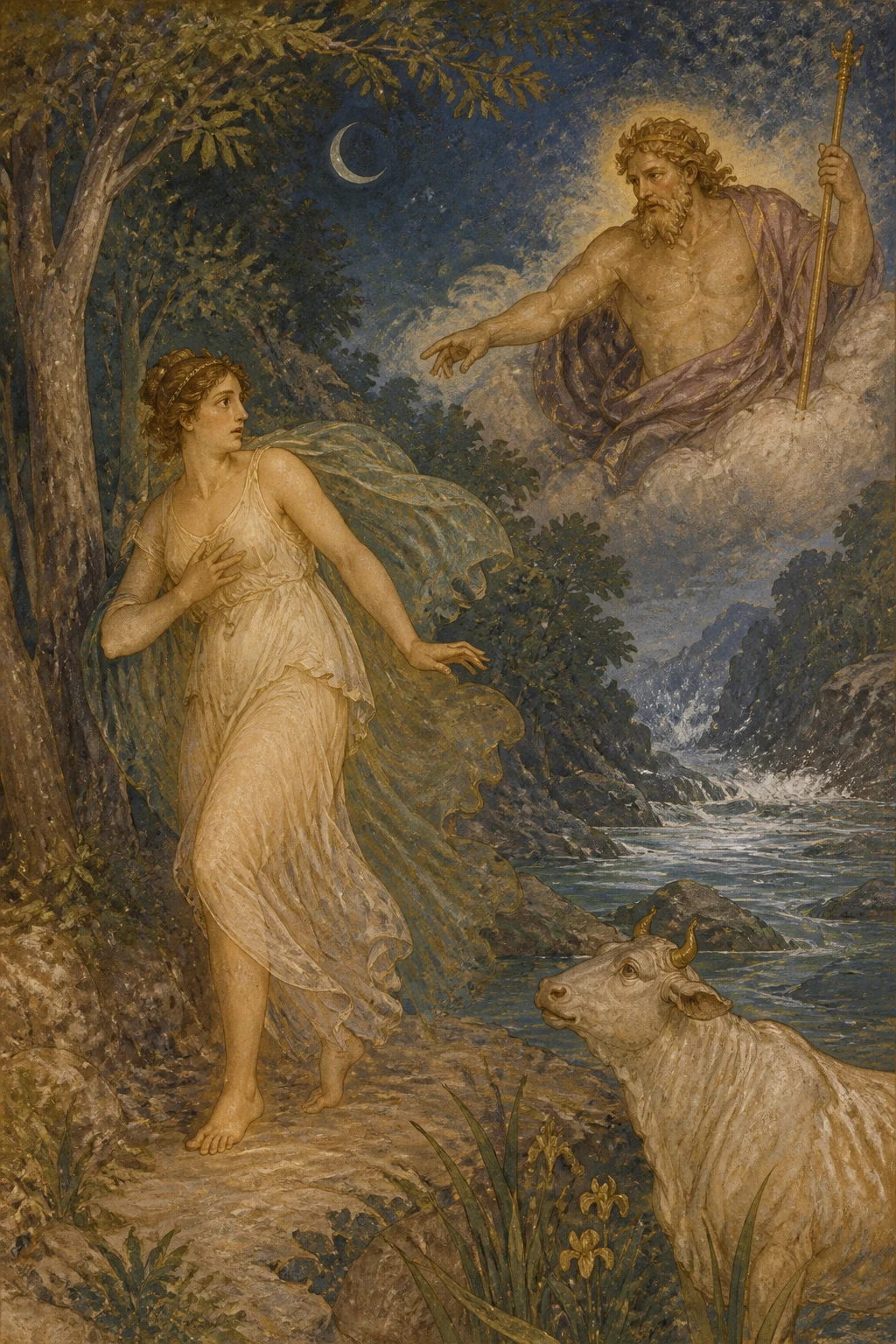
3. Argus and Ismene, daughter of Asopus, had a son, Iasus, who is said to have been the father of Io. But Castor, the author of the Chronicles, and many of the tragic poets say that Io was the daughter of Inachus, while Hesiod and Acusilaus say that she was the daughter of Peiren. While she was serving as priestess of Hera, Zeus seduced her. When Hera discovered him, he touched the girl and changed her into a white cow, then swore that he had not slept with her. Hence Hesiod says that oaths sworn for love do not draw down the anger of the gods. Hera asked Zeus to give her the cow and appointed Argus the All-Seeing as its guardian. Pherecydes says that this Argus was the son of Arestor; Asclepiades, that he was the son of Inachus; and Cercops, that he was the son of Argus and Ismene, daughter of Asopus. Acusilaus says that he sprang from the earth. Argus tethered her to the olive tree in the grove of the Mycenaeans. Zeus ordered Hermes to steal the cow, but Hierax betrayed him, and, unable to escape notice, Hermes struck Argus with a stone and killed him. From this he was called the Slayer of Argus. Hera then sent a gadfly to torment the cow. Io first came to the gulf called Ionian after her, then passed through Illyria, crossed Mount Haemus, and traversed the strait then called the Thracian Strait, but now named the Bosporus after her. She went on to Scythia and the Cimmerian land, and after wandering over vast stretches of land and swimming across wide seas in both Europe and Asia, she finally reached Egypt. There she regained her former shape and gave birth to a son, Epaphus, beside the river Nile. Hera asked the Curetes to make the child disappear, and they did so. When Zeus learned of this, he killed the Curetes, while Io set out in search of her child. She wandered throughout Syria, for she had been told that the wife of the king of Byblos was nursing her son there. Having found Epaphus, she returned to Egypt and married Telegonus, who was then king of the Egyptians. She set up an image of Demeter, whom the Egyptians called Isis, and they likewise gave Io the name Isis.
4. Epaphus became king of the Egyptians and married Memphis, daughter of the Nile. He founded the city of Memphis and named it after her, and fathered a daughter, Libya, after whom the land of Libya was named.
Libya and Poseidon had twin sons, Agenor and Belus. Agenor departed for Phoenicia, where he became king and founded a great line of descendants; we shall therefore postpone our account of him. Belus remained in Egypt and ruled there. He married Anchinoe, daughter of the Nile, and had twin sons, Aegyptus and Danaus, as well as Cepheus and Phineus, according to Euripides. Belus settled Danaus in Libya and Aegyptus in Arabia. Aegyptus also conquered the land of the Melampodes and named it Egypt after himself. By many wives Aegyptus had fifty sons, and Danaus fifty daughters.
Later, when they quarreled over the kingdom, Danaus, fearing the sons of Aegyptus, was the first to build a ship, on Athena’s advice. He put his daughters aboard and fled.
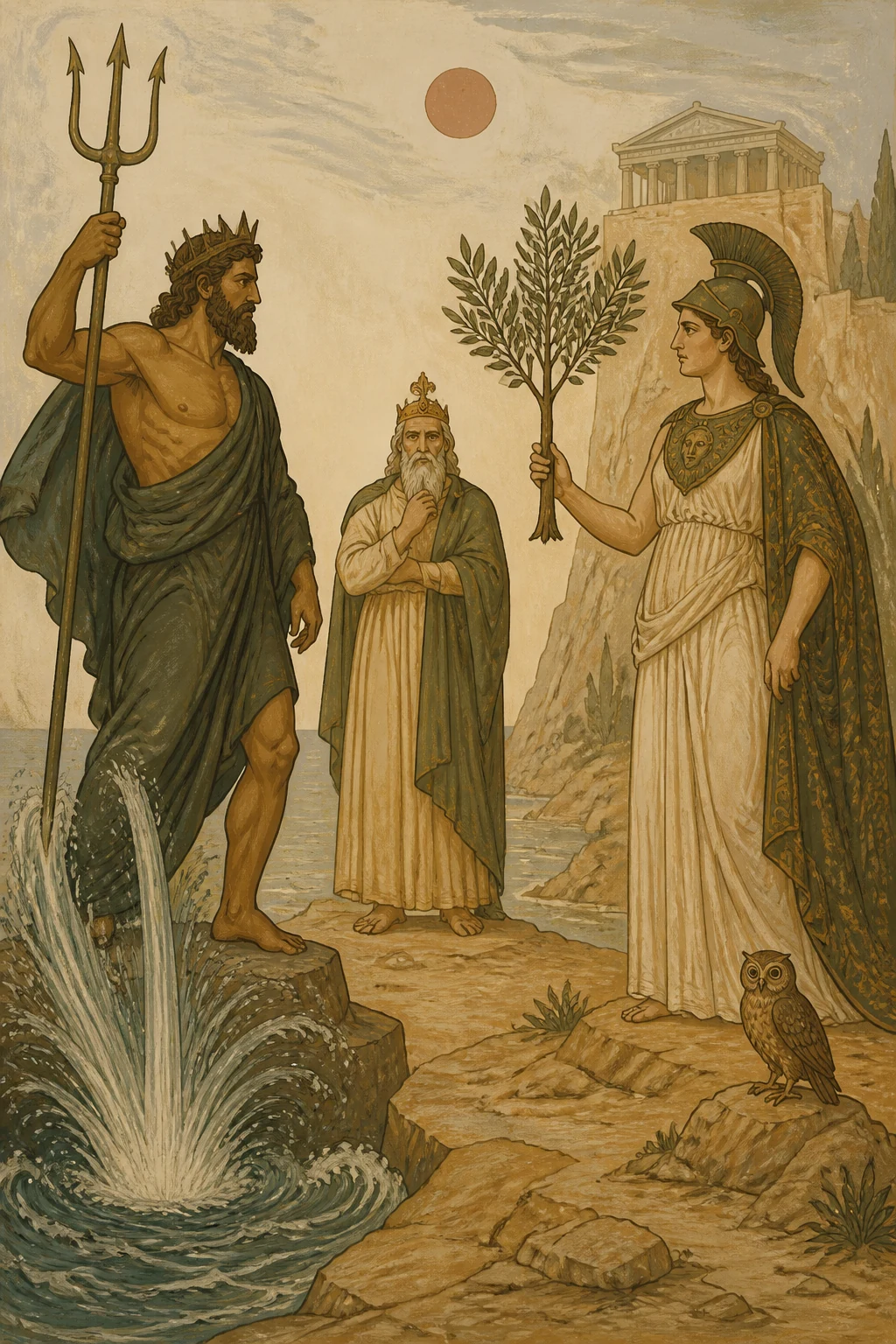
He put in at Rhodes and set up the image of Athena of Lindus. From there he came to Argos, where Gelanor, the reigning king, surrendered the kingdom to him. Having taken possession of the land, he named its inhabitants Danaans after himself. The country was without water, for Poseidon had dried up even its springs in anger at Inachus, because he had testified that the land belonged to Hera. Danaus therefore sent his daughters to fetch water. One of them, Amymone, while searching for water, threw a spear at a deer and struck a sleeping satyr. He sprang up and tried to force himself upon her, but Poseidon appeared and the satyr fled. Amymone lay with Poseidon, and he revealed to her the springs at Lerna.
5. The sons of Aegyptus came to Argos and urged Danaus to end their enmity, asking to marry his daughters. Danaus distrusted their promises and still bore them a grudge for his exile, but he agreed to the marriages and assigned the girls by lot. Hypermnestra, the eldest, was set apart for Lynceus, and Gorgophone for Proteus, since these sons had been born to Aegyptus by a woman of royal blood, Argyphia. Of the others, Busiris, Enceladus, Lycus, and Daiphron were allotted Automate, Amymone, Agave, and Scaea, the daughters of Danaus by Europe. These daughters, too, were born to Danaus by a woman of royal blood, while Gorgophone and Hypermnestra were his daughters by Elephantis. Istrus received Hippodamia; Chalcodon, Rhodia; Agenor, Cleopatra; Chaetus, Asteria; Diocorystes, Hippodamia; Alces, Glauce; Alcmenor, Hippomedusa; Hippothous, Gorge; Euchenor, Iphimedusa; and Hippolytus, Rhode. These ten sons were born of an Arabian woman, and the maidens of Hamadryad nymphs, some of Atlantea and others of Phoebe. Agaptolemus was allotted Peirene; Cercetes, Dorion; Eurydamas, Phartis; Aegius, Mnestra; Argius, Evippe; Archelaus, Anaxibia; and Menemachus, Nelo. These seven sons were born of a Phoenician woman, and the maidens of an Ethiopian woman. The sons of a Tyrian woman received the daughters of Memphis without drawing lots, because their names matched: Clitus received Clite; Sthenelus, Sthenele; and Chrysippus, Chrysippe.
The twelve sons of the naiad nymph Caliadne drew lots for the daughters of the naiad nymph Polyxo. The sons were Eurylochus, Phantes, Peristhenes, Hermus, Dryas, Potamon, Cisseus, Lixus, Imbrus, Bromius, Polyctor, and Chthonius; the maidens were Autonoe, Theano, Electra, Cleopatra, Eurydice, Glaucippe, Anthelea, Cleodore, Evippe, Erato, Stygne, and Bryce. The sons born to Aegyptus by Gorgo drew lots for the daughters of Pieria: Periphas received Actaea; Oeneus, Podarce; Aegyptus, Dioxippe; Menalces, Adite; Lampus, Ocypete; and Idmon, Pylarge.
These were the youngest: Idas received Hippodice, and Daiphron, Adiante—these two daughters had Herse for their mother; Pandion received Callidice; Arbelus, Oeme; Hyperbius, Celaeno; and Hippocorystes, Hyperippe. These sons were born of Hephaestine, and the maidens of Crino. When the marriages had been assigned by lot, Danaus held a feast and gave his daughters daggers. They killed their bridegrooms as they slept, all except Hypermnestra: she spared Lynceus because he had left her a virgin. For this Danaus shut her up and kept her under guard. The other daughters of Danaus buried their bridegrooms’ heads at Lerna and gave their bodies burial outside the city. At Zeus’s command, Athena and Hermes purified the women. Later Danaus united Hypermnestra with Lynceus and gave his remaining daughters to the victors in an athletic contest. Amymone bore Poseidon a son, Nauplius. He lived to a great age and sailed the seas, luring those he encountered to their deaths with beacon fires. In the end he himself met the same death. Before his death he married Clymene, daughter of Catreus, according to the tragic poets; Philyra, according to the author of the Returns; or Hesione, according to Cercops. He had three sons, Palamedes, Oeax, and Nausimedon.