Prevod
1. Of the sons of Aeolus, Athamas, who ruled over Boeotia, had by Nephele a son, Phrixus, and a daughter, Helle. Later he married Ino, who bore him Learchus and Melicertes. Plotting against Nephele’s children, Ino persuaded the women to roast the seed grain. They took it and did so without their husbands’ knowledge. The earth, sown with roasted grain, yielded no yearly harvest. Athamas therefore sent messengers to Delphi to ask how the crop failure might be ended. Ino persuaded the messengers to report that the oracle had declared the barrenness would cease if Phrixus were sacrificed to Zeus. On hearing this, Athamas, under pressure from the inhabitants of the country, brought Phrixus to the altar. But Nephele snatched him away, together with his sister, and gave them a golden-fleeced ram she had received from Hermes. Carried through the sky on its back, they passed over land and sea. When they reached the sea between Sigeum and the Chersonese, Helle slipped into the depths and drowned; after her, that sea was named the Hellespont. Phrixus reached Colchis, whose king was Aeetes, son of Helios and Perseis, and brother of Circe and of Pasiphae, whom Minos married. Aeetes welcomed him and gave him one of his daughters, Chalciope, in marriage. Phrixus sacrificed the golden-fleeced ram to Zeus, Guardian of Fugitives, and gave its fleece to Aeetes, who nailed it to an oak in the grove of Ares. Phrixus had four sons by Chalciope: Argus, Melas, Phrontis, and Cytisorus.
2. Later, through Hera’s wrath, Athamas also lost his children by Ino. Driven mad, he shot Learchus with an arrow, while Ino threw herself into the sea with Melicertes.
Banished from Boeotia, Athamas asked the god where he should settle. The oracle told him to settle wherever wild beasts offered him hospitality. After traveling through a great stretch of country, he came upon wolves feeding on portions of sheep. At the sight of him they abandoned the meat they were sharing and fled. Athamas settled the country and named it Athamantia after himself. He married Themisto, daughter of Hypseus, and fathered Leucon, Erythrius, Schoeneus, and Ptous.
3. Sisyphus, son of Aeolus, founded Ephyra, now called Corinth, and married Merope, daughter of Atlas. They had a son, Glaucus, who by Eurymede fathered Bellerophon, the slayer of the fire-breathing Chimaera. In Hades Sisyphus is punished by rolling a stone with his hands and head, striving to push it over the crest; but as he pushes it forward, it is driven back again. He pays this penalty because of Aegina, daughter of Asopus: it is said that when Zeus secretly carried her off, Sisyphus revealed this to Asopus, who was searching for her.
4. Deion, king of Phocis, married Diomede, daughter of Xuthus. They had a daughter, Asterodia, and sons, Aenetus, Actor, Phylacus, and Cephalus, who married Procris, daughter of Erechtheus. Later Eos fell in love with Cephalus and carried him off.
5. Perieres took possession of Messenia and married Gorgophone, daughter of Perseus, who bore him Aphareus, Leucippus, Tyndareus, and Icarius. Many, however, say that Perieres was not the son of Aeolus but of Cynortas, son of Amyclas. We shall therefore give an account of Perieres’ descendants among the family of Atlas.
6. Magnes married a naiad nymph and had two sons, Polydectes and Dictys, who settled Seriphos.
7. Salmoneus at first lived in Thessaly, but later went to Elis and founded a city there. He was arrogant and wished to make himself the equal of Zeus, and for his impiety he was punished. He declared that he himself was Zeus, took away the sacrifices offered to that god, and ordered them to be offered to him instead. Dragging dried hides and bronze cauldrons behind his chariot, he said that he was making thunder; and flinging blazing torches into the sky, he said that he was making lightning. Zeus struck him with a thunderbolt and destroyed the city he had founded, together with all its inhabitants.
8. Tyro, daughter of Salmoneus and Alcidice, was brought up in the household of Cretheus, her father’s brother. She fell in love with the river Enipeus and constantly visited its streams, pouring out her laments to them. Poseidon took the likeness of Enipeus and lay with her. She secretly gave birth to twin sons and exposed them. While the infants lay abandoned, some horse herders passed by, and one of their mares struck one of the babies with her hoof, bruising part of his face. A herder took up both children and reared them, naming the bruised one Pelias and the other Neleus. When they grew to manhood, they discovered who their mother was and killed her stepmother, Sidero. For on learning that Sidero had mistreated their mother, they attacked her. She fled before them into Hera’s sanctuary, but Pelias slaughtered her at the very altars, and throughout his life he continued to dishonor Hera.
9. Later the brothers quarreled, and Neleus was driven out. He went to Messenia, founded Pylos, and married Chloris, daughter of Amphion. By her he had a daughter, Pero, and sons, Taurus, Asterius, Pylaon, Deimachus, Eurybius, Epilaus, Phrasius, Eurymenes, Evagoras, Alastor, Nestor, and Periclymenus. Poseidon gave Periclymenus the power to change his shape. When Heracles sacked Pylos, he fought against him, becoming now a lion, now a snake, now a bee; but he died at Heracles’ hands along with the other sons of Neleus. Nestor alone survived, because he was being brought up among the Gerenians. He married Anaxibia, daughter of Cratieus, and had two daughters, Pisidice and Polycaste, and sons, Perseus, Stratichus, Aretus, Echephron, Pisistratus, Antilochus, and Thrasymedes.
10. Pelias lived in Thessaly and married Anaxibia, daughter of Bias, or, according to some, Phylomache, daughter of Amphion. He had a son, Acastus, and daughters, Pisidice, Pelopia, Hippothoe, and Alcestis.
11. Cretheus founded Iolcus and married Tyro, daughter of Salmoneus, who bore him Aeson, Amythaon, and Pheres. Amythaon lived in Pylos and married Idomene, daughter of Pheres. They had two sons, Bias and Melampus. Melampus lived in the country, and before his house stood an oak containing a nest of snakes. When his servants killed the snakes, he gathered wood and burned their bodies, but reared their young. When the young snakes were fully grown, they came to him as he slept, climbed onto his shoulders, and cleaned out his ears with their tongues. He awoke in alarm and found that he understood the calls of the birds flying overhead. Learning from them, he foretold the future to humankind. He also acquired the art of divination through sacrifices, and after meeting Apollo by the river Alpheus, he became an outstanding seer.
12. Bias sought the hand of Pero, daughter of Neleus. Since she had many suitors, Neleus said that he would give his daughter to the man who brought him the cattle of Phylacus. These were at Phylace, guarded by a dog that neither man nor beast could approach. Unable to steal the cattle himself, Bias asked his brother to help him.
Melampus promised to do so, and foretold that he would be caught in the theft and held captive for a year, after which he would obtain the cattle. Having made this promise, he went to Phylace, where, just as he had foretold, he was caught stealing and kept bound in a house. When little of the year remained, he heard the woodworms in a hidden part of the roof: one was asking how much of the beam had already been eaten through, and the others replied that very little was left. At once he ordered that he be moved to another building. This was done, and soon afterward the house collapsed. Phylacus was amazed, and on learning that Melampus was an exceptional seer, released him and asked him to explain how his son Iphiclus might have children. Melampus promised to do so on condition that he receive the cattle. He sacrificed two bulls, cut them up, and summoned the birds. A vulture came, and from it he learned that Phylacus had once been castrating rams and had laid his still-bloody knife beside Iphiclus’ genitals. The boy fled in terror, and Phylacus then drove the knife into the sacred oak, whose bark grew around it and hid it. The vulture said that if Melampus found the knife, scraped off its rust, and gave it to Iphiclus to drink for ten days, he would father a child. Having learned this from the vulture, Melampus found the knife, scraped off its rust, and gave it to Iphiclus to drink for ten days. A son, Podarces, was born to him. Melampus drove the cattle to Pylos, obtained Neleus’ daughter, and gave her to his brother. For a time he lived in Messenia; but when Dionysus drove the women of Argos mad, he cured them in return for a share of the kingdom and settled there with Bias.
13. Bias and Pero had a son, Talaus. By Lysimache, daughter of Abas, son of Melampus, Talaus had Adrastus, Parthenopaeus, Pronax, Mecisteus, Aristomachus, and Eriphyle, whom Amphiaraus married.
Parthenopaeus had a son, Promachus, who marched against Thebes with the Epigoni; Mecisteus had Euryalus, who went to Troy. Pronax had a son, Lycurgus. Adrastus and Amphithea, daughter of Pronax, had three daughters, Argia, Deipyle, and Aegialia, and two sons, Aegialeus and Cyanippus.
14. Pheres, son of Cretheus, founded Pherae in Thessaly and fathered Admetus and Lycurgus. Lycurgus settled near Nemea and married Eurydice, or, according to some, Amphithea. He had a son, Opheltes, who was later called Archemorus.
15. When Admetus was king of Pherae, Apollo served him as a hired laborer while he was courting Alcestis, daughter of Pelias. Pelias had promised to give his daughter to the man who yoked a lion and a boar to a chariot. Apollo yoked them and gave them to Admetus, who brought them to Pelias and received Alcestis. But while offering the wedding sacrifices, he forgot to sacrifice to Artemis. For this reason, when he opened the bridal chamber, he found it filled with coiling snakes. Apollo told him to appease the goddess, and asked the Fates to allow Admetus, when he was about to die, to escape death if someone freely chose to die in his place. When the day of his death came, neither his father nor his mother was willing to die for him, but Alcestis died in his stead. Kore sent her back to the world above; or, as some say, Heracles fought Hades and brought her back to Admetus.
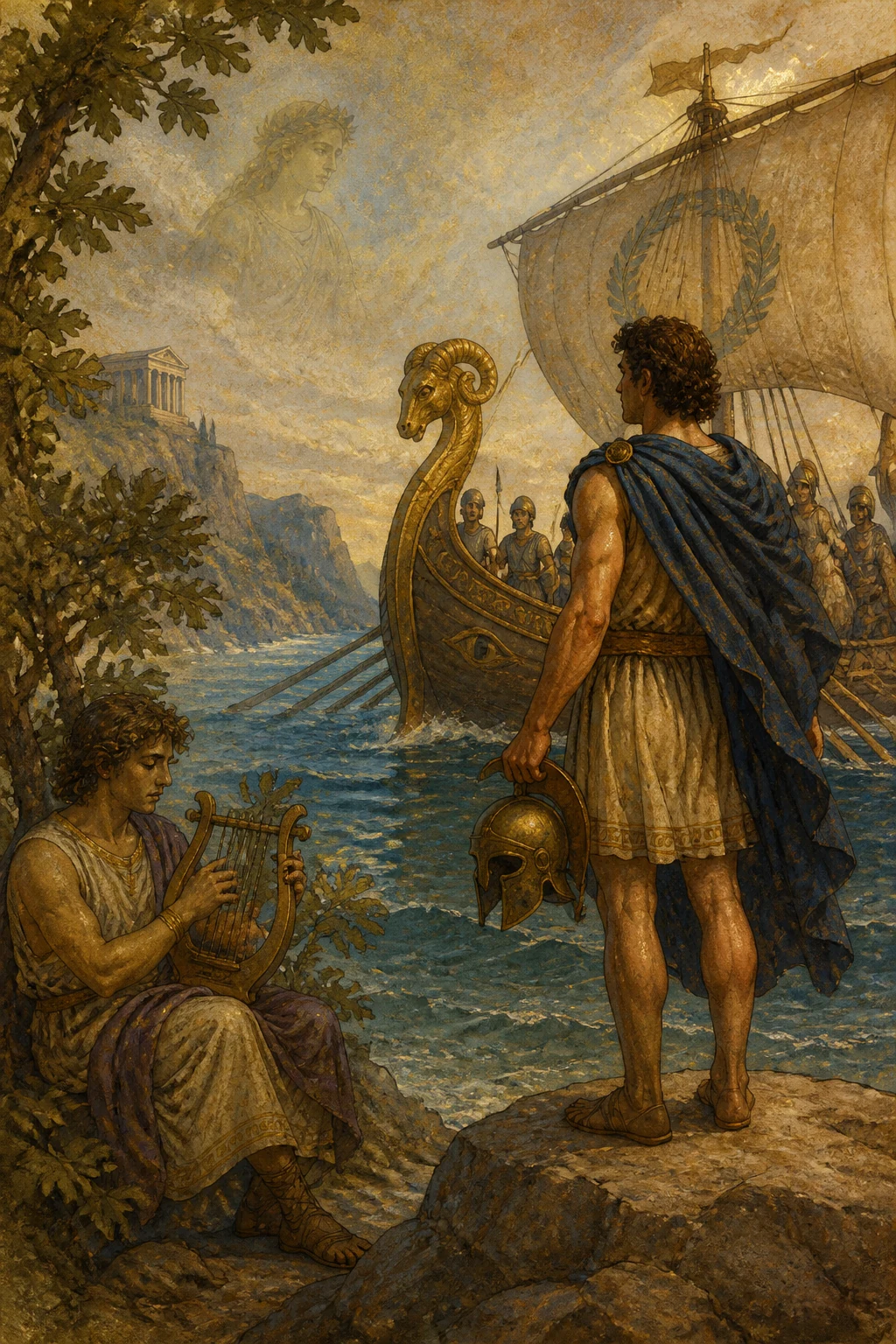
16. Aeson, son of Cretheus, and Polymede, daughter of Autolycus, had a son, Jason. He lived in Iolcus, where Pelias had become king after Cretheus. When Pelias consulted the oracle about his kingship, the god warned him to beware of the man with one sandal. At first he did not understand the oracle, but later its meaning became clear to him. While offering a sacrifice to Poseidon by the sea, he summoned Jason, along with many others, to attend. Jason, who loved farming and spent his time in the country, hurried to the sacrifice. In crossing the river Anaurus, he lost one of his sandals in the stream and came out wearing only the other. Pelias saw him and understood the oracle. He approached Jason and asked what he would do, if he held power and had received an oracle saying that one of his fellow citizens would kill him. Whether the answer simply occurred to him, or whether Hera in her wrath prompted it so that Medea might come to Pelias’ ruin—for he paid Hera no honor—Jason said, “I would order him to bring me the Golden Fleece.” On hearing this, Pelias immediately ordered Jason to go in search of the fleece. It was in Colchis, hanging from an oak in the grove of Ares, guarded by a sleepless dragon. Sent on this quest, Jason asked Argus, son of Phrixus, for help. Under Athena’s guidance, Argus built a fifty-oared ship, named Argo after its builder. In its prow Athena fitted a piece of wood from the oak of Dodona, endowed with speech. When the ship was built, Jason consulted the oracle, and the god instructed him to gather the noblest men of Greece and sail. Those who assembled were these: Tiphys, son of Hagnias, who steered the ship; Orpheus, son of Oeagrus; Zetes and Calais, sons of Boreas; Castor and Polydeuces, sons of Zeus; Telamon and Peleus, sons of Aeacus; Heracles, son of Zeus; Theseus, son of Aegeus; Idas and Lynceus, sons of Aphareus; Amphiaraus, son of Oicles; Caeneus, son of Coronus; Palaemon, son of Hephaestus or of Aetolus; Cepheus, son of Aleus; Laertes, son of Arcisius; Autolycus, son of Hermes; Atalanta, daughter of Schoeneus; Menoetius, son of Actor; Actor, son of Hippasus; Admetus, son of Pheres; Acastus, son of Pelias; Eurytus, son of Hermes; Meleager, son of Oeneus; Ancaeus, son of Lycurgus; Euphemus, son of Poseidon; Poeas, son of Thaumacus; Butes, son of Teleon; Phanus and Staphylus, sons of Dionysus; Erginus, son of Poseidon; Periclymenus, son of Neleus; Augeas, son of Helios; Iphiclus, son of Thestius; Argus, son of Phrixus; Euryalus, son of Mecisteus; Peneleus, son of Hippalmus; Leitus, son of Alector; Iphitus, son of Naubolus; Ascalaphus and Ialmenus, sons of Ares; Asterius, son of Cometes; and Polyphemus, son of Elatus.
17. They put to sea under Jason’s command and landed on Lemnos. At that time Lemnos was without men and was ruled by Hypsipyle, daughter of Thoas, for the following reason. The women of Lemnos had paid Aphrodite no honor, and she afflicted them with a foul smell. Their husbands therefore took captive women from neighboring Thrace and slept with them. Feeling themselves dishonored, the Lemnian women murdered their fathers and husbands. Hypsipyle alone saved her own father, Thoas, by hiding him. When the Argonauts landed on Lemnos, then ruled by women, they lay with them. Hypsipyle slept with Jason and bore two sons, Euneus and Nebrophonus.
18. From Lemnos they sailed to the Doliones, whose king was Cyzicus. He welcomed them warmly. They put to sea from there at night, but encountered contrary winds and unknowingly landed again among the Doliones. The Doliones, thinking them a Pelasgian force—for the Pelasgians were constantly making war on them—engaged them in battle by night, neither side recognizing the other. The Argonauts killed many, among them Cyzicus. When daylight came and they realized what had happened, they mourned, cut off their hair, and gave Cyzicus a splendid burial. After the funeral they sailed away and landed in Mysia.
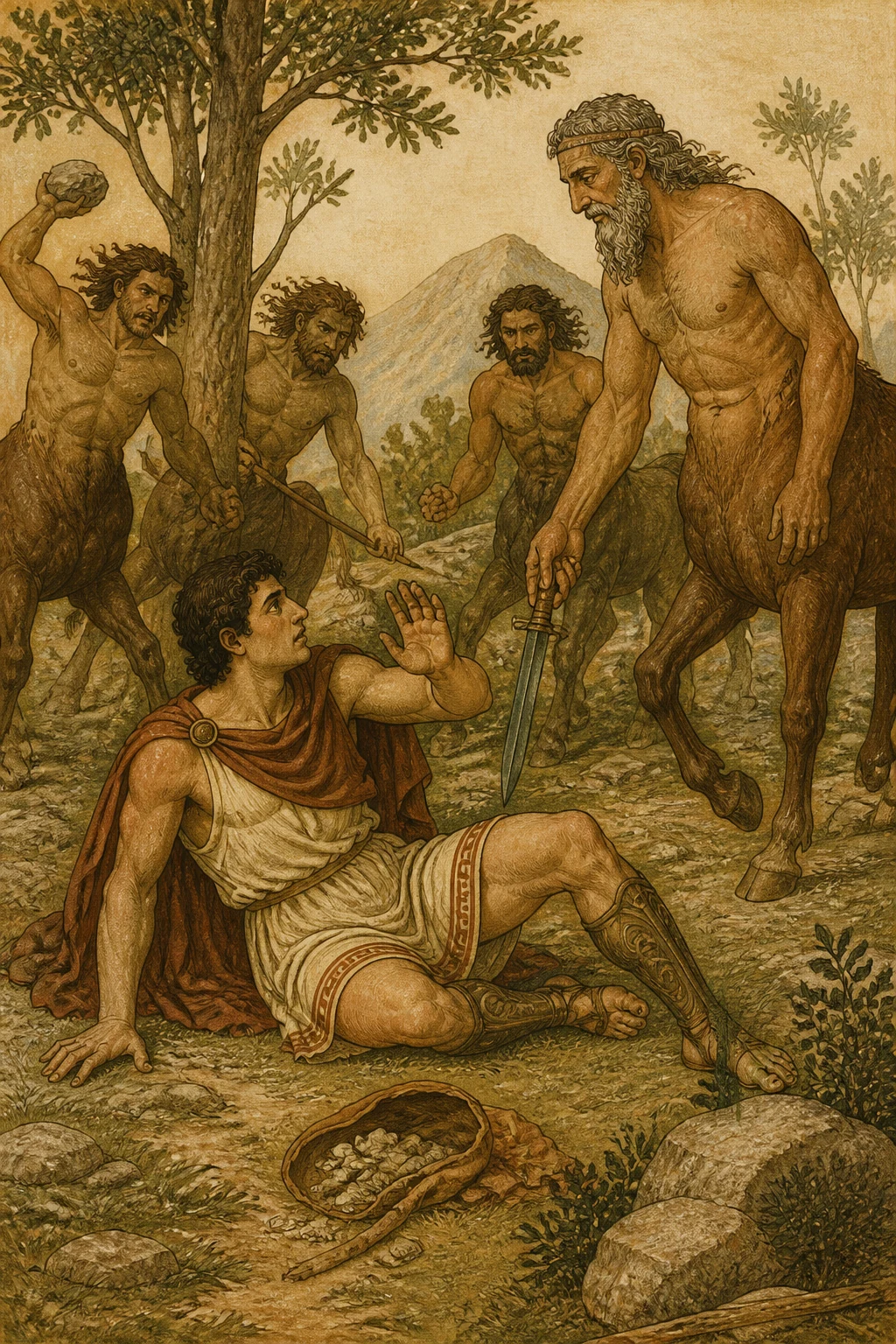
19. There they left Heracles and Polyphemus behind. For Hylas, son of Theiodamas and beloved of Heracles, had been sent to fetch water, and nymphs carried him off because of his beauty.
Polyphemus heard him cry out, drew his sword, and ran after him, thinking he was being carried off by robbers. He met Heracles and told him what had happened. While the two were searching for Hylas, the ship put to sea. Polyphemus founded the city of Cius in Mysia and ruled there, while Heracles returned to Argos.
Herodorus, however, says that Heracles did not sail at all on that occasion, but was serving as a slave under Omphale. Pherecydes says that he was left behind at Aphetae in Thessaly, because the Argo declared that she could not bear his weight. Demaratus records that he sailed all the way to Colchis; indeed, Dionysius says that he was even the leader of the Argonauts.
20. From Mysia they went to the land of the Bebryces, whose king was Amycus, son of Poseidon and the nymph Bithynis. A man of great strength, he forced strangers who landed there to box with him, and killed them in this way. He now came to the Argo and challenged their best man to a boxing match. Polydeuces agreed to fight him and killed him with a blow to the elbow. When the Bebryces rushed at him, the heroes seized their weapons and killed many of them as they fled.
21. Sailing from there, they reached Salmydessus in Thrace, where Phineus, a blind seer, lived. Some say he was a son of Agenor, others of Poseidon. As for his blindness, some say that the gods inflicted it because he foretold the future to humankind; others that Boreas and the Argonauts blinded him because, at the urging of their stepmother, he had blinded his own sons; and some that Poseidon blinded him because he revealed to the sons of Phrixus the sea route from Colchis to Greece. The gods also sent the Harpies against him. These were winged creatures, and whenever a meal was set before Phineus, they swooped down from the sky and snatched most of it away. What little they left was so befouled with their stench that he could not eat it. When the Argonauts wished to learn about their voyage, he said that he would advise them if they freed him from the Harpies. They set a table of food before him, and suddenly the Harpies swooped down with a shriek and snatched it away. Seeing them, the winged sons of Boreas, Zetes and Calais, drew their swords and pursued them through the air. Now the Harpies were fated to die at the hands of the sons of Boreas, while the sons of Boreas were fated to die whenever they pursued something and failed to catch it. During the pursuit, one of the Harpies fell into the river Tigres in the Peloponnese, which is now called Harpys after her. Some call her Nicothoe, others Aellopus. The other, called Ocypete, or according to some Ocythoe—Hesiod calls her Ocypode—fled by way of the Propontis as far as the Echinades islands, which are now called the Strophades after her. For when she reached them she turned back, and on reaching the shore she collapsed from exhaustion, together with her pursuer. Apollonius, however, says in his Argonautica that the Harpies were pursued as far as the Strophades islands and suffered no harm, having sworn never again to molest Phineus.
22. Freed from the Harpies, Phineus explained the voyage to the Argonauts and advised them about the Clashing Rocks in the sea. These rocks were immense, and, driven together by the force of the winds, they closed the sea passage. Thick mist swept over them amid a great crashing noise, and even birds could not pass between them. He therefore told the Argonauts to release a dove between the rocks. If they saw it pass safely through, they should sail on without fear; but if it perished, they should not try to force their passage. After hearing this, they put to sea. As they approached the rocks, they released a dove from the prow. While it was flying through, the rocks clashed together and sheared off the tips of its tail feathers. Waiting for the rocks to draw apart, the Argonauts rowed with all their strength and, with Hera’s help, passed through, though the tips of the ship’s stern ornaments were cut away. From that time onward the Clashing Rocks stood still, for it was fated that once a ship had passed through, they should remain fixed forever.
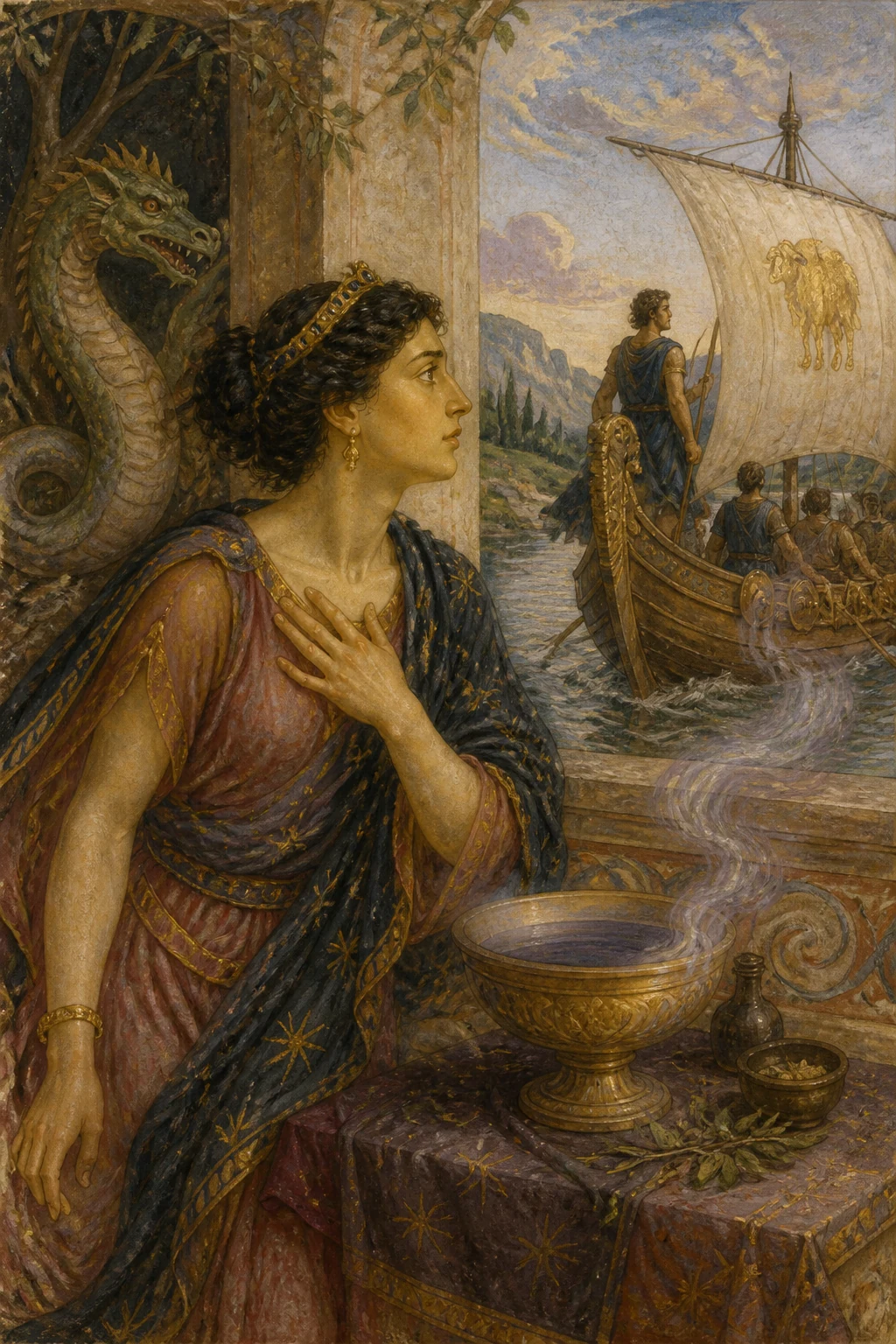
23. The Argonauts reached the Mariandynians, where King Lycus welcomed them warmly. There the seer Idmon died from a wound inflicted by a boar, and Tiphys also died. Ancaeus undertook to steer the ship. Sailing past the Thermodon and the Caucasus, they came to the river Phasis in Colchis. When the ship was moored, Jason went to Aeetes, explained the task Pelias had laid upon him, and asked him to give him the fleece. Aeetes promised to do so if Jason could single-handedly yoke the bronze-footed bulls. He had two savage bulls of extraordinary size, a gift from Hephaestus, with bronze feet and fire streaming from their mouths. After yoking them, Jason was to sow dragon’s teeth, for Aeetes had received from Athena half the teeth whose other half Cadmus had sown at Thebes. While Jason was wondering how he could possibly yoke the bulls, Medea fell in love with him. She was the daughter of Aeetes and Idyia, daughter of Oceanus, and was skilled in sorcery. Fearing that the bulls would kill him, she promised, without her father’s knowledge, to help him yoke them and to put the fleece into his hands, if he would swear to make her his wife and take her with him to Greece. Jason swore, and she gave him a potion, telling him to anoint his shield, spear, and body with it before attempting to yoke the bulls. Once anointed, she said, he would be safe from harm by fire or iron for a single day. She also explained that when the teeth were sown, armed men would spring from the earth to attack him. When he saw them gathered in a crowd, he was to throw stones among them from a distance; then, while they fought one another over this, he should kill them. Jason listened and anointed himself with the potion, then went to the temple grove in search of the bulls. They charged at him amid a great rush of flame, but he yoked them. When he sowed the teeth, armed men sprang up from the earth. Wherever he saw them most thickly gathered, he threw stones without being seen; then, as they fought one another, he approached and killed them. But although the bulls had been yoked, Aeetes would not give up the fleece. Instead, he intended to burn the Argo and kill those aboard her. Before he could act, Medea led Jason to the fleece by night. She put the dragon that guarded it to sleep with her potions and returned with Jason to the Argo, carrying the fleece. Her brother Apsyrtus went with her as well, and the Argonauts put to sea with them that night.
24. When Aeetes learned what Medea had dared to do, he set off in pursuit of the ship. Seeing him close behind, Medea murdered her brother, cut him into pieces, and threw them into the sea. Aeetes fell behind in the pursuit as he gathered his son’s limbs. He therefore turned back, buried the parts of his son’s body he had recovered, and named the place Tomi.
He sent many Colchians to search for the Argo, threatening that if they failed to bring Medea back, they would suffer the punishment intended for her. They separated and searched in different directions. The Argonauts were already sailing past the river Eridanus when Zeus, angered by the murder of Apsyrtus, sent a violent storm upon them and drove them off course. As they sailed past the Apsyrtides islands, the ship spoke, declaring that Zeus’ anger would not cease until they went to Ausonia and were purified by Circe of Apsyrtus’ murder. They sailed past the peoples of Liguria and the Celts, crossed the Sardinian Sea, and, passing Tyrrhenia, reached Aeaea. There they came as suppliants to Circe and were purified.
25. As they sailed past the Sirens, Orpheus held the Argonauts back by singing a song to counter theirs. Butes alone swam out toward them, but Aphrodite snatched him away and settled him at Lilybaeum. After the Sirens, Charybdis and Scylla awaited the ship, along with the Wandering Rocks, above which great flames and rising smoke could be seen. But Thetis, at Hera’s request, brought the ship safely through with the help of the Nereids. Passing the island of Thrinacia, where the cattle of Helios were kept, they reached Corcyra, the island of the Phaeacians, whose king was Alcinous. Of the Colchians who had failed to find the ship, some settled beside the Ceraunian Mountains, while others went to Illyria and settled the Apsyrtides islands. Some, however, came to the Phaeacians, found the Argo, and demanded that Alcinous surrender Medea. He said that if she had already lain with Jason, he would give her to him; but if she was still a virgin, he would send her back to her father. Arete, Alcinous’ wife, forestalled this by joining Medea and Jason in marriage. The Colchians therefore settled among the Phaeacians, while the Argonauts put to sea with Medea.
26. While sailing at night, they encountered a violent storm. Apollo stood upon the Melantian heights and shot an arrow into the sea, lighting it with a flash. They saw an island nearby and put in there, naming it Anaphe because it had appeared so unexpectedly. They built an altar to Apollo the Radiant, offered sacrifice, and began to feast. Twelve serving women whom Arete had given to Medea mocked the heroes in jest; hence, even to this day, it is customary for women to exchange jests at the sacrifice. They sailed from there, but Talos prevented them from landing on Crete. Some say that he belonged to the bronze race, others that Hephaestus gave him to Minos. He was a man of bronze, though some say he was a bull. He had a single vein running from his neck to his ankles, and at its lower end a bronze nail was driven in. This Talos guarded the island, running around it three times each day. Thus, when he saw the Argo approaching, he pelted her with stones.
But Medea deceived him, and he died. According to some, she drove him mad with drugs; according to others, she promised to make him immortal and drew out the nail, so that all his ichor flowed out and he died. Some say that Poeas shot him in the ankle and killed him. After staying there one night, they sailed to Aegina to fetch water, and held a contest among themselves over drawing it. From there they sailed past Euboea and Locris and reached Iolcus, having completed the entire voyage in four months.
27. Pelias, having given up hope that the Argonauts would return, wished to kill Aeson. Aeson asked leave to take his own life, and while performing a sacrifice, boldly drank the bull’s blood and died. Jason’s mother cursed Pelias and hanged herself, leaving behind an infant son, Promachus. Pelias killed this child too.
On his return, Jason handed over the fleece, but waited for an opportunity to avenge the wrongs he had suffered. For the moment he sailed to the Isthmus with the heroes and dedicated the ship to Poseidon. Later he asked Medea to find a way to make Pelias pay.
She went to Pelias’ palace and persuaded his daughters to cut their father into pieces and boil him, promising to make him young again with her drugs. To win their belief, she cut up a ram and boiled it, then turned it into a lamb. Believing her, they cut their father into pieces and boiled him.
Acastus buried his father with the help of the people of Iolcus, and drove Jason and Medea out of the city.
28. They came to Corinth and lived happily for ten years. But when Creon, king of Corinth, betrothed his daughter Glauce to Jason, Jason put Medea aside and married her. Medea invoked the gods by whom Jason had sworn and bitterly reproached him again and again for his ingratitude. She sent his bride a robe steeped in poison; when Glauce put it on, she was consumed by a fierce blaze, along with her father, who came to her aid. Medea then killed the children she had borne Jason, Mermerus and Pheres, and, receiving from Helios a chariot drawn by winged dragons, fled in it to Athens. Another account says that, as she fled, she left her children, who were still infants, seated as suppliants at the altar of Hera of the Heights; but the Corinthians dragged them away and wounded them to death. Medea came to Athens, where she married Aegeus and bore a son, Medus. Later, after plotting against Theseus, she was driven into exile from Athens with her son. Medus conquered many barbarian peoples and named the whole country under his rule Media; he died while campaigning against the Indians. Medea returned unrecognized to Colchis and found that Aeetes had been deprived of his kingdom by his brother Perses. She killed Perses and restored the kingdom to her father.