Prevod
Rumor of the new marvel might have filled Crete’s hundred cities, had Crete not lately witnessed a wonder nearer home in the transformation of Iphis. For once, in the land of Phaestus, close to the kingdom of Cnossus, there lived a man of little renown named Ligdus, a freeborn commoner. His wealth was no greater than his rank, but his life and his good faith were beyond reproach. As his pregnant wife’s time drew near, he gave her this warning: “There are two things I pray for: that your pain may be light, and that you bear a boy. A girl is a heavier burden, and our means will not stretch so far. So if, as I pray will not happen,
the child you bring into the world should happen to be a girl—reluctantly I command it: forgive me, love!—she must be killed.” He spoke, and their faces were washed with streaming tears, his who gave the command, and hers who received it. Still Telethusa kept pleading with her husband, though in vain, not to confine her hopes so narrowly. Ligdus remained fixed in his resolve. And now she could scarcely bear her belly’s full-grown weight, when in the middle of the night, in the semblance of a dream, the daughter of Inachus, attended by her sacred procession, stood—or seemed to stand—before her bed. Upon her brow were crescent horns, with ears of corn gleaming like yellow gold,
and a royal crown. With her came barking Anubis, holy Bubastis, the many-colored Apis, and he who stills his voice and counsels silence with his finger; there were sacred rattles, and Osiris, never sought enough, and the foreign serpent, filled with sleep-bringing venom. Then, as though Telethusa had awakened and saw her clearly, the goddess spoke: “Telethusa, one of my worshippers, put aside your heavy cares and evade your husband’s command.
When Lucina has delivered you of your child, do not hesitate to rear it, whatever it may be. I am a goddess who helps, and I bring aid when called upon. You shall not complain that you have worshipped an ungrateful deity.” So she counseled her and left the room. Joyfully the Cretan woman rose from bed and, lifting her pure hands to the stars, prayed that her vision might prove true.
When her pains grew stronger, and the burden of her womb thrust itself into the light, a girl was born, unknown to the father. The mother ordered the child to be reared, pretending it was a boy; her story was believed, and only the nurse shared the secret. The father paid his vows and gave the child a family name: the grandfather had been Iphis. The mother rejoiced in the name, since either sex could bear it, and with it she deceived no one.
Thus the deception, begun in a loving cause, remained concealed. The child was dressed as a boy, and had a face which, whether you called it a girl’s or a boy’s, would have been beautiful in either. Meanwhile, the thirteenth year had followed the tenth, when your father, Iphis, betrothed you to golden-haired Ianthe, the maiden most praised for the gift of beauty among the women of Phaestus, daughter of Telestes of Dicte.
They were equal in age and beauty, and had received their first instruction, the lessons of childhood, from the same teachers. So love touched the innocent hearts of both and dealt each an equal wound. But their hopes were unequal: Ianthe looked forward to marriage and the promised wedding day, believing that the one she thought a man would be her husband. Iphis loved one she despaired of ever possessing, and that very despair fed the flames: a girl burned with love for a girl.
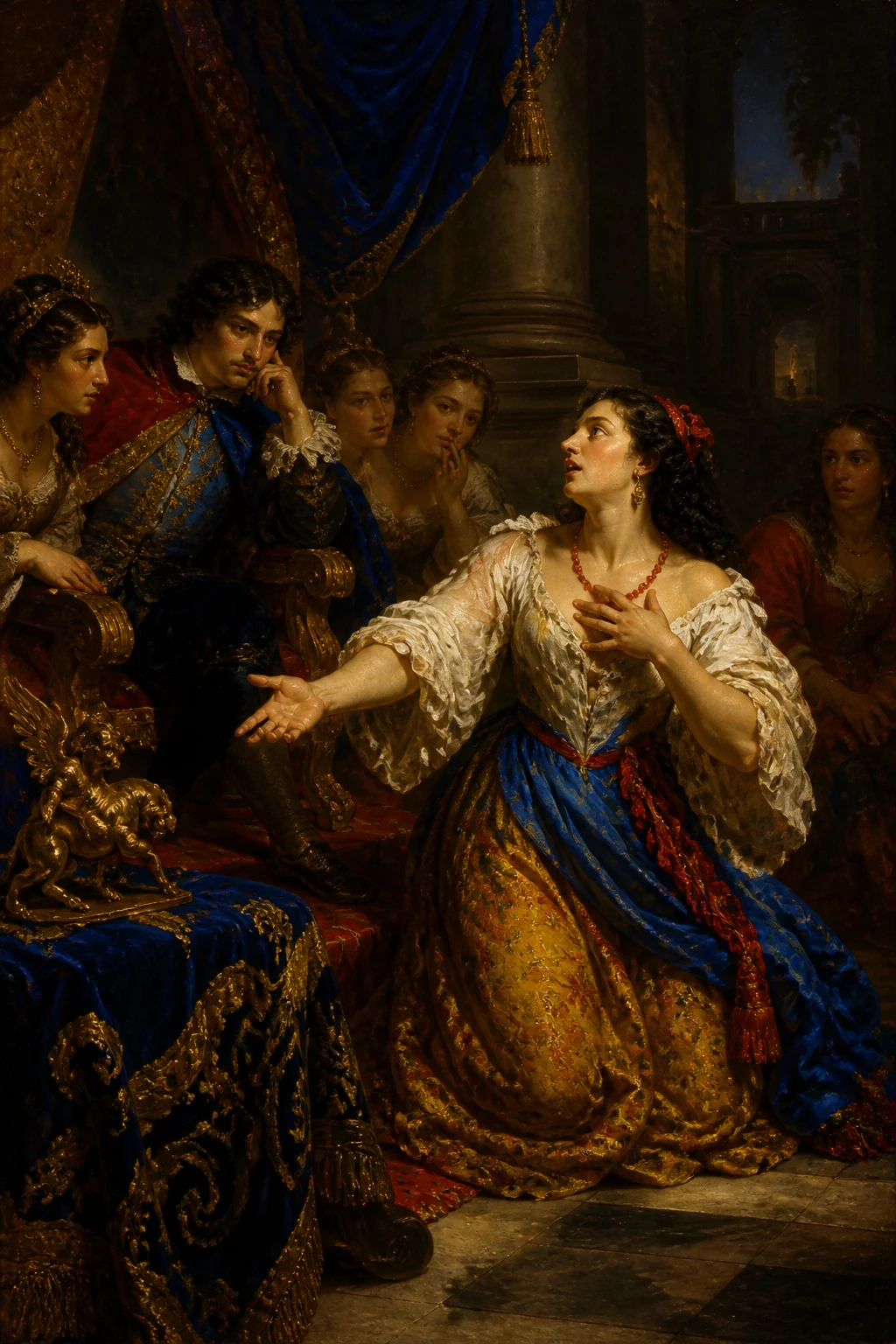
Scarcely holding back her tears, she said, “What end awaits me, possessed by a passion known to no one, so monstrous, so strange a kind of love? If the gods wished to spare me, they should have spared me; if not, if they wished to destroy me, they might at least have given me a natural, ordinary affliction. No cow burns with love for a cow, no mare for a mare: the ram inflames the ewes, the doe follows her stag.
So too the birds mate, and among all living creatures no female is seized with desire for another female. I wish I did not exist! Yet, lest Crete fail to produce every kind of monster, the daughter of the Sun loved a bull: still, she was a female loving a male. My love is madder than hers, if we speak the truth! Yet she pursued the hope of fulfillment; through cunning, disguised as a cow, she submitted to the bull, and had a lover who could be deceived!
Let all the ingenuity in the world gather here; let Daedalus himself fly back on his waxed wings: what could he do? Could his clever arts turn me from a girl into a boy? Could he transform you, Ianthe? Why not strengthen your heart and master yourself, Iphis, and shake off these senseless, foolish flames? Look at what you were born, unless you are deceiving yourself as well, and seek what is allowed: love what a woman ought to love!
Hope is what captures the heart, hope is what nourishes love; reality denies you that. No watchful guardian keeps you from her dear embrace, no jealous husband’s vigilance, no father’s harshness; she herself does not refuse your pleading. And yet you cannot possess her; even if everything were done, even if gods and men strove for you, you could not be happy. Even now, no part of my prayers has gone unanswered: the kindly gods have given me all they could.
What I want, my father wants, and she herself, and my future father-in-law. But Nature does not want it, and she is stronger than them all; she alone stands in my way. Look, the longed-for time is coming, the wedding day is here, and soon Ianthe will be mine— yet I shall never have her: we shall thirst amid the waters. Juno, guardian of brides, and you, Hymenaeus, why do you come to rites where there is no bridegroom, where we are both brides?”
With that she fell silent. The other maiden burned no less fiercely, and prayed for you to hasten, Hymenaeus. Fearing what Ianthe prayed for, Telethusa kept postponing the day, now delaying it with a feigned illness, often pleading omens and visions as excuses. But at last she had exhausted every pretext; the postponed wedding day was upon them, with only one day left. Then she took the ribbons from her own hair and her daughter’s, and with their hair unbound, clasped the altar, crying, “Isis, who dwell in Paraetonium, in the fields of Mareotis, in Pharos, and by the Nile divided into seven mouths, help us, I pray, and relieve our fear!
You, goddess, you I once saw, with these your sacred emblems; I recognized them all, the rattling of the sacred instruments and the bronze that accompanied you, and treasured your commands in my heart. That this child lives, that I have escaped punishment—look, this is your counsel and your gift. Have pity on us both, and come to our aid!” Tears followed her words.
The goddess seemed to shake her altar—and had indeed shaken it; the temple doors trembled, the moonlike horns flashed, and the sacred rattle rang out. Not free of fear, yet cheered by the favorable omen, the mother left the temple. Iphis followed at her side, with a longer stride than usual; the fairness of her face faded, her strength increased, her features grew sharper, her unbound hair grew shorter, and she had more vigor than a girl had possessed. For you who were lately a girl are now a boy. Bring gifts to the temples, and rejoice with fearless faith! They brought gifts to the temples and added an inscription, a single brief verse:
THE GIFTS IPHIS VOWED AS A GIRL HE PAID AS A BOY. The next day’s light had revealed the wide world with its rays, when Venus, Juno, and Hymenaeus gathered at the wedding torches, and Iphis, now a young man, possessed his own Ianthe.