O besedilu
Konec zgodbe zgodb
- Vir
- Pentameron
- Avtor
- Giambattista Basile
- Jezik branja
- English
- Jezik izvirnika
- Neapolitan
- Čas branja
- 7 min branja
- Obseg
- 6 strani
- Naslov izvirnika
- Jornata Quinta X Scompetura de lo cunto de li cunte
O izvirniku
Pentameron
Baročna, divja starejša plast evropske pravljice, polna obratov in pretiravanj. Bralni jezik je English, izvirnik pa prihaja iz vira Pentameron v jeziku Neapolitan.
Besedilo
Konec zgodbe zgodb
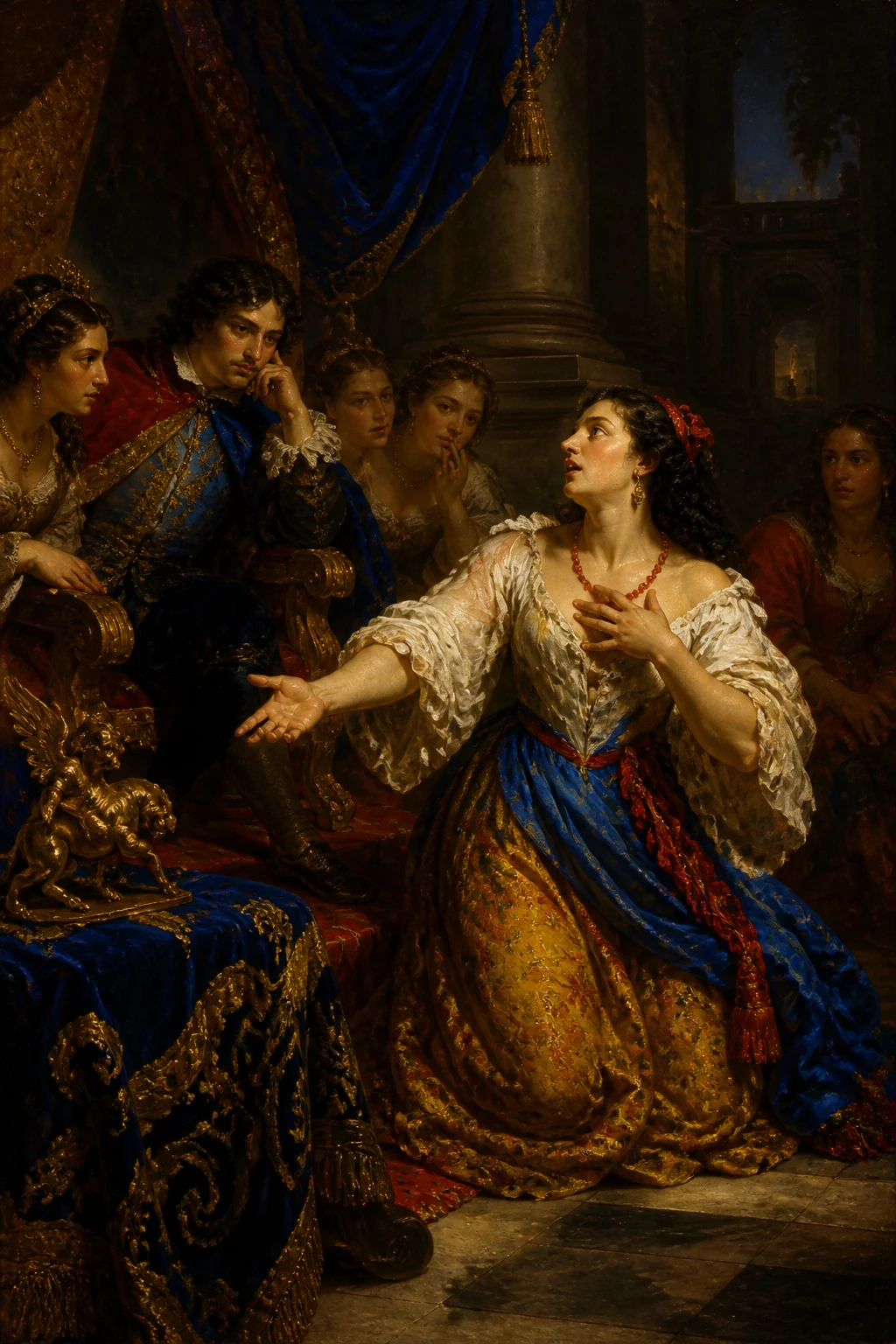
To conclude the introduction to the Entertainments, forming the Tenth Entertainment of the Fifth Day. _Zoza tells the story of her misfortunes. The slave woman, finding herself touched on a sore spot, keeps interrupting so that the tale cannot be finished.
But the Prince insists on hearing it against her wishes, and, discovering his wife’s treachery, has her put to death, pregnant and all, and marries Zoza._ _They had all listened with ears pricked to Ciommetella’s tale. Some praised the skill with which she had told it; others grumbled, accusing her of poor judgment, since she ought not, in the presence of a princess who was herself a slave, to expose the disgraceful deeds of another of the same sort. They said she had run a great risk of spoiling the game. But Lucia truly lived up to her name, squirming all over as the tale was told, so that the agitation of her body betrayed the storm within her heart: in this story of another slave she had seen the very image of her own villainies. She would have broken up the gathering at once;
but partly because she could not tear herself away from the tales—the doll had set such a fire within her, just as someone bitten by a tarantula cannot tear himself away from music—and partly to give Taddeo no grounds for suspicion, she swallowed this bitter pill, intending to take proper revenge at a fitting time and place. But Taddeo, who had grown fond of this pastime, signaled to Zoza to tell her tale. After making her courtesies, she said:_ “Truth, my lord Prince, has always been the mother of hatred, and therefore I would not wish my obedience to your commands to offend anyone here; for, being unaccustomed to inventing fictions and weaving fables, I am compelled, both by nature and by circumstance, to speak the truth. And though the proverb says, ‘Piss clear and cock a snook at the doctor,’ nevertheless, knowing that truth is unwelcome in the presence of princes, I tremble lest I say something that may anger you.” “Say whatever you please,” replied Taddeo, “for nothing can come from that lovely mouth but what is sweet and sugared.” These words were dagger thrusts to the slave woman’s heart, and she would have shown it, had black faces been as readable a book of the soul as white ones. She would have given a finger from her hand never to have heard these tales;
for her heart had grown blacker than her face, and, fearing that the previous tale had been a first warning of the disaster to follow, she foresaw a foul day from its very morning. Meanwhile Zoza began to enchant those around her with the sweetness of her words, telling all her troubles from beginning to end, starting with her natural melancholy, an unhappy omen of what she was to endure;
for she had carried from the cradle the bitter root of all those calamities which, unlocked by a forced laugh, had forced so many tears from her. She went on to tell of the old woman’s curse, her pilgrimage with all its anguish, her arrival at the fountain, her weeping until she was utterly spent, and the treacherous sleep that had caused her ruin. Hearing her make straight for the heart of the matter, and seeing that the boat was heading for disaster, the slave woman cried, _“Be quiet, shut mouth, or fist in belly give, and little Giorgetto kill!”_
Taddeo, who had now seen how the land lay, could contain himself no longer. Throwing off his mask and casting all restraint aside, he said, “Let her tell it to the very end, and no more of these threats about little Giorgetto or big Giorgio! You’ll find I’m more than a match for you; and if my temper rises, you’d be better off under a cartwheel!” He ordered Zoza to continue despite his wife. Needing no more than this signal, she went on to tell of finding the broken pitcher and of the slave woman’s deceit in snatching this good fortune from her hands. As she spoke, she burst into such tears that not one person present could withstand their force. From Zoza’s tears and the silence of the slave woman, who had been struck dumb, Taddeo grasped and fathomed the truth of the affair. He gave Lucia such a dressing-down as one would not give a donkey, and made her confess this treachery with her own mouth;
then he immediately ordered her to be buried alive, with only her head above ground, so that her death would be all the more lingering. Embracing Zoza, he had her honored as his princess and wife, and sent word to the King of Valle-pelosa to come to the festivities. With this new marriage the slave woman’s grandeur and the entertainment of the tales came to an end. May it do us good, and good health to us all, for I came away, step by step, with a little spoonful of honey.
CONCLUSION. TO ANYONE WHO HAS READ THIS BOOK, WHETHER SKIMMING OR SPELLING IT OUT SONNET By M. R. S. D. For any error you may find, Dear Reader, within these pages, It is shameful to grumble, for this Art Can fool even Argus, as another has said.
And then, if you know how to read, Make allowances for these or other errors; If you do not, then, to play the mighty warrior, You might resort to this remedy.
Prescription: one penny’s worth of ABC; No longer go about with saddled asses, And you will know more than the man from Chiaia. So, leaving all this nonsense aside, Read and reread, and take this in Tuscan: May it do you good, and good health to you.
CONTENTS Fourth Day Page 5
I. The Cock’s Stone 7
II. The Two Brothers 14
III. The Three Animal Kings 27
IV. The Seven Rinds of Bacon 36
V. The Dragon 44
VI. The Three Crowns 57
VII. The Two Little Cakes 70
VIII. The Seven Little Doves 79
IX. The Raven 95
X. Pride Punished 110 The Grappling Hook. Eclogue 119 Fifth Day 130
I. The Goose 135
II. The Months 140
III. Pinto Smauto 147
IV. The Golden Trunk 155
V. Sun, Moon, and Talia 167
VI. The Wise Woman 174
VII. The Five Sons 180
VIII. Nennillo and Nennella 187
IX. The Three Citrons 195
X. Conclusion of The Tale of Tales 209 Sonnet 213 Transcriber’s Note This work was transcribed from the edition published in 1788, with the edition of 1749 used to check corrections. Every effort has been made to keep the text as faithful as possible to the original, silently correcting minor typographical errors. More substantial corrections are listed below (with the original text in brackets).
7 liberatolo [liberatelo] 10 ’mmoscare [’uvoscare] 25 de [pe] 76 piede [piece] 80 segnale [senale] 82 darene [derene] 86 votatase [vetatase] 92 facenno [fanno]
95 de n’obedire [de’ obedire] 97 penne [ppene] 99 sinno [sunno] 107 dell’autre [da ll’autre] 116 mbroccato [mroccato] 120 ontare [onrare] 127 morga [mmorge]
134 smorere [smorfire] 137 spontava [passava] 145 bedarraje [badarraje] 149 contentaje [contaje] 156 comm’a Tavernara [taverna] 166 comme [con me]
171 ’ngenocchiatose [gnenocchiatase] 182 n’uocchio [n’uoccio] 199 t’abbistano [t’abbentano] 203 domannata [dommennata] 205 ’nciricciannola [ncignannola]
210 offennesse [affennese] For ease of reading, a table of contents has been added at the end of the volume. The cover was created by the transcriber and placed in the public domain.
Izvirnik
Jornata Quinta X Scompetura de lo cunto de li cunte
Naslednje strani prikazujejo izvirno besedilo za primerjavo.
Pe chiudetura de la ’ntroduzzione de li Trattenemiente, che sarrà lo Trattenemiento X. de la Jornata Quinta. _Conta Zoza la storia de li guaje suoje. La Schiava, che se sente toccare li taste fa fuorfece fuorfece, azzò no scompa lo Cunto. Ma lo Prencepe a dispietto sujo lo vò sentire, e scopierto lo trademiento de la mogliere, la fa morire prena, e bona, e se piglia Zoza._ _Stettero tutte a rrecchie pesole a ssentire lo Cunto de Ciommetella, e parte laudaro lo sapere, co che l’avea contato, parte nne mormoraro, tassannola de poco jodizio, che non doveva ’n
presenzia de na Prencepessa schiava, spubrecare li vituperie de n’autra simmele, e decevano, che s’era posta a no gran riseco de sconcecare lo juoco. Ma Lucia fece veramente da Lucia, cernennose tutta, mentre se contava sto Cunto, che a l’arteteca de lo cuorpo se consideraje la borrasca, ch’aveva drinto a lo core, avenno visto drinto no Cunto de n’autra schiava lo retratto spiccecato de le mmarcancegne soje: ed averria fatto scacare subeto la scommerzione; ma parte perchè non se poteva spesare de li Cunte, tanto fuoco l’avea puosto ncuorpo la Pipata, comme l’attarantato non se pò spesare de li suone. E parte pe non dare materia a Taddeo de sospettare, se gliottette sto veluocciolo, co penziero de farene a tiempo, ed a luoco no buono resentemiento. Ma Taddeo che l’era
trasuto ngrazia sto spassatiempo, azzennaje a Zoza, che decesse lo sujo, la quale fatto la crejanza soja, decette._ La veretà, Segnore Prencepe, fu sempre mamma dell’odio, e perzò non vorria che l’obedire a li commanne vuostre offennesse quarcuno de chiste, che stanno ntuorno; perchè non essenno usata a fegnere nvenziune, ed a tessere favole, so costretta, e pe natura, e pe azzedente a dire lo vero; e si bè dice lo proverbio: piscia chiaro, e fa la fico a lo Miedeco: tutta vota sapenno ca la veretà non è rricevuta a la presenzia de li Princepe, io tremmo de dire cosa, che ve faccia fuorze nfomare. Dì chello che buoje, respose Taddeo, ca da ssa bella vocca non pò scire cosa, si no nzoccarata, e doce. Ste parole foro pognalate a lo core de la schiava, e n’averria mostrato
signale, si le ffacce negre comme le ghianche fossero libro dell’arma, e averria pagato no dito de la mano ad essere diuna de sti cunte; perchè lo core l’era fatto chiù nigro de la facce, e dubetanno, che lo Cunto passato non fosse stato primmo annunzio, e po malanno, da la matina se zonnaje lo male juorno. Ma Zoza fra sto tiempo commenzaje a ncantare li circostante co la docezza de le pparole, contanno da lo prencipio a la fine tutte l’affanne suoje, accommenzanno appunto da la natorale malanconia soja, nfelice agurio de chello, che doveva passare; portannose da la connola la mara radeca de tutte le male sciagure, che co la chiave de no riso sforzato la sforzaro a tanta lagreme. Secotaje dapò la jastemma de la vecchia, lo pellegrinaggio sujo co tante
angosce, l’arrivata a la fontana, lo chiagnere a bita tagliata, lo suonno tradetore causa de la roina soja. La schiava sentennola pigliare larga, e ritta, e bedenno la varca mal’abbiata, gridaje: _Stare zitta, appilare, si no punia a ventre dare, e Giorgetiello mazzocare_. Taddeo, che aveva scopierto paese, non appe cchiù fremma; ma levatose la mascara, e ghiettanno la varda ’n terra disse: Lassala contare fi ’n ponta, e non fare cchiù ste llevate de cappa de Giorgetiello, e Giorgione, ca all’utemo no m’aje trovato sulo: e si mme saglie lo senapo, meglio che te pigliasse rota de carro: e commannato a Zoza, che secotiasse a despietto de la mogliere; essa che non ne voze autro che lo zinno, secotaje la trovata de la lancella rotta, lo nganno de la
schiava pe levarele da le mmano sta bona fortuna; e accossì decenno, scappaje a chiagnere de manera, che non fu persona llà presente, che stesse sauda a le botte. Taddeo, che da le lagreme de Zoza, e da lo selenzio de la schiava, ch’era ammotuta, comprese, e pescaje la veretà de lo fatto; e facenno a Lucia tale lavata de capo, che non se sarria fatto a n’Aseno, fattole confessare de vocca propia sto trademiento; deze subeto ordene, che fosse atterrata viva co la capo schitto da fora, azzò fosse cchiù stentata la morte soja, ed abbracciato Zoza la fece onorare comm’a Prencepessa, e mmogliere soja, facennose avisato lo Rrè de Valle-pelosa, che benesse a ste ffeste, e co ste nnove nozze termenaje la grannezza de la schiava, e lo trattenemiento de li Cunte,
e buon prode nce faccia, e ssanetate, ch’io mme ne venne a pede a pede co na cocchiarella de mele. SCOMPETURA. A CHI HA LEJUTO STO LIVRO O SCORRENNO, O COMPETANNO SONETTO Del M. R. S. D. Pe quacche arrore, che trovato avisse, O Lejetore mio, drinto ste Ccarte, Mormorare è bregogna, ca chest’Arte Porzì ad Argo la fa, comm’autro disse. E po, se tu saje lejere, de chisse
O d’autre arrure pigliane le pparte; Se no nne faje, pe ffarela da Marte, A sto remmedio attenere porrisse. Recepe Santacroce no tornese, Ne ghire cchiù co ll’asene ’nvardate, E saperraje cchiù tu de lo Chiajese. Lasanno perzò tutte ste bajate, Lieje, e relieje, ed agge ’n toscanese, Il buon prode ti faccia, e ssanetate. INDICE Quarta jornata Pag. 5 I. La preta de lo gallo 7
II. Li duje fratielle 14 III. Li trè Rri anemale 27 IV. Le ssette cotenelle 36 V. Lo dragone 44 VI. Le tre corune 57 VII. Le doje pizzelle 70 VIII. Li sette palommielle 79 IX. Lo cuorvo 95 X. La soperbia castecata 110 La vorpara. Egroca 119 Quinta jornata 130 I. La papara 135
II. Li mise 140 III. Pinto Smauto 147 IV. Lo turzo d’oro 155 V. Sole, Luna e Talia 167 VI. La sapia 174 VII. Li cinco figlie 180 VIII. Nennillo e Nennella 187 IX. Le tre cetre 195 X. Scompetura de lo Cunto de li Cunte 209 Sonetto 213 Nota del Trascrittore La trascrizione di quest’opera è stata effettuata sulla base
dell’edizione pubblicata nel 1788, usando come riscontro per le correzioni l’edizione del 1749. Si è cercato di mantenere il testo il più possibile fedele all’originale, correggendo senza annotazione minimi errori tipografici. Le correzioni più sostanziali sono annotate di seguito (tra parentesi il testo originale). 7 liberatolo [liberatelo] 10 ’mmoscare [’uvoscare] 25 de [pe] 76 piede [piece] 80 segnale [senale] 82 darene [derene] 86 votatase [vetatase]
92 facenno [fanno] 95 de n’obedire [de’ obedire] 97 penne [ppene] 99 sinno [sunno] 107 dell’autre [da ll’autre] 116 mbroccato [mroccato] 120 ontare [onrare] 127 morga [mmorge] 134 smorere [smorfire] 137 spontava [passava] 145 bedarraje [badarraje] 149 contentaje [contaje]
156 comm’a Tavernara [taverna] 166 comme [con me] 171 ’ngenocchiatose [gnenocchiatase] 182 n’uocchio [n’uoccio] 199 t’abbistano [t’abbentano] 203 domannata [dommennata] 205 ’nciricciannola [ncignannola] 210 offennesse [affennese] Per comodità di lettura è stato aggiunto un indice a fine volume. Copertina creata dal trascrittore e posta nel pubblico dominio.
Nadaljuj z branjem