O besedilu
Sapija
- Vir
- Pentameron
- Avtor
- Giambattista Basile
- Jezik branja
- English
- Jezik izvirnika
- Neapolitan
- Čas branja
- 9 min branja
- Obseg
- 7 strani
- Naslov izvirnika
- Jornata V VI LA SAPIA
O izvirniku
Pentameron
Baročna, divja starejša plast evropske pravljice, polna obratov in pretiravanj. Bralni jezik je English, izvirnik pa prihaja iz vira Pentameron v jeziku Neapolitan.
Besedilo
Sapija
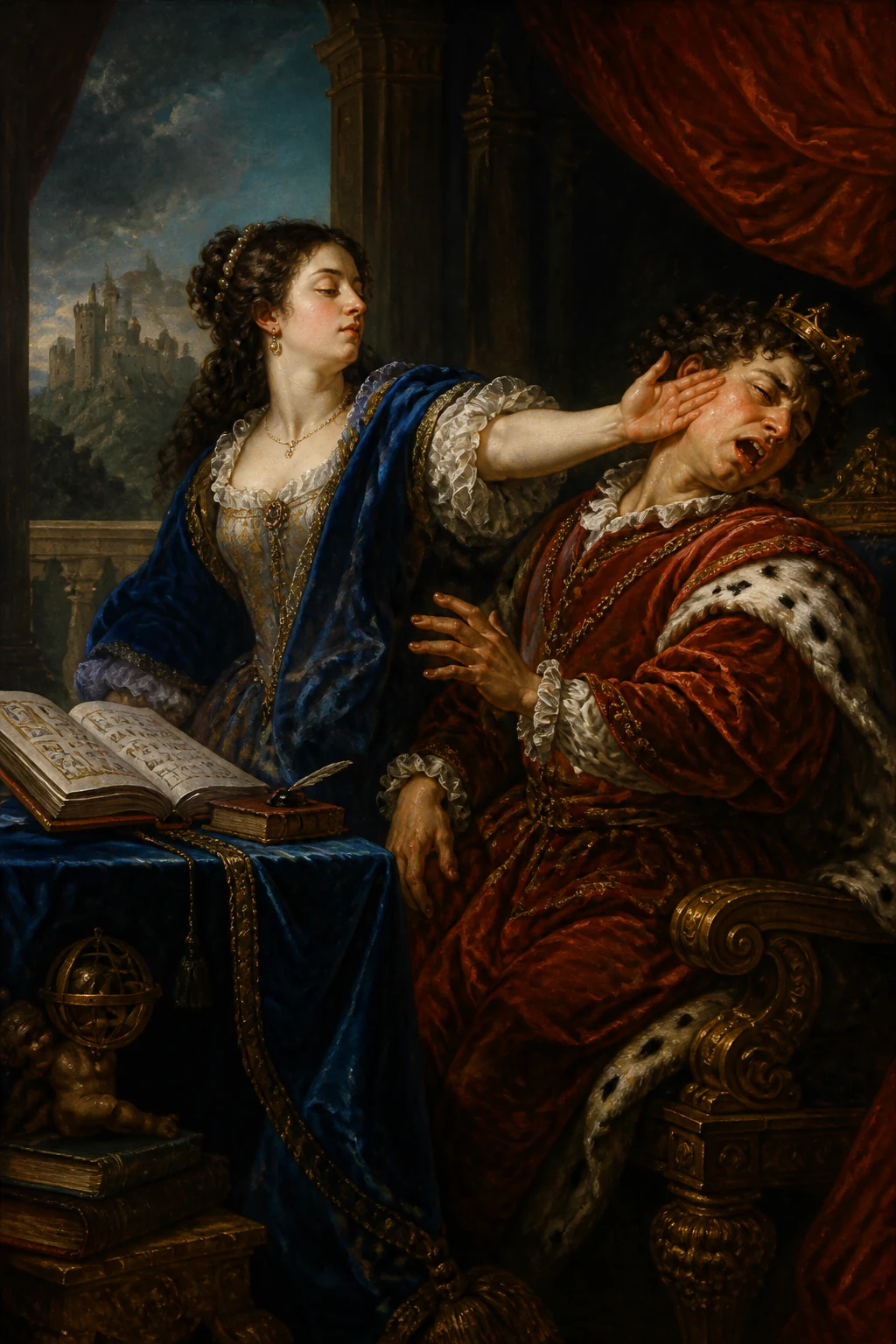
_Sapia, the daughter of a great Baroness, makes a wise man of Cenzullo, a King’s son who could not learn his letters. Wishing to avenge a slap she gave him, he marries her and subjects her to a thousand torments; but after she has borne him three children without his knowing anything of it, they are reconciled._ _The Prince and Princess rejoiced greatly to see Talia’s affairs come to a happy conclusion, for they had never imagined that she could find such a haven amid so fierce a storm. They bade Antonella bring forth her tale, and she began as follows._ There are three kinds of ignorant people in this world, each more deserving than the last of being put into an oven: the first knows nothing; the second wishes to know nothing; the third thinks he knows everything. The ignorant fellow I am about to tell you of belongs to the second kind: unwilling to let knowledge enter his head, he hates the person who teaches him and, like another Nero, seeks to deprive his teacher of the means of life.
Once upon a time there was a King of Castiello Chiuso who had a son so thickheaded that nothing could persuade him to remember his A, B, C, D. Whenever anyone spoke to him of letters or learning, he flew into a fury, and neither scolding nor beatings nor threats did any good. His poor father was swollen with vexation like a toad and did not know what course to take to awaken the wits of this wretched son, rather than leave his kingdom in the hands of a blockhead, knowing that ignorance and the government of a kingdom could never go together.
At that same time there lived a daughter of the Baroness Cenza who, for the great learning she had acquired by the age of thirteen, had earned the name of Sapia. When the King heard of her admirable gifts, he decided to entrust his son to the Baroness so that her daughter might teach him, thinking that the girl’s company and the desire to compete with her might do him some good. So the Prince was lodged in the Baroness’s house, and Sapia began to teach him his primer. But when she saw that her kind words were so much seed sown behind his back, and that her sound reasoning went in one ear and out the other, her hand slipped and she gave him a slap. Carluccio, for that was the Prince’s name, felt such shame at this that what he had refused to do for coaxing he did out of mortification and spite, so that within a few months he could not only read;
he had advanced so far in grammar that he mastered all its rules. His father was so delighted that his feet scarcely touched the ground; and taking Carluccio away from that house, he set him to studying higher subjects, until he became the most learned man in the kingdom:
but the blow Sapia had given him had left so deep an impression that he saw it before his eyes when he was awake and dreamed of it when he slept, until he resolved either to avenge himself or die. Meanwhile Sapia reached marriageable age, and the Prince, who had been waiting with his match at the touchhole for a chance to take revenge, said to his father:
“My lord, I acknowledge that I owe my existence to you, and for that I am indebted to you up to the rooftops; but I know myself equally indebted to Sapia, who has taught me how to live well. Since I can find no adequate way of repaying so great a debt, I should like, if it pleases you, to take her as my wife. I assure you that you would be laying the whetstone to my life.” When the King heard his son’s resolve, he answered, “My son, though Sapia is not of the rank your wife ought to possess, her virtue weighs so heavily in the scales against our blood that she may fairly make this match. If you are content, I am satisfied.” He sent for the Baroness and had the marriage articles drawn up at once. After festivities befitting a great lord, the Prince asked the King to grant him separate apartments where he might live with his wife. To please him, the King had a beautiful palace prepared apart from his own. There the Prince took Sapia and shut her up in a room, giving her bad food, worse drink, and worse treatment still in bed, for he would not pay the marriage debt. The poor woman became the most despairing creature in the world, unable to understand why she was being treated so cruelly when she had scarcely entered her new home:
but one day her lord took it into his head to see Sapia, and entering her room, he asked how she was. “Lay your hand upon your heart,” Sapia answered, “and you will know how I can be. What have I done to you, that you treat me like a dog? Why ask for me as your wife if you meant to keep me worse than a slave?”
To these words the Prince replied, “Do you not know that whoever gives an offence writes it in dust, while whoever receives it writes it in marble? Remember well what you did to me when you were teaching me to read, and know that I wanted you for my wife for no other reason than to make your life bitter and avenge the insult I received.” “Then,” Sapia replied, “I reap evil for having sown good. If I struck you, it was because you were an ass, and I wished to make you wise. You know that those who love you make you weep, and those who wish you ill make you laugh.” If the Prince had been bitter about the slap before, he now burned with anger at having his ignorance thrown in his face; all the more because, where he had expected Sapia to admit her fault, he found her bold as a cock, giving him answer for answer. So he turned his back and went away, leaving her worse off than before. Returning some days later and finding her still of the same mind, he departed more incensed than ever, determined to let her stew in her own juices like an octopus and punish her with a cudgel of cotton wool. Meanwhile the King made over all the possessions of his life against the bedpost of his sickbed, and his son, now lord and master of all his dominions, wished to go in person to take possession of them. He therefore assembled a mounted train of men-at-arms and knights worthy of his station and set out with them. The Baroness, having learned of her daughter’s miserable life, had prudently sought to remedy matters by digging a passage beneath the Prince’s palace, through which she brought some comfort and refreshment to poor Sapia. Learning a few days beforehand of the new King’s departure, she had coaches and splendid liveries made ready, dressed her daughter in the finest style, and sent her off with a company of ladies by a shorter road. Thus Sapia arrived a day before her husband at the place where he was to stop. Taking a house opposite the palace prepared for him, she seated herself at the window in all her finery. When the King arrived and saw this very cream of beauty and grace, he fell in love at once and laid such persistent siege to her that he gained his desire. Leaving her pregnant, he gave her a beautiful bracelet as a remembrance of his love. When the King departed to visit the other cities of his kingdom, she slipped back home, and at the end of nine months gave birth to a handsome boy. On returning to his capital, the King went to see Sapia, expecting to find her dead; instead he found her fresher than ever, and more stubborn than ever in telling him that she had printed five fingers on his face to make a wise man of him when he had been an ass.
The King went away in a rage. When he had to set out again on another visit, Sapia, following her mother’s advice, did just as she had done the first time. Having enjoyed her husband’s embraces, she received from him a rich jewel to wear upon her head and became pregnant with another boy, whom she brought into the world after returning home, when her time was ripe. The same good fortune befell her a third time: the King gave her a heavy chain of gold and precious stones and left her with child, this time a girl, who came safely into port at the appointed time. When the King returned from his travels, he found that the Baroness, after giving her daughter a sleeping draught, had spread the report that she was dead and sent her to be buried; then she had secretly had her taken from the grave and hidden in her house. Thereupon the King joyfully arranged another marriage with a lady of high rank. He brought her to the royal palace, and while the festivities were in full and dazzling swing, Sapia appeared in the hall with her three children, three precious jewels. Throwing herself at the King’s feet, she demanded justice, begging him not to deprive these children, who were his own flesh and blood, of their kingdom. For a while the King stood like a man in a dream. At last, seeing that Sapia’s wisdom reached to the stars, and finding, when he least expected it, three supports for his old age presented before him, his heart softened. He gave the other lady to his brother in marriage with a great estate, and took Sapia back, showing all the people of the world _That the wise man rules the stars._
Izvirnik
Jornata V VI LA SAPIA
Naslednje strani prikazujejo izvirno besedilo za primerjavo.
_Sapia, figlia de na gran Baronessa, fa deventare ommo accuorto Cenzullo, che era figlio de no Rrè, che non poteva capere lettere; lo quale pe no boffettone, che le dette Sapia, volennose vennecare, se la pigliaje pe mmogliere, e dapò mille strazie, avutone, senza sapere cosa nesciuna, tre ffiglie, s’accordarono nsieme._ _Fecero na prejezza granne lo Signore Prencepe, e la Prencepessa, quanno veddero arrivare a buon termene le ccose de Talia, che non se credevano maje, che drinto a tanta borrasca trovasse sto puorto, e dato ordene ad Antonella, che sfodarasse lo cunto sujo, essa accossì mese mano._ Tre so le specie de li gnorante a lo munno, che meretarriano l’uno cchiù dell’autro essere puoste a no furno: lo primmo, che non sà: lo
secunno, che non vò sapere; lo tierzo, che pretenne de sapere: De la seconna spezia, è lo gnorante de chi v’aggio da parlare, lo quale non volenno farese trasire nchiocca lo ssapere, odia chi nce lo nvezza, e nuovo Nerone, cerca de levarele la via de lo ppane. Era na vota lo Rrè de Castiello chiuso, ch’aveva no figlio accossì capo-tuosto, che no nc’era remmedio, che bolesse tenere a mmente l’A.
B. C. D. e sempre che se le parlava, de lettere, e de mparare, faceva cose de fuoco, che non jovavano strile, nè mmazziate, nè mmenaccie de manera, che lo negrecato patre nne stava abbottato comme a rruospo, e non sapeva che partito pigliare pe scetare lo ngiegno de sto figlio sciaurato, e no lassare lo regno ’n mano a no mammalucco, sapenno essere mpossibile cosa, fare lega la gnoranzia, e dominio de no regno.
A sto medesemo tiempo nc’era la fegliola de la Baronessa Cenza, che pe tanto sapere, a lo quale era arrivata ’n tridece anne, n’acquistaje lo nomme de Sapia; le bertolose qualetà de la quale essenno dette a lo Rrè, fece pensiero de dare lo figlio a la Baronessa, che lo facesse nvezzare da la figlia, penzanno, che co la compagnia, e co la competenzia de la fegliola, avesse fatto quarche bene. Puosto addonca lo Prencepe a la casa de la Baronessa, accommenzaje Sapia a nvezzarele la santa-croce; ma vedenno, che le belle parole se le semmenava da dereto, le bone ragiune da n’arecchia le trasevano e da l’autra scevano, le scappaje la mano, e le dette no boffettone; de la quale cosa se pigliaje tanto scuorno Carluccio (che accossì se chiammava
lo Prencepe) che chello, che non aveva fatto pe ccarezzielle, fece pe bregogna, e despietto, tanto che ’n poche mise non sulo seppe lejere; ma passaje tanto nnante a la grammatica, che fece pe tutte regole, de la quale cosa appe tanto giubelo lo Patre, che non toccava pede ’n terra; e levato Carluccio da chella casa, le fece studiare l’autre ccose cchiù granne, che deventaje lo cchiù ssaputo de chillo regno: ma fu ttanto la mpressione de lo cuorpo, che le dette Sapia, che veglianno lo teneva nnante l’uocchie, dormenno se lo nzonnava; tanto che fece pensiero de morire, o de vennecarese. Venne fra sto tiempo Sapia a l’ajetà de marite, e lo Prencepe, che aspettava co lo miccio a la serpentina, accasione de fare le bennette soje, disse a lo Patre:
Signore mio, io confesso d’avere recevuto l’essere da vuje, e perzò ve tengo n’obreco nfi ncoppa l’astraco: ma a Sapia, che m’ave dato lo buono essere, mme canosco autro tanto obrecato: e perzò non trovanno manera vastante de pagarele tanto debeto, se ve fosse ’n piacere, la vorria pe mmogliere, assecurannote, ca mettarrisse na cota sopra la perzona mia. Lo Rrè, che ntese sta deleberazione de lo figlio, le respose; figlio mio, si bè Sapia non è de chella carata, che doverria essere na mogliere toja, pure co la vertute soja posta a la velanza de lo sango nuostro scenne tanto, che le pò fare sto partito; perzò tu contento, io pagato; e fatto chiammare la Baronessa, fece fare subeto li capitole, e ffatto ffeste competente a no Segnore granne,
cercaje ’n grazia a lo Rrè n’appartamiento spartato, dove potesse stare co la mogliere; e lo Rrè pe ccontentarelo, le fece apparecchiare no Palazzo bellissemo separato da lo sujo, dove portatose Sapia, la restrense a na cammara, dannole male da magnare, peo da vevere, e ccotte peo non volenno pagare lo debeto; tanto, che la negra se vedde la cchiù desperata femmena de lo munno: non sapenno la causa de sto male trattamiento a ttiempo, ch’appena era trasuta a la casa: ma venuto voglia a lo Segnore de vedere Sapia, trasette a la cammara soja, e l’addemmannaje comme steva: Menate la mano pe lo stommaco, respose Sapia, ca vedarraje commo pozzo stare, e che cosa t’aggio fatto, pe la quale mme tratte de sta manera comme a ccane? A che
fine cercareme pe mmogliere, si mme volive tenere peo de na schiava? a ste parole respose lo Prencepe; non saje tu ca chi fa l’affesa la scrive ’n porvere, e chi la receve ’n marmolo. Allecordate buono, che mme faciste quanno mme mmezzave de lejere, e ssacce ca non ped autro t’aggio voluto pe mmogliere, che pe ssauza de sta vita toja, e mmennecareme de la ngiuria recevuta. Addonca, leprecaje Sapia, arrecoglio male ped avere semmenato bene. S’io te dette, lo ffice ca jiere n’aseno, pe ffarete deventare Sapio. Tu saje ca chi te vole bene te fa chiagnere, e chi te vole male te fa ridere. Lo Prencepe se primmo steva marfuso de lo boffettone, mo se nzorfaje pe bederese renfacciata la gnoranzia soja, e ttanto cchiù, che dove pensava, che
Sapia devesse darese ’n corpa de l’arrore, vedde, che ardita comme a gallo le responneva da tuzzo a tuzzo, e perzò votatole le spalle, se nne jette, lassannola peo che non steva: ma tornato fra cierte autre juorne, e ttrovatala co lo stisso appontamiento, se nne partette cchiù ncotenuto de primmo, resoluto de farela cocere co l’acqua soja comme a ppurpo, e ccasticarela co la mazza de la vammace. Fra sto miezo lo Rrè fece cessione de li bene de la vita ncoppa a na colonna de no lietto martoro, e rrestato isso dommeno, e dommenanzio de tutte li state, voze ire a pigliare lo possesso de persona, e mese ’nn ordene cavarcate de gente d’arme, e de Cavaliere degne de la perzona soja, co li quale se mese ’n viaggio. La Baronessa, che, saputo la vita stentata de la
Figlia, pe rremmediare prudentemente a sto desordene, aveva fatto na cava pe ssotto lo palazzo de lo Prencepe, pe dove soccorreva de quarche refrisco la poverella Sapia: previsto poche juorne nnante la partuta de lo nuovo Rrè, fece fare carrozze, e livrere de sfuorgio, e bestuta la figlia de tutto punto, co na compagnia de Signore la fece ammarciare pe na strata scortatora, tanto che se trovaje no juorno nnante dove aveva da fermarese lo marito, e pigliato la casa ncontro lo Palazzo, che l’aveva apparecchiato, se mese tutta apparata a la fenestra, dove arrivato lo Rrè, e bisto lo sciore de lo pegnato de le grazie, se nne ncrapicciaje subeto, e fece tanta zappe, che l’appe ’n mano, e lassatala prena, le dette no bello vranchiglio pe mmemoria de l’ammore
sujo; ed essennose partuto lo Rè pe girare l’autre Ccitate de lo regno sujo, essa sbignaje a la vota de la casa soja, e ’n capo de nove mise fece no bello figlio mascolo. Ma tornato lo Rrè a lo capo de lo regno sujo, tornaje a bedere Sapia; credenno de trovarela trapassata, ma la vedde la cchiù ffresca de maje, e cchiù che mmaje ostenata a direle, che pe farelo sapio, dov’era n’aseno, le segnaje cinco dita ’n facce.
Lo Rrè sdegnato se partette, ed avenno a tornare fore a l’autra viseta, Sapia co lo consiglio de la mamma fece lo medesemo, ch’aveva fatto la primma vota, e godutase lo marito, n’appe na ricca gioja pe portare ’n testa, e nne restaje prena de n’autro figlio mascolo, che tornata a la casa, comme fu ammaturo lo tiempo, scarrecaje, e ssoccessole la terza vota sto chiajeto, le fu dato da lo Rrè na grossa catena d’oro, e prete preziose, e la lassaje graveta de na figlia femmena: la quale scie a ppuorto a lo tiempo debeto, e benuto lo Rrè da fore, trovaje, che la Baronessa avenno dato l’adduobbio a la figlia sparze voce, ch’era morta, e mmannatala ad atterrare, destramente la fece pigliare da la fossa, e annasconnere drinto la casa. Pe la quale cosa lo Rrè co
na festa granne trattaje n’autro accasamiento co na perzona granne, la quale portatala a lo Palazzo riale, mentre se facevano feste da stordire, comparze Sapia a la sala, co li tre figlie, ch’erano tre gioje, e ghiettatase a li piede de lo Rrè, cercaje justitia, che non dovesse levare lo regno a sti figliule, ch’erano lo sango sujo. Lo Rrè pe no piezzo stette comme a n’ommo, che se nzonna. All’utemo vedenno, ca lo ssapere de Sapia arrivava a le Stelle, e bisto appresentarese quanno manco se lo credeva tre ppontelle de la vecchiezza soja, se le ntennerette lo core, e dato chella Segnora pe mmogliere a lo frate co gruosso stato, se pigliaje Sapia, facenno canoscere a la gente de lo Munno, _Ca l’ommo Sapio dommena le Stelle._
Nadaljuj z branjem