Prevod
He had finished, and both the tale and its teller had moved them all, Theseus above all. Seeing him eager to hear of the gods’ wondrous deeds, the Calydonian river-god, leaning on his elbow, addressed him thus: “There are some, bravest of men, whose shape was changed once and remained in its new form; others have the power to pass through many shapes, as you do, Proteus, dweller in the sea that encircles the earth.
For people have seen you now as a youth, now as a lion; at one time you were a savage boar, at another a serpent they would fear to touch; at another, horns made you a bull. Often you could appear as a stone, often as a tree; sometimes, taking on the likeness of flowing water, you were a river, sometimes fire, the opposite of water. No less a power belongs to Autolycus’ wife, the daughter of Erysichthon. Her father was a man who scorned the majesty of the gods and burned no incense on their altars.
He is even said to have profaned a grove of Ceres with his axe and desecrated its ancient woods with iron. Among them stood a mighty oak, its trunk grown strong with age, a forest in itself; sacred ribbons, commemorative tablets, and garlands encircled it, tokens of prayers fulfilled. Often beneath it the Dryads had led their festive dances; often, too, joining hands in a circle, they had measured the circuit of its trunk, and the oak’s circumference filled fifteen outstretched arm-spans. The rest of the woodland lay as far beneath it as the grass beneath the woods.
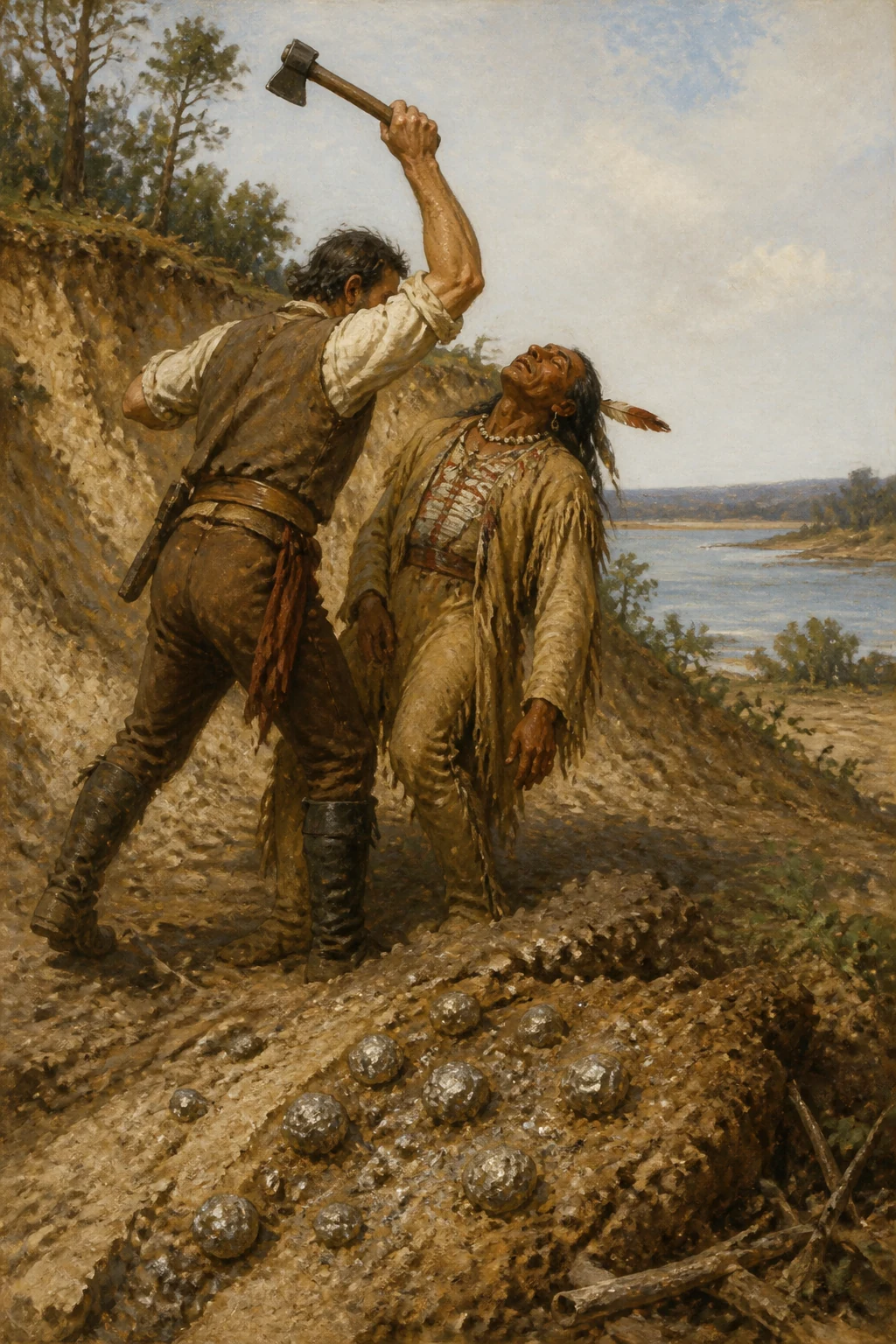
Yet not even this kept the son of Triopas from laying his axe upon it. He ordered his servants to fell the sacred oak; and when he saw them hesitate at his command, the wicked man snatched an axe from one of them and cried: “Even if it were not merely dear to the goddess, but the goddess herself, its leafy crown would soon be touching the earth.” He spoke, and as he poised his weapon for a slanting blow, the oak of Ceres shuddered and gave a groan; its leaves and acorns alike began to pale, and its long branches too took on a pallid hue.
When his impious hand had wounded its trunk, blood streamed from the broken bark, just as when a great bull falls in sacrifice before the altar and blood pours from its severed neck. All stood aghast, and one among them dared to check the outrage and restrain the savage axe. The Thessalian looked at him and said, “Take the reward for your pious thoughts!” Turning his blade from tree to man, he struck off his head, then hacked at the oak again, and from the heart of the trunk a voice replied: “I am a nymph within this wood, most dear to Ceres, and as I die I foretell that punishment for your deeds
is close at hand: this comforts me in death.” He persisted in his crime, and at last the tree, weakened by countless blows and hauled upon with ropes, fell, crushing a great stretch of woodland beneath its weight. The Dryads, stunned by their own loss and the woodland’s, all sisters, went in mourning to Ceres, clad in black, and begged that Erysichthon be punished.
The lovely goddess nodded her assent, and with that movement of her head shook the fields laden with ripening grain. She devised a punishment that would have stirred pity, had his deeds not put him beyond all pity: to have deadly Hunger tear him apart. Since the goddess herself could not approach her—for the Fates forbid that Ceres and Hunger ever meet—she addressed one of the mountain spirits, a rustic Oread, in these words: “There is a place on the farthest borders of icy Scythia, a dismal waste, a barren land without crops or trees; numbing Cold dwells there, and Pallor, and Shivering, and famished Hunger. Command her to bury herself
in the wicked heart of this sacrilegious man. Let no abundance overcome her; let her triumph in a contest with my power. And lest the length of the journey frighten you, take my chariot, take my dragons, and guide them through the heights with the reins.” And she gave them to her. Carried through the air in the chariot, the nymph reached Scythia, and on the summit of a frozen mountain called Caucasus she drew up the serpents’ necks.
There in a stony field she saw Hunger, whom she sought, tearing up the scanty grass with her nails and teeth. Her hair was matted, her eyes sunken, her face pale, her lips grey with neglect, her throat rough with decay, her skin so hard and thin that her entrails showed through; dry bones jutted beneath her hollow loins; in place of a belly was only the space for one; her chest seemed to hang loose, held only by the framework of her spine.
Wasting had enlarged her joints; her kneecaps bulged, and her ankles protruded in enormous knobs. Seeing her from afar—for she did not dare go near—the nymph delivered the goddess’s commands. Though she lingered only briefly, though she stood far off and had only just arrived, she thought she felt hunger herself, and wheeled the dragons back toward Haemonia, drawing the reins high in the air.
Hunger carried out Ceres’ commands, though her work is always opposed to the goddess’s. Borne by the wind through the air, she reached the appointed house and at once entered the blasphemer’s bedchamber. Finding him sunk in deep sleep, for it was night, she clasped him in both her arms, breathed herself into him, breathed upon his throat, his breast, his mouth, and spread starvation through his empty veins.
Her task accomplished, she left the fertile world and returned to her accustomed home, her barren cave. Gentle Sleep still soothed Erysichthon with its peaceful wings. In his dreams he reached for feasts, worked his empty mouth, ground tooth against tooth, and strained his throat, deluded by imaginary food, swallowing nothing but thin air in place of a meal. But when sleep fled, a furious craving for food raged through his greedy throat and burning entrails.
At once he demanded all that sea, earth, and air produce, and complained of hunger before laden tables, seeking feast upon feast. What could have fed cities, what could have satisfied a nation, was not enough for one; the more he sent down into his belly, the more he craved. As the ocean receives the rivers of the whole earth and is never filled with water, but drinks up streams from distant lands; as ravenous fire never refuses fuel, consuming countless logs, and the more it is given, the more it demands, growing greedier with abundance: so the mouth of impious Erysichthon accepted every feast and asked for more. All food in him
became a cause for food, and eating always left him empty. Already his hunger and the deep abyss of his belly had dwindled his ancestral wealth, but his dreadful hunger remained undiminished even then, and the flame of his insatiable appetite burned on. At last, with his fortune swallowed, only his daughter remained, deserving a better father. Destitute, he sold her too. The noble girl refused to have a master, and stretching her hands toward the nearby sea, she cried, “Save me from slavery, you who took my maidenhood as your prize!” It was Neptune who had taken it.
He did not scorn her prayer. Though her pursuing master had just seen her, the god changed her shape, giving her a man’s face and the clothing of a fisherman. Looking at her, her master said, “You who wield the rod and hide the dangling bronze hook beneath a little bait, may the sea be calm for you, may the fish in its waters trust you and never notice your hooks until they are caught: tell me where the girl is who stood just now on this shore in a shabby dress, her hair dishevelled—for I saw her standing here, and her tracks go no farther.”
She saw that the god’s gift was working well and, delighted to be asked about herself, answered his question: “Whoever you are, forgive me: I have not turned my eyes from this water, so intent have I been on my work. And to put you beyond doubt, may the sea-god bless my craft as surely as no one has stood on this shore for some time except myself, and certainly no woman.”
Her master believed her and turned his steps back across the sand, leaving deceived; her own shape was restored to her. But when her father learned that she could change her body, he sold the granddaughter of Triopas to master after master. She escaped now as a mare, now as a bird, now as a cow, now as a stag, providing her ravenous father with food dishonestly gained.
Yet when the force of his affliction had consumed all he possessed, and only fed his grievous sickness anew, he began to tear his own limbs with savage bites, and the wretched man fed his body by consuming it. But why dwell on others? I too, young man, have the power to change my body, though the number of my shapes is limited. At times I appear as I am now; at times I coil into a snake; at times, a leader of the herd, I gather my strength into my horns— my horns, while I still had them! Now one side of my brow has lost its weapon, as you can see.” Groans followed his words.