Prevod
Yet the Fates do not allow Troy’s hope to fall with her walls: her sacred relics, and his father, sacred too, the hero born of Venus bears upon his shoulders, a burden worthy of reverence. Of all that wealth, these are the spoils the dutiful man chooses, along with his own Ascanius; and with his fleet of exiles he sails from Antandros, leaving the accursed shores of Thrace and the earth that streams with Polydorus’ blood.
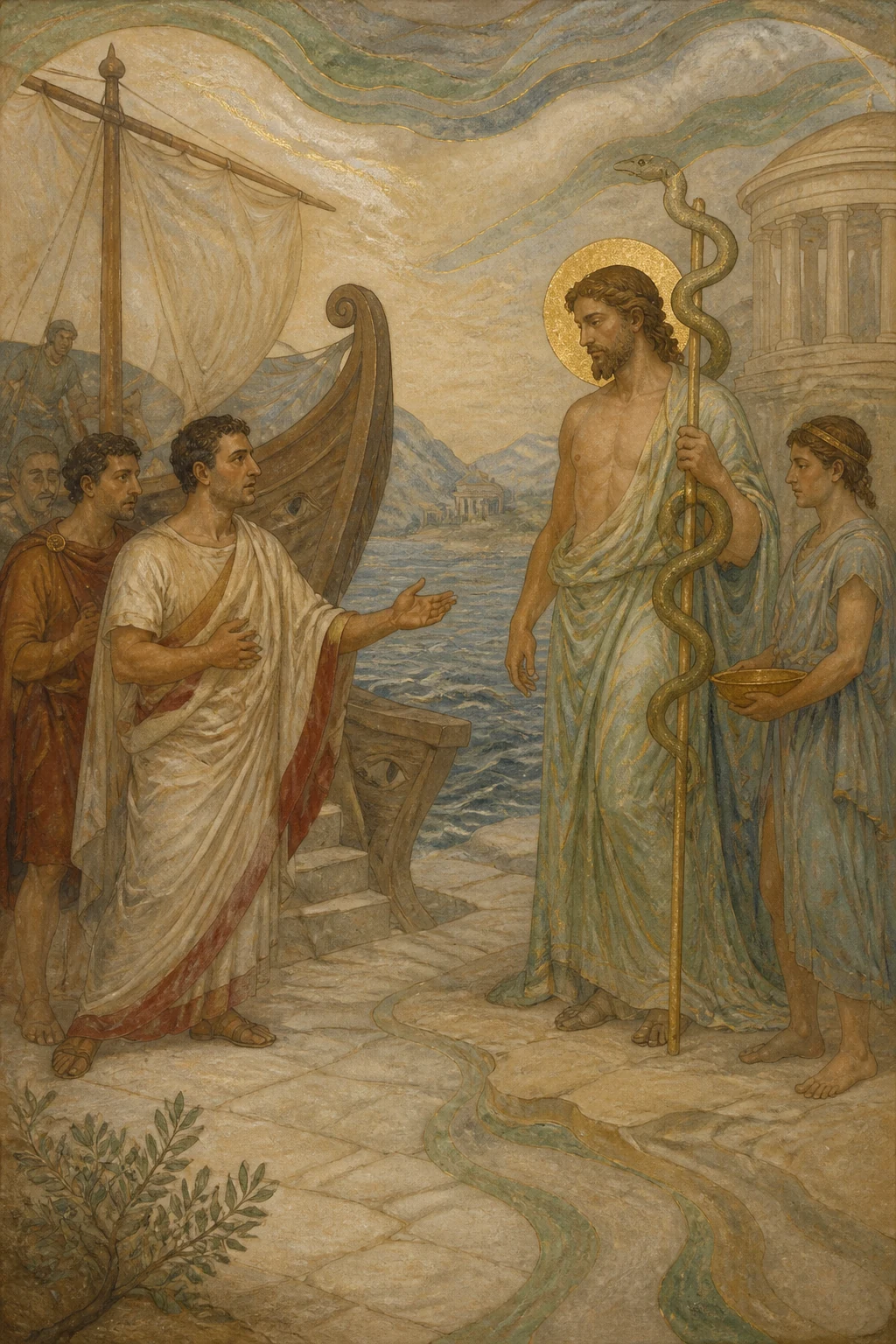
With favouring winds and a following tide, he enters Apollo’s city, his companions at his side. Anius, who ruled its people as their king and served Phoebus as his priest, welcomed him into temple and home, and showed him the city, its famous shrines, and the two trees that Latona once clung to as she gave birth. When incense had been offered to the flames, wine poured upon it, and the entrails of slaughtered oxen burned according to custom, they sought the royal house, where, reclining on sumptuous coverlets, they enjoyed the gifts of Ceres and the flowing wine of Bacchus.
Then the dutiful Anchises said, “Chosen priest of Phoebus, am I mistaken, or, when I first saw these walls, did you have a son and, as I remember, four daughters?” Anius shook his head, his temples bound with snow-white ribbons, and answered sadly, “You are not mistaken, greatest of heroes: you saw the father of five children, whom now—so violently does fortune toss us mortals about!— you see almost bereft. For what help is my absent son, whom the island named after him, Andros, holds as its founding father and the ruler of its realm?
The Delian god gave him the gift of prophecy; to my daughters Bacchus gave other gifts, beyond anything one could wish or believe: whatever my daughters touched was changed to grain, to flowing wine, or to grey Minerva’s oil, and rich indeed were the blessings they bestowed. When the son of Atreus, Troy’s destroyer, learned of this— so you must not think that we escaped all share in the storm that struck you—he used armed force to tear them, unwilling, from their father’s arms, and ordered them to feed the Argive fleet with their heavenly gift.
They fled wherever each could: two sought Euboea, and two their brother’s island, Andros. Soldiers came, threatening war unless they were surrendered. Fear overcame a brother’s love: he gave up his own flesh and blood to punishment—and you may forgive their frightened brother: no Aeneas was there, no Hector to defend Andros, the Hector through whom you held out into the tenth year.
Already chains were being readied for the captives’ arms, when they raised their hands, still free, to heaven and cried, ‘Father Bacchus, help us!’ And the giver of their gift did help—if to destroy them in some wondrous fashion can be called help. How they lost their human shape I could not learn, nor can I tell you now; only the outcome of their sorrow is known: they grew feathers and became your wife’s own birds, snow-white doves.”
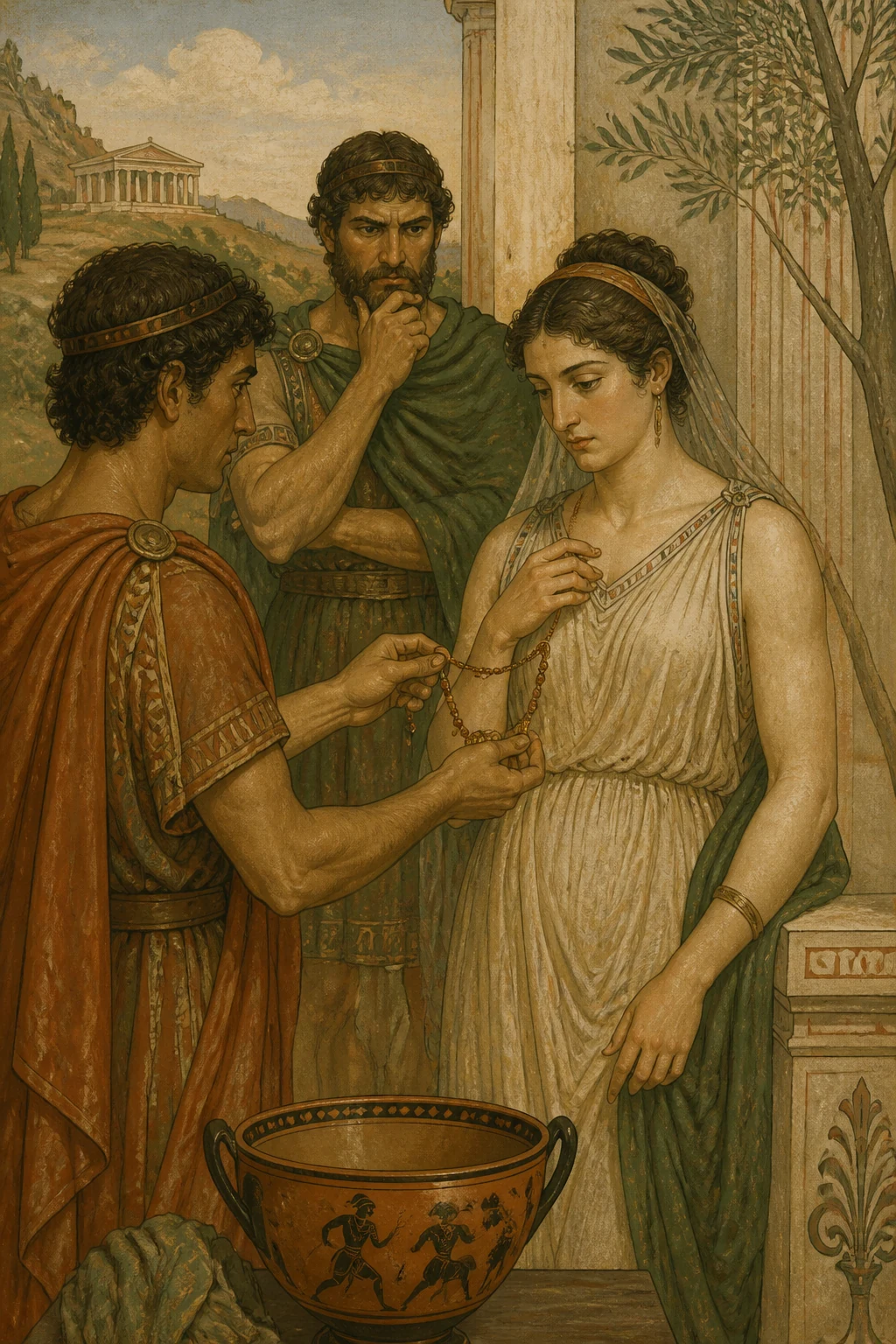
With this and other talk they filled the hours of feasting, then, when the tables were cleared, they sought their beds. At daybreak they rose and consulted the oracle of Phoebus, who told them to seek their ancient mother and their ancestral shores. The king saw them off with gifts: a sceptre for Anchises, a cloak and quiver for his grandson, and for Aeneas a mixing-bowl, which his guest-friend Therses of Ismenus had once brought him from Aonia’s shores.
Therses had sent him this bowl; Alcon of Hyle had made it, engraving it with a long unfolding tale. There was a city, and you could count its seven gates: these served in place of a name, revealing which city it was. Before it, funeral processions, tombs, fires, and pyres, and mothers with streaming hair and breasts laid bare, proclaimed its grief. Even the nymphs seemed to weep and mourn their dried-up springs; a leafless tree stood stark and bare, and goats gnawed at parched rocks.
Here the artist showed Orion’s daughters in the heart of Thebes, two maidens baring their throats and offering their breasts to the blade; then, with weapons plunged into their tender flesh, they lay dead for their people, and were borne through the city in splendid funeral processions and burned in a crowded square. Then, from the maidens’ ashes, lest their line should perish, two young men arose, whom tradition calls the Coroni, and led the funeral rites for their mothers’ ashes.
So far the story shone in figures on the ancient bronze; around the bowl’s upper rim ran raised acanthus leaves of gold. The Trojans returned gifts no less precious than those they received: they gave the priest a casket for keeping incense, a libation bowl, and a crown gleaming with gold and gems.