O besedilu
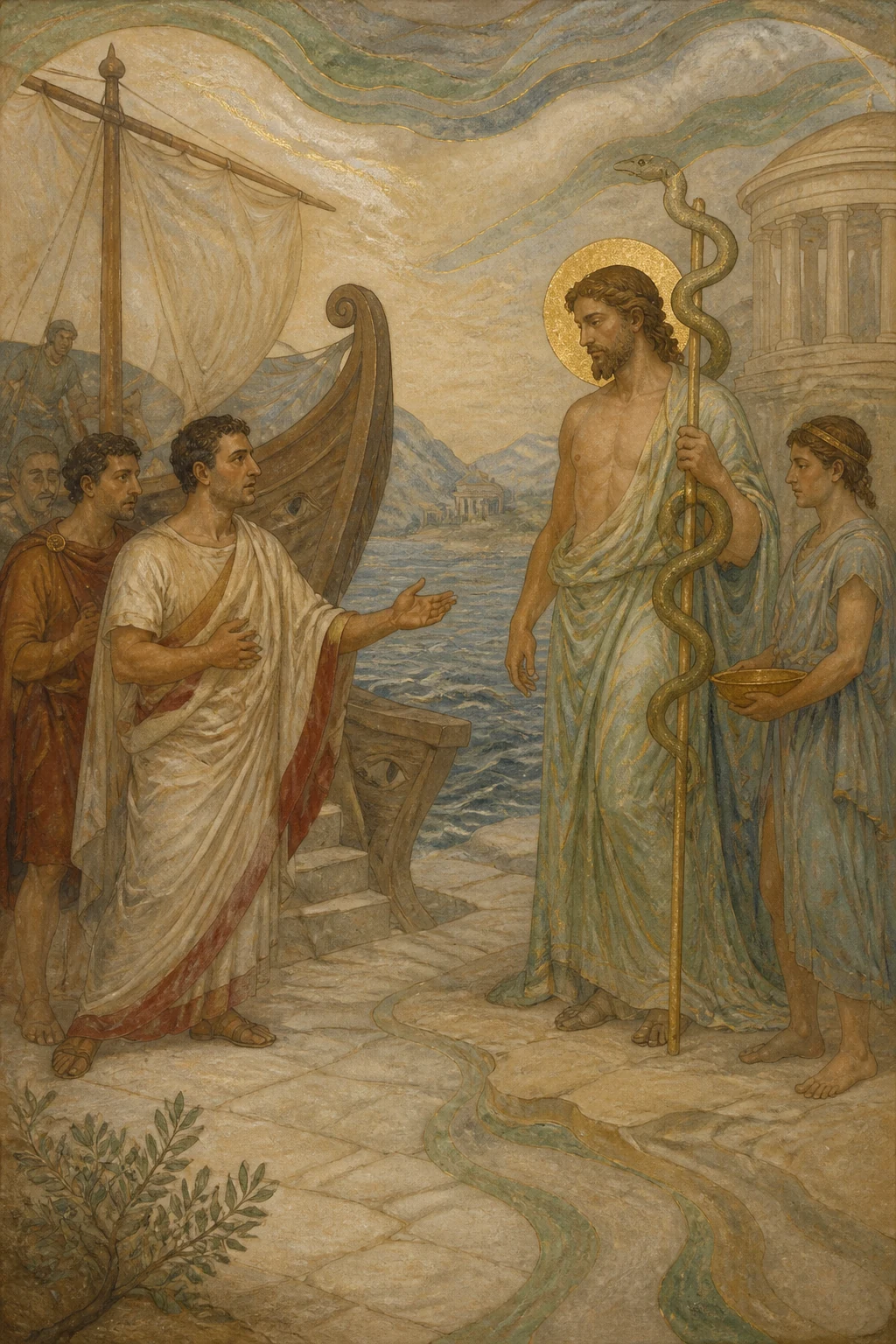
Eskulapov prihod v Rim
- Vir
- Ovidove preobrazbe
- Avtor
- Ovid
- Jezik branja
- English
- Jezik izvirnika
- Latin
- Čas branja
- 7 min branja
- Obseg
- 5 strani
- Naslov izvirnika
- Aesculapius Comes to Rome
O izvirniku
Ovidove preobrazbe
Pesniški tok antičnih preobrazb, kjer bogovi, ljudje in narava stalno menjavajo obliko. Bralni jezik je English, izvirnik pa prihaja iz vira Ovidove preobrazbe v jeziku Latin.
Besedilo
Eskulapov prihod v Rim
Reveal now, Muses, ever-present powers who inspire poets (for you know, and the vast reach of antiquity cannot deceive you), how the island encircled by the deep Tiber's waters brought Coronis's son among the sacred powers of Romulus's city. Once a dreadful plague had tainted the air of Latium, and pale bodies wasted away with a blood-draining sickness. When, weary of funerals, the people saw that human efforts were useless, that the physicians' arts could do nothing, they sought heavenly help and journeyed to Delphi, the earth's central place, where Phoebus speaks his oracles.
They begged him to relieve their misery with a saving prophecy and end the sufferings of so great a city. The shrine, the laurel, and the quiver the god himself carried all trembled together, and from the sanctuary's depths the tripod uttered these words, stirring their frightened hearts: “What you seek here, Roman, you should have sought nearer home; seek it nearer home even now! It is not Apollo you need to lessen your grief, but Apollo's son.
Go under favorable omens, and summon my offspring!” When the wise senate received the god's commands, they inquired what city the son of Phoebus inhabited, and sent envoys to sail for the shores of Epidaurus. As soon as the envoys reached them in their curved ship, they approached the council and the elders of Greece, begging that they grant them the god, whose presence would end the deaths among the Ausonian people: so the unerring oracle declared.
Their opinions differed and divided: some thought such help should not be refused; many urged that they keep their protector, not send him away or surrender their divine power. While they hesitated, twilight drove out the lingering daylight, and the earth's shadow had spread darkness over the world, when the healing god appeared in a dream, standing before your bed, Roman, just as he appears in his temple, holding a rustic staff in his left hand, and with his right smoothing the strands of his long beard, and speaking these words from his tranquil heart: “Lay aside your fears! I shall come and leave my image behind.
Only look closely at this serpent coiled around my staff, and study it well, so that you may recognize it! I shall take its shape, but shall be larger, appearing as great as heavenly bodies should when they assume another form.” At once the god vanished with his words, and with words and god sleep departed; kindly daylight followed the flight of sleep. The next dawn had driven away the fires of the stars.
Uncertain what to do, the leaders came to the splendid temple of the god they sought, and prayed that he would show by heavenly signs where he himself wished to dwell. They had scarcely finished when the god, a serpent gleaming with a lofty golden crest, hissed to announce his coming, and at his arrival shook the statue, the altars, the doors, the marble pavement, and the golden roof.
He reared breast-high in the middle of the temple and looked around with eyes that flashed with fire. The frightened crowd trembled. The priest, his sacred hair bound with a white band, recognized the divine presence. “Behold the god, the god!” he cried. “All who are here, be reverent in heart and tongue! Most glorious one, may your appearance bring us good fortune; help the peoples who observe your rites!”
All who were there worshipped the god they had seen, and all repeated the priest's words; the descendants of Aeneas offered their own devout homage in heart and voice. The god assented, and by shaking his crest gave them a sure pledge, hissing again with his flickering tongue. Then he glided down the shining steps, turned his head backward, and, as he left, looked at his ancient altars, bidding farewell to his familiar home, the temple he had inhabited.
Then, immense, he slithered over ground strewn thick with flowers, bending his coils, and through the city's midst made his way to the harbor sheltered by a curving breakwater. Here he paused and, seeming with a tranquil look to dismiss his escort and the dutiful crowd that followed him, laid his body in the Ausonian ship. It felt the divine burden, and its hull sank beneath the god's weight.
The descendants of Aeneas rejoiced, and, sacrificing a bull on shore, untied the twisted mooring ropes of their garlanded ship. A gentle breeze drove the vessel onward. The god towered high, his neck resting heavily upon the curving stern, and gazed down at the blue waters. With gentle west winds he crossed the Ionian Sea, and at the sixth rising of Dawn, daughter of Pallas, reached Italy, sailing past Lacinian shores, renowned for the goddess's temple, and the coast of Scylaceum.
He left Iapygia behind, passed the Amphrisian rocks with the oars to his left and steep Celennia to his right, and skirted Romethium, Caulon, and Narycian shores. He passed the strait and the narrows of Sicilian Pelorus, the home of King Aeolus, son of Hippotas, and the mines of Temese, then headed for Leucosia and the rose gardens of warm Paestum. Next he skirted Capreae, Minerva's headland, the hills rich in Surrentine vines, Hercules' city, Stabiae, and Parthenope, born for ease, and beyond it the shrine of the Cumaean Sibyl.
From there he reached the hot springs and Liternum, where mastic trees grow, and the Volturnus, dragging great loads of sand beneath its swirling waters; Sinuessa, thronged with snow-white doves; unwholesome Minturnae; the place where Aeneas buried his nurse; the home of Antiphates; Trachas, hemmed in by marshland; Circe's land; and Antium on its crowded shore. When the sailors turned their sailing ship toward this harbor (for the sea was now rough), the god uncoiled himself and, gliding in many curves and mighty coils, entered his father's temple beside the yellow sands.
When the sea grew calm, the Epidaurian left his father's altars, having enjoyed the hospitality of his divine kinsman, and furrowed the shore's sand with his dragging, rattling scales. Resting against the rudder, he laid his head high on the stern, until he came past Castrum and the sacred dwelling place of Lavinium to the Tiber's mouth. Here all the people, crowds of mothers and fathers, rushed from every side to meet him, with those who tend your fires, Trojan Vesta, and hailed the god with joyful cries.
Wherever the swift ship was drawn against the current, incense crackled on altars set in rows along the banks on either side, scenting the air with smoke, and slaughtered victims warmed the knives plunged into them. Now he had entered Rome, the capital of the world. The serpent rose and moved his neck, which had leaned against the mast's top, looking about for a fitting home.
The river divides into two branches, flowing around a place called the Island, and on either side stretches equal arms about the land between. Here the serpent son of Phoebus left the Latin ship and, resuming his heavenly form, brought an end to mourning, coming to the city as its healer. Yet he came as a stranger to join the gods of our shrines:
Izvirnik
Aesculapius Comes to Rome
Naslednje strani prikazujejo izvirno besedilo za primerjavo.
Source ID: ovid_metamorphoses_story_103 Citation: Ovid, Metamorphoses 15.622-15.745 Original language: Latin Source: PerseusDL canonical-latinLit Source URL: https://github.com/PerseusDL/canonical-latinLit/blob/master/data/phi0959/phi006/phi0959.phi006.perseus-lat2.xml Segmentation certainty: medium 622: Pandite nunc, Musae, praesentia numina vatum 623: (scitis enim, nec vos fallit spatiosa vetustas,) 624: unde Coroniden circumflua Thybridis alti 625: insula Romuleae sacris adiecerit urbis.
626: Dira lues quondam Latias vitiaverat auras, 627: pallidaque exsangui squalebant corpora morbo. 628: Funeribus fessi postquam mortalia cernunt 629: temptamenta nihil, nihil artes posse medentum, 630: auxilium caeleste petunt mediamque tenentes 631: orbis humum Delphos adeunt, oracula Phoebi, 632: utque salutifera miseris succurrere rebus 633: sorte velit tantaeque urbis mala finiat, orant: 634: et locus et laurus et, quas habet ipse, pharetras 635: intremuere simul, cortinaque reddidit imo 636: hanc adyto vocem pavefactaque pectora movit: 637: “Quod petis hinc, propiore loco, Romane, petisses,
638: et pete nunc propiore loco! nec Apolline vobis, 639: qui minuat luctus, opus est, sed Apolline nato. 640: Ite bonis avibus prolemque accersite nostram!” 641: Iussa dei prudens postquam accepere senatus, 642: quam colat, explorant, iuvenis Phoebeius urbem, 643: quique petant ventis Epidauria litora mittunt. 644: Quae simul incurva missi tetigere carina, 645: concilium Graiosque patres adiere, darentque, 646: oravere, deum, qui praesens funera gentis 647: finiat Ausoniae: certas ita dicere sortes.
648: Dissidet et variat sententia, parsque negandum 649: non putat auxilium, multi retinere suamque 650: non emittere opem nec numina tradere suadent: 651: dum dubitant, seram pepulere crepuscula lucem, 652: umbraque telluris tenebras induxerat orbi, 653: cum deus in somnis opifer consistere visus 654: ante tuum, Romane, torum, sed qualis in aede 655: esse solet, baculumque tenens agreste sinistra 656: caesariem longae dextra deducere barbae 657: et placido tales emittere pectore voces: 658: “Pone metus! Veniam simulacraque nostra relinquam.
659: Hunc modo serpentem, baculum qui nexibus ambit, 660: perspice et usque nota visu, ut cognoscere possis! 661: Vertar in hunc, sed maior ero tantusque videbor, 662: in quantum verti caelestia corpora debent.” 663: Extemplo cum voce deus, cum voce deoque 664: somnus abit, somnique fugam lux alma secuta est. 665: Postera sidereos aurora fugaverat ignes: 666: incerti, quid agant, proceres ad templa petiti 667: perveniunt operosa dei, quaque ipse morari 668: sede velit, signis caelestibus indicet, orant.
669: Vix bene desierant, cum cristis aureus altis 670: in serpente deus praenuntia sibila misit 671: adventuque suo signumque arasque foresque 672: marmoreumque solum fastigiaque aurea movit 673: pectoribusque tenus media sublimis in aede 674: constitit atque oculos circumtulit igne micantes. 675: Territa turba pavet. Cognovit numina castos 676: evinctus vitta crines albente sacerdos: 677: “En deus est deus est! Animis linguisque favete, 678: quisquis ades!” dixit. “Sis, o pulcherrime, visus 679: utiliter populosque iuves tua sacra colentes !”
680: Quisquis adest, visum venerantur numen, et omnes 681: verba sacerdotis referunt geminata piumque 682: Aeneadae praestant et mente et voce favorem. 683: Adnuit his motisque deus rata pignora cristis 684: et repetita dedit vibrata sibila lingua. 685: Tum gradibus nitidis delabitur oraque retro 686: flectit et antiquas abiturus respicit aras 687: adsuetasque domos habitataque templa salutat.
688: Inde per iniectis adopertam floribus ingens 689: serpit humum flectitque sinus mediamque per urbem 690: tendit ad incurvo munitos aggere portus. 691: Restitit hic agmenque suum turbaeque sequentis 692: officium placido visus dimittere vultu 693: corpus in Ausonia posuit rate: numinis illa 694: sensit onus, pressa estque dei gravitate carina; 695: Aeneadae gaudent caesoque in litore tauro 696: torta coronatae solvunt retinacula navis.
697: Impulerat levis aura ratem: deus eminet alte, 698: impositaque premens puppim cervice recurvam 699: caeruleas despectat aquas modicisque per aequor 700: Ionium zephyris sextae Pallantidos ortu 701: Italiam tenuit praeterque Lacinia templo 702: nobilitata deae Scylaceaque litora fertur; 703: linquit Iapygiam laevisque Amphrisia remis 704: saxa fugit, dextra praerupta Celennia parte, 705: Romethiumque legit Caulonaque Naryciamque, 706: evincitque fretum Siculique angusta Pelori 707: Hippotadaeque domos regis Temesesque metalla, 708: Leucosiamque petit tepidique rosaria Paesti.
709: Inde legit Capreas promunturiumque Minervae 710: et Surrentino generosos palmite colles 711: Herculeamque urbem Stabiasque et in otia natam 712: Parthenopen et ab hac Cumaeae templa Sibyllae. 713: Hinc calidi fontes lentisciferumque tenetur 714: Liternum multamque trahens sub gurgite harenam 715: Volturnus niveisque frequens Sinuessa columbis 716: Minturnaeque graves et quam tumulavit alumnus 717: Antiphataeque domus Trachasque obsessa palude 718: et tellus Circaea et spissi litoris Antium.
719: Huc ubi veliferam nautae advertere carinam 720: (asper enim iam pontus erat), deus explicat orbes 721: perque sinus crebros et magna volumina labens 722: templa parentis init flavum tangentia litus. 723: Aequore placato patrias Epidaurius aras 724: linquit et hospitio iuncti sibi numinis usus 725: litoream tractu squamae crepitantis harenam 726: sulcat et innixus moderamine navis in alta 727: puppe caput posuit, donec Castrumque sacrasque 728: Lavini sedes Tiberinaque ad ostia venit.
729: Huc omnis populi passim matrumque patrumque 730: obvia turba ruit, quaeque ignes, Troica, servant, 731: Vesta, tuos, laetoque deum clamore salutant. 732: Quaque per adversas navis cita ducitur undas, 733: tura super ripas aris ex ordine factis 734: parte ab utraque sonant et odorant aera fumis, 735: ictaque coniectos incalfacit hostia cultros. 736: Iamque caput rerum, Romanam intraverat urbem: 737: erigitur serpens summoque acclinia malo 738: colla movet sedesque sibi circumspicit aptas.
739: Scinditur in geminas partes circumfluus amnis 740: (Insula nomen habet), laterumque a parte duorum 741: porrigit aequales media tellure lacertos. 742: Huc se de Latia pinu Phoebeius anguis 743: contulit et finem, specie caeleste resumpta, 744: luctibus imposuit venitque salutifer urbi. 745: Hic tamen accessit delubris advena nostris:
Nadaljuj z branjem