Prevod
Once upon a time, as never before, there lived a young lad whose parents were poor. He worked as a hired hand wherever he could, earning his daily bread. And because he had been blessed with good looks, all the young men in the village envied him. The other hired hands had taken against him and were forever making fun of him, but he paid no heed to their nonsense and went about his work. When they gathered in the evening to gossip about everything under the sun, he pretended not to understand the barbs they aimed at him, making himself out to be a simpleton. And so they nicknamed him the village gawker. The masters he served were very pleased with him and vied with one another to hire him. Whenever he passed through the village, the girls nudged one another and peeped at him from beneath their eyebrows. And, truth be told, they had something worth looking at. His face was handsome and clear; his hair, black as a raven’s wing, streamed like a mane over his neck, white as snow. A little moustache was just beginning to show, like a shadow on his upper lip. But his eyes! Ah, my dear, he had eyes that had set every girl pining. When the cows were being watered, the girls outdid one another in finding reasons to speak to him, but he took no notice of anyone and pretended not to understand what they wanted. To show one another how little they cared about his indifference, they mockingly called him the village Prince Charming. And why should he not have been? He looked neither right nor left, but went about his business with the cattle, and the work that came from his hands was better done than that of any of the other hired men. Whatever he did, however he managed it, the cows he tended were finer than anyone else’s. They gave more milk than the other men’s cows, for wherever he led them, the pasture was sweeter and more plentiful. You could tell where he had set foot, for even the grass seemed to rejoice. It would seem he had been born under a lucky star and was destined to make something of himself. But he knew nothing of this and had no thought of putting on airs, for he did not know what the course of time held in store for him. Humble as God had made him, he minded his own affairs, never meddling, by word or deed, with other people or their business. And it was precisely for this that the village lads and the other hired hands mocked him. One spring day, tired from following the cows about, he went into the shade of a great leafy tree and fell asleep. And he had certainly chosen a fine spot for it. There was a little valley decked with all manner of flowers, every one in bloom, as though urging a passerby to walk among them. A little farther off, a brook, rising from a spring in the side of a hill, wound its way through burdock and other plants, and the murmur of its waters seemed to invite you to sleep. The tree beneath which he had taken shelter was majestic and seemed to be striving to reach the clouds. Among its spreading branches the little birds courted and built their nests; merely listening to their twittering would kindle the fire of love in anyone’s breast. Its dense leaves cast a shade that made you long to rest beneath it. Clearly, this lad was not such a gawker after all, and the other hired men in the village had unfairly saddled him with that name. No sooner had he laid down his head than he fell asleep. He had scarcely slept longer than it has taken me to tell you this when he suddenly sprang to his feet. He had dreamed a beautiful dream and awakened. He had dreamed that a fairy had come to him—why, a fairy fairer than all the fairies in heaven and on earth—and told him to go
to the court of the emperor who ruled that land, for there he would make his fortune. When he awoke, he said to himself, “Now, what can this mean?” And he began to ponder. All that long day his thoughts gave him no peace, yet he could not make the least sense of such a dream. He did not understand that the star beneath which he had been born was coming to his aid. The next day, when he took the cattle out to pasture again, he turned from his path and gladly went back to that same tree. Once more he lay down at its foot, and once more he dreamed the same dream. When he rose, he said to himself, “There’s something uncanny about this,” and again he spent the whole day lost in thought. On the third day he deliberately made his way past the same tree, lay down beneath it, and dreamed the same dream. This time, moreover, the fairy threatened him with sickness and every human misery if he did not go. So, when he got up and brought the cows home and put them in their enclosure, he went before his master and said, “Master, I’ve a mind to go out into the world and seek my fortune. I’ve worked as a hired hand long enough, and so far I’ve seen no sign that I might better myself. Be so good as to settle what you owe me.” “But why leave me, lad? Aren’t you content with the wages I pay you? Haven’t you enough to eat? Stay with me instead, and I’ll look about for a good village girl with a little dowry. I’ll help you too, as much as my heart prompts me, and you can make a home here like all your neighbours. Don’t go wandering about the world, lest you end up with nothing to your name, as wretched as can be.” “As for being content with you, master, I am indeed. I have enough to eat; I wouldn’t bring God’s anger on me by saying otherwise. But this longing to go out into the world has come upon me, and I won’t stay, no matter what.” When his master saw there was no persuading him to remain, he gave him the little that was still owing, and the lad took his leave and set out. Leaving his village, the young man went straight to the imperial court and hired himself out as a gardener’s hand. The gardener was only too glad to take him on when he saw how good-looking he was, for the emperor’s daughters had already given him several sharp scoldings for hiring the ugliest and most repulsive fellows alive. Good-looking the lad might be, but his clothes—well, what would you expect a cowherd to wear? The gardener had him bathed, gave him clean linen, and dressed him in clothes more fitting for a servant in the imperial gardens. And since the lad had such a well-proportioned figure, his new clothes suited him handsomely. Besides his other gardening duties, his chief task was to make twelve little bouquets every day and give them each morning to the twelve princesses, the emperor’s daughters, when they came out of the palace to walk in the garden. These princesses were fated never to marry until someone discovered the secret of their enchantment and made one of them fall in love. The Fates had endowed them with a passion for dancing. They were mad about it, and every night each of them wore out a pair of white silk slippers dancing. No one knew where they went to dance at night. The emperor was deeply troubled, both by the expense of so many slippers and by his daughters’ icy hearts, which none of the young men who had come to woo them could touch. He had therefore sent word throughout his own country and foreign lands that whoever could tell him what his daughters did at night to wear out a pair of slippers each might choose whichever one he liked for his wife. He knew he kept them all together in a chamber of his palace, shut and barred behind nine iron doors with nine great locks. Yet no one knew what they did at night to wear out their shoes, for no one had ever seen them leave their rooms; indeed, they could not have done so. It would seem they had been doomed to spend their whole lives in this way. Such was their appointed fate. As soon as the emperor’s proclamation became known, suitors began pouring in: sons of princes and emperors, sons of great noblemen, and even sons of lesser nobles. Each in turn kept watch outside the princesses’ door for a night. Every morning the emperor waited most impatiently for good news, but instead he was told that the young man who had taken up his watch the evening before was nowhere to be found. No one knew what had become of them. Not so much as a trace remained. Eleven young men had already suffered this fate. Those who were left began to hang back; they would no longer keep watch. They would forgo marrying girls for whom so many young men had lost their lives. And so, one by one, they left the emperor’s court and went home, abandoning the girls to their fate, for no one was willing to throw his life away for the sake of a woman. The emperor himself was seized with dread at the disappearance of the young men who had tried to watch his daughters, and no longer dared encourage anyone. He was obliged to go on buying twelve pairs of slippers every day, and began to fear that his daughters would grow old by the hearth, braiding white hair without ever wearing a bridal crown. The gardener’s hand carried out his duties faithfully, in his own quiet way. The princesses were pleased with the bouquets he gave them, and the gardener was pleased with his work. When he handed the flowers to the princesses, he never raised his eyes to them; but when he gave the youngest her bouquet, he blushed as red as a peony, without knowing why, and his heart thumped as though it would leap out of his chest. The girl noticed, but supposed the lad was shy, and that this was why he grew so red when he came before them. Day after day it went on, and he knew well enough that such a prize was far beyond his reach. But what could he do with his heart? It kept urging him on, confound it, and he would have liked to keep watch himself, though then he remembered what had happened to those who had watched before him. One day the youngest princess let slip to her sisters how the servant who brought their flowers blushed like a beetroot when he came before them, and how handsome he was. No sooner did the eldest hear such words from her youngest sister than she began to scold her, with a good deal of mockery, asking how she could even think of speaking so kindly of a hired hand, since it might suggest that her heart was beginning to soften towards someone. The lad’s heart urged him to go before the emperor and ask to keep watch himself. Yet, quite apart from knowing his place, and quite apart from remembering the fate of so many young men who had perished, he feared losing his employment and being left with nothing. And, worse still, he was tormented by the thought that if he were driven from the imperial court, he would never see the emperor’s daughters again. For, as he gave them flowers every morning, however much he tried to guard against falling in love, the grace and beauty of the princesses, and above all the gentle gaze of the youngest, had so enchanted him that he felt he could not live if he could no longer touch their hands each morning—hands white as a sheet of paper, with skin as soft as down. Day and night these thoughts tormented him, and he did not know how to fulfil his heart’s desire, without which he felt he could no longer live. One night, falling asleep with his mind fixed on the longing that gnawed at his heartstrings, he dreamed that he saw the fairy from the flowery valley where she had appeared to him before. She said, “Go to the eastern corner of the garden. There you will find two young laurels, one cherry-red and the other rose-coloured. Beside them you will see a little golden hoe, a golden pitcher, and a silken towel. Take these young laurels and plant them in two handsome pots. Tend their soil with the golden hoe, water them with the golden pitcher, wipe them gently with the silken towel, and care for them as you would the apple of your eye. When they have grown to the height of a man, whatever you ask of them will be granted exactly as you wish.” With that she vanished like a phantom, before the gardener’s hand could thank her. He had scarcely shaken off the bewilderment of sleep, had not even rubbed his eyes, when he ran to the eastern corner of the garden. There he was beside himself with joy, for everything the fairy had told him of in his dream stood before him. Now he rubbed his eyes and pinched himself to make sure he was not still asleep. Could what he saw truly be real? Once he was certain it was no vision of the night, he took up the laurels. He tended them as well as he knew how, often loosening their soil with the little hoe he had found there, watering them with the pitcher and wiping them with the towel. Why make a long story of it? He cared for them as for the apple of his eye, just as the fairy had commanded. The laurels grew and flourished as though by a miracle. Before long they were tall. Such beautiful laurels had never been seen. When they reached the height of a man, he came to them one day and said to one, as the fairy had taught him, “Laurel, laurel, with the golden hoe I have tended you, with the golden pitcher I have watered you, with the silken towel I have wiped you. Grant me the gift that, whenever I wish, no one may see me.” He stood dumbfounded with wonder, for at that very instant he saw a flower bud appear, swell and grow, then open into a blossom so lovely that no one could resist smelling it. He reached out, plucked it, and tucked it into his bosom, for this was what the fairy had taught him to do. That evening, when the princesses went into their chamber, locked and barred with nine great locks, to go to bed, he slipped
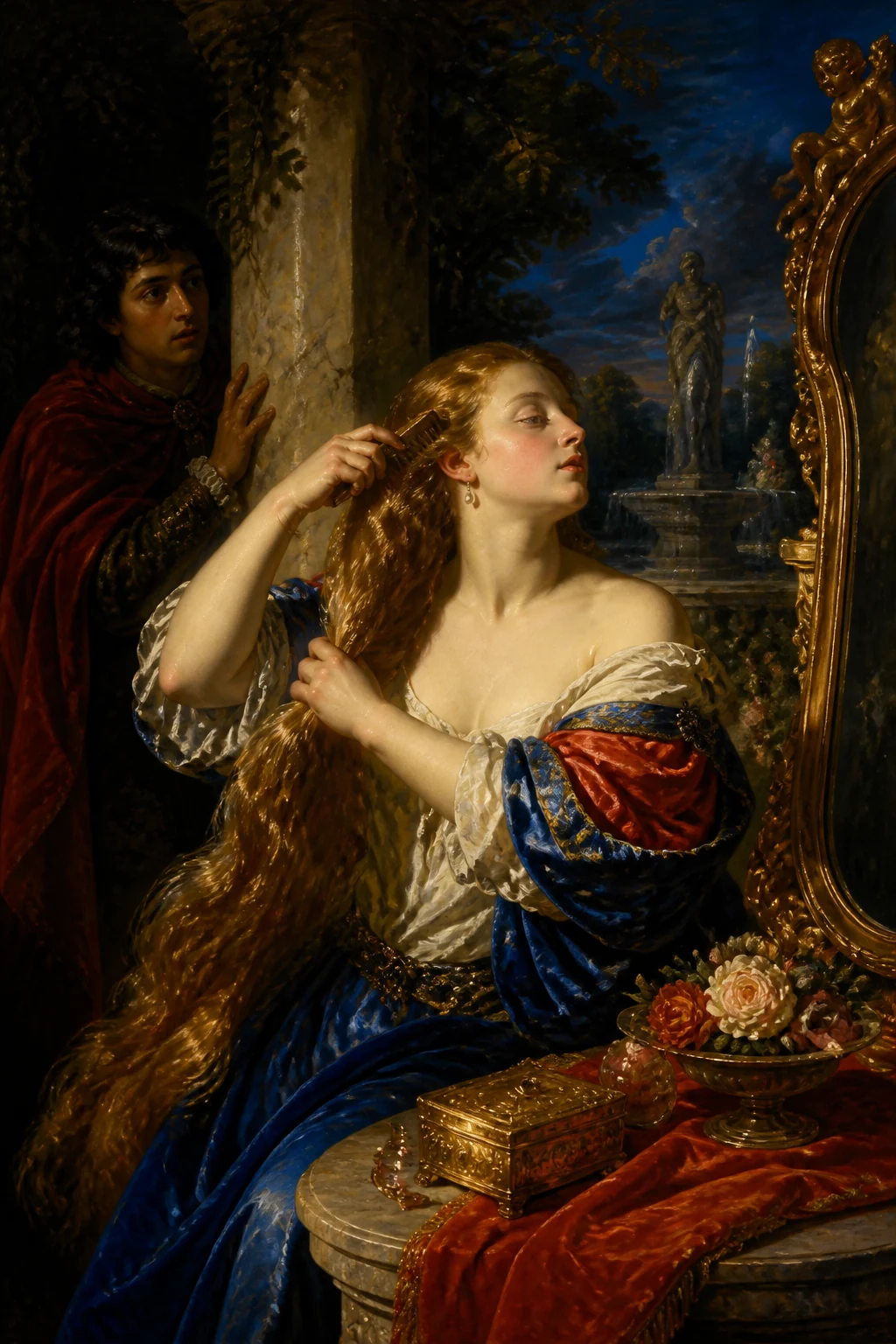
in beside them and entered with them. He could see everything they did, but they could not see him. He watched as, instead of undressing for bed, they began combing their hair, putting on costly clothes, and dressing to go out. Astonished by what he saw, he resolved to follow them closely and discover where they would get out, where they would go, and what they would do. Suddenly the eldest girl said to her sisters, “Are you ready, girls?” “We are ready,” they answered. Then the eldest stamped her foot, and at once the floor of the room opened in two. They went down through the opening and walked on and on until they reached a garden enclosed by a copper wall. As they were about to enter, the eldest stamped her foot again, and the garden’s steel gates swung open. On the way in, the lad stepped on the youngest girl’s dress. She turned quickly, saw no one, and called to her sisters, “Sisters, I suspect someone has slipped along after me. Look, I felt someone tread on my dress.” Her sisters looked all around, and seeing no one either, replied, “Don’t be so suspicious, sister. Who could be here, or follow us? Not even a magic bird could make its way to where we are now. Look and see whether your dress caught on a bramble; timid as you are, you must have imagined someone stepped on it. Don’t be so easily frightened.” She said no more. The lad followed them. They passed through a forest with silver leaves, then another with golden leaves, and then another whose leaves were all diamonds and precious stones, sparkling so brightly they dazzled the eyes. At last they reached a great lake. In the middle of it rose a little hill, and on it stood palaces such as he had never seen before. The emperor’s palaces were nothing beside these, which shone so brightly that you could sooner look at the sun than at them. And they were built with such cunning that when you went up into them you seemed to be going down, and when you came down you seemed to be going up. Twelve little boats, with oarsmen dressed in cloth of pure gold, waited at the shore. As soon as the princesses arrived, each stepped into a boat, and they set off. The gardener’s hand climbed into the youngest girl’s boat. The boats moved away in a line like cranes in flight. Only the youngest girl’s boat kept falling behind. The oarsman wondered why it was heavier than usual and pulled with all his strength to catch up with the others. As soon as they reached the far shore of the lake, music rang out that made you dance whether you wished to or not. The girls darted like lightning into the palace and began dancing with the young men who had kept watch over them. They danced and danced until their slippers wore through. The lad stayed close behind them all the while. And when he entered the palace, what a sight met his eyes! The ballroom was so vast and wide that you could scarcely see its far end. It was adorned with gold and precious stones, and all around it torches burned in candlesticks of pure gold taller than a man. The milk-white walls shone dazzlingly, with bands of gold studded with sapphires and rubies that glittered like fire. The hired hand settled into a corner and gazed at all these marvels. And he had plenty to gaze at, for never had his eyes beheld such things. But as for staying in one place—there was no hope of that! He too went hopping and skipping about against his will, for while that music played, no one could stand still without dancing. Even the candlesticks, tables, and benches in the room were bouncing. And no one could possibly imagine the beauty of the songs and music: organs, flutes, guitars, lutes, long horns, bagpipes, and many other instruments played together in such harmony that the finest musicians in the world would have been struck dumb. And what tunes they played! With what fire they struck up the hora, the bătuta, the “At the Tent Door,” the solo dance, the pipăruș, and all the rest—dances that would leave you gasping for breath. They danced and danced until dawn drew near. Then, all at once, the music stopped, and a table appeared as though out of the ground, laden with every delicacy in the world and some that were not. They all sat down to eat and feasted and made merry to their hearts’ content. The gardener’s hand stayed in his corner and watched with his mouth watering. Black servants, dressed in richly adorned and very costly clothes, waited on them at table. When they rose from the feast, they set off home, returning by the way they had come. The lad clung to their heels like the devil following a monk. As they were passing through the garden of silver leaves, it occurred to the hired hand to break a little branch from one of the trees. At once a mighty rustling filled the whole forest, like an angry storm sweeping down upon the trees. Yet not a single leaf shifted from its place or even trembled as it might in the faintest breeze. The girls started. “What can that be, dear sister?” they said. “What should it be?” replied the eldest. “The little bird that nests in the church tower at our father’s palace must have flown through the leaves, for only she can make her way here.” The girls went on and returned to the palace where they were kept locked up, entering by the same way they had left. The next day, when the gardener’s hand gave the emperor’s daughters their bouquets, he cleverly hid the broken branch among the youngest girl’s flowers. The princess was astonished when she received her bouquet. She looked at the servant with something like pity and could not understand how that little branch had found its way among the flowers she had been given. The second evening passed in the same way. Once more the lad secretly followed them, only this time he broke a little branch from one of the trees with golden leaves and put it among the flowers he gave the youngest princess the following day. Once more the eldest sister soothed the others with reassuring words when they heard the rustling in the forest where the servant had broken off the branch. When the youngest princess received the flowers next day with the little branch hidden among them, a burning thrill ran through her. She waited for a suitable moment, then, pretending she wished to take a walk, went out into the garden. Meeting the servant at a turn in the path, she stopped him and said, “Where did you get the little branch you put in my bouquet?” “From a place Your Highness knows very well.” “So you followed us, and you know where we go at night?” “Something like that, Your Highness.” “How did you manage to come after us without any of my sisters seeing you?” “By stealth.” “Here is a purse of money. Say not a word about our nightly outing.” “My silence is not for sale, Your Highness.” “But if I hear that you have breathed a word, I shall have your head cut off.” Her mouth spoke these harsh words, but her heart was thinking something else. It seemed to her that this servant was growing handsomer and handsomer. On the third night, when he followed them again, still unseen, he broke a little branch in the forest whose trees had diamond leaves. Once more a rustling ran through the foliage, and once more the eldest sister soothed the younger ones’ fears with reassuring words. Yet the youngest princess felt, without knowing why, a secret joy stealing into her heart. The next day, when she found the diamond branch in her bouquet, she stole a sidelong glance at the servant and thought him scarcely different from the sons of princes and emperors. So charming did he seem to her. The lad, for his part, stole longing looks at the princess and saw that she was somewhat troubled, but he pretended to notice nothing and went about his work. The princess’s sisters came upon them talking, and laughed at her and teased her with mocking words. The youngest girl said nothing and swallowed her shame. She could not marvel enough at how the hired hand had managed to discover their secret. You see, she had taken it into her head that this young man could not be an ordinary fellow, since he had found out things that not even enchantresses knew. And indeed, his proud bearing, his handsome, gentle face, showed plainly enough that he was no common servant. Besides, there was something inviting about his appearance and everything about him. When the girls went indoors, the youngest princess told them that the gardener’s hand knew everything they did at night. Then they gathered in council and plotted to make him too lose his heart and his senses, as they had done to the other young men. But this time too the lad slipped into the girls’ chamber to listen to their counsel. It was as though a little hedgehog had whispered in his ear that they were about to discuss something concerning him. Now that he knew everything, everything he needed to know, he went to his laurels and said to the rose-coloured one, “Laurel, laurel! With the golden hoe I have tended you, with the golden pitcher I have watered you, with the silken towel I have wiped you. Grant me the wit and accomplishments of a prince’s or an emperor’s son.” As before, a flower bud sprouted, grew, and opened into a marvellous blossom. He took the flower and tucked it into his bosom. At once the sunburn fell away from his face, leaving it clear and radiant, as though he had only just been born.
He felt something stirring in his mind that he could not account for. Yet he found himself beginning to think differently than he ever had before. It seemed his wits had grown sharper. And all at once he found himself dressed in clothes such as the sons of emperors and princes wore. Then he went to the emperor and asked to be allowed to watch over his daughters for a night. The emperor took pity on his youth and advised him to go about his business rather than throw his life away. But the young man insisted, and the emperor agreed. He never so much as suspected that this was the gardener’s servant, so greatly had the young man changed. When the emperor presented him to his daughters and told them what he wished to do, they did not recognize him either. Only the youngest, whose heart was already troubled by thoughts of him, knew him at once, and began to pine with love. The following night, when they set off to dance, they took him along. He knew what was in store for him, however, and took the greatest care not to fall into their trap. They reached the enchanted palace and danced until nearly dawn, then sat down to supper. He too was brought the drink that all those who had come before him had drunk, the drink meant to rob him of his reason and his senses, the drink that would destroy him as it had the others. Then he turned to the youngest princess, his eyes filled with tears and burning with the love that consumed him, and said tenderly, “Is this what you wish? See, I am to perish for love of you, if your heart is so cold.” “No, my heart is not cold; the fire of your love has warmed it,” she answered. “Do not drink. I would rather be a gardener’s wife with you than an emperor’s daughter.” At these words he flung the drink behind him, drew closer to her, and said, “Have no fear, Your Highness. A gardener’s wife you shall never be.” All those present heard their words. The spell was broken, and every one of them, great and small, suddenly found themselves in the emperor’s palace.
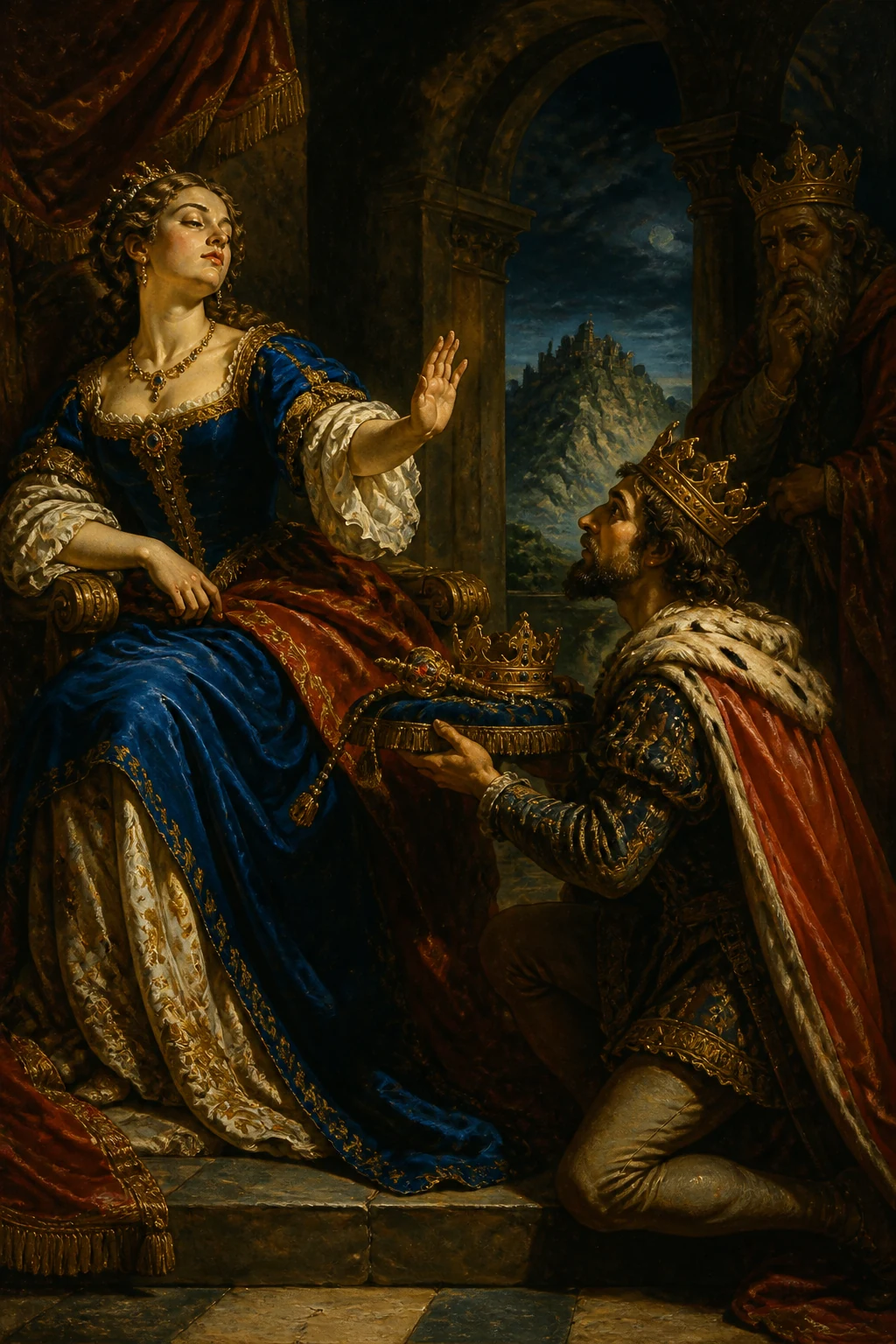
The enchanted palace vanished like a phantom, as though it had never existed in this world. When the emperor saw them, he stood speechless with wonder, clutching his beard in both hands. The former gardener’s servant told him the whole secret of their nightly adventures. The emperor gave his youngest daughter in marriage to the handsome, loving young man. Then the other daughters came forward, each with the son of an emperor or a prince whom she had chosen for herself. The emperor consented and settled each of them in a home of her own. And there was such rejoicing everywhere that a hundred mouths, let alone a single one like mine, could not describe it. Before the wedding, the youngest daughter asked her betrothed what power had enabled him to uncover the secret of their deeds and the spell that held them bound. He told her. Then, so that her husband should have no power beyond her own, but be an ordinary mortal like everyone else, she went and cut down the laurels and threw them into the fire. After that they were married and lived happily, as happily as one may in this motley world of ours, until at last they all reached a ripe old age. And I mounted a saddle, etc.