Prevod
Prišel je dan, ko so vsi travniški prebivalci hiteli sem ter tja, mahali s tipalkami in naglo govorili drug z drugim. Debelega starega Črička ni bilo nikjer na spregled. Rekel je, da šepa na eno nogo in da bo najbolje, če mirno ostane v svoji luknji. Mladi Črički so menili, da ga je strah. Morda ga je res bilo, toda sam je trdil, da šepa.
Vse žuželke, ki so imele svoje luknje, so zlezle vanje in si nesle hrano. Vsi so bili zaskrbljeni in nemirni, nekateri pa celo sitni. Vse to zato, ker je kmet s svojimi delavci prišel na travnik kosit. Začeli so na strani ob cesti, toda z vsakim korakom Konj se je kosilnica bližala prebivalcem, ki so živeli sredi travnika ali niže proti reki.
»To sem že videla,« je rekla Kača podveznica. »Umaknila sem se veliki kosilnici in se skrila v travo ob drevju ali ob štorih, kamor kosilnica ni mogla. Potem pa so prišli možje in tisto travo pokosili s kosami, jaz pa sem se morala odplaziti čez kratka, ostra travna strnišča do svoje luknje. Ko se mi bodo tokrat približali, bom zlezla v luknjo in ostala tam.«
»Saj navsezadnje niso tako slabi,« je rekla Rega. »Na prostem so mi bolj všeč, kakor so mi bili v hiši. Nekoč so me tu zunaj videli, pa me niso skušali ujeti.«
Mimo je prihitela Travniška miš. »Domov moram k svojim mladičkom,« je rekla. »Strah jih bo, če me ne bo tam.« »Kot da jim boš kaj prida pomagala, če boš tam!« je zagodrnjal glas pod njenimi nogami. Stala je nad luknjo, v kateri je tičal debeli stari Čriček s svojo šepavo nogo.
Mama Travniška miš je bila za hip videti precej jezna, potem pa je odgovorila: »Res nisem posebno velika in močna, lahko pa zacvilim in Konjema povem, kje je gnezdo. Potem ne bosta stopila nanj. Lani sem imela tam deset ali dvanajst mladičkov in eden izmed mož jih je pobral, si jih ogledal in jih nato položil nazaj. Tako sem se prestrašila, da mi je dlaka stala pokonci in sem se tresla kakor latovka v vetru.«
»Hm! Preveč prestrašena, da bi zbežala,« je rekel glas pod njenimi nogami. »Matere ne zbežijo in ne pustijo svojih otrok v nevarnosti,« je odgovorila Travniška miš. »Mislim, da je veliko pogumneje biti pogumen, kadar te je strah, kakor takrat, ko te ni.« Švrknila je z dolgim repom in odbrzela skozi travo. Do gnezda ni šla po najkrajši poti, ker je pomislila, da jo Kača podveznica morda opazuje. Ni hotela, da bi izvedela, kje živi. Vedela je, da ima rada mlade Miške, in ni želela, da bi prišla pogledat njene mladičke, medtem ko nje ne bi bilo doma. Govorila je, da Kača ni dobra družba za majhne otroke.
»Nas to prav nič ne moti,« so rekli Komarji s spodnjega konca travnika. »Danes smo tako in tako nenavadno lačni in veseli bomo, ko pridejo možje.«
»Zaradi tega pa res ni treba zganjati takšnega hrupa,« je rekel Metulj monarh. »Preprosto zlezite v svoje luknje ali odletite.« »Včasih stopijo na luknje in jih zaprejo,« je rekla Mravlja. »Kaj bi storil, če bi bil v luknji, pa bi ta nehala biti luknja in bi bila samo še zemlja?«
»Zlezel bi ven, najbrž,« je odgovoril Metulj monarh in brezskrbno zaprhutal. »Že,« je rekla Mravlja, »ampak ne vem, skozi kaj bi se sploh dalo zlesti ven.«
Metulja monarha že ni bilo več. Saj veste, metulji si nikoli zaradi ničesar prav dolgo ne belijo glave. »Je kdo videl Gosenico pedica?« je vprašala Dolgotipalčna kobilica. »Kje je?«
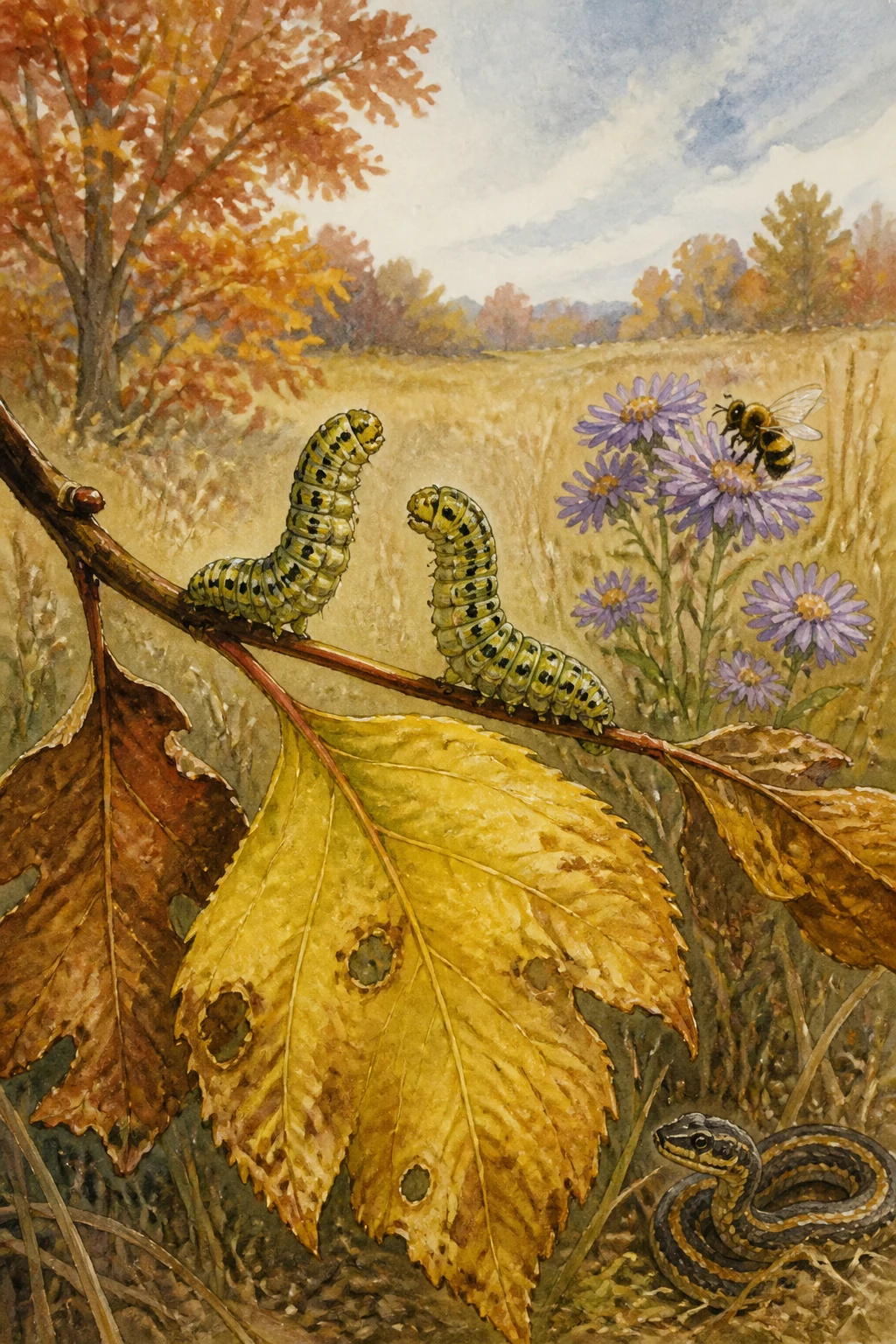
»O, na drevesu sem,« je odgovoril prijazen glas nad njihovimi glavami, »ampak prav dolgo ne bom ostala tu zgoraj. Ko bo trava pokošena, bom prišla dol.«
»Ojoj, ojoj, ojoj!« so vzklikale Mravlje in hitele naokrog. »Ne moremo se domisliti, kaj hočemo storiti. Ne vemo, kaj bi morale storiti. Ne moremo se domisliti in ne vemo, pa tudi ne mislimo, da bi morale!«
»Škljoc!« je rekla Kobilica in se pognala v zrak. »Pohiteti moramo, pohiteti, pohiteti!« S stebelca kreše je skočila na trpotec. »Pohiteti moramo,« je rekla in s trpotca skočila nazaj na krešo.
Visoko na drevesu, kjer je bila Gosenica pedica, je na veji sedelo nekaj Dolgotipalčnih kobilic in predirljivo pelo: »Si že kdaj? Si že kdaj? Kdaj? Kdaj? Kdaj? Si že kdaj?« To kaže, kako zelo so bile vznemirjene, saj so navadno pele samo ponoči.
Potem je po travniku prihrumela kosilnica, ki sta jo vlekla Slepi konj in Lisasti sivec, vodil pa jo je sam kmet. Za njimi so se dvigali oblaki prahu, Kobilice so se z mogočnimi skoki umikale s poti in vse petje in cvrčanje je potihnilo, dokler kosilnica ni šla mimo. Trave s kimajočimi glavicami so zanihale in popadale, ko so ostra rezila zdrsela tik nad tlemi. »Seno bomo postale,« so rekle, »in živele bomo v velikem skednju.«
»Zdaj bomo pognale nove nežne zelene bilke,« so rekle travne korenine. »Lepo vreme za košnjo,« je prhnil Lisasti sivec. »Do poldneva bomo pokosili vso travo na tem travniku.«
»Prijetna tla za hojo,« je rekel Slepi konj in stresel z glavo, da je zažvenketala vprega. Potem so Konja, kmet in kosilnica odšli daleč stran in travniški prebivalci so se spet zbrali.
»No,« je rekla Rega. »Za nekaj časa je mimo.« Mravlje in Kobilice so se vrnile na svoja stara mesta. »Ravno prav smo ravnali,« so veselo vzklikali. »Umaknili smo se s poti.«
Gosenica pedica in Dolgotipalčne kobilice so prilezle z drevesa, ko je mimo prifrčal Metulj monarh. »Okrog gnezda Travniške miši so možje pustili travo nepokošeno,« je povedal Metulj monarh, »Krave zgoraj pri hlevu pa govorijo, kako vesele bodo sena, ko pride mraz.«
»Trava mora rasti in seno je treba pokositi,« je rekla modra stara Rega, »in ko pride čas, vedno vemo, kaj nam je storiti. Puk-rup! Puk-r-r-rup!« »Mislim,« je rekel debeli stari Čriček, ko je prilezel iz svoje luknje, »da je moja šepava noga že dovolj zdrava, da lahko stopim nanjo. Za šepavo nogo ni boljšega kot počitek.«
Izvirnik
There came a day when all the meadow people rushed back and forth, waving their feelers and talking hurriedly to each other. The fat old Cricket was nowhere to be seen. He said that one of his legs was lame and he thought it best to stay quietly in his hole. The young Crickets thought he was afraid. Perhaps he was, but he said that he was lame.
All the insects who had holes crawled into them carrying food. Everybody was anxious and fussy, and some people were even cross. It was all because the farmer and his men had come into the meadow to cut the grass. They began to work on the side nearest the road, but every step which the Horses took brought the mower nearer to the people who lived in the middle of the meadow or down toward the river.
"I have seen this done before," said the Garter Snake. "I got away from the big mower, and hid in the grass by the trees, or by the stumps where the mower couldn't come. Then the men came and cut that grass with their scythes, and I had to wriggle away over the short, sharp grass-stubble to my hole. When they get near me this time, I shall go into my hole and stay there."
"They are not so bad after all," said the Tree Frog. "I like them better out-of-doors than I did in the house. They saw me out here once and didn't try to catch me."
A Meadow Mouse came hurrying along. "I must get home to my babies," she said. "They will be frightened if I am not there."
"Much good you can do when you are there!" growled a voice down under her feet. She was standing over the hole where the fat old Cricket was with his lame leg.
The mother Meadow Mouse looked rather angry for a minute, and then she answered: "I'm not so very large and strong, but I can squeak and let the Horses know where the nest is. Then they won't step on it. Last year I had ten or twelve babies there, and one of the men picked them up and looked at them and then put them back. I was so frightened that my fur stood on end and I shook like June grass in the wind."
"Humph! Too scared to run away," said the voice under her feet.
"Mothers don't run away and leave their children in danger," answered the Meadow Mouse. "I think it is a great deal braver to be brave when you are afraid than it is to be brave when you're not afraid." She whisked her long tail and scampered off through the grass. She did not go the nearest way to her nest because she thought the Garter Snake might be watching. She didn't wish him to know where she lived. She knew he was fond of young Mice, and didn't want him to come to see her babies while she was away. She said he was not a good friend for young children.
"We don't mind it at all," said the Mosquitoes from the lower part of the meadow. "We are unusually hungry today anyway, and we shall enjoy having the men come."
"Nothing to make such a fuss over," said a Milkweed Butterfly. "Just crawl into your holes or fly away."
"Sometimes they step on the holes and close them," said an Ant. "What would you do if you were in a hole and it stopped being a hole and was just earth?"
"Crawl out, I suppose," answered the Milkweed Butterfly with a careless flutter.
"Yes," said the Ant, "but I don't see what there would be to crawl out through."
The Milkweed Butterfly was already gone. Butterflies never worry about anything very long, you know.
"Has anybody seen the Measuring Worm?" asked the Katydid. "Where is he?"
"Oh, I'm up a tree," answered a pleasant voice above their heads, "but I sha'n't be up a tree very long. I shall come down when the grass is cut."
"Oh, dear, dear, dear!" cried the Ants, hurrying around. "We can't think what we want to do. We don't know what we ought to do. We can't think and we don't know, and we don't think that we ought to!"
"Click!" said a Grasshopper, springing into the air. "We must hurry, hurry, hurry!" He jumped from a stalk of pepper-grass to a plantain. "We must hurry," he said, and he jumped from the plantain back to the pepper-grass.
Up in the tree where the Measuring Worm was, some Katydids were sitting on a branch and singing shrilly: "Did you ever? Did you ever? Ever? Ever? Ever? Did you ever?" And this shows how much excited they were, for they usually sang only at night.
Then the mower came sweeping down the field, drawn by the Blind Horse and the Dappled Gray, and guided by the farmer himself. The dust rose in clouds as they passed, the Grasshoppers gave mighty springs which took them out of the way, and all the singing and shrilling stopped until the mower had passed. The nodding grasses swayed and fell as the sharp knives slid over the ground. "We are going to be hay," they said, "and live in the big barn."
"Now we shall grow some more tender green blades," said the grass roots.
"Fine weather for haying," snorted the Dappled Gray. "We'll cut all the grass in this field before noon."
"Good feeling ground to walk on," said the Blind Horse, tossing his head until the harness jingled.
Then the Horses and the farmer and the mower passed far away, and the meadow people came together again.
"Well," said the Tree Frog. "That's over for a while."
The Ants and the Grasshoppers came back to their old places. "We did just the right thing," they cried joyfully. "We got out of the way."
The Measuring Worm and the Katydids came down from their tree as the Milkweed Butterfly fluttered past. "The men left the grass standing around the Meadow Mouse's nest," said the Milkweed Butterfly, "and the Cows up by the barn are telling how glad they will be to have the hay when the cold weather comes."
"Grass must grow and hay be cut," said the wise old Tree Frog, "and when the time comes we always know what to do. Puk-rup! Puk-r-r-rup!"
"I think," said the fat old Cricket, as he crawled out of his hole, "that my lame leg is well enough to use. There is nothing like rest for a lame leg."