Prevod
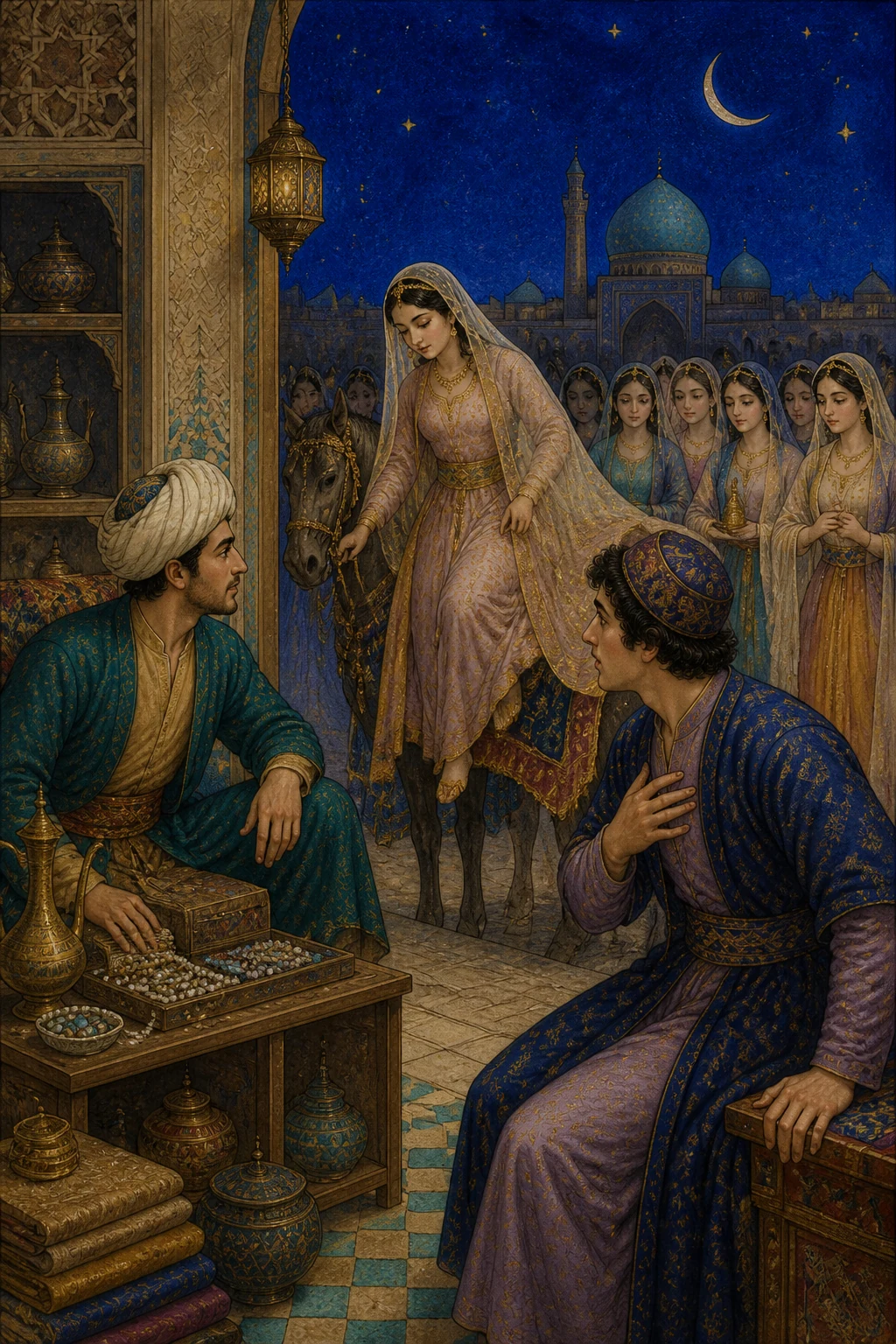
It is also related, O fortunate king, that in ancient times, in ages long gone, there lived in the land of Persia a king named Shahraman, whose seat was in Khurasan. He had a hundred concubines, yet in all his life none had borne him a son or a daughter. One day he reflected on this and lamented that most of his life had passed without his being blessed with a son to inherit the kingdom after him, as he himself had inherited it from his fathers and forefathers. The thought plunged him into the deepest sorrow and distress. As he sat one day, one of his mamluks came in and said, “My lord, at the gate is a merchant with a slave girl more beautiful than any ever seen.” “Bring me the merchant and the girl,” said the king. They were brought before him, and he found her straight and slender as a Rudayni spear, wrapped in a silken mantle embroidered with gold. The merchant unveiled her face, and her beauty lit up the room. Seven tresses hung down to her anklets like horses’ tails. She had kohl-dark eyes, full hips, and a slender waist; she could cure the sick man’s sorrow and quench the fire of longing. As the poet said:
I am enthralled by her, whose beauty is complete, perfected by serenity and grace. Neither tall nor short is she, yet her hips strain against her mantle. Her figure strikes the mean between fullness and slenderness, with neither height nor shortness to offend. Her hair flows past her anklets, yet her face is everlasting day. The king marvelled at her beauty, her loveliness, and the perfect proportions of her figure, and said to the merchant, “Old man, how much is this girl?” The merchant replied, “My lord, I bought her for two thousand dinars from the merchant who owned her before me. I have travelled with her for three years, and by the time I reached this place I had spent another three thousand dinars. She is my gift to you.” The king bestowed a splendid robe of honour upon him and ordered that he be given ten thousand dinars. The merchant took the money, kissed the king’s hands, thanked him for his gracious generosity, and departed. Then the king entrusted the girl to the tirewomen, saying, “Attend to this girl and adorn her. Furnish a private chamber for her and take her there.” He ordered his chamberlains to carry to her everything she needed. The kingdom in which he dwelt lay beside the sea, and his city was called the White City. They brought the girl into a private chamber whose windows overlooked the sea. And dawn overtook Shahrazad, and she fell silent, leaving her tale untold.
When it was the seven hundred and thirty-ninth night
She said: It has reached me, O fortunate king, that when the king took the girl and entrusted her to the tirewomen, he said, “Attend to her and take her into a private chamber,” and ordered his chamberlains to shut all the doors upon her after carrying in everything she needed. So they brought her into a chamber whose windows overlooked the sea. Then the king went in to the girl, but she neither rose for him nor paid him any heed. “It seems,” he said, “that she lived among people who taught her no manners.” He turned to look at her and saw that she was surpassingly lovely, with a figure of perfect grace and proportion, her face like the full moon’s round disk or the radiant sun in a cloudless sky. He marvelled at her beauty and her shapely form, and glorified God the Creator, exalted be His power. Then he approached her and sat beside her, drew her to his breast, seated her on his lap, and tasted the moisture of her lips, finding it sweeter than honey. He ordered tables to be brought, laden with the finest dishes of every kind. The king ate and fed her morsels until she was satisfied, yet she did not speak a single word. He began talking to her and asking her name, but she remained silent, neither uttering a word nor answering him, her head still bowed towards the ground. Only her extraordinary beauty and loveliness, and her beguiling charm, shielded her from his anger. The king said to himself, “Glory be to God who created this girl! How enchanting she is, except that she does not speak! But perfection belongs to God Most High alone.” Then he asked the serving girls whether she had spoken. “From the moment she arrived until now,” they answered, “she has not uttered a single word, nor have we heard her voice.” So the king summoned some of his slave girls and concubines and ordered them to sing to her and make merry with her, in the hope that she might speak. They performed before her with every kind of music, play, and diversion, and sang until everyone in the gathering was enraptured. But the girl merely watched them in silence, neither laughing nor speaking. The king grew disheartened, dismissed the girls, and remained alone with her.
Then he took off his clothes and hers, and looked upon her body, which seemed an ingot of silver, and his love for her grew immense. He lay with her and took her maidenhead, finding her a virgin. He rejoiced exceedingly and said to himself, “How wonderful! How could a girl so lovely in figure and appearance have remained a virgin in the hands of merchants?” Thereafter he devoted himself wholly to her and paid no attention to anyone else, forsaking all his concubines and favourites. He spent an entire year with her as though it were a single day, yet still she did not speak. One day, when his love and passion had grown still stronger, he said to her, “O desire of every soul, great is my love for you. For your sake I have forsaken all my slave girls, concubines, wives, and favourites, and made you my portion in this world. For a whole year I have been patient with you, and I ask God Most High, in His bounty, to soften your heart towards me so that you may speak to me. If you are mute, tell me by a sign, that I may abandon hope of hearing your voice. I pray that God, glory be to Him, will grant me a son by you to inherit my kingdom after me, for I am alone and without an heir, and I have grown old. By God, if you love me, give me an answer.” The girl bowed her head towards the ground in thought, then raised it and smiled at the king, so that he imagined lightning had filled the chamber. She said, “O valiant king, O mighty lion, God has answered your prayer. I am with child by you, and the time of my delivery is near, though I do not know whether the child is male or female. Had I not conceived by you, I would never have spoken a single word to you.”
When the king heard her words, his face shone with joy and delight, and in his great happiness he kissed her head and hands. “Praise be to God,” he said, “who has granted me two things I longed for: first, that you should speak; and second, that you should tell me you are with child by me.” Then he rose, went out, and sat upon his royal throne in the utmost delight. He ordered the vizier to distribute a hundred thousand dinars among the poor, the needy, widows, and others, as alms on his behalf and in thanksgiving to God Most High. The vizier did as the king commanded. Afterwards the king returned to the girl, sat beside her, embraced her, and drew her to his breast. “My lady,” he said, “you who hold me as your slave, why have you been silent? You have been with me for a whole year, night and day, waking and sleeping, yet never once in all that year did you speak to me until today. What was the reason for your silence?” The girl replied, “Listen, O king of the age. Know that I am a wretched stranger, brokenhearted, parted from my mother and my family.” When the king heard this, he understood her meaning and said, “As for calling yourself wretched, there is no place for such words. My whole kingdom, my possessions, and all that I enjoy are at your service, and I too have become your slave. As for your saying that you are parted from your mother, your family, and your brother, tell me where they are, and I will send for them and have them brought to you.” She said, “Know, O fortunate king, that my name is Julnaz of the Sea. My father was one of the kings of the sea. When he died, he left us his kingdom, but while we were ruling it another king rose against us and took it from our hands. I have a brother named Salih, and my mother is one of the women of the sea. My brother and I quarrelled, and I swore that I would cast myself upon the mercy of a man of the land. So I left the sea and sat by moonlight on the shore of an island. A man passed by, took me, and carried me home. He tried to have his way with me, but I struck him on the head and nearly killed him. Then he took me out and sold me to the man from whom you bought me, a good and upright man, devout, trustworthy, and honourable. Had your heart not loved me, and had you not preferred me above all your concubines, I would not have stayed with you a single hour. I would have thrown myself into the sea from this window and returned to my mother and my people. But I was ashamed to go to them carrying your child, lest they think ill of me. Even if I swore to them, they would not believe me when I told them that a king had bought me with his own money, made me his portion in this world, and chosen me above his wives and all the women in his possession. That is my story, and there is no more to tell.” And dawn overtook Shahrazad, and she fell silent, leaving her tale untold.
When it was the seven hundred and fortieth night
She said: It has reached me, O fortunate king, that when King Shahraman questioned Julnaz of the Sea, she told him her story from beginning to end. When he heard it, he thanked her, kissed her between the eyes, and said, “By God, my lady and light of my eyes, I could not bear to be parted from you for a single hour. If you left me, I would die that instant. What then is to be done?” She replied, “My lord, the time of my delivery draws near, and my family must be present to attend me, for the women of the land do not know how the daughters of the sea give birth, nor do the daughters of the sea know how the women of the land give birth. When my family come, I can move freely among them, and they among me.” The king asked, “How can they walk in the sea without getting wet?” She answered, “We walk in the sea as you walk upon the land, through the blessing of the names engraved upon the ring of Solomon son of David, peace be upon them both. But, O king, when my family and my kin arrive, I shall tell them that you bought me with your own money and have treated me with kindness and generosity. You must confirm my words before them, so that they may see your circumstances with their own eyes and know that you are a king and the son of a king.” The king said, “My lady, do whatever you wish and desire. I shall obey you in all you do.” The girl said, “Know, O king of the age, that we travel through the sea with our eyes open. We see all that is in it, and we see the sun, the moon, the stars, and the sky just as though we were on the face of the earth, and it does us no harm. Know also that in the sea there are many peoples and many different forms of all the creatures found upon the land. Indeed, all that is on land is very little compared with what is in the sea.” The king marvelled at her words.
Then the girl took two pieces of Qamari aloeswood from the shoulder of her garment, broke off a portion, kindled a brazier, and cast the wood into it. She gave a piercing whistle and began speaking words that no one could understand. A great cloud of smoke rose as the king watched. Then she said to him, “My lord, go and hide in an inner room, so that I may show you my brother, my mother, and my family without their seeing you. I wish to bring them here, and in this very place, at this very hour, you shall behold wonders and marvel at the diverse shapes and strange forms God Most High has created.” The king rose at once and went into an inner room, from which he watched what she did. She continued burning incense and reciting incantations until the sea foamed and surged, and a handsome youth of splendid appearance rose from it, like the moon at its full. His brow was radiant, his cheeks rosy, and his hair like pearls and jewels. No one could have resembled his sister more closely, and his very appearance seemed to recite these two verses:
The moon attains its fullness once a month, but the beauty of your face grows fuller every day. It takes its lodging in a single mansion of the zodiac, while every heart affords a home to you. Then a grey-haired old woman emerged from the sea, accompanied by five girls like moons, all bearing a resemblance to the girl named Julnaz. The king saw the youth, the old woman, and the girls walking upon the surface of the water towards her. When they drew near the window and Julnaz saw them, she rose and greeted them with joy and delight. At the sight of her they recognized her, came in, embraced her, and wept bitterly. Then they said, “Julnaz, how could you leave us for four years without letting us know where you were? By God, the world has grown narrow around us in the anguish of parting from you. Not a day have we found pleasure in food or drink, and night and day we have wept with longing for you.” The girl kissed the hand of the young man, her brother, and the hand of her mother, and greeted her cousins likewise. They sat with her for a while, asking after her condition, what had happened to her, and how she now fared. She said, “Know that when I left you and came out of the sea, I sat on the shore of an island. A man took me and sold me to a merchant, who brought me to this city and sold me to its king for ten thousand dinars. The king lavished care upon me, forsaking all his concubines, wives, and favourites for my sake, and I have occupied him to the exclusion of everything he possesses and everything in his city.”
When her brother heard this, he said, “Praise be to God who has reunited us with you! But my wish, sister, is that you should rise and return with us to our country and our people.” At these words the king almost lost his reason, fearing that the girl would agree to her brother’s request and that he would be powerless to prevent her, passionately in love with her as he was. He was bewildered and terrified at the thought of losing her. But when Julnaz heard her brother’s words, she said, “By God, brother, the man who bought me is king of this city, a mighty king, wise, generous, and good, bountiful beyond measure. He has honoured me, and he is a man of noble character and great wealth. He has neither son nor daughter. He has treated me kindly and shown me every goodness. From the day I came to him until now, I have never heard him say one harsh word to wound my feelings. He is always gentle with me and does nothing without consulting me. With him I live in the happiest circumstances and enjoy every blessing. Moreover, if I left him, he would perish, for he cannot bear to be parted from me, not even for a single hour. And I too would die if I left him, so greatly do I love him for all the kindness he has shown me during my stay. Even if my father were alive, I would not enjoy with him the standing I enjoy with this great and exalted king. You have seen that I am carrying his child. Praise be to God who made me the daughter of a king of the sea and gave me as husband the greatest of the kings of the land! God Most High has not forsaken me, but has given me something better in return.” And dawn overtook Shahrazad, and she fell silent, leaving her tale untold.
When it was the seven hundred and forty-first night
She said: It has reached me, O fortunate king, that Julnaz of the Sea told her brother her whole story, saying, “God Most High has not forsaken me, but has given me something better in return. The king has neither son nor daughter, and I pray that God Most High will grant me a son to inherit from this mighty king the mansions, palaces, and estates with which God has endowed him.” When her brother and her cousins heard her words, their hearts were gladdened, and they said, “Julnaz, you know your place among us and how dearly we love you. You know that you are dearer to us than anyone else, and you must believe that we desire only your ease, free of trouble and hardship. If you are not happy, rise and return with us to our land and our family. But if you are happy here, honoured and content, that is all we wish and hope for, for in every circumstance we desire nothing but your happiness.” Julnaz replied, “By God, I live in the utmost comfort, happiness, and honour, with all that I could wish.” When the king heard these words, he rejoiced and his heart was reassured. He thanked her inwardly, and his love for her grew still stronger and entered the very depths of his heart. He knew now that she loved him as he loved her, and that she wished to remain with him until she saw the child she would bear him.
Then Julnaz of the Sea ordered her serving girls to bring tables laden with dishes of every kind. Julnaz had herself overseen the cooking in the kitchen, and the girls brought them food, sweetmeats, and fruit. She ate with her family, and afterwards they said, “Julnaz, your lord is a stranger to us. We have entered his house without his permission, and he knows nothing of us, though you praise his generosity to us. You have also brought us his food and we have eaten it, yet we have not met him. We have not seen him, nor has he seen us; he has neither joined us nor eaten with us, so that bread and salt might bind us together.” They all refused to eat any more and grew angry with her, and fire streamed from their mouths like blazing torches. When the king saw this, he almost lost his wits with terror. Julnaz rose and soothed them, then went into the inner room where the king, her lord, was hiding. “My lord,” she said, “have you seen and heard how I thanked and praised you before my family? Have you heard them say that they wish to take me back with them to our people and our country?” The king replied, “I have heard and seen. May God reward you well on our behalf! By God, not until this blessed hour did I know the measure of your love for me, though I never doubted that you loved me.” She said, “My lord, is the reward of goodness anything but goodness? You have treated me kindly, lavished great blessings upon me, and shown me the deepest love. You have done me every kindness and preferred me above all those you love and desire. How, then, could my heart consent to leave you and go away? How could it, when you are so kind and generous to me? I ask you, of your graciousness, to come and greet my family, so that you may see them and they may see you, and friendship and affection may grow between you. Know, O king of the age, that my brother, my mother, and my cousins have come to love you dearly because of my praise of you. They have said, ‘We will not leave you and return to our country until we have met the king and greeted him.’ They wish to see you and enjoy your company.” The king replied, “I hear and obey, for that is my own desire.”
He rose and went to them, greeting them most courteously. They hastened to rise and received him with the greatest warmth. He sat with them in the palace and ate with them at the table, and remained in their company for thirty days. Then they wished to return to their own country and dwelling places, and took leave of the king and Queen Julnaz of the Sea. They departed after the king had honoured them most lavishly. In time Julnaz completed the days of her pregnancy, and when the hour of delivery came she gave birth to a boy like the moon at its full. The king was overjoyed, for never in his life had he been blessed with a son or daughter. They held festivities and adorned the city for seven days, amid the greatest happiness and delight. On the seventh day Queen Julnaz’s mother, her brother, and all her cousins arrived, having learned that she had given birth. And dawn overtook Shahrazad, and she fell silent, leaving her tale untold.
When it was the seven hundred and forty-second night
She said: It has reached me, O fortunate king, that when Julnaz had given birth and her family came to her, the king welcomed them and rejoiced at their arrival. He said, “I resolved not to name my son until you came, so that you might choose his name yourselves.” They named him Badr Basim, and all agreed upon the name. Then they presented the boy to his maternal uncle Salih, who took him in his arms, rose from among them, and walked about the palace to the right and left. Then he carried him out of the palace, went down into the salt sea with him, and walked on until he vanished from the king’s sight. When the king saw him take his son and disappear into the depths of the sea, he gave the child up for lost and began to weep and wail. Seeing him in this state, Julnaz said, “O king of the age, do not fear or grieve for your son. I love my child even more than you do. He is with my brother, so do not be troubled by the sea or fear that he will drown. Had my brother known that any harm would come to the little one, he would not have done this. This very hour he will bring your son back safe, God Most High willing.” Scarcely an hour had passed when the sea churned and surged, and the child’s uncle emerged from it with the king’s son unharmed. He flew from the sea until he reached them, the child quiet in his arms, his face like the moon on the night of its fullness.
Then the child’s uncle looked at the king and said, “Perhaps you feared some harm might befall your son when I took him down into the sea?” “Yes, my lord,” the king replied. “I feared for him and never thought he would escape it alive.” Salih said, “O king of the land, we have anointed his eyes with a kohl known to us, and recited over him the names engraved upon the ring of Solomon son of David, peace be upon them both. Whenever a child is born among us, we do as I have described to you. So do not fear that he will drown or suffocate, or that any sea he enters will harm him. Just as you walk upon the land, so we walk in the sea.” Then he took a sealed pouch from his pocket, broke its seal, and poured out its contents. From it fell strings of gems of every kind, rubies and other precious stones, three hundred rods of emerald, and three hundred shafts of great jewels as large as ostrich eggs, their radiance brighter than the light of the sun and moon. He said, “O king of the age, these jewels and rubies are my gift to you. We have never brought you a gift before, for we did not know where Julnaz was, nor had we any trace or news of her. Now that we have found you joined to her, and we have all become one family, we have brought you this gift. Every little while we shall bring you its like, God Most High willing, for these jewels and rubies are more plentiful among us than pebbles upon the land. We know the good from the poor, and all the ways to find them and the places where they lie, and they are easy for us to obtain.” When the king saw those jewels and rubies, his mind reeled and his wits were confounded. “By God,” he said, “a single one of these gems is worth my kingdom!” He thanked Salih of the Sea for his generosity, then looked at Queen Julnaz and said, “Your brother has put me to shame with his bounty and this magnificent gift, beyond the reach of the people of the earth.” Julnaz thanked her brother for what he had done, but he said, “O king of the age, yours is the prior claim upon us, and our gratitude is your due. You have treated my sister kindly, and we have entered your house and eaten your food. As the poet said:
Had I wept for love of Sa‘di before she wept, I would have eased my soul before regret could come. But she wept first, and her tears stirred mine, so I said, ‘The honour belongs to the one who began.’ Then Salih said, “O king of the age, even if we stood upon our faces in your service for a thousand years, we could not repay you. It would still be little beside your worth.” The king thanked him profusely, and Salih, his mother, and his cousins stayed with him for forty days. Then Salih, Julnaz’s brother, rose and kissed the ground before the king, his sister’s husband. “What do you wish, Salih?” the king asked. Salih replied, “O king of the age, you have showered us with kindness. We ask now that, in your graciousness, you grant us leave to depart, for we long for our families, our country, our kindred, and our homes. We shall never cease to attend you, my sister, and my sister’s son. By God, O king of the age, my heart cannot bear to part from you, but what can we do? We were reared in the sea, and the land does not suit us.” When the king heard this, he rose to his feet and bade farewell to Salih of the Sea, his mother, and his cousins. They wept together at parting, and said to him, “Soon we shall be with you again. We shall never abandon you, but shall visit you every little while.” Then they flew towards the sea, entered it, and vanished from sight. And dawn overtook Shahrazad, and she fell silent, leaving her tale untold.
When it was the seven hundred and forty-third night
She said: It has reached me, O fortunate king, that when Julnaz’s sea-born kindred bade farewell to her and the king, they wept at their parting, then flew into the sea and vanished from sight. The king treated Julnaz with ever greater kindness and honour, and the little boy flourished. His uncle, grandmother, aunt, and his mother’s cousins would come to the king’s palace every little while, stay for a month or two, then return to their own dwellings. As the boy grew older, he grew ever more handsome, until he reached the age of fifteen. He was unequalled in perfection, stature, and grace. He had learned penmanship, reading, histories, grammar, language, and archery; he had learned to wield the lance, to ride, and all the other accomplishments required of kings’ sons. Not a man or woman in the city failed to speak of the youth’s charms, for his beauty and perfection were extraordinary, and he embodied the poet’s words:
His down has traced in amber upon pearl two lines of jet across an apple’s blush. Death lies in his languid eyes when they glance, and drunkenness in his cheeks, not in the wine. The king loved him exceedingly. He summoned the vizier, the emirs, the officers of state, and the great men of the kingdom, and bound them by solemn oaths to make Badr Basim king over them after his father. They swore the binding oaths with gladness. The king was kind to all, gentle in speech and a source of goodness, speaking only of what would benefit the people. On the following day he rode out with the officers of state, the emirs, and all the troops. They passed through the city and returned. When they drew near the palace, the king dismounted to attend his son, and he and all the emirs and officers of state carried the ceremonial saddlecloth before him, each taking his turn for a while. They continued thus until they reached the palace vestibule, the prince still mounted. Then he dismounted, and his father and the emirs embraced him and seated him upon the royal throne. His father and the emirs stood before him. Badr Basim judged between the people, dismissing the unjust and appointing the just, and continued to administer affairs until nearly noon. Then he rose from the throne and went in to his mother, Julnaz of the Sea, with the crown upon his head, looking like the moon. When she saw him, with the king attending him, she rose, kissed him, congratulated him on his kingship, and prayed that he and his father might live long and triumph over their enemies. He sat with his mother and rested. In the afternoon he rode out with the emirs before him to the exercise ground, where he practised feats of arms with his father and the officers of state until nightfall. Then he returned to the palace with everyone going before him. Every day he rode to the exercise ground, and on his return sat in judgment among the people, dealing justly between emir and pauper. He continued in this way for a whole year. Afterwards he began riding out to hunt and pursue game, and travelling through the countries and provinces under his rule, proclaiming safety and security and performing the duties of kingship. He was without equal in his age for honour, courage, and justice among the people. Then one day King Badr Basim’s father fell ill. His heart faltered, and he felt that he was passing to the abode of eternity. His illness worsened until he was near death, and he summoned his son and charged him to care for his subjects, his mother, all the officers of state, and all his retainers. Once again he made them swear allegiance to his son, binding them with solemn oaths. A few days later he passed into the mercy of God Most High. His son Badr Basim, his wife Julnaz, the emirs, viziers, and officers of state mourned him. They built him a tomb and buried him in it, then observed a full month of mourning. Julnaz’s brother Salih, her mother, and her cousins came and offered their condolences for the king. They said, “Julnaz, though the king has died, he has left behind this accomplished youth. A man who leaves such a son has not truly died. He is peerless, a mighty lion.” And dawn overtook Shahrazad, and she fell silent, leaving her tale untold.
When it was the seven hundred and forty-fourth night
She said: It has reached me, O fortunate king, that Julnaz’s brother Salih, her mother, and her cousins said to her, “Though the king has died, he has left behind this peerless youth, this mighty lion, this radiant moon.” Then the officers of state and the great men came before King Badr Basim and said, “O king, there is no shame in grieving for the king, yet grief is fitting only for women. Do not burden your heart and ours with sorrow for your father. He has died, but he has left you behind, and a man who leaves such a son has not truly died.” They spoke gently to him and consoled him, then took him to the bath. When he came out, he put on a splendid robe woven with gold and studded with jewels and rubies, set the royal crown upon his head, and sat upon his throne. He attended to the people’s affairs, upheld the weak against the strong, and secured the poor man’s rights against the emir. The people loved him dearly. He continued thus for a whole year, while his sea-born family visited him every little while, and his life was pleasant and his heart content. He remained in this happy state for a long time. Then one night his uncle came in to Julnaz and greeted her. She rose, embraced him, seated him beside her, and said, “Brother, how are you, and how are my mother and my cousins?” “Sister,” he replied, “they are well and happy, enjoying every good fortune. They lack only the sight of your face.” She set some food before him, and he ate. As they talked, they spoke of King Badr Basim, his beauty and good looks, his stature and grace, his horsemanship, intelligence, and refinement. King Badr Basim was reclining nearby. When he heard his mother and uncle speaking of him, he pretended to be asleep and listened to their conversation. Salih said to his sister Julnaz, “Your son is seventeen years old and still unmarried. We fear that something might happen to him before he has a child. I wish to marry him to one of the princesses of the sea, one who is his equal in beauty and loveliness.” Julnaz said, “Name them to me, for I know them.” He began naming them one after another, but she kept saying, “I will not accept this one for my son. I will marry him only to one who is his equal in beauty, intelligence, faith, refinement, nobility of character, royal rank, family standing, and descent.” He said, “I know no more daughters of the kings of the sea. I have named more than a hundred girls to you, and not one pleases you. But look, sister: is your son asleep or not?” She felt him and found signs of sleep upon him. “He is asleep,” she said. “What have you to tell me, and why does it matter whether he sleeps?” He replied, “Sister, I have remembered a girl of the sea who would suit your son. But I fear that if I mention her while he is awake, his heart may become enamoured of her. Perhaps we may be unable to obtain her, and then he, we, and the officers of his state will all suffer and be burdened with the affair. As the poet said:
Love at its beginning is but a mouthful of water; once it holds sway, it becomes a boundless sea. When his sister heard this, she said, “Tell me about this girl. What is her name? I know the daughters of the sea, royal and otherwise. If I find her suitable for him, I shall ask her father for her hand, even if I must spend everything I possess upon her. So tell me, and fear nothing, for my son is asleep.” He said, “I fear he may be awake. As the poet said:
I fell in love when his charms were described to me; sometimes the ear falls in love before the eye. Julnaz said, “Speak briefly, brother, and have no fear.” He replied, “By God, sister, no one is fit for your son but Princess Jawhara, daughter of King al-Samandal. She is his equal in beauty and loveliness, splendour and perfection. Neither in the sea nor on land is there anyone more graceful or sweeter in manner. She is beautiful and lovely, shapely and well proportioned, with rosy cheeks, a radiant brow, hair like jewels, wide dark eyes, full hips, a slender waist, and a lovely face. When she turns, she puts oryx and gazelles to shame; when she walks, the willow bough envies her. When she unveils, she shames the sun and moon and takes captive all who look upon her. Sweet are her lips and supple her limbs.” When she heard her brother’s words, she said, “You speak truly, brother. By God, I have seen her many times. She was my companion when we were little, but today we have lost touch because of the distance between us. It is eighteen years now since I saw her. By God, none but she is fit for my son.” Badr Basim heard their words and understood everything they had said, from beginning to end, in describing the girl Salih had named, Jawhara daughter of King al-Samandal. He fell in love with her from the telling, though he continued to pretend he was asleep. For her sake a flame blazed in his heart, and he drowned in a sea whose shore and depths could not be fathomed. And dawn overtook Shahrazad, and she fell silent, leaving her tale untold.
When it was the seven hundred and forty-fifth night
She said: It has reached me, O fortunate King, that when King Badr Basim heard his uncle Salih and his mother Julnaz describe King Samandal’s daughter, a fire blazed in his heart for her, and he sank into a sea with neither shore nor bottom. Then Salih looked at his sister Julnaz and said, “By Allah, sister, among all the kings of the sea there is none more foolish than her father, nor any more powerful. So tell your son nothing of this maiden until we have asked her father for her hand on his behalf. If he graciously consents, we shall praise Allah Most High; and if he refuses us and will not marry her to your son, we shall spare ourselves the trouble and seek another bride.” When Julnaz heard her brother Salih’s words, she said, “An excellent plan.” Then they fell silent and passed the night, while King Badr Basim’s heart burned with love for Queen Jauhara. He kept his secret, saying nothing of her to his mother or his uncle, though love had set him upon a bed of glowing coals. In the morning, the king and his uncle went to the bathhouse and washed. Then they came out and drank wine, and food was set before them. King Badr Basim, his mother, and his uncle ate their fill and washed their hands. Afterward Salih rose to his feet and said to King Badr Basim and his mother Julnaz, “With your permission, I have resolved to return to my mother. I have been with you for several days, and my family will be anxious about me and awaiting my return.” King Badr Basim said to his uncle Salih, “Stay with us this one day.” He agreed. Then the king said, “Come, Uncle, let us go out into the garden.” So they went to the garden and wandered about, enjoying its sights, until King Badr Basim sat beneath a shady tree, wishing to rest and sleep. But he recalled his uncle Salih’s description of the maiden and her beauty and loveliness, and he wept abundant tears and recited these two verses:
“Were I asked, while the flames blazed high, With fire in my heart and my very entrails burning, ‘Would you rather behold your beloved Or drink a draught of pure, cool water?’ I would say, ‘My beloved.’” Then he lamented, groaned, and wept, and recited these two verses:
“Who will deliver me from love of a graceful gazelle, Whose face is like the sun—nay, fairer still? My heart was once at peace, untouched by love, Till it blazed for Samandal’s daughter.” When his uncle Salih heard his words, he struck one hand against the other and said, “There is no god but Allah, and Muhammad is the Messenger of Allah! There is no power and no strength save in Allah, the Most High, the Almighty!” Then he asked, “My son, did you hear what your mother and I said of Queen Jauhara, and how we described her?” Badr Basim replied, “Yes, Uncle. I fell in love with her merely from hearing what you said. My heart has fastened upon her, and I cannot endure being without her.” Salih said, “O King, let us return to your mother and tell her what has happened. Ask her permission for me to take you with me and seek Queen Jauhara’s hand for you. Then we can bid her farewell and set out together. For I fear that if I take you away without her consent, she will be angry with me, and rightly so: I shall have caused your separation, just as I caused her separation from us. Besides, the city will be left without a king, with no one to govern its people or attend to their affairs. Your kingdom may fall into disorder and your sovereignty slip from your hands.” When Badr Basim heard his uncle Salih’s words, he said, “Know, Uncle, that if I return to my mother and consult her, she will never allow it. I shall neither return to her nor ask her advice.” He wept before his uncle and said, “I will go with you without telling her, and afterward I will return.” Hearing his nephew’s words, Salih was at a loss and said, “In all things I seek the help of Allah Most High.” When he saw his nephew in such a state, and knew that he would not return to his mother but was determined to accompany him, he took from his finger a ring engraved with some of the names of Allah Most High. He handed it to King Badr Basim and said, “Put this on your finger, and you will be safe from drowning and other dangers, and from the harm of the creatures and great fish of the sea.” King Badr Basim took the ring from his uncle Salih and put it on his finger, and the two plunged into the sea. Then dawn overtook Shahrazad, and she ceased her permitted tale.
When it was the seven hundred and forty-sixth night,
She said: It has reached me, O fortunate King, that when King Badr Basim and his uncle Salih plunged into the sea, they journeyed on until they reached Salih’s palace and entered it. There they found his maternal grandmother seated among her relatives. They approached and kissed their hands, and when his grandmother saw him, she rose, embraced him, and kissed him between the eyes. “A blessed arrival, my son!” she said. “How did you leave your mother Julnaz?” He replied, “She is well and in good health, and sends her greetings to you and her cousins.” Then Salih told his mother what had passed between him and his sister Julnaz, and how King Badr Basim had fallen in love with Queen Jauhara, daughter of King Samandal, merely from hearing her described. He related the story from beginning to end, saying, “He has come for no other purpose than to ask her father for her hand and marry her.” When King Badr Basim’s grandmother heard Salih’s words, she was exceedingly angry with him, and became troubled and distressed. “My son,” she said, “you did wrong to mention Queen Jauhara, King Samandal’s daughter, before your nephew. You know that King Samandal is a fool and a tyrant, a man of little sense and great power, who begrudges his daughter Jauhara to every suitor. All the kings of the sea have sought her hand, but he has refused them and approved of none. Instead he sent them away, saying, ‘You are not her equals in beauty or loveliness, or in anything else.’ I fear that if we ask her father for her hand, he will reject us as he has rejected the others; and we are people of honor, who would return brokenhearted.” When Salih heard his mother’s words, he said, “Mother, what are we to do? King Badr Basim fell in love with this maiden when I spoke of her to my sister Julnaz, and he said, ‘We must ask her father for her hand, even if I must give up my entire kingdom.’ He declares that unless he marries her, he will die of love and longing for her.”
Then Salih said to his mother, “Know that my nephew is handsomer and more beautiful than she. His father was king of all the Persians, and now he is their king. Jauhara is a fitting bride for none but him. I have resolved to take rubies and other jewels as a gift worthy of her father, and ask him for her hand. If he objects that he is a king, my nephew is also a king and the son of a king. If he makes beauty his argument, my nephew is more beautiful than she. If he boasts of the extent of his kingdom, my nephew’s realm is wider than hers and her father’s, and his soldiers and followers more numerous, for his dominion is greater than her father’s. I must strive to fulfill my nephew’s desire, even at the cost of my life, for I brought this about. Just as I cast him into the seas of love for her, so I must labor to marry him to her. May Allah Most High help me.” His mother said, “Do as you wish, but beware of speaking harshly to him. You know his folly and his power, and I fear he may strike you down, for he respects no one’s rank.” He replied, “I hear and obey.” Then he rose and took two bags filled with jewels and rubies, rods of emerald, and precious stones of every kind. He had his servants carry them, and set out with them and his nephew for King Samandal’s palace. He asked leave to enter and was admitted. On entering, he kissed the ground before the king and greeted him with the finest salutations. When King Samandal saw him, he rose and received him with the greatest honor, then bade him sit. Once Salih was seated, the king said, “A blessed arrival! We have missed you, Salih. What need has brought you to us? Tell me what you require, that I may grant it.” Salih rose and kissed the ground a second time, saying, “O King of the Age, my appeal is to Allah and to the valiant king, the mighty lion whose noble praises travelers carry abroad, whose fame has spread through every land and country for generosity and kindness, pardon, forgiveness, and gracious favor.” Then he opened the two bags, took out the jewels and other treasures, and scattered them before King Samandal. “O King of the Age,” he said, “may you accept my gift and graciously gladden my heart by receiving it from me.” Then dawn overtook Shahrazad, and she ceased her permitted tale.
When it was the seven hundred and forty-seventh night,
She said: It has reached me, O fortunate King, that when Salih presented his gift to King Samandal, he said, “I ask the king to show me favor and gladden my heart by accepting it.” King Samandal replied, “For what reason have you brought me this gift? Tell me your story and make your need known. If I can fulfill it, I shall do so this very hour and spare you further trouble. If I cannot, Allah burdens no soul beyond its capacity.” Salih rose and kissed the ground three times, saying, “O King of the Age, my request is one you can grant, for it lies within your power and is yours to bestow. I have imposed no hardship on the king, nor am I mad, to ask him for something beyond his power. As one of the sages said, ‘If you wish to be obeyed, ask what can be done.’ As for the need that has brought me here, the king—may Allah preserve him—is well able to fulfill it.” The king said, “State your need, explain your business, and ask what you desire.” Salih replied, “O King of the Age, know that I have come as a suitor, seeking that peerless pearl, that hidden jewel, Queen Jauhara, the daughter of our lord. O King, do not disappoint one who has come seeking your favor.” When the king heard his words, he laughed in mockery until he fell back upon his seat. “Salih,” he said, “I had thought you a sensible man and a worthy young fellow, who acted only with sound judgment and spoke only with wisdom. What has happened to your wits, to drive you to so momentous and perilous an undertaking as seeking the daughters of kings who rule over lands and provinces? Has your standing risen so high that you have reached such an exalted rank? Or has your judgment sunk so low that you confront me with such words?” Salih replied, “May Allah prosper the king! I have not asked for her on my own behalf, though had I done so, I would have been her equal and more. You know that my father was one of the kings of the sea, even if today you are our king. But I seek her hand only for King Badr Basim, ruler of the lands of Persia, whose father was King Shahraman, whose might you know. If you claim to be a great king, King Badr Basim is a greater one. If you claim your daughter is beautiful, King Badr Basim is more beautiful than she, fairer in form and nobler in birth and lineage; he is the foremost knight of his age. If you grant my request, O King of the Age, you will have put a thing in its rightful place. But if you lord it over us, you will not have treated us fairly or dealt justly with us. You know, O King, that Queen Jauhara, the daughter of our lord the king, must one day marry, for the sage says, ‘A maiden must have either marriage or the grave.’ If you have resolved to marry her, my nephew has a better claim than any other man.”
When the king heard Salih’s words, he flew into such a rage that he nearly lost his senses, and his soul all but left his body. “You dog of a man!” he said. “Does the like of you dare address me in this fashion, speaking of my daughter in assemblies and declaring that your sister Julnaz’s son is her equal? Who are you? Who is your sister? Who is her son, and who was his father, that you should speak to me in such terms and address me in this manner? What are you compared with us but dogs?” Then he shouted to his servants, “Boys, strike off this scoundrel’s head!” They took their swords, drew them, and rushed at Salih, but he turned and fled toward the palace gate. On reaching it, he found his cousins, kinsmen, clansmen, and servants: more than a thousand horsemen clad in iron armor and closely woven mail, with spears and bright swords in their hands. When they saw Salih in such a state, they asked, “What has happened?” He told them his story. His mother had sent them to his aid, and when they heard his account, they understood that the king was a powerful fool. They dismounted, drew their swords, and entered King Samandal’s presence. They found him seated on his royal throne, unaware of their approach and still raging against Salih; his attendants, servants, and followers were unprepared. When he saw them with drawn swords, he cried to his men, “Wretches! Strike off these dogs’ heads!” But in no time King Samandal’s men were routed and took to flight, while Salih and his kinsmen seized King Samandal and bound his arms behind his back. Then dawn overtook Shahrazad, and she ceased her permitted tale.
When it was the seven hundred and forty-eighth night,
She said: It has reached me, O fortunate King, that Salih and his kinsmen bound King Samandal’s arms behind his back. When Jauhara became aware of what had happened, she learned that her father had been taken prisoner and his followers slain. She fled the palace to an island, where she sought out a tall tree and hid among its branches. While the two forces were fighting, some of King Samandal’s servants fled. Badr Basim saw them and asked what had happened, and they told him. When he heard that King Samandal had been captured, he feared for his life and took to flight, saying to himself, “This turmoil has arisen on my account. I am the one they want.” So he fled in search of safety, not knowing where to turn, until fate led him to the very island where Jauhara, King Samandal’s daughter, had taken refuge. He came to the tree and threw himself down like a dead man, hoping to rest by lying there. Little did he know that a man pursued can find no rest, and that no one knows what fate has hidden for him in the unseen. When he raised his eyes toward the tree, his gaze met Jauhara’s. He looked at her and saw that she was like the moon in its splendor. “Glory be to the Creator of this wondrous form,” he said, “the Creator of all things, who has power over everything! Glory be to Allah the Almighty, the Creator, the Maker, the Fashioner! By Allah, if my surmise is true, this must be Jauhara, King Samandal’s daughter. I think that when she heard of the war between them, she fled to this island and hid in this tree. And if she is not Queen Jauhara, she is more beautiful still.” Then he pondered her situation and said to himself, “I shall rise, take hold of her, and ask her who she is. If it is indeed she, I shall ask her herself for her hand, and that is all I desire.” He stood up and said to Jauhara, “O goal of all desire, who are you, and who brought you to this place?” Jauhara looked at Badr Basim and saw that he was like the full moon emerging from beneath dark clouds, slender of figure and charming in his smile. She said, “O man of lovely bearing, I am Queen Jauhara, daughter of King Samandal. I have fled here because Salih and his army fought my father, killed his soldiers, and took him and some of his men prisoner. I fled in fear for my life.” Then Queen Jauhara said to King Badr Basim, “I came to this place only to escape being killed, and I do not know what fate has done with my father.”
When King Badr Basim heard her words, he marveled greatly at this strange coincidence and said, “There is no doubt that, through her father’s capture, I have gained my desire.” Then he looked at her and said, “Come down, my lady, for I am slain by love of you, and your eyes have taken me captive. It was on your account and mine that this turmoil and these battles arose. Know that I am King Badr Basim, ruler of Persia, and that Salih is my uncle. He is the one who came to your father to ask for your hand. I have left my kingdom for your sake, and our meeting at this moment is a wondrous stroke of fortune. Come down to me, so that we may go together to your father’s palace. I shall ask my uncle Salih to release him, and I shall lawfully marry you.” When Jauhara heard Badr Basim’s words, she said to herself, “Was it on account of this vile scoundrel that all this happened—my father taken prisoner, his chamberlains and attendants slain, and I driven from my palace to this island like a captive? Unless I devise some trick to protect myself from him, he will get me into his power and have his way, for he is a lover, and a lover is held blameless for whatever he may do.” So she deceived him with sweet words and gentle speech, while he knew nothing of the schemes she harbored against him. “My lord and light of my eyes,” she said, “are you King Badr Basim, son of Queen Julnaz?” He replied, “Yes, my lady.” Then dawn overtook Shahrazad, and she ceased her permitted tale.
When it was the seven hundred and forty-ninth night,
She said: It has reached me, O fortunate King, that Jauhara, daughter of King Samandal, said to King Badr Basim, “My lord, are you King Badr Basim, son of Queen Julnaz?” He answered, “Yes, my lady.” She said, “May Allah destroy my father and strip him of his kingdom! May He never comfort his heart or bring him home from exile, if he desires anyone more handsome than you or more charming in manner. By Allah, he has little sense and less judgment.” Then she said, “O King of the Age, do not hold my father’s actions against me. If you have loved me a handspan, I have loved you an arm’s length. I have fallen into the snare of your love and become one of those slain by you. The love that was in you has passed into me, and what remains with you is not a tenth of what I feel.” Then she came down from the tree, approached him, embraced him, pressed him to her breast, and began to kiss him. When King Badr Basim saw what she did, his love and passion for her grew stronger. He believed that she had fallen in love with him and trusted her, and began embracing and kissing her. Then he said, “O Queen, by Allah, my uncle Salih did not describe to me a quarter of a tenth of your beauty—not even a quarter of one carat out of twenty-four.” Then Jauhara pressed him to her breast, uttered words that could not be understood, spat in his face, and said, “Leave this human form and take the shape of a bird, the fairest of birds, with white feathers and red beak and feet!” Before she had finished speaking, King Badr Basim was transformed into a bird of surpassing beauty. He shook himself, stood upon his feet, and gazed at Jauhara. With her was one of her slave girls, named Marsinah. Jauhara looked at her and said, “By Allah, were I not afraid because my father is his uncle’s prisoner, I would kill him. May Allah grant him no reward! What an ill-omened arrival his has been for us! All this turmoil is his doing. But take him, girl, carry him to the Waterless Island, and leave him there to die of thirst.” The girl took him and brought him to the island. She was about to leave him and return when she said to herself, “By Allah, one endowed with such beauty and loveliness does not deserve to die of thirst.” So she took him away from the Waterless Island and brought him to another island, rich in trees, fruit, and streams. She left him there and returned to her mistress, saying, “I have left him on the Waterless Island.”
Such was the case with Badr Basim. As for Salih, King Badr Basim’s uncle, after he had overcome King Samandal, killed his followers and servants, and taken him prisoner, he sought the king’s daughter Jauhara but could not find her. He returned to his own palace and said to his mother, “Mother, where is my nephew, King Badr Basim?” She replied, “My son, by Allah, I know nothing of him and do not know where he has gone. When he heard that you had fought King Samandal and that war and battle had broken out between you, he took fright and fled.” When Salih heard his mother’s words, he grieved for his nephew and said, “Mother, by Allah, we have been remiss in our care of King Badr Basim. I fear that he may perish, or that one of King Samandal’s soldiers may fall upon him, or that the king’s daughter Jauhara may find him. Then we shall be put to shame before his mother, and no good will come to us from her, for I took him without her permission.” He sent followers and scouts to search for him throughout the sea and elsewhere, but they could find no trace of him. They returned and told King Salih, whose sorrow and distress increased, and whose heart was sorely troubled for King Badr Basim.
Such was the case with King Badr Basim and his uncle Salih. As for his mother, Julnaz of the Sea, when her son Badr Basim went down into the sea with his uncle Salih, she waited for him, but he did not return, and no news of him reached her. She waited many days, then rose, descended into the sea, and went to her mother. When her mother saw her, she rose, kissed her, and embraced her, as did her cousins. Julnaz asked her mother about King Badr Basim, and she replied, “My daughter, he came here with his uncle. Then his uncle took rubies and jewels and went with him to King Samandal to ask for his daughter’s hand. But the king refused him and spoke harshly to your brother. I sent some thousand horsemen to your brother, and war broke out between them and King Samandal. Allah granted your brother victory over him: he killed his followers and soldiers and took King Samandal prisoner. The news reached your son, and it seems he feared for his life, for he fled from us against our wishes. He has not returned since, and we have heard no news of him.” Then Julnaz asked about her brother Salih, and her mother told her, “He sits upon the royal throne in King Samandal’s place, and has sent men in every direction to search for your son and Queen Jauhara.” When Julnaz heard her mother’s words, she grieved bitterly for her son and became exceedingly angry with her brother Salih for taking him into the sea without her permission. Then she said, “Mother, I fear for our kingdom, for I came here without informing anyone there. I fear that if I stay away too long, our rule may fall into disorder and the kingdom slip from our hands. The wisest course is for me to return and govern the kingdom until Allah disposes my son’s affairs for us. Do not forget my son or neglect his cause, for if any harm comes to him, I shall surely perish. I see the world only through him, and find joy only in his life.” Her mother replied, “Gladly and with all honor, my daughter. Do not ask how deeply we suffer from his absence and separation.” Then her mother sent men to search for him, while Julnaz returned to her kingdom with a sorrowful heart and weeping eyes, feeling that the whole world had closed in upon her. Then dawn overtook Shahrazad, and she ceased her permitted tale.
When it was the seven hundred and fiftieth night,
She said: It has reached me, O fortunate King, that when Queen Julnaz returned from her mother’s home to her kingdom, her heart was heavy and her distress great. Such was her case. As for King Badr Basim, when Queen Jauhara enchanted him and sent him with her slave girl to the Waterless Island, saying, “Leave him there to die of thirst,” the girl instead set him on a green and fruitful island, with trees and streams. He ate its fruit and drank from its streams, and remained there for many days and nights in the shape of a bird, not knowing where to go or how to fly. One day, while he was on that island, a hunter came there to catch something to sustain himself. He saw King Badr Basim in the form of a bird with white feathers and red beak and feet, a sight to captivate the eye and astonish the mind. The hunter admired him and said to himself, “What a beautiful bird! I have never seen its like in beauty or form.” Then he cast his net over him, caught him, and took him into the city, saying to himself, “I shall sell him and take the money.” A man of the city met him and asked, “How much for this bird, hunter?” The hunter replied, “If you buy it, what will you do with it?” “Slaughter it and eat it,” said the man. The hunter answered, “Who could bring himself to slaughter and eat this bird? I intend to present it to the king, who will give me more than you would pay for it. He will not slaughter it, but will enjoy looking at its beauty and loveliness. In all my life as a hunter, I have never seen its like among the creatures of sea or land. And if you wanted it, what is the most you would give me? One dirham! By Almighty Allah, I shall not sell it.”
Then the hunter took him to the king’s residence. When the king saw him, he admired his beauty and loveliness and the redness of his beak and feet, and sent a servant to buy him. The servant came to the hunter and asked, “Will you sell this bird?” He replied, “No; it is a gift from me to the king.” The servant took it to the king and told him what the hunter had said. The king accepted the bird and gave the hunter ten dinars. He took them, kissed the ground, and departed. The servant brought the bird into the king’s palace, placed him in a fine cage, hung it up, and set food and water beside him. When the king came down, he said to the servant, “Where is the bird? Bring it, so that I may look at it. By Allah, it is beautiful.” The servant brought it and set it before the king, who saw that it had eaten none of the food provided. “By Allah,” said the king, “I do not know what it eats, so that I may feed it.” Then he ordered food to be brought, and tables were set before him, from which he ate. When the bird saw the meat, dishes, sweets, and fruit, he ate of everything on the king’s table. The king was astonished at the way he ate, as were all those present. Then the king said to the servants and mamluks around him, “Never in my life have I seen a bird eat as this one does.” He ordered that his wife be brought to see it. The servant went to fetch her and said, “My lady, the king asks you to come and look at this bird he has acquired. When we brought in the food, it flew out of its cage, alighted on the table, and ate of everything there. Come, my lady, and look at it, for it is beautiful to behold, and one of the marvels of the age.” When she heard the servant’s words, she came quickly. But as soon as she looked at the bird and examined it closely, she covered her face and turned to leave. The king rose and followed her, saying, “Why have you covered your face, when no one is here but your slave girls, the servants who attend you, and your husband?” She replied, “O King, this bird is no bird, but a man like you.” When the king heard his wife’s words, he said, “You are making it up! How fond you are of joking! How can it be anything but a bird?” She answered, “By Allah, I am not joking with you, and I have told you nothing but the truth. This bird is King Badr Basim, son of King Shahraman, ruler of the lands of Persia, and his mother is Julnaz of the Sea.” Then dawn overtook Shahrazad, and she ceased her permitted tale.
When it was the seven hundred and fifty-first night,
She said: It has reached me, O fortunate King, that when the king’s wife said to him, “This is no bird, but a man like you: King Badr Basim, son of King Shahraman, whose mother is Julnaz of the Sea,” he asked her, “How did he come to take this shape?” She replied, “Queen Jauhara, daughter of King Samandal, enchanted him.” Then she told him all that had happened from beginning to end: how Jauhara’s hand had been sought from her father, how her father had refused, and how Badr Basim’s uncle Salih had fought King Samandal, defeated him, and taken him prisoner. When the king heard his wife’s account, he marveled greatly. Now this queen, his wife, was the most skilled enchantress of her age. The king said to her, “By my life, I entreat you to free him from his enchantment and leave him no longer in torment. May Allah Most High cut off Jauhara’s hand! How vile she is, how little faith she has, and how great are her deceit and cunning!” His wife said, “Tell him, ‘Badr Basim, enter this chamber.’” The king ordered him to enter the chamber, and when he heard the king’s words, he went in. Then the king’s wife rose, veiled her face, took a bowl of water in her hand, and entered the chamber. She spoke over the water in words that could not be understood, then said to him, “By the virtue of these mighty names and noble verses, and by the power of Allah Most High, Creator of the heavens and the earth, who brings the dead to life and apportions sustenance and the spans of lives, leave the form in which you now are and return to the form in which Allah created you!” Before she had finished speaking, he shook himself and regained his own shape. The king beheld a handsome youth, more beautiful than anyone on the face of the earth.
When King Badr Basim saw what had happened, he said, “There is no god but Allah, and Muhammad is the Messenger of Allah! Glory be to the Creator of all creatures, who determines their sustenance and their appointed lives!” Then he kissed the king’s hands and prayed for his long life. The king kissed Badr Basim’s head and said, “Badr Basim, tell me your story from beginning to end.” So he related his story, concealing nothing, and the king marveled at it. Then he said, “Badr Basim, Allah has delivered you from the enchantment. What have you decided? What do you wish to do?” He replied, “O King of the Age, I ask of your kindness that you fit out a ship for me, with a company of your servants and everything I need. I have been absent a long time, and I fear that I may lose my kingdom. Nor do I think my mother is still alive after our separation. Most likely she has died of grief for me, for she does not know what has happened to me or whether I am alive or dead. I beg you, O King, to complete your kindness by granting what I ask.” When the king beheld his beauty, loveliness, and eloquence, he granted his request, saying, “I hear and obey.” He fitted out a ship for him, loaded it with everything he needed, and sent a company of his servants with him. After bidding the king farewell, Badr Basim went aboard, and they sailed over the sea with a favorable wind. They traveled for ten days without interruption, but on the eleventh day the sea rose in a violent storm. The ship was tossed up and down, and the sailors could no longer control it. They remained in this state, with the waves playing with them, until they drew near a rock in the sea. The rock struck the ship and shattered it, and everyone aboard drowned except King Badr Basim, who, after coming close to death, climbed onto a plank. The plank carried him over the sea, and he did not know where he was going. He had no means of checking its course, but drifted wherever wind and water bore him.
He remained thus for three days, and on the fourth the plank brought him to the shore. There he saw a city as white as a snow-white dove, built on an island by the sea, with lofty towers, handsome buildings, and high walls against which the waves beat. When King Badr Basim saw the island and its city, he rejoiced greatly, for he had been on the point of dying from hunger and thirst. He climbed off the plank and tried to make his way up to the city, but mules, asses, and horses, as numerous as the grains of sand, came at him, striking him and preventing him from leaving the sea and entering the city. So he swam around to the other side of the city and climbed ashore, where he found no one. In wonder he said, “Whose city can this be? It has no king, and there is no one in it. Where did those mules, asses, and horses come from, which kept me from coming ashore?” He walked on, pondering his plight and not knowing where to go. At last he saw an old grocer. King Badr Basim greeted him, and the old man returned his greeting. Seeing how handsome he was, the old man asked, “Young man, where have you come from? Who brought you to this city?” He told him his story from beginning to end, and the old man marveled and said, “My son, did you not see anyone on your way?” Badr Basim replied, “Father, that is just what astonishes me about this city: it is empty of people.” The old man said, “My son, come up into the shop, lest you perish.” Badr Basim went up and sat in the shop, and the old man rose and brought him some food. “My son,” he said, “go into the back of the shop. Glory be to Him who has delivered you from that she-devil!” King Badr Basim was greatly frightened. He ate his fill of the old man’s food, washed his hands, then looked at him and said, “My lord, why do you speak like this? You have made me afraid of this city and its people.” The old man replied, “My son, know that this is the City of the Sorcerers. It has a queen who is a sorceress like a she-devil, a diviner and enchantress, cunning and treacherous. The horses, mules, and asses you saw are all human beings like you and me, but they are strangers here. Whenever a young man like you enters this city, that unbelieving sorceress takes him and keeps him with her for forty days. After the forty days, she enchants him, and he becomes a mule, a horse, or an ass, like those animals you saw beside the sea.” Then dawn overtook Shahrazad, and she ceased her permitted tale.
When it was the seven hundred and fifty-second night,
She said: It has reached me, O fortunate King, that when the old grocer had told King Badr Basim his tale and explained the sorceress queen’s ways, he said to him, “She has bewitched all the people of this city. When you wished to come up from the sea, they feared she would bewitch you as she had bewitched them, and so they signed to you, ‘Do not come up, lest the sorceress see you.’ They did this out of pity for you, for she might do to you what she had done to them.” He added, “She wrested this city from its people by sorcery. Her name is Queen Lab, which in Arabic means the course of the sun.” When King Badr Basim heard the old man’s words, he was seized with terror and began to tremble like a reed in the wind. “I could scarcely believe I had escaped the misery of the enchantment I suffered,” he said, “only for fate to cast me into a place worse still!” He fell to brooding over his plight and all that had befallen him. Seeing how frightened he was, the old man said, “My son, get up and sit on the threshold of the shop. Look at these people, at their clothes and their colors, and at the enchantment they suffer. But have no fear: the queen and everyone in the city love and respect me. They would neither alarm my heart nor trouble my peace of mind.” Hearing this, King Badr Basim went out and sat at the shop door to watch the passersby, and saw a multitude beyond counting. When the people noticed him, they came up to the old man and said, “Old man, is this your latest captive, the prey you have caught?” He replied, “This is my brother’s son. I heard that his father had died, so I sent for him and brought him here to quench the fire of my longing.” They said, “He is a handsome youth indeed, but we fear Queen Lab may betray you and take him from you, for she loves handsome young men.” The old man answered, “The queen will not disobey me. She respects and loves me, and once she knows he is my nephew, she will not meddle with him, hurt me through him, or trouble my heart on his account.” So King Badr Basim stayed with the old man for several months, eating and drinking in comfort, and the old man came to love him dearly.
One day Badr Basim was sitting at the old man’s shop as usual when a thousand guards appeared, bearing naked swords and dressed in many kinds of garments, with jewel-studded belts about their waists. They rode Arabian horses and wore Indian swords at their sides. They came to the old man’s shop, greeted him, and passed on. After them came a thousand slave girls, lovely as moons, wearing garments of satin silk embroidered with gold and set with jewels of every kind. All bore spears, and in their midst rode a maiden on an Arabian mare whose golden saddle was studded with jewels and rubies. They rode on until they reached the old man’s shop, greeted him, and passed by. Then Queen Lab herself approached in a magnificent procession. When she reached the shop, she saw King Badr Basim sitting there, like the moon at its full. She was bewildered by his beauty and grace, and became so captivated that she was beside herself with love. She drew up before the shop, dismounted, and sat beside King Badr Basim. “Where did you find this handsome youth?” she asked the old man. “He is my nephew,” he answered, “and has only lately come to me.” She said, “Let him spend tonight with me, so that we may talk together.” He asked, “Will you take him from me without bewitching him?” “Yes,” she said. “Swear it to me,” he said. So she swore that she would neither harm nor bewitch him. Then she ordered a fine horse to be brought for him, saddled and fitted with a golden bridle, all its trappings of gold set with jewels. She gave the old man a thousand dinars, saying, “Use this for your needs.” Then Queen Lab took King Badr Basim away with her, and he was like the full moon on its fourteenth night. As he rode beside her, everyone who saw him and his beauty grieved for him, saying, “By God, this youth does not deserve to be bewitched by that accursed woman.” King Badr Basim heard what they said, but remained silent, entrusting his fate to God Most High. They rode on toward the palace. And dawn overtook Shahrazad, and she fell silent, leaving her tale untold.
When it was the seven hundred and fifty-third night,
She said: It has reached me, O fortunate King, that King Badr Basim rode on with Queen Lab and her followers until they reached the palace gate. There the emirs, servants, and great officers of state dismounted, and she instructed the chamberlains to dismiss all the dignitaries. They kissed the ground and withdrew, while the queen entered the palace with her servants and slave girls. King Badr Basim beheld a palace the like of which he had never seen, its walls built of gold. In its midst was a great pool, filled with abundant water, set in a vast garden. Looking into the garden, he saw birds of every shape and color singing in all manner of tongues, their voices now joyous, now sorrowful. Gazing upon this splendid kingdom, he said, “Glory be to God! In His generosity and forbearance, He provides even for those who worship others besides Him.” The queen sat at a window overlooking the garden, on an ivory couch piled high with bedding. King Badr Basim sat beside her, and she kissed him and clasped him to her breast. Then she ordered the slave girls to bring a table, and they brought one of red gold, inlaid with pearls and jewels and laden with every kind of food. They ate their fill and washed their hands, after which the girls brought vessels of gold, silver, and crystal, together with flowers of every kind and dishes of sweetmeats and nuts. Then the queen called for singers, and ten slave girls appeared, lovely as moons, carrying all kinds of musical instruments. The queen filled a cup and drank it, then filled another and handed it to King Badr Basim, who took it and drank. They continued drinking until they had had their fill, and then she ordered the girls to sing. They sang in every mode, until King Badr Basim imagined that the palace itself was dancing with delight. His senses reeled, his heart opened, and he forgot that he was a stranger. He said to himself, “This queen is young and beautiful. I shall never leave her, for her kingdom is greater than mine, and she is lovelier than Queen Jawhara.” He went on drinking with her until evening came. Lamps and candles were lit and incense burned, and they drank until they were drunk, while the singers continued their songs. When Queen Lab was overcome with wine, she rose from her seat, lay down on a bed, and dismissed the slave girls. Then she bade King Badr Basim lie beside her, and he spent the night with her in the sweetest delight until morning. And dawn overtook Shahrazad, and she fell silent, leaving her tale untold.
When it was the seven hundred and fifty-fourth night,
She said: It has reached me, O fortunate King, that when the queen awoke, she entered the bath within the palace, taking King Badr Basim with her, and they bathed together. When they came out, she clothed him in the finest garments and ordered the wine service to be brought. The slave girls brought it, and the two drank. Then the queen rose, took King Badr Basim by the hand, and sat with him upon the throne. She ordered food to be brought, and they ate and washed their hands. The slave girls then set before them vessels of wine, fruit, flowers, and sweetmeats and nuts. They continued eating and drinking while the girls sang in many different modes until evening. Thus they passed forty days in feasting, drinking, and delight. Then she said to him, “Badr Basim, is this place pleasanter, or your uncle the grocer’s shop?” He replied, “By God, O Queen, this is pleasant indeed, for my uncle is a poor fellow who sells beans.” She laughed at his words, and they lay down together in the greatest happiness until morning. When King Badr Basim awoke, he did not find Queen Lab beside him. “I wonder where she has gone,” he said. Her absence made him uneasy and left him bewildered. When a long time had passed and she had not returned, he said to himself, “Where can she have gone?” He dressed and searched for her, but could not find her. “Perhaps she has gone into the garden,” he thought. So he went there and saw a flowing stream, with a white hen-bird beside it. On the bank stood a tree, and in its branches were birds of many colors. He watched them unseen, and presently a black bird flew down to the white one and began feeding her from its beak, as pigeons do. Then the black bird mounted her three times. A little later the white bird took human form, and when he looked closely, he saw that it was Queen Lab. He realized that the black bird was a bewitched man whom she loved, and that she turned herself into a bird so that he might mate with her. Jealousy seized him, and he was furious with Queen Lab on account of the black bird.
He returned to his chamber and lay down on his bed. An hour later she came back and began kissing him and teasing him playfully, but he was so angry with her that he would not speak a word. She understood what troubled him and knew for certain that he had seen her turn into a bird and had watched the other bird mate with her. Yet she betrayed nothing and kept her thoughts concealed. When he had satisfied her desire, he said, “O Queen, I would like your leave to visit my uncle’s shop. I long to see him, for it is forty days since I last saw him.” She replied, “Go to him, but do not stay away long, for I cannot bear to part with you, nor can I endure a single hour without you.” “I hear and obey,” he said. Then he mounted and rode to the old grocer’s shop. The old man welcomed him, rose to embrace him, and asked, “How are you faring with that unbelieving woman?” He answered, “I have been well and comfortable. But last night she was sleeping beside me, and when I awoke, I did not see her. So I dressed and went about searching for her until I came to the garden…” He told him what he had seen by the stream, and about the birds in the tree. When the old man heard his account, he said, “Beware of her. Know that all the birds in that tree are young strangers whom she loved and then bewitched into birds. The black bird you saw was one of her mamluks, and she loved him dearly. But he cast his eyes upon one of her slave girls, so she turned him into a black bird.” And dawn overtook Shahrazad, and she fell silent, leaving her tale untold.
When it was the seven hundred and fifty-fifth night,
She said: It has reached me, O fortunate King, that when Badr Basim told the old grocer the whole story of Queen Lab and what he had seen her do, the old man informed him that all the birds in the tree were young strangers whom she had bewitched. The black bird, too, had been one of her mamluks, whom she had changed into that shape. “Whenever she longs for him,” he said, “she turns herself into a hen-bird so that he may mate with her, for she loves him dearly. Now that she knows you have discovered her secret, she harbors evil against you and will not treat you honestly. But no harm shall come to you from her so long as I watch over you, so do not be afraid. I am a Muslim, and my name is Abdallah. There is no greater magician in my time, but I use magic only when necessity compels me. Often I undo that accursed woman’s spells and deliver people from her, and I pay her no heed, for she has no power over me. Rather, she fears me greatly. So do all the sorcerers in the city who practice her arts. They all follow her faith, worshipping fire instead of the Almighty King. Come to me tomorrow and tell me what she does to you, for tonight she will seek your destruction. I shall tell you how to deal with her and escape her cunning.”
King Badr Basim took leave of the old man and returned to her, finding her seated and waiting for him. When she saw him, she rose, welcomed him, and seated him beside her. She brought him food and drink, and they ate their fill and washed their hands. Then she ordered wine to be brought, and they drank until midnight. She pressed cup after cup upon him until he was drunk and lost all sense and reason. Seeing him in this state, she said, “I beseech you by God and by the One you worship: if I ask you something, will you tell me the truth and answer my question?” Drunk as he was, he replied, “Yes, my lady.” She said, “My lord and light of my eyes, when you awoke and did not find me, you searched for me and came upon me in the garden, where you saw the black bird mount me. I shall tell you the truth about that bird. He was one of my mamluks, and I loved him dearly. One day he looked with desire upon one of my slave girls, and jealousy seized me, so I changed him into a black bird. As for the girl, I killed her. Even now I cannot bear to be without him for an hour. Whenever I long for him, I turn myself into a hen-bird and go to him so that he may mount me and possess me, as you saw. Is this not why you are angry with me? Yet by fire and light, by shade and burning heat, my love for you has only grown, and I have chosen you as my portion in this world.” Still drunk, he replied, “What you have understood about my anger is true. There is no other cause for it.” She embraced and kissed him, made a show of love, and lay down to sleep, while he lay beside her.
At midnight she rose from the bed. King Badr Basim was awake, but pretended to be asleep, stealing glances at her to see what she would do. He saw her take something red from a red bag and plant it in the middle of the palace. At once it became a river, flowing like the sea. She took a handful of barley, scattered it over the earth, and watered it from that stream. It sprang up into ripe, eared grain, which she gathered and ground into flour. She put it aside, then returned and slept beside Badr Basim until morning. When dawn came, King Badr Basim rose and washed his face, then asked the queen’s leave to visit the old man. She granted it, and he went to the old man and told him what she had done and all he had witnessed. The old man laughed when he heard his tale. “By God,” he said, “that unbelieving sorceress has plotted against you! But pay her no heed.” Then he brought out about a pound of roasted barley meal and said, “Take this with you. When she sees it, she will ask, ‘What is this, and what will you do with it?’ Tell her, ‘More of a good thing is all to the good,’ and eat some of it. When she brings out her own meal and says, ‘Eat some of this,’ pretend to eat hers, but eat this instead. Beware of swallowing any of hers, even a single grain. If you eat so much as one grain, her magic will gain power over you, and she will bewitch you. She will say, ‘Leave this human shape,’ and you will pass from your own form into whatever shape she wishes. But if you do not eat any, her spell will fail and cannot harm you. She will be deeply ashamed and say, ‘I was only jesting with you.’ She will profess love and affection, but all of it will be hypocrisy and deceit. You in turn must make a show of love and say, ‘My lady, light of my eyes, eat some of this meal and taste how delicious it is.’ If she eats even a single grain, take some water in your palm, throw it in her face, and say, ‘Leave this human shape and take the form of…’ naming whatever shape you wish. Then leave her and come to me, so that I may arrange matters for you.”
Badr Basim took leave of him and returned to the palace. When he entered her presence, she said, “Welcome, welcome indeed!” She rose and kissed him, saying, “You have been long away from me, my lord.” “I was with my uncle,” he answered. Seeing the barley meal beside her, he said, “My uncle gave me some of this meal to eat.” She replied, “We have better meal than his.” Then she put his meal in one dish and hers in another, saying, “Eat this, for it is tastier than yours.” He pretended to eat it, and when she believed he had done so, she took some water in her hand, sprinkled him with it, and said, “Leave this shape, you vile wretch, you scoundrel, and become an ugly, one-eyed mule!” But he did not change. Seeing him remain as he was, she rose, kissed him between the eyes, and said, “My beloved, I was only jesting with you. Do not turn against me because of it.” He replied, “By God, my lady, my feelings toward you have not changed at all. I know that you love me. Now eat some of this meal of mine.” She took a mouthful and ate it, but as soon as it settled in her stomach, she began to tremble. King Badr Basim took water in his palm, sprinkled it in her face, and said, “Leave this human shape and become a dappled she-mule!” In an instant she found herself transformed. Tears streamed down her cheeks, and she rubbed her face against his feet. He rose to bridle her, but she would not accept the bridle, so he left her and went to the old man, telling him what had happened. The old man rose, brought out a bridle, and said, “Take this and bridle her with it.” Badr Basim took it and returned to her. When she saw him, she came forward, and he put the bridle into her mouth and mounted her. He rode out of the palace and went to Sheikh Abdallah. When the old man saw her, he rose and said, “May God Most High disgrace you, accursed woman!” Then he said to Badr Basim, “My son, you must remain in this city no longer. Mount her and ride wherever you please, but beware of handing the bridle to anyone.” King Badr Basim thanked him, took his leave, and rode away.
He traveled for three days, until he came in sight of a city. There he met an old man with a handsome white beard, who asked, “My son, where have you come from?” He replied, “From the city of this sorceress.” The old man said, “You shall be my guest tonight.” He accepted and rode along the road with him. Presently they encountered an old woman who wept whenever she looked at the mule. “There is no god but God!” she cried. “This mule is just like my son’s mule that died, and my heart is sore for her. For God’s sake, my lord, sell her to me.” He replied, “By God, mother, I cannot sell her.” She said, “I beg you by God, do not refuse me. If I do not buy this mule for my son, he will surely die.” She persisted in her pleas until he said, “I will not sell her for less than a thousand dinars.” Badr Basim thought to himself, “Where could this old woman find a thousand dinars?” But at once she drew a thousand dinars from her belt. When King Badr Basim saw the money, he said, “Mother, I was only jesting with you. I cannot sell her.” The old man looked at him and said, “My son, no one tells lies in this city. Anyone who lies here is put to death.” So King Badr Basim dismounted from the mule. And dawn overtook Shahrazad, and she fell silent, leaving her tale untold.
When it was the seven hundred and fifty-sixth night,
She said: It has reached me, O fortunate King, that when King Badr Basim dismounted from the mule and handed her over to the old woman, she took the bridle from her mouth, scooped up some water, and sprinkled her with it, saying, “My daughter, leave this shape and return to the form you had before.” At once she changed back into her former shape, and the two women rushed into each other’s arms. King Badr Basim realized that the old woman was her mother and that he had been tricked. He tried to flee, but the old woman gave a mighty whistle, and an ifrit appeared before her, huge as a mountain. King Badr Basim stopped in terror. The old woman mounted the ifrit’s back, seated her daughter behind her, and placed King Badr Basim in front of her. The ifrit flew off with them, and in no more than an hour they reached Queen Lab’s palace. When she had seated herself upon her royal throne, she turned to King Badr Basim and said, “You vile wretch! You came here and gained your wish, but now I shall show you what I will do to you and that old grocer. How often I have treated him kindly, while he repays me with harm! You could never have achieved your purpose without his help.” Then she took water, sprinkled him with it, and said, “Leave the shape you now possess and become an ugly bird, the ugliest of all birds!” At once he changed into a hideous bird. She put him in a cage and denied him food and drink, but one of the slave girls saw him and took pity on him. Without the queen’s knowledge, she brought him food and water.
One day, finding her mistress off her guard, the girl slipped out and went to the old grocer. She told him what had happened and said, “Queen Lab is determined to destroy your nephew.” The old man thanked her and said, “I shall surely take the city from her and make you its queen in her stead.” Then he gave a mighty whistle, and an ifrit with four wings appeared. He said to him, “Take this girl to the city of Julnaz of the Sea and her mother Farasha, for they are the greatest sorceresses on the face of the earth.” To the girl he said, “When you arrive, tell them that King Badr Basim is Queen Lab’s prisoner.” The ifrit carried her away and flew with her, and within an hour set her down upon the palace of Queen Julnaz of the Sea. The girl descended from the roof and entered Queen Julnaz’s presence. She kissed the ground and told her everything that had befallen her son, from beginning to end. Julnaz rose to receive her, honored and thanked her, and had the drums of glad tidings beaten throughout the city. She told her people and the great officers of her kingdom that King Badr Basim had been found.
Then Julnaz of the Sea, her mother Farasha, and her brother Salih summoned all the tribes of the jinn and the armies of the sea, for the kings of the jinn had submitted to them after the capture of King Samandal. They flew through the air and descended upon the sorceress’s city. They plundered the palace and killed everyone within it, then sacked the city and slew all the unbelievers there in the twinkling of an eye. Julnaz said to the girl, “Where is my son?” The girl brought the cage before her and pointed to the bird inside. “This is your son,” she said. Queen Julnaz took him from the cage, scooped up some water, and sprinkled him with it, saying, “Leave this shape and return to the form you had before.” Before she had finished speaking, he shook himself and became a man as he had been. When his mother saw him restored to his own shape, she rose and embraced him, and he wept bitterly. His uncle Salih, his grandmother Farasha, and his cousins likewise embraced him, kissing his hands and feet. Then Julnaz sent for Sheikh Abdallah and thanked him for his kindness to her son. She married him to the slave girl whom he had sent with news of her son, and he consummated the marriage. Then she made him king of that city. She assembled the surviving inhabitants who were Muslims and had them swear allegiance to Sheikh Abdallah, binding them by oath to obey and serve him. They said, “We hear and obey.”
Then they took leave of Sheikh Abdallah and returned to their own city. When they entered their palace, the people greeted them with rejoicing and glad tidings. They decorated the city for three days, so great was their delight at the return of their king, Badr Basim, and their joy knew no bounds. Afterward King Badr Basim said to his mother, “Mother, nothing remains but for me to marry, so that we may all be united in happiness.” She replied, “My son, an excellent thought! But wait until we inquire which of the kings’ daughters would be a suitable bride for you.” His grandmother Farasha, his cousins, and his uncle said, “Badr Basim, we shall all help you at once to gain what you desire.” Each of the women rose and set out to search the lands. Julnaz of the Sea likewise sent her slave girls riding on the necks of ifrits, saying, “Leave no city and no royal palace unvisited until you have examined all the beautiful maidens within.” When King Badr Basim saw the care they were taking over the matter, he said to his mother Julnaz, “Mother, leave this business, for no one will content me but Jawhara, daughter of King Samandal. She is a jewel, just as her name declares.” His mother replied, “Now I know your wish.” At once she sent for King Samandal, and he was immediately brought before her. Then she sent for Badr Basim, and when he arrived, she told him that Samandal had come. He went in to him, and when King Samandal saw him approaching, he rose, greeted him, and welcomed him. King Badr Basim asked him for his daughter Jawhara’s hand, and he replied, “She is at your service, your handmaid, yours to command.” King Samandal sent some of his companions to his own country, ordering them to bring his daughter Jawhara and tell her that her father was with King Badr Basim, son of Julnaz of the Sea. They flew into the air, vanished for an hour, then returned with Queen Jawhara. When she saw her father, she hurried to him and embraced him. He looked at her and said, “My daughter, know that I have married you to this valiant king, this mighty lion, King Badr Basim, son of Queen Julnaz. He is the handsomest and most beautiful man of his age, the highest in rank and the noblest in lineage. None is fit for you but he, and none is fit for him but you.” She replied, “Father, I cannot disobey you. Do as you wish. All sorrow and distress have passed away, and I am one of his servants.” Then they summoned the judges and witnesses and drew up the marriage contract between King Badr Basim, son of Queen Julnaz of the Sea, and Queen Jawhara. The people decorated the city, proclaimed the glad tidings, and released everyone from the prisons. The king clothed the widows and orphans and bestowed robes of honor upon the officers of state, the emirs, and the great nobles. Then they held a magnificent celebration and prepared banquets, rejoicing morning and evening for ten days. The bride was displayed before King Badr Basim in nine changes of raiment. Then King Badr Basim bestowed a robe of honor upon King Samandal and sent him back to his country, his people, and his kin. They continued in the sweetest life and the happiest of days, eating, drinking, and enjoying every delight, until there came to them the Destroyer of Pleasures and the Sunderer of Companies. This is the end of their tale. May God have mercy upon them all.