Prevod
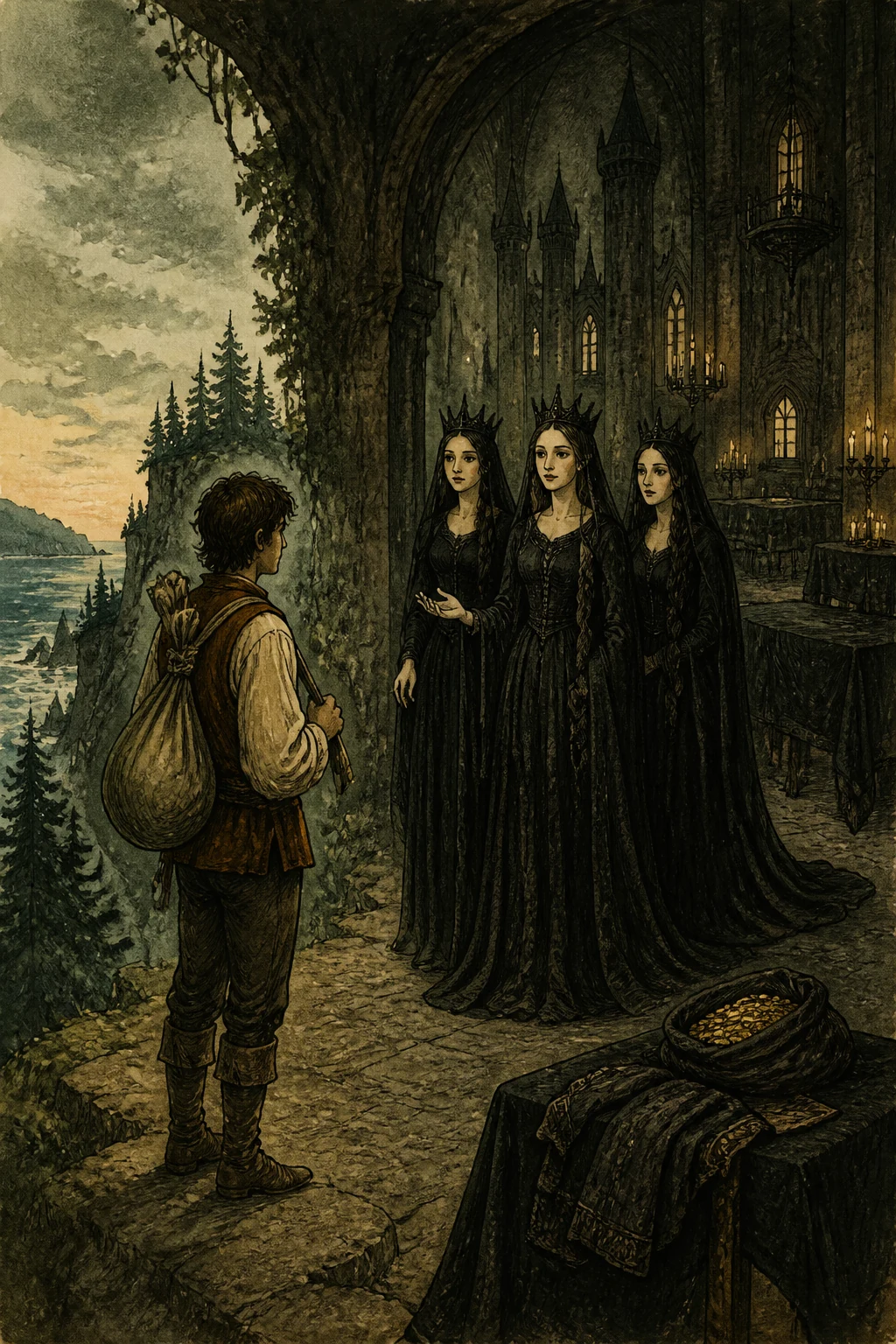
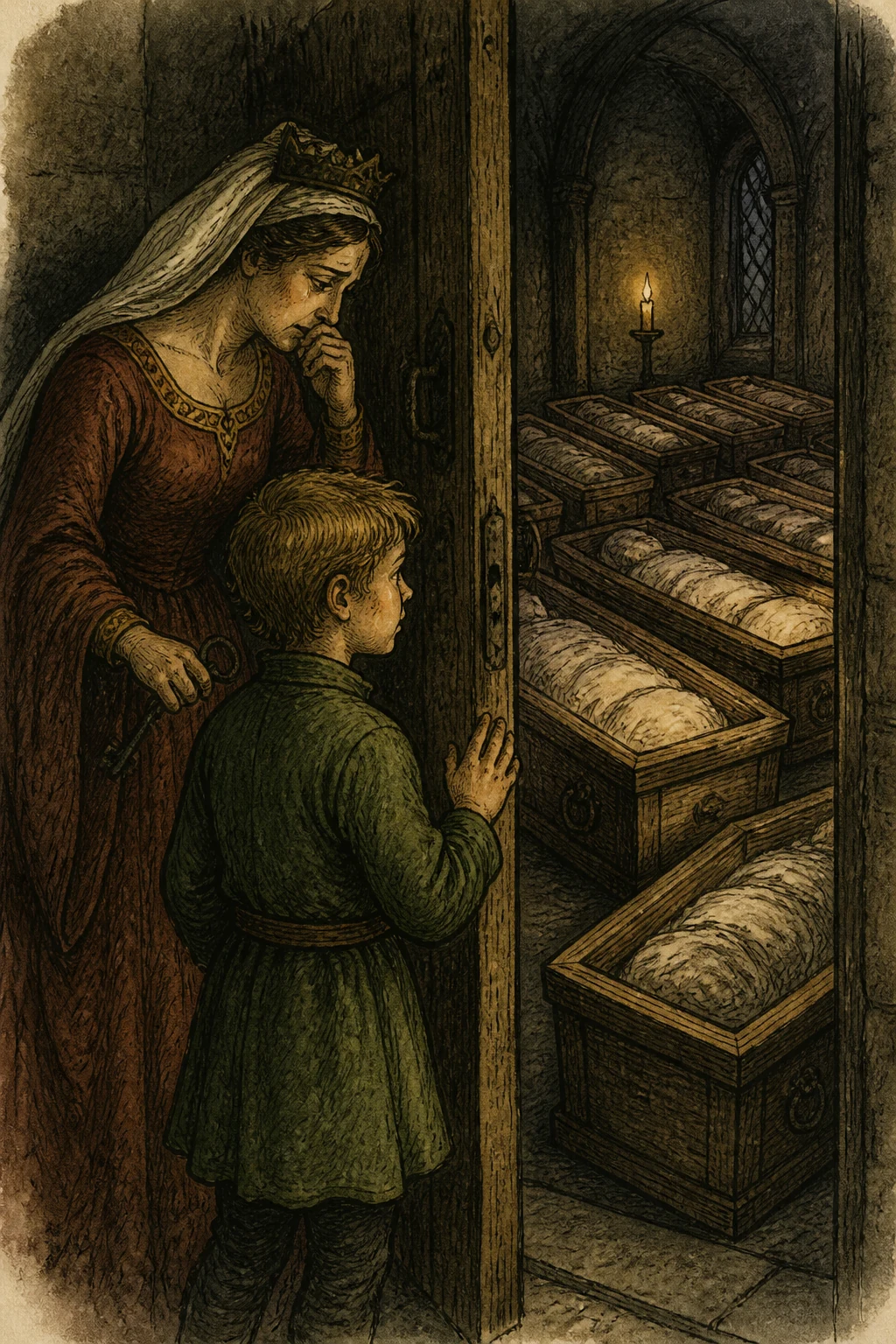
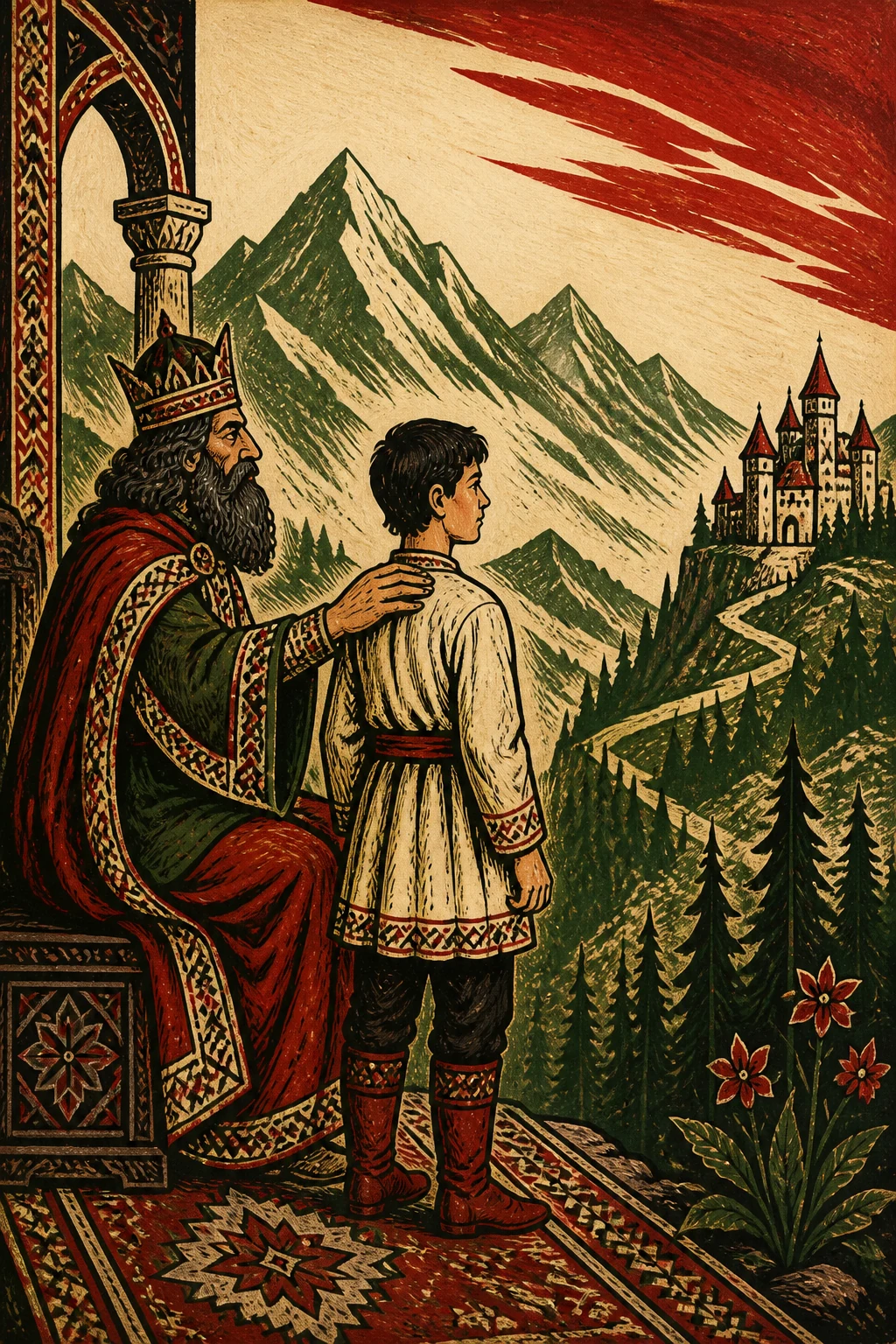
Once upon a time, as never before, and so on. There was once a very rich and powerful emperor. This emperor had a son and a daughter. When his son happened to die, he buried him with great honors and all the pomp befitting an emperor. When the time came to carry the dead prince to church, the emperor’s daughter asked to go along and see her brother to his grave. So closely had her father guarded this maiden that, until then, neither the sun had seen her little face nor the wind had stirred her hair. She dressed in black, let her hair fall loose down her back, and went thus to follow her brother to the grave. And dressed this way, she looked lovelier than ever. For there was no denying that she was very beautiful. Lilies and violets were nothing beside her; she would not have thought them worthy of her little finger. When the people saw how delicate and lovely she was, they could only stare. Such a dainty, enchanting little creature was seldom seen—you could have swallowed her in a glass of water. Gazing at her, the people forgot the dead prince and everything else. Just then a gentle, light breeze sprang up and scattered her tresses, and she felt a cold shiver steal through her heart. At last, one way or another, they buried the dead prince, and everyone went home. Now, in that city there lived a poor widow. She had a son who was exceedingly good, humble, and as shy as a maiden. All the noblemen’s sons envied him and wished him harm. Yet they could find no fault in him that would give them an excuse to lay hands on him. The widow’s son surpassed all the nobles and emperors in bearing and stature. He was astonishingly handsome. You would have picked him out of a thousand. And his speech was sweet as well. Words flowed from his mouth like honey. No one ever tired of listening to him. Since her brother’s death, the princess had not been feeling well. Perhaps it was one thing, perhaps another; perhaps she had been struck by the evil eye, perhaps by some sudden affliction; but all the charm-workers and healers could find no cure for her. Her mother noticed that her daughter was with child. In vain the girl swore that she knew herself innocent of any wrongdoing. Who would believe her? Her belly betrayed her. Yet she was not lying; she had simply found herself in this condition. And when her father learned that his daughter was to become a mother without ever having worn the wedding crown, he blazed with fury. He would listen neither to entreaties nor to anything else. There was no possibility of defending herself before him. So he ordered the imperial council to assemble at once in secret and decide what punishment his daughter deserved for such wickedness, and how to wash away the shame she had brought upon her father’s gray hairs. The imperial council judged that, to cleanse so dreadful a dishonor, the girl must be put to death. Some said she should be burned alive. Others said her eyes should be put out and she should be driven into the wilderness to be eaten by wild beasts. Still others said a millstone should be tied around her neck and she should be cast into the Danube. Just then, as ill luck would have it, the widow’s son happened to pass that way on his own business. The moment the nobles saw him, they came to an agreement, and their decision as to what should be done with the emperor’s daughter was settled. They were unanimous that the girl must perish. But since she was an emperor’s daughter, and since she must have committed her sin with a man who ought likewise to perish, that man should be the widow’s son, seeing that the girl would not name the true wrongdoer and the imperial council could hardly be expected to guess. As they decided, so they did. The emperor gave the order, and at once a great barrel was brought and lined with pitch. They put the princess and the widow’s son inside it, sealed it tightly, and set it afloat on the Danube. But while the coopers were closing the barrel, one of the princess’s serving women, a more tenderhearted soul, slipped through the crowd of onlookers and secretly passed them a troughful of apples, two unleavened loaves, and a small keg of water. Luckily, no one saw her. The barrel floated down the Danube for three days and three nights without stopping anywhere. The provisions inside it ran out. The poor girl bewailed her innocence in words that tore at the heart, while the poor young man, as innocent as she was, comforted her and would not let her lose hope in God. And then, what do you think happened? On the fourth day, very early in the morning, the barrel struck a log and broke apart. As it happened, the waves of the Danube had carried it to the bank, where it struck a log that the water had washed ashore as well. So the two unfortunate souls climbed onto dry land and thanked God for saving their lives and letting them see daylight once again. They took a little path and entered a dense forest. There they followed a trail, walking on and on until they saw a small clearing open before them. In this clearing they came upon a very beautiful house, with a field of flowers for its courtyard. Everything in this house was in perfect order. Nothing was lacking. Every household thing had its own steward, and nothing was without its appointed place. Whenever you wanted something, you had only to give the order, and it was done at once. Here, indeed, it was a matter of “Table, lay yourself! Table, clear yourself!” Many years passed after these events. The emperor had forgotten his daughter. The princess and the widow’s son had come to an understanding and married. Neither of them ever regretted it afterward. You see, he had never strayed in all his life until then, but was as pure as when his mother had borne him; and he had found the princess a virtuous maiden. The child with whom she had been pregnant when her father drove her away was born, and proved such a lovely boy that you could not help doting on him. Living happily together, they forgot their former troubles. God’s might watched over them and kept them from harm. Only, there was not another soul to be seen anywhere about. They might have been at the very end of the earth. One day the emperor, the girl’s father, went out hunting. He ventured farther into the forest than he had ever gone before. Pursuing one quarry after another, he lost his way. He groped about uphill and searched downhill, but could find no path to lead him out into the open. He began to grow anxious. Then, all at once, he came upon the clearing with the house. He saw the house too, and marveled to find so beautiful a dwelling in such a wild stretch of forest. Whether he liked it or not, he had to go there, for he had not tasted a bite in who knew how long. First he sent ahead his servant, who had not left his side for so much as the striking of a spark. The servant returned and told the emperor that he was most heartily welcome to stay there. Once inside, the emperor sent his servant to the kitchen to roast two partridges from among the birds he had shot. The servant put the partridges on a spit and set them over the fire, then forgot all about them, for what he saw and heard quite bewildered him. All the little household things in that house could talk, even the pots and the poker. There were two pots over the fire, and these pots were quarreling. The emperor’s servant heard them bickering with his own ears. “You there, thick-lips, move aside! You’ve boiled enough.” “Move aside yourself, you stunted thing! Your very innards are boiled through.” And as he stood gaping at them, the servant forgot the partridges and everything else. By the time he came to his senses, the roast had burned to ashes. The poor fellow wept and wailed so pitifully that your heart would have ached for him. The princess soothed him, saying she would ask the emperor to forgive his mistake. Then she sent to invite the emperor into the great room. While they sat there talking, the master of the house ordered the table to be laid. The emperor was dumbfounded when he saw the table come in by itself, and the plates, spoons, and other utensils arrive with their steward, who set each in its proper place. The dishes came, and they ate. After they had finished eating, they sat talking; but instead of the table being cleared, the spoons began to leap about upon it. Their steward scolded them, but they would not obey him. The emperor took no notice, for he was talking to his host’s son, a lively, talkative little fellow whom it was a pleasure to converse with. Then the host, wishing to restore order, said, “The emperor cannot possibly have done such a thing.” “There is no one else here it could be,” replied the steward of the spoons. “We must search him.” “Enough of your nonsense,” the host told him. “Come now, clear the table and be off.” Hearing what they were saying, the emperor asked to be searched so that he might be cleared of suspicion, for he knew himself innocent. Then, when they pulled off his boot, the missing spoon fell out of it. The truth was that the host had arranged with the steward of the spoons to play this trick on him. The emperor turned as red as beetroot with shame and, raising his voice in distress, cried, “Lord, reveal Thy wonder! I know myself innocent of this. I did not put the spoon in my boot.” “Just as you do not know how the spoon came there,” said his hostess, “neither do I know to this day by whom I conceived this little boy.” Then they recognized one another, embraced, and forgave each other. The princess thanked the emperor because God had put it into his mind to place in the barrel with her the young man whom she had afterward married; for he had fallen in love with her, cherished her, and cared for her as his faithful wife. Now that he knew her innocence, the emperor could not do enough to comfort her. He praised her husband too for taking such good care of her, and all together they returned to the imperial seat, giving glory to God because innocence had risen to the surface like oil. And I mounted a saddle, and so on.