Prevod
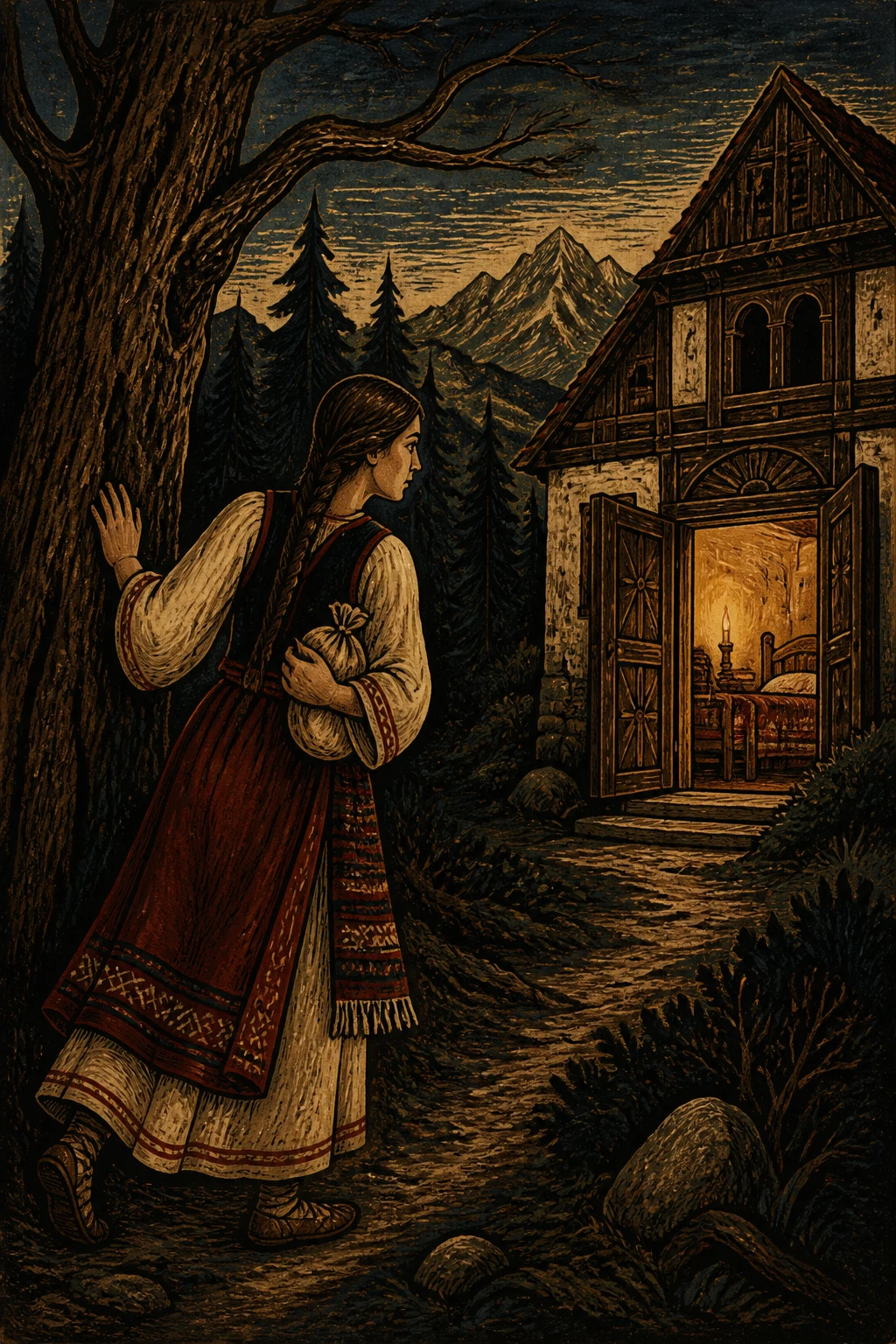
Once upon a time, as never before, and so on. There was once an old man who had a grown daughter, whose diligence was known far and wide. The old man married a second time, taking an old woman who also had a grown daughter. But the old woman made her husband’s daughter do all the hard work about the house, while her own daughter grew sluggish from sitting idle. The poor old man’s daughter spun, wove, baked bread, swept and dusted without so much as a murmur; yet the old woman always took her own daughter’s side, slandered the other girl to her father, and scolded her bitterly. Not a day that God sent passed without her quarrelling with him and demanding that he drive his child away. “Unless you take your daughter away from here,” she would say, “I shall never again share bread and salt with you.” The poor man kept putting her off; but one night the old woman poured water over the hearth and put out the fire whose embers the old man’s daughter had banked the evening before. The next day, at the crack of dawn, the girl rose to light the fire, for every task fell to her; but she found no live embers in the hearth. Afraid her stepmother would scold her, she climbed onto the roof of their little sunken cottage and looked in every direction, hoping to catch sight of a glimmer of fire somewhere, so that she might go and beg at least a single coal. But nowhere could she see what she sought. Then, just as she was about to climb down, she made out a tiny flame barely flickering in the east. She climbed down from the roof and set off towards it. On and on she went, yet she came no nearer to the fire; but along the way she came upon a neglected orchard, which called out to her:
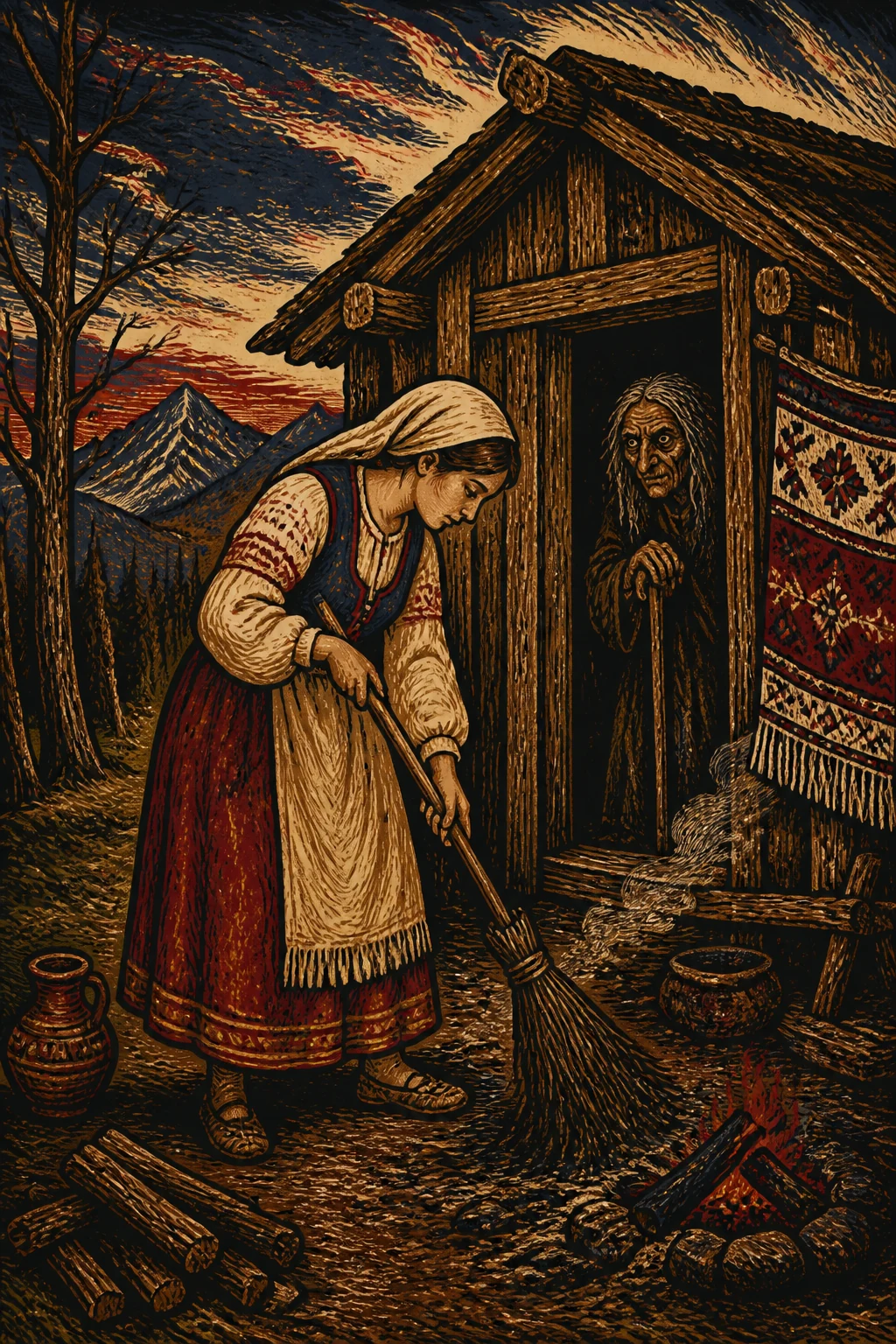
“Maiden, maiden, come and clear the caterpillars from what trees I have left, and when you return I shall give you ripe fruit to eat.” The girl set to work at once, and as soon as she had finished she went on her way. Farther along she came upon a well, which called to her: “Maiden, maiden, come and clean me out, and I shall give you cool water to refresh yourself when you return.” The girl cleaned out the well and went on. She walked a while longer and came upon an oven, which also called to her: “Maiden, maiden, come and mend my clay and sweep out my ashes, and when you return I shall give you warm flatbread.” The girl patched and swept the oven, then continued on her way. A little farther on she came to a small house and knocked at the gate. “Who is there?” a voice asked from within. “If you are a good soul, come in; if not, stay away, for I have a little she-dog with iron teeth and steel grinders, and she will tear you to shreds.” “A good soul,” the girl replied. Once she had gone inside, fearing that her stepmother would beat her if she returned home after being away so long, she asked whether a servant was needed. Saint Friday, who lived there and had welcomed the girl, replied that she did indeed need such a girl, and so she stayed. First Saint Friday told her that her morning task was to feed the little creatures she kept in the yard, but their food must be neither hot nor cold; after that she was to dust and put the house in order. Then Mother Saint Friday went to church. The girl did everything just as she had been told. When Saint Friday came home, she asked her little creatures, who were dragons, snakes, weasels, owls, lizards, vipers and green lizards, how the girl had fed them. They all answered that they had not even noticed their mistress was away, so well had they been cared for. Mother Saint Friday entered the house and found everything in its proper place, and she was well pleased. After some time the girl said, “Mother Saint Friday, I have grown homesick for my father. Be so kind as to let me go.” “Go, my child; but first comb through my hair, and you will see a stream flowing past the house, carrying all manner of boxes, chests and caskets. Whichever you choose shall be your wages.” They sat down, and soon the girl saw the water flowing as Saint Friday had said, bearing some very beautiful boxes and chests. The girl thought that if she took one of those lovely chests, her service would not be worth so much, and she waited until she saw a small, roughly made box coming along. Then she said, “Mother Saint Friday, here is something I have found that is worth just as much as my work.” “Take it, my child, if you will not choose something finer, and go with God.” The old man’s daughter said farewell and set off with the box under her arm. On her way back past the oven she received a warm flatbread, and when she passed the well she drank cool water and refreshed herself; then, reaching the orchard, she ate ripe fruit. The girl arrived home and found her father heartbroken with grief. She told him all she had done and opened the box. And what should they see inside? Pearls, precious stones, beads, embroidered blouses covered in gold spangles, and silk wrap-skirts. The old woman and her daughter were consumed with envy, while the old man’s heart swelled with joy. So the old woman sent her own daughter to do as the old man’s daughter had done. On and on the old woman’s daughter went, until she reached the orchard, which called to her too, asking her to clear its trees. But she answered, “What, do you think I am mad, to scratch my hands for your sake?” She left it and went farther, until she reached the well. When the well called to her, she answered it too: “What, have I eaten thorn apple, to wear myself out cleaning you?” And she went farther still, until she came upon the oven, which called to her just as it had called to the old man’s daughter. To it she said:
“Well! Whatever next, that I should dirty my dear little hands and crawl about inside you!” And she went on until she too arrived at Saint Friday’s house. There she was questioned just as the old man’s daughter had been, and taken into service. Mother Saint Friday told her to do the same things she had told the old man’s daughter, then went to church. When Saint Friday returned, all the creatures stretched out their necks and complained that the girl had scalded their throats. She went into the house and found such a muddle that no one could have made head or tail of it. At last the lazy girl said, “Mother Saint Friday, I have grown homesick for my mother. Give me what I am owed, for I am sick of this place and want to go home.” “Go, my child,” Saint Friday replied, “but wait a little longer, for a stream will pass before the gate, carrying all manner of things. Choose whichever you fancy and take it; meanwhile, comb through my hair.” Hardly had the girl laid her hands on Saint Friday’s head when she darted away and snatched from the stream the largest and finest chest she could see. Saint Friday said to her, “Since you have chosen this chest, take it; but do not open it until you are home. And when you open it, be alone in the room with your mother, so that no one else may see what is inside.” The girl took the chest and left. As she passed the oven on her way back, she saw warm flatbreads and tried to take one, but could not, though she was ravenous. She passed the well with a longing gaze, for it would not give her so much as a drop of water to refresh herself; and when she passed the orchard, her mouth watered, but she could not even go near enough to rest a little in its shade from the scorching sun. Reaching home hungry and worn out with weariness, she could wait no longer. She called her mother aside and told her to send the old man and his daughter out of the house. As soon as they were alone, they opened the chest. And what came out? Dragons, snakes and all the other creatures whose throats she had scalded when she fed them; and at once they tore the two women apart and devoured them. The whole village was horrified by what had happened, and everyone understood that this was divine retribution. The old man’s daughter, however, married one of the handsomest young men in the village, who asked her father for her hand and took her to wife. There was great rejoicing in the village at their wedding, and they live happily to this day. Whoever does not believe it need only look about, and will see many such households. And I mounted a saddle, and so on.