Prevod
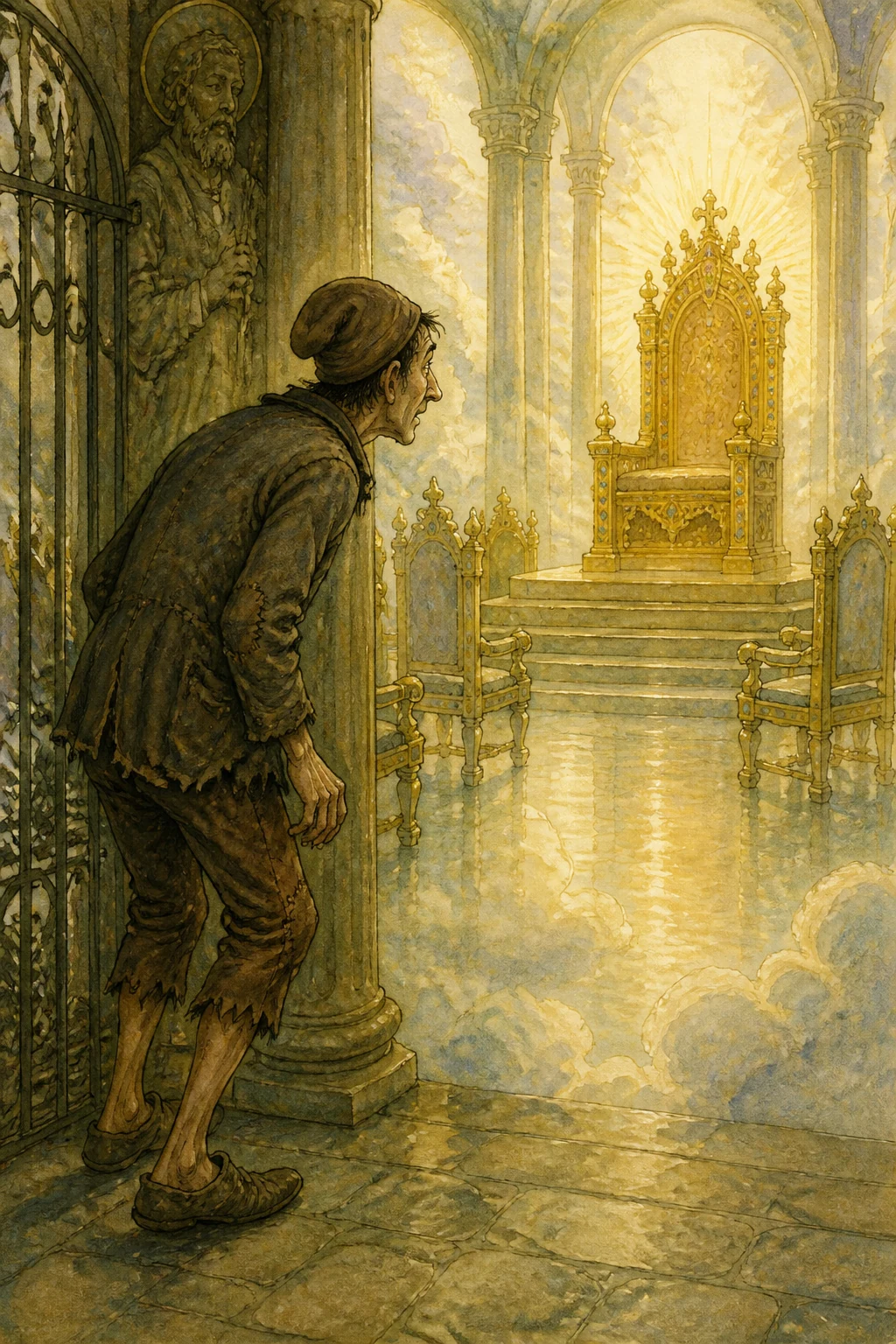
Up in the first heaven, in a delightful garden, the Apostle Santiago sat meditating, his leonine head, with its curly locks the steel-gray of battle armor, resting on his right hand. He looked scarcely less troubled and withdrawn than when, after toiling all day at his fisherman’s trade on the Sea of Tiberias, he had found that not a single fish had entered his nets; only then, consolation had come with the arrival of the Messiah and the miraculous catch. Now—though these were fishing times—the son of Zebedee looked in every direction and could not divine whence salvation, even by a miracle, might come to those he loved so dearly.
Before the Patron Saint, in the midst of the field, rose a gigantic tree, its trunk ancient and gnarled, its branches tangled, but almost stripped of leaves, and those that remained were yellow and withered. For all its decline, that vegetable colossus inspired reverence; although many of its sturdy limbs were snapped and torn away, it retained a majestic bearing; its age-old form made it venerable; its appearance invited reflection on the frailty of greatness. Countless trophies of war hung from its branches. Breastplates, gorgets, helmets, greaves, and gauntlets, with heroic dents and rents left by cleaving blows and slashes; flaming swords with broken points, and lances splintered and shattered; bucklers bearing proud devices; white mantles emblazoned with the crimson cross, seemingly traced in the hot blood of a wound; yataghans taken from the Moors; turbans torn away together with the heads beneath them; gallant banners riddled by musket fire; Boabdil’s Moorish cloak and Moctezuma’s picturesquely feathered diadem... At the foot of the tree, tethered to it by a stout iron chain, stood a creature of surpassing beauty, a warhorse luminous in its whiteness: the Christian Pegasus, that ideal charger which galloped through the clouds and descended to bring us victory.
The Apostle’s eyes rested on the horse as though he had never beheld it before. He noticed the radiant whiteness of its coat, the flowing lightness and delicate rippling of its mane, the fire in its eyes, the hot breath issuing from its nostrils, the slenderness of its legs, fine as a woman’s ankle, the strange electricity given off by the noble celestial creature’s body. Merely sensing the gaze of its rider of old, the horse quivered, pricked up its ears, drew in the air, struck the earth with its gleaming hoof, and seemed to say in the language of signs: “When will the hour come? Must we remain like this forever? Why do you not untie me? Why do we not race once more, amid flashes and sparks, across the red firmament, through the blazing air of pitched battles?”
The warrior Apostle rose and went to stroke his mount’s back. He wished to comfort it, to soothe its impatience, and did not know how, for he too, glorious veteran that he was, dreamed ceaselessly of renewing the exploits of bygone days. As if to sharpen his longing and quicken his memories, a soul appeared nearby that had only just entered Paradise, for it showed clear signs of not knowing the paths, of being bewildered and uncertain. The newcomer was of medium height, dark-skinned, weather-beaten, and lean; scraps of yellow and red cloth encircled his torso, and the blood flowing from several mortal wounds was rapidly dyeing them all one shade. Santiago ran toward that brave man with open arms, and the Spaniard, seeing before him the Apostle of his homeland, fell to his knees and kissed his feet with infinite tenderness.
“Bonaerges, son of thunder,” the Spaniard murmured devoutly, “why have you forsaken us? In our misfortune, we trusted in you. We hoped you would brandish the thunderbolt above our enemies, or rain heavenly fire upon them, such as you wished to bring down upon those Samaritans who shut their city’s gates against Jesus. Look, Santiago, at what we have come to now. I shall tell you in the words of the Epistle read on your feast day: we have been made a spectacle unto the nations, and to angels, and to men. We have become the lowest things in the world. And all because you were not with us, Apostle of battles. Unleash your charger, guide him through the air, take your place at our head. The white horse scents the fray. Can you not hear him neighing, eager to spring forward at the cry of ‘Charge, Spain!’? Come down; they are waiting for you there. The land that believed itself invincible through you awaits you. Your charger is straining to break his chain. Santiago! Good Santiago! Lord Santiago!”
Hearing such urgent pleas, the Apostle was moved still more deeply. To loose the white charger, gallop away, wield the flaming steel once more! How long he had yearned for it! It was not by choice that he remained idle, with his mount tethered to the tree and his weapons hanging from its branches... And raising and comforting the Spaniard and clasping him to his breast, Santiago began to bind his bloody wounds; once this was done, he went to the trunk and untied the white charger, which, wild with joy at finding itself free and imagining that the adventures of former days were dawning anew, tossed its head, sent its mane streaming, pranced proudly, and, beating the dust with its burnished hooves, raised a little golden cloud. Meanwhile, the Patron Saint took down his coat of mail and put it on, donned his broad hat edged with fluted scallop shells, secured his mantle upon his shoulders, slipped his arm through his shield, and buckled on his baldric and terrible sword. The Spaniard, meanwhile, set the gold-embroidered saddle on the horse and fitted its bridle and breastplate, studded with cabochon gems. And just as the Apostle was setting his foot firmly in the silver stirrup to spring into the saddle, behold, another Spaniard emerged from the neighboring wood, dressed in coarse brown cloth and crude leather sandals, signaling to the Apostle to stop. He waited: in that weather-beaten peasant in rustic garb, he had just recognized San Isidro, the poor, hardworking day laborer, who in all his life had ridden nothing but donkeys laden with wheat, taking them to the mill.
“Orders from the Lord!” the husbandman shouted at the top of his voice. “Orders from the Lord! We need that horse to harness to the plow and help break up the clods. And that Spaniard there is to come and drive the team. You know well, Bonaerges, what the Lord said on that memorable occasion when your mother asked him to give you and your brother the highest places in heaven: those who would be greatest must first drink their cup. Countryman of mine, to the plow with you, patiently, and without wasting a moment...”