Prevod
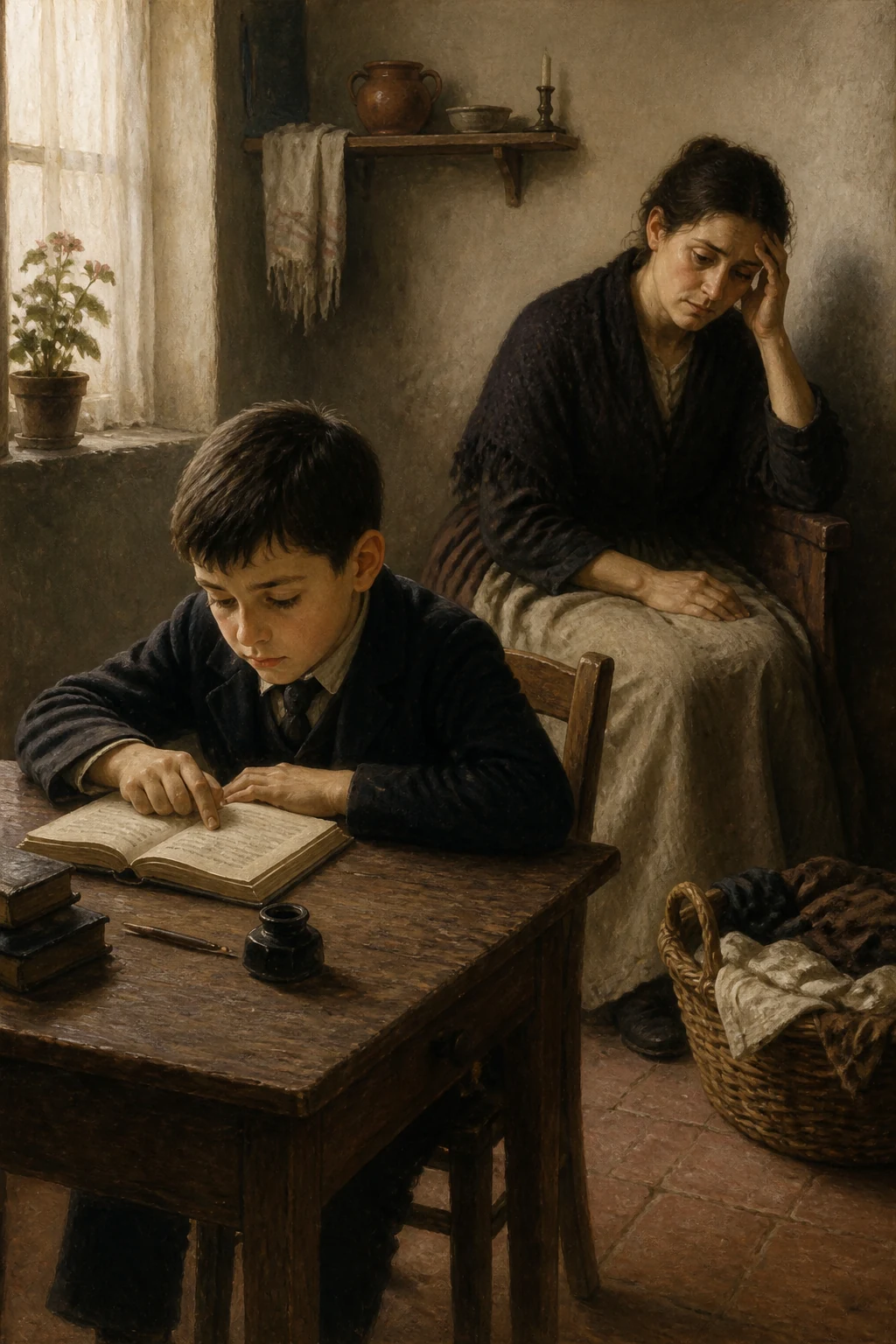
The family evening lasted until ten, and Angelito always bargained for another five minutes or quarter of an hour, resisting bedtime like all children of six or seven, when reason first begins to dawn. While Rosario, his mother, sewed unhurriedly, now and then raising her neatly coiffed head and smiling face, which motherhood had, so to speak, rounded and softened, Carlos, his father, gave the boy his lesson. “Rather than waste my time at the café...” he would reply, almost apologetically, when his friends teased him in the street, coming out point-blank with: “We hear you’ve taken to teaching the ABC...”
The truth was that Carlos had grown accustomed to the lesson, to the sweet intimacy of evenings spent like this, between his loving, contented wife and the precocious, intelligent child, so eager to learn. Outside, the rain fell relentlessly, the wind whistled, or frost hardened the paving stones; inside, the lamp shone affectionately through the old lace of its shade, the fire burned gently, and the warm, peaceful atmosphere of the sitting room spread into the adjoining bedroom, a nest of peace and tenderness, so different from the gloomy, foul-smelling dens where Carlos’s cronies used to lurk—the very men who fancied themselves such rakes and slyly mocked the father who taught his own son.
That night Angelito was rebellious, distracted, inattentive to his lesson. While reading he had swallowed half the words, and, obliged to go back and repeat what he had skipped, his little voice took on those shrill, irritable tones that betray a child’s anger. When he wrote, he pursed his little mouth into a trumpet, gripped the penholder stiffly, made more than a dozen great inkblots on the paper, and finally dashed down the pen with a sudden movement, splashing ink as far as his mother’s white needlework. She gave a cry of surprise and annoyance. Carlos looked at his wife, shook his head, and touched his forehead as if to say, “I don’t know what’s got into this child today.” Rosario rose, took the boy into her lap, and began a mother’s anxious questioning. “What is it, darling? Does something hurt? Are you sleepy? Does it hurt here, or here?” And she stroked his cheeks and temples, feeling for the heat of a fever. A child can fall ill so suddenly!
Finding no heat or other alarming symptom, Rosario made her voice deeper and sterner. “Now you’re going to be good... You know I don’t like naughty little boys... Poor Papa will fall ill if you torment him; then you’ll have to look after him and bring his medicine to bed... Come, Angel, let’s finish your lessons; you still have your Catechism to do...”
Without answering, Angel stared into a dark corner of the room. His tense little face and the fixed gaze of his eyes, a clear, limpid blue, betrayed one of those struggles with ideas beyond their years that ravage and ripen children’s tender minds at once.
“Mama,” he answered at last, very slowly, as though speaking in his sleep, “is Uncle Alejandro never coming?” His mother shuddered. The thought of her brother, away at war with his regiment, often assailed Rosario too amid her domestic happiness, poisoning it with the fear that at the very hour when she lay resting between clean sheets, close to loving arms, Alejandro might be lying face-up to the sun, his chest pierced and his eyes glazed for ever.
“Is Uncle Alejandro never coming, Mama?” the boy repeated in that childish tone that foretells tears. “He’ll come if God wills it, my son,” his mother answered in a broken voice, pressing the child to her breast.
“When will he come? Papa, when? Will he come this week? Tell me.” “I don’t know, darling,” his father exclaimed. “Come, let’s have your primer. It’s late, little fellow.” “But when, Papa? Why don’t you know?”
“Because until the war is over, sweetheart... until it’s over, Uncle Alejandro can’t come.” The child’s turquoise eyes darkened with concentration and the immense effort to understand.
“What is war like?” he exclaimed at last. “People fighting one another, to see who wins.” “The good people against the bad, Papa?” “Yes, the good against the bad.”
“Uncle Alejandro is good,” Angel declared. “And how do they fight?” “With rifles, with swords, with cannons.” The child clapped his hands. “You must take me, Papa. You must take me.”
“Poor little fellow!” Carlos sighed. “War is no place for children.” “Is it for grown men?” “Yes.” “Then why aren’t you at war? You’re big, very big.”
“Because I’m not a soldier,” his father said, vexed and somewhat mortified—as though those words had not been spoken by a six-year-old—and trying to sound persuasive. “Uncle Alejandro is a soldier; you know he came to show you his uniform. Soldiers study for that, to defend their country...”
“Their country...” the child repeated, impressed by the grave emphasis Carlos had given the word. “Our country... is it here?” “Here... where?”
“In our little house.” “No... that is, yes... Our house is in our country, but our country is much more... it’s all the houses you see in this town and in other towns, so many, many of them! And it’s the land as well, and the forests, and the villages, and Madrid, and everything...”
“And the churches too?” Angel murmured in the tone he used for his bedtime prayers. “Those too.” “And the Virgin? Our Mama in heaven?” “The Virgin too; yes, our Mama in heaven is our country.”
“And does Uncle Alejandro love our country?” “You see,” Rosario interrupted, making no attempt to hide the emotion that misted her eyes, “your poor uncle loves it very much. Why, he risks being shot and dying just like that, all of a sudden—only think. Pray, my son, pray that they don’t kill your uncle.”
The child fell silent, thinking hard, almost painfully. “And do people who don’t go to war never die?” he asked at last, following the thread of his budding logic.
“They die too.” “Then I want to go to war when I’m big,” the little boy declared firmly. “And I want you to go, Papa. We have to die in the end, don’t we? Then let’s die for that... for that... For our Mama in heaven, for our country!”
A silence followed the child’s words. His parents looked at one another, speechless, filled with a strange reverence, as though the innocent’s voice had come from other realms, from somewhere higher. And after a few moments Carlos said to his wife:
“Put him to bed. It’s well past ten.” “And his Catechism lesson?” “He’s given it today already,” his father answered, kissing Angel fervently where his fair hair began.