Prevod
From there they caught sight of the tomb of Sthenelus, son of Actor. Returning from the war against the bold Amazons—for he had gone with Heracles—he had been struck by an arrow and died there on the seashore.
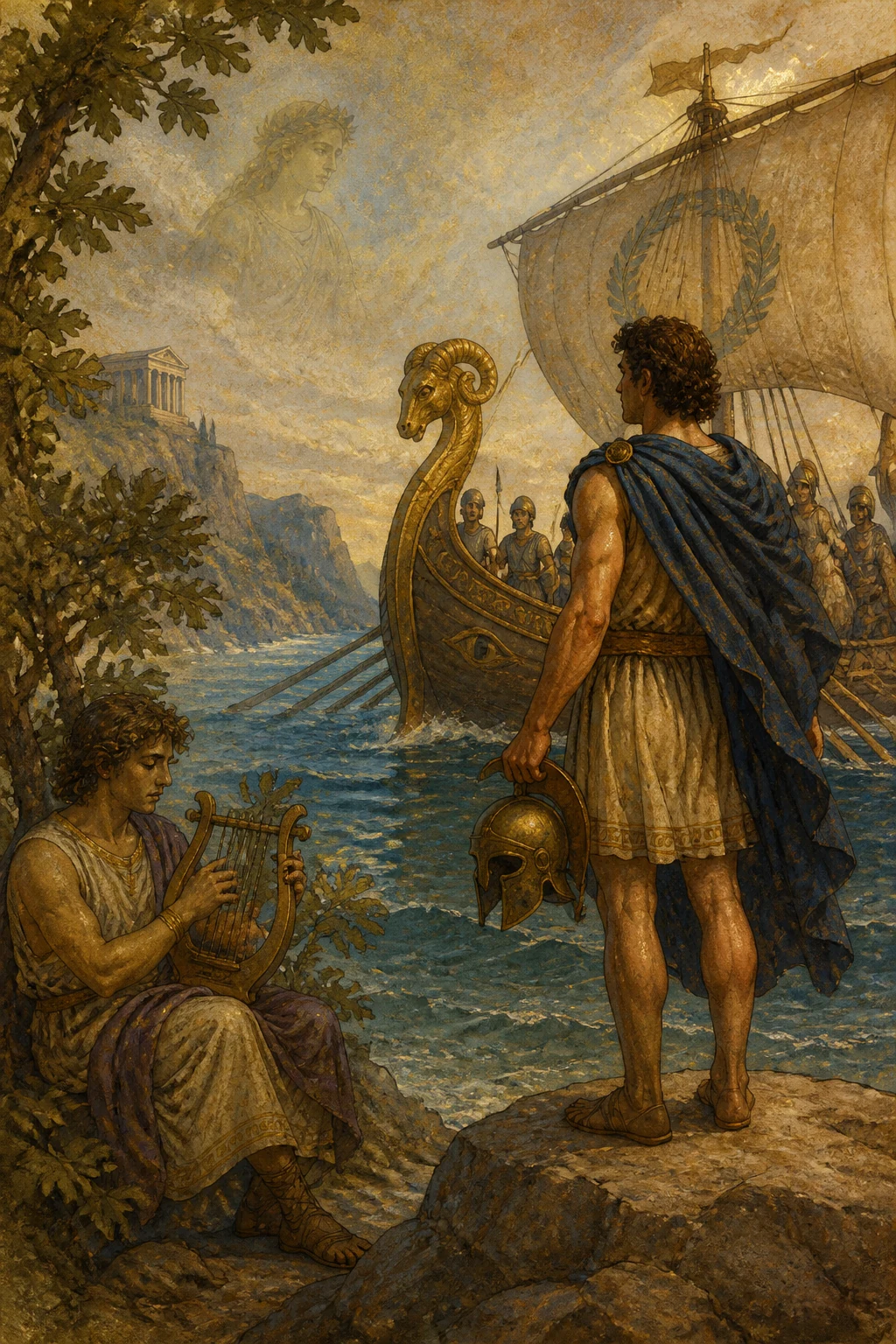
They sailed no farther for the moment. Persephone herself had sent up the sorrowing spirit of Actor’s son, who had begged to see, if only briefly, men of his own kind. Standing on the crown of his tomb, he gazed at the ship, looking just as he had when he went to war; about his head shone a splendid four-crested helmet with a crimson plume.
Then he sank back into the vast darkness. They stared in wonder, and Mopsus, son of Ampycus, interpreted the sign and urged them to put ashore and appease him with libations. Swiftly they hauled up the sail, cast their mooring ropes onto the beach, and tended Sthenelus’ tomb. They poured offerings for him and slaughtered sheep in sacrifice.
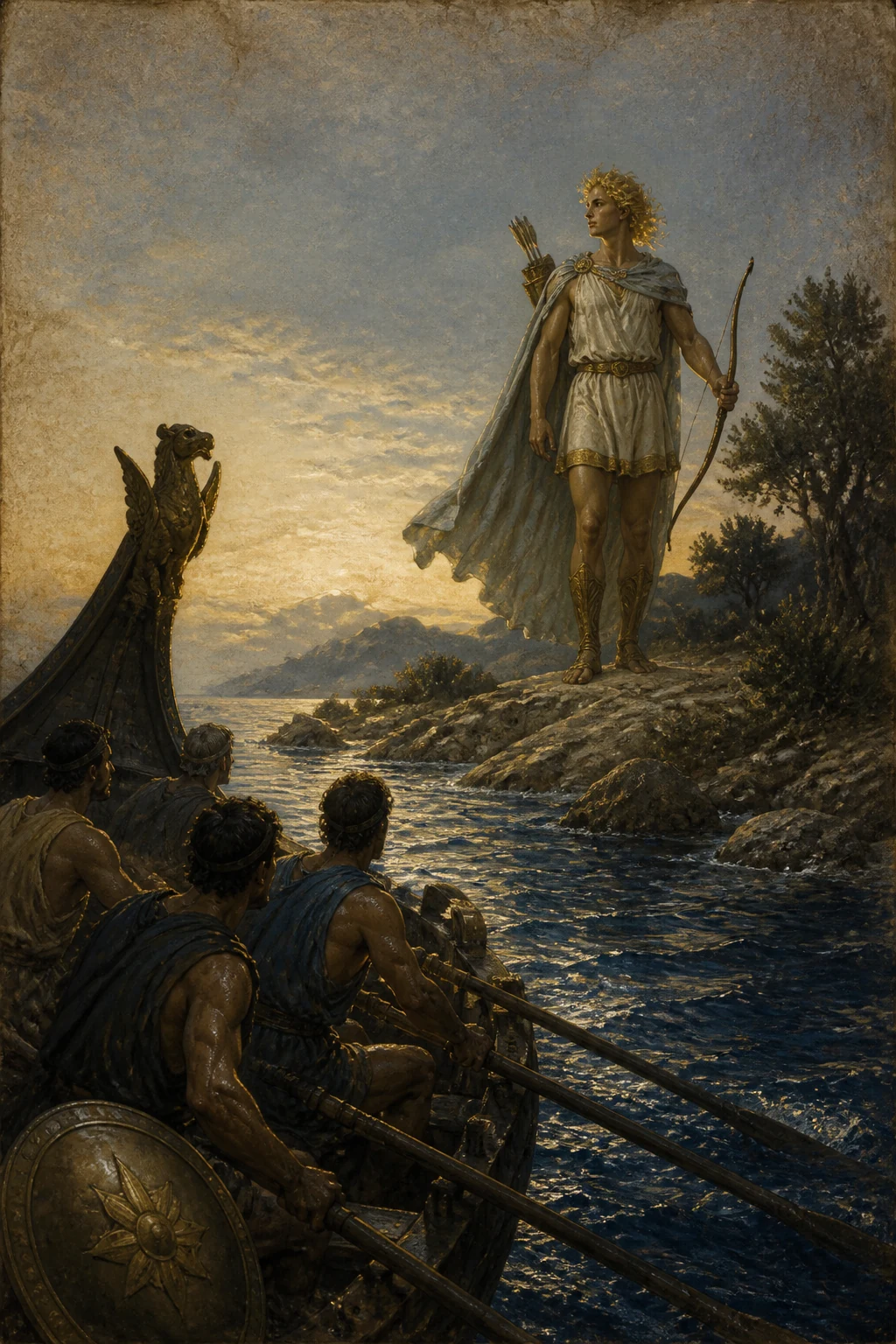
Apart from the offerings to the dead, they built an altar to Apollo, Preserver of Ships, and burned the thighbones of their victims. Orpheus also dedicated his lyre there, and from that time the place has borne the name Lyre. At once, as the wind freshened, they went aboard; lowering the sail, they stretched it taut with the sheets on either side. The ship sped steadily out to sea, like a hawk high in the air that spreads its wings to the breeze and sweeps swiftly onward, neither beating nor stirring them, but riding serenely on their quiet span.
Soon they passed the brackish waters of the Parthenius, the gentlest of rivers. In its lovely streams the maiden daughter of Leto cools her body whenever she returns from hunting and ascends to heaven.
Then through the night they pressed on without pause, rowing past Sesamus and the steep Erythini, Crobialus, Cromna, and wooded Cytorus. From there they rounded Carambis at sunrise and rowed along a great stretch of coast throughout the day and the night that followed.
Soon they reached the land of Assyria, where Zeus had settled Sinope, daughter of Asopus, and himself granted her virginity, deceived by his own promises. For he had desired her love and pledged to give her whatever her heart might choose.
She cunningly asked him to leave her a maiden. In the same way she deceived Apollo when he longed to share her bed, and after him the river Halys; nor did any mortal man ever subdue her in a lover’s embrace.
There at that time lived the sons of noble Deimachus of Tricca—Deileon, Autolycus, and Phlogius—who had strayed from Heracles. When they recognized the company of heroes, they came to meet them and told them truly who they were. They had no wish to remain there any longer, but boarded the ship as the northwest wind began to blow.
With these men aboard, they sped onward before the swift breeze, leaving behind the river Halys, then the Iris flowing nearby, and the projecting coast of Assyria. That same day they rounded, at a distance, the Amazons’ headland, which shelters a harbor.
Here the hero Heracles had once ambushed Melanippe, daughter of Ares, when she ventured out. Hippolyte gave him her richly wrought girdle as ransom for her sister, and he sent Melanippe back unharmed.
They put ashore in the bay beneath that headland, at the mouths of the Thermodon, for the sea was growing rough as they sailed. No other river is like the Thermodon, nor sends so many streams branching separately across the land.
If anyone counted them all, they would number four less than a hundred; yet there is only one true spring. It flows down to the plain from the lofty mountains said to be called the Amazonian Mountains.
From there it spreads straight inland over higher ground, and so its courses are winding. This way and that it twists, wherever it finds the lowest land, one stream wandering far away, another close by. Many channels are nameless where they branch off; but the main river, mingled with a few of them, pours openly into the Euxine Sea beyond a curving headland.
Had they lingered, they would have joined battle with the Amazons, and their contest would not have been bloodless. For the Amazons who dwelt about the plain of Doiantias were neither gentle nor respectful of law; savage violence and the deeds of Ares were their concern. Indeed, they were descended from Ares and the nymph Harmonia, who bore the war-loving god his warlike daughters after lying with him in the glades of the Acmonian wood. But Zeus sent the northwest wind blowing once again, and with it they left behind the curving coast where the Amazons of Themiscyra were arming.
For they did not all live together in a single city, but inhabited the country in three separate tribes. These, then ruled by Hippolyte, lived apart; the Lycastians occupied another region, and the spear-throwing Chadesians another. During the next day and the following night the voyagers reached the land of the Chalybes.
These people have no concern for plowing with oxen or planting crops of honey-sweet fruit; nor do they pasture flocks in dewy meadows. Instead, they mine the harsh, iron-bearing earth and exchange its produce for their livelihood. No dawn ever rises for them without toil: amid black soot and smoke they endure their heavy labor.
Immediately afterward they rounded the headland of Zeus Genetaeus and sailed safely past the land of the Tibareni. Here, whenever women bear their husbands children, the men themselves lie groaning in bed with their heads bandaged, while the women feed their husbands well and prepare for them the baths due to women in childbed.
Next they passed the Sacred Mountain and the country where the Mossynoeci live in wooden towers among the hills, from which they take their name. Their customs and laws are unlike those of other people.
Whatever it is customary to do openly, among the people or in the marketplace, they do within their houses; and whatever we do at home, they do outside without reproach, in the middle of the streets.
Nor do they feel any public shame in lovemaking. Like swine at pasture, not in the least embarrassed by those present, they lie on the ground and couple openly with their women. Their king, meanwhile, sits in the tallest tower and delivers judgments to his many subjects—an unhappy man! For if he errs at all in administering justice, they shut him up without food for the whole day.
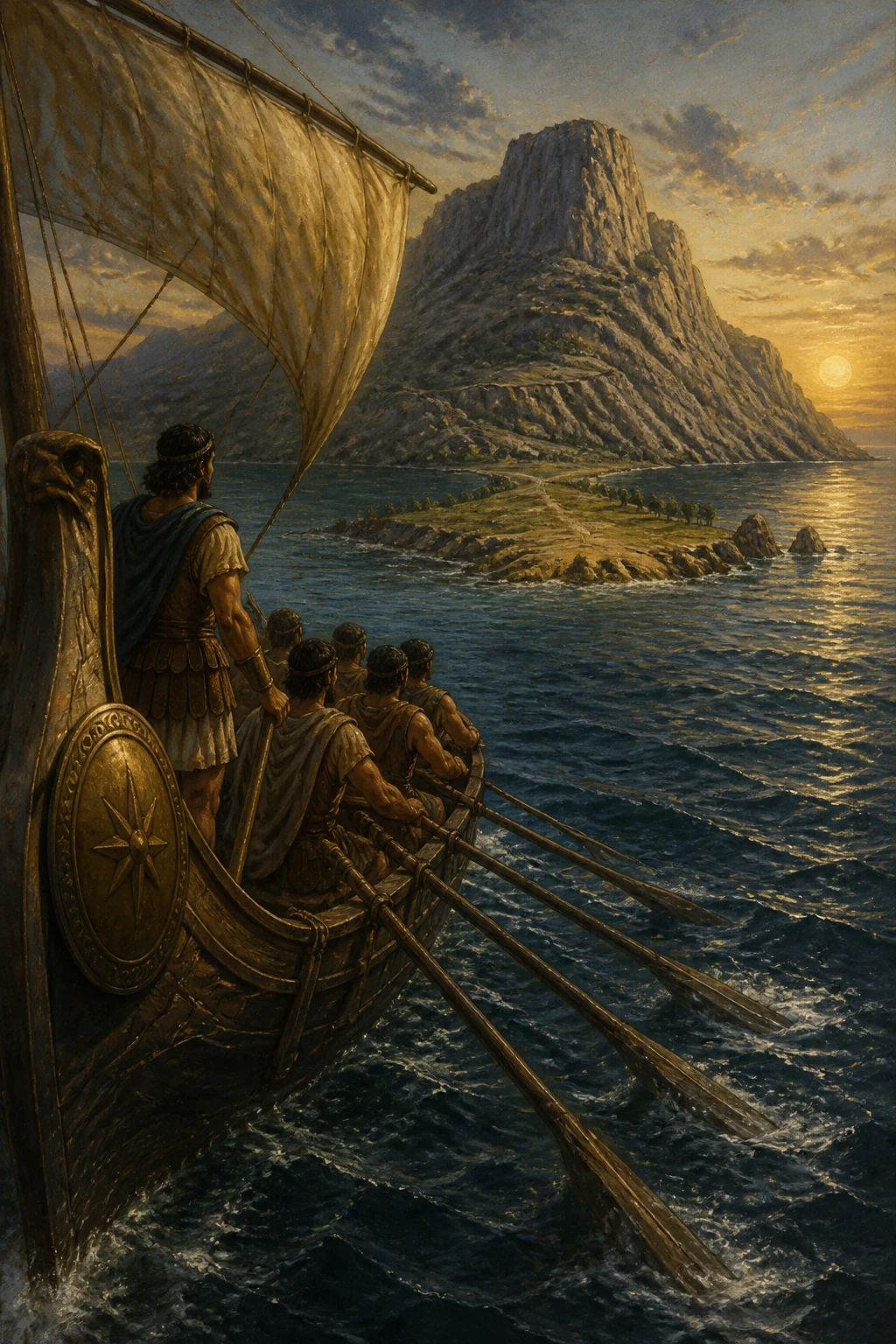
After passing them, the heroes rowed on through the day until they were almost opposite the island of Ares, for the gentle breeze had died at dusk. Then they saw a bird of Ares, one of the island’s inhabitants, darting high through the air. Shaking its wings above the speeding ship, it shot a sharp feather down at her. It struck noble Oileus in the left shoulder, and, wounded, he let the oar fall from his hands. The others stared aghast at the feathered missile.
Erybotes, who sat beside him, drew it out and bound the wound with the strap he unfastened from his hanging sword sheath. Another bird appeared, flying after the first; but the hero Clytius, son of Eurytus, had already bent his curved bow and sent a swift arrow at it. He struck it, and it wheeled over and fell close beside the speeding ship.
Then Amphidamas, son of Aleus, spoke to them: “The island of Ares is near us; you know it yourselves now that you have seen these birds. But I do not think our arrows will be enough to secure a landing. Let us devise some other means of help, if you mean to put ashore, remembering the commands of Phineus.
“For even Heracles, when he came to Arcadia, could not drive the birds from Lake Stymphalis with his bow—I saw it myself. Instead, he stood on a lofty height and shook a bronze rattle in his hands, making it thunder; and they fled far away, shrieking in bewildered terror.
“Let us now devise some such plan. I will tell you what I have thought out. Put on your high-crested helmets; then let half of you row in turn, while the other half cover the ship with polished spears and shields.
“All together raise a tremendous shout, so that the unfamiliar din may frighten them, as well as the nodding crests and the spears lifted overhead. And when we reach the island itself, beat your shields and raise a deafening clamor.”
So he spoke, and all approved his helpful plan. They put on their bronze helmets, which gleamed fearfully, with crimson plumes tossing above them. Half rowed by turns, while the others covered the ship with spears and shields.
As a man roofs his courtyard with tiles, both to adorn his house and to keep out the rain, fitting one firmly over another in overlapping rows, so they fitted their shields together and roofed the ship.
Like the shout that rises from the turmoil of warriors advancing to battle, when the ranks clash, their cry spread high into the air above the ship. They saw no more birds; but when they drew close to the island and beat their shields, countless birds at once rose in terror and hovered here and there.
As when the son of Cronus sends thick hail from the clouds upon a town and its houses, and those who live beneath the roofs sit quietly listening to the rattle overhead, because the storm has not caught them unawares and they have made their roofs secure beforehand: so the birds showered feathers thickly upon them as they swept high across the sea toward the mountains on the farther shore.
But why had Phineus intended this godlike company of heroes to land here? What help was to come to them in answer to their hopes? The sons of Phrixus were sailing from Aea, from the court of Aeetes in Cytaea, toward the city of Orchomenus. They had embarked in a Colchian ship to claim their father’s immense wealth, for on his deathbed he had commanded them to make this journey.
That day they were already very close to the island. But Zeus roused the north wind to blow in all its might, marking with rain the wet season of Arcturus. By day it had only stirred the leaves a little, breathing on the topmost branches in the mountains; but at night it swept mightily down upon the sea and, roaring in its blasts, raised the waves. Black mist wrapped the sky, and no bright stars could be seen anywhere through the clouds: impenetrable darkness closed around them.
Drenched and trembling at the prospect of dreadful death, the sons of Phrixus were helplessly driven before the waves. The force of the wind tore away their sails, and the ship herself, shaken by the surges, broke in two.
Then, at the gods’ prompting, all four of them seized a great timber, one of the many that had been scattered when the ship broke apart, though they had been fastened together with stout bolts. The waves and gusts of wind carried them, struggling in distress, toward the island, barely beyond the reach of death.
At once an immeasurable rain burst forth, pouring upon the sea, the island, and all the mainland opposite, where the overbearing Mossynoeci lived. In the murky night a rushing wave cast the sons of Phrixus together with their stout timber onto the island’s shore. At sunrise the boundless rain from Zeus ceased. Soon the two companies met nearby, and Argus was the first to speak: “Whoever you are, we implore you by Zeus Who Watches Over All: be kind and help us in our need.
“Fierce squalls swept down upon us at sea and scattered all the timbers of our wretched ship, in which we had embarked to cross the waters on a necessary errand. So now we clasp your knees and beg you, if you will listen, to give us something to cover our bodies, and to pity and care for men of your own age in their misfortune.
“Respect us as strangers and suppliants, for the sake of Zeus, Protector of Guests and Suppliants. Strangers and suppliants alike belong to Zeus; surely his watchful eye is upon us.” Then Aeson’s son, believing that the prophecies of Phineus were being fulfilled, questioned him carefully: “We shall gladly give you all these things at once.
“But come, tell me truly where you live, what business bids you cross the sea, and your names and lineage.” Argus, helpless in his misery, answered him: “Surely you yourselves have heard before of a certain Phrixus, a descendant of Aeolus, who came from Greece to Aea—Phrixus, who reached the city of Aeetes riding upon a ram that Hermes had made golden. You could still see its fleece today.
“At the ram’s own bidding he sacrificed it to Zeus, son of Cronus, above all other gods, as the Protector of Fugitives. Aeetes welcomed him into his palace and gladly gave him his daughter Chalciope, asking no bridal gifts.
“We are the children of those two. Phrixus has now died in old age in the house of Aeetes, and we, obeying our father’s commands, were making our way to Orchomenus to claim the possessions of Athamas.
“And if you wish to learn our names, this is Cytissorus, this Phrontis, and this Melas; you may call me Argus.” So he spoke. The heroes rejoiced at the meeting and gathered around them in amazement. Then Jason answered in fitting words: “So it is as kinsmen on our father’s side that you beg us to help you kindly in your distress.
“For Cretheus and Athamas were brothers. I am the grandson of Cretheus, and with these companions I am sailing from Greece itself to the city of Aeetes. But we shall tell one another more of this later.
“First put on some clothes. I believe it was at the bidding of the immortals that you came into my hands in your need.” With that, he gave them clothing from the ship to put on. Then they all went together to the temple of Ares to sacrifice sheep. Quickly they took their places around the altar, which stood outside the roofless temple; within stood a sacred black stone to which all the Amazons had once prayed.
When they crossed over from the mainland, it was not their custom to burn offerings of sheep or cattle upon this altar; instead, they sacrificed horses, which they kept in great herds. When the heroes had offered sacrifice and eaten their fill of the feast they had prepared, Aeson’s son began to speak: “Zeus truly watches over everything. We mortals, whether god-fearing or unjust, never wholly escape his notice.
“As he rescued your father from death at his stepmother’s hands and bestowed immeasurable wealth upon him far away, so now he has saved you unharmed from this deadly storm. On this ship you may sail in either direction, wherever you please—back to Aea or to the rich city of divine Orchomenus.
“For Athena designed her, cutting her timbers with bronze from the summit of Pelion, and Argus built her with the goddess’s help. But a cruel wave shattered your own ship before she even came near the rocks that clash against each other all day long in the narrow strait.
“Come, then, help us in our desire to carry the golden fleece to Greece, and guide us on our voyage. For I am sailing to fulfill the sacrifice owed for Phrixus and avert the anger of Zeus against the descendants of Aeolus.”
So he spoke to win them over. But they shuddered when they heard him, for they did not believe they would find Aeetes kindly disposed toward men eager to carry off the ram’s fleece. Argus, distressed that they should undertake such a voyage, replied: “Friends, whatever strength we have shall never withhold its help, however little, when need arises.
“But Aeetes is fearfully hardened in deadly cruelty, and so I greatly dread this voyage. He boasts that he is a son of the Sun; countless tribes of Colchians dwell around him, and in his terrible battle cry and mighty strength he could rival Ares himself.
“Nor would it be easy to take the fleece without Aeetes’ knowledge. Such is the serpent coiled about it on every side to guard it—deathless and sleepless, born of Earth herself on the slopes of the Caucasus, beside the rock of Typhaon. There, they say, when Typhaon stretched his mighty hands against Zeus, son of Cronus, the god struck him with a thunderbolt, and hot blood dripped from his head. He fled on through the mountains to the Nysaean plain, where even now he lies submerged beneath the waters of the Serbonian marsh.”
So he spoke, and many a cheek turned pale at once when they heard of such an ordeal. But Peleus quickly answered with bold words: “Dear friend, do not let your heart be so utterly afraid.
“We are not so wanting in courage that we must prove inferior to Aeetes in a trial of arms. I believe we too shall come there knowing something of war, descended as we are from the very blood of the blessed gods.
“So if he will not give us the golden fleece in friendship, I do not think the tribes of Colchians will save him.” Thus they spoke in turn to one another, until, having eaten supper and satisfied their hunger once again, they lay down to sleep.
When they woke at dawn, a fresh, favorable wind was blowing. They raised the sails, which stretched taut beneath its gusts, and swiftly left the island of Ares far behind. As night came on, they passed the island of Philyra. Here Cronus, son of Uranus, had deceived Rhea and lain with Philyra, in the days when he ruled the Titans on Olympus and Zeus was still being reared by the Idaean Curetes in a cave in Crete. The goddess surprised them in the midst of their lovemaking, and Cronus leaped from the bed and fled in the shape of a long-maned horse. In shame, Philyra, daughter of Ocean, left that place and its familiar haunts and went to the lofty mountains of the Pelasgians. There, from that strangely altered union, she bore the mighty Chiron, part horse and part god.
From there they sailed past the Macrones, the boundless land of the Becheires, the overbearing Sapeires, and then the Byzeres. Always they cut swiftly onward, borne by the gentle wind.
Now, as they sailed, the innermost recess of the Pontus came into view, and the sheer heights of the Caucasus rose before them. There Prometheus, his limbs bound to the rugged rocks in unbreakable bronze fetters, fed his liver to an eagle that returned again and again.
At evening they saw it flying high above the ship, close to the clouds, with a shrill rush of wings; yet even at that height its passing shook all their sails. For it had not the form of an ordinary bird of the air, but beat its swift wings like polished oars. Not long afterward they heard Prometheus’ agonized cries as his liver was torn out. The sky resounded with his wailing until they saw the flesh-eating eagle dart back from the mountain along the same path.
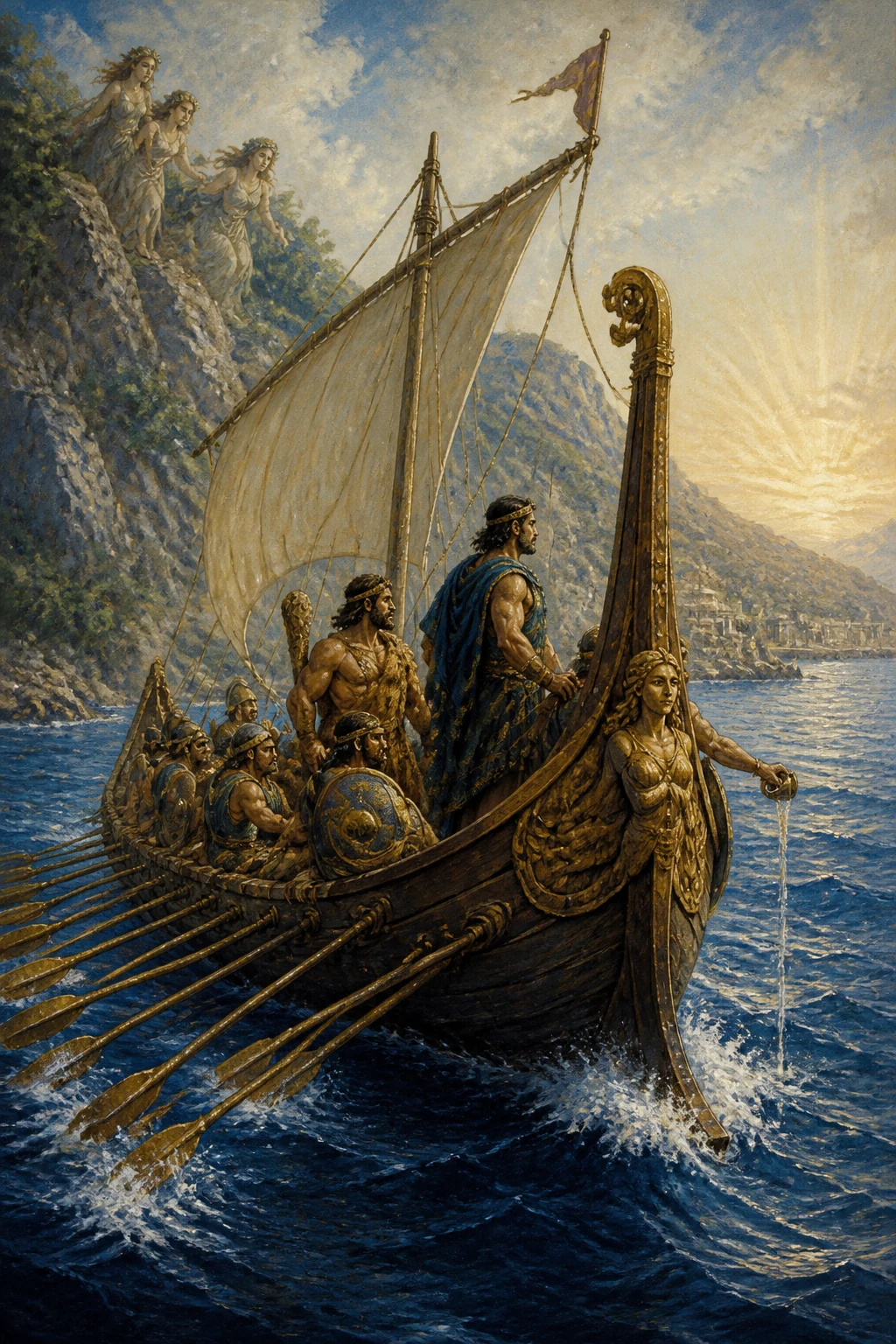
In the night, guided by Argus’ knowledge, they reached the broad-flowing Phasis and the farthest limits of the sea. At once they furled the sails and stowed them with the yard in the hollow mast-crutch; then they lowered the mast itself and laid it slantwise. Swiftly they rowed into the river’s mighty current, which seethed around them as it yielded to their passage. On their left they had the steep Caucasus and the Cytaean city of Aea; on the other side lay the plain of Ares and the god’s sacred grove, where the serpent kept watch over the fleece spread upon the leafy branches of an oak.
Aeson’s son himself poured honey-sweet libations of unmixed wine from a golden cup into the river, offering them to Earth, to the gods of the country, and to the souls of dead heroes. He prayed that they would be kindly helpers, keeping the company unharmed, and would graciously receive the ship’s mooring ropes.
Then Ancaeus spoke: “We have reached the land of Colchis and the waters of the Phasis. Now it is time for us to take counsel together: shall we try Aeetes with gentle words, or will some other course bring us success?”
So he spoke. At Argus’ urging, Jason ordered them to row into a densely shaded marsh nearby and anchor the ship there. They made their way into it and spent the night.
Before long, dawn shone upon their waiting eyes.