Prevod
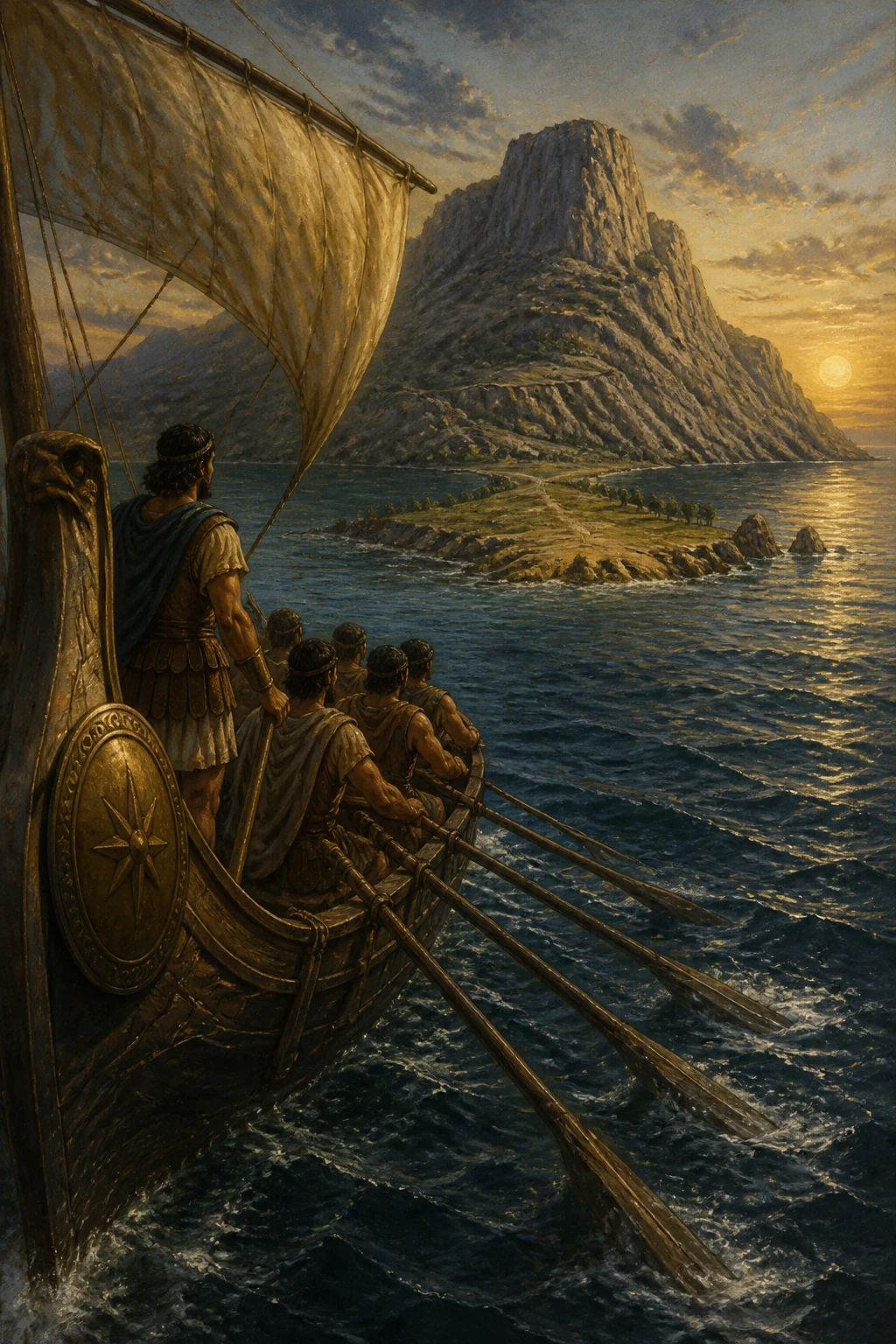
So he spoke, and at once they ceased such talk and bent to the unrelenting toil of rowing. Soon they passed the swift-flowing river Rhebas and the crag of Colone, and before long sailed beyond Cape Melaena and on to the mouth of the Phyllis. There Dipsacus had once welcomed the son of Athamas into his house when he fled from the city of Orchomenus upon the ram. A meadow nymph had borne Dipsacus; violence gave him no pleasure, and of his own free will he lived beside his father’s waters with his mother, tending flocks along the shore.
They swiftly passed his shrine, the river’s broad banks and the plain, and the deep-flowing Calpe, watching them as they went. All through the day and the windless night they drove onward with tireless oars.
As laboring oxen toil to cleave the sodden fields, while streams of sweat pour from their flanks and necks, their eyes roll sideways beneath the yoke, and their parched breath rasps ceaselessly from their mouths; planting their hooves in the earth, they labor all day long.
So the heroes strained as they drew their oars up from the sea. At the hour when the immortal light has not yet come, yet the darkness is no longer deep, and a faint gleam steals over the night—the hour that waking men call twilight—they rowed into the harbor of the deserted island of Thynias and stepped ashore, worn out by their grievous toil.
There the son of Leto appeared to them, journeying from Lycia far away to the boundless land of the Hyperboreans. As he walked, clusters of golden curls streamed on either side of his cheeks. In his left hand he carried a silver bow, and a quiver hung across his back from his shoulder. The whole island shook beneath his feet, and waves washed over the shore.
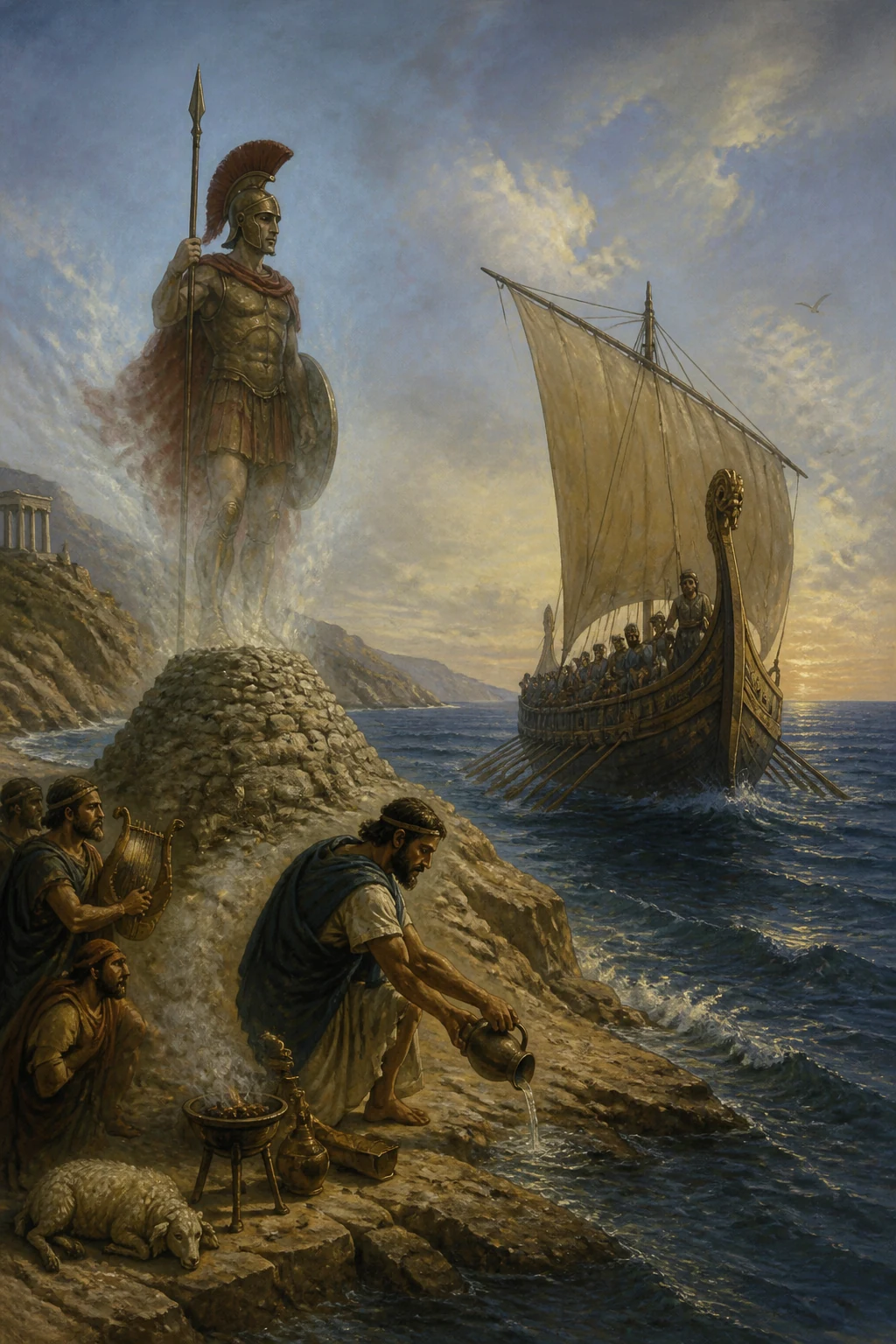
At the sight, helpless awe seized them; not one dared look straight into the god’s beautiful eyes. They stood with their heads bowed to the ground, while he passed far away through the air toward the sea. At last Orpheus spoke to the heroes: “Come, let us call this island sacred to Apollo of the Dawn, since he appeared to us all as he passed at daybreak. Let us raise an altar on the shore and offer whatever we have at hand. And if he grants us a safe return to the land of Haemonia, then we shall lay upon it the thighbones of horned goats.
“For now, I urge you to win his favor with the savor of sacrifice and with libations as we can. Be gracious, lord, be gracious, you who have appeared to us!” So he spoke. At once some built an altar of stones, while others roamed the island, searching for a glimpse of deer or wild goats, such as graze in great numbers in the deep woods.
The son of Leto granted them game. From every beast they reverently burned the thighbones, wrapped in double folds of fat, upon the sacred altar, calling on Apollo of the Dawn. Around the burning offerings they formed a wide circle for the dance, singing the beautiful refrain, “Ie Paean, Ie Paean, Phoebus!” With them the noble son of Oeagrus led the clear-voiced song upon his Bistonian lyre, telling how beneath the rocky ridge of Parnassus the god had once slain the monstrous Delphyne with his bow, still a naked youth, still rejoicing in his flowing locks.
Be gracious! Forever, lord, your hair remains unshorn, forever unharmed: so it is ordained. Only Leto herself, the daughter of Coeus, strokes it with her loving hands. Often the Corycian nymphs, daughters of Pleistus, heartened him with their cries, calling out, “Ie, Ie!” From this arose that beautiful refrain in praise of Phoebus.
When they had honored him with dancing and song, they poured holy libations and swore, touching the sacrificial offerings, always to help one another in unity of heart. To this day there stands a shrine to kindly Concord, which they themselves built there, honoring that most glorious goddess.
When the third day dawned, they left the steep island before a fresh west wind. From there they sailed past the mouth of the Sangarius on the opposite shore, the fertile land of the Mariandynians, the waters of the Lycus, and Lake Anthemousis. As they sped onward, the ropes and all the ship’s tackle shook in the breeze.
At dawn, after the wind had fallen in the darkness, they gladly reached the anchorage of the Acherusian headland. It rises in sheer cliffs, looking out over the Bithynian Sea. Below it, smooth rocks stand rooted in the brine, and the rolling waves thunder mightily around them; above, spreading plane trees grow upon its very summit.
From the headland a sheltered hollow slopes inland, and there lies the cave of Hades, overhung with woods and rocks. From its dreadful depths an icy breath streams ceaselessly, always gathering a white frost about it, which melts beneath the midday sun.
Silence never possesses that grim headland. It resounds alike with the echoing sea below and with the rustle of leaves shaken by winds deep within its hollows. There too is the mouth of the river Acheron, which bursts through the headland and empties into the eastern sea; a deep ravine brings it down from the heights.
In later generations the Megarians of Nisaea named it Soonautes, Savior of Ships, when they came to settle in the land of the Mariandynians. For it had saved them and their vessels when they were caught in a deadly storm.
There, then, they promptly brought their ship ashore, passing inside the Acherusian headland as the wind was just dying away. Their arrival did not long escape Lycus, ruler of that land, or the Mariandynians: they were the slayers of Amycus, according to the report that had reached them already. For that very reason the people made a pact of friendship with them.
They gathered from every side to welcome Polydeuces himself like a god, for they had long been waging bitter war against the overbearing Bebrycians. That day they all went together into the city and shared a friendly feast in the halls of Lycus, delighting their hearts with conversation.
The son of Aeson told him the lineage and name of each of his companions, the commands of Pelias, how they had been entertained by the women of Lemnos, and all that they had done at Cyzicus among the Doliones; ἐτελεσσαν; corrected diacritic error (ἐτελεσσαν) in the source text.
He told how they had reached Mysia and Cius, where, against their will, they had left the hero Heracles; he recounted the words of Glaucus, how they had defeated Amycus and the Bebrycians, the prophecies and sufferings of Phineus, how they had escaped the Cyanean Rocks, and how the son of Leto had appeared to them upon the island. As he listened to the tale unfold, Lycus was enchanted; but grief seized him at the thought of Heracles left behind, and he addressed them all: “My friends, what a man’s help you have lost as you make this long voyage to Aeetes! I know him well, for I saw him here in the halls of my father Dascylus, when he came on foot through the mainland of Asia, bringing back the girdle of warlike Hippolyte. At that time the first down was just beginning to grow upon my cheeks.
“Here, at the funeral games for my brother Priolas, whom Mysian men had slain—and whom our people have mourned ever since in most pitiful laments—he fought and killed the mighty boxer Titias, who surpassed all the young men in beauty and strength. He dashed his teeth to the ground.
“Together with the Mysians, he subdued beneath my father’s rule the Phrygians, whose fields border ours. He also won him the tribes of the Bithynians and their land, as far as the mouth of the Rhebaeus and the crag of Colone. After them the Paphlagonians descended from Pelops likewise yielded, all whose country is encircled by the dark waters of the Billaeus.
“But now, with Heracles living far away, the Bebrycians and the insolence of Amycus have robbed me of much of my land. Little by little they have cut away broad tracts, until they have pushed their borders to the meadows of the deep-flowing Hypius.
“Yet through you they have paid the price. Nor, I believe, was it against the gods’ will that the son of Tyndareus brought war upon the Bebrycians that day when he slew that man. And so whatever gratitude I have the power to show, I will show gladly. That is the duty of weaker men when others, stronger than themselves, have first done them a service.
“For the benefit of you all, I shall urge my son Dascylus to accompany you on your voyage. With him beside you, you will meet with a welcome from the peoples along the sea, all the way to the very mouth of the Thermodon.
“And for the sons of Tyndareus in particular I shall build a lofty shrine high upon the Acherusian headland. Sailors far out at sea will see it and seek their favor; afterward I shall set apart for them rich fields of well-plowed land outside the city, as for gods.”
So they spent that whole day pleasantly at the feast. Early next morning they hurried down to the ship. Lycus himself went with them, giving them countless gifts to take away, and sent his son from home to join their voyage.
There appointed fate struck Idmon, son of Abas, renowned for his gift of prophecy. Yet prophecy could not save him, for destiny was leading him to his death. In the water meadows of the reedy river lay a white-tusked boar, cooling its flanks and enormous belly in the mud—a deadly monster that even the marsh nymphs feared. No man knew of it; it fed alone throughout the broad fen.
As the son of Abas walked along the banks of the muddy river, the beast suddenly leaped high from its unseen hiding place among the reeds and struck his thigh sideways, shearing through the sinews and the bone.
He fell to the ground with a piercing cry, and his companions cried out together at the blow. Peleus at once cast his hunting spear at the deadly boar as it rushed to escape into the marsh. It charged back at him, but Idas struck it, and with a bellow it fell upon the sharp spear.
They left it lying there on the ground, while his grieving companions carried Idmon back to the ship as his life ebbed away. He died in their arms. Then they put aside all thought of the voyage and remained there sorrowing, occupied with the dead man’s burial.
For three whole days they mourned him; on the fourth they buried him with great honors. The people joined in his funeral, together with King Lycus himself, and they slaughtered countless sheep beside his grave, as is fitting for the dead.
There in that land the hero’s burial mound still stands, and upon it is a marker for later generations to see: a shaft of wild olive, such as ships are built from, which flourishes with leaves a little below the Acherusian headland. And if the Muses require me to tell this too without reserve, Phoebus expressly commanded the Boeotians and the men of Nisaea to honor him as guardian of their city and to build their town around that ancient wild-olive trunk. Yet to this day, instead of the god-fearing son of Aeolus, Idmon, they pay honor to Agamestor.
Who else was it that died? For the heroes then raised yet another mound for a fallen companion, and the graves of those two men can still be seen. They say that Tiphys, son of Hagnias, died; it was not his fate to sail any farther. A brief illness laid him to rest there, far from his native land, while the company was still honoring the son of Abas with funeral rites.
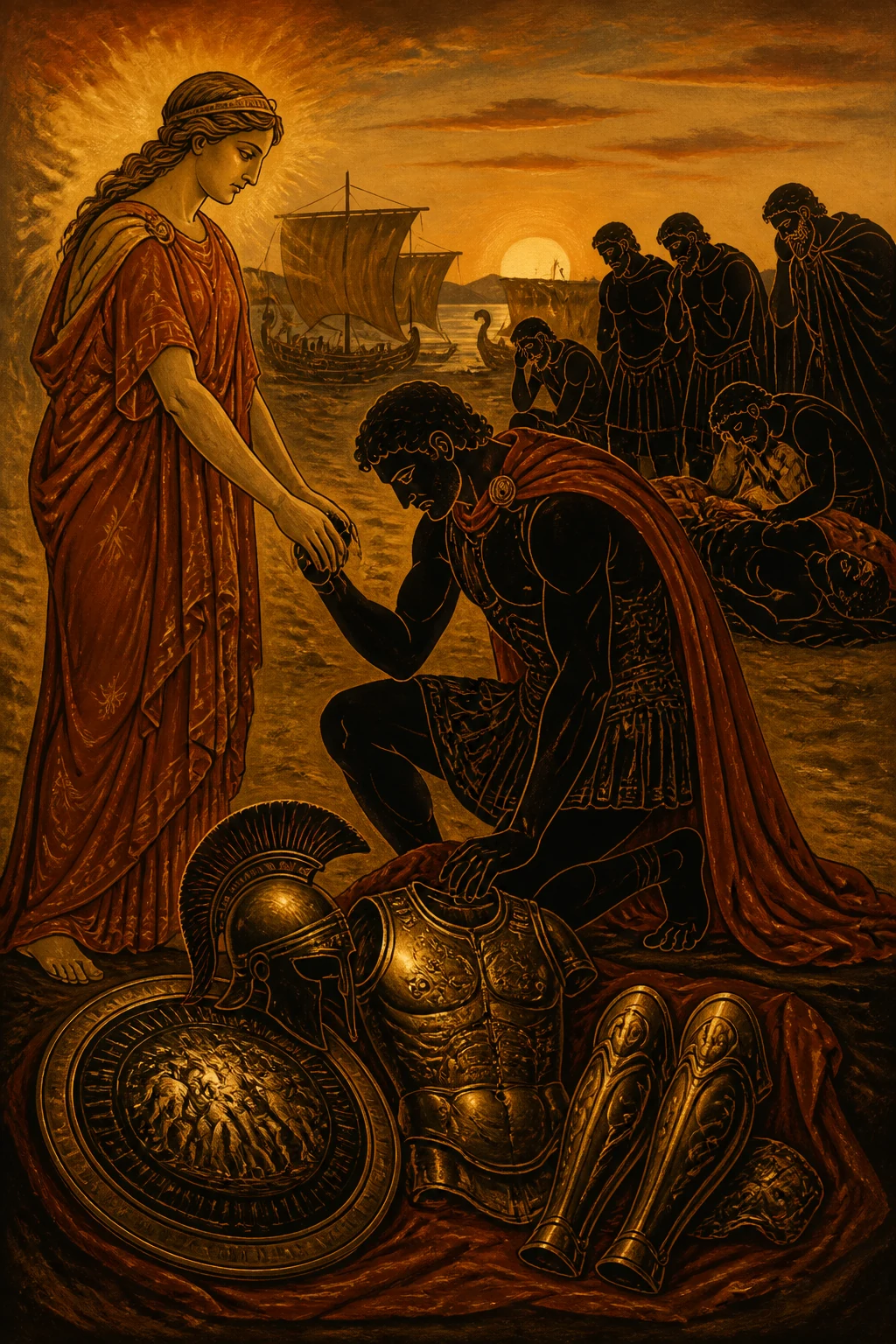
To their fatal sorrow was added an unbearable grief. When they had buried him too, close beside the other, they flung themselves down helplessly before the sea and lay motionless, wrapped in their cloaks, thinking neither of food nor drink. They let their hearts sink under their anguish, for all hope of returning home seemed far away.
And they would have lingered there in grief still longer had Hera not filled Ancaeus with extraordinary courage—Ancaeus, whom Astypalaea bore to Poseidon beside the waters of the Imbrasus. He excelled above all in steering ships, and now he hastened to Peleus and said: “Son of Aeacus, what honor is there in abandoning our labors and lingering in a foreign land? It was not so much for my skill in war—ἐόντά corrected diacritic error (ἐόντά) in the source text.—that Jason brought me from Parthenia in search of the fleece, as for my knowledge of ships.
“So let there be not the slightest fear on my account for the ship. There are other skilled men here as well; whichever of them we set at the stern, none will spoil our voyage. Come, tell them all this, and boldly rouse them to remember their task.”
So he spoke, and Peleus’s heart leaped with joy. At once he stood among them and said: “My friends, why do we linger in fruitless sorrow? Those men have met the deaths allotted to them. But there are helmsmen among our company still, and many of them. Let us not shrink from putting them to the test. Up, then, and to work! Cast your grief aside.”
But Aeson’s son answered him helplessly: “Son of Aeacus, where are these helmsmen? Those whom we once boasted were skilled sit with bowed heads, grieving even more than I do.
“And so I foresee a dreadful doom for us as well as for the dead, if we can neither reach the city of ruthless Aeetes nor return through the rocks to the land of Greece. Here, on this very spot, an inglorious and wretched fate will cover us as we grow old to no purpose.”
So he spoke; and Ancaeus eagerly undertook to guide the swift ship, for the goddess’s prompting had stirred him. After him Erginus, Nauplius, and Euphemus rose, eager to take the helm. But the company held them back, and most of the companions chose Ancaeus.
At dawn on the twelfth day they went aboard, for a strong west wind was blowing in their favor. Swiftly they rowed out beyond the Acheron, then spread their canvas, trusting to the wind. With sails unfurled they cut their way far onward, rejoicing in the fair weather.
Soon they passed the mouth of the river Callichorus. There, they say, the Nysaean son of Zeus celebrated his mysteries when, leaving the peoples of India, he came to dwell in Thebes. He led dances before the cave in which he passed the solemn, sacred nights. From this the neighboring people call the river Callichorus, the River of Fair Dances, and the cave Aulion, the Lodging Place.