O besedilu
Nioba
- Vir
- Ovidove preobrazbe
- Avtor
- Ovid
- Jezik branja
- English
- Jezik izvirnika
- Latin
- Čas branja
- 9 min branja
- Obseg
- 7 strani
- Naslov izvirnika
- Niobe
O izvirniku
Ovidove preobrazbe
Pesniški tok antičnih preobrazb, kjer bogovi, ljudje in narava stalno menjavajo obliko. Bralni jezik je English, izvirnik pa prihaja iz vira Ovidove preobrazbe v jeziku Latin.
Besedilo
Nioba
All Lydia seethes, and through the towns of Phrygia the tale of what had happened spreads, filling the wide world with talk. Niobe had known her before her own marriage, when, still a maiden, she lived in Maeonia, near Sipylus; yet the punishment of Arachne, her countrywoman, did not teach her to yield to the gods or speak with greater humility. Much encouraged her pride; yet neither her husband's art, nor their noble birth, nor the power of their mighty kingdom delighted her so much, though all these things delighted her, as her own children. Niobe might have been called the happiest of mothers, had she not thought herself so.
For Manto, Tiresias's daughter, who foresaw the future, had passed through the streets, stirred by divine inspiration, prophesying: “Women of Thebes, come in throngs and offer incense with devout prayers to Latona and her two children, and bind your hair with laurel. Latona commands you through my lips.” They obey, and all the women of Thebes adorn their temples with leaves as ordered and offer incense and words of prayer to the sacred flames.
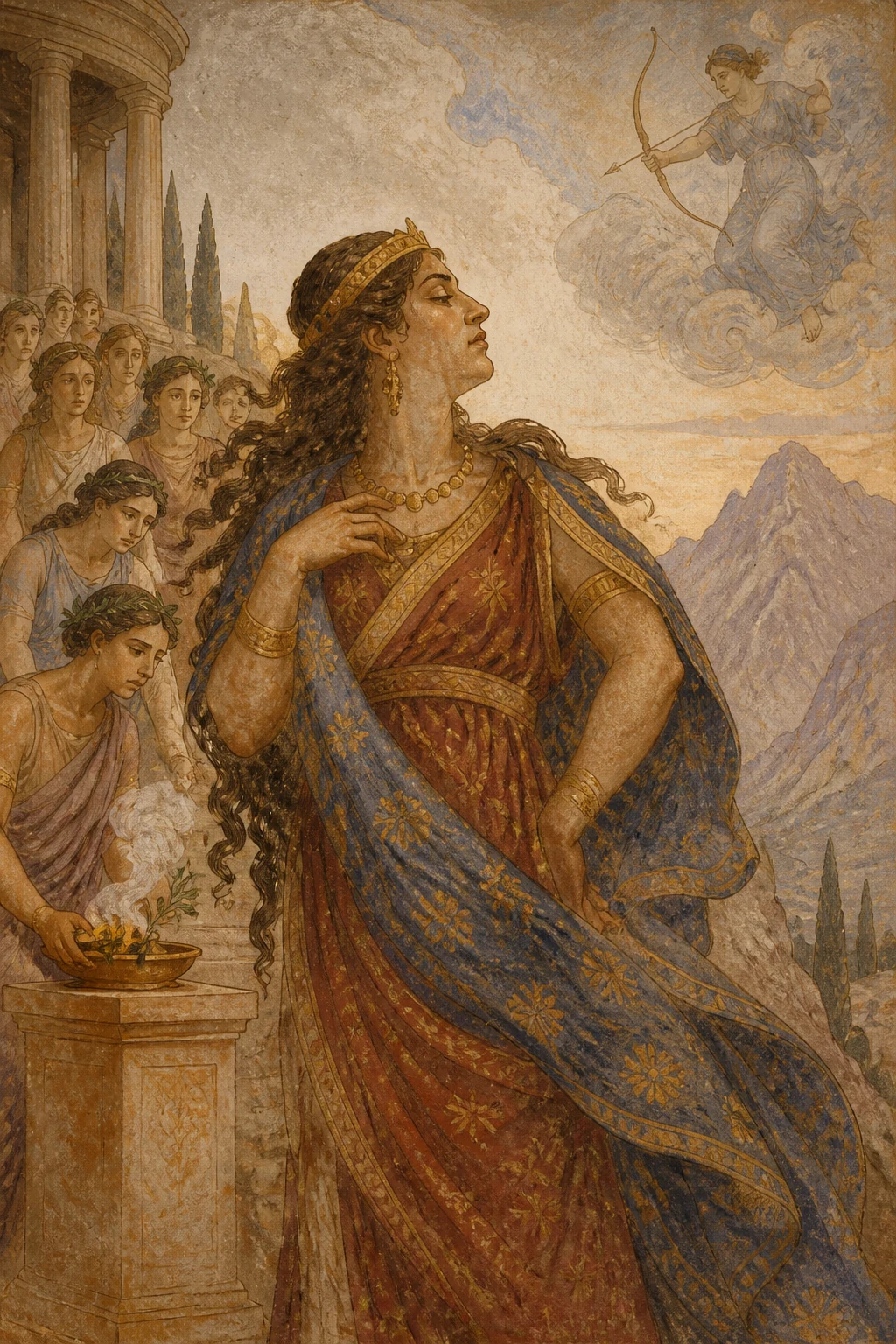
Now Niobe comes, surrounded by a great crowd of attendants, splendid in Phrygian robes interwoven with gold, and beautiful, so far as anger allows. Shaking her lovely head, her hair streaming down over both shoulders, she halts; then, standing tall, she casts her proud eyes around. “What madness,” she says, “to prefer gods you have only heard of to those you see! Why is Latona worshipped at the altars, while my divinity still receives no incense? Tantalus is my father, the only mortal permitted to share the tables of the gods; my mother is the sister of the Pleiades; mighty Atlas is my grandfather, who bears the vault of heaven on his shoulders.
Jupiter is my other grandfather; I glory in him as my father-in-law too. The peoples of Phrygia fear me; the royal house of Cadmus is under my rule, and the walls raised by my husband's lyre, with all their people, are governed by him and me. Wherever I turn my eyes within my house, boundless wealth meets my gaze. Add to this a beauty worthy of a goddess. Add seven daughters and as many sons, and soon sons-in-law and daughters-in-law.
Ask now what grounds I have for pride, and dare to prefer to me the Titaness Latona, daughter of some Coeus or other, to whom the vast earth once denied even a little place in which to give birth. Neither heaven nor earth nor sea would receive your goddess: she was an exile from the world, until Delos pitied her wanderings and said, ‘You wander a stranger on land, and I upon the waves,’ and gave her an unsteady refuge. She became the mother of two: a mere seventh of the children my womb has borne.
I am happy—who could deny it?—and happy I shall remain: who could doubt that either? My abundance has made me secure. I am too great for Fortune to harm; though she take much away, she will leave me far more. My blessings have put me beyond fear. Suppose some of this multitude of children could be taken from me: even so, I should not be stripped down to a mere two, Latona's brood. How far is she from childlessness?
Go! Enough of this worship! Go quickly, and take the laurel from your hair.” They remove it and leave the rites unfinished, yet worship the goddess in hushed murmurs, as they still may. The goddess was outraged, and on the highest peak of Cynthus she addressed her twin children in these words: “See how I, your mother, proud to have borne you, who would yield to none among goddesses except Juno, am questioned whether I am a goddess at all, and barred from altars worshipped through the ages, unless you help me, my children.
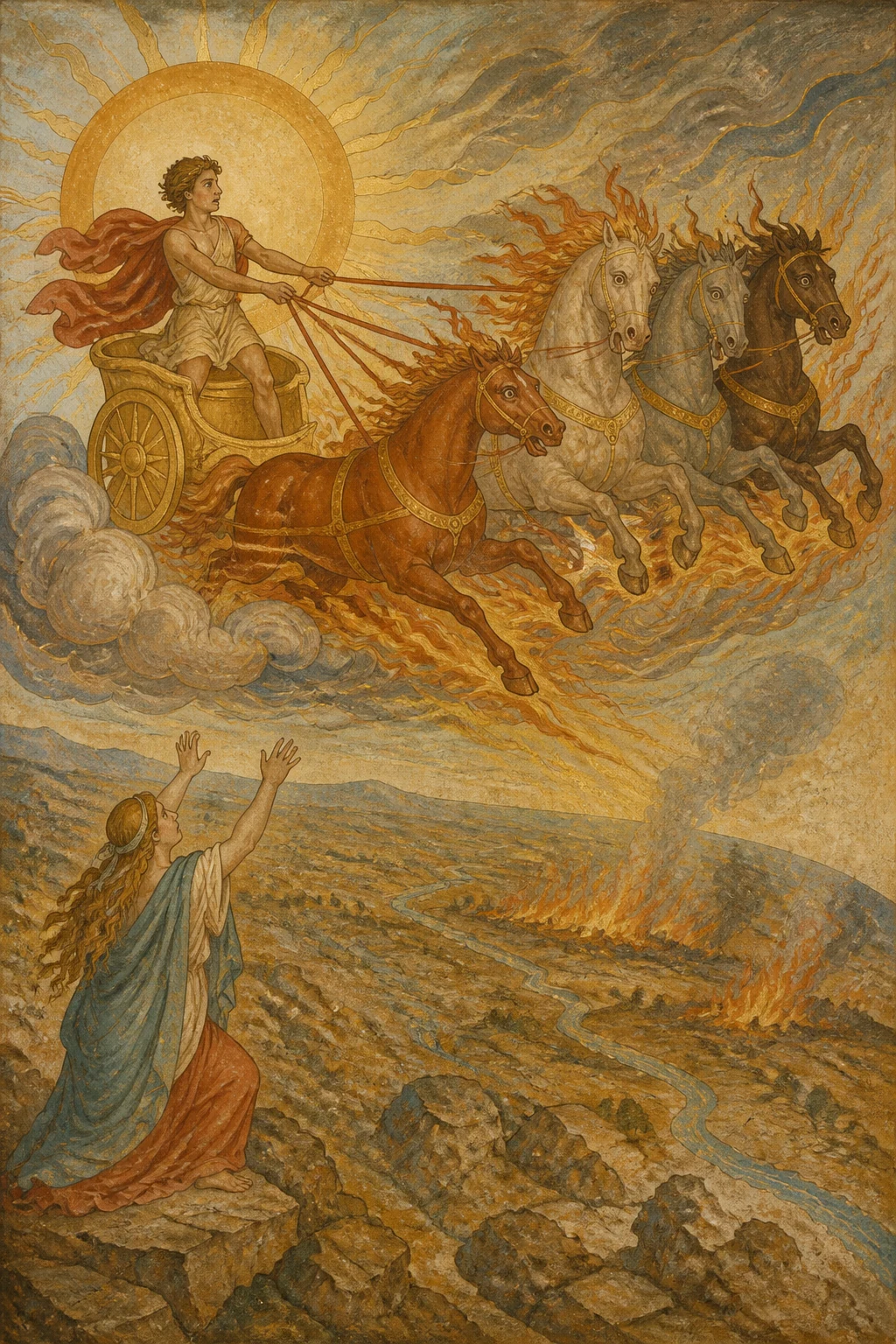
Nor is this my only grievance: the daughter of Tantalus has added insults to her dreadful deed, and dared to rank you below her children, calling me childless—may that word recoil upon her!—and wickedly displaying her father's tongue.” Latona was about to add entreaties to her tale, but Phoebus said, “Enough! Long complaints only delay her punishment.” Phoebe said the same; and gliding swiftly through the air, hidden by clouds, they reached the citadel of Cadmus.
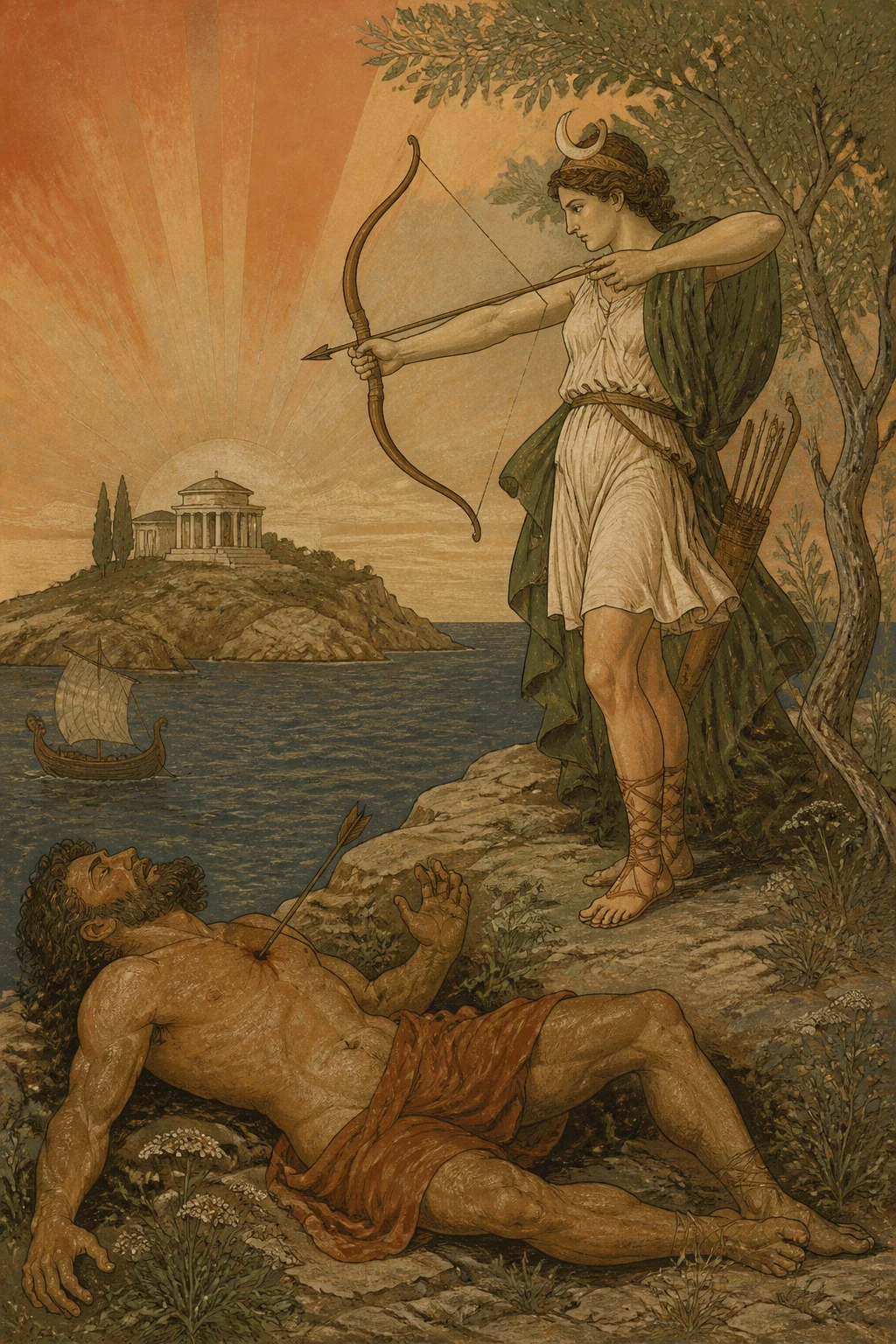
Near the walls lay a broad, level plain, continually pounded by horses, where countless wheels and hard hooves had softened the clods beneath them. There some of Amphion's seven sons were mounting their spirited horses, sitting on saddlecloths crimson with Tyrian dye, and handling reins heavy with gold. Among them was Ismenus, once the first burden his mother bore. As he guided his horse's course in a steady circle, checking its foaming mouth, he cried, “Ah, me!” An arrow stood fixed in the middle of his chest; his dying hand released the reins, and slowly he slipped sideways over the horse's right shoulder.
Next Sipylus, hearing the rattle of a quiver in the empty air, gave his horse the reins, as a sailor, foreseeing rain, flees at the sight of a cloud and unfurls all his hanging sails, lest the faintest breeze escape him. Yet as he gave rein, an inescapable arrow overtook him: it lodged quivering high in his neck, and its naked iron point protruded from his throat.
Pitched forward as he was, he rolled down over the flying legs and mane, and stained the earth with his warm blood. Unhappy Phaedimus and Tantalus, who bore his grandfather's name, had finished their usual exercises and turned to the young men's sport of the oil-slick wrestling ground. Already they had locked themselves in a close embrace, struggling chest to chest, when an arrow loosed from the taut string pierced them both, just as they stood entwined.
Together they groaned, together their limbs twisted in pain and sank to earth, together as they lay their eyes rolled for the last time, together they breathed their last. Alphenor saw them and, tearing and beating his breast, flew to lift their cold limbs in his arms, and fell in that act of brotherly devotion: for the Delian god pierced his inmost heart with deadly iron.
When he pulled it out, part of his lung came away on the barbs, and his blood poured into the air with his breath. But long-haired Damasichthon was struck by more than one wound. He was hit where the lower leg begins, where the sinewy knee makes a supple joint. And while he tried to draw out the deadly shaft with his hand, another arrow drove through his throat up to its feathers.
His blood forced it out, then shot high into the air and spurted far, piercing the empty space. Last, Ilioneus raised his arms in prayer, though prayer would do no good. “O gods, all of you together,” he cried, not knowing that not all should be implored, “spare me!” The archer was moved, but by then the arrow could not be recalled. Yet the boy died of the slightest wound: the shaft had barely pierced his heart.
News of the disaster, the people's grief, and her household's tears told the mother of this sudden ruin. She marvelled that the gods had had the power, and raged that they had dared such a deed, that their authority was so great. For the father, Amphion, had driven a sword through his breast and in dying ended both his grief and his life. Ah, how different this Niobe was from the Niobe who had just driven the people from Latona's altars and walked through the city with her head held high, the envy of her people, but now pitied even by an enemy.
She flung herself upon the cold bodies, bestowing last kisses at random on all her sons. Then, lifting her bruised arms from them toward heaven, she said, “Feed, cruel Latona, on my anguish, feed, and glut your heart upon my grief! Glut your savage heart,” she said, “with seven funerals! I myself am borne to burial. Exult, my enemy, and triumph in your victory! But why call it victory? In my misery I still have more than you in your happiness: even after so many deaths, I win.”
She had spoken, and the string rang out from the bended bow. The sound terrified everyone except Niobe alone: her misery made her bold. In black robes, their hair unbound, the sisters stood before their brothers' biers. One of them, pulling at the arrow lodged in her flesh, sank dying, her face resting on her brother. Another, trying to comfort her wretched mother, fell suddenly silent and doubled over at the wound.
Only as her breath was leaving her did she close her lips. One collapsed in fruitless flight; another died upon her sister; one hid; another could be seen trembling. When six had been given to death, suffering different wounds, the last remained. Her mother covered her with her whole body, with all her robes, and cried, “Leave me one, the youngest! Of so many I ask only the youngest—only one!”
And as she pleaded, the child she pleaded for fell dead. Bereft, she sat among her lifeless sons and daughters and her husband, and hardened in her grief. No breeze stirred her hair; the colour in her face was bloodless; her eyes stood fixed in her sorrowful face; nothing in her form remained alive. Within, her very tongue froze against her hard palate, and her veins could no longer move; her neck could not bend, her arms could make no movement, her feet could not walk; even her inward organs were stone.
Yet still she weeps. Enfolded in a mighty whirlwind, she was swept back to her native land. There, fixed upon a mountain peak, she melts in tears, and even now the marble streams with them.
Izvirnik
Niobe
Naslednje strani prikazujejo izvirno besedilo za primerjavo.
Source ID: ovid_metamorphoses_story_040 Citation: Ovid, Metamorphoses 6.146-6.312 Original language: Latin Source: PerseusDL canonical-latinLit Source URL: https://github.com/PerseusDL/canonical-latinLit/blob/master/data/phi0959/phi006/phi0959.phi006.perseus-lat2.xml Segmentation certainty: medium 146: Lydia tota fremit, Phrygiaeque per oppida facti 147: rumor it et magnum sermonibus occupat orbem.
148: Ante suos Niobe thalamos cognoverat illam, 149: tum cum Maeoniam virgo Sipylumque colebat; 150: nec tamen admonita est poena popularis Arachnes 151: cedere caelitibus verbisque minoribus uti. 152: Multa dabant animos: sed enim nec coniugis artes 153: nec genus amborum magnique potentia regni 154: sic placuere illi, quamvis ea cuncta placerent, 155: ut sua progenies; et felicissima matrum 156: dicta foret Niobe, si non sibi visa fuisset.
157: Nam sata Tiresia venturi praescia Manto 158: per medias fuerat divino concita motu 159: vaticinata vias: “Ismenides, ite frequentes 160: et date Latonae Latonigenisque duobus 161: cum prece tura pia lauroque innectite crinem. 162: Ore meo Latona iubet.” Paretur, et omnes 163: Thebaides iussis sua tempora frondibus ornant 164: turaque dant sanctis et verba precantia flammis.
165: Ecce venit comitum Niobe celeberrima turba, 166: vestibus intexto Phrygiis spectabilis auro, 167: et, quantum ira sinit, formosa: movensque decoro 168: cum capite inmissos umerum per utrumque capillos 169: constitit; utque oculos circumtulit alta superbos, 170: “quis furor, auditos” inquit “praeponere visis 171: caelestes? aut cur colitur Latona per aras, 172: numen adhuc sine ture meum est? mihi Tantalus auctor, 173: cui licuit soli superorum tangere mensas, 174: Pleiadum soror est genetrix mea, maximus Atlas 175: est avus, aetherium qui fert cervicibus axem; 176: Iuppiter alter avus socero quoque glorior illo.
177: Me gentes metuunt Phrygiae, me regia Cadmi 178: sub domina est, fidibusque mei commissa mariti 179: moenia cum populis a meque viroque reguntur. 180: In quamcumque domus adverti lumina partem, 181: inmensae spectantur opes. Accedit eodem 182: digna dea facies. Huc natas adice septem 183: et totidem iuvenes et mox generosque nurusque. 184: Quaerite nunc, habeat quam nostra superbia causam, 185: nescio quoque audete satam Titanida Coeo 186: Latonam praeferre mihi, cui maxima quondam 187: exiguam sedem pariturae terra negavit.
188: Nec caelo nec humo nec aquis dea vestra recepta est: 189: exsul erat mundi, donec miserata vagantem 190: “hospita tu terris erras, ego” dixit “in undis” 191: instabilemque locum Delos dedit. Illa duorum 192: facta parens: uteri pars haec est septima nostri. 193: Sum felix: quis enim neget hoc? felixque manebo: 194: hoc quoque quis dubitet? tutam me copia fecit, 195: Maior sum, quam cui possit Fortuna nocere, 196: multaque ut eripiat, multo mihi plura relinquet.
197: Excessere metum mea iam bona. Fingite demi 198: huic aliquid populo natorum posse meorum, 199: non tamen ad numerum redigar spoliata duorum, 200: Latonae turbam: qua quantum distat ab orba? 201: Ite, satis, propere ite, sacri est laurumque capillis 202: ponite.” Deponunt et sacra infecta relinquunt, 203: quodque licet tacito venerantur murmure numen. 204: Indignata dea est summoque in vertice Cynthi 205: talibus est dictis gemina cum prole locuta: 206: “En ego vestra parens, vobis animosa creatis, 207: et nisi Iunoni nulli cessura dearum, 208: an dea sim dubitor perque omnia saecula cultis
209: arceor, o nati, nisi vos succurritis, aris. 210: Nec dolor hic solus: diro convicia facto 211: Tantalis adiecit vosque est postponere natis 212: ausa suis, et me, quod in ipsam reccidat, orbam, 213: dixit et exhibuit linguam scelerata paternam.” 214: Adiectura preces erat his Latona relatis: 215: “desine!” Phoebus ait: “poenae mora longa querella est.” 216: Dixit idem Phoebe: celerique per aera lapsu 217: contigerant tecti Calmeida nubibus arcem.
218: Planus erat lateque patens prope moenia campus, 219: adsiduis pulsatus equis, ubi turba rotarum 220: duraque mollierat subiectas ungula glaebas. 221: Pars ibi de septem genitis Amphione fortes 222: conscendunt in equos Tyrioque rubentia suco 223: terga premunt auroque graves moderantur habenas. 224: E quibus Ismenus, qui matri sarcina quondam 225: prima suae fuerat, dum certum flectit in orbem 226: quadrupedis cursus spumantiaque ora coercet, 227: “ei mihi!” conclamat medioque in pectore fixa 228: tela gerit, frenisque manu moriente remissis 229: in latus a dextro paulatim defluit armo.
230: Proximus, audito sonitu per inane pharetrae, 231: frena dabat Sipylus, veluti cum praescius imbris 232: nube fugit visa pendentiaque undique rector 233: carbasa deducit, ne qua levis effluat aura. 234: Frena tamen dantem non evitabile telum 235: consequitur; summaque tremens cervice sagitta 236: haesit, et exstabat nudum de gutture ferrum. 237: Ille, ut erat, pronus per crura admissa iubasque 238: volvitur et calido tellurem sanguine foedat.
239: Phaedimus infelix et aviti nominis heres 240: Tantalus, ut solito finem imposuere labori, 241: transierant ad opus nitidae iuvenale palaestrae; 242: et iam contulerant arto luctantia nexu 243: pectora pectoribus, cum tento concita nervo, 244: sicut erant iuncti, traiecit utrumque sagitta. 245: Ingemuere simul, simul incurvata dolore 246: membra solo posuere, simul suprema iacentes 247: lumina versarunt, animam simul exhalarunt.
248: Adspicit Alphenor laniataque pectora plangens 249: advolat, ut gelidos complexibus adlevet artus, 250: inque pio cadit officio: nam Delius illi 251: intima fatifero rupit praecordia ferro. 252: Quod simul eductum est, pars est pulmonis in hamis 253: eruta cumque anima cruor est effusus in auras. 254: At non intonsum simplex Damasichthona vulnus 255: adficit. Ictus erat qua crus esse incipit et qua 256: mollia nervosus facit internodia poples.
257: Dumque manu temptat trahere exitiabile telum, 258: altera per iugulum pennis tenus acta sagitta est. 259: Expulit hanc sanguis, seque eiaculatus in altum 260: emicat et longe terebrata prosilit aura. 261: Ultimus Ilioneus non profectura precando 262: bracchia sustulerat, “di” que “o communiter omnes,” 263: dixerat ignarus non omnes esse rogandos 264: “parcite.” Motus erat, cum iam revocabile telum 265: non fuit, arquitenens. Minimo tamen occidit ille 266: vulnere, non alte percusso corde sagitta.
267: Fama mali populique dolor lacrimaeque suorum 268: tam subitae matrem certam fecere ruinae, 269: mirantem potuisse, irascentemque, quod ausi 270: hoc essent superi, quod tantum iuris haberent. 271: Nam pater Amphion ferro per pectus adacto 272: finierat moriens pariter cum luce dolorem. 273: Heu quantum haec Niobe Niobe distabat ab illa, 274: quae modo Latois populum submoverat aris 275: et mediam tulerat gressus resupina per urbem, 276: invidiosa suis, at nunc miseranda vel hosti.
277: Corporibus gelidis incumbit et ordine nullo 278: oscula dispensat natos suprema per omnes. 279: A quibus ad caelum liventia bracchia tollens 280: “pascere, crudelis, nostro, Latona, dolore, 281: pascere” ait “satiaque meo tua pectora luctu: 282: “Corque ferum satia” dixit, “per funera septem” 283: efferor. Exsulta victrixque inimica triumpha. 284: Cur autem victrix? miserae mihi plura supersunt, 285: quam tibi felici: post tot quoque funera vinco.”
286: Dixerat, et sonuit contento nervus ab arcu. 287: Qui praeter Nioben unam conterruit omnes: 288: illa malo est audax. Stabant cum vestibus atris 289: ante toros fratrum demisso crine sorores. 290: E quibus una trahens haerentia viscere tela 291: imposito fratri moribunda relanguit ore: 292: altera solari miseram conata parentem 293: conticuit subito duplicataque vulnere tota est.
294: oraque compressit, nisi postquam spiritus ibat. 295: Haec frustra fugiens collabitur, illa sorori 296: inmoritur, latet haec, illam trepidare videres. 297: Sexque datis leto diversaque vulnera passis 298: ultima restabat. Quam toto corpore mater, 299: tota veste tegens “unam minimamque relinque 300: de multis minimam posco” clamavit “et unam.” 301: Dumque rogat, pro qua rogat, occidit. Orba resedit 302: exanimes inter natos natasque virumque, 303: deriguitque malis. Nullos movet aura capillos, 304: in vultu color est sine sanguine, lumina maestis 305: stant inmota genis, nihil est in imagine vivum.
306: Ipsa quoque interius cum duro lingua palato 307: congelat, et venae desistunt posse moveri; 308: nec flecti cervix nec bracchia reddere motus 309: nec pes ire potest; intra quoque viscera saxum est. 310: Flet tamen. Et validi circumdata turbine venti 311: in patriam rapta est. Ibi fixa cacumine montis 312: liquitur, et lacrimas etiam nunc marmora manant.
Nadaljuj z branjem