Prevod
She said: “I have heard, O fortunate King, that Ala al-Din said, ‘My father equipped me with fifty loads of merchandise and gave me ten thousand dinars. I traveled until I reached the Lion’s Forest, where Bedouins fell upon me and took my money and my goods. I came into this city with no idea where I might spend the night, and when I saw this place, I took shelter here.’ The man said to him, ‘My son, what would you say if I gave you a thousand dinars and a suit of clothes worth another thousand?’ Ala al-Din asked, ‘On what terms would you give me this, uncle?’ He replied, ‘This young man with me is my nephew, his father’s only child. I too have an only child, a daughter named Zubayda al-Udiyya, a girl of great beauty. I married her to him, and he loves her, but she detests him. Then he broke an oath he had sworn on pain of a threefold divorce. His wife could scarcely believe her good fortune, and left him at once. He has set everyone upon me, urging me to restore her to him, but I told him that this could not lawfully be done unless she first married another man. We agreed to find a stranger to act as her intervening husband, so that no one would taunt him over the affair. Since you are a stranger here, come with us, and we will have your marriage contract drawn up. You shall spend tonight with her, divorce her in the morning, and receive what I have promised you.’ Ala al-Din thought, ‘A night with a bride, in a house and on a bed, is better than a night in alleys and passageways.’ So he went with them to the judge. When the judge saw Ala al-Din, he took a liking to him and asked the girl’s father, ‘What is it you wish?’ He replied, ‘We wish to make this man an intervening husband for our daughter, but we shall draw up a bond obliging him to pay ten thousand dinars as her marriage portion. If he spends the night with her and divorces her in the morning, we shall give him a suit worth a thousand dinars, a mule worth a thousand dinars, and a thousand dinars in cash. But if he refuses to divorce her, he must pay ten thousand dinars.’ They drew up the marriage contract on these terms, and the girl’s father took a written bond to that effect. Then he took Ala al-Din with him, dressed him in the suit, and led him to his daughter’s house. Leaving him at the door, he went in to his daughter and said, ‘Take the deed for your marriage portion. I have married you to a handsome young man named Ala al-Din Abu al-Shamat, so treat him with the utmost kindness.’ He handed her the deed and went away.
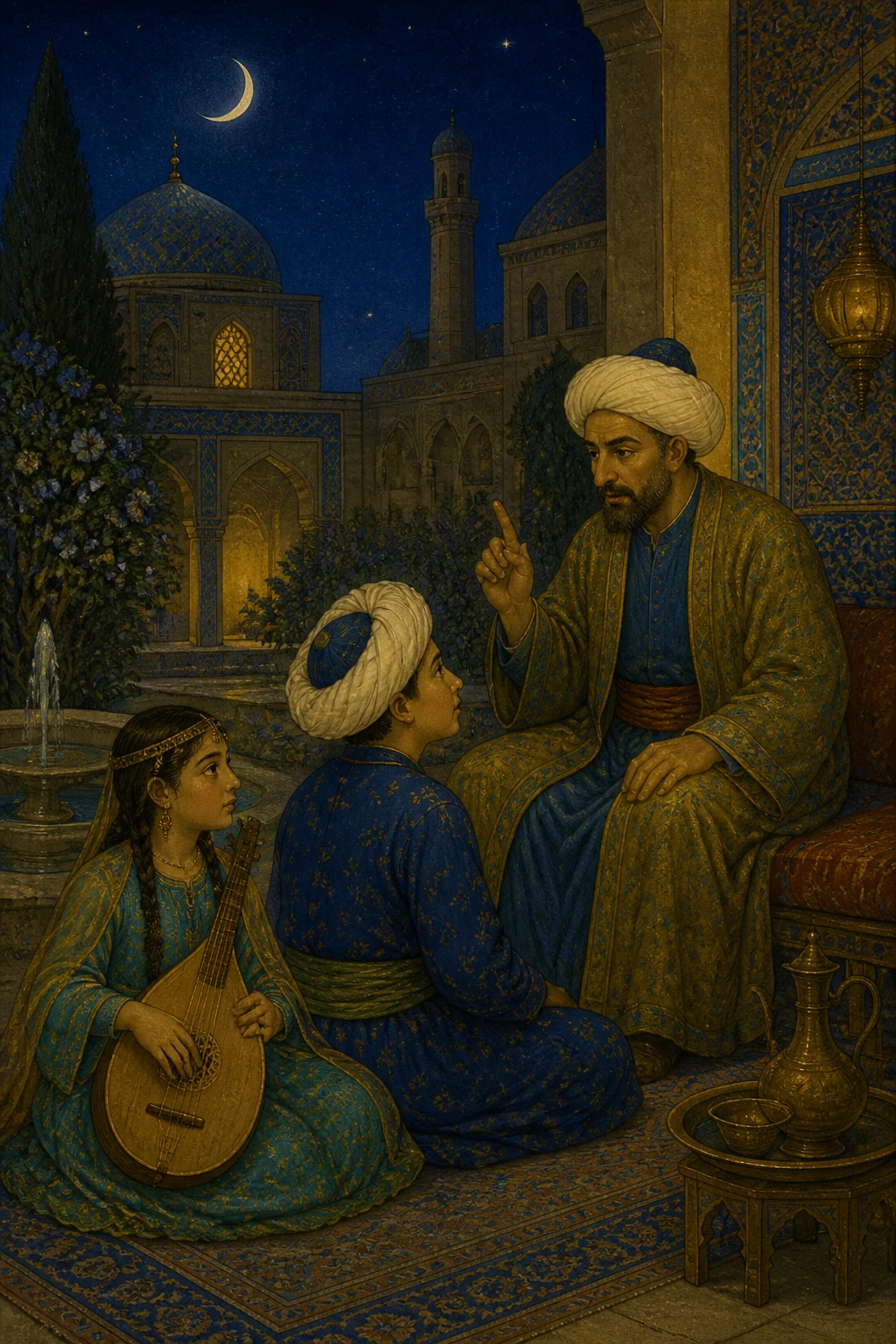
Now the girl’s cousin had a housekeeper who used to visit his cousin Zubayda al-Udiyya, and he had always treated the woman generously. He said to her, ‘Mother, once my cousin Zubayda sees this handsome young man, she will never have me again. I beg you to devise some trick to keep the girl away from him.’ She replied, ‘By your youth, I will not let him come near her!’ Then she went to Ala al-Din and said, ‘My son, I offer you counsel for the sake of God Most High. Take my advice: do not go near that girl. Let her sleep alone. Do not touch her or approach her.’ ‘Why?’ he asked. She replied, ‘Her body is covered with leprosy, and I fear she will infect you in the beauty of your youth.’ ‘Then I want nothing to do with her,’ he said. She went to the girl and told her the same thing she had told Ala al-Din. The girl said, ‘I have no need of him. I shall let him sleep alone, and in the morning he can go his way.’ Then she called a maid and said, ‘Take him a tray of food for his supper.’ The maid carried the food to him and set it before him. He ate his fill, then sat and recited the Surah of Ya Sin in a beautiful voice. The girl listened and found his voice like the psalms of the house of David. She thought, ‘May God bring misery upon that old woman who told me he had leprosy! No one suffering from such an affliction could have a voice like this. What she said about him must be a lie.’ Then she took up an Indian-made lute, tuned its strings, and sang to it in a voice that would halt a bird in midair, chanting these two verses:
‘I love a gazelle with languid, dark-ringed eyes; when he walks, the willow branches envy him. He denies me, while another enjoys his embrace: such is God’s bounty, bestowed on whom He wills.’ When Ala al-Din heard her sing these words, having finished the surah, he too began to sing and recited this verse:
‘My greetings to the graceful form beneath those clothes, and to the roses blooming in the gardens of those cheeks.’ The girl rose, her love now stronger than before, and lifted the curtain. When Ala al-Din saw her, he recited these two verses:
‘She appeared a moon, swayed like a willow bough, breathed ambergris, and gazed with a gazelle’s eyes. Sorrow, it seems, is enamored of my heart: whenever she departs, it finds its hour of union.’ Then she came toward him, her hips swaying, her slender body bending, a creation of Him whose kindness works unseen. Each cast upon the other a glance that brought a thousand pangs of longing. When the arrow of her eyes had lodged deep in his heart, he recited these two verses:
‘She gazed upon the moon in heaven and recalled to me our nights of union at al-Raqmatayn. Both of us were gazing at a moon, yet I looked through her eyes, and she through mine.’ When she drew near and only two steps remained between them, he recited these two verses:
‘One night she loosened three dark tresses of her hair, and showed me four nights all at once. She turned her face toward the moon in heaven, and showed me two moons at a single time.’ But when she came up to him, he said, ‘Keep away from me, lest you infect me!’ She bared her wrist, revealing the two rounded curves of her forearm, white as silver, and said, ‘You keep away from me! You have leprosy, and I do not want you to infect me.’ He asked, ‘Who told you I was a leper?’ ‘The old woman told me,’ she replied. He said, ‘And the old woman told me that you were afflicted with leprosy!’ Then he bared his arms for her, and she saw that his body was like pure silver. She clasped him to her breast, and he drew her to his chest, and the two embraced. Then she took him with her, lay upon her back, and loosened her trousers. The thing his father had bequeathed him stirred, and he cried, ‘Your aid, Sheikh Zakariya, father of mighty roots!’ He laid his hands upon her waist, set his sweet root at the Gate of the Breach, and thrust it forward until it reached the Gate of Sha‘riyya, having passed through the Gate of Conquests. Then he entered the markets of Monday, Tuesday, Wednesday, and Thursday, and found the carpet fitted the hall exactly; the casket sought its lid until the two met. When morning came, he said to her, ‘Our joy was scarcely complete before the crow snatched it and flew away.’ ‘What do you mean by that?’ she asked. He replied, ‘My lady, I have only this hour left to stay with you.’ ‘Who says so?’ she asked. He said, ‘Your father has taken a bond from me for ten thousand dinars, your marriage portion. If I do not pay it today, they will imprison me for it in the judge’s house, and at present I do not have so much as a half-silver piece toward those ten thousand dinars.’ She asked, ‘My lord, is the right of divorce in your hands or theirs?’ ‘In mine,’ he replied, ‘but I have no money.’ She said, ‘The matter is simple, so fear nothing. Take these hundred dinars. If I had more, I would give you all you wanted, but my father, out of love for his nephew, has carried all my money from here to his own house. He even took all my jewelry. If tomorrow he sends you an officer of the court…’ But morning overtook Shahrazad, and she fell silent, leaving her tale untold.
When it was the two hundred and fifty-seventh night
She said: “I have heard, O fortunate King, that the girl said to Ala al-Din, ‘If tomorrow they send you an officer of the court, and the judge and my father tell you to divorce me, say to them, “Under what school of law may a man marry in the evening and divorce in the morning?” Then kiss the judge’s hand and give him a present, and likewise kiss the hand of each witness and give him ten dinars. They will all speak on your behalf. If they ask, “Why do you not divorce her and take the thousand dinars, the mule, and the suit, according to the conditions we laid upon you?” tell them, “Every hair upon her head is worth a thousand dinars to me. I shall never divorce her, nor shall I take a suit or anything else.” If the judge says, “Then pay the marriage portion,” tell him, “At present I am unable to pay.” The judge and witnesses will then deal gently with you and give you time.’
While they were talking, the judge’s officer knocked at the door. Ala al-Din went out to him, and the officer said, ‘Come speak with the judge. Your father-in-law has summoned you.’ Ala al-Din gave him five dinars and said, ‘Officer, under what law must I marry in the evening and divorce in the morning?’ He replied, ‘That is quite unlawful among us. If you do not know the law, I shall act as your advocate.’ They went to the court, where the judge asked, ‘Why have you not divorced the woman and taken what was agreed upon?’ Ala al-Din went up to the judge, kissed his hand, and slipped fifty dinars into it, saying, ‘My lord judge, under what school of law may I marry in the evening and be forced to divorce in the morning?’ The judge replied, ‘A forced divorce is not lawful under any of the Muslim schools of law.’ The girl’s father said, ‘If you will not divorce her, then pay me the marriage portion of ten thousand dinars.’ Ala al-Din said, ‘Give me three days.’ The judge replied, ‘Three days is not a sufficient grace period. He shall give you ten.’ They agreed on this, stipulating that at the end of ten days he must either pay the marriage portion or divorce her. Ala al-Din left them on those terms, bought meat, rice, clarified butter, and whatever other provisions were needed, and returned home. He went in to the girl and told her all that had happened. She said, ‘Between night and day, wonders may come to pass. Well did the poet say:
“Be gentle when anger puts you to the test, and patient when calamity befalls you. The nights of time are heavy with child, and every wonder may be born of them.”’ Then she rose, prepared the food, and set out the meal. They ate and drank, enjoying themselves in delight. Afterward he asked her to play a musical suite for him. She took up the lute and played a suite that would move the hardest stone to ecstasy, while the strings cried in that gathering, ‘O David!’ She passed into the lively movement of the suite. While they were thus enjoying themselves, laughing and rejoicing, there came a knock at the door. She said, ‘Go and see who is there.’ He went down and opened the door, and found four dervishes standing outside. ‘What do you want?’ he asked. They replied, ‘Our lord, we are dervishes far from home. Music and tender verses are the nourishment of our souls. We wish to rest with you tonight until morning, then go our way, and God Most High will reward you. We are lovers of music, and every one of us knows odes, poems, and muwashshahat by heart.’ He said, ‘I must ask someone first.’ He went upstairs and told her, and she said, ‘Open the door to them.’ So he opened the door, brought them upstairs, seated them, and welcomed them. Then he brought them food, but they would not eat. ‘Our lord,’ they said, ‘our sustenance is the remembrance of God in our hearts, and the sound of song in our ears. Well did the poet say:
“Our only purpose is to meet together; eating is but the habit of beasts.” We were listening to some lovely music, but when we came upstairs it ceased. Tell us, was the musician a white slave girl, a black slave girl, or a freeborn woman?’ He replied, ‘She is my wife.’ Then he told them everything that had happened to him and said, ‘My father-in-law has bound me to pay ten thousand dinars for her marriage portion, and they have given me ten days.’ One of the dervishes said, ‘Do not grieve, and let only pleasant thoughts occupy your mind. I am the sheikh of a dervish lodge, with forty dervishes under my authority. I shall collect the ten thousand dinars from them for you, and you can pay your father-in-law the marriage portion you owe him. But ask her to play us a suite, so that we may rejoice and our spirits may revive. For music is food to some, medicine to others, and to others a cooling fan.’ Now these four dervishes were the Caliph Harun al-Rashid, the vizier Ja‘far al-Barmaki, Abu Nuwas al-Hasan ibn Hani, and Masrur, the executioner of wrath. The reason they had passed by this house was that the caliph had been troubled in spirit and had said to his vizier, ‘Vizier, I wish to go out and walk through the city, for my heart is oppressed.’ They had dressed as dervishes and gone down into the city. Passing by that house, they heard the music and wished to discover its source. They spent the night in pleasure and harmony, exchanging conversation until morning. Then the caliph placed a hundred dinars beneath the carpet, and they took their leave and went on their way. When the girl lifted the carpet, she found the hundred dinars beneath it and said to her husband, ‘Take these hundred dinars I found under the carpet. The dervishes put them there before they left, without our knowing.’ Ala al-Din took them, went to the market, and bought meat, rice, clarified butter, and everything else they needed.
On the second night he lit the candles and said to her, ‘The dervishes have not brought the ten thousand dinars they promised me. But they are poor men.’ While they were talking, the dervishes knocked at the door. She said, ‘Go down and let them in.’ He opened the door, and they came upstairs. He asked, ‘Have you brought the ten thousand dinars you promised me?’ They replied, ‘We have not yet been able to obtain any of it, but have no fear. Tomorrow, God Most High willing, we shall brew a batch of alchemy. Now ask your wife to play us a splendid suite to revive our hearts, for we love music.’ She played them a suite upon the lute that would set solid stone dancing. They spent the night in happiness and delight, in conversation and good cheer, until morning rose and spread its shining light. Then the caliph placed a hundred dinars beneath the carpet, and they took their leave and went their way. They continued visiting him in this fashion for nine nights, and every night the caliph placed a hundred dinars beneath the carpet. But when the tenth night came, they did not appear. The reason for their absence was that the caliph had sent for a great merchant and said to him, ‘Bring me fifty loads of the cloth that comes from Egypt…’ But morning overtook Shahrazad, and she fell silent, leaving her tale untold.
When it was the two hundred and fifty-eighth night
She said: “I have heard, O fortunate King, that the Commander of the Faithful said to that merchant, ‘Bring me fifty loads of the cloth that comes from Egypt, each load worth a thousand dinars. Mark the price on every load, and bring me an Abyssinian slave.’ The merchant brought him everything he had ordered. Then the caliph gave the slave a gold basin and ewer, a gift, and the fifty loads. He wrote a letter in the name of Shams al-Din, chief of the merchants of Cairo and Ala al-Din’s father, and said to the slave, ‘Take these loads and everything with them to such-and-such a quarter, where the chief of the merchants has his house, and ask, “Where is my master Ala al-Din Abu al-Shamat?” The people will direct you to the quarter and the house.’ The slave took the loads and all that accompanied them, and set out as the caliph had commanded.
So much for him. As for the girl’s cousin, he went to her father and said, ‘Come, let us go to Ala al-Din and have him divorce my cousin.’ The father went out with him, and together they made their way to Ala al-Din’s house. When they arrived, they found fifty mules bearing fifty loads of cloth, and a slave riding another mule. They asked him, ‘To whom do these loads belong?’ He replied, ‘To my master Ala al-Din Abu al-Shamat. His father equipped him with merchandise and sent him to Baghdad, but Bedouins fell upon him and took his money and his goods. When the news reached his father, he sent me with these loads to replace them. He has also sent him, in my charge, a mule carrying fifty thousand dinars, a bundle of clothing worth a great sum, a sable coat, and a gold basin and ewer.’ The girl’s father said, ‘He is my son-in-law. I will show you his house.’ Meanwhile, Ala al-Din was sitting at home in deep distress when a knock sounded at the door. He said, ‘Zubayda, God knows whether your father has sent an officer from the judge or from the governor.’ She replied, ‘Go down and see what the matter is.’ He went down and opened the door. There stood his father-in-law, the chief of the merchants and Zubayda’s father, with a handsome, brown-skinned Abyssinian slave mounted on a mule. The slave dismounted and kissed his hands. Ala al-Din asked, ‘What do you want?’ He replied, ‘I am the slave of my master Ala al-Din Abu al-Shamat, son of Shams al-Din, chief of the merchants in Egypt. His father has sent me to him with these goods entrusted to my care.’ Then he handed him the letter. Ala al-Din took it, opened it, and read what was written within:
‘O letter of mine, when my beloved sees you, kiss the earth and the sandals at his feet. Be patient, and do not hasten away, for my soul and all my comfort are in his hands. After fullest greetings, salutations, and honors: from Shams al-Din to his son Ala al-Din Abu al-Shamat. Know, my son, that news has reached me of the slaying of your men and the plundering of your money and your merchandise. I have therefore sent you these fifty loads of Egyptian cloth to replace them, together with the suit of clothes, the sable coat, and the gold basin and ewer. Fear nothing, my son: may all my wealth be your ransom. Do not give way to sorrow. Your mother and the household are well and in good health, and send you their warmest greetings. I have also heard, my son, that they made you an intervening husband for the girl Zubayda al-Udiyya and bound you to pay fifty thousand dinars as her marriage portion. That sum is coming to you with the loads, in the charge of your slave Salim.’
When he had finished reading the letter, he took delivery of the goods. Then he turned to his father-in-law and said, ‘Father-in-law, take the fifty thousand dinars as your daughter Zubayda’s marriage portion, and take the merchandise to trade with. Keep the profit for yourself and return the capital to me.’ He replied, ‘By God, I will take nothing. As for your wife’s marriage portion, settle that between the two of you.’ After the loads had been carried inside, Ala al-Din and his father-in-law entered the house. Zubayda asked her father, ‘Father, whose goods are these?’ He replied, ‘These goods belong to your husband Ala al-Din. His father has sent them to replace those the Bedouins took from him. He has also sent him fifty thousand dinars, a bundle of clothing, a sable coat, a mule, and a gold basin and ewer. As for your marriage portion, that is for you to decide.’ Ala al-Din rose, opened the chest, and gave her the money due to her. The girl’s cousin said, ‘Uncle, make Ala al-Din divorce my wife for me.’ Her father replied, ‘That can no longer be done. The right of divorce rests with him.’ The young man went away, grieving and humiliated, and took to his bed at home. The blow proved fatal, and he died.
As for Ala al-Din, after receiving his goods he went to the market and bought the food, drink, clarified butter, and other things he needed, making his preparations as on every other night. He said to Zubayda, ‘Look at those lying dervishes! They made us a promise and broke it.’ She replied, ‘You are the son of the chief of the merchants, yet you did not have so much as a half-silver piece. What, then, could those poor dervishes do?’ He said, ‘God Most High has made us independent of them. But if they come again, I shall not open the door.’ She replied, ‘Why not? Good fortune only came to us with their coming, and every night they put a hundred dinars beneath our carpet. You must open the door if they come.’ When daylight withdrew and night approached, they lit the candles, and he said, ‘Zubayda, come and play us a suite.’ Just then there was a knock at the door. She said, ‘Go and see who is there.’ He went down, opened the door, and found the dervishes. ‘Welcome, you liars!’ he said. ‘Come upstairs.’ They went up with him, and he seated them and brought them a tray of food. They ate and drank, delighting in their pleasures. Afterward they said, ‘Our lord, our hearts have been troubled on your account. What happened between you and your father-in-law?’ He replied, ‘God has compensated us beyond all we could wish.’ They said, ‘By God, we were afraid for you.’ But morning overtook Shahrazad, and she fell silent, leaving her tale untold.
When it was the two hundred and fifty-ninth night
She said: “I have heard, O fortunate King, that the dervishes said to Ala al-Din, ‘By God, we were afraid for you. Nothing kept us away but our lack of money.’ He replied, ‘Swift relief has come to me from my Lord. My father has sent me fifty thousand dinars, fifty loads of cloth worth a thousand dinars apiece, a suit of clothes, a sable coat, a mule, a slave, and a gold basin and ewer. My father-in-law and I have made peace, and my wife is now securely mine. Praise be to God for all of it!’ Then the caliph rose to relieve himself, and the vizier Ja‘far leaned toward Ala al-Din and said, ‘Mind your manners, for you are in the presence of the Commander of the Faithful.’ Ala al-Din asked, ‘What discourtesy have I shown in the presence of the Commander of the Faithful? And which of you is he?’ The vizier replied, ‘The man who was speaking to you, and who has just risen to relieve himself, is the Commander of the Faithful, the Caliph Harun al-Rashid. I am his vizier Ja‘far; this is Masrur, the executioner of his wrath; and this is Abu Nuwas al-Hasan ibn Hani. Use your reason, Ala al-Din. How many days’ journey is it from Egypt to Baghdad?’ ‘Forty-five days,’ he answered. The vizier said, ‘Your goods were plundered only ten days ago. How could the news have reached your father, and how could he have packed these loads and sent them on a journey of forty-five days, all within ten?’ Ala al-Din asked, ‘My lord, where, then, did all this come from?’ He replied, ‘From the caliph, the Commander of the Faithful, because of his great affection for you.’
While they were speaking, the caliph returned. Ala al-Din rose and kissed the ground before him, saying, ‘May God preserve you, Commander of the Faithful, and prolong your life. May the people never be deprived of your bounty and kindness.’ The caliph said, ‘Ala al-Din, have Zubayda play us a suite to celebrate your deliverance.’ She played a wondrous suite upon the lute, until even solid stone would have thrilled to it and the lute cried in that gathering, ‘O David!’ They spent the night in the greatest happiness until morning. Then the caliph said to Ala al-Din, ‘Come to the court tomorrow.’ He replied, ‘I hear and obey, Commander of the Faithful, God Most High willing, and may you remain in good health.’ Ala al-Din took ten trays, arranged a splendid gift upon them, and brought them to the court the following day. While the caliph sat upon his throne in the audience hall, Ala al-Din entered at the door, reciting these two verses:
‘May happiness attend you every day in majesty, while envy’s nose is ground in dust. May all your days be bright and fair, and all your enemies’ days be black.’ The caliph said, ‘Welcome, Ala al-Din!’ Ala al-Din replied, ‘Commander of the Faithful, the Prophet, God bless him and grant him peace, accepted gifts. These ten trays and all they contain are my gift to you.’ The Commander of the Faithful accepted them, ordered a robe of honor for him, appointed him chief of the merchants, and gave him a seat in the court. While he was sitting there, his father-in-law, Zubayda’s father, arrived and found Ala al-Din seated in his place, wearing a robe of honor. He said to the Commander of the Faithful, ‘King of the age, why is this man sitting in my place and wearing that robe?’ The caliph replied, ‘I have appointed him chief of the merchants. Offices are bestowed, not held forever. You are dismissed.’ He answered, ‘He is one of us and belongs to us. You have done well, Commander of the Faithful. May God set the best among us over our affairs. Many a lesser man has risen to greatness.’ Then the caliph had a decree written for Ala al-Din and gave it to the governor, who handed it to the herald. The herald proclaimed in the court, ‘There is no chief of the merchants but Ala al-Din Abu al-Shamat! His word shall be obeyed, his dignity safeguarded. He is entitled to honor, respect, and high standing!’ When the court dispersed, the governor went out with the herald before Ala al-Din, and the herald cried, ‘There is no chief of the merchants but my lord Ala al-Din Abu al-Shamat!’ They led him through the streets of Baghdad, while the herald repeated his proclamation. The next morning Ala al-Din opened a shop for the slave and installed him there to buy and sell. As for Ala al-Din himself, he would mount and ride to his appointed seat in the caliph’s court. But morning overtook Shahrazad, and she fell silent, leaving her tale untold.
When it was the two hundred and sixtieth night
She said: “I have heard, O fortunate King, that Ala al-Din used to mount and ride to the caliph’s court. One day, as he sat in his customary place, someone said to the caliph, ‘Commander of the Faithful, may your life be spared: such-and-such a boon companion has passed into the mercy of God Most High. May you live on after him.’ The caliph asked, ‘Where is Ala al-Din Abu al-Shamat?’ Ala al-Din came before him, and when the caliph saw him, he bestowed a splendid robe of honor upon him, made him his boon companion, and assigned him a monthly stipend of a thousand dinars. So he remained with the caliph, keeping him company. One day, while he sat as usual in his place in the caliph’s service, a commander came up to the court carrying a sword and shield and said, ‘Commander of the Faithful, may your life be spared: the captain of the sixty has died today.’ The caliph ordered a robe of honor for Ala al-Din Abu al-Shamat and appointed him captain of the sixty in the dead man’s place. The former captain had neither son nor daughter nor wife, so Ala al-Din went down and took possession of his property. The caliph said to him, ‘Bury him in the earth, and take all he has left: his money, male and female slaves, and servants.’ Then the caliph shook his handkerchief, and the court dispersed. Ala al-Din went out with Captain Ahmad al-Danaf, commander of the caliph’s right wing, and his forty followers on his right, and Captain Hasan Shuman, commander of the caliph’s left wing, and his forty followers on his left. Ala al-Din turned to Captain Hasan Shuman and his men and said, ‘I ask you all to intercede with Captain Ahmad al-Danaf, that he may accept me as his son under God’s covenant.’ Ahmad kissed him and said, ‘I and my forty followers shall walk before you to the court every day.’
Ala al-Din continued in the caliph’s service for some days. Then one day he left the court and returned home, dismissing Ahmad al-Danaf and his men to go their way. He sat with his wife Zubayda al-Udiyya, who had lit the candles, and after a while she rose to relieve herself. As he sat there, he suddenly heard a terrible scream. He sprang up and hurried to see who had cried out, and found his wife Zubayda al-Udiyya lying on the ground. He placed his hand upon her breast and found that she was dead. Her father’s house stood opposite Ala al-Din’s, and he too had heard her cry. He asked, ‘What has happened, my lord Ala al-Din?’ He replied, ‘May your life be spared, my father: your daughter Zubayda al-Udiyya is dead. But, my father, the honor due to the dead is prompt burial.’ In the morning they laid her in the earth, and Ala al-Din consoled her father, while her father consoled him.
Such was the fate of Zubayda al-Udiyya. As for Ala al-Din, he dressed in mourning, ceased attending the court, and remained with weeping eyes and a sorrowful heart. The caliph asked Ja‘far, ‘Vizier, why has Ala al-Din ceased to attend the court?’ The vizier replied, ‘Commander of the Faithful, his heart is grieving for his wife Zubayda, and he is occupied with mourning her.’ The caliph said, ‘It is our duty to offer him our condolences.’ ‘I hear and obey,’ replied the vizier. The caliph went out with the vizier and some servants. They mounted and rode to Ala al-Din’s house. As he sat there, the caliph, the vizier, and their attendants approached. He rose to meet them and kissed the ground before the caliph, who said, ‘May God grant you a worthy recompense.’ Ala al-Din replied, ‘May God prolong your life for us, Commander of the Faithful.’ The caliph asked, ‘Ala al-Din, why have you ceased attending the court?’ He replied, ‘Because I grieve for my wife Zubayda, Commander of the Faithful.’ The caliph said, ‘Put sorrow away from you. She has passed into the mercy of God Most High, and grief can do you no good.’ Ala al-Din answered, ‘Commander of the Faithful, I shall not cease to mourn her until I die and they bury me beside her.’ The caliph said, ‘In God there is recompense for every loss. Neither cunning nor wealth can deliver anyone from death. Well did the poet say:
“Every son of woman, however long he lives unharmed, shall one day be borne upon the curving bier. How can he take his pleasure in life, or find it sweet, whose cheeks must have the dust laid over them?”’ When the caliph had finished offering his condolences, he urged Ala al-Din not to absent himself from court, and returned to his own residence. Ala al-Din passed the night at home, and in the morning mounted and rode to the court. He entered the caliph’s presence and kissed the ground before him. The caliph stirred upon his throne to greet him, welcomed and saluted him, and seated him in his proper place. Then he said, ‘Ala al-Din, you are my guest tonight.’ He took him into his palace and summoned a slave girl named Qut al-Qulub. ‘Ala al-Din had a wife named Zubayda al-Udiyya,’ he told her, ‘who used to soothe away his cares and sorrows. She has passed into the mercy of God Most High, and I wish you to play him a suite upon the lute.’ But morning overtook Shahrazad, and she fell silent, leaving her tale untold.
When it was the two hundred and sixty-first night
She said: “I have heard, O fortunate King, that the caliph said to his slave girl Qut al-Qulub, ‘I wish you to play him a suite upon the lute, one of the wonders of the world, to soothe away his cares and grief.’ The girl rose and played a marvelous suite. The caliph asked, ‘What do you think of this girl’s voice, Ala al-Din?’ He replied, ‘Zubayda had a finer voice, but this girl is a master of the lute. She could move solid stone to ecstasy.’ ‘Has she pleased you?’ the caliph asked. ‘She has pleased me, Commander of the Faithful,’ he replied. The caliph said, ‘By my life and the tombs of my ancestors, she is my gift to you, together with her serving girls.’ Ala al-Din thought the caliph was jesting. But in the morning the caliph went in to Qut al-Qulub and said, ‘I have given you to Ala al-Din.’ She rejoiced, for she had seen him and fallen in love with him. Then the caliph left the palace for the court, summoned the porters, and said, ‘Move Qut al-Qulub’s belongings, and convey her and her serving girls in litters to Ala al-Din’s house.’ They carried her, her serving girls, and her possessions to Ala al-Din’s house and installed her in the palace. The caliph sat in judgment until the end of the day, then dismissed the court and returned to his palace.
So much for him. As for Qut al-Qulub, when she entered Ala al-Din’s palace with her serving girls, who numbered forty apart from the eunuchs, she said to two of the eunuchs, ‘Let one of you sit on a chair to the right of the door, and the other on a chair to the left. When Ala al-Din comes, kiss his hands and tell him, “Our lady Qut al-Qulub asks you to come to her in the palace, for the caliph has given her to you, together with her serving girls.”’ They replied, ‘We hear and obey,’ and did as she had commanded. When Ala al-Din arrived, he found two of the caliph’s eunuchs sitting at the door. Astonished, he thought, ‘Perhaps this is not my house. Otherwise, what can have happened?’ When the eunuchs saw him, they rose, kissed his hands, and said, ‘We are the caliph’s attendants and the slaves of Qut al-Qulub. She sends you her greetings and says that the caliph has given her to you, together with her serving girls. She asks you to come to her.’ He replied, ‘Tell her she is welcome, but that as long as she remains with me, I shall not enter the palace where she is lodged, for what belonged to the master is not fitting for his servants. And ask her, “How much was your daily allowance in the caliph’s household?”’ They went up and told her what he had said. She replied, ‘A hundred dinars a day.’ He said to himself, ‘I had no need for the caliph to give me Qut al-Qulub, only for me to spend such a sum upon her. But there is nothing to be done.’
She stayed with him for several days, during which he allotted her a hundred dinars a day, until one day Ala al-Din failed to attend the court. The Caliph said, “Vizier Ja‘far, I gave Qut al-Qulub to Ala al-Din only to console him for the loss of his wife. Why, then, has he ceased to visit us?” “Commander of the Faithful,” replied the Vizier, “truly it is said, ‘He who finds his beloved forgets his friends.’” The Caliph said, “Perhaps some excuse has kept him from us. We shall visit him.” A few days earlier, Ala al-Din had said to the Vizier, “I complained to the Caliph of my grief for my wife, Zubayda al-Udiyya, and he gave me Qut al-Qulub.” The Vizier replied, “Had he not loved you, he would never have given her to you. Have you lain with her, Ala al-Din?” “No, by Allah,” he answered. “I scarcely know what she looks like.” “Why is that?” “Vizier, what is fit for the master is not fit for his servants.” Now the Caliph and Ja‘far went in disguise to visit Ala al-Din, and continued on their way until they entered his house. He recognized them, rose, and kissed the Caliph’s hands. Seeing the signs of grief upon him, the Caliph said, “Ala al-Din, why are you so sorrowful? Have you not gone in to Qut al-Qulub?” He replied, “Commander of the Faithful, what is fit for the master is not fit for his servants. To this day I have not gone in to her, and scarcely know what she looks like. I beg you to release me from this gift.” The Caliph said, “I wish to see her and ask how she fares.” “I hear and obey, Commander of the Faithful,” replied Ala al-Din. So the Caliph went in to her. But morning overtook Shahrazad, and she fell silent, leaving her tale untold.
When the two hundred and sixty-second night had come,
She said: It has reached me, O fortunate King, that the Caliph went in to Qut al-Qulub. When she saw him, she rose and kissed the ground before him. “Has Ala al-Din lain with you?” he asked. “No, Commander of the Faithful,” she replied. “I sent to invite him to come to me, but he refused.” The Caliph ordered her to be taken back to the palace, and said to Ala al-Din, “Do not keep away from us.” Then he returned home. Ala al-Din passed the night, and in the morning mounted and rode to court, where he took his place as captain of the sixty. The Caliph ordered the treasurer to give Vizier Ja‘far ten thousand dinars, and when the money had been handed over, he said to the Vizier, “I charge you to go down to the slave market and buy a slave girl for Ala al-Din with these ten thousand dinars.” The Vizier obeyed the Caliph’s command, took Ala al-Din with him, and went to the slave market. It happened that on that very day the Caliph’s governor of Baghdad, whose name was Emir Khalid, also went down to the market to buy a slave girl for his son. Now he had a wife named Khatun, who had borne him an ugly son called Habazlam Bazaza. The boy was twenty years old and did not know how to ride a horse, though his father was a bold and seasoned warrior, a mighty defender, who rode steeds and plunged into the seas of night. One night Habazlam Bazaza had a dream that left him in need of ritual washing. He told his mother, who rejoiced and informed his father, saying, “I wish us to marry him off, for he is now of an age to wed.” Her husband replied, “He is ugly, foul-smelling, filthy, and uncouth. No woman would accept him.” “Then we shall buy him a slave girl,” she said. Thus, by the decree of Almighty Allah, Emir Khalid the governor and his son Habazlam Bazaza went down to the market on the same day as the Vizier and Ala al-Din.
While they were in the market, a broker appeared leading a slave girl of exquisite beauty and a graceful, well-proportioned figure. The Vizier said, “Broker, offer a thousand dinars for her.” The broker led her past the governor, and Habazlam Bazaza cast upon her a glance that brought a thousand pangs of longing in its wake. He became infatuated with her, and love took firm hold of his heart. “Father,” he said, “buy me this girl.” He called the broker over and asked the girl her name. “My name is Yasmin,” she replied. His father said, “My son, if she pleases you, raise the bid.” “Broker,” said the youth, “what has been offered for her?” “A thousand dinars.” “Then I bid a thousand and one.” The broker went to Ala al-Din, who offered two thousand. Thereafter, whenever the governor’s son raised the price by one dinar, Ala al-Din raised it by a thousand. The governor’s son grew angry and said, “Broker, who is bidding against me for this girl?” The broker replied, “Vizier Ja‘far wishes to buy her for Ala al-Din Abu al-Shamat.” Ala al-Din brought the price to ten thousand dinars, and her master accepted his bid and received the money. Ala al-Din took her and said, “I set you free for the sake of Almighty Allah.” Then he married her and brought her home. The broker returned with his commission, and the governor’s son called to him, “Where is the girl?” He replied, “Ala al-Din bought her for ten thousand dinars, freed her, and married her.” The young man was overcome with anguish, and his sorrow deepened. He returned home, sick with love for her, threw himself upon his bed, and refused food, while his passion and longing grew ever stronger.
When his mother saw him so weak, she said, “May you be well, my son! What has made you ill?” “Buy me Yasmin, Mother,” he replied. “When the flower seller passes,” she said, “I shall buy you a jasmine bush.” “It is not the jasmine one smells,” he answered, “but a slave girl named Yasmin whom my father would not buy for me.” She said to her husband, “Why did you not buy him this girl?” He replied, “What is fit for the master is not fit for his servants. I have no power to take her, for it was none other than Ala al-Din, captain of the sixty, who bought her.” The young man grew weaker, abandoning sleep and food, and his mother bound her head with the bands of mourning. As she sat at home grieving for her son, an old woman came in to her. She was the mother of Ahmad Qumaqum the thief. This thief could break through walls and snatch things from upper stories; he could steal the kohl from an eye. Such had been his wicked ways in his early days. Later they made him chief of the watch, but he committed a theft and was caught. The governor seized him and brought him before the Caliph, who ordered him put to death at the place of execution. He sought the Vizier’s protection, and since the Caliph never refused the Vizier’s intercession, Ja‘far pleaded for him. The Caliph said, “How can you intercede for a pest who harms the people?” He replied, “Commander of the Faithful, imprison him. Whoever built the prison was a wise man, for prison is the tomb of the living and the delight of their enemies.” The Caliph ordered him put in fetters, upon which these words were inscribed: “Bound until death; to be released only upon the corpse-washer’s bench.” So they put him in prison in chains. His mother used to visit the house of Emir Khalid the governor, and would also visit her son in prison, saying, “Did I not tell you to repent of your wickedness?” He would reply, “Allah decreed this for me. But, Mother, when you visit the governor’s wife, ask her to intercede with him on my behalf.”
When the old woman entered the governor’s house, she found his wife wearing the bands of mourning. “Why are you grieving?” she asked. “I am grieving for the loss of my son Habazlam Bazaza.” “May your son be spared! What has befallen him?” So she told her the story. The old woman said, “What would you say to a fair exchange that would restore your son to health?” “What would you do?” she asked. The old woman replied, “I have a son named Ahmad Qumaqum the thief, who lies in prison in fetters inscribed, ‘Bound until death.’ Now rise, put on your finest clothes, adorn yourself as beautifully as you can, and greet your husband with smiles and a cheerful face. When he asks of you what men ask of women, refuse him and do not yield. Say to him, ‘How strange! When a man wants something from his wife, he presses her until he has his way, but when a wife wants something from her husband, he will not grant it.’ He will ask, ‘What do you want?’ Say, ‘First you must swear to grant it.’ If he swears by his head or by Allah, tell him, ‘Swear by the divorce of me.’ Do not yield until he has sworn by divorce. Then say, ‘You have a captain in your prison named Ahmad Qumaqum. He has a poor mother who has appealed to me to plead with you. She said, “Ask him to intercede for my son with the Caliph, so that he may repent and earn his reward.”’” The governor’s wife replied, “I hear and obey.” Then the governor came in to his wife. But morning overtook Shahrazad, and she fell silent, leaving her tale untold.
When the two hundred and sixty-third night had come,
She said: It has reached me, O fortunate King, that when the governor came in to his wife, she spoke as the old woman had instructed her. He swore by divorce to grant her request, whereupon she yielded to him, and he spent the night with her. In the morning he washed, prayed, and went to the prison. “Ahmad Qumaqum, you thief,” he said, “will you repent of your ways?” He replied, “I have repented and returned to Allah, and with heart and tongue I say, ‘I ask Allah’s forgiveness.’” The governor brought him out of prison and took him, still in fetters, to court. Then he approached the Caliph and kissed the ground before him. “Emir Khalid,” said the Caliph, “what do you seek?” He brought Ahmad Qumaqum forward, swaggering in his chains before the Caliph. “Qumaqum,” said the Caliph, “are you still alive?” He replied, “Commander of the Faithful, a wretch’s life is slow to end.” The Caliph said, “Emir Khalid, why have you brought him here?” He answered, “He has a poor, helpless mother with no one but him. She has appealed to your servant to intercede with you, Commander of the Faithful, that you may release him from his fetters. He will repent of his former ways, and you may restore him to his old post as chief of the watch.” The Caliph asked Ahmad Qumaqum, “Have you repented of your former deeds?” “I have repented to Allah, Commander of the Faithful,” he replied. The Caliph ordered a smith to be brought and his fetters struck off upon the corpse-washer’s bench. He appointed him chief of the watch and enjoined him to lead an upright and honest life. Ahmad kissed the Caliph’s hands and departed in the robe of honor belonging to his office, while his appointment was publicly proclaimed. He remained in his post for some time. Then his mother visited the governor’s wife, who said to her, “Praise be to Allah, who has delivered your son from prison safe and sound! Why have you not told him to devise some way of bringing the slave girl Yasmin to my son Habazlam Bazaza?” “I shall tell him,” she replied.
She left her and went to her son, whom she found drunk. “My son,” she said, “it was the governor’s wife alone who secured your release from prison. She wants you to devise some way of killing Ala al-Din Abu al-Shamat and bringing the slave girl Yasmin to her son Habazlam Bazaza.” He replied, “Nothing could be easier. I shall arrange something this very night.” Now this was the first night of the new month, when the Commander of the Faithful customarily spent the night with Lady Zubayda to mark the freeing of a slave girl or a male slave, or some similar occasion. The Caliph’s habit was to take off his royal robes, lay aside his rosary, sword, and royal signet, and place them all upon the chair in his audience hall. He also possessed a golden lamp set with three jewels strung upon a golden wire, and this lamp was very dear to him. He entrusted the robes, the lamp, and his other possessions to the eunuchs and entered Lady Zubayda’s apartments. Ahmad Qumaqum the thief waited until midnight, when Canopus shone, all creatures slept, and the Creator spread His veil over them. Then he drew his sword in his right hand, took his grappling hook in his left, and made for the Caliph’s audience hall. He set up his rope ladder, cast his hook upon the hall and caught it fast, then climbed the ladder to the roof. He lifted the trapdoor and descended into the hall, where he found the eunuchs asleep. He drugged them and took the Caliph’s robes, rosary, sword, handkerchief, signet, and jeweled lamp. Then he left by the way he had come and went to the house of Ala al-Din Abu al-Shamat. That night Ala al-Din was occupied with the joys of his bride; he lay with her, and she conceived by him. Ahmad Qumaqum the thief descended into Ala al-Din’s hall, lifted a marble slab from its floor, dug beneath it, and buried some of the stolen things, keeping the rest with him. He plastered the marble slab back into place as it had been, and left by the way he had entered. “I shall sit and get drunk,” he said to himself, “with the lamp before me, and drink my wine by its light.” Then he went home.
In the morning the Caliph went to the hall and found the eunuchs drugged. He roused them and reached for his belongings, but could find neither robes nor signet, rosary nor sword, handkerchief nor lamp. He flew into a terrible rage, put on the red robes of anger, and took his seat at court. The Vizier came forward, kissed the ground before him, and said, “May Allah shield the Commander of the Faithful from evil.” “Vizier,” he replied, “evil is overflowing.” “What has happened?” asked the Vizier, and the Caliph told him everything. Just then the governor arrived, with Ahmad Qumaqum the thief in his train, and found the Caliph in a furious temper. When the Caliph saw him, he said, “Emir Khalid, how fares Baghdad?” “Safe and secure,” he answered. “You lie!” said the Caliph. “Why, Commander of the Faithful?” He told him what had happened and said, “I command you to bring all these things back to me.” The governor replied, “Commander of the Faithful, the worms in vinegar breed within it. No stranger could ever have reached such a place.” “If you do not bring me these things,” said the Caliph, “I shall kill you.” He replied, “Before you kill me, kill Ahmad Qumaqum the thief, for none should know thieves and traitors better than the chief of the watch.” Ahmad Qumaqum rose and said to the Caliph, “Grant my intercession for the governor, and I shall undertake to find the thief and follow his trail until I discover him. But give me two men from the judge and two from the governor, for whoever has done this fears neither you nor the governor nor anyone else.” The Caliph replied, “You shall have what you ask, but the search must begin with my palace, then the house of the captain of the sixty.” Ahmad Qumaqum said, “You are right, Commander of the Faithful. Perhaps the culprit is someone brought up in your palace or in the house of one of your favorites.” The Caliph said, “By my head, whoever is proved guilty of this deed shall be put to death, even if he is my own son.” Ahmad Qumaqum took the men he wanted and obtained a decree authorizing him to break into houses and search them. But morning overtook Shahrazad, and she fell silent, leaving her tale untold.
When the two hundred and sixty-fourth night had come,
She said: It has reached me, O fortunate King, that Ahmad Qumaqum took the men he wanted and obtained a decree authorizing him to break into houses and search them. He went forth carrying a rod, one third of ill omen, one third of brass, and one third of iron and steel. He searched the Caliph’s palace and Vizier Ja‘far’s palace, then made the rounds of the houses of chamberlains and deputies until he came to the house of Ala al-Din Abu al-Shamat. Hearing the commotion outside his house, Ala al-Din rose from beside his wife Yasmin, went downstairs, and opened the door. He found the governor amid the bustle and said, “What is the matter, Emir Khalid?” The governor told him the whole affair, and Ala al-Din said, “Come into my house and search it.” “Forgive me, my lord,” said the governor. “You are trustworthy, and far be it from a trusted man to prove a traitor.” “My house must be searched,” Ala al-Din insisted. So the governor, the judges, and the witnesses entered. Ahmad Qumaqum went straight to the floor of the hall and approached the marble slab beneath which he had buried the stolen goods. He brought his rod down upon it with all his strength, and the slab broke, revealing something gleaming beneath it. The captain said, “In the name of Allah! What Allah wills! Through the blessing of our arrival, a treasure has opened before us. Let me descend into this hoard and see what is in it.” The judge and the witnesses looked into the place and found all the stolen goods. They drew up a document declaring that the goods had been found in Ala al-Din’s house, affixed their seals to it, and ordered his arrest. They took the turban from his head and made an inventory of all his money and possessions. Ahmad Qumaqum the thief seized the slave girl Yasmin, who was pregnant by Ala al-Din, and handed her to his mother, saying, “Deliver her to Khatun, the governor’s wife.” She took Yasmin and brought her to the governor’s wife. When Habazlam Bazaza saw her, his health returned, and he rose at once, overjoyed. He approached her, but she drew a dagger from her belt and said, “Keep away from me, or I shall kill you and myself.” His mother Khatun said, “You whore, let my son have his way with you.” Yasmin replied, “You bitch! Under what law may a woman marry two men? What has brought dogs into the lions’ den?” The youth’s passion only increased, and longing and love weakened him. He refused food and took to his pillow. The governor’s wife said to her, “You whore, how dare you make me grieve for my son? You shall be tortured, and Ala al-Din is certain to be hanged.” She replied, “I shall die loving him.” The governor’s wife rose, stripped her of her jewels and silken clothes, dressed her in sackcloth and a hair shirt, and sent her down to the kitchen to serve among the slave girls. “Your reward,” she said, “will be to chop wood, peel onions, and tend the fires beneath the pots.” Yasmin replied, “I would accept any torment or service rather than look upon your son.” Allah softened the hearts of the slave girls toward her, and they took turns doing her work in the kitchen.
Such was the case of Yasmin. As for Ala al-Din Abu al-Shamat, they took him and the Caliph’s belongings and brought them to court. While the Caliph sat upon his throne, they appeared with Ala al-Din and the stolen goods. “Where did you find them?” he asked. “In the very heart of Ala al-Din Abu al-Shamat’s house,” they replied. The Caliph was consumed with anger. He took back his possessions, but found no lamp among them. “Ala al-Din,” he said, “where is the lamp?” Ala al-Din replied, “I did not steal, nor did I know or see anything. I have no knowledge of this.” “Traitor!” said the Caliph. “I draw you close, and you turn away from me! I trust you, and you betray me!” Then he ordered him hanged. The governor led him away, with a crier proclaiming before him, “This is the punishment—and less than the punishment—of one who betrays the rightly guided caliphs!” And the people gathered at the gallows.
Such was the case of Ala al-Din. As for Ahmad al-Danaf, Ala al-Din’s chief, he was sitting with his followers in a garden. While they were enjoying themselves in happiness and contentment, one of the water carriers employed at court came in, kissed Ahmad al-Danaf’s hand, and said, “Captain Ahmad al-Danaf, you sit here at ease while the water rises beneath your feet, and you know nothing of what has happened.” “What is the news?” asked Ahmad al-Danaf. The water carrier replied, “Your son in Allah’s keeping, Ala al-Din, has been taken to the gallows.” Ahmad al-Danaf said, “What stratagem have you, Hasan Shuman?” He replied, “Ala al-Din is innocent of this affair. Some enemy has played a trick upon him.” “What do you advise?” “His rescue is in our hands, if the Lord wills.” Hasan Shuman went to the prison and said to the jailer, “Give us a man condemned to death.” He gave him a man who resembled Ala al-Din Abu al-Shamat more closely than anyone else. Hasan covered the man’s head, and Ahmad al-Danaf took him between himself and Ali al-Zaybaq the Egyptian. Ala al-Din had already been brought forward to be hanged when al-Danaf approached and put his foot upon the executioner’s foot. The executioner said, “Ali, give me room to do my work.” Al-Danaf replied, “Accursed fellow, take this man and hang him in place of Ala al-Din Abu al-Shamat, for Ala al-Din has been wronged. We shall ransom Ishmael with the ram.” The executioner took the man and hanged him in Ala al-Din’s place. Then Ahmad al-Danaf and Ali al-Zaybaq the Egyptian took Ala al-Din and brought him to Ahmad’s hall. Once inside, Ala al-Din said, “May Allah reward you, my chief.” Ahmad replied, “Ala al-Din, what is this deed you have done?” But morning overtook Shahrazad, and she fell silent, leaving her tale untold.
When the two hundred and sixty-fifth night had come,
She said: It has reached me, O fortunate King, that Ahmad al-Danaf said to Ala al-Din, “What is this deed you have done? Allah have mercy on him who said, ‘Do not betray one who trusts you, even if you are yourself a traitor.’ The Caliph gave you a place at his side and named you the Faithful and Trusted. How could you treat him so and steal his belongings?” Ala al-Din replied, “By the Most Great Name, my chief, this was not my doing. I am innocent of it, and I do not know who did it.” Ahmad al-Danaf said, “Only an open enemy could have done this, and whoever commits a deed shall receive his recompense. But, Ala al-Din, you can no longer remain in Baghdad. Kings are not to be defied, my son, and long is the suffering of a man whom kings pursue.” “Where shall I go, my chief?” asked Ala al-Din. He replied, “I shall take you to Alexandria. It is a blessed city, with a green and flourishing threshold, and life there is pleasant.” “I hear and obey, my chief,” he said. Ahmad al-Danaf told Hasan Shuman, “Keep watch, and if the Caliph asks after me, tell him I have gone to make a circuit of the provinces.” Then he took Ala al-Din and left Baghdad. They traveled on until they reached the vineyards and orchards, where they found two Jews employed by the Caliph riding two mules. Ahmad al-Danaf said to them, “Pay the protection toll.” “Why should we pay you a protection toll?” they asked. “I am the guardian of this valley,” he replied. Each gave him a hundred dinars, after which Ahmad al-Danaf killed them and took their mules. He mounted one, and Ala al-Din mounted the other, and they rode to the city of Ayas. They stabled the mules at an inn and spent the night there. In the morning Ala al-Din sold his mule, and they entrusted Ahmad al-Danaf’s mule to the gatekeeper. They boarded a ship in the port of Ayas and sailed to Alexandria. Ahmad al-Danaf went ashore with Ala al-Din, and as they walked through the market they came upon a broker calling for bids on a shop with an upper room reached from within. The bid stood at nine hundred and fifty dinars. Ala al-Din said, “I offer a thousand.” The seller accepted, for the property belonged to the public treasury. Ala al-Din received the keys, opened the shop, then opened the upper room and found it furnished with carpets and cushions. He also found a storeroom containing sails, masts, ropes, chests, sacks full of beads and cowrie shells, clubs, axes, maces, knives, scissors, and other things, for its former owner had been a dealer in miscellaneous wares.
Ala al-Din Abu al-Shamat sat down in the shop, and Ahmad al-Danaf said to him, “My son, the shop, the upper room, and everything in them are now yours. Stay here, buy and sell, and have no misgivings, for Almighty Allah has blessed trade.” He remained with him for three days. On the fourth he bade him farewell and said, “Stay in this place until I go and return with news that the Caliph has granted you safety. I shall also find out who played this trick upon you.” Then he set out and traveled to Ayas, took his mule from the inn, and rode to Baghdad. He met Hasan Shuman and his followers and said, “Hasan, has the Caliph asked after me?” “No,” he replied. “You have not even crossed his mind.” Ahmad resumed his service to the Caliph and began to sniff out the news. One day he saw the Caliph turn to Vizier Ja‘far and say, “Consider, Vizier, what Ala al-Din has done to me.” He replied, “Commander of the Faithful, you have punished him by hanging, and what befell him was his just reward.” The Caliph said, “Vizier, I wish to go down and see him hanging there.” “Do as you wish, Commander of the Faithful,” replied the Vizier. The Caliph went with Vizier Ja‘far to the gallows. Raising his eyes, he saw that the hanged man was not Ala al-Din Abu al-Shamat, the Faithful and Trusted. “Vizier,” he said, “this is not Ala al-Din.” “How do you know it is not he?” “Ala al-Din was short, and this man is tall.” The Vizier replied, “A hanged man stretches.” “Ala al-Din was fair, and this man’s face is black.” “Do you not know, Commander of the Faithful, that death has its darkening pall?” The Caliph ordered the body taken down. When they lowered it, he found the names of the two elders inscribed upon the soles of its feet. “Vizier,” he said, “Ala al-Din was a Sunni, and this man is a Rafidi.” He replied, “Glory be to Allah, Knower of the Unseen! We do not know whether this is Ala al-Din or another.” The Caliph ordered him buried, and they buried him. And Ala al-Din passed out of memory, utterly forgotten.
Such was his case. As for Habazlam Bazaza, the governor’s son, his passion and longing endured until he died, and they laid him in the earth. As for the slave girl Yasmin, her term was completed, the pains of labor came upon her, and she gave birth to a boy as lovely as the moon. The slave girls asked her, “What will you name him?” She replied, “Had his father been alive and well, he would have named him. But I shall call him Aslan.” She suckled him for two full years, then weaned him, and he crawled and walked. One day, while his mother was busy with her work in the kitchen, the boy wandered off, saw the stairs to the sitting room, and climbed them. Emir Khalid the governor was sitting there. He took the child onto his lap and praised his Lord for what He had created and fashioned. Studying the boy’s face, he found him the very image of Ala al-Din Abu al-Shamat. Meanwhile Yasmin searched for her son and could not find him. She went up to the sitting room and saw Emir Khalid seated with the child playing upon his lap. Allah had planted love for the boy in Emir Khalid’s heart. The child turned, saw his mother, and threw himself toward her, but Emir Khalid held him close and said, “Come here, girl.” When she approached, he asked, “Whose son is this?” “He is my son and the fruit of my heart,” she replied. “Who is his father?” “His father is Ala al-Din Abu al-Shamat, and now he has become your son.” He said, “Ala al-Din was a traitor.” She replied, “May he be spared that charge! Far be it from him! Never could the trusted man be a traitor.” He said, “When this boy grows up and asks you, ‘Who is my father?’ tell him, ‘You are the son of Emir Khalid the governor, chief of police.’” “I hear and obey,” she replied.
Emir Khalid the governor had the boy circumcised and raised him with the greatest care. He brought him a learned teacher skilled in calligraphy, who taught him to read and write. The boy read, reviewed, and completed the recitation of the Quran, and came to address Emir Khalid as “Father.” The governor would hold exercises in the riding ground, assemble the horses, and take the boy down to teach him the arts of war and the ways of thrusting and striking. Thus he attained mastery in horsemanship, learned courage, reached the age of fourteen, and rose to the rank of emir. One day Aslan met Ahmad Qumaqum the thief, and they became companions. He followed him to the tavern, where Ahmad Qumaqum brought out the jeweled lamp he had stolen among the Caliph’s possessions, set it before him, and drank by its light until he was drunk. Aslan said, “Captain, give me this lamp.” “I cannot give it to you,” he replied. “Why not?” “Because lives were lost on its account.” “Whose life was lost on its account?” He replied, “A man once came among us and became captain of the sixty. His name was Ala al-Din Abu al-Shamat, and he died because of it.” “What was his story?” asked Aslan. “Why did he die?” Ahmad replied, “You had a brother named Habazlam Bazaza, who reached the age of sixteen and was ready to marry. His father wished to buy him a slave girl…” And he told him the story from beginning to end, describing Habazlam Bazaza’s illness and the injustice done to Ala al-Din. Aslan said to himself, “Perhaps this slave girl Yasmin is my mother, and my father is none other than Ala al-Din Abu al-Shamat.” He left Ahmad in sorrow and encountered Captain Ahmad al-Danaf. When al-Danaf saw him, he said, “Glory be to Him who has no equal!” Hasan Shuman asked, “My chief, what astonishes you?” He replied, “The face of this boy Aslan. He is the very image of Ala al-Din Abu al-Shamat.” Ahmad al-Danaf called, “Aslan!” The boy answered, and he asked him, “What is your mother’s name?” “She is called the slave girl Yasmin,” he replied. Ahmad said, “Aslan, be at ease and let your heart rejoice, for your father is none other than Ala al-Din Abu al-Shamat. But go to your mother, my son, and ask her about your father.” “I hear and obey,” he replied.
He went in to his mother and questioned her. “Your father is Emir Khalid,” she said. He replied, “My father is none other than Ala al-Din Abu al-Shamat.” His mother wept and asked, “Who told you this, my son?” “Captain Ahmad al-Danaf told me,” he replied. So she related everything that had happened and said, “My son, truth has appeared and falsehood has vanished. Know that your father is Ala al-Din Abu al-Shamat. Yet it was Emir Khalid who raised you and made you his son. My son, when you meet Captain Ahmad al-Danaf, say to him, ‘My chief, I ask you by Allah to avenge my father Ala al-Din Abu al-Shamat upon his murderer.’” The boy left her and went on his way. But morning overtook Shahrazad, and she fell silent, leaving her tale untold.
When the two hundred and sixty-sixth night had come,
She said: It has reached me, O fortunate King, that Aslan left his mother and went to Captain Ahmad al-Danaf. He kissed his hand, and Ahmad said, “What is it, Aslan?” He replied, “I now know for certain that my father is Ala al-Din Abu al-Shamat, and I want you to avenge him upon his murderer.” “Who killed your father?” “Ahmad Qumaqum the thief.” “Who told you this?” He replied, “I saw with him the jeweled lamp that disappeared among the Caliph’s belongings. I asked him to give it to me, but he refused, saying, ‘Lives were lost on its account.’ Then he told me that he himself had broken in, stolen the goods, and planted them in my father’s house.” Ahmad al-Danaf said, “When you see Emir Khalid the governor putting on his battle dress, say to him, ‘Dress me as you dress yourself.’ Then go out with him and display some feat of courage before the Commander of the Faithful. The Caliph will say to you, ‘Ask a favor of me, Aslan.’ Say, ‘I ask you to avenge my father upon his murderer.’ He will reply, ‘Your father is alive: he is Emir Khalid the governor.’ Say, ‘My father is Ala al-Din Abu al-Shamat. Governor Khalid has only the claim upon me of having raised me.’ Tell him everything that passed between you and Ahmad Qumaqum the thief, and say, ‘Commander of the Faithful, order him searched, and I shall bring the lamp out of his pocket.’” “I hear and obey,” replied Aslan.
Aslan went out and found Emir Khalid preparing to attend the Caliph’s court. “I wish you to dress me in battle array like yourself,” he said, “and take me with you to the Caliph’s court.” Khalid dressed him and took him to court. Then the Caliph rode with the army outside the city, where pavilions and tents were pitched, the ranks were drawn up, and balls and polo sticks were brought out. One horseman would strike the ball with his stick, and another would strike it back. Among the soldiers was a spy who had been induced to murder the Caliph. He took the ball and struck it with his stick, aiming it straight at the Caliph’s face. But Aslan intercepted it and struck it back at the man who had sent it. It landed between his shoulders, and he fell to the ground. “Allah bless you, Aslan!” said the Caliph. Then they dismounted and sat upon chairs, and the Caliph ordered the man who had struck the ball to be brought before him.
When the man was brought before him, the caliph asked, “Who urged you to do this? Are you an enemy or a friend?” He answered, “An enemy. I meant to kill you.” “Why?” asked the caliph. “Are you not a Muslim?” “No,” he replied. “I am a Rafidi.” The caliph ordered him put to death, then said to Aslan, “Ask a favor of me.” “I ask you to avenge my father on his murderer.” “Your father is alive,” said the caliph, “and standing on his own two feet.” “Who is my father?” “The emir Khalid, the governor.” “Commander of the Faithful, he is only my foster father. My true father is Ala al-Din Abu al-Shamat.” “Your father was a traitor.” “Commander of the Faithful, far be it from the trustworthy to betray his trust! In what did he betray you?” “He stole my suit of clothes and the things that were with it.” “Commander of the Faithful, far be it from my father to be a traitor! But tell me, my lord: when your missing clothes were restored to you, did the lamp come back as well?” “We never found it.” “I saw it with Ahmad Qamqam and asked him for it, but he would not give it to me. He said, ‘Lives have been lost over this.’ He told me of Hubzulam Bazaza, the emir Khalid’s son, and his infirmity, his love for the slave girl Yasmin, and his release from his shackles, and how he himself had stolen the clothes and the lamp. Now, Commander of the Faithful, avenge my father on his murderer.” The caliph said, “Seize Ahmad Qamqam!” They seized him, and the caliph asked, “Where is Captain Ahmad al-Danaf?” When he appeared before him, the caliph said, “Search Qamqam.” Ahmad thrust his hands into the man’s pocket and drew out the jeweled lamp. “Come here, traitor!” said the caliph. “Where did you get this lamp?” “I bought it, Commander of the Faithful.” “Where did you buy it?” asked the caliph. “Who could possess its like, to sell it to you?” They beat him until he confessed that he had stolen the clothes and the lamp. Then the caliph said, “Why did you commit these deeds, traitor, and bring ruin upon Ala al-Din Abu al-Shamat, that faithful and trustworthy man?”
The caliph then ordered both him and the governor taken into custody. The governor said, “Commander of the Faithful, I am wronged! You ordered me to hang him, and I knew nothing of this trickery. The plot was between the old woman, Ahmad Qamqam, and my wife; I knew nothing of it. Aslan, I place myself under your protection!” Aslan interceded for him with the caliph, who then asked, “What has become of this boy’s mother?” “She is in my house,” answered the governor. “Then I command you to have your wife restore her clothes and jewelry and return her to her former dignity. Break the seal on Ala al-Din’s house, and give his son his estate and money.” “I hear and obey,” said the governor. He went down and gave his wife the command, and she dressed Aslan’s mother in her own clothes. He broke the seal on Ala al-Din’s house and gave Aslan the keys. Then the caliph said, “Ask a favor of me, Aslan.” “I ask you to reunite me with my father.” The caliph wept and said, “Most likely it was indeed your father who was hanged and died. But by the lives of my ancestors, whoever brings me the good news that he is alive shall have whatever he asks.” Ahmad al-Danaf came forward, kissed the ground before him, and said, “Grant me immunity, Commander of the Faithful.” “You have it,” said the caliph. “Then I bring you good news: Ala al-Din Abu al-Shamat, the faithful and trustworthy, is alive and well.” “What are you saying?” “By your life, what I say is true. I ransomed him with another man who deserved death, took him to Alexandria, and set him up in a small provisions shop.” “I charge you to bring him here,” said the caliph. And dawn overtook Shahrazad, and she fell silent, leaving her tale untold.
When it was the two hundred and sixty-seventh night
She said: It has reached me, O fortunate king, that the caliph said to Ahmad al-Danaf, “I charge you to bring him here.” “I hear and obey,” he answered. The caliph ordered ten thousand dinars to be given to him, and he set out for Alexandria.
Such was the case with Aslan. As for his father, Ala al-Din Abu al-Shamat, he sold all the goods he had in his shop, until little remained but a sack and a few odds and ends. He shook out the sack, and from it fell a bead as large as his palm, hanging from a gold chain. It had five faces, inscribed with names and talismans as fine as the tracks of ants. He rubbed all five faces, but no one answered him, and he thought, “Perhaps it is a bead of onyx.” He hung it up in the shop. Just then a consul was passing along the street. He looked up, saw the bead hanging there, and sat down at the shop. “Sir,” he asked, “is this bead for sale?” “Everything I have is for sale,” replied Ala al-Din. “Will you sell it to me for eighty thousand dinars?” Ala al-Din answered, “May God grant us a better bargain.” “Will you sell it for a hundred thousand?” “It is yours for a hundred thousand dinars. Pay me the money.” The consul said, “I cannot carry its price about with me: Alexandria is full of thieves and police. Come with me to my ship, and I will give you the money, together with a bale of Angora wool, a bale of satin, a bale of velvet, and a bale of broadcloth.” Ala al-Din gave him the bead, rose, and locked the shop. He handed the keys to his neighbor, saying, “Keep these keys in trust while I go aboard this consul’s ship and fetch the price of my bead. If I am delayed, and Captain Ahmad al-Danaf, who settled me here, comes to you, give him the keys and tell him what has happened.” Then he went with the consul to the ship. Once aboard, the consul had a chair set out for him and seated him upon it, then said, “Bring the money.” He paid him the price and gave him the five bales he had promised, then said, “Sir, honor me by taking a morsel of food or a drink of water.” “If you have water, give me some,” said Ala al-Din. The consul ordered sherbet to be brought, but it was drugged with henbane. When Ala al-Din drank it, he fell upon his back. They put away the chairs, set out the oars, unfurled the sails, and a favorable wind carried them out to the open sea. Then the captain ordered Ala al-Din brought up from the hold. They brought him up and held an antidote beneath his nose. He opened his eyes and asked, “Where am I?” “You are with me, bound and in safe keeping,” replied the captain. “Had you kept saying, ‘May God grant us a better bargain,’ I would have raised my price.” “What is your trade?” asked Ala al-Din. “I am a sea captain, and I mean to take you to my heart’s beloved.”
While they were talking, a ship appeared carrying forty Muslim merchants. The captain bore down upon it, caught it with grappling hooks, and boarded it with his men. They plundered and seized it, then sailed with it to the city of Genoa. The captain who had Ala al-Din with him went to the door of a pavilion in a palace, where a veiled young woman came down to meet him. “Have you brought the bead and its owner?” she asked. “I have brought them both.” “Give me the bead.” He gave it to her, then went to the harbor and fired a salute. The king of the city learned that the captain had arrived and went out to meet him. “How was your voyage?” he asked. “Very good indeed. I captured a ship carrying forty-one Muslim merchants.” “Bring them ashore,” said the king. He brought them out in chains, Ala al-Din among them. The king and the captain mounted their horses and drove the prisoners before them until they reached the audience hall. They took their seats, and the first prisoner was brought forward. “Where are you from, Muslim?” asked the king. “From Alexandria.” “Executioner, kill him!” The executioner struck with his sword and cut off his head. So it went with the second and the third, until all forty had been killed.
Ala al-Din was the last of them, and he drank deep of grief at their fate. “God have mercy on you, Ala al-Din!” he said to himself. “Your life is over.” The king asked him, “And what country are you from?” “Alexandria.” “Executioner, strike off his head!” The executioner raised his sword and was about to behead Ala al-Din when a venerable old woman came forward before the king, who rose to honor her. “King,” she said, “did I not tell you that when the captain brought prisoners, you were to remember the convent and spare one or two to serve in the church?” “Mother,” he answered, “if only you had come an hour earlier! But take this prisoner who remains.” She turned to Ala al-Din and asked, “Will you serve in the church, or shall I let the king kill you?” “I will serve in the church,” he replied. She took him out of the audience hall and led him to the church. “What work must I do?” he asked. “You must rise in the morning, take five mules to the forest, cut dry firewood, break it up, and bring it to the convent kitchen. After that, you must roll up the carpets, sweep, wash the paving stones and marble, and put the furnishings back as they were. Then take half an ardeb of wheat, sift it, grind it, knead it, and make it into small loaves for the convent. Take a wayba of lentils, sift them, crush them, and cook them. Then fill the four cisterns with water, carrying it in the barrel, and set out three hundred and sixty-six bowls. Crumble the loaves into them, pour the lentils over them, and take each monk or patriarch his bowl.” Ala al-Din said, “Take me back to the king and let him kill me. That would be easier than this work!” “If you perform all the service required of you,” she replied, “you will escape death. If you fail, I will have the king kill you.”
Ala al-Din sat down, burdened with care. In the church were ten blind, crippled men, and one of them said, “Bring me a chamber pot.” Ala al-Din brought it, and the man relieved himself in it, then said, “Throw away the filth.” He did so, and the man said, “Christ bless you, servant of the church.” Just then the old woman came in and asked, “Why have you not finished your work in the church?” “How many hands do I have,” he asked, “to finish all this work?” “Fool!” she said. “I brought you here for nothing but work.” Then she said, “Here, my son, take this rod”—it was made of brass, with a cross at its head—“and go out into the street. If you meet the governor of the city, say to him, ‘I summon you to serve the church for the sake of the Lord Christ.’ He will not disobey you. Have him take the wheat, sift it, grind it, bolt it, knead it, and bake it into little loaves. Whoever disobeys you, strike him, and fear no one.” “I hear and obey,” he answered. He did as she told him and continued to press high and low into service for seventeen years. One day, as he was sitting in the church, the old woman came in and said, “Go outside the convent.” “Where shall I go?” “Spend tonight in a tavern, or with one of your friends.” “Why are you driving me out of the church?” “Husn Maryam, daughter of King Yuhanna, the ruler of this city, wishes to visit the church, and no one may remain in her path.” He obeyed and rose, making as though to leave the church, but he said to himself, “I wonder whether the king’s daughter is like our women, or more beautiful than they are. I shall not go until I have seen her.” So he hid in a chamber with a small window overlooking the church. As he watched, the king’s daughter approached, and he cast a glance at her that brought a thousand sighs in its wake, for she was like the full moon emerging from beneath the clouds. With her was a young woman. And dawn overtook Shahrazad, and she fell silent, leaving her tale untold.
When it was the two hundred and sixty-eighth night
She said: It has reached me, O fortunate king, that when Ala al-Din looked at the king’s daughter, he saw a young woman with her, to whom she was saying, “You are welcome, Zubayda.” Ala al-Din looked closely at the young woman and recognized his wife, Zubayda the lute player, who had died. Then the king’s daughter said to Zubayda, “Come, play us a melody on the lute.” “I will play you no melody,” she answered, “until you grant my desire and fulfill your promise to me.” “What did I promise you?” “You promised to reunite me with my husband, Ala al-Din Abu al-Shamat, the faithful and trustworthy.” “Zubayda,” she said, “be at ease and let your heart rejoice. Play us a melody to celebrate our reunion with your husband, Ala al-Din.” “Where is he?” “He is in this chamber, listening to our words.” Zubayda played a melody on the lute that would have set solid rock dancing. When Ala al-Din heard it, his longing flared, and he rushed out of the chamber and threw his arms about his wife, Zubayda the lute player. She recognized him, and they embraced and fell senseless to the floor. Princess Husn Maryam came forward, sprinkled rose water over them, and revived them. “May God reunite you,” she said. Ala al-Din answered, “Through your loving kindness, my lady.”
Then Ala al-Din turned to his wife, Zubayda the lute player, and said, “You died, Zubayda, and we buried you in the grave. How have you come back to life and reached this place?” She answered, “My lord, I did not die. A servant of the jinn snatched me away and flew here with me. The one you buried was a female jinni who assumed my shape and feigned death. After you buried her, she broke out of the grave and returned to the service of her mistress, the king’s daughter Husn Maryam. As for me, I fell unconscious, and when I opened my eyes, I found myself with Husn Maryam, the king’s daughter, who stands here. I asked her, ‘Why have you brought me here?’ She answered, ‘It is foretold that I shall marry your husband, Ala al-Din Abu al-Shamat. Will you accept me as your fellow wife, Zubayda, so that I may have one night and you the next?’ I told her, ‘I hear and obey, my lady. But where is my husband?’ She answered, ‘What God has decreed for him is written upon his brow. When he has fulfilled all that is written there, he must come to this place. Until God unites us with him, let us ease the pain of his absence with melodies and the playing of instruments.’ So I remained with her all this time, until God reunited me with you in this church.”
Then Husn Maryam turned to him and said, “My lord Ala al-Din, will you accept me as your wife and be my husband?” “My lady,” he answered, “I am a Muslim and you are a Christian. How can I marry you?” “God forbid that I should be an unbeliever!” she said. “I am a Muslim, and for eighteen years I have held fast to Islam. I renounce every faith that is contrary to it.” “My lady,” he said, “I wish to return to my own country.” She answered, “Know that I have seen written upon your brow certain things that you must fulfill before you attain your desire. And I bring you glad tidings, Ala al-Din: you have a son named Aslan, who now holds your rank at the caliph’s court and has reached the age of eighteen. Know, too, that truth has come to light and falsehood has vanished. Our Lord has exposed the man who stole the caliph’s possessions: it was Ahmad Qamqam, the treacherous thief, who is now in prison, bound in chains. It was I who sent you the bead and placed it inside the sack in your shop. It was I who sent the captain to bring you and the bead. This captain is enamored of me and seeks my favors, but I would not yield myself to him. Instead I told him, ‘I will not yield to you unless you bring me the bead and its owner.’ I gave him a hundred purses of gold and sent him out disguised as a merchant, though he is a sea captain. And when they brought you forward to be killed after the forty prisoners who were with you, it was I who sent the old woman to you.” “May God reward you with every blessing on my behalf,” he said.
Then Husn Maryam renewed her profession of Islam before him. When he knew the truth of her words, he said, “Tell me about the powers of this bead and where it came from.” She answered, “This bead comes from a treasure hoard, and five powers are lodged within it to help us in time of need. My father’s mother was a sorceress who could decipher secret signs and steal the riches from hidden treasures. She obtained this bead from one such hoard. When I grew older and reached the age of fourteen, I read the Gospel and other scriptures, and found the name of Muhammad, may God bless him and grant him peace, in the four books: the Torah, the Gospel, the Psalms, and the Furqan. I believed in Muhammad, may God bless him and grant him peace, and embraced Islam, for my reason made clear to me that none is rightly worshipped but Almighty God, and that the Lord of mankind accepts no religion but Islam. When my grandmother grew feeble, she gave me this bead and taught me its five powers. Before she died, my father said to her, ‘Cast a geomantic figure for me and see what my end will be and what shall happen to me.’ She answered, ‘The ill-fated man will die at the hands of a prisoner who comes from Alexandria.’ My father swore to kill every prisoner who came from there. He told the captain of this, saying, ‘You must attack the ships of the Muslims. Whoever you find from Alexandria, kill him or bring him to me.’ The captain obeyed him, until he had killed as many men as there were hairs upon his head. Then my grandmother died, and I cast a geomantic figure for myself, keeping my question in my heart: ‘Who, I wonder, will marry me?’ It was revealed to me that I would marry none but a man named Ala al-Din Abu al-Shamat, the faithful and trustworthy. I marveled at this and waited patiently until the appointed time came and I met you.”
He then married her and said, “I wish to return to my own country.” “If that is so,” she answered, “come with me.” She took him and hid him in a chamber of her palace, then went in to her father. “My daughter,” he said, “I feel exceedingly low today. Sit with me while I drink.” She sat down, and he called for the wine table. She kept filling his cup and giving him wine until he lost all awareness. Then she put henbane into a cup and gave it to him. He drank and fell upon his back. She went to Ala al-Din, brought him out of the chamber, and said, “Your enemy lies on his back. Do with him as you please, for I have made him drunk and drugged him.” Ala al-Din went in and saw him lying drugged. He bound his arms tightly and shackled him, then gave him the antidote, and he awoke. And dawn overtook Shahrazad, and she fell silent, leaving her tale untold.
When it was the two hundred and sixty-ninth night
She said: It has reached me, O fortunate king, that Ala al-Din gave the king, Husn Maryam’s father, the antidote. He awoke to find Ala al-Din and his daughter astride his chest. “My daughter,” he said, “would you treat me so?” She answered, “If I am your daughter, embrace Islam, for I have embraced it. Truth became clear to me, and I followed it; falsehood became clear to me, and I shunned it. I have surrendered myself to God, Lord of the Worlds, and I renounce, in this world and the next, every faith contrary to Islam. If you become a Muslim, you are welcome and shall be honored. If not, your death is better than your life.” Ala al-Din also urged him to convert, but he refused and defied them. So Ala al-Din drew a dagger and cut his throat from vein to vein. He wrote an account of what had happened upon a piece of paper and laid it on the king’s forehead. Then he took such valuables as were light to carry and precious in worth, and they left the palace and went to the church. Husn Maryam brought out the bead, placed her hand upon the face engraved with a couch, and rubbed it. At once a couch appeared before her. She, Ala al-Din, and his wife Zubayda the lute player mounted it, and she said, “By the power of the names, talismans, and mystic characters inscribed upon this bead, rise with us, O couch!” The couch rose and carried them to a barren valley. She turned the bead’s four other faces toward the sky, then turned downward the face bearing the couch, and it descended to the ground. She turned the face bearing the image of a pavilion, rubbed it, and said, “Let a pavilion be raised in this valley.” A pavilion rose, and they sat within it. The valley was desolate, with neither vegetation nor water. She turned the four faces toward the sky and said, “By the names of God, let trees grow here and a sea flow beside them.” At once trees sprang up, and beside them surged a roaring sea of clashing waves. They performed their ablutions with its water, prayed, and drank. Then she turned the bead’s three remaining faces to bring forward the one bearing the image of a table spread with food, and said, “By the names of God, let the feast be laid.” At once a feast appeared, with every kind of sumptuous dish. They ate and drank and gave themselves up to pleasure and delight.
Such was their case. As for the king’s son, he went in to wake his father and found him murdered. He found the paper Ala al-Din had written, read it, and learned what it contained. Then he searched for his sister but could not find her. He went to the old woman at the church and asked about her. “I have not seen her since yesterday,” she answered. He returned to the troops and cried, “To horse, men!” He told them what had happened, and they mounted and rode until they drew near the pavilion. Husn Maryam turned and saw dust filling the horizon. When it had risen and drifted away, her brother and the troops appeared beneath it, shouting, “Where do you think you are going, with us at your heels?” The young woman said to Ala al-Din, “How firmly do you stand in battle and combat?” “Like a peg in bran,” he answered. “I know nothing of fighting and warfare, of swords and spears.” She took out the bead and rubbed the face bearing the image of a horse and rider. At once a horseman appeared out of the open country and fell upon them with his sword, striking until he routed them and drove them off. Then she asked Ala al-Din, “Will you travel to Cairo or Alexandria?” “To Alexandria,” he answered. They mounted the couch, and she spoke an incantation over it. In an instant it carried them to Alexandria. Ala al-Din sheltered the women in a cave and went into the city, where he bought clothes for them. He brought the clothes back, dressed them, and took them to his shop and the rooms above it. Then he went out to fetch their midday meal. Just then Captain Ahmad al-Danaf arrived from Baghdad. Ala al-Din saw him in the street, embraced him, greeted him, and welcomed him warmly.
Captain Ahmad al-Danaf gave him the glad news of his son Aslan, who had reached the age of twenty. Ala al-Din told him all that had happened to him from beginning to end and took him to the shop and the rooms above it. Ahmad al-Danaf was filled with wonder. They passed the night there, and in the morning Ala al-Din sold the shop and added its price to the money he already had. Then Ahmad al-Danaf told him that the caliph wished to see him. “I am going to Cairo first,” Ala al-Din said, “to greet my father, my mother, and my family.” They all mounted the couch and traveled to blessed Cairo, alighting in al-Darb al-Asfar, for his family’s house was in that quarter. He knocked at the door, and his mother called, “Who is at the door, now that our loved ones are gone?” “It is I, Ala al-Din,” he answered. They came down and embraced him. He brought his wife and his possessions into the house, then entered with Ahmad al-Danaf. They rested there for three days, after which he asked leave to depart for Baghdad. His father said, “My son, stay with me.” “I cannot bear to be parted from my son Aslan,” he answered. So he took his father and mother with him, and they traveled to Baghdad. Ahmad al-Danaf went in to the caliph, brought him the good news of Ala al-Din’s arrival, and told him his story. The caliph went out to meet him, taking his son Aslan along, and they greeted him with embraces. Then the caliph ordered Ahmad Qamqam the thief brought before him. When he appeared, he said to Ala al-Din, “Here is your enemy. Deal with him.” Ala al-Din drew his sword and struck off Ahmad Qamqam’s head. The caliph then held a splendid wedding celebration for Ala al-Din, having summoned the judges and witnesses and drawn up his marriage contract with Husn Maryam. When Ala al-Din went in to her, he found her an unpierced pearl. Then the caliph appointed his son Aslan chief of the Sixty and bestowed magnificent robes of honor upon them all. They lived in the greatest comfort and happiness until there came to them the Destroyer of Delights and the Sunderer of Companies.