Prevod
She said: It has reached me, O fortunate King, that King Ghayur set out for his own country with his daughter and his retinue, taking Amjad with them. When he was settled in his kingdom, he seated Amjad on his grandfather’s throne. As for Qamar al-Zaman, he appointed his son As‘ad to rule in his stead in the city of his grandfather Armanus, who was well pleased with him. Then Qamar al-Zaman made ready and traveled with his father, King Shahriman, until they reached the Islands of Khalidan. The city was adorned in his honor, and the drums of rejoicing sounded for an entire month. Qamar al-Zaman took his father’s place upon the throne, and there he ruled until the Destroyer of Delights and the Sunderer of Companies came to them. And God knows best.
The king said, “Shahrazad, this is a most marvelous tale.” She replied, “O King, this tale is no more marvelous than the tale of Ala al-Din Abu al-Shamat.” “And what,” he asked, “is the tale of Ala al-Din Abu al-Shamat?”
She said: It has reached me, O fortunate King, that in ancient times and bygone ages there lived in Cairo a merchant named Shams al-Din. He was among the finest of merchants and the most truthful in speech, and he possessed servants and attendants, male and female slaves, mamluks, and great wealth. He was chief of the merchants of Cairo. He had a wife whom he loved and who loved him, but though he had lived with her for forty years, she had borne him neither daughter nor son. One day, as he sat in his shop, he saw that every merchant had a son or two, or more, sitting in shops just like their fathers. It was a Friday, and the merchant went to the bathhouse and performed his Friday ablution. When he came out, he took the barber’s mirror, looked at his face, and said, “I bear witness that there is no god but God, and I bear witness that Muhammad is the Messenger of God.” Then he looked at his beard and saw that the white had covered the black, and he remembered that gray hair is the herald of death. His wife knew the hour of his return and had bathed and made herself ready for him. When he entered, she said, “Good evening.” “I have seen no good,” he replied. She had told the slave girl, “Bring the supper,” and when the food was set before him, she said, “Eat, my lord.” “I shall eat nothing,” he answered, turning his face from the table. “Why is this?” she asked. “What has made you sad?” He replied, “You are the cause of my sadness.” And dawn overtook Shahrazad, and she fell silent, leaving her tale untold.
When it was the Two Hundred and Fiftieth Night,
She said: It has reached me, O fortunate King, that Shams al-Din said to his wife, “You are the cause of my sadness.” “Why?” she asked. He replied, “When I opened my shop today, I saw that every merchant had a son or two, or more, sitting in shops just like their fathers. I said to myself, ‘He who took your father will not spare you.’ On our wedding night you made me swear that I would take no other wife, keep no Abyssinian, Greek, or other slave girl as a concubine, and never spend a night away from you. Yet you are barren, and lying with you is like carving stone.” She said, “God’s name protect me! The fault is yours, not mine: your seed is clear.” “And what is the matter with a man whose seed is clear?” he asked. “He cannot get women with child or father children.” “Where, then, can I find something to thicken the seed? I will buy it, and perhaps it will thicken mine.” She replied, “Look for it among the apothecaries.”
The merchant passed the night and awoke regretting that he had reproached his wife, while she regretted reproaching him. He went to the market, found an apothecary, and said, “Peace be upon you.” The man returned his greeting, and he asked, “Have you anything to thicken the seed?” “I had some, but it is all gone,” the apothecary replied. “Ask my neighbor.” He went from one to another until he had questioned every apothecary, and they all laughed at him. Then he returned to his shop and sat down. Now the head of the brokers in that market was a hashish eater who took opium and barsh and used green hashish. His name was Shaykh Muhammad Simsim, and he was a poor man. It was his custom to greet the merchant every morning, so he came as usual and said, “Peace be upon you.” The merchant returned his greeting angrily. “My lord,” he asked, “why are you angry?” The merchant told him everything that had passed between himself and his wife, saying, “I have been married to her for forty years, and she has never conceived either a son or a daughter by me. They told me that the reason she does not conceive is that my seed is clear, so I have searched for something to thicken it, but found nothing.” “My lord,” said the broker, “I have something to thicken the seed. What would you say to a man who made your wife conceive by you after these forty years?” “If you do that,” replied the merchant, “I shall reward you generously and shower you with favors.” “Give me a dinar.” “Take these two dinars,” said the merchant. He took them and said, “Give me that porcelain bowl.” The merchant handed him the bowl, and he carried it to the hashish seller, from whom he bought two ounces of Rumi makarkar. He also took some Chinese cubebs, cinnamon, cloves, cardamom, ginger, white pepper, and mountain skink, pounded them all together, and boiled them in fine oil. Then he took three ounces of male frankincense and a cupful of black seed, which he soaked, and made all these things into a paste with honey. He put it in the bowl, returned to the merchant, and handed it to him, saying, “This is the seed thickener. Take a little on the tip of a spoon after eating mutton and domestic pigeons, well seasoned with warming spices. Eat your supper and drink a syrup of refined sugar.”
The merchant procured all these things and sent them to his wife, saying, “Cook this well, and take the seed thickener and keep it until I ask for it.” She did as he bade her and set out the food, and he ate his supper. Then he called for the bowl and tasted its contents. He found them so much to his liking that he ate the rest and lay with his wife, who conceived that very night. The first month passed, then the second and third, without her monthly bleeding, and she knew that she was with child. When her time was fulfilled, labor pains seized her, and rejoicing began. The midwife undertook the hard work of delivering her, then charmed the child with the names of Muhammad and Ali, proclaimed God’s greatness and recited the call to prayer in his ear, wrapped him up, and gave him to his mother. She offered him her breast, and he suckled until he was full and fell asleep. The midwife remained with them for three days, until they prepared the sweets to be distributed on the seventh day. Then they scattered the ceremonial salt, and the merchant came in and congratulated his wife on her safe delivery. “Where is God’s trust?” he asked. She presented him with a child of wondrous beauty, fashioned by the Almighty Disposer of all things. He was only seven days old, but anyone who saw him would have taken him for a year-old child. The merchant looked into his face and saw a shining full moon, with beauty spots upon his cheeks. “What have you named him?” he asked. “Had it been a girl,” she replied, “I would have named her. But this is a boy, and none but you shall name him.”
In those days people named their children by a favorable omen. While they were discussing a name, someone happened to call out, “My lord Ala al-Din!” So the merchant said to his wife, “We shall call him Ala al-Din Abu al-Shamat.” He appointed wet nurses and nursemaids to tend him, and for two years he drank milk before they weaned him. He grew and flourished and began to walk upon the earth. When he reached the age of seven, they put him in an underground chamber for fear of the evil eye, and his father said, “He shall not leave this chamber until his beard has grown.” He appointed a slave girl and a male slave to attend him: the girl prepared his meals, and the man carried them down to him. Then he had him circumcised and gave a great feast in his honor. Afterward he brought a learned man to teach him writing, the Quran, and the sciences, until he became accomplished and knowledgeable. One day the slave carried his meal down and forgot to close the hatch. Ala al-Din climbed out and went to his mother, who had a gathering of distinguished women with her. As they were talking, he came among them, like a young mamluk reeling with the intoxication of his own beauty. When the women saw him, they veiled their faces and said to his mother, “May God requite you, woman! How can you let this strange mamluk come in upon us? Do you not know that modesty is part of faith?” “Invoke the name of God,” she replied. “This is my son, the fruit of my heart, the son of Shams al-Din, chief of the merchants, a child of nurses and necklaces, cherished and choice.” They said, “We have never seen a son of yours before.” She replied, “His father feared the evil eye for him, so he had him brought up in an underground chamber.” And dawn overtook Shahrazad, and she fell silent, leaving her tale untold.
When it was the Two Hundred and Fifty-first Night,
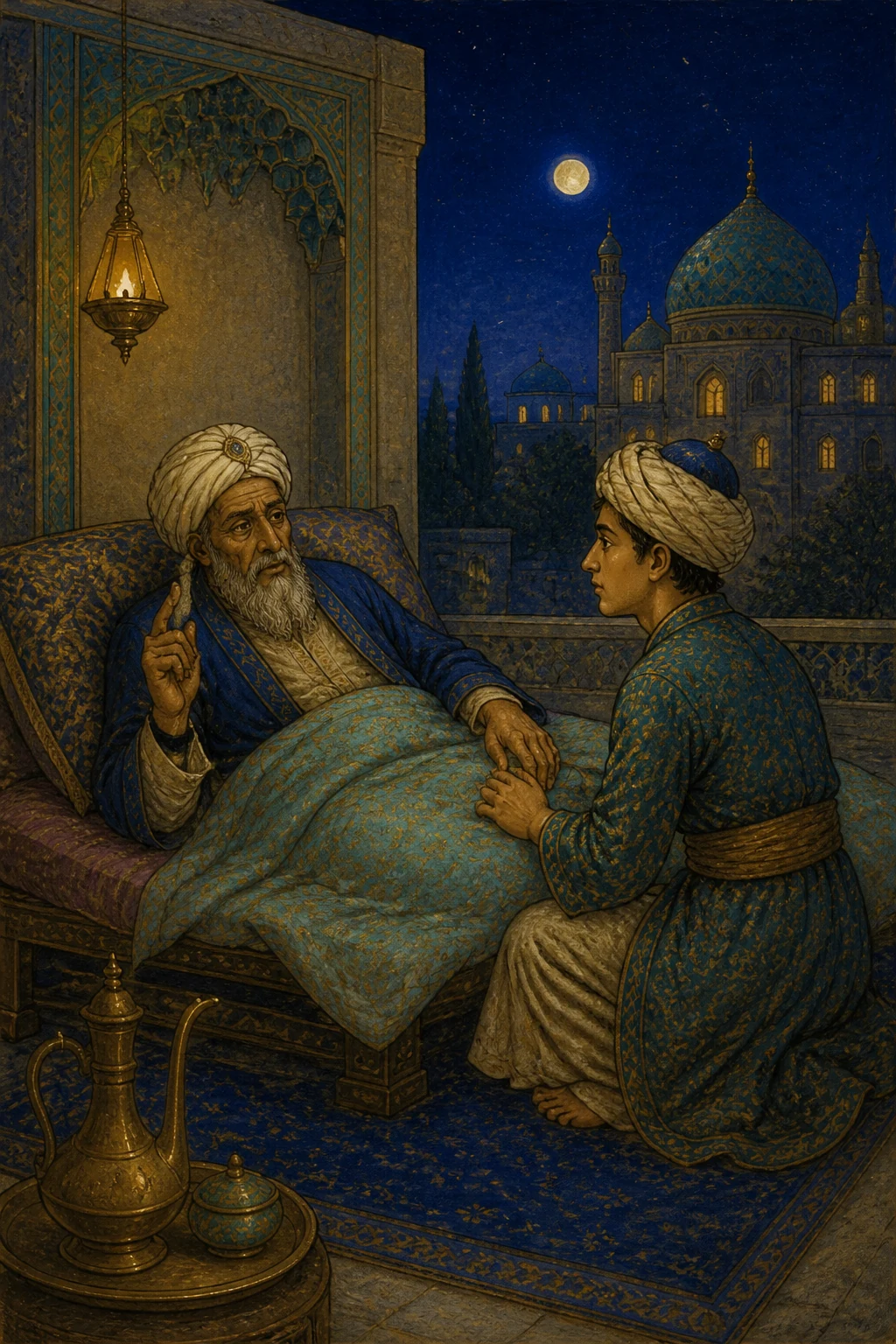
She said: It has reached me, O fortunate King, that Ala al-Din’s mother said to the women, “His father feared the evil eye for him, so he had him brought up in an underground chamber. Perhaps the servant forgot to close the hatch, and he climbed out. We had not intended him to come out until his beard had grown.” The women congratulated her on her son, and the boy left them and went into the courtyard, then climbed to the sitting room and sat down. While he was there, the slaves came in with his father’s mule. “Where has this mule been?” Ala al-Din asked them. “We took your father to the shop riding on her, and brought her back.” “What is my father’s trade?” “Your father is chief of the merchants of Egypt and lord of the sons of the Arabs.” Ala al-Din went to his mother and asked, “Mother, what is my father’s trade?” “My son,” she replied, “your father is a merchant, the chief of the merchants of Egypt and lord of the sons of the Arabs. His slaves consult him only over sales worth at least a thousand dinars. If a sale amounts to nine hundred dinars or less, they do not consult him but conduct it themselves. No merchandise comes from foreign lands, little or much, without passing through his hands to be disposed of as he pleases; and no merchandise is packed up and sent abroad except through your father. Almighty God, my son, has given your father wealth beyond counting.” He said, “Mother, praise be to God, I am the son of the lord of the sons of the Arabs, and my father is chief of the merchants. Why, then, do you put me in that underground chamber and leave me imprisoned there?” She replied, “My son, we put you there only for fear of people’s eyes. The evil eye is real, and most of those in their graves are there because of it.” He said, “Mother, where is there any refuge from what is decreed? Caution cannot avert fate, and what is written cannot be escaped. He who took my grandfather will not spare my father: if he lives today, he may not live tomorrow. If my father dies and I come out and say, ‘I am Ala al-Din, son of the merchant Shams al-Din,’ no one will believe me. The elders will say, ‘We have never seen either a son or a daughter of Shams al-Din.’ Then the public treasury will come and seize my father’s wealth. God have mercy on him who said, ‘A man dies and his wealth departs, and the basest of men take his women.’ So, Mother, speak to my father and have him take me to the market, open a shop for me, and stock it with goods, so that I may sit there and learn buying and selling, giving and taking.” “My son,” she answered, “when your father comes, I shall tell him.”
When the merchant returned home, he found his son Ala al-Din Abu al-Shamat sitting beside his mother. “Why have you brought him out of the underground chamber?” he asked her. “Cousin,” she replied, “I did not bring him out. The servants forgot to close the hatch. I was sitting with a gathering of distinguished women when he came in upon us…” Then she told him what his son had said. He said to the boy, “My son, tomorrow, if Almighty God wills, I shall take you with me to the market. But, my son, sitting in markets and shops requires good manners and proper conduct at all times.” Ala al-Din passed the night rejoicing at his father’s words. When morning came, his father took him to the bathhouse and dressed him in a suit worth a great sum of money. After they had breakfasted and drunk sherbet, he mounted his mule, set his son upon another, and took him behind him to the market. The people of the market saw the chief of the merchants approaching, followed by a youth whose face was like the moon on its fourteenth night. One of them said to his companion, “Look at that boy behind the chief of the merchants! We thought well of him, but he is like a leek: white on top and green at heart.” Shaykh Muhammad Simsim, the head broker already mentioned, said to the merchants, “We shall no longer consent to have him as our chief.”
It was the custom of the chief of the merchants, when he came from home in the morning and sat down in his shop, for the head of the market to come forward and recite the Fatiha for the merchants. They would then rise and go with him to the chief of the merchants, recite the Fatiha for him, wish him good morning, and return to their shops. But when the chief of the merchants sat down in his shop that day, the merchants did not come as usual. He summoned the head broker and asked, “Why have the merchants not gathered as they always do?” “I do not care to carry tales,” he replied, “but the merchants have agreed to depose you from the leadership and will no longer recite the Fatiha for you.” “Why is that?” “What is the meaning of this boy sitting beside you, when you are an old man and chief of the merchants? Is he your mamluk, or is he a relative of your wife’s? I suspect that you are in love with him and have a taste for boys.” The merchant shouted, “Be silent! May God make you foul in body and character! This is my son.” “We have never seen a son of yours.” “When you brought me the seed thickener, my wife conceived and bore him. But for fear of the evil eye I brought him up in an underground chamber. I meant him to stay there until he could grasp his beard in his hand, but his mother would not have it, and he asked me to open a shop for him, stock it with merchandise, and teach him buying and selling.” The head broker went to the merchants and told them the truth of the matter. They all rose and accompanied him to the chief of the merchants, stood before him, recited the Fatiha, and congratulated him on the boy. “May our Lord preserve both root and branch,” they said. “But when even the poorest among us has a son or daughter, he makes a pot of porridge for his brethren and invites his friends and relations. You have done no such thing.” “I owe you that,” he replied, “and we shall gather in the garden.” And dawn overtook Shahrazad, and she fell silent, leaving her tale untold.
When it was the Two Hundred and Fifty-second Night,
She said: It has reached me, O fortunate King, that the chief of the merchants promised the merchants a feast, saying, “We shall gather in the garden.” When morning came, he sent the furnisher to the hall and pavilion in the garden and ordered him to furnish them. He also sent the provisions for cooking—sheep, clarified butter, and everything else required—and had two tables laid, one in the pavilion and one in the hall. The merchant Shams al-Din girded himself for service, as did his son Ala al-Din. He said to him, “My son, when a gray-bearded man comes in, I shall welcome him and seat him at the table in the pavilion. When a beardless youth comes in, you are to take him into the hall and seat him at the table there.” “Why, Father?” he asked. “Why have you set out two tables, one for the men and one for the boys?” “My son,” he replied, “a beardless youth is shy of eating in the presence of grown men.” His son approved of this. When the merchants arrived, Shams al-Din received the men and seated them in the pavilion, while his son Ala al-Din received the boys and seated them in the hall. Then the food was served, and they ate and drank, enjoyed themselves and made merry. They drank sherbet, incense was burned, and the elders sat discussing learning and tradition. Among them was a merchant named Mahmud al-Balkhi, outwardly a Muslim but inwardly a Magian, who sought corruption and lusted after boys. He cast a glance at Ala al-Din that brought a thousand sighs in its wake. Satan hung a jewel upon the youth’s face for him, and he was seized with passion, longing, and infatuation. This merchant, Mahmud al-Balkhi, used to obtain cloth and merchandise from Ala al-Din’s father. He rose to stroll about and turned toward the boys, who stood to greet him. Ala al-Din had felt the need to relieve himself and had gone away. The merchant Mahmud turned to the boys and said, “If you persuade Ala al-Din to travel with me, I shall give each of you a suit worth a great sum of money.” Then he left them and returned to the men’s gathering.
As the boys sat there, Ala al-Din came back. They rose to greet him and seated him among them in the place of honor. One of them said to his companion, “My lord Hasan, tell me: where did you obtain the capital with which you buy and sell?” He replied, “When I had grown up and reached manhood, I said to my father, ‘Father, provide me with a stock of merchandise.’ He answered, ‘My son, I have nothing, but go and borrow money from a merchant, trade with it, and learn buying and selling, giving and taking.’ So I went to a merchant and borrowed a thousand dinars. With them I bought cloth and traveled to Damascus, where I made twice as much in profit. Then I bought merchandise in Damascus, took it to Baghdad, and sold it, again making twice as much in profit. I went on trading until my capital amounted to some ten thousand dinars.” Each of the boys told his companion a similar story, until the talk came round to Ala al-Din Abu al-Shamat. “And you, my lord Ala al-Din?” they asked. He replied, “I was brought up in an underground chamber and came out only this week. I go to the shop and return home from it.” They said, “You are used to sitting at home and know nothing of the pleasures of travel. Travel is only for men.” “I have no need to travel,” he replied. “There is nothing to equal comfort.” One of them said to his companion, “He is like a fish: take it out of the water and it dies.” Then they said to him, “Ala al-Din, the only glory of merchants’ sons lies in traveling to make their fortunes.” This so vexed Ala al-Din that he left the boys with tearful eyes and a sorrowful heart, mounted his mule, and went home. His mother saw him deeply distressed and weeping. “What makes you weep, my son?” she asked. He replied, “All the merchants’ sons taunted me, saying, ‘The only glory of merchants’ sons lies in traveling to earn money.’” And dawn overtook Shahrazad, and she fell silent, leaving her tale untold.
When it was the Two Hundred and Fifty-third Night,
She said: It has reached me, O fortunate King, that Ala al-Din said to his mother, “The merchants’ sons taunted me, saying, ‘The only glory of merchants’ sons lies in traveling to earn dirhams and dinars.’” His mother asked, “My son, do you wish to travel?” “Yes,” he replied. “To what country will you go?” “To the city of Baghdad, for a man can earn twice his money there.” She said, “My son, your father has great wealth. If he will not fit you out with merchandise from his own money, I shall provide you with it from mine.” “The best kindness is the swiftest,” he replied. “If you mean to do me a favor, now is the time.” She summoned the slaves and sent them for the cloth packers, then opened a storeroom and brought out cloth for him, which they packed into ten loads.
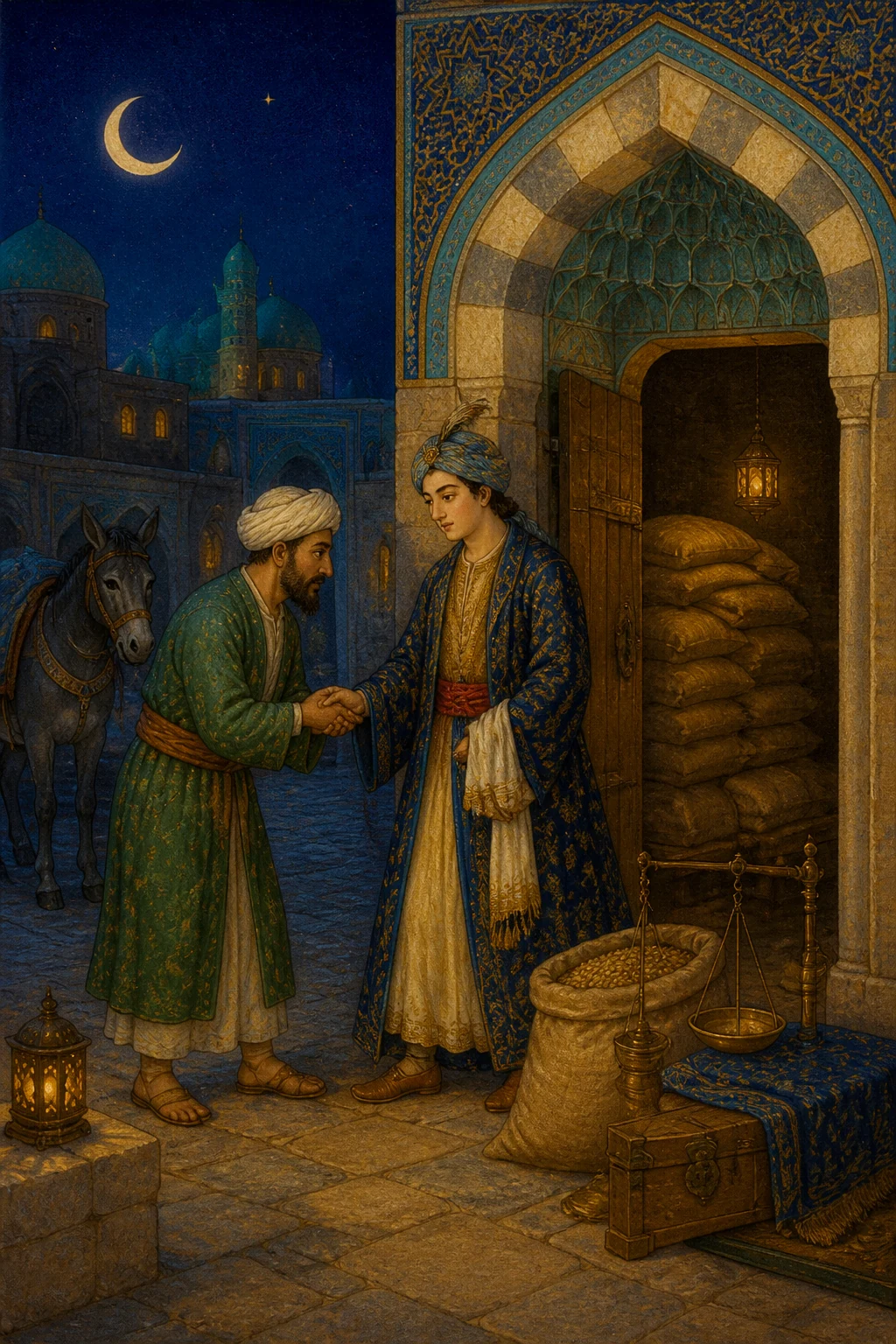
Such was the case with his mother. As for his father, he looked about the garden and could not find his son Ala al-Din. He asked after him and was told, “He mounted his mule and went home.” So he mounted and followed him. When he entered his house, he saw the packed loads and asked about them. His wife told him what the merchants’ sons had said to Ala al-Din. He said to him, “My son, may God disappoint all hopes of foreign travel! The Messenger of God, God bless him and grant him peace, said, ‘It is part of a man’s happiness to find his livelihood in his own country.’ And the ancients said, ‘Shun travel, though it be but a mile.’” Then he asked his son, “Are you determined to travel, and will nothing turn you from it?” His son replied, “I must travel to Baghdad with merchandise, or else I shall strip off my clothes, put on the garb of the dervishes, and wander through the lands.” His father said, “I am neither needy nor destitute; I have great wealth.” He showed him all his money, merchandise, and cloth, saying, “I have cloth and goods suited to every country.” Among these he showed him forty packed loads, each marked with its value of a thousand dinars. Then he said, “My son, take these forty loads and the ten your mother has given you, and travel under Almighty God’s protection. But I fear for you on account of a forest on your road called the Lion’s Forest, and a valley there called the Valley of Dogs, for in those places lives are taken without leave.” “Why, Father?” he asked. “Because of a Bedouin highwayman called Ajlan.” The boy replied, “Livelihood comes from God, and if my portion is there, no harm will befall me.” Then Ala al-Din mounted and rode with his father to the animal market. A muleteer dismounted from his mule, kissed the hand of the chief of the merchants, and said, “By God, my lord, it has been a long time since you employed us on any trading journey.” He replied, “Every age has its reign and its men. God have mercy on him who said:
I saw an old man walking through the land, his beard hanging down to meet his knees. I asked him, “Why are you so bent?” He turned his hands toward me and replied, “My youth was lost somewhere upon the earth, and here I stoop to search for it.” When he had finished his verses, he said, “Captain, it is only this son of mine who wishes to travel.” The muleteer replied, “May God preserve him for you.” Then the chief of the merchants bound his son and the muleteer to one another by a pledge, made the boy his charge as a son, and commended him to his care, saying, “Take these hundred dinars for your men.” The chief of the merchants then bought sixty mules and a covering for the shrine of Sidi Abd al-Qadir al-Jilani. He said to his son, “While I am absent, this man is your father in my place. Obey him in everything he tells you.” Then he took the mules and the men home, and that night they held a complete recitation of the Quran and a celebration in honor of Shaykh Abd al-Qadir al-Jilani. When morning came, the chief of the merchants gave his son ten thousand dinars, saying, “When you enter Baghdad, if cloth is selling briskly, sell yours. If trade is slow, spend from these dinars.” Then they loaded the mules, bade one another farewell, and set out until they had left the city. Mahmud al-Balkhi had also prepared to travel toward Baghdad, brought out his merchandise, and pitched his tents outside the city. He said to himself, “You will gain your pleasure with this boy only in the open country, where there is no talebearer or watcher to trouble you.” Now the boy’s father was owed a thousand dinars by Mahmud al-Balkhi, the balance of a business transaction. He went to him, bade him farewell, and said, “Give the thousand dinars to my son Ala al-Din.” He commended the boy to his care, saying, “He is like your own son.” So Ala al-Din joined Mahmud al-Balkhi. And dawn overtook Shahrazad, and she fell silent, leaving her tale untold.
When it was the Two Hundred and Fifty-fourth Night,
She said: It has reached me, O fortunate King, that Ala al-Din joined Mahmud al-Balkhi. Mahmud told Ala al-Din’s cook not to prepare anything, and himself supplied food and drink for Ala al-Din and his company. Then they set out. The merchant Mahmud al-Balkhi had four houses: one in Cairo, one in Damascus, one in Aleppo, and one in Baghdad. They traveled on through wilderness and desert until they drew near Damascus. Mahmud sent his slave to Ala al-Din, whom he found sitting and reading. The slave approached and kissed his hands. “What do you want?” Ala al-Din asked. He replied, “My master sends you greetings and invites you to a feast at his house.” “Let me first consult my father, the captain Kamal al-Din the muleteer.” He asked the captain’s advice about going, and he said, “Do not go.” Then they traveled from Damascus until they reached Aleppo, where Mahmud al-Balkhi gave a feast and sent to invite Ala al-Din. He consulted the captain, who forbade him to go. They traveled on from Aleppo until they were one day’s journey from Baghdad, and Mahmud al-Balkhi gave another feast and sent to invite Ala al-Din. Again he consulted the captain, who forbade him, but Ala al-Din said, “I must go.” He rose, buckled a sword beneath his clothes, and went to Mahmud al-Balkhi, who stood to welcome him and greeted him. He had a splendid meal brought before him, and they ate and drank and washed their hands. Then Mahmud al-Balkhi leaned toward Ala al-Din to steal a kiss, but the boy intercepted it with his palm. “What are you trying to do?” he asked. Mahmud replied, “I have brought you here because I wish to enjoy your favors on this occasion, and have you fulfill the words of the poet:
Could you not come to us for one brief moment, long enough to milk a little ewe or fry an egg? You could eat whatever little bread we have, and pocket whatever silver comes your way, then carry off with ease as much as you desire: a little span, a little finger’s length, or a little handful. Then Mahmud al-Balkhi lunged at Ala al-Din, seeking to prey upon him, but Ala al-Din sprang up, drew his sword, and said, “Shame upon your gray hairs! Do you not fear God, whose might is terrible? Have you never heard the poet’s words:
Guard your white hairs from any stain of shame, for white is quick to take the mark of dirt. When Ala al-Din had finished his verses, he said to Mahmud, “These goods are a trust from God and are not for sale. Had I sold them to another for gold, I would have sold them to you for silver. But, by God, you wretch, I shall never keep company with you again.” Then Ala al-Din returned to the captain Kamal al-Din and said, “This man is a libertine. I shall never keep company with him again or travel the same road with him.” “My son,” he replied, “did I not tell you not to go to him? But if we part company with him, I fear we shall come to harm. Let us remain one caravan.” “I cannot travel with him ever again,” Ala al-Din replied. He had his merchandise loaded and set out with his men until they came down into a valley, where they wished to halt. The muleteer said, “Do not unload here. Keep going and make haste, so that perhaps we may reach Baghdad before its gates are shut. They open and close them only while the sun is up, for fear that the city may fall into the hands of the Rafidis, who would throw the books of learning into the Tigris.” Ala al-Din said, “Father, I did not bring this merchandise to this country merely to earn a livelihood, but to see foreign lands.” “My son,” he replied, “we fear for you and your wealth because of the Bedouins.” Ala al-Din said, “Man, are you the servant or the master? I shall not enter Baghdad until morning, so that the young men of Baghdad may see my merchandise and know who I am.” The muleteer replied, “Do as you wish. I have given you my advice, and you know best how to save yourself.”
Ala al-Din ordered them to unload the mules. They took down the bales, pitched the tent, and remained there until midnight. Then Ala al-Din went out to relieve himself and saw something glittering in the distance. “Captain,” he asked the muleteer, “what is that glittering thing?” The muleteer looked closely and made out spearheads, iron weapons, and Bedouin swords. They were Bedouins, led by a chief called Shaykh Ajlan Abu Na’ib. When they drew near and saw the merchandise, they said to one another, “What a night of plunder!” Hearing this, the captain Kamal al-Din the muleteer cried, “Back, you basest of Arabs!” Abu Na’ib struck him in the chest with his lance, and its point flashed out through his back. He fell dead at the entrance to the tent. The water carrier cried, “Back, you vilest of Arabs!” They struck him on the shoulder with a sword that flashed through his body, and he fell dead. All this happened as Ala al-Din stood watching. Then the Bedouins swept through the caravan, attacking and killing until not one of Ala al-Din’s company remained alive. They loaded the merchandise onto the mules and went away. Ala al-Din said to himself, “Nothing will get you killed but your mule and these fine clothes.” He tore off his outer garments and threw them over the mule’s back, leaving himself in only his shirt and drawers. Then he looked before him at the tent entrance and saw a pool of blood flowing from the slain. He rolled in it in his shirt and drawers until he looked like a dead man drenched in his own blood.
Such was his case. As for the Bedouin chief Ajlan, he said to his men, “Arabs, was this caravan coming from Cairo or going out from Baghdad?” And dawn overtook Shahrazad, and she fell silent, leaving her tale untold.
When it was the Two Hundred and Fifty-fifth Night,
She said: It has reached me, O fortunate King, that when the Bedouin asked his men, “Was this caravan coming from Cairo or going out from Baghdad?” they answered, “It was coming from Cairo to Baghdad.” He said, “Go back to the dead, for I suspect that the owner of this caravan is not dead.” The Bedouins returned to the bodies and went over them, stabbing and striking, until they reached Ala al-Din, who had thrown himself among the slain. When they came to him, they said, “You have made yourself out to be dead, so we shall finish killing you.” The Bedouin drew back his lance and was about to plunge it into Ala al-Din’s chest when Ala al-Din cried, “Your blessing, O my lord Abd al-Qadir al-Jilani!” He saw a hand turn the lance away from his breast toward the breast of the captain Kamal al-Din the muleteer. The Bedouin stabbed him instead and left Ala al-Din alone. Then they loaded the merchandise onto the mules and went away. Ala al-Din looked and saw that the birds had flown with their plunder. He rose and began to run, but the Bedouin Abu Na’ib said to his companions, “Arabs, I saw something move.” One of them rode out, saw Ala al-Din running, and called, “Flight will do you no good with us behind you!” He spurred his horse, which raced after him. Ala al-Din had seen a trough of water ahead, with a cistern beside it. He climbed into an opening in the cistern, stretched himself out, and pretended to be asleep, saying, “O You who veil our faults so graciously, grant me Your shelter that none can pierce!” The Bedouin stopped beneath the cistern and reached up to seize Ala al-Din. Ala al-Din cried, “Your blessing, O my lady Nafisa! Now is your hour!” At once a scorpion stung the Bedouin in the palm. He screamed, “Arabs, come here! I have been stung!” He got down from his horse, and his companions came and helped him mount again. “What has happened to you?” they asked. “A scorpion stung me,” he replied. Then they took the caravan and went away.
Such was their case. As for Ala al-Din, he remained lying in the opening of the cistern. Meanwhile Mahmud al-Balkhi ordered his merchandise loaded and set out until he reached the Lion’s Forest, where he found all Ala al-Din’s men lying dead. He rejoiced at this and dismounted, making his way to the cistern and trough. His mule was very thirsty and turned to drink from the trough, but she saw Ala al-Din’s reflection and shied away. Mahmud al-Balkhi looked up and saw Ala al-Din lying there, stripped to his shirt and drawers. “Who has done this to you,” he asked, “and left you in such a wretched state?” “The Bedouins,” he replied. Mahmud said, “My son, let the mules and wealth be your ransom. Take comfort in the words of the poet:
If men’s heads are spared destruction, the loss of wealth is no more than the clipping of nails. But come down, my son, and fear no harm.” Ala al-Din climbed down from the opening in the cistern, and Mahmud set him upon a mule. They traveled on until they entered Baghdad and came to Mahmud al-Balkhi’s house. He ordered Ala al-Din to be taken to the bath, saying, “The money and merchandise are your ransom, my son. If you yield to me, I shall give you twice the value of all your money and goods.” When he came out of the bath, Mahmud took him into a hall adorned with gold, with four iwans opening off it. Then he ordered a table spread with every kind of food, and they ate and drank. Mahmud al-Balkhi leaned toward Ala al-Din to kiss his cheek, but Ala al-Din intercepted the kiss with his palm and said, “Are you still following your wicked ways? Did I not tell you that, had I sold these goods to another for gold, I would have sold them to you for silver?” He replied, “It is only for this purpose that I offer you merchandise, a mule, and fine clothes, for love of you has driven me out of my senses. How well the poet said:
Our master Abu Bilal related to us, on the authority of some of his elders, who had it from Sharik: “A lover cannot find relief from his torment through embraces and kisses until he fucks.” Ala al-Din said to him, “That is something that can never be. Take your clothes and your mule, and open the door so that I may leave.” He opened the door for him, and Ala al-Din went out, with the dogs barking behind him, and went on his way. As he walked through the darkness, he came upon the door of a mosque, entered its vestibule, and took shelter there. Presently he saw a light approaching. Looking closely, he made out two lanterns carried by two slaves walking ahead of two merchants, one a handsome old man and the other a youth. He heard the youth say to the old man, “For God’s sake, Uncle, give me back my cousin, my wife.” The old man replied, “Have I not warned you time and again? Yet you swear by divorce as though it were your Qur’an.” Then the old man turned to his right and saw the young fellow, who was as fair as a piece of the moon. “Peace be upon you,” he said. Ala al-Din returned his greeting, and the old man asked, “Who are you, young man?” He replied, “I am Ala al-Din, son of Shams al-Din, chief of the merchants in Cairo. I asked my father to let me take up trading, so he equipped me with fifty loads of merchandise…” But morning overtook Shahrazad, and she fell silent, leaving off her permitted tale.