Waltey
Šest tovarišev
025 The Six Companions
Mother's Nursery Tales · Katharine PyleO besedilu
Šest tovarišev
- Vir
- Mother's Nursery Tales
- Avtor
- Katharine Pyle
- Jezik branja
- Slovenščina
- Jezik izvirnika
- English
- Čas branja
- 11 min branja
- Obseg
- 9 strani
- Naslov izvirnika
- 025 The Six Companions
O izvirniku
Mother's Nursery Tales
Štiriintrideset zgodovinskih literarnih priredb starejših pravljic, ki jih je Pyle tudi ilustrirala. Bralni jezik je Slovenščina, izvirnik pa prihaja iz vira Mother's Nursery Tales v jeziku English.
Besedilo
Šest tovarišev
Neki mož po imenu John je bil zvest vojak in je kralju služil vso vojno, pa tudi ranjen je bil; toda ko se je vojna končala in so ga odpustili iz vojske, je za plačilo dobil le tri srebrnike.
»Prav grdo je, da tako ravnajo s človekom,« je rekel John. »Pa nič zato! Če le najdem prave prijatelje, ki mi bodo pomagali, bomo kralju pobrali ves zaklad, še preden bomo opravili svoje.«
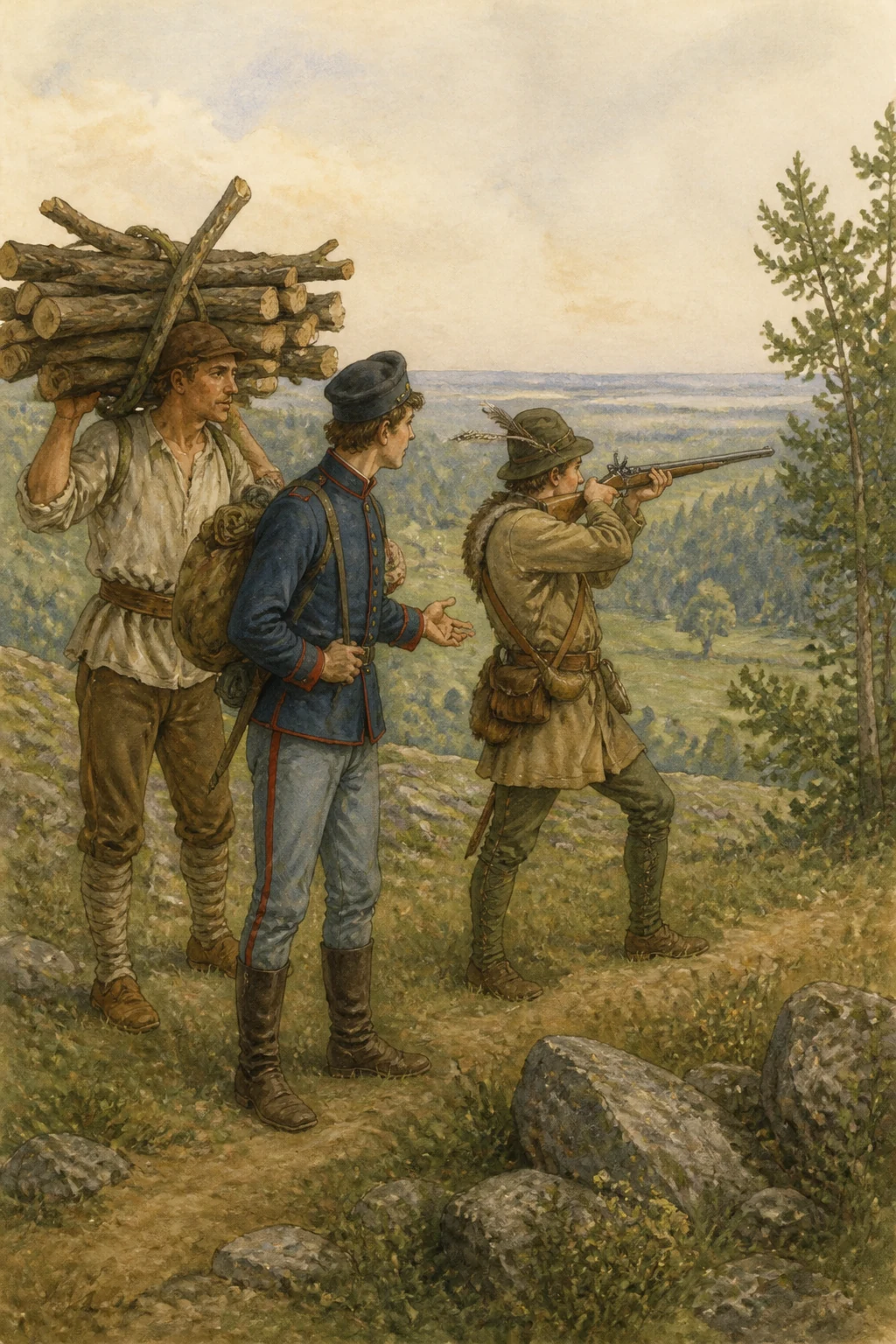
Oprtal si je torej nahrbtnik in se odpravil v svet iskat prave prijatelje, ki bi mu pri tem pomagali. Hodil je in hodil, dokler ni prišel do gozda, tam pa je neki mož ruval drevesa s koreninami vred, kakor da bi bila navadne travne bilke.
»Ti si ravno pravi zame,« je rekel John. »Pojdi z menoj, pa bova obogatela.« Mož je bil takoj za to. »Le počakaj,« je rekel, »da povežem to dračje in ga odnesem domov materi.«
Šest dreves je zložil skupaj, sedmo pa ovil okoli njih, da jih je držalo v svežnju. Nato si jih je naložil na ramo in jih odnesel tako zlahka, kakor da ne bi tehtala nič.
Ko se je vrnil, sta se z vojakom odpravila sreči naproti. Nista prišla daleč, ko sta naletela na lovca, ki je prislonil puško k ramenu in skrbno meril. Vojak se je ozrl po travnikih, a ni videl ničesar, na kar bi bilo mogoče streljati.
»Kaj meriš?« je vprašal. »Dve milji od tod je gozd,« je rekel mož. »V gozdu raste hrast. Na najvišjem listu tega hrasta sedi muha. Tej muhi bom odstrelil levo oko.«
»Pojdi z menoj,« je rekel vojak, »mi trije bomo skupaj prav gotovo obogateli.« Lovec je rad privolil. Oprtal si je puško in odkorakal z njima.
Kmalu so prišli do sedmih mlinov na veter, katerih krila so se veselo vrtela, čeprav ni bilo čutiti niti sapice. »To je pa čudno!« je rekel vojak. »Prav rad bi vedel, kaj poganja ta krila.«
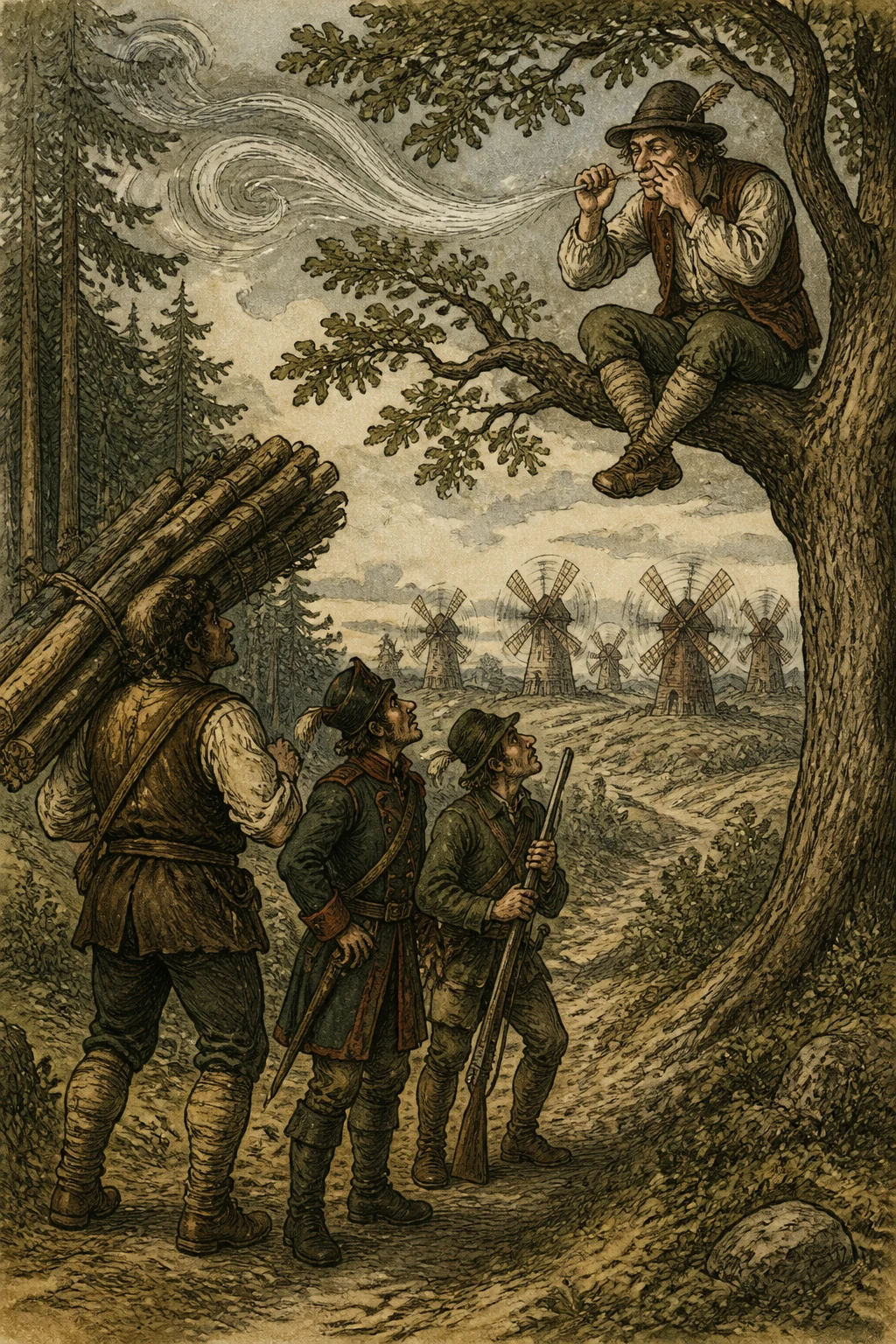
Dve milji naprej so naleteli na moža, ki je sedel na vrhu griča. S prstom si je mašil eno nosnico, skozi drugo pa pihal. »Kaj počneš?« je vprašal vojak.
»Piham, da se vrtijo krila sedmih mlinov na veter dve milji od tod in lahko mlinar melje žito,« je odgovoril mož. »Pojdi z nami,« je rekel vojak. »V svet gremo, da bi obogateli.«
Mož je rad privolil; tako ali tako se je že dvigal veter, zato ga mlinar ne bo več potreboval. Zdaj so torej potovali skupaj že štirje.
Čez nekaj časa so prišli do kupa skal, v njihovi senci pa je sedel neki mož. Eno nogo si je odpel in jo snel, drugo pa je imel iztegnjeno pred seboj.
»Tako se pa res lahko dobro odpočiješ,« je rekel vojak. »Tega ne delam zato, da bi si odpočil,« je rekel mož. »Tekač sem. Če bi si pritrdil še drugo nogo in se pognal v tek, bi v hipu izginil izpred oči. Uredil sem si tako, da lahko eno nogo snamem in se zato premikam počasneje; čeprav me navadni ljudje še tako komaj dohajajo.«
»Poberi svojo nogo in pojdi z nami,« je rekel vojak. »Obogateli bomo, in če se nam pridružiš, si bomo vse razdelili na enake dele.«
Tekač je privolil. Pobral je nogo in poskakoval po drugi, pa so ga komaj dohajali, tako hiter je bil.
Prehodili so komaj kakšno miljo, ko so srečali moža, ki je imel klobuček postrani poveznjen čez eno uho. »Hej!« ga je poklical vojak. »Zakaj nosiš klobuk tako postrani, namesto da bi ga imel naravnost na glavi kakor drugi ljudje?«
»Oh, vsakič, ko ga poravnam, pritisne tak mraz, da rože pomrznejo in celo ptice zmrznejo na drevesih.« »To je čudovit dar,« je rekel vojak. »Pojdi z nami, pa bomo skupaj obogateli. Zdaj nas je šest in to je dovolj. Nikogar več ne bomo vzeli medse.«
Tako je šest krepkih tovarišev potovalo naprej, dokler niso prišli do mesta, v katerem je živel kralj. Ta kralj je imel edino hčer, ki je tekla tako hitro, kakor da bi nizko nad tlemi letela ptica, in kralj je razglasil, da se z njo ne sme poročiti nihče, ki je ne more prehiteti; če pa pride kdo, ki bi jo prehitel, jo bo dobil za ženo. Toda dotlej je še nihče ni mogel premagati v teku.
Vojak je s svojimi petimi tovariši odkorakal do palače, kar se da pogumno potrkal na vrata in prosil, da bi govoril s kraljem. Vratar jih sprva ni hotel spustiti noter, saj so bili razcapani in prašni, toda vojak ga je tako srdito pogledal, da si jih ni upal zavrniti.
Šest tovarišev so odpeljali v veliko dvorano, kjer je sedel kralj, ob njem njegova hči, okoli njega pa vsi njegovi plemiči. No, kaj so torej vojak in njegovi tovariši hoteli od kralja?
Vojak se je hotel pomeriti v teku s kraljično; ker pa sam ni bil posebno dober tekač, bi namesto njega tekel njegov služabnik. Kralj je v to privolil, vendar je vojaka posvaril, da bosta ob porazu tako on kot njegov služabnik izgubila življenje.
Vojak se ni bal tvegati, zato so določili tekmovalno progo, kraljična in tekač pa sta se pripravila. Teči sta morala do studenca, oddaljenega mnogo, mnogo milj, tam vsak napolniti vrč z vodo in ga prinesti nazaj v palačo. Kdor bi se prvi vrnil z vodo, bi zmagal.
Tekač se je sklonil in si pripel drugo nogo. Zdaj je bil pripravljen in s kraljično sta se pognala na pot. Kraljična je letela kakor ptica, tekač pa je tekel kakor veter. V hipu je izginil izpred oči in že napolnil vrč ter se odpravil nazaj, še preden je bila kraljična na polovici poti do studenca.
Tekač je sedel, da bi si malo odpočil. Bil je zelo zaspan in sklenil je, da bo malce zadremal, preden preteče še preostanek poti. Da mu ne bi bilo preudobno in ne bi spal predolgo, je pobral konjsko lobanjo, ki je ležala na bližnjem polju, in si jo položil pod glavo namesto blazine.
Toda tekač je zaspal trdneje, kot je nameraval. Tudi kraljična je prišla do studenca, napolnila vrč in se odpravila nazaj, nato pa je na polovici poti naletela na tekača, ki je trdno spal, ob njem pa je stal vrč vode.
To je bila priložnost za kraljično. Čisto tiho je izlila vodo iz tekačevega vrča in ga praznega postavila nazaj k njemu. Nato je pohitela proti palači, tekača pa pustila spati.
Zdaj bi bilo vse izgubljeno, če ne bi bilo lovca. Skozi okno palače je opazoval tekmo in videl vse, kar se je zgodilo. Hitro je napolnil puško, pomeril in spečemu tekaču odstrelil lobanjo izpod glave. Tekač se je zbudil, sedel in se ozrl okoli sebe.
Kraljična je bila že skoraj pri palači, njegov vrč pa je ležal prazen ob njem. Toda to zanj ni bilo nič hudega. Zgrabil je vrč in se pognal hitreje od vetra. Stekel je nazaj do studenca, napolnil vrč in se z njim vrnil do vrat palače, še preden je kraljična stopila skozi zunanja vrata.
Po pravici bi moral zdaj vojak dobiti kraljično za ženo, toda kralj se ni mogel sprijazniti s tem, da bi jo omožil s tako navadnim človekom. Kraljična pa bi si že ob sami misli na to najraje izjokala oči. S kraljem sta se dolgo posvetovala in nazadnje skupaj skovala načrt.
Kralj je dal narediti sobo vso iz železa, ki jo je bilo mogoče segreti bolj kakor katero koli peč. Nato je poklical tovariše k sebi in rekel: »Pošteno ste zmagali v tekmi, zato sem ukazal, naj vam pripravijo jedačo in pijačo, da boste lahko proslavili zmago.«
Nato jih je odpeljal v železno sobo, kjer jih je čakala razkošna pojedina. Vseh šest je sedlo za mizo ter začelo jesti in piti, kralj pa je odšel ven in za seboj zaklenil vrata. Potem je ukazal, naj pod sobo zakurijo ogenj in ga vzdržujejo, dokler se soba ne razžari do rdečega.
Šest tovarišev je sedelo za mizo ter veselo jedlo in pilo, dokler jim ni postalo prevroče. Tedaj so vstali, da bi odšli iz sobe, a ugotovili so, da so vrata zaklenjena in da so zaprti. Takoj so uganili, kakšno ukano so jim pripravili, vendar jih to ni niti najmanj vznemirilo.
»Tole boš pa ti uredil,« je vojak rekel možu s klobukom čez eno uho. Mož si je poravnal klobuk in sobo je takoj zajel mraz. Tako mrzlo je postalo, da so si morali tovariši zavihati ovratnike suknjičev in hoditi naokrog, da so se ogreli.
Kralj je počakal toliko časa, da je bil prepričan, da se je vseh šest že zadušilo od vročine, nato pa je ukazal odpreti vrata. Kako je bil presenečen, ko so vsi prišli ven prav tako zdravi in čili kot prej, le od mraza so bili videti nekoliko premraženi.
Toda kralj še vedno ni hotel dati hčere vojaku. Poklical ga je k sebi in rekel: »Poslušaj, če se odpoveš poroki s kraljično, te bom naredil bogatega za vse življenje.«
»Že, ampak koliko mi boš dal?« je vprašal vojak. »Dal ti bom toliko zlata, kolikor ga lahko odneseš.« Vojak sprva ni vedel, kaj naj na to reče. Vse od vojne je imel slaboten hrbet; če pa bi mu kralj dal toliko zlata, kolikor ga lahko odnese njegov služabnik, bi se kraljični prav rad odpovedal.
Kralju ni bilo mar, kdo bo odnesel zlato. Prav rad je privolil, da ga da toliko, kolikor ga lahko odnese služabnik. »Prav,« je rekel vojak. »Čez teden dni se vrnem po zlato, ti pa ga dotlej zberi in mi ga pripravi.«
Vojak je nato najel vse krojače, ki jih je mogel najti, in jim naročil, naj mu sešijejo velikansko vrečo. Ko je bila končana, je bila velika kakor hiša.
Ko je bila vreča nared, sta se z močnim možem vrnila v palačo, in ravno tedaj se je iztekel dogovorjeni teden. Močni mož je zvito vrečo nosil na ramenih.
Kralj je medtem dal iz zakladnice prinesti tono zlata in bil prepričan, da je to več, kot bi lahko odnesel še tako močan človek.
Ko sta vojak in njegov tovariš prišla do zlata, je močni mož razgrnil vrečo, z eno roko dvignil tono zlata in jo vrgel vanjo. »Za začetek bo že,« je rekel, »ampak potrebovali bomo še več.«
Kralj se je prestrašil. Ukazoval je, naj iz zakladnice prinašajo vedno več zlata, pa ga še zdaleč ni bilo dovolj. »Zlahka odnesem dvakrat toliko in še več,« je zaklical močni mož.
Nazadnje je bila kraljeva zakladnica prazna in po vsem kraljestvu je poslal po še več zlata, pa ga še vedno ni bilo dovolj. »No, prav!« je nazadnje vzkliknil močni mož. »Vidim, da si storil, kar si mogel; zadovoljiti se bomo morali s tem, kar imamo.« Nato si je zavihtel vrečo na ramo in odkorakal z njo, vojak in drugi tovariši pa so šli z njim.
Toda kralj je bil ves iz sebe. Ves njegov zaklad so odnesli navaden vojak in njegovi pajdaši. Skoraj raje bi jim bil prepustil kraljično kakor to. Topotal je in besnel, nato pa sklical svoje konjenike ter poslal za tovariši dva polka, da bi jih skupaj z zakladom pripeljala nazaj.
Konjeniki so tovariše kmalu dohiteli, saj so ti potovali mirno in brez vsake naglice. »Stojte! Stojte!« je zaklical poveljnik polka. »Prišel sem, da vas in zaklad odpeljem nazaj h kralju. Boste šli mirno z nami ali vas bomo morali odvleči?«
»Počakaj malo,« je rekel pihač. »Preden se še naprej pogovarjava o tem, bi lahko malo zaplesali po zraku.« S prstom si je zamašil eno nosnico in pihnil skozi drugo, pa je poveljnik s svojim polkom odletel v zrak. Vrteli so se in plesali kakor suho listje, ki ga nosi veter.
Čez nekaj časa jim je dovolil, da so se spet spustili na tla. »No!« je rekel. »Imate dovolj ali bi radi še en ples?« Ne! Vojaki si niso želeli še enkrat vrtinčiti po zraku. Zdaj so si želeli samo še varno vrniti v palačo.
»Prav,« je rekel pihač. »Potem se vrnite h kralju in mu povejte, da bom, če pošlje za nami vso svojo vojsko, tudi z njo ravnal enako.«
Toda tega si kralj ni upal storiti. Zaklada ni bilo več in ni mogel tvegati, da bi mu povrhu odpihnilo še vojsko. Tovariši so brez nadaljnjih ovir nadaljevali pot, čez čas pa so sedli in si razdelili zaklad. Vsak ga je dobil dovolj, da je bil bogat in preskrbljen do konca življenja.
Izvirnik
025 The Six Companions
Naslednje strani prikazujejo izvirno besedilo za primerjavo.
A certain man named John had been a faithful soldier, and had served the King all through the war, and had been wounded, too; but when the war came to an end and he was discharged he only received three pieces of silver as payment.
“That is a mean way to treat a fellow,” said John. “But never mind! If I can only get the right sort of friends to help me we will get all the King’s treasure from him before we are done.”
So he shouldered his knapsack and off he set into the world to find the right sort of friends to help him do this.
He walked along and walked along till he came to a wood, and there was a man pulling up trees by the roots as though they were no more than grasses.
“You are the very man for me,” said John. “Come along with me and we will make our fortunes.”
The man was willing. “But wait,” said he, “until I tie these fagots together and take them home to my mother.”
He laid six of the trees together and twisted the seventh around them to hold them. Then he walked off with them on his shoulder as easily as though they were nothing.
When he came back he and the soldier started out in search of their fortunes.
They had not gone far when they came to a hunter who had raised his gun to his shoulder and was taking careful aim. The soldier looked about over the meadows, but could see nothing to shoot.
“What are you aiming at?” asked he.
“Two miles away there is a forest,” said the man. “In the forest is an oak tree. On the top-most leaf of that oak tree there is a fly. I am going to shoot out the left eye of that fly.”
“Come along with me,” said the soldier, “we three will certainly make our fortunes together.”
Very well; the hunter was willing. So he shouldered the gun and off he tramped alongside of the other.
Presently they came to seven mill-wheels, and the sails were turning merrily, and yet there was not a breath of wind stirring. “That is a curious thing!” said the soldier. “Now what is turning those sails I should like to know.”
Two miles farther on they came to a man sitting on top of a hill. He held a finger on one side of his nose and blew through the other.
“What are you doing?” asked the soldier.
“I am blowing to turn the wheels of seven windmills two miles away, so that the miller can grind his corn,” answered the man.
“Come with us,” said the soldier. “We are going out into the world to make our fortunes.”
Very well, the man was willing; the wind was springing up, anyway, so the miller would not need him. So now there were four of them journeying along together.
After awhile they came to a heap of rocks, and there in the shade of it sat a man. He had unfastened one of his legs, and taken it off, and he sat with the other stretched out before him.
“That is a good way to rest,” said the soldier.
“I am not doing this to rest,” said the man. “I am a runner. If I were to put on this other leg and start off I would be out of sight in a twinkling. I have arranged to take off one leg so that I can go more slowly; though ordinary people find it hard to keep up with me even so.”
“Take up your leg and come with us,” said the soldier. “We are going to make our fortunes, and it shall be share and share alike with us if you will come along.”
To this the runner agreed. He took up his one leg and hopped along on the other, and they found it hard work to keep up with him, he went so fast.
They had gone but a mile or so when they met a man who wore a little hat cocked down over one ear.
“Hello!” called the soldier. “Why do you wear your hat in that fashion instead of straight on your head like other people?”
“Oh, every time I set it straight there comes such a heavy frost that the flowers are blighted, and even the birds freeze in the trees.”
“That is a wonderful gift,” said the soldier. “Come along with us, and we will make our fortunes together. And now there are six of us, and that is enough. We will have no more in our company.”
So the six stout comrades journeyed on until they came to the town where the King lived. This King had one daughter, and she could run so fast that it was like a bird skimming along, and the King had said that no one should marry her unless he could run faster than she could; if such a one came along he should have her for a wife. But so far no one had been able to outrun her.
The soldier with his five comrades marched up to the palace and knocked at the door as bold as bold, and asked to see the King.
At first the gatekeeper did not wish to let the six in, for they were worn and dusty, but the soldier looked at him so fiercely that he did not dare to refuse.
The six comrades were brought into the great hall where the King sat with his daughter beside him and all his nobles about him.
Well, and what did the soldier and his fellows want with the King.
Oh, the soldier wanted to try a race with the princess; but he was not much of a runner himself, so he would let his servant run for him.
The King was willing for that, but he warned the soldier that if he failed in the race he and his servant, too, would lose their lives.
The soldier was not afraid to risk that, so the race course was laid out, and the Princess and the runner made ready. They were to run to a fountain miles and miles and miles away, and each was to fill a pitcher with water and bring it back to the palace. Whichever first returned with the water would win the race.
The runner stooped down and buckled on his second leg, and then he was ready, and he and the Princess set out. The Princess flew like a bird, but the runner ran like the wind. He was out of sight in a twinkling, and had filled his pitcher and started home again before the Princess was half-way to the fountain.
The runner sat down to rest a bit. He was very sleepy and he thought he would just take a little nap before going the rest of the way. In order not to be too comfortable and sleep too long he picked up a horse’s skull that lay in a field near by and put it under his head for a pillow.
But the runner slept more soundly than he meant to do.
The Princess also reached the fountain and filled her pitcher and started home again, and then, half-way home, she came across the runner fast asleep with his pitcher of water beside him.
This was the chance for the Princess. Very quietly she poured the water from the runner’s pitcher, and set it down beside him empty. Then she hurried on toward the palace, leaving the runner still asleep.
And now all would have been lost except for the hunter. He had been watching from the palace window and had seen everything that happened. He made haste to load his gun, and took aim and shot the skull from under the sleeper’s head. This awakened the runner. He sat up and looked about him.
There was the Princess almost back at the palace, and his pitcher lay empty beside him.
However, this was nothing to him. He picked up his pitcher and away he went, swifter than the wind. He ran back to the fountain and filled the pitcher, and got back with it to the castle door before the Princess had come in at the outer gate.
And now by rights the Princess belonged to the soldier, but the King could not make up his mind to have her married to a common man like that. As for the Princess she was ready to cry her eyes out at the thought of it. She and the King talked and talked together, and at last they made up a plan between them.
The King had a room made that was all of iron and could be heated until it was hotter than any oven. Then he called the comrades to him and said, “Now you have fairly won the race, and I have ordered food and drink to be set out for you, so that you may make merry over it.”
He then showed the companions into the iron room, and there a grand feast had been made ready. The six sat down at table and began to eat and drink, but the king went on out and locked the doors behind him. Then he ordered a fire to be built under the room, and to be kept up until the room was red hot.
The six companions sat around the table eating and drinking merrily enough, until they began to feel too warm. Then they got up to leave the room, but they found the door was locked and they were fastened in. At once they guessed the trick that had been played upon them, but they were not troubled over that in the least.
“This is something for you to see to,” said the soldier to the man with the hat over one ear.
The man set his hat straight and at once a frost fell upon the room. It grew so cold that the comrades had to turn up their coat collars and walk about to keep warm.
The King waited until he thought the six would certainly be suffocated by the heat, and then he ordered the door to be opened. What was his surprise when all the men walked out just as well and hearty as ever, except that they looked somewhat pinched with the cold.
But the King was as unwilling as ever to give his daughter to the soldier. He called the soldier to him and said, “Listen, if you will give up marrying the Princess I will make you rich for life.”
“Yes, but how much will you give me?” asked the soldier.
“I will give you all the gold you can carry.”
Well, the soldier hardly knew what to say to that. Ever since he had been in the war his back had been weak; but if the King would give him as much as his servant could carry he would give up the Princess and welcome.
The King did not care who carried off the gold. He was quite willing to give as much as the servant could carry.
“Very well,” said the soldier. “In a week’s time I will come back for the gold, and do you gather it together and have it ready for me.”
The next thing the soldier did was to hire all the tailors he could get, and have them make for him an enormous sack, and when it was finished it was as big as a house.
When it was done he and the strong man went back to the palace together, and the week was just up. The strong man carried the sack, rolled up, on his shoulders.
Meanwhile the King had had a ton of gold brought up from his treasure-house, and that, he was sure, was more than the strongest man could carry.
When the soldier and his comrade came where the gold was the strong man opened up the sack, and taking up the ton of gold with one hand he threw it into the sack. “That will do for a beginning,” said he, “but we will have to have more than that.”
The King was frightened. He ordered more gold and more to be brought up from his treasure-house, and still there did not begin to be enough. “I can easily carry twice as much, and more,” cried the strong man.
At last the King’s treasure-house was empty, and he sent out all over the kingdom for more gold, and still there was not enough.
“Oh, well!” cried the strong man at last, “I see you have done your best; we will have to be content with what we have.” Then he swung the sack up over his shoulder and marched off with it, and the soldier and the other comrades went along with him.
But the King was in a terrible state of mind. Here all his treasure had been carried off by a common soldier and his followers. He would almost rather have given up the Princess than that. He stamped and raged, and then he called his horsemen together, and sent out two regiments after the comrades to bring them back again and the treasure with them.
It did not take the horsemen long to catch up to the comrades for they were traveling along quietly enough, and without any haste.
“Stop! stop!” cried the captain of the regiment. “I have come to take you and the treasure back to the King. Will you come along quietly, or will we have to drag you?”
“Wait a bit,” said the blower. “Before we talk further about it suppose you take a dance in the air.” He put one finger to his nostril and blew through the other and away went the captain and his regiment, whirling and dancing through the air like dry leaves when the wind blows them.
After awhile he allowed them to settle down to earth again. “There!” said he. “Have you had enough, or would you like another dance?”
No! the regiment had no wish for another whirl through the air. All they wished for now was to get safely back to the palace again.
“Very well,” said the blower. “Then go back to the King and tell him if he sends his whole army out after us I will treat it in the same way.”
But this the King dared not do. His treasure was gone and he could not risk having his army blown away, into the bargain. The comrades went on their way with no further hindrance, and after awhile they sat down and divided the treasure among them and each one had enough to make him rich and prosperous for life.
Nadaljuj z branjem