Prevod
In the evenings, in the narrow streets of the great city, when the sun was setting and the clouds shone like gold high up among the chimneys, someone or other would often hear a strange sound, like the ringing of a church bell. But it could be heard for only a moment, for there was such a rumbling of carts and such a shouting, and that gets in the way. “Now the evening bell is ringing!” people said. “Now the sun is going down!”
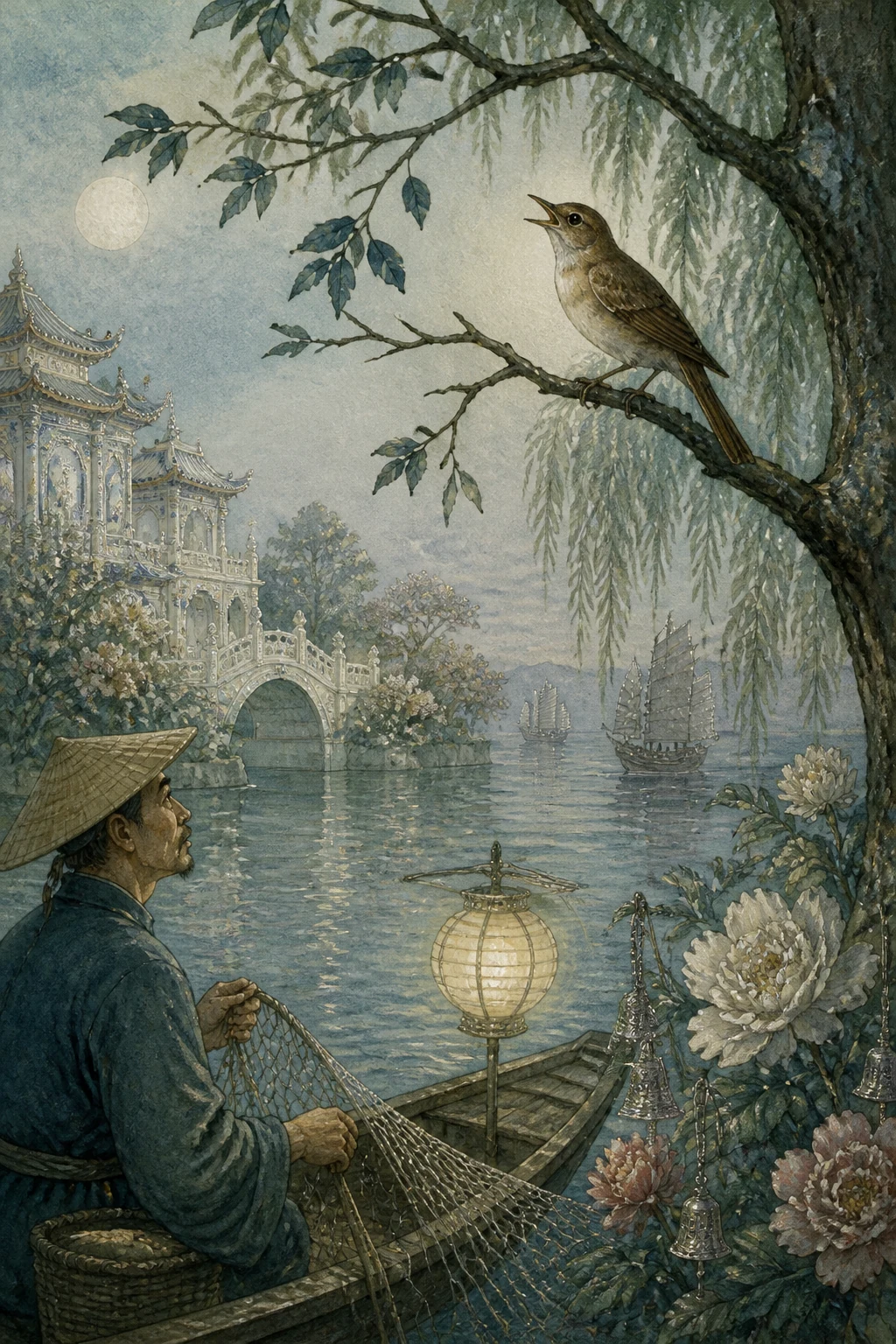
Those who went outside the city, where the houses stood farther apart, with gardens and little fields between them, saw the evening sky in still greater splendour and heard the bell’s peal far more clearly. It was as though the sound came from a church deep in the quiet, fragrant forest; and people looked that way and grew quite solemn. Time passed, and one person said to another, “Can there be a church out there in the forest? That bell has such a strange, lovely sound. Shall we go out and have a closer look?” So the rich drove and the poor walked, but the road seemed so strangely long to them, and when they reached a number of willows growing at the edge of the forest, they sat down there and looked up into the long branches, imagining themselves truly out in the greenwood. The confectioner from the city came out and pitched his tent, and then another confectioner came and hung a bell just above his tent—a bell that had been tarred to withstand the rain, and had no clapper. When people went home again, they said it had all been so romantic, which means something quite beyond the ordinary business of drinking tea. Three people declared that they had made their way through the forest to its very end, and had heard the strange ringing all the while, but there it had seemed to them to come from the city. One of them wrote a whole ballad about it, saying that the bell sounded like a mother’s voice speaking to a dear, wise child, and that no melody was lovelier than its peal.
The emperor of the country also heard about it and promised that whoever could discover for certain where the sound came from should receive the title of “Bell-ringer to the World,” even if it proved not to be a bell at all.
Now many people went into the forest for the sake of securing this comfortable livelihood, but only one came home with anything like an explanation. None had gone far enough into the forest, and neither had he; but he said the ringing came from a very large owl in a hollow tree. It was one of those owls of wisdom, which kept knocking its head against the wood, though whether the sound came from its head or from the hollow trunk he could not yet say with certainty. So he was appointed Bell-ringer to the World and wrote a little treatise on the owl every year; but people were none the wiser.
Now it happened to be a confirmation day. The pastor had spoken so beautifully and so earnestly, and the young people being confirmed had been deeply moved. It was an important day for them: in an instant they passed from children into grown people, and the child’s soul was now, as it were, to fly into a more sensible person. The sunshine was glorious. The newly confirmed went out of the city, and from the forest the great unknown bell rang with marvellous power. At once they all felt a longing to go there—all but three. One had to go home and try on her ball gown, for it was that very gown and that very ball that had led to her being confirmed this time; otherwise she would not have been among them. The second was a poor boy who had borrowed his confirmation coat and boots from his landlord’s son, and had to return them at a certain hour. The third said that he never went anywhere unfamiliar unless his parents were with him, and that he had always been a good child and meant to remain so, even after his confirmation—and one ought not to make fun of that! But they did.
Three of them, then, did not go along. The others strode off; the sun shone and the birds sang, and the newly confirmed sang with them and held one another’s hands, for they had not yet been given offices of any kind, and were all alike before Our Lord.
But soon two of the youngest grew tired and turned back towards the city. Two little girls sat down to weave wreaths, so they went no farther either; and when the others reached the willows where the confectioner had settled, they said, “There now, here we are! The bell doesn’t really exist; it’s only something people imagine!”
At that very moment the bell sounded deep in the forest, so sweetly and solemnly that four or five decided to go a little farther after all. The forest was so dense, so thick with leaves, that it was quite a struggle to get through. Woodruff and anemones grew almost too high; flowering bindweed and bramble runners hung in long garlands from tree to tree, where the nightingale sang and the sunbeams played. Oh, it was lovely, but it was no path for the girls to take: their dresses would have been torn to pieces. Great boulders lay there, overgrown with moss of every colour, and fresh spring water bubbled out, making a curious sound like “Cluck, cluck!”
“Surely that can’t be the bell!” said one of the newly confirmed, and he lay down to listen. “This needs proper study!” And there he stayed, letting the others go on.
They came to a house made of bark and branches. A great crab-apple tree leaned over it, as though it wished to shake down all its bounty upon the roof, which was blooming with roses. Its long branches stretched right across the gable, and on the gable hung a little bell. Could that be the one they had heard? Yes, they all agreed it was—all but one, who said that this bell was too small and delicate to be heard as far away as they had heard it, and that it was quite another kind of sound that could so move a human heart. The one who spoke was a king’s son, and the others said, “People like him always think they know better.”
So they let him go on alone, and as he walked his heart filled more and more with the solitude of the forest. Yet he could still hear the little bell with which the others were so pleased, and now and then, when the wind blew from the confectioner’s, he could also hear them singing over their tea. But the deep strokes of the bell sounded stronger still, and soon it was as though an organ were playing with them. The sound came from the left, from the side where the heart lies.
Now there was a rustling in the bushes, and a little boy stood before the prince, a boy in wooden shoes and a jacket so short that one could plainly see how long his wrists were. They knew each other. The boy was the very one of the newly confirmed who had been unable to come along because he had to go home and return the jacket and boots to his landlord’s son. He had done so, and now, in wooden shoes and his poor clothes, he had set out alone, for the bell rang so powerfully, so deeply, that he had to come.
“Then we can go together!” said the prince. But the poor boy in wooden shoes was very shy. He tugged at his short jacket sleeves and said he was afraid he could not walk fast enough to keep up. Besides, he thought they ought to look for the bell on the right, for that was the place of everything great and glorious.
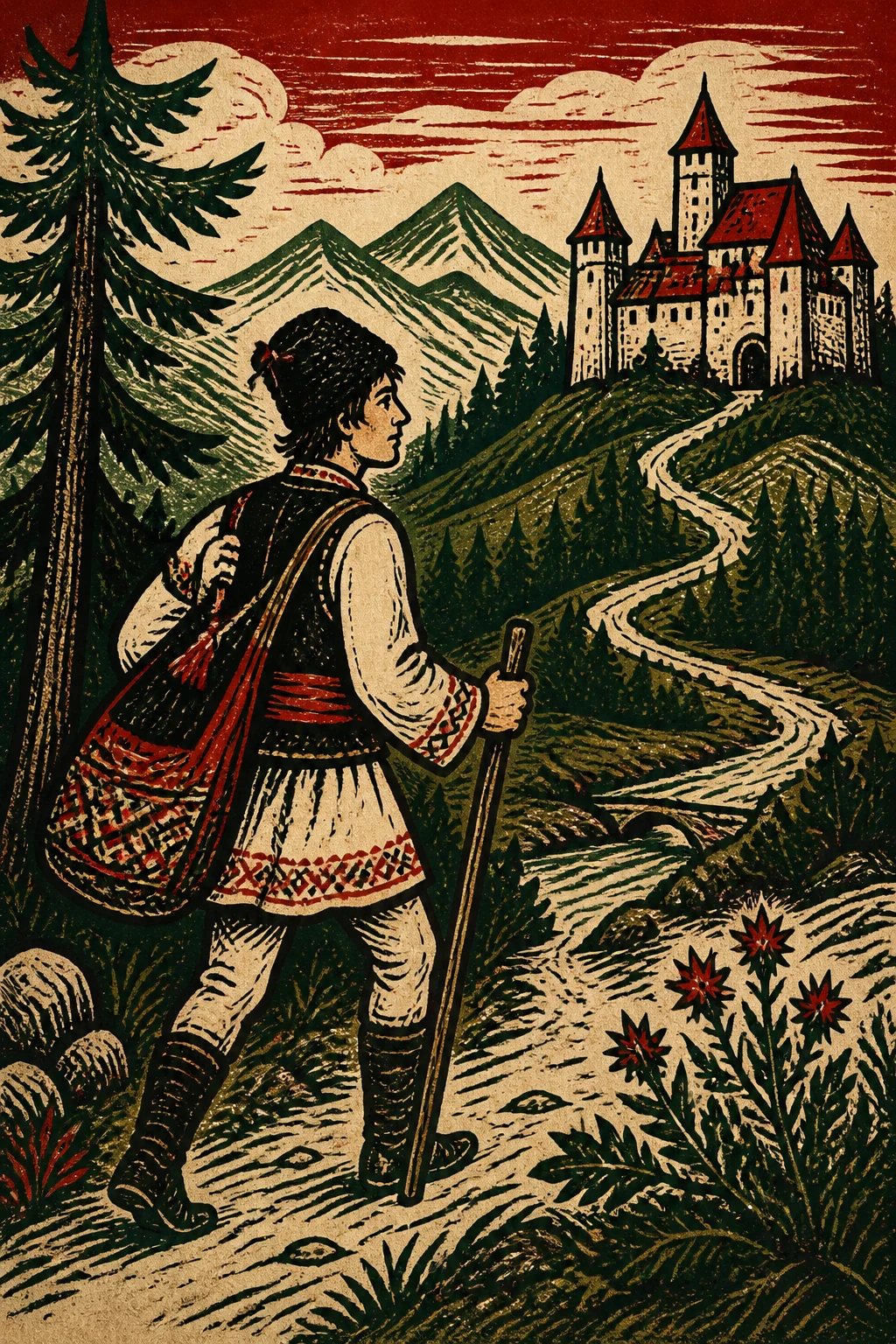
“Then we shan’t meet at all!” said the prince, and he nodded to the poor boy, who went into the darkest, thickest part of the forest, where the thorns tore his poor clothes and scratched his face, hands, and feet until they bled. The prince, too, received some good scratches, but at least the sun shone on his path, and it is he whom we shall now follow, for he was a spirited lad.
“I will and must find the bell!” he said, “even if I have to go to the end of the world!” The nasty monkeys sat up in the trees and grinned with all their teeth. “Shall we pelt him?” they said. “Shall we pelt him? He’s a king’s son!”
But undaunted he went deeper and deeper into the forest, where the most wonderful flowers grew. There were white star-lilies with blood-red stamens, sky-blue tulips that sparkled in the wind, and apple trees whose apples looked exactly like great shining soap bubbles—just imagine how those trees must have gleamed in the sunshine! Around the loveliest green meadows, where stags and does played in the grass, grew magnificent oaks and beeches; and wherever the bark of a tree had split, grass and long trailing shoots grew in the crevice. There were also great stretches of woodland with still lakes, where white swans swam and beat their wings. The prince often stood still and listened. Many times he thought the bell was ringing up to him from one of these deep lakes, but then he could tell that it was not coming from there, but from still deeper in the forest.
Now the sun was setting, the sky glowed red as fire, and the forest grew so still, so very still. He sank to his knees, sang his evening hymn, and said, “I shall never find what I am seeking! Now the sun is setting, now night is coming, the dark night. Yet perhaps I may see the round red sun once more before it sinks quite below the earth. I shall climb those rocks; they rise as high as the tallest trees!”
And he clutched at trailing vines and roots and climbed the wet stones, where water snakes writhed and toads seemed to bark at him. But he reached the top before the sun, seen from that height, had quite gone down. Oh, what splendour! The sea, the great glorious sea, rolling its long waves towards the shore, stretched out before him, and the sun stood like a great shining altar out there where sea and sky met. Everything melted together in glowing colours; the forest sang and the sea sang, and his heart sang with them. All nature was one great holy church, in which the trees and floating clouds were the pillars, the flowers and grass the woven velvet cloth, and heaven itself the great dome. Up there the red colours faded as the sun vanished, but millions of stars were kindled, millions of diamond lamps shone out, and the prince spread his arms towards the heavens, towards the sea and the forest. At that very moment, from the aisle on the right, came the poor newly confirmed boy in his short sleeves and wooden shoes. He had arrived just as soon, coming by his own path, and they ran to meet each other and clasped hands in the great church of nature and poetry. Above them the unseen holy bell rang out, and blessed spirits floated in a dance around it to a jubilant hallelujah!