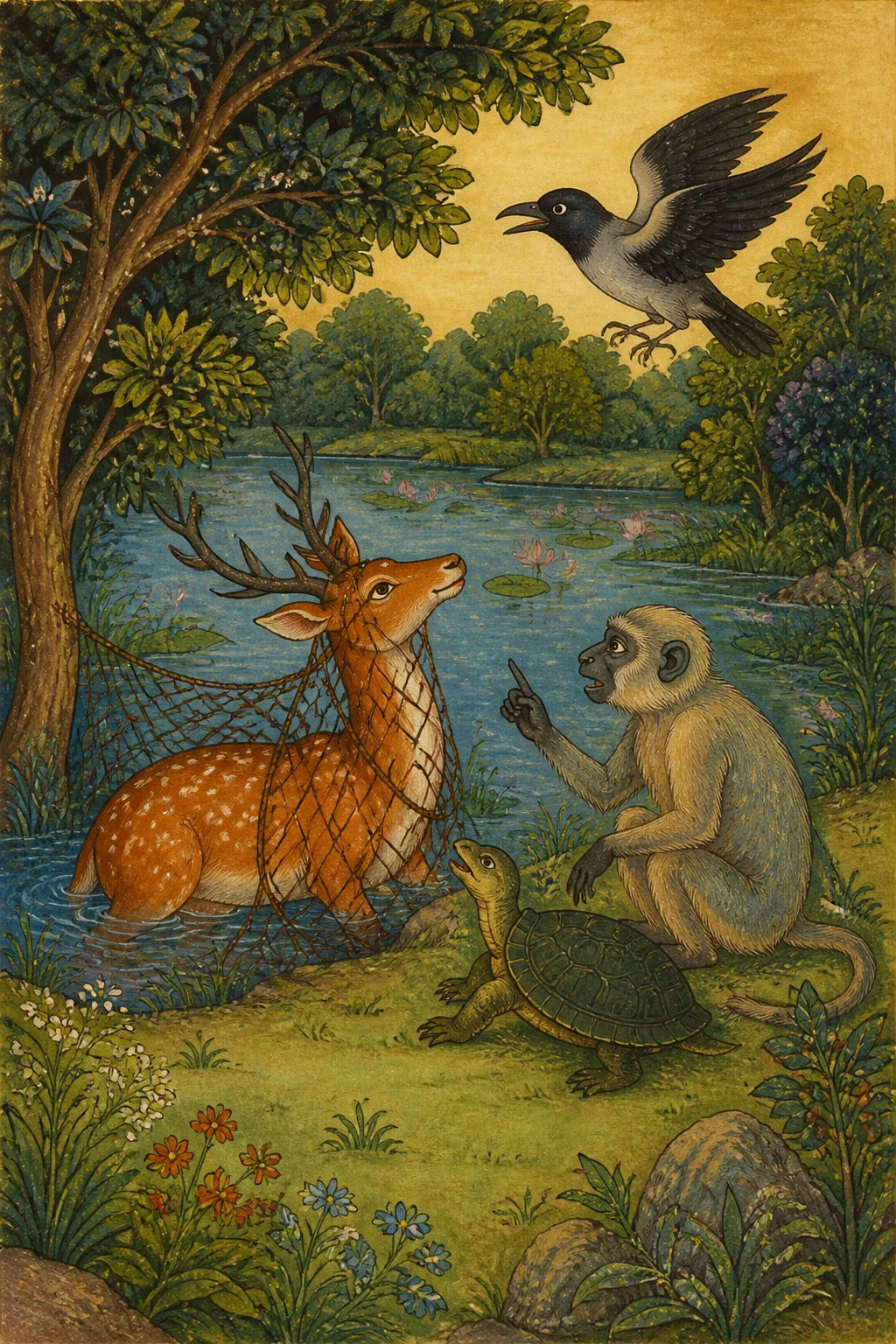
Waltey
Jelen v lovčevi zanki
Pančatantra · indijska zbirka pripovediO besedilu
Jelen v lovčevi zanki
- Vir
- Pančatantra
- Avtor
- indijska zbirka pripovedi
- Jezik branja
- English
- Jezik izvirnika
- Sanskrit
- Čas branja
- 11 min branja
- Obseg
- 9 strani
- Naslov izvirnika
- Tantra 02 mitra-samprapti chunk 5
O izvirniku
Pančatantra
Indijske zgodbe o zvijači, prijateljstvu in modrosti v svetu živali in vladarjev. Bralni jezik je English, izvirnik pa prihaja iz vira Pančatantra v jeziku Sanskrit.
Besedilo
Jelen v lovčevi zanki
A man stricken with fear draws deep breaths again and again;
he looks in every direction and nowhere finds peace.
Hearing this, Citrāṅga said, “My dear Mantharaka, you have rightly understood the cause of my terror. I escaped the hunters’ arrows and reached this place with great difficulty. Those hunters have probably slaughtered my herd. I have come to you for refuge: show me some place beyond their reach.”
Mantharaka replied, “My dear Citrāṅga, listen to what the science of conduct teaches:
Two means of escape are prescribed when an enemy appears:
one lies in wielding the hands, the other in swiftness of foot.
“Go quickly, then, into the dense forest, before those wicked hunters arrive.”
Just then Laghupatanaka hurried up and said, “My dear Mantharaka, the hunters have gone home, carrying great loads of meat. Citrāṅga, you may come out of the water without fear.” Thus the four became friends, and passed their days happily beside that lake, enjoying conversations filled with wise sayings beneath the shade of a tree at midday. Indeed, it is well said:
Clad in a mantle of delight, their hair standing on end as they savor fine words,
poets find their joy increasing even without the embrace of women.
He who gathers no treasure of wise sayings—
what offering will he make at the sacrificial feast of conversation?
And again:
He who cannot retain a saying heard once, nor compose one himself,
and keeps no notebook—where will he find a fitting verse?
One day, at the hour of their gathering, the deer did not arrive. The others grew anxious and began to discuss it among themselves. “Why has our friend not come today? Has a lion or some other beast killed him? Have hunters caught him? Has he fallen into a forest fire, or into a pit or ravine while tempted by fresh grass?” Indeed, it is well said:
Even when someone is in his own garden, those who love him imagine harm, blinded by affection;
how much more when he is deep in a terrifying forest known to hold countless dangers!
Then Mantharaka said to the crow, “My dear Laghupatanaka, Hiraṇyaka and I are both too slow to search for him. Go and scour the forest, and see whether you can find him alive somewhere.” Laghupatanaka set off at once. He had not gone far when he found Citrāṅga beside a small pool, held fast in a concealed snare. Distraught with grief at the sight, he said, “My friend, what has happened?” At the sight of the crow, Citrāṅga’s heart grew still heavier. Indeed, it is rightly said:
Whether brought low by illness or utterly ruined, a creature who sees someone dear
will often feel a still greater surge of sorrow.
When his tears had subsided, Citrāṅga said to Laghupatanaka, “My friend, death has surely come for me. Yet it is a blessing that I have been able to see you. For it is said:
If a friend appears when death is near,
that meeting brings comfort either way, whether one lives or dies.
“Forgive whatever I may have said too freely in the intimacy of our literary conversations. And convey these words from me to Hiraṇyaka and Mantharaka:
Whatever harsh words I have spoken, knowingly or unknowingly,
may you both, in your kindness, forgive me today.
Hearing this, Laghupatanaka said, “My friend, you need not fear while you have friends like us. I shall hurry back with Hiraṇyaka. Besides, good men do not lose their composure in adversity. As it is said:
Rare is the mother who bears a son who does not exult in prosperity, despair in adversity, or tremble in battle—a jewel among the three worlds.
With these words Laghupatanaka reassured Citrāṅga, then flew back to Hiraṇyaka and Mantharaka and told them how the deer had been caught in a snare. Hiraṇyaka resolved to free him, and the crow took him on his back and hurried once more to Citrāṅga. At the sight of the mouse, a little hope of life stirred in the deer, and he said:
The wise should make true-hearted friends to ward off calamity;
no one without friends can cross the flood of trouble in this world.
Hiraṇyaka said, “My friend, you are skillful and versed in the science of conduct. How, then, did you fall into this concealed snare?”
Citrāṅga replied, “This is no time for debate, my friend. Before that wicked hunter returns, quickly gnaw through the snare around my feet.”
Hiraṇyaka laughed and said, “Do you still fear the hunter, even now that I am here? I have grown deeply disillusioned with learned treatises, seeing that even someone like you, so well versed in the science of conduct, can come to such a plight. That is why I ask.” Citrāṅga replied, “My friend, fate can defeat even intelligence. As it is said:
When men are bound in the noose of Death and their minds are struck down by fate,
even the greatest find their judgment taking crooked paths.
The line of letters that the Creator has inscribed upon the brow—
not even the wisest, with all their powers, can wipe it away.
While the two were speaking, Mantharaka, his heart burning with distress at his friend’s misfortune, slowly made his way to the spot. Seeing him, Laghupatanaka said to Hiraṇyaka, “Oh, here is a fresh misfortune!”
Hiraṇyaka asked, “Is the hunter coming?” The crow replied, “Never mind the hunter for now. Here comes Mantharaka. He has acted most unwisely: if that wicked hunter arrives, we may all be killed on his account. I can fly into the sky; you can save yourself by slipping into a hole; and Citrāṅga can run swiftly away. But he is a creature of the water—what will become of him on dry land? That is what troubles me.” Just then Mantharaka reached them.
Hiraṇyaka said, “My friend, you should not have come here. Go back as quickly as you can, before the hunter arrives.”
Mantharaka replied, “My friend, what could I do? I could not stay there and endure the burning anguish of my friend’s peril. That is why I came. Indeed, it is well said:
How could separation from loved ones and the loss of wealth be borne,
were it not for the company of friends, that sovereign remedy?
Better to give up life than to be parted from friends like you;
life may return in another birth, but friends like you will not.
While he was still speaking, the hunter appeared, his bow drawn back to his ear. At the sight of him, the mouse instantly severed the deer’s sinew snare. Citrāṅga sprang away, glancing back as he ran; Laghupatanaka flew into a tree; and Hiraṇyaka slipped into a nearby hole. The hunter, downcast at the deer’s escape and the waste of his efforts, then noticed Mantharaka moving slowly across the open ground. He thought, “Though fate has robbed me of the deer, it has provided this tortoise for food. His flesh will feed my family today.” With this thought he wrapped the tortoise in darbha grass, fastened him to his bow, slung it over his shoulder, and set off for home. Seeing him carried away, Hiraṇyaka cried out in anguish, “Alas! What a terrible misfortune! Before I can reach the end of one sorrow,
as though struggling toward the far shore of the sea,
another has overtaken me. Misfortunes multiply wherever there is an opening.
One goes happily without stumbling while the road is level;
but once a stumble comes, every step leads over uneven ground.
Yielding yet true, unbroken in adversity,
and of sound stock—rare indeed are such a bow, a friend, and a wife.
Neither in mother nor wife, neither in brother nor son,
does a man place such trust as in a friend bound closely to his heart.
“If fate had decreed the loss of my wealth, why did it also take away the friend who gave me rest when I was weary from that journey? Never shall I find another friend like Mantharaka. For it is said:
A great gain in times of want, someone to whom one may tell one’s secrets,
and deliverance from danger—these are the three rewards of friendship.
“After him, I have no other friend like this. Why, alas, does fate rain arrows of misfortune upon me without cease? First the loss of wealth, then the loss of my followers, then exile from my home, and now separation from my friend! Yet perhaps this is simply the nature of life for all living beings. As it is said:
The body is ever close to destruction; wealth is a dwelling place of trouble;
meetings end in partings; all that comes into being must decay.
And again: Blows fall again and again upon a wound;
when wealth dwindles, the fire of hunger grows;
enmities arise in times of trouble;
misfortunes multiply wherever there is an opening.
“How well someone has said:
A refuge when danger comes, a vessel of affection and trust—
who created this jewel, the two syllables of ‘mitra,’ friend?
Meanwhile Citrāṅga and Laghupatanaka returned to the spot, both lamenting. Hiraṇyaka said, “What use is idle lamentation? Before Mantharaka is carried out of sight, let us devise a way to free him. As it is said:
He who, bewildered by calamity, does nothing but lament
only increases his weeping and never puts an end to his trouble.
Those skilled in policy prescribe but one remedy for misfortune:
set about removing it, and cast despair aside.
And again: Counsel taken to safeguard gains already won,
to secure gains yet to come,
and to deliver one who has fallen into danger—
that indeed is counsel of the highest kind.
Hearing this, the crow said, “Then do as I suggest. Let Citrāṅga go ahead along the hunter’s path, find a small pool, and lie motionless on its bank. I shall perch on his head and peck at it gently. Seeing my beak at work, the hunter will be convinced that the deer is dead; he will put Mantharaka down on the ground and run to fetch the deer. Meanwhile, you must gnaw through the bindings of darbha grass, so that Mantharaka can hurry into the pool.” Citrāṅga said, “My friend, you have devised an excellent plan. We may surely count Mantharaka as freed already. For it is said:
The heart’s first surge of confidence foretells success or failure in any creature’s undertaking;
the wise perceive its message, but others do not.
“Let us do just that.” They put the plan into action, and the hunter soon saw Citrāṅga lying beside a pool near the path, with the crow attending him. Delighted, he thought, “Surely this poor deer, his life all but spent from the pain of the snare, somehow broke free, made his way into this part of the forest, and died. The tortoise is securely bound and cannot escape me. Let me fetch the deer as well.” Having made up his mind, he put the tortoise on the ground and hurried toward the deer. At once Hiraṇyaka’s diamond-hard teeth cut the grass bindings to pieces. Mantharaka emerged from the grass and slipped into the pool. Before the hunter could reach him, Citrāṅga sprang up and fled with the crow. Abashed and dejected, the hunter turned back, only to find that the tortoise too was gone. Sitting down there, he recited this verse: “That great deer had already fallen into my snare, yet you took him from me;
the tortoise I had secured has surely vanished at your command as well.
Wasted with hunger, I wander this forest, bereft of my wife and children.
Whatever more you have not yet done, O Fate, do that too—I shall endure it.
After many such lamentations, he went home. Once he was far away, the crow, the tortoise, the deer, and the mouse came together in supreme delight and embraced one another, feeling as though they had been born anew. They returned to their lake and passed their days in great happiness, enjoying conversations rich in wise sayings. Knowing this, a discerning person should gather friends and deal with them without deceit. For it is said:
He who makes friends in this world and treats them without guile
will never suffer defeat while he stands together with them.
Thus ends the second book, entitled “The Winning of Friends,” in the Pañcatantra composed by the venerable Viṣṇuśarman.
*********************************************************************** The Third Book: Crows and Owls. Introductory Tale: The Story of Meghavarṇa and Arimardana.
Izvirnik
Tantra 02 mitra-samprapti chunk 5
Naslednje strani prikazujejo izvirno besedilo za primerjavo.
Source ID: panchatantra_gretil_tantra_02_chunk_05 Source URL: https://gretil.sub.uni-goettingen.de/gretil/1_sanskr/5_poetry/4_narr/vispancu.htm bhaya-trasto naraḥ śvāsaṃ prabhūtaṃ kurute muhuḥ | diśo 'valokayaty eva na svāsthyaṃ vrajati kvacit tac chrutvā citrāṅga āha-bho mantharaka ! jñātaṃ tvayā samyaṅ me trāsa-kāraṇam | ahaṃ lubdhaka-śara-prahārād uddhāritaḥ kṛcchreṇātra samāyātaḥ | mama yūthaṃ tair lubdhakair vyāpāditaṃ bhaviṣyati | tac charaṇāgatasya me darśaya kiṃcid agamyaṃ sthānaṃ lubdhakānām | tad ākarṇya mantharaka āha-bhoś citrāṅga ! śrūyatāṃ nīti-śāstram | dvāv upāyāv iha proktau vimuktau śatru-darśane | hastayoś cālanād eko dvitīyaḥ pāda-vega-jaḥ tad gamyatāṃ śīghraṃ ghanaṃ vanaṃ yāvad adyāpi nāgacchanti te durātmāno lubdhakāḥ |
atrāntare laghupatanakaḥ satvaram abhyupetyovāca-bho mantharaka ! gatās te lubdhakāḥ sva-gṛhonmukhāḥ pracura-māṃsa-piṇḍa-dhāriṇaḥ | tac citrāṅga ! tvaṃ viśrabdho jalād bahir bhava | tatas te catvāro 'pi mitra-bhāvam āśritās tasmin sarasi madhyāhna-samaye vṛkṣa-cchāyādhastāt subhāṣita-goṣṭhī-sukham anubhavantaḥ sukhena kālaṃ nayanti | athavā yuktam etad ucyate- subhāṣita-rasāsvāda-baddha-romāñca-kañcukaṃ | vināpi saṃgamaṃ strīṇāṃ kavīnāṃ sukham edhate subhāṣita-maya-dravya-saṅgrahaṃ na karoti yaḥ | sa tu prastāva-yajñeṣu kāṃ pradāsyati dakṣiṇām tathā ca- sakṛd uktaṃ na gṛhṇāti svayaṃ vā na karoti yaḥ | yasya saṃpuṭikā nāsti kutas tasya subhāṣitam athaikasminn ahani goṣṭhī-samaye mṛgo nāyātaḥ | atha te vyākulībhūtāḥ parasparaṃ jalpitum ārabdhāḥ | aho kim adya suhṛn na samāyātaḥ | kiṃ siṃhādibhiḥ kvacid vyāpādita uta lubdhakair atha vānale prapatito gartā-viṣame vā nava-tṛṇa-laulyād iti | athavā sādhv idam ucyate-
sva-gṛhodyāna-gate'pi snigdhaiḥ pāpaṃ viśaṅkyate mohāt | kim u dṛṣṭa-bahv-apāya-pratibhaya-kāntāra-madhya-sthe atha mantharako vāyasam āha-bho laghupatanakāhaṃ hiraṇyakaś ca tāvad dvāv apy aśaktau tasyānveṣaṇaṃ kartuṃ mandagatitvāt | tad gatvā tvam araṇyaṃ śodhaya yadi kutracit taṃ jīvantaṃ paśyasīti | tad ākarṇya laghupatanako nātidūre yāvad gacchati tāvat palvala-tīre citrāṅgaḥ kūṭa-pāśa-niyantritas tiṣṭhati | taṃ dṛṣṭvā śoka-vyākulita-manās tam avocat | bhadra kim idam ? citrāṅgo 'pi vāyasam avalokya viśeṣeṇa duḥkhita-manā babhūva | athavā yuktam etat- api mandatvam āpanno naṣṭo vāpīṣṭa-darśanāt | prāyeṇa prāṇināṃ bhūyo duḥkhāvego 'dhiko bhavet tataś ca vāṣpāvasāne citrāṅgo laghupatanakam āha-bho mitra saṃjāto 'yaṃ tāvan mama mṛtyuḥ | tad yuktaṃ sampannaṃ yad bhavatā saha me darśanaṃ sañjātam | uktaṃ ca-
prāṇātyaye samutpanne yadi syān mitra-darśanaṃ | tad dvābhyāṃ sukha-daṃ paścāj jīvato 'pi mṛtasya ca tat kṣantavyaṃ yan mayā praṇayāt subhāṣita-goṣṭhīṣv abhihitaṃ | tathā hiraṇyaka-mantharakau mama vākyād vācyau | ajñānāj jñānato vāpi duruktaṃ yad udāhṛtam | mayā tat kṣamyatām adya dvābhyām api prasādataḥ tac chrutvā laghupatanaka āha-bhadra na bhetavyam asmad-vidhair mitrair vidyamānaiḥ | yāvad ahaṃ drutataraṃ hiraṇyakaṃ gṛhītvāgacchāmi | aparaṃ ye sat-puruṣā bhavanti te vyasane na vyākulatvam upayānti | uktaṃ ca- sampadi yasya na harṣo vipadi viṣādo raṇe na bhīrutvaṃ | taṃ bhuvana-traya-tilakaṃ janayati jananī sutaṃ viralaṃ evam uktvā laghupatanakaś citrāṅgam āśvāsya yatra hiraṇyaka-mantharakau tiṣṭhatas tatra gatvā sarvaṃ citrāṅga-pāśa-patanaṃ kathitavān | hiraṇyakaṃ ca citrāṅga-pāśa-mokṣaṇaṃ prati kṛta-niścayaṃ pṛṣṭham āropya bhūyo 'pi satvaraṃ citrāṅga-samīpe gataḥ | so 'pi mūṣakam avalokya kiṃcij jīvitāśayā saṃśliṣṭa āha-
āpan-nāśāya vibudhaiḥ kartavyāḥ suhṛdo 'malāḥ | na taraty āpadaṃ kaścid yo 'tra mitra-vivarjitaḥ hiraṇyaka āha-bhadra tvaṃ tāvan nīti-śāstra-jño dakṣa iti | tat katham atra kūṭa-pāśe patitaḥ ? sa āha-bho na kālo 'yaṃ vivādasya | tan na yāvat sa pāpātmā lubdhakaḥ samabhyeti tāvad drutataraṃ kartayemaṃ mat-pāda-pāśaṃ | tad ākarṇya vihasyāha hiraṇyakaḥ-kiṃ mayy api samāyāte lubdhakād bibheṣi tataḥ śāstraṃ prati mahatī me viraktiḥ sampannā yad bhavad-vidhā api nīti-śāstra-vida etām avasthāṃ prāpnuvanti | tena tvāṃ pṛcchāmi | sa āha-bhadra karmaṇā buddhir api hanyate | uktaṃ ca- kṛtānta-pāśa-baddhānāṃ daivopahata-cetasāṃ | buddhayaḥ kubja-gāminyo bhavanti mahatām api vidhātrā racitā yā sā lalāṭe'kṣara-mālikā | na tāṃ mārjayituṃ śaktāḥ sva-śaktyāpy atipaṇḍitāḥ
evaṃ tayoḥ pravadatoḥ suhṛd-vyasana-santapta-hṛdayo mantharakaḥ śanaiḥ śanais taṃ pradeśam ājagāma | taṃ dṛṣṭvā laghupatanako hiraṇyakam āha-aho na śobhanam āpatitam | hiraṇyaka āha-kiṃ sa lubdhakaḥ samāyāti ? sa āha-āstāṃ tāval lubdhaka-vārtā | eṣa mantharakaḥ samāgacchati | tad anītir anuṣṭhitānena yato vayam apy asya kāraṇān nūnaṃ vyāpādanaṃ yāsyāmo yadi sa pāpātmā lubdhakaḥ samāgamiṣyati | tad ahaṃ tāvat kham utpatiṣyāmi | tvaṃ punar bilaṃ praviṣyātmānaṃ rakṣayiṣyasi | citrāṅgo 'pi vegena dig-antaraṃ yāsyati | eṣa punar jalacaraḥ sthale kathaṃ bhaviṣyatīti vyākulo 'smi | atrāntare prāpto 'yaṃ mantharakaḥ | hiraṇyaka āha-bhadra, na yuktam anuṣṭhitaṃ bhavatā yad atra samāyātaḥ | tad bhūyo 'pi drutataraṃ gamyatāṃ yāvad asau lubdhako na samāyāti |
mantharaka āha-bhadra, kiṃ karomi ? na śaknomi tatra-stho mitra-vyasanāgni-dāghaṃ soḍhum | tenāham atrāgataḥ | athavā sādhv idam ucyate- dayita-jana-viprayogo vitta-viyogaś ca sahyāḥ syuḥ | yadi sumahauṣadha-kalpo vayasya-jana-saṃgamo na syāt varaṃ prāṇa-parityāgo na viyogo bhavādṛśaiḥ | prāṇā janmāntare bhūyo na bhavanti bhavad-vidhāḥ evaṃ tasya pravadata ākarṇa-pūrita-śarāsano lubdhako 'py upāgataḥ | taṃ dṛṣṭvā mūṣakeṇa tasya snāyu-pāśas tat-kṣaṇāt khaṇḍitaḥ | atrāntare citrāṅgaḥ satvaraṃ pṛṣṭham avalokayan pradhāvitaḥ | laghupatanako vṛkṣam ārūḍhaḥ | hiraṇyakaś ca samīpa-varti bilaṃ praviṣṭaḥ | athāsau lubdhako mṛga-gamanād viṣaṇṇa-vadano vyartha-śramas taṃ mantharakaṃ mandaṃ mandaṃ sthala-madhye gacchantaṃ dṛṣṭavān | acintayac ca-yady api kuraṅgo dhātrāpahṛtas tathāpy ayaṃ kūrma āhārārthaṃ sampāditaḥ | tad adyāsyāmiṣeṇa me kuṭumbasyāhāra-nirvṛttir bhaviṣyati |
evaṃ vicintya taṃ darbhaiḥ sañchādya dhanuṣu samāropya skandhe kṛtvā gṛhaṃ prati prasthitaḥ | atrāntare taṃ nīyamānam avalokya hiraṇyako duḥkhākulaḥ paryadevayat-kaṣṭaṃ bhoḥ kaṣṭam āpatitam | ekasya duḥkhasya na yāvad antaṃ gacchāmy ahaṃ pāram ivārṇavasya | tāvad dvitīyaṃ samupasthitaṃ me chidreṣv anarthā bahulī-bhavanti tāvad askhalitaṃ yāvat sukhaṃ yāti same pathi | skhalite ca samutpanne viṣame ca pade pade yan namraṃ saralaṃ cāpi yac cāpatsu na sīdati | dhanur mitraṃ kalatraṃ ca durlabhaṃ śuddha-vaṃśajam na mātari na dāreṣu na sodarye na cātmaje | viśrambhas tādṛśaḥ puṃsāṃ yādṛṅ mitre nirantare yadi tāvat kṛtāntena me dhana-nāśo vihitas tan-mārga-śrāntasya me viśrāma-bhūtaṃ mitraṃ kasmād apahṛtaṃ | aparam api mitraṃ paraṃ mantharaka-samaṃ na syāt | uktaṃ ca-
asampattau paro lābho guhyasya kathanaṃ tathā | āpad-vimokṣaṇaṃ caiva mitrasyaitat phala-trayam tad asya paścān nānyaḥ suhṛn me | tat kiṃ mamopary anavarataṃ vyasana-śarair varṣati hanta vidhiḥ | yata ādau tāvad vitta-nāśas tataḥ parivāra-bhraṃśas tato deśa-tyāgas tato mitra-viyoga iti | athavā svarūpam etat sarveṣām eva jantūnāṃ jīvita-dharmasya | uktaṃ ca- kāyaḥ saṃnihitāpāyaḥ sampadaḥ padam āpadām | samāgamāḥ sāpagamāḥ sarvam utpādi bhaṅguram tathā ca- kṣate prahārā nipatanty abhīkṣṇaṃ dhana-kṣaye vardhati jāṭharāgniḥ | āpatsu vairāṇi samudbhavanti cchidreṣv anarthā bahulī-bhavanti aho sādhūktaṃ kenāpi | prāpte bhaye paritrāṇaṃ prīti-viśrambha-bhājanaṃ |
kena ratnam idaṃ sṛṣṭaṃ mitram ity akṣara-dvayaṃ atrāntare ākranda-parau citrāṅga-laghupatanakau tatraiva samāyātau | atha hiraṇyaka āha-aho kiṃ vṛthā-pralapitena | tad yāvad eṣa mantharako dṛṣṭi-gocarān na nīyate tāvad asya mokṣopāyaś cintyatām iti | uktaṃ ca- vyasanaṃ prāpya yo mohāt kevalaṃ paridevayet | krandanaṃ vardhayaty eva tasyāntaṃ nādhigacchati kevalaṃ vyasanasyoktaṃ bheṣajaṃ naya-paṇḍitaiḥ | tasyoccheda-samārambho viṣāda-parivarjanaṃ anyac ca- atīta-lābhasya surakṣaṇārthaṃ bhaviṣya-lābhasya ca saṅgamārtham | āpat-prapannasya ca mokṣaṇārthaṃ yan mantryate'sau paramo hi mantraḥ tac chrutvā vāyasa āha-bho yady evaṃ tat kriyatāṃ mad-vacaḥ | eṣa citrāṅgo 'sya mārge gatvā kiṃcit palvalam āsādya tasya tīre niścetano bhūtvā patatu | aham apy asya śirasi samāruhya mandaiś cañcu-prahāraiḥ śira ullekhiṣyāmi yenāsau lubdhako 'muṃ mṛtaṃ matvā mama cañcu-prahāra-pratyayena mantharakaṃ bhūmau kṣiptvā mṛgārthe dhāvati | atrāntare tvayā darbha-maya-bandhana-veṣṭanāni khaṇḍanīyāni yenāsau mantharako drutataraṃ palvalaṃ praviśati |
citrāṅgaḥ prāha-bho bhadro 'yaṃ dṛṣṭo mantras tvayā | nūnaṃ mantharako mukto mantavyaḥ | uktaṃ ca- siddhiṃ vā yadi vāsiddhiṃ cittotsāho nivedayet | prathamaṃ sarva-jantūnāṃ prājño vetti na cetaraḥ tat tad evaṃ kriyatām | tathānuṣṭhite sa lubdhakas tathaiva mārgāsanna-palvala-tīrasthaṃ citrāṅgaṃ vāyasa-sanātham adrākṣīt | taṃ dṛṣṭvā harṣita-manā vyacintayat | nūnaṃ pāśa-vedanayā varāko 'yaṃ mṛgo gatvāyuḥ-śeṣa-jīvitaḥ pāśaṃ troṭayitvā katham apy etad vanāntaraṃ praviṣṭo yāvan mṛtaḥ | tad vaśyo 'yaṃ me kacchapaḥ suyantritatvāt | tad enam api tāvad gṛhṇāmīty avardhāya kacchapaṃ bhū-tale prakṣipya mṛgam upādravat | atrāntare hiraṇyakena vajropama-daṃṣṭrā-prahāreṇa tad darbha-veṣṭanaṃ tat-kṣaṇāt khaṇḍaśaḥ kṛtaṃ | mantharako 'pi tṛṇa-madhyān niṣkramya palvalaṃ praviṣṭaḥ | citrāṅgo 'py aprāptasyāpi tasyotthāya vāyasena saha drutaṃ pranaṣṭaḥ | atrāntare vilakṣo viṣāda-paro nivṛtto lubdhako yāvat paśyati tāvat kacchapo 'pi gataḥ | tataś ca tatropaviśyemaṃ ślokam apaṭhat-
prāpto bandhanam apy ayaṃ guru-mṛgas tāvat tvayā me hṛtaḥ samprāptaḥ kamaṭhaḥ sa cāpi niyataṃ naṣṭas tavādeśataḥ | kṣut-kṣāmo 'tra vane bhramāmi śiśukais tyaktaḥ samaṃ bhāryayā yac cānyan na kṛtaṃ kṛtānta kurute tac cāpi sahyaṃ mayā evaṃ bahu-vidhaṃ vilapya sva-gṛhaṃ gataḥ | atha tasmin dūrī-bhūte sarve'pi te kāka-kūrma-mṛgākhavaḥ paramānanda-bhājo militvā parasparam āliṅgya punar jātān ivātmano manyamānas tad eva saraḥ prāpya mahā-sukhena subhāṣita-goṣṭhī-vinodaṃ kurvantaḥ kālaṃ nayanti sma | evaṃ jñātvā vivekinā mitra-saṅgrahaḥ kāryaḥ | tathā mitreṇa sahāvyājena vartitavyam | uktaṃ ca- yo mitrāṇi karoty atra na kauṭilyena vartate | taiḥ samaṃ na parābhūtiṃ samprāpnoti kathañcana iti śrī-viṣṇu-śarma-viracite pañcatantre mitra-samprāptir nāma
dvitīyaṃ tantraṃ samāptam *********************************************************************** tṛtīyaṃ tantram atha kākolūkīyam prastāvanā kathā meghavarṇārimardana-vṛttāntaḥ
Nadaljuj z branjem