O besedilu
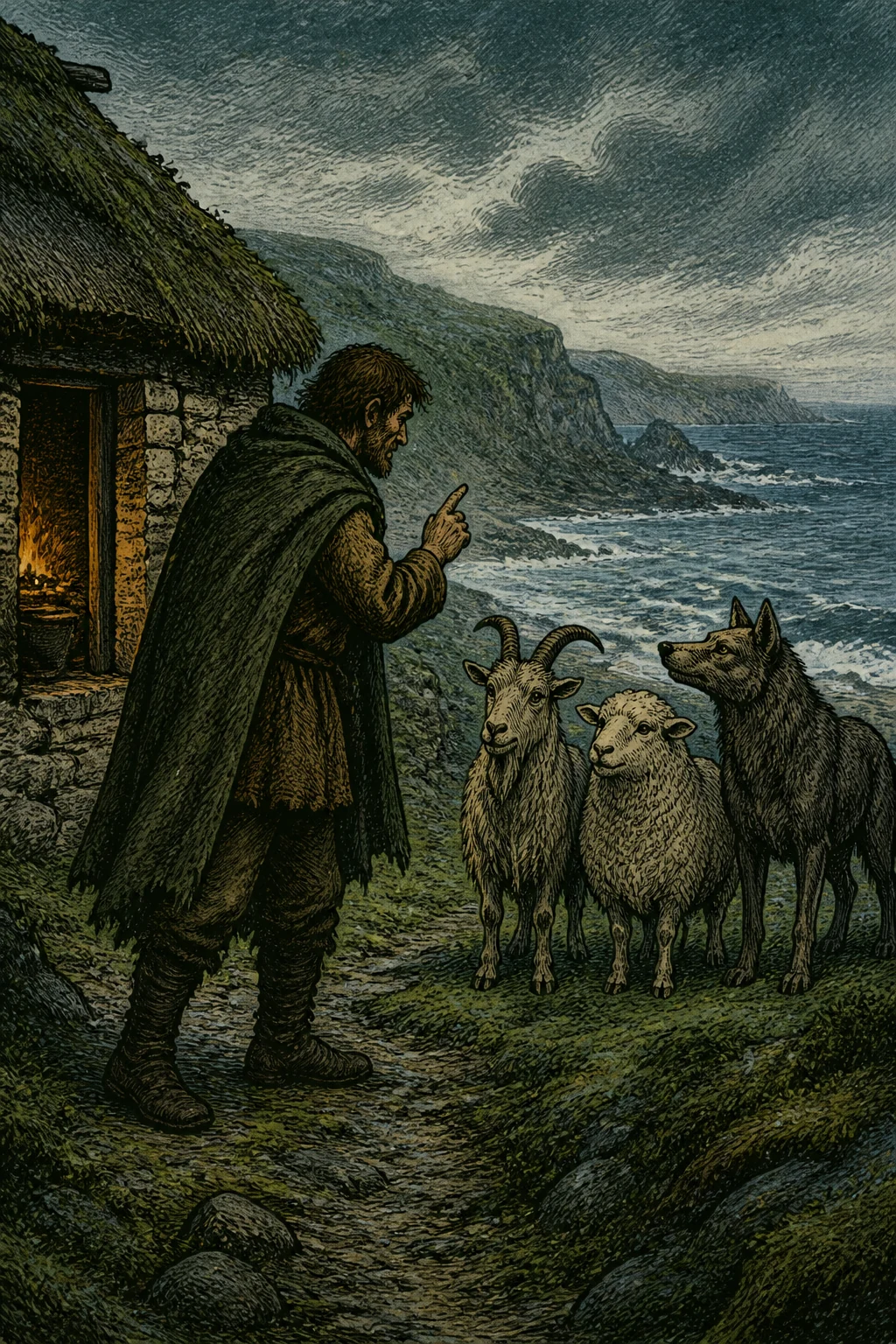
Krojač in tri zveri
- Vir
- Beside the Fire
- Avtor
- Douglas Hyde
- Jezik branja
- English
- Jezik izvirnika
- Gaeilge
- Čas branja
- 9 min branja
- Obseg
- 7 strani
- Naslov izvirnika
- 001 An Táilliúr agus na Trí Beithigh
O izvirniku
Beside the Fire
Irske pripovedi ob ognju: preobrazbe, prikazni, zvijače in otoško ustno izročilo. Bralni jezik je English, izvirnik pa prihaja iz vira Beside the Fire v jeziku Gaeilge.
Besedilo
Krojač in tri zveri
He saw a flea stirring and killed it. “What a fine warrior I am,” he said then, “to have been able to kill that flea!”
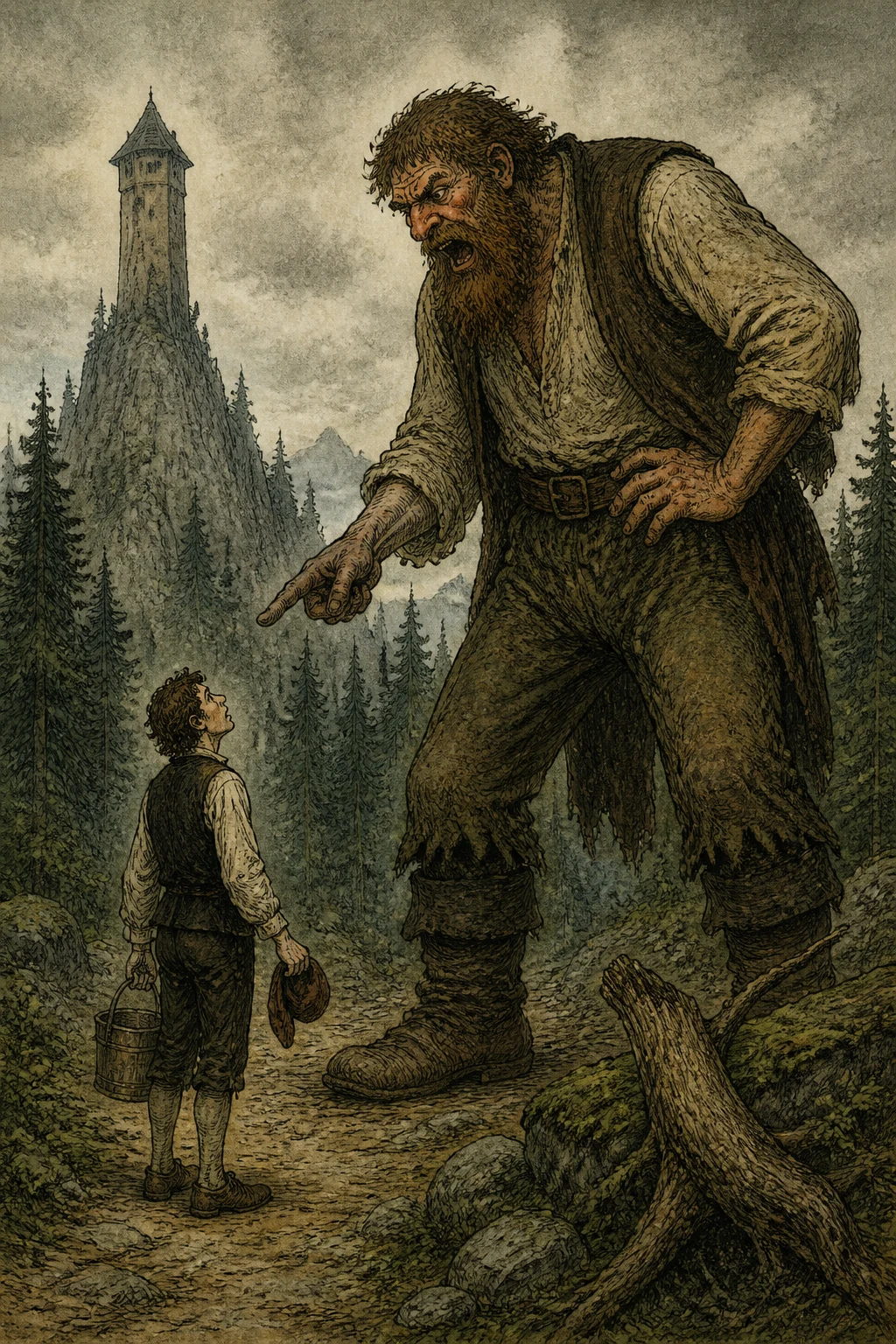
Then he said he must go to Dublin, to the king’s court, to see what he could do. The court had long been under construction, but whatever was built during the day was pulled down at night, and because of this no one could finish it. Three giants came by night and knocked it down. The tailor set out the next day, taking a spade and a shovel with him. He had not gone far when he met a white horse and greeted him. “God bless you,” said the horse. “Where are you going?” “I am going to Dublin,” said the tailor, “to build the king’s court, so that I may get a lady for a wife, if I can finish it.” For the king had promised his own daughter, with a great deal of money, to whoever could build the court. “Would you make me a hole?” said the old white horse. “I could hide in it when people come to take me to the mill and the kiln, so that they would not see me, for they have worn me out with working for them.”
“Indeed I will,” said the tailor, “and welcome.” He took his spade and shovel, dug a hole, and told the white horse to go down into it and see whether it would fit him. The white horse went down into the hole, but when he tried to get out again, he could not.
“Make me a way now,” said the white horse, “so that I can get out of this hole when I am hungry.” “I will not,” said the tailor. “Stay there until I come back, and I will lift you out.”
The tailor set off the next day and met a fox. “God bless you,” said the fox. “God and Mary bless you.” “Where are you going?” “I am going to Dublin to see whether I can build a court for the king.” “Would you make me a place where I could hide?” said the fox. “The other foxes are beating me and will not let me have anything in their company.” “I will do that for you,” said the tailor. He took his axe and saw and cut some rods, and made what you might call a basket for him. Then he told the fox to go down into it and see whether it would fit him. The fox went in, and when the tailor had him down, he put his foot over the opening. When the fox was satisfied at last that he had a fine place, he asked the tailor to let him out, but the tailor said he would not. “Stay there until I come back,” he said.
The tailor set off the next day, and he had not been walking long when he met a wolf. The wolf greeted him and asked where he was bound. “I am going to Dublin to build a court for the king, if I can do it,” said the tailor. “If you made me a trap,” said the wolf, “it would be
When he reached Dublin, he put out a notice calling on all the craftsmen who had been building the court to come to him, and saying that he would pay them. In those days people earned only a penny a day. A great many craftsmen gathered the next day and began working for him. They were going home at the end of the day when the tailor told them to put a great stone on top of the work they had done. When the great stone had been raised, the tailor arranged something beneath it so that he could topple it down when a giant came close enough. The workmen went home then, and the tailor hid behind the great stone. When night fell, he saw the three giants coming. They began knocking down the court until they reached the place where the tailor was hidden, and one of them struck a blow with his hammer at that very spot. The tailor tipped the stone down on him, and it fell on him and killed him. Then the others went home, leaving what remained standing, since one of their own men was dead.
The craftsmen came again the next day and worked until night. When they were going home, the tailor told them to put the great stone on top of the work, as it had been the night before. They did this for him and went home, and the tailor hid as he had the previous evening. When everyone had gone to rest, the two giants came and began knocking down what stood before them; and as they began, they let out two great roars.
The tailor kept busy until he toppled the great stone down, so that it fell on the head of the giant beneath it and killed him. There was only one giant left then, and he did not come back before the court was finished.
The tailor went to the king then and told him to give him his wife and his money, since he had finished the court. But the king told him he would give him no wife until he killed the other giant, and that he would give him nothing at all until he had killed the last one. The tailor said then that he would gladly kill the other giant for him; there was no difficulty in that at all.
The tailor went off until he came to the place where the other giant lived, and asked whether he needed a servant boy. The giant said he did, if he could find a boy who would do whatever he himself could do. “Whatever you do, I will do,”
said the tailor. They went to their dinner then, and when they had eaten, the giant asked the tailor whether he could drink as much broth, straight from the pot, as he could himself.
“I can,” said the tailor, “provided you give me an hour before we begin.” “I will give you that,” said the giant. The tailor went out, found a sheepskin, and sewed it up into a bag. Then he hung it under his coat. He came in again and told the giant to drink a gallon of the broth first. The giant drank it straight from the pot.
“I will do that,” said the tailor. He set to work and poured it into the skin, while the giant thought he had drunk it. The giant drank another gallon, and the tailor let another gallon down into the skin, but the giant thought he was drinking it. “Now I will do something you cannot do,” said the tailor. “You will not,” said the giant. “What is it you will do?”
“Make a hole and let the broth out again,” said the tailor. “Do it yourself first,” said the giant. The tailor gave a slash with his knife and let the broth out of the skin. “Now you do that,” he said to the giant. “I will,” said the giant, giving himself a slash in the belly with the knife, and he killed himself. That was how the tailor killed the third
giant. He went to the king then and told him to send out his wife and his money, and said he would knock down the court if he did not get his wife. They were afraid then that he would pull the court down again, so they sent the woman out to him. When he and his wife had been gone a day, they regretted it and went after him to take the woman back. The people following him kept on until they reached the place where the wolf was, and the wolf said to them, “The tailor and his wife were here yesterday. I saw them passing, and if you let me out now, I am faster than you, and I will follow them and catch them.”
The wolf and the people of Dublin went on, following them until they reached the place where the fox was. The fox greeted them and said, “The tailor and his wife were here this morning, and if you let me out, I am faster than you, and I will follow them and catch them.” So they let the fox out.
The wolf, the fox, and the army of Dublin went on then, trying to catch the tailor. They came to the place where the old white horse was, and the old white horse told them that the tailor and his wife had been there that morning. “Let me out,” he said. “I am faster than you, and I will catch them.” They let the old white horse out, and the old white horse, the fox, the wolf, and the army of Dublin all went together after the tailor and his wife. Before long they caught up with the tailor and saw him and his wife ahead of them.
When the tailor saw them coming, he and his wife came out of the wood, and he sat down on the ground. When the old white horse saw the tailor sitting down, he said, “That is just how he was when he made the hole for me that I could not get out of once I had gone in. I will go no nearer to him.”
“No,” said the fox, “but that is how he was when he was making that thing for me, and I will go no nearer to him.”
“No!” said the wolf. “That is how he was when he was making the trap I was caught in. I will go no nearer to him.”
They all went away from him then and returned home. The tailor and his wife came home to Galway, and they gave me a paper coat and shoes of thick milk—I have lost them since. They took the ford and I took the pool; they were drowned, and here I am.
Izvirnik
001 An Táilliúr agus na Trí Beithigh
Naslednje strani prikazujejo izvirno besedilo za primerjavo.
y\ie>.^t^ei^\. eux)MJ. ConniM)\c ye vyei>~r\cv[X) ^5 eijM^e
m^|\b ye c>xi v]\e6.r^cu^X). "Oub^ipc ye 4>.nn pn "tl^c bjieAJ 6.n 5M|'5i"6eAc mij-e nuA.i^ a. bf me ^b^IcA /M|^ A>n •o|\eAncuit) pn X)o ni^pbA-o!"
X)ubMpt: ye ^nn pn 50 gc^icfe^t) i^e -oul 50 b'l'A.cliA>c 50 cuipc An IA15, 50 bpeic^re^.t) -pe atj t)ciuc]:A'6 leif a ■oeun6.m. t)i An cui]ac pn '5^ "oeunMri le ^ta-oa, acc An TTieAt) -01 '00 gnicToe Ann ^'An Ia "OO IcA^AToe Ann ]'An onoce e, AjU]' nio|A yeu-o -ouine ai]\ bic a cu]\ fUAf mA]A jcaH Aip pn. 'S 1AX) C]n i^ACAC a cigeAX) '|^An oi-oce a bi'oeAio 'jAleAgAt). "Cnncij An caiIiu|a An Ia ai]\ nA itia|aac, Ajuj- -00 cuj ye leii^ An tiiplip An ypi^x) Ajuf An
Cj^luA^^AT),
11io]i biTA-OA cuAit) ye ■^\i\\ ca]'a-6 cApAll bAn -oo, ajuj' cuip i^e ]:o|AAn Ai|\. " 5° mbeAnnuij "Oia "duic," Ap ]'An CApAll, " CA "bymX. cu "out ?" " Ua me "oul 50 D'I'acIi ac," A^ fAn CAilnj]\, "le-oeunAiii cuii\ce An ]\'\-^, 50 bj-'^j' me beAn-UApAL, mA 05 tiom a "oeunAm," mA]\ "oo jcaII An ]ii5 50 "DciubiAAt) ye a in^eAn yein A^vip a lAn aij^ji-o l,6ice "Don ce pn a ciuc].-a"6 teip An cuipc pn "oo cup fUA]\ "An nx)eun].'A polb -OAm ?" Ap pAn peAn-jeAppAn bAn^ " pACAinn 1 bj-'olAc Ann nuAip aca nA "OAome mo cAbAipc cum An muibnn Ajup cum An aca 1 piocc nAc bpeicp-opiAt) me, 6ip CA me cpAToce aca, A5 ■oeunAm oibpe "661b."
'"OeunyMt) ine y\n 50 •oeitinn," {s]\ y^n ri.}hu\\, " c^-c^uy ■jTAilce." Uii^ i^e ^n yp^x) \.e^y A^uf An q^tuA^^AX), a^U]' •pinno I'e poll, A^up "OubAi^ic pe leip aii 5-CApAll bAn -oul ptop Ann, 50 bpeicpeAt) pe An bpoippeA-o pe "66. Cuai-6 An cApAll b^n piop Ann pAn bpoll, acc nuAip "o'peuc pe -oo reA-cc I'UAp A]\ip Ap, niop peim pe.
"*Oeun AicoAni A.noip," Ap pAn c^pAll bAn, "a ciiic|:Ap me Aniop Ap An bpoll po nuAi]\ ^ beiueAp ocApAp opm." "tli "oeunpAt)," Ap pAn CAiliup, "pAn Ann pin 50 x)ci5it) me Aip m'Aip, A^up cojitato me Aniop cu."
'O'lmci^ An CAiln'ip An Ia cs^]\ nA m^pAC, A^np c^p^j.!) •66 An pionnAc, "5° mbeAnnm^ TDia ■oinc," Ap pAii •pionnAc. " 5° mbeAnniiig "Oia. '^np 17liiipe "ouiu." *' Ci. b^ruil cu 'oul?" "Ua me "onl 50 b'l'AcliAC 50 b|:encAit) me An "o cm c]r Ait) lioni ciii]\c -oeunMii -oo'n pi^." "An nt)eiJn|.-A aic t)Mn, a pAC|:Mnn 1 bpolAC innci," Ap p6n pionnAc, " CA An ciiix) eile -oe nA pionnAi jib-ooni'buAlA-o A^np ni leijeAnn piA-o-OAin Aon nit) ire'nnA 5-cuit)eACCA." "*Oeun]:Ait) me pin t)Uic," " Ap pAn CAilni]\. Utig pe lei]' A cuA^ Ajup A pAb, A51.1]' bAin pe plACA, 50 nt)eApnAi5 pe, niAji t)eii|i]:A, cliAb X)6, Ajup t)ubAi]ic pe lei]' An cponnAc t)ul pio]' Ann, 50 bpeicpeAt) pe An bpoimreAt) i^e 66. CuAit) An I'lonnAC Ann, a^u]' nuAin pi.iAi]\ An CAilii'iji pio]e, leA^ pe a coin ai]\ An b]Doll a bi Ann. HuAip a bi ah ponnAC pApcA pAoi -oeipeAt) 50 ]\Aib aic -oeAp Ai^e x)'iah]\ pe Ai]\ An CAiln'in a lei^eAn aiiiac, A^up tj'ppeAjAip An CAilui]i nAC lei^jTCAt) ; " "jTAn Ann I'ln 50 t)ci5T6 mipe Aip m'Ai]%" A]i pe.
"O'lmcij An CAiliu]) An Ia ai]\ nA iiiA]^Ac, Agup nf pAt)A bi pe piubAl 5ii]i CApAt) mAt)p'-AllA vo, A^iip ciii]\ An mAt)p'-AllA pojiAn Ai]i, Aju]' x^'piApjiuij ]'e -oe ca ]iAib pe A5 C]\iaII. " Ua me tduI job'l'AcliAC 50 nt)eiJn]:Ait) me cui]ic t)o'n ]\i5 niA C15 liom pin t)eiinAm," a]\ pAn CAiliiip." "'Da nt)eun].-A cencc t»Am," a]\ pAn mAt)-n'-AllA, " beToeAt)
TluAip CAinig i^e gob'l'AcliAC cin]\ ]^e pAipeu]^ attiac An meAT) Uict)' cei]\t)e •00 bi A5 cogbAil no> cui]\ce "oo ceAcc
cuige-peAn, Ajup 50 n-iocpAt) pei]'eAn ia-o ^^^V ^^^
bi-oeA-o -oAoine A5 pAJAib 'yisn Ain ]'in acc ptgni 'pAn Ia. •Oo qunnni j a l^n Uic-o ceii\-oe An Ia ai^ nA niA]\AC, a^u]' copAig piAX) A5 obAi]\ ■00. Di I'lAt) Ag 'ou'L A bAile An-oi- A15 An Iab niiAip t)i.ibAi|\c An CAitui]\ teo "An cLoc tii6]\ pn "oo cup y^^y ■^ip bA]\p nA li-oib]\e a bi "oeunuA Aige." tluAip "o' A]\t)UijeAt) puAp An clociiiop I'm, cui]a An caiLiu]a pbije eigin -puici 50 teAjpA-o pe AnuAp 1 nuAip a cmcp-At) An p-AUAC coiii pA^OA teice. 'O'lmcig An tuct) oib]\e a bAile Ann pin, Ajup cuato An cAiliup 1 bpolAC Aip cul nA cloice ni6i]\e. HuAip CAinij 'oo]icA'OAp nA h-ci-oce connAipcpe nA
Cpi yAUAlj A5 CeACC, AgUp COpUlg pAT) A5 beAJAt) nA
cuipce no 50 -ocAinij piA-o coiii p6"OA leip An aic a pAib An
CAlllU]\ piA]', AgU]' buAll p-eA]1 ACA buille -o'a opt) A1]\
An AIC A pAib pe 1 bp'olAC. LeAg An CAiliup An cloc AnuAp Ai]i, Ajup, CU1C y1 Aip, Agup iiiA]\b pt e. *0'imci5 piAX) A bAile Ann pin, Agup "o'yAg piAt) An nieAt) a bi Ann jAn leA^An, 6 b'l yeAp aca fein tiiApb.
UAini5 Ml luce cei^A-oe A]\if, An Ia ai]a nA iriA]iAc, Ajuf b'l pAT) Aj obAip 50 "ori An oit)ce, aju]" nuAip a "bf pAt) •out AlJAile •out)Ai]\c An CAiliup leo An cloc tTi6|i "oo cu|\ I^UA]" Ai]\ bAi^p nA 1i-oib]Ae TtiA]! "bt p An oi-oce j^oime pn. Tlinne pAt) pn -oo, Aguf -o'lnicij pAt) AbAite, ajuj' cuai-o An CAibiu]i 1 b^rolAC, n\i>.]\ bi ye An c]\Acn6nA ^Aoiriie pn. 11uAi]\ bi nA T)Aoine iiile unci jce 'nnA -puAiiimeAp CAini5 An -OA f.'ACAC, A511]' bi pAt) A5 beAjAn An mew a bi
]AOmpA ; AgU]' nUA1]\ COfUlj pA"0, CUIIipAX) -OA ^bAOt) A]^CA.
Di An CAiliu]\ Ai]\ pubAb Agu]' e A5 obAijA no ^xi]\ bcAj -pe AnuA]' An cloc m6]\ gu^i cmc p ai]\ cloi^ionn An f-ACAi^ a bi ]:uici Aju]' niA]\b p e. Hi ]AAib Ann pn acc An c-Aon i'ACAC AtiiAin Ann, aju]' ni CAinig "j^eii^eAn 50 -[AAib An ci'npc cptocnui^ce.
CuAit) An CAiliu]A ctiiii An |M5 Ann pn, Ajuf ■oubAi]\c ]'e leip A beAn Agu]" a cuto ai]151'o x)o cAbAi]\c "oo, ttia]! "oo bi An ciii]Ac •oeAncA Aige, acc "oubAijic An |\i5 lei]" nAC x)ciub]iA'6 I'e Aon beAn -oo, no 50 inA]\b]:A"6 i^e An -pACAC eile, Agu]^ nAC 'ociub|AA'6 fe 'OA'OAiii "oo Anoi|" no 50 mA]ib]:At) ]'e An yeA]A -oeiiieAnnAc. T)iibAinc An caiIiuja Ann pn 50 iTiApbjrAt) -pe An -jtacac eile "66, Ajup yAilce, nAC ]iAib Aon tiiAille ai]i bic ai]a pn.
'O'lmcij An CAilni]A Ann pin, 50 'ocAinij |'e cum nA h-Aice A pAib An pACAC eile, Ajup -©'pApiui^ a]a ceAp- CU15 buACAill UAi-o. 'OubAipc An pACAc 5U]A ceApcui^, "OA bpA§At) pe buACAill A "oeunp-At) An pu-o a *oeunpAt) -pe p'em. " Hut) Aip bic a -oeunpAp cupA, -oeunpAi-o mipe 6,"
A]\ pAn CAlllUJI.
CuAit) piAt) cum A iTomeip Ann pm, A^up nuAip bi pe icce ACA tDubAipc An pACAC leip An CAiliup An •ociucpA'6 leip An oipeAt) Anbpuic 6l Agup e pein, Aniop A-p a pucAt).
" UlUCp-Alt)," ApV ■['An CAlllUp, "acc 50 'OCIubjIAlt) CU UA1|A
t)AiTi pul A copocAmAoit) AijA." " t)eAppAi"6 me pn •ouic," Ap •pAn p'ACAC. CuAit) An CAiliup AmAC Ann pn, Aguf
^\iA.^\ ye cpoicionn c^op^c ^JUf -o'fuMJ ye X^i>y e, 50 ntje^priAij ye tti^Ia. t)e i>.^iiy veiyyw^ ye poy y6.ot rid. c6c^ e. UAimg ye Afce^c Min pn, ^5"]" "oubMjAU -pe lei]' A-n "b^TA^CA-c g^tun t)e'n ^nbpuic 61 1 "ocoi^a.c. 'O'ol A-n ^a-c^c pn ATi'iof i^y 6. pucMo.
" 'Oeun]rM-6 mi]'e pn," ^.p f^nc Aibup. Dt ye A>1]^ pub^l 5vi|\ "66i]\c ye Afce^-c j^A^n j-cpoicionn e, a-ju]' -pAOil An ]:AtA.c 50 piMb ye oIca Mje. "O'ol A-n y^cA-c j^lun eile A-nn pn, ^^511]' lei^ A.n CAiliup j^-lun eile poy 'yi^n 5-c|Aoicionn, acc f aoiI xsn y^c^c, 50 ii^ib f e '5^ 6l. " '06^nfTMt) Tni]'e HUT) Anoi]" n^c 'ornic]:6.T6 leA.c-i'^^ ■oeun-MTi," Ap f^n CAilnip. "Hi -oeAnirA," a]a f^n ytyt^c, " cyexix) e y^n TOO -oeAnirA ?''
"Poll -oo -oeunAm, Ajuf An c-Anbpuic "oo leije^n Am AC A]n]%" A]\ I'An CAilni]u ""OeAn ru y^m 1 "ocofAC e," A|\ "pAn |-ACAC. Uuj An CAiln't]\ "p]\A'o" x)e'n I'gin, Ajuj' lei5 -pe AniAc An c-AnbHUic 6.y An ^-cjAoicionn. ""OeAn, cui'A, pn," A]\ i^e leif An bpACAC. *' "OeAnpA-o," a]a ]'An ]:acac A5 CAbAipc ppAt) "oe'n -pjin 'nnA buil^ pein -^uy riA]\b y6 e -p^m. Sin e An caoi a TTiA]ib ye An c|AiomAt)
•pACAC.
CuAix) -pe -oo'n ]ii j Ann pin, Ajup -oubAiiic ye lei]% An beAn Ajup A ciiix) Ai]A5it» -00 cu]i AiriAC cuije, Ajup 50 leA^pA'o pe An cui]\c nuinA bpA^A-o ye An beAn. ^f pAicciop 0]\]iA Ann ]'in 50 leAjpAt) ye An cuipc A|Aif, Ajup cuip pA"o An beAn ahiac cuije,
lluAiji bf ye Ia imri jce, e pein A^up a beAn, jIac pAt) AicpeACA]' A^up leAn pAt) e, 50 mbAinpeA"6 pAt) An beAn •oe Apip. Of An tiimnncip -oo bi 'nnA "oiAig 'ja leAnAiriAinc no 50 T)CAini5 pAX) puAp -oo'n aic a pAib An mAT5p'-AllA, Ajup -oubAipn An niA-0]i'-AllA leo. ""bi An CAiliup\ Agup A beAn Ann po Ant)e, connAi]\c mipe iat) a^ -oul ca]\c, Ajup mA -pgAOileAnn pb mipe Anoip ca me niop luAice 'nA pb-pe, Ajuf leAnpAit) me iax) 50 mbeAppAit) me oppA."
*0'inici5 An iiia-o]\'-AsIIa. ^511)' iiiuinnci]A b'tVcliA-c, Agu]' "bi pAXJ X)A leAnAiiiAinc 50 "ocAinig pAt) 'oo'n aic a liAib An ponnAc, aju]' cui|i An ponnAC ppAn op]iA, A^uf ■oubAijic ye leo, " "bi An caiUuja Ajuf A beAn Ann I'o Ai|\ niMTDin AnTDiu, Agu]^ niA I'^AOitpt) pb) AmAC tne ca m6 nio]' luAice'nA pb aju]- leAn]:Ai-6 me ia"o aju]beA]i]--Ai'6 me o|a]aa." SjaoiI yiAX) AmAC An ponnAC Ann pn.
'0'imci5 An mA-o]\'-AllA Ajuf An ponnAC, Aguf A^^m tD'L'AcliAC Ann pn, A5 ^reucAinc An n^AbA-o pA-o An caibiu]\, Ajti)^ CAinij i^iAt) "oo'n aic a ^\Aib An ]'eAn-5eA]\]AAn bAn, A5U]^T)ubAiiic An i^eAn-^eApjAAn bAn leo, 50 ]\Aib An CAibiujA, A5U]' A beAn Ann pn ai]a mATOin, " A5Uf -pgAoib- ^^^^oe AmAC me," a]i i^e, " ca me nfoj' buAice 'nA pb-'pe A^uf beAiAirAit) me o]A]aa." SjaoiI pAt> AmAC An -['CAn 5eA]\]\-Nn bAn, aju]' leAn An i'eAn-5eA]A|iAn bAn, An ponnAc, An mA-op'-AllA, A5UI' Ajim O'VacIiac An caiI-iu|a 'f ^ beAn, 1 5-cuToeAcc A ceibe, Agu]- niop bpAtJA 50 -ocAinij pAO i^UAf teif An CAilni]^, aju]' connAipc pAt) e ]:ein ^ a "beAn AmAC ]AompA.
lluAii^ connAi]\c An caiIiu)\ lAt) A5 cijeAcc CAinig -pe yein Y ^ beAn ahiac a^ An g-coii^ce, aju]- fuit) •pe pof ai|^ An CAlAm,
nuAi]A connAipc An feAn-5eA]A|iAn bAn An caiIiu|\ aj fUToe pop -oubAipc 1^6, *' Sin e An cumA a bi pe nuAi]\ pinne pe An poll -OAmpA, nA]\ feut) me ceACC AmAC Ap, nuAip cuAit) me ApceAc Ann ; ni pAcpAit) me niop poijpe ■66."
" til b-eAt)," Ap pAn pionnAC, *' acc ip niAp pin, ■00 1)1 pe nuAip b'l -pe •oeAnAm An |\ui"o -OAm-pA, A^up nt pAcpAi-6 mipe niop poijpe -oo "
"rii b-eAt) ! " Ap pAn mAXDp'-AllA, "acc ip mA]\ pin -oo
Ijf ye nu^ip bi ye vei>^r\6.rn An ceuccd^ 'nn^ \\6^^'b ^r\^ye 54>.bcd>. Ill ]\ac]:m-6 Tni]'e mo\- Voi5]-e •66."
'O'lmcig p^TD uile UMTO Ann pn, Aju^-o'p'LlpA'o. CAini5 An CAi'Liij]\ Agu]' A beAn a bAile 50 5^il-l-i"i' ^"5 pAt) ■OAtn ^xocAit) pAipeip ^S^f ^r°5^ bAinne ]iAmAi|A — caiU tne lAt) 6 foin. "puAip pA-o-pAn An c-ac Aguf mife An locAn, bAiccAt iAt)-f An Ajuf CAini5 mife.
Nadaljuj z branjem