Prevod
Once there was an emperor who had three sons, and before his palace stood a golden apple tree that blossomed and bore ripe fruit in a single night. But someone would pick the apples, and no one could discover who it was.
One day the emperor began talking to his sons. “Where does all the fruit from our apple tree go?” His eldest son replied, “I shall watch the tree tonight and see who picks it.” When darkness fell, he went beneath the apple tree and lay down to keep watch. But just as the apples began to ripen, he fell asleep, and when he woke at dawn, the tree had been stripped bare. He went to his father and told him the whole truth.
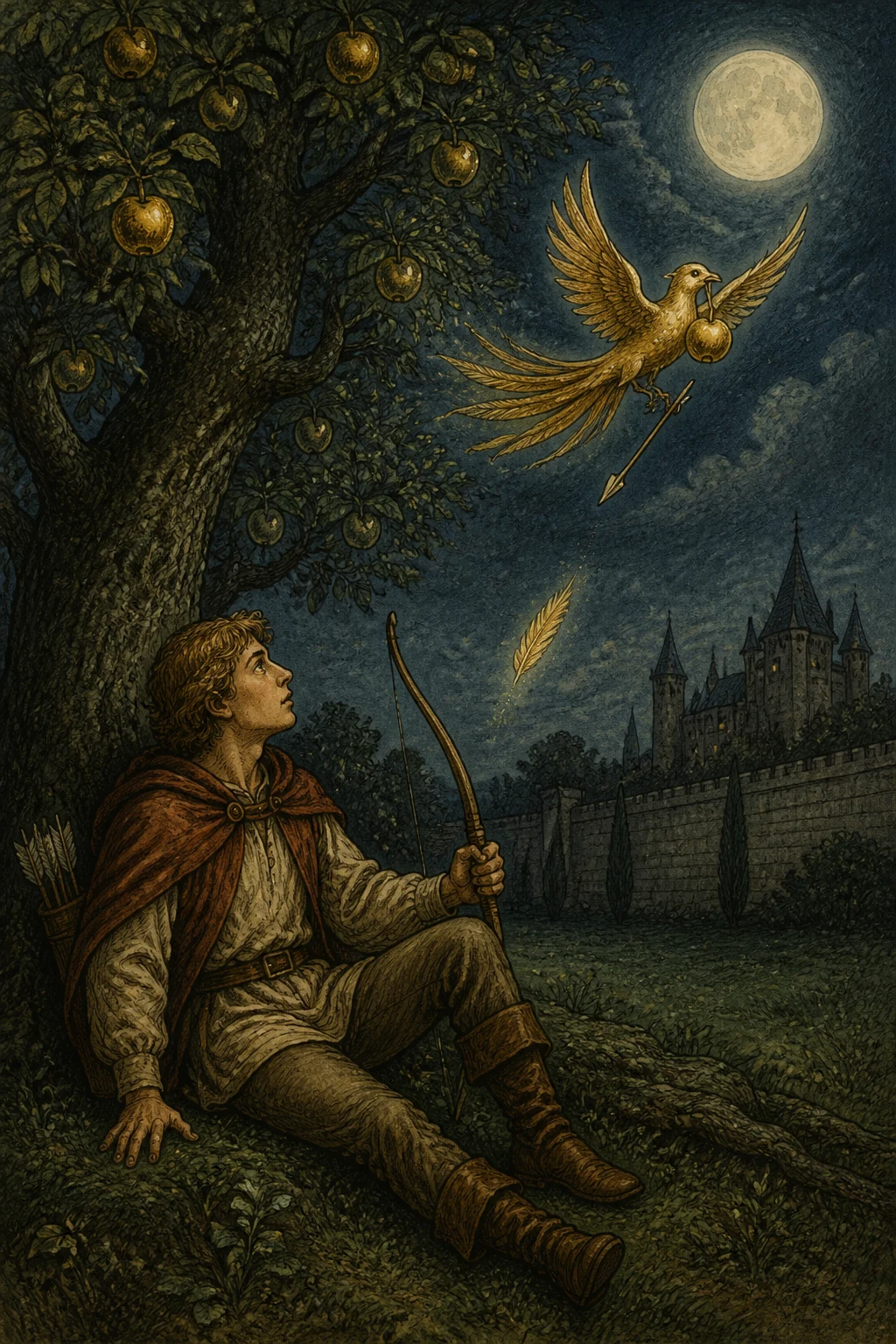
Then the second son offered to watch the apple tree, but he fared just like the first: he fell asleep beneath it, and when he woke at dawn, the apples had all been picked. Now it was the youngest son’s turn to keep watch. He made ready, went to the apple tree, set a bed beneath it, and lay down to sleep. Shortly before midnight he woke and looked up at the tree. The apples were already beginning to ripen, and the whole palace shone with their light. At that moment nine golden peahens flew down. Eight alighted on the apple tree, while the ninth landed on his bed. As soon as she touched the bed, she turned into a maiden whose beauty had no equal in all the empire. The two embraced and kissed until after midnight. Then the maiden rose and thanked him for the apples, and he began begging her to leave him at least one. She left him two: one for himself and the other to take to his father. Then the maiden turned back into a peahen and flew away with the others.
When morning dawned, the emperor’s son rose and took both apples to his father. His father was delighted and praised his youngest son. That evening the youngest prince settled down as before to watch the apple tree, and once again he kept watch in the same way and brought his father two golden apples the following day. After he had done this for several nights, his brothers began to envy him, for they had been unable to guard the apples, while he succeeded every night. Now there happened to be a wicked old hag who promised them she would catch him and discover how he guarded the tree. That evening she crept beneath the apple tree, crawled under the bed, and lay hidden there. Later the youngest prince came and lay down as before. Around midnight, the nine peahens appeared. Eight alighted on the apple tree, and the ninth landed on his bed and turned into a maiden.
Then the old woman gently took hold of the maiden’s braid, which hung over the side of the bed, and cut it off. At once the maiden sprang from the bed, turned into a peahen, and flew away. The other peahens left the apple tree and followed her, and so they all vanished. The prince sprang up too and cried, “What was that?” And there was the old woman beneath his bed. He seized her and dragged her out, and the next day he ordered her to be tied to horses’ tails and torn apart.
The peahens never came to the apple tree again, and the prince did nothing but grieve and weep. At last he resolved to go out into the world in search of his peahen and not return home until he had found her. He went to his father and told him what he intended. His father tried to dissuade him, urging him to give up the idea and promising to find him any other maiden he wished in all the empire. But it was all in vain. He made ready and set out into the world with a single servant to seek his peahen.
After wandering about the world for a long time, he came one day to a lake. There he found a great and splendid palace, and in it an old woman, an empress, and her daughter. He asked the old woman, “For God’s sake, grandmother, do you know anything of nine golden peahens?” The old woman replied, “Ah, my son, I know of them indeed. They come here to this lake every day at noon to bathe. But forget about the peahens. Here is my daughter, a beautiful maiden, and all this wealth—it shall all be yours.”
But he could hardly wait to see the peahens and would not even listen to what the old woman said about her daughter. The next morning the prince rose and made ready to go to the lake to wait for the peahens. Meanwhile, the old woman bribed his servant and gave him a little pair of bellows used for blowing up a fire. “Do you see these bellows?” she said. “When you reach the lake, just blow a little air on the back of his neck without his noticing. Then he will fall asleep and be unable to speak to the peahens.”
The wretched servant did just that. When they reached the lake, he found his chance and blew on the back of his master’s neck with the bellows. The poor prince at once fell into a sleep as deep as death. No sooner had he fallen asleep than the nine peahens appeared. Eight settled on the lake, while the ninth alighted on his horse and began embracing him and trying to wake him. “Wake up, my darling! Wake up, my heart! Wake up, my soul!”
But he knew nothing, as though he were dead. When the peahens had bathed, they all flew away together. At once he woke and asked the servant, “Well, did they come?” The servant replied that they had, and told him how eight had settled on the lake, while the ninth had alighted on his horse, embraced him, and tried to wake him. When the poor prince heard this, he was beside himself with grief.
The next morning he made ready with his servant again, mounted his horse, and rode slowly along the lakeshore. Once more the servant found his chance to blow on the back of his neck with the bellows, and he immediately fell into a sleep as deep as death. No sooner had he fallen asleep than the nine peahens appeared. Eight settled on the lake, while the ninth alighted on his horse and began embracing him and trying to wake him. “Wake up, my darling! Wake up, my heart! Wake up, my soul!” But it was no use: he slept as though he were dead.
Then she said to the servant, “Tell your master that he may wait for us here once more tomorrow, but after that he will never see us here again.” And so they flew away once more. As soon as they had gone, the prince woke and asked the servant, “Did they come?” The servant replied, “Yes, and they left word that you may wait for them here once more tomorrow, but after that they will never come here again.” When the poor prince heard this, he did not know what to do with himself. In his anguish and sorrow he kept tearing the hair from his head.
When the third day dawned, he again made ready to go to the lake and mounted his horse. This time, however, he would not ride slowly along the shore, but kept galloping so that he would not fall asleep. Yet somehow the servant again found his chance to blow on the back of his neck with the bellows, and at once he slumped over his horse and fell asleep. No sooner had he fallen asleep than the nine peahens appeared. Eight settled on the lake, while the ninth alighted on his horse and began trying to wake him, embracing him and crying, “Wake up, my darling! Wake up, my heart! Wake up, my soul!”
But it was no use: he slept as though he were dead. Then the peahen said to the servant, “When your master wakes, tell him to bring the upper peg down upon the lower one, and then he will find me.” With that, all the peahens flew away. As soon as they had gone, the prince woke and asked the servant, “Did they come?” The servant replied, “They did, and the one who alighted on your horse told me to tell you to bring the upper peg down upon the lower one, and then you will find her.” When he heard this, the prince drew his sabre and cut off the servant’s head.
After that he began travelling through the world alone. After a long journey he came to a mountain, where he spent the night with a hermit and asked whether he could tell him anything about nine golden peahens. The hermit replied, “Ah, my son, you are fortunate! God himself has guided you to the right place. They are no more than half a day’s journey from here. You need only go straight on, and you will come to a great gateway. Once you pass through it, keep to the right and you will come straight to their city. Their palace is there.” When morning dawned, the prince rose, made ready, thanked the hermit, and set off as he had been told.
As he journeyed on, he came to the great gateway, and after passing through it he turned at once to the right. Around noon he caught sight of the white city and was overjoyed. When he entered it, he asked his way to the palace of the golden peahens. At the entrance the guards stopped him and asked who he was and where he came from. Once he had told them, they went to inform the empress. As soon as she heard, she ran breathlessly to meet him in her maiden’s form, took him by the hand, and led him into the palace. There was great rejoicing, and a few days later the two were married, and he remained there to live with her.
After some time the empress went out for a walk, while the prince stayed in the palace. As she was leaving, she gave him the keys to twelve cellars and said, “You may enter all the cellars, but you must on no account enter the twelfth or open its door. Do not risk your life!” With that she went away. Left alone in the palace, the prince began to wonder, “What could there be in the twelfth cellar?”
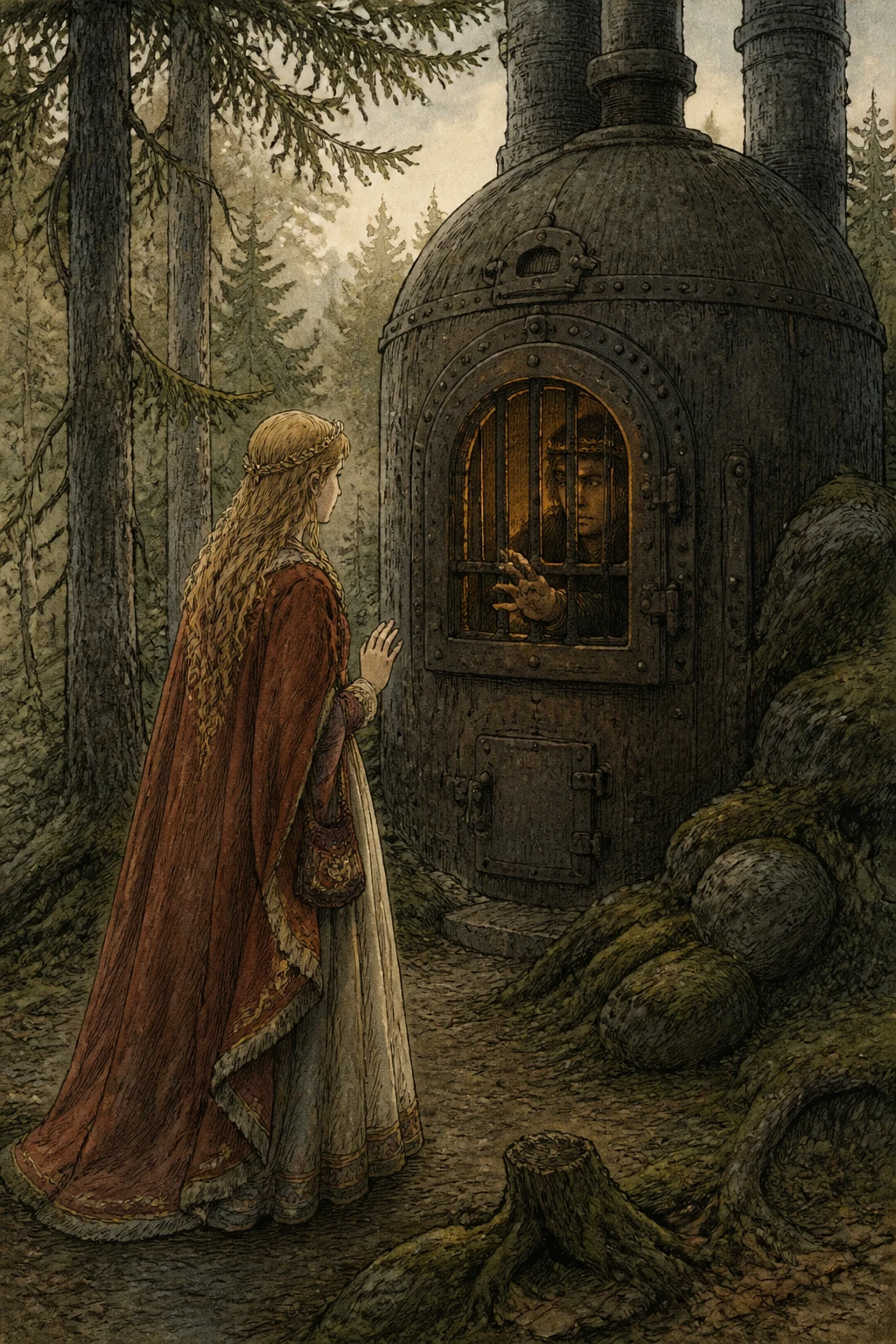
Then he began opening the cellars one after another. When he reached the twelfth, he did not at first intend to open it, but curiosity kept gnawing at him: what could there be in that cellar? At last he opened the twelfth cellar too. In the middle of it stood a great barrel bound with iron hoops, with its bung removed. A voice came from within it: “For God’s sake, brother, I beg you, I am dying of thirst! Give me a cup of water!” The prince took a cup of water and poured it into the barrel, but the moment he did so, one of the iron hoops snapped. Then the voice came from the barrel again: “For God’s sake, brother, I am dying of thirst! Give me another cup of water!” The prince poured in another cup, and another hoop snapped.
For a third time the voice came from the barrel: “For God’s sake, brother, I am dying of thirst! Give me one more cup of water!” The prince poured in another cup, and the third hoop snapped. Then the barrel fell apart, and a dragon flew out of it, caught the empress on her way, and carried her off. Later the maids came and told the prince what had happened. In his grief the poor fellow did not know what to do. At last he resolved to go out into the world once more and search for her.
After travelling through the world for a long time, he came to a river. As he walked beside it, he noticed a little fish struggling in a puddle. When the fish saw the prince, it began to plead with him. “For God’s sake, be a brother to me and throw me into the river! One day you will have great need of me. Just take one of my scales, and when you need me, rub it a little.” The prince picked up the little fish, took one of its scales, and threw it into the river, then wrapped the scale in his handkerchief.
Some time later, as he continued on his way through the world, he found a fox caught in an iron trap. When the fox saw him, it said, “For God’s sake, be a brother to me and free me from this trap! One day you will need me. Just take one of my hairs, and when you need me, rub it a little.” He took a hair from the fox and set it free.
Later, as he was crossing a mountain, he found a wolf caught in an iron trap. When the wolf saw him, it too said, “For God’s sake, be a brother to me and set me free! I shall help you in your hour of need. Just take one of my hairs, and when you need me, rub it a little.” He took a hair from the wolf and set it free.
After another long journey, the prince met a man and asked him, “For God’s sake, brother, have you ever heard anyone say where the dragon emperor’s palace is?” The man gave him clear directions and told him at what time he should arrive. The prince thanked him and went on his way, and at last he reached the dragon’s city. When he entered the dragon’s palace, he found his wife, and both were overjoyed to be together again. They began to discuss what they should do and how they might escape. At last they agreed to flee. They hurriedly made ready for the journey, mounted their horses, and rode away.
They had scarcely escaped from the palace when the dragon came riding home. He entered the palace and found the empress gone, so he said to his horse, “What shall we do now? Shall we eat and drink, or shall we give chase?” The horse replied, “Eat and drink. We shall catch them, never fear.” When the dragon had eaten, he mounted his horse and rode after them, and in no time he had caught up with them.
As soon as he reached them, he took the empress away from the prince and said, “Go your way in peace. This time I spare you because you gave me water in the cellar. But do not come back if you value your life.” The poor prince went a little way, but he could not resist the longing of his heart. He turned back, and the next day he came once more to the dragon’s palace, where he found the empress sitting alone and shedding tears.
When they were together again, they began once more to discuss how they might escape. Then the prince said to her, “When the dragon comes home, ask him where he got that horse, and tell me, so that I can look for one like it. Perhaps then we shall be able to escape him.” With that he left the palace. When the dragon came home, she began to flatter him and caress him, talking to him of all manner of things. At last she said, “What a swift horse you have! Where did you get him, for heaven’s sake?” He replied, “Ah, not everyone can get a horse where I got mine.
“On such-and-such a mountain there lives an old woman who has twelve horses at her manger, each more beautiful than the last. But in a corner there is another horse that looks as though he were mangy. So he seems, but he is the best of all. He is the brother of my horse, and whoever gets him can ride up into the heavens. But anyone who wants a horse from the old woman must serve her for three days. She has a mare and a foal, and he must guard that mare and foal for three nights. Whoever keeps them safe for three nights may choose any horse he wishes. But whoever enters her service and fails to keep the mare and foal safe for those three days loses his head.”
The next day, when the dragon had left home, the prince came, and she told him everything she had heard. Then he went to the old woman on the mountain, and when he reached her, he said, “God be with you, grandmother!” She returned his greeting. “God help you, my son. What brings you here?” He said, “I should like to enter your service.” The old woman replied, “Very well, my son. If you keep my mare safe for three days, I shall give you whichever horse you wish. But if you fail, I shall take your head.”
Then she led him into the middle of the courtyard, which was surrounded by stakes set close together. On every stake there was a human head, except for one, and that stake kept crying, “Give me a head, old woman!” The old woman showed him all this and said, “You see, all these men entered my service, but they could not keep the mare safe.” Yet the prince was not frightened, and stayed to serve her.
When evening came, he mounted the mare and rode out into the fields, with the foal running beside her. He remained in the saddle all the while, but around midnight he grew drowsy and fell asleep. When he woke, he found himself sitting astride a log with the halter in his hands. At the sight of this he took fright and sprang up to look for the mare. As he searched, he came to a river. Seeing it, he remembered the little fish he had thrown from the puddle into the water. He took its scale from his handkerchief and rubbed it a little between his fingers. At once the little fish appeared from the water. “What is it, sworn brother?” He replied, “The old woman’s mare has run away, and I do not know where she is.”
The little fish said, “There she is among us. She has turned into a fish, and the foal into a little fish. Strike the water with the halter and say, ‘Out with you, old woman’s mare!’” So he struck the water with the halter, saying, “Out with you, old woman’s mare!” At once she became a mare as before and came out onto the bank with her foal. Then he put the halter on her, mounted, and rode home, with the foal beside her.
When he reached home, the old woman gave him something to eat, then led the mare into the stable and beat her with a poker. “Among the fish, you whore!” The mare replied, “I was among the fish, but the fish are his friends, and they betrayed me.” Then the old woman said, “Go among the foxes, then!” As night approached, he mounted the mare and rode out into the fields, with the foal running beside her.
He remained in the saddle all the while, but around midnight he grew drowsy and fell asleep. When he woke, he found himself sitting astride a log with the halter in his hands. At the sight of this he took fright and sprang up to look for the mare. But he immediately remembered what the old woman had said to her, so he took the fox’s hair from his handkerchief and rubbed it. At once the fox appeared before him. “What is it, sworn brother?” He replied, “The old woman’s mare has run away, and I do not know where she is.”
The fox replied, “Here she is among us. She has turned into a fox, and the foal into a cub. Strike the ground with the halter and say, ‘Out with you, old woman’s mare!’” So he struck the ground with the halter, saying, “Out with you, old woman’s mare!” The mare became a mare as before and suddenly appeared in front of him with her foal. Then he put the halter on her, mounted, and rode home, with the foal beside her.
When he reached home, the old woman brought him a meal, then immediately led the mare into the stable and beat her with a poker, saying, “Among the foxes, you whore!” The mare replied, “I was among the foxes, but the foxes are his friends, and they betrayed me.” Then the old woman said, “Go among the wolves, then!” As night approached, the prince mounted the mare and rode out into the fields, with the foal running beside her.
He remained in the saddle all the while, but around midnight he grew drowsy and fell asleep on the mare. When he woke, he found himself sitting astride a log with the halter in his hands. At the sight of this he took fright and sprang up to look for the mare. But he immediately remembered what the old woman had said to her, so he took the wolf’s hair from his handkerchief and rubbed it. At once the wolf appeared before him. “What is it, sworn brother?” He said, “The old woman’s mare has run away, and I do not know where she is.” The wolf replied, “Here she is among us. She has turned into a she-wolf, and the foal into a cub. Strike the ground with the halter and say, ‘Out with you, old woman’s mare!’” So he struck the ground with the halter, saying, “Out with you, old woman’s mare!” The mare became a mare as before and suddenly appeared in front of him with her foal. Then the prince put the halter on her, mounted, and rode home, with the foal beside her.
When he reached home, the old woman gave him a meal, then led the mare into the stable and beat her with a poker, saying, “Among the wolves, you whore!” The mare replied, “I was among the wolves, but the wolves are his friends, and they betrayed me.” Then the old woman came outside, and the prince said to her, “Well, grandmother, I have served you faithfully. Now give me what we agreed.” She replied, “My son, a bargain must be kept. There are the twelve horses: choose whichever you wish.” But he said, “Why should I choose? Give me that mangy one in the corner. Fine horses are not for the likes of me.” Then the old woman tried to dissuade him. “Why would you take that mangy creature when there are such splendid horses here?” But he stood firm, saying, “Give me the one I want. That was our bargain.” The old woman had no choice but to give him the mangy horse. He took his leave of her and set off, leading the horse by its halter.
When he had led it into a forest, he rubbed it down and groomed it, and the horse shone as though its coat were gold. Then he mounted and urged it into a gallop. It flew like a bird and in no time brought him to the dragon’s palace. As soon as the prince entered, he said to the empress, “Make ready as quickly as you can.” They hurriedly prepared, both mounted the horse, and set off, commending themselves to God. A little later the dragon came home and saw that the empress was gone. He said to his horse, “What shall we do now? Shall we eat and drink, or shall we give chase?” The horse replied, “Whether you eat or not, whether you drink or not, whether you give chase or not, you will never catch him.” When the dragon heard this, he mounted at once and set off in pursuit.
When the two saw the dragon pursuing them, they took fright and began urging their horse to run faster. But the horse replied, “Do not be afraid. There is no need to flee.” At last, just as the dragon was about to catch up with them, his horse called to the horse carrying the prince and the empress, “For God’s sake, brother, wait for me! I am fit to drop from chasing you.” The other replied, “Why are you fool enough to carry that monster? Twist your legs, dash him against a rock, and come with me.”
When the dragon’s horse heard this, he tossed his head and heaved his body, twisted his legs, and dashed the dragon against a rock. The dragon burst into pieces, and the horse joined the others. Then the empress mounted him, and so they returned safely to her empire, where they remained and ruled for the rest of their lives.