Waltey
Pustolovščine Kana ma Kana, sina Dav al Makana
Tisoč in ena noč · arabska pripovedna tradicijaO besedilu
Pustolovščine Kana ma Kana, sina Dav al Makana
- Vir
- Tisoč in ena noč
- Avtor
- arabska pripovedna tradicija
- Jezik branja
- English
- Jezik izvirnika
- Arabic
- Čas branja
- 96 min branja
- Obseg
- 77 strani
- Naslov izvirnika
- مغامرة كان ما كان ابن ضوء المكان - الليالي ١٣٨ إلى ١٤٤
O izvirniku
Tisoč in ena noč
Zgodbe v zgodbah, polne trgovcev, dvorov, preoblek in nočnih zapletov. Bralni jezik je English, izvirnik pa prihaja iz vira Tisoč in ena noč v jeziku Arabic.
Besedilo
Pustolovščine Kana ma Kana, sina Dav al Makana
She said: It has reached me, O fortunate king, that Nuzhat al-Zaman’s husband said to her, “If you wish to see what the world will be like after you are gone, look at what it has been like after others have gone. Give her an honored place in your house, then, and relieve her poverty.” Such was the case with Nuzhat al-Zaman, her husband, and the mother of Daw al-Makan. As for Kan ma Kan and his cousin Qudiya fa-Kan, they grew and flourished until they were like two fruitful boughs or two radiant moons, and reached the age of fifteen. Qudiya fa-Kan was among the loveliest of secluded maidens: fair of face, slender of waist, full of hip, with saliva sweet as Salsabil, a graceful figure, and lips more delicious than wine. One who described her spoke these two verses:
“The choicest wine seems drawn from the nectar of her mouth, its clustered pearls plucked from between her lips. Its grapes sway when you bend her supple form: glory to her Creator, whose nature none can fathom!” God had gathered every beauty in her: her figure put the boughs to shame, the rose begged mercy of her cheek, and the sweetness of her mouth mocked the finest wine. She delighted the heart and the beholder, as the poet said:
“A beauty whose perfections are complete, whose dark-fringed eyes put painted eyes to shame. Her glances in her lover’s heart are like a sword in the hand of Ali, Commander of the Faithful.” As for Kan ma Kan, his beauty was wondrous and his perfection peerless. In loveliness he had no equal; courage shone between his eyes and bore witness in his favor, never against him, and every heart inclined toward him. When the first down appeared upon his cheeks, many poems were made about him, among them these:
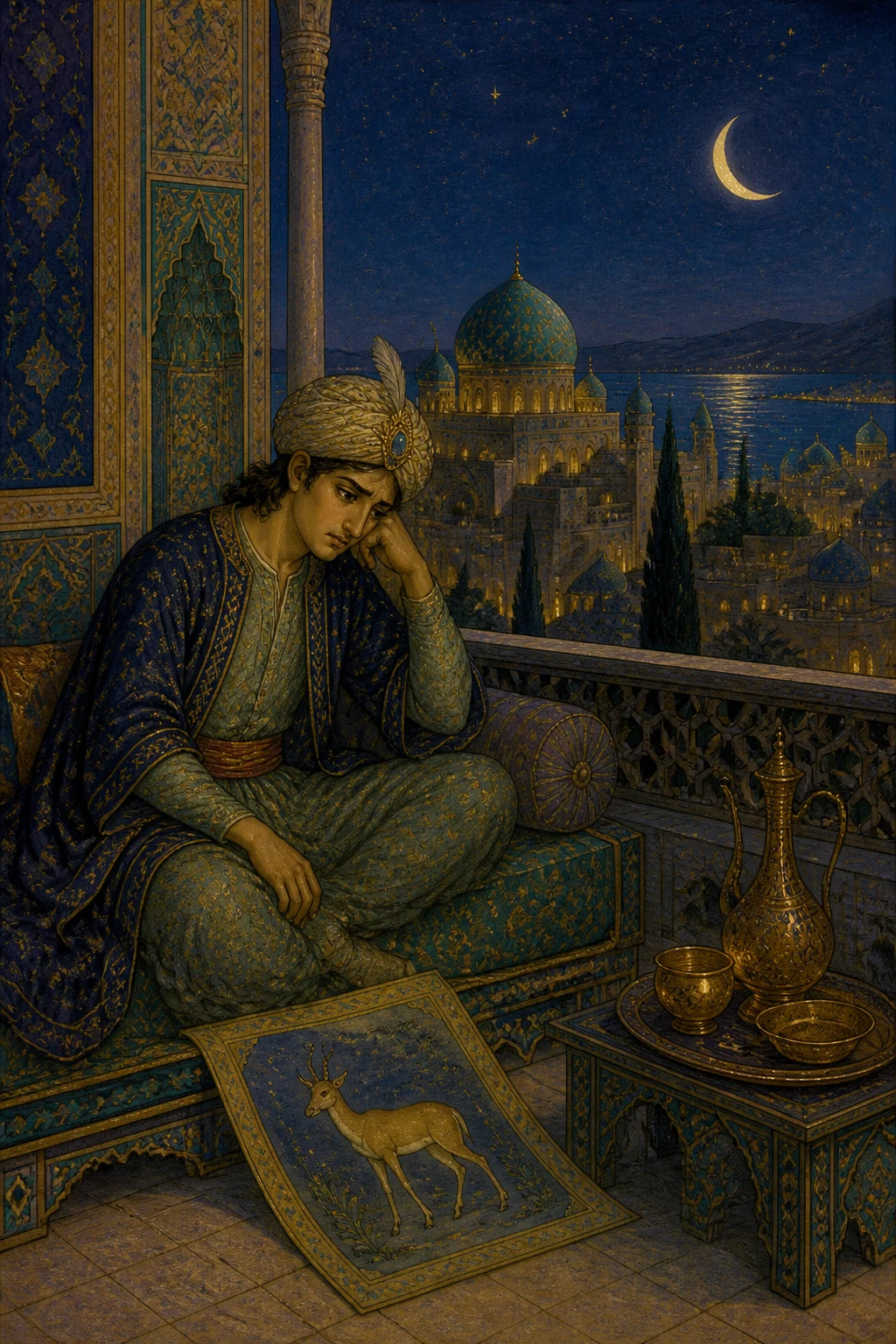
“My excuse for loving him was not plain until his beard appeared; night crept across his cheek and wandered there bewildered. A young gazelle: when eyes gaze on his beauty, his glances draw a dagger against them.” And another poet said:
“The souls of lovers have been traced upon his cheek like ants, perfected there in crimson blood. Marvel at them, a martyred host whose dwelling is a flame, whose raiment there is green silk!” Now, on one of the feast days, Qudiya fa-Kan went out to offer her holiday greetings to certain relatives at court. Her maidservants surrounded her, and beauty enveloped her; the rose of her cheek envied her beauty spot, and the chamomile smiled at the gleam of her teeth. Kan ma Kan began circling about her, letting his eyes linger upon her as she shone like the radiant moon. Then he took courage, loosened his tongue in verse, and recited these two lines:
“When will the heart that longs for nearness be healed of separation, and the smiling lips of union greet the end of coldness? Ah, would I knew whether I shall spend one night united with a beloved who feels some part of what I feel!” When Qudiya fa-Kan heard these verses, she openly reproached and rebuked him, threatening him with painful punishment. Kan ma Kan was vexed and returned to Baghdad in anger. Qudiya fa-Kan then went up to her palace and complained of her cousin to her mother, who said, “My daughter, perhaps he meant you no harm. Is he not an orphan? Besides, he said nothing to disgrace you. Take care not to tell anyone of this, for the news might reach the sultan, who would cut short his life and extinguish his memory, leaving no more trace of him than of yesterday gone by or a dead man in his grave.” News of Kan ma Kan’s love for Qudiya fa-Kan spread through Baghdad, and the women talked of it. His heart grew heavy, his patience dwindled, and his mind was troubled; his condition was hidden from no one. He longed to reveal the anguish of separation in his heart, but feared her anger, and recited these two verses:
“When you fear the reproaches of one whose gentle temper they disturb, endure her as a man endures the cautery in hope of being cured.” And morning overtook Shahrazad, and she ceased her permitted tale.
When it was the hundred and thirty-ninth night,
She said: It has reached me, O fortunate king, that when the grand chamberlain became sultan, they named him King Sasan. News of Kan ma Kan’s love for Qudiya fa-Kan reached him, and he regretted having lodged them together in one place. He went in to his wife Nuzhat al-Zaman and said, “To bring dry grass and fire together is among the gravest dangers. Men cannot be trusted with women so long as eyes are dark and figures supple. Your brother’s son Kan ma Kan has reached manhood, and he must be forbidden to enter the women’s apartments. It is still more necessary to keep your daughter from men, for one such as she should be secluded.” She replied, “You speak truly, O wise king and perfect prince.” When morning came, Kan ma Kan went in to his aunt Nuzhat al-Zaman as was his custom and greeted her. She returned his greeting and said, “I have something to tell you which I would rather not say, but I must tell you against my will.” “What is it?” he asked. She said, “The king has heard of your love for Qudiya fa-Kan and has ordered that she be kept from you. If you need anything, I shall send it out to you from behind the door, but you must not see Qudiya fa-Kan.” When he heard this, he turned back without uttering a word and told his mother what his aunt had said. His mother replied, “This has come about only because you talk so much. You know that the story of your love for Qudiya fa-Kan has spread far and wide. How can you eat their food and then fall in love with their daughter?” He said, “I wish to marry her. She is my cousin, and I have the best claim to her.” His mother said, “Be silent, lest the news reach King Sasan and plunge you into a sea of sorrows. They have sent us no supper tonight. Were we in any other city, we should die of hunger or suffer the humiliation of begging.” When Kan ma Kan heard his mother’s words, the grief in his heart deepened, and he recited these verses:
“Spare me these unceasing reproaches: my heart has left me for the one who has enslaved it. Ask not a grain of patience of me, for, by the House of God, patience and I are divorced. When those who blame me bid me cease, I disobey them: I am true in my profession of love. By force they have forbidden me to visit her, yet, by the Merciful, I am no libertine. When my bones hear her name, they are like birds pursued by hawks. Tell those who blame me for my love that, by my God, I love my cousin!” When he had finished his verses, he said to his mother, “There is no longer any place for me with my aunt or these people. I shall leave the palace and live on the outskirts of the city among the poor.” He went out and did as he had said. His mother would go back and forth to King Sasan’s house and take from it enough to sustain them both. Then Qudiya fa-Kan found herself alone with Kan ma Kan’s mother and said, “My uncle’s wife, how is your son?” She answered, “His eyes are weeping and his heart is sorrowful. He cannot escape the bondage of love, and is caught in the snares of his passion for you.” Qudiya fa-Kan wept and said, “By God, I have not forsaken him out of hatred, but because I fear his enemies will harm him. My longing is many times greater than his. Had it not been for his stumbling tongue and fluttering heart, my father would not have cut off his favors and visited deprivation and refusal upon him. But fortune turns for all mankind, and patience is best in every matter. Perhaps He who decreed our separation will graciously grant our reunion.” Then her eyes overflowed with tears, and she recited these two verses:
“My cousin, the passion within me is equal to all that has befallen you. But I have hidden my love from others: why did you not hide yours?” Kan ma Kan’s mother thanked her and went away, then told her son what had passed. His longing grew, and he said, “I would not exchange her for two thousand houris.” Then he recited these two verses:
“By God, I will not heed a blamer’s words, nor divulge the secret I have kept concealed. The one whose union I desired is absent from me: how often have my eyes kept vigil while my beloved slept!” Days and nights passed while he tossed upon the embers of suffering, until he reached the age of seventeen and his beauty came to its full perfection. One night, unable to sleep, he said to himself, “Why do I see my body wasting away? How long must I remain unable to attain what I desire? I have no fault but my lack of rank and wealth. Yet the fulfillment of hopes rests with God. I must drive my soul from its homeland until it either dies or wins its desire.” Having formed this resolve, he recited these verses:
“Let my heart beat ever more wildly: abasement before men is not its way. Forgive me, for my soul is like a page whose heading is surely written in tears. Behold my cousin, a houri descended to us with her guardian Ridwan’s consent. Whoever seeks to withstand the deadly onslaught of her eyes will not escape their assault. I shall travel through the spacious earth to rescue my soul and grant it something other than denial. I shall return rejoicing in my heart’s desire, and meet the champions on their field. I shall come home driving spoils before me, and bear down mightily upon my peers.” Then Kan ma Kan left the palace on foot, barefoot, wearing a short-sleeved shirt. On his head was a felt cap seven years old, and he carried a loaf three days old. Barefoot he walked through the pitch-black night until he reached the gate of Baghdad, where he waited. When they opened the city gate, he was the first to leave. All that day he crossed valleys and deserts. When night came, his mother looked for him and could not find him. The world, for all its breadth, closed in upon her, and she took pleasure in none of its delights. She waited for him the first day, the second, and the third, until ten days had passed without news of him. Her heart grew heavy, and she wept and cried, “O solace of my loneliness, you have stirred my grief by leaving me and abandoning your homeland! My son, in which direction shall I call to you? What country shelters you now?” Then she sighed deeply and recited these verses:
“We knew that after your departure we should waste away, while separation’s bows drew arrows against us. When they saddled their mounts and crossed the sands, they left me wrestling with the agony of death. In the dark of night a ringdove called to me; she mourned, and I said to her, ‘Gently! By your life, were she as sorrowful as I, she would wear no necklace and dye no feet.’ My beloved has left me, and in his wake I have found causes of grief that never leave me.” Then she refused food and drink, and her weeping and lamentation increased. She wept openly before all, and her sorrow became known throughout the land. People began saying, “Where is your watchful eye, O Daw al-Makan? Do you see what has befallen Kan ma Kan, that he has left his homeland and gone away, though his father fed the hungry and commanded justice and security?” News of Kan ma Kan reached King Sasan. And morning overtook Shahrazad, and she ceased her permitted tale.
When it was the hundred and fortieth night,
She said: It has reached me, O fortunate king, that news of Kan ma Kan reached King Sasan through the great emirs, who said to him, “He was born a king and is of the line of King Umar al-Numan. We have heard that he has gone into exile from his homeland.” When King Sasan heard this, he was deeply vexed. He remembered the kindness the young man’s father had shown him and how he had entrusted his son to his care. He grieved for Kan ma Kan and said, “He must be sought throughout the lands.” He sent Emir Tarkash to search for him with a hundred horsemen. After ten days they returned, and Tarkash said, “I have learned no news of him and found no trace.” King Sasan was deeply saddened. As for his mother, she could find neither rest nor patience, and twenty days had now passed since his departure.
Such was their case. As for Kan ma Kan, when he left Baghdad he was bewildered and did not know which way to turn. He traveled alone through the wilderness for three days without seeing a man on foot or horseback. Sleep fled him, his wakefulness increased, and he thought of his family and his homeland. He sustained himself on the plants of the earth, drank from its rivers, and rested beneath its trees in the heat of the day. Then he left that road for another and followed it for three days. On the fourth he came upon a land of grassy plains and lovely growth, a land that had drunk from the clouds’ cups to the voices of turtledoves and pigeons, until its hills were green and its open spaces fair. Kan ma Kan remembered his father’s country and, overcome by his feelings, recited:
“I set out hoping to return, but I do not know when. Driven from my homeland, I could find no way to avert what had befallen me.” When he had finished his verses, he ate some of the plants, performed his ablutions, and offered the prescribed prayers. He sat down to rest and remained in that place all day. When night came, he slept until midnight, then awoke and heard a human voice reciting these verses:
“Life is nothing but the gleam of your beloved’s smile, the sight of a radiant face. Death is easier than the coldness of a beloved whose phantom does not even visit me by night. How joyful are companions when they gather, with lover and beloved in their midst! Especially in springtime, among its blossoms, when the season is made sweet by all you hasten to enjoy. O drinker of red wine, take what you see before you: a richly adorned earth and flowing water!” When Kan ma Kan heard these verses, his sorrow stirred, tears streamed down his cheeks like rivulets, and fire blazed in his heart. He rose to look for the speaker but could see no one in the darkness. Restless, he descended to the bottom of the valley and walked along the riverbank. Then he heard the same voice sighing deeply and reciting these verses:
“If fear makes you conceal what love has laid within you, let your tears flow freely on the day of parting. Between my loved ones and me lie covenants of love, and so I long for them through all my days. My heart finds comfort in Taym, and the breeze from Taym, when it blows, moves me to yearning. O Saad, does the ankleted lady remember, after our separation, the pledge and covenant between us? Will nights of union bring us together once again, so each may tell something of what they have endured? She said, ‘Love for us has bewitched you.’ I answered, ‘How many lovers have you bewitched—may God preserve you!’ May God deny my eyes the pleasure of her beauty if, since she left, they have tasted sweet sleep. Ah, the sting within my heart! I know no antidote but union and a kiss from her lips.” When Kan ma Kan heard these verses from the unseen speaker a second time, he knew that the man was a lover like himself, barred from reaching the one he loved. He said to himself, “Perhaps I may meet him, and we can each tell the other our sorrows. I shall make him my companion in exile.” He cleared his throat and called, “You who travel through the murky night, come near and tell me your story. Perhaps you will find me able to help you in your affliction.” When the speaker heard this, he answered, “You who call to me and listen to my verses, what manner of horseman are you? Are you human or one of the jinn? Answer quickly before your death draws near! For twenty days I have traveled through this wilderness without seeing a soul or hearing any voice but yours.” Hearing this, Kan ma Kan said to himself, “His story is like mine. I too have been traveling for twenty days without hearing a voice.” The stranger said, “If you are one of the jinn, go in peace. If you are human, wait a little until day dawns and the night departs with its darkness.” When morning came, Kan ma Kan looked and saw a Bedouin Arab. He went up and greeted him, and the Bedouin returned his greeting, welcoming him courteously and with honor. Yet he despised him when he saw his youth and poverty, and said, “Young man, what people do you come from? To which Arab tribe do you belong? What is your story, traveling by night as you do? That is the way of champions. Last night you spoke to me in words fit only for a valiant horseman and a battle-hardened hero. Now you are in my power; but I pity your youth, so I shall make you my companion and keep you to serve me.”
When Kan ma Kan heard these harsh words after the fine verses the man had recited, he knew that the Bedouin despised him and meant to take advantage of him. He answered gently, “O noble Arab, let us leave aside my youth and my serving you. Tell me why you travel through the wilderness by night, reciting poems. What has driven you to this?” He replied, “Listen, boy. I am Sabah ibn Rammah ibn Hammam, and my people are Arabs of Syria. I have a cousin named Najma, whose very sight brings blessing. My father died, and I was brought up by my uncle, Najma’s father. When she and I grew older, he kept her from me because he saw that I was poor and had little money. I brought the great men of the Arabs and the chiefs of the tribes to plead with him, and out of regard for them he consented to our marriage. But he demanded fifty horses, fifty she-camels, ten male slaves, ten slave girls, fifty loads of wheat, and as many of barley. He laid on me more than I could bear and made the bride-price far too great. Now I am traveling from Syria to Iraq, and for twenty days I have seen no one but you. I intend to enter the country around Baghdad and watch for rich merchants coming out. Then I shall follow them, rob them of their wealth, kill their men, and drive off their camels and their loads. And who are you?” Kan ma Kan said, “My story is like yours, except that my sickness is more dangerous than yours, for my cousin is a king’s daughter. What you have mentioned would not suffice her family, nor would anything of that kind satisfy them.” Sabah said, “Perhaps you are a fool, or love has driven you mad. How can your cousin be a king’s daughter when you bear no mark of royalty and are nothing but a pauper?” He replied, “O peerless Arab, do not wonder at such a state amid the changes of fortune. If you wish to know plainly, I am Kan ma Kan, son of Sultan Daw al-Makan, son of King Umar al-Numan, lord of Baghdad and the land of Khurasan. Fortune has dealt unjustly with me, and King Sasan has taken the throne. I left Baghdad secretly so that no one would see me, and have traveled through this land for twenty days without meeting anyone but you. Your story is like mine, and your quest resembles mine.”
When Sabah heard this, he cried, “What joy! I have gained my heart’s desire! Today I need no prize but you. You are of royal blood, though dressed as a pauper, and your family will never abandon you. When they learn where you are, they will ransom you with their wealth. Turn your back, my boy, and walk before me!” Kan ma Kan said, “Do not do this, brother Arab. My family would not buy me back for silver or gold. I am a poor man and possess neither little nor much. Put aside such conduct and take me as a companion. Leave Iraq, and let us wander through the world. Perhaps we shall win our bridal gifts and bride-prices, and gain kisses and embraces from our cousins.” At this Sabah grew angry and flared with rage. “Wretch!” he said. “Do you answer me back, vilest of dogs? Turn your back, or I shall make you suffer!” Kan ma Kan smiled and said, “How should I turn my back? Have you no sense of justice? Do you not fear the Arabs’ reproaches, taking a boy captive in shame and humiliation without testing him on the field, without learning whether he is a horseman or a coward?” Sabah laughed and said, “By God, how strange! You are a boy in years, but great in speech. Such words come only from a battle-hardened champion.” Kan ma Kan said, “Fairness demands that, if you wish to take me prisoner and make me your servant, you throw down your weapons, lighten your clothing, and wrestle with me. Whoever throws the other shall have his way and make him his servant.” Sabah laughed. “I think you talk so much only because your death is near.” He threw down his weapons, tucked up his skirts, and approached Kan ma Kan. They grappled, and the Bedouin found the youth outweighed him as a hundredweight outweighs a tiny coin. He looked at the firmness of his feet upon the earth and found them like two well-founded minarets or two immovable mountains. He realized his own weakness and regretted coming to grips with him. “Would that I had fought him with my weapons!” he thought. Then Kan ma Kan seized him firmly and shook him until he felt as though his entrails were being torn apart. “Stay your hand, boy!” he cried. But Kan ma Kan paid no heed. He lifted him from the ground and carried him toward the river. Sabah called out, “Champion, what do you mean to do with me?” He answered, “I mean to throw you into this river. It will carry you to the Tigris, the Tigris will carry you to the Isa Canal, the Isa Canal will carry you to the Euphrates, and the Euphrates will cast you into your own country. Your people will see and recognize you, and learn of your manly virtue and the sincerity of your love.” Sabah cried, “O horseman of the plains, do not act so foully! Release me, by the life of your cousin, queen of beauties!” Kan ma Kan set him on the ground. Finding himself free, Sabah went to his shield and sword and took them up, debating whether to attack him. Kan ma Kan understood his thoughts and said, “I know what was in your heart when you took your sword and shield. You thought that though you had little skill in wrestling, if you were wheeling about on horseback you could bear down on me with your sword. I shall grant your wish, so that no grievance remains in your heart. Give me the shield and attack me with your sword. Either you shall kill me or I shall kill you.” Sabah threw him the shield, drew his sword, and charged. Kan ma Kan took the shield in his right hand and defended himself with it. Sabah struck at him, saying, “Only this final, decisive stroke remains!” But Kan ma Kan caught it upon the shield, and it came to nothing. He had no weapon with which to strike back, and Sabah continued raining sword blows upon him until his arm grew weary. When Kan ma Kan saw his strength failing and his resolve weakening, he rushed at him, shook him, and threw him to the ground. He bound his arms behind his back with his sword belt and dragged him by the feet toward the river. Sabah said, “What do you mean to do with me, peerless horseman and champion of the field?” He answered, “Did I not tell you that I would send you down the river to your people, so they need not worry about you and you need not be delayed for your wedding to your cousin?” Sabah was distraught. He wept and cried, “Do not do it, peerless horseman! Make me one of your servants instead.” Then his eyes overflowed with tears, and he recited these two verses:
“I have wandered far from my family—how long my exile! Would that I knew whether I must die a stranger. I shall die, and my people will not know where I was slain; I shall perish in exile without seeing my beloved.” Kan ma Kan pitied him and released him, after taking solemn pledges that he would accompany him on the road and be a faithful companion. Sabah tried to kiss Kan ma Kan’s hand, but he would not allow it. Then the Bedouin went to his provision bag, opened it, and took out three barley cakes, which he set before Kan ma Kan. They sat together on the riverbank and ate, then performed their ablutions and prayed. Afterward they sat talking of the reversals fortune had brought them. Kan ma Kan asked the Bedouin, “Where are you bound?” Sabah answered, “For Baghdad, your city. I shall stay there until God provides me with the bride-price.” “The road is yours,” he replied. The Bedouin bade him farewell and set off toward Baghdad. Kan ma Kan rose and said to himself, “My soul, how can you return in poverty and want? By God, I shall not go back empty-handed. Relief must come to me, if God wills.” He went to the river, performed his ablutions, and prayed. When he prostrated himself and laid his forehead upon the earth, he called upon his Lord, saying, “O God, who sends down the rain and sustains the worm within the rock, I ask You to provide for me through Your power and Your gentle mercy.” He ended his prayer with the salutation of peace, yet every path seemed closed to him. As he sat looking to right and left, a horseman appeared, mounted upon a steed whose reins he had let fall loose. Kan ma Kan sat upright. After a while the rider reached him, at his last breath, for he was grievously wounded. Tears poured down his cheeks like water from the mouths of waterskins, and he said to Kan ma Kan, “O noble Arab, take me as your friend for as long as I live, for you will not find my like. Give me a little water, though drinking water is not good for wounds, especially when the soul is departing. If I live, I shall give you what will banish your poverty; if I die, you will be blessed for your good intention.”
The rider’s horse was so beautiful that the beholder was bewildered and the tongue failed to describe it. Its legs were like columns of marble, made ready for the day of battle and tumult. When Kan ma Kan saw the horse, he was entranced and said to himself, “There can be no other horse like this in our time.” He helped the rider dismount, treated him gently, and gave him a little water to drink. He waited until the man had rested, then turned to him and asked, “Who has done this to you?” The rider answered, “I shall tell you the truth of it. I am a thief and a raider; all my life I have stolen horses, carrying them off by night and day. My name is Ghassan, the scourge of every mare and stallion. I heard of this horse in the land of the Byzantines, where it belonged to King Afridun, who named it Qatul and nicknamed it the Madman. I traveled to Constantinople for its sake and began watching for it. While I was doing so, an old woman set out, one held in great honor by the Byzantines and unsurpassed among them in deceit. Her name is Shawahi, Mistress of Wiles. She had this steed with her, and only ten slaves, charged with its care. She was bound for Baghdad, intending to appear before King Sasan and ask him for peace and safe conduct. Coveting the horse, I followed them. I kept on their trail but could find no way to reach it, for the slaves guarded it closely, until they arrived in these lands. I feared they would enter Baghdad. While I was pondering how to steal the horse, a cloud of dust rose before them and filled the horizon. It cleared to reveal fifty horsemen banded together to waylay merchants. Their leader was called Kahrdash, a lion in battle who made champions seem like moths.” And morning overtook Shahrazad, and she ceased her permitted tale.
When it was the hundred and forty-first night,
She said: It has reached me, O fortunate king, that the wounded horseman said to Daw al-Makan, “Kahrdash fell upon the old woman and her companions, surrounded them, and threw them into confusion. Before an hour had passed, he had bound the ten slaves and the old woman, taken possession of the horse, and gone off rejoicing. I said to myself, ‘All my trouble has been wasted, and I have not gained my desire.’ Still, I waited to see how things would turn out. When the old woman found herself a captive, she wept and said to Kahrdash, ‘O valiant horseman and lionhearted champion, what use have you for an old woman and slaves, now that you have gained the horse you wanted?’ She deceived him with gentle words and swore that she would bring him horses and livestock. He released her and the slaves, then rode away with his companions. I followed them until I reached this region, keeping my eye on the horse. When I found an opportunity, I stole it and mounted, took a whip from my feed bag, and struck it. When they discovered me, they pursued and surrounded me on every side, assailing me with arrows and spears. I held firm upon its back, and it fought for me with forelegs and hind legs until it bore me out of their midst like a shooting star or a darting arrow. But in the fierce struggle I received several wounds. For three days I have been upon its back without tasting food. My strength has failed, and the world means little to me now. You have treated me kindly and shown me compassion. I see that you are scantily clothed and plainly sorrowful, yet the traces of former prosperity are upon you. What is your name?” He replied, “I am called Kan ma Kan, son of King Daw al-Makan, son of King Umar al-Numan. My father died, and I was brought up an orphan. A base man succeeded him and became king over high and low.” Then he told him his story from beginning to end. The horse thief was moved to pity and said, “You are of great lineage and lofty honor. May you rise to eminence and become the finest horseman of the age. If you can lift me up, mount behind me, and take me to my own country, you will gain honor in this world and reward on the Day of Summoning. I have no strength left to hold myself upright. If I die upon the road, you will have won this horse, and you have a better right to it than anyone.” Kan ma Kan said, “By God, if I could carry you on my shoulders, I would. If my life were mine to give, I would give you half of it without asking for this horse, for I am one who practices kindness and aids the afflicted. A good deed done for the sake of God Most High closes seventy doors of calamity.” He resolved to lift the man onto the horse and set out, trusting in the Gentle, the All-Aware. But the man said to him, “Wait a little.” Then he closed his eyes, opened his hands, and said, “I bear witness that there is no god but God, and I bear witness that Muhammad is the Messenger of God.” He made ready for death and recited these verses:
“I wronged mankind and roamed the lands, and spent my life in drinking wine. I plunged through torrents to steal horses and laid dwellings waste with wicked deeds. My burden is great, my crime is grievous, and Qatul has brought my affairs to their end. I hoped through that horse to gain my desires, but my journey has defeated me. All my life I stole horses, until death came to me at the Almighty’s decree. In the end I suffered and toiled only to provide for a poor orphan stranger.” When he had finished his verses, he closed his eyes, opened his mouth, and gave one gasp, departing this world. Kan ma Kan dug a grave and laid him in the earth. Then he stroked the horse’s face and saw that King Sasan possessed nothing to equal it. Afterward merchants brought him news of all that had happened during his absence between King Sasan and the vizier Dandan: the vizier had renounced King Sasan’s authority, taking half the army with him. They had sworn that they would acknowledge no sultan but Kan ma Kan, and Dandan had bound them by solemn oaths. He had led them to the islands of India, the Berber lands, and the country of the Sudan. Armies had gathered to them like a surging sea, with neither beginning nor end to be seen. He intended to return to the kingdom with all these forces and kill anyone who opposed him. He had sworn not to sheathe the sword of war until he had made Kan ma Kan king. When this news reached Kan ma Kan, he sank into a sea of thought. King Sasan, meanwhile, learned that high and low throughout the realm had turned against him, and plunged into a sea of care and sorrow. He opened the treasuries and distributed wealth and favors among the officers of state. He wished that Kan ma Kan would come to him, so that he might win his heart through kindness and generosity and place him in command of the troops still loyal to him, thus fanning the embers of his own strength.
When Kan ma Kan heard this news from the merchants, he hastened back to Baghdad on that steed. King Sasan was still bewildered and at a loss when word reached him of Kan ma Kan’s arrival, and he sent out all the troops and dignitaries of Baghdad to meet him. Everyone in the city came out to welcome him and walked before him to the palace. The eunuchs carried the news to his mother, who came to him and kissed him between the eyes. “Mother,” he said, “let me go to my uncle, Sultan Sasan, who has overwhelmed me with kindness and bounty.” The officers of state could scarcely find words to describe the horse and its master, that lord of knights. “O King,” they told Sasan, “never have we seen such a man.” Then King Sasan went to greet him. When Kan ma Kan saw him approaching, he rose, kissed his hands and feet, and offered him the horse as a gift. Sasan welcomed him, saying, “Welcome, my son Kan ma Kan! By Allah, the earth itself seemed too narrow for me while you were away. Praise be to Allah for your safe return!”
Then the sultan looked at the horse, whose name was Qatul, and recognized it as the steed he had seen in such-and-such a year, during the siege of the worshippers of the Cross, when he was with Kan ma Kan’s father, Daw al-Makan, at the time his uncle Sharkan was killed. He said to him, “Had your father been able to obtain this horse, he would have bought it for a thousand steeds. But now glory has returned to its rightful owners. We accept your gift, and bestow it upon you in turn. You have a better right to it than any man, for you are the lord of knights.” He then ordered a splendid robe of honor and a number of horses to be brought for Kan ma Kan, assigned him the largest apartments in the palace, showered him with wealth, and treated him with the utmost honor. Thus dignity and happiness came to Kan ma Kan, for Sasan feared what might come of the vizier Dandan’s designs. Kan ma Kan rejoiced, and his humiliation and disgrace fell away. He entered his rooms, turned to his mother, and said, “Mother, how is my cousin?” “By Allah, my son,” she replied, “my anxiety over your absence has left me no thought for your beloved.” “Mother,” he said, “go to her and plead with her; perhaps she will grant me a glimpse of her face.” His mother answered, “Desire bows men’s necks in humiliation. Put such talk aside, lest it bring you ruin. I shall not go to her, nor approach her with such a message.” Hearing this, he told her what the basket-maker had said: that the old woman Dhat al-Dawahi had entered the country and meant to come to Baghdad. “It was she who killed my uncle and my grandfather,” he said. “I must wipe away our shame and take revenge.” Then he left his mother and went to a crafty, scheming old bawd named Saadana. He complained to her of his plight and his love for Qudiya Fakan, and asked her to go and soften the maiden’s heart toward him. “I hear and obey,” said the old woman. She left him, went to Qudiya Fakan’s palace, and pleaded his cause. Then she returned and told him that Qudiya Fakan sent him greetings and had promised to come to him at midnight. And dawn overtook Shahrazad, and she fell silent, leaving her tale untold.
When it was the hundred and forty-second night
She said: It has reached me, O fortunate King, that the old woman returned to Kan ma Kan and told him that Qudiya Fakan sent him greetings and had promised to visit him at midnight. At this news he rejoiced in his cousin’s promise. When midnight came, she arrived wrapped in a black silk mantle, entered his chamber, and woke him from sleep. “How can you claim to love me,” she said, “when you lie asleep so comfortably, with your mind at ease?” He awoke and answered, “By Allah, desire of my heart, I slept only in the hope that your phantom might visit me in a dream.” Then she reproached him in gentle words and recited these verses:
Were you sincere in love, you would not turn to sleep, you who profess to walk the paths of fondness and desire. By Allah, cousin, no eyes consumed by love have ever slept! Kan ma Kan was ashamed before her. They embraced and complained to one another of the pain of separation and the violence of their longing. Thus they remained until morning showed its bright brow and dawn broke clear. Then Kan ma Kan wept bitterly, heaved deep sighs, and recited these verses:
O you who came to visit after long estrangement, with pearls strung in a necklace within your smiling mouth! A thousand times I kissed you and embraced your slender form, and passed the night with my cheek pressed beneath your own, until the morning light appeared and startled us, like the edge of a sword flashing forth from its sheath. When he had finished his verses, Qudiya Fakan bade him farewell and returned to her private apartments. She confided her secret to some of her maidservants, and one of them went to King Sasan and told him what had happened. He went to Qudiya Fakan, drew his sword, and was about to strike off her head when her mother, Nuzhat al-Zaman, came in and said, “For Allah’s sake, do her no harm! If you hurt her, the story will spread among the people, and she will remain a byword of shame among the kings of this age. Kan ma Kan is a man of honor and chivalry; he would do nothing shameful. Be patient and do not act in haste. Everyone in the palace and all the people of Baghdad have heard that the vizier Dandan has gathered troops from every land and is bringing them here to make Kan ma Kan king.” Sasan replied, “I shall plunge him into such misery that no earth will bear him and no sky will shelter him. I soothed him and bestowed favors upon him only for the sake of my subjects, lest they incline toward him. You shall see what happens.” Then he left her and went out to attend to the affairs of his kingdom.
Such was the case with King Sasan. As for Kan ma Kan, the following day he went to his mother and said, “Mother, I have resolved to make raids, waylay travelers, and drive off horses, livestock, slaves, and mamluks. When I have amassed wealth and improved my condition, I shall ask my uncle Sasan for Qudiya Fakan’s hand.” She replied, “My son, people’s possessions are not there for the taking. They are defended by the blows of swords, the thrusts of spears, and men who capture lions and hunt leopards.” “Never,” said Kan ma Kan, “shall I abandon my purpose unless death overtakes me.” Then he sent the old woman to Qudiya Fakan to tell her that he meant to set out and obtain a dowry worthy of her. “You must bring me an answer from her,” he told the old woman. “I hear and obey,” she replied. She went to Qudiya Fakan and returned with her answer: “She will be with you at midnight.” In his anxiety he stayed awake until midnight, when suddenly she entered and said, “May my soul ransom you from sleeplessness!” He rose to meet her. “Desire of my heart,” he said, “may my soul ransom you from every harm!” Then he told her what he intended, and she wept. “Do not weep, cousin,” he said. “I pray that He who has decreed our parting will graciously grant us reunion and harmony.”
Then Kan ma Kan made ready for his journey. He went in to his mother and bade her farewell, descended from the palace, girded on his sword, wound his turban, veiled his face, and mounted his steed Qatul. Bright as the full moon, he rode through the streets until he reached the gate of Baghdad. There he found his companion Sabah ibn Rabah leaving the city. When Sabah saw him, he ran to his stirrup and greeted him. Kan ma Kan returned his greeting, and Sabah said, “Brother, how did you come by this horse and all this wealth, while I possess nothing but my sword?” Kan ma Kan replied, “A hunter brings back game according to the strength of his purpose. Fortune came to me an hour after we parted. Will you come with me, be true in your companionship, and travel through the wilderness?” “By the Lord of the Kaaba,” said Sabah, “henceforth I shall call you nothing but my master.” Then he ran before the horse, his sword over his shoulder and his bag between his shoulder blades. They traveled through the wilderness for four days, eating the gazelles they hunted and drinking from springs. On the fifth day they reached a high hill overlooking pastures where camels, sheep, cattle, and horses filled the slopes and plains, their young playing about the folds. At the sight Kan ma Kan’s joy increased and his heart swelled with delight. He resolved to fight and seize the camels, male and female, and said to Sabah, “Let us descend upon this wealth, left here apart from its owners, and fight whoever comes, near or far, until we win a share of it.” Sabah replied, “Master, its owners are a vast multitude, and among them are mighty champions and horsemen. If we cast our lives into this terrible venture, we shall face grave danger.” Kan ma Kan laughed, knowing him for a coward, and left him. He rode down the hillside intent on raiding, chanting these verses:
We are the house of Numan, men of lofty purpose, lords whose swords strike at the crowns of heads. When battle rises before us, we stand firm in its market. Among us the poor man sleeps secure, never beholding want’s hideous face. And I look for aid from the Sovereign of all dominion, the Creator of souls. Then he charged upon the herds like a raging camel and drove all the camels, cattle, sheep, and horses before him. The slaves rushed at him with polished swords and long spears. Foremost among them was a Turkish horseman, fierce in war and combat and skilled in wielding brown spears and gleaming blades. He charged Kan ma Kan, saying, “Woe to you! Had you known whose herds these were, you would never have done this. Know that they belong to a band of Greeks and a company of Circassians, every one of them a grim champion. They are a hundred horsemen who have cast off allegiance to every sultan. A horse was stolen from them, and they have sworn not to leave this place without it.” When Kan ma Kan heard this, he cried, “Here is the horse you mean, the one you seek and wish to fight me for! Come forth, all of you, and do your worst!” Then he shouted between Qatul’s ears and burst upon them like a ghoul. Wheeling upon the horseman, he thrust his spear through him until his kidneys spilled out, then turned upon a second, a third, and a fourth, and slew them all. The slaves quailed before him. “Sons of whores!” he cried. “Drive the herds and horses on, or I shall dye my spearhead in your blood!” They drove the herds away and set off, while Sabah came down to him, shouting in delight. Suddenly a cloud of dust rose and spread until it veiled the horizon, and beneath it appeared a hundred horsemen like grim-faced lions. At the sight Sabah fled from the plain to the hillside, where he watched the fighting. “I am a horseman only in play and jest,” he said. The hundred horsemen surrounded Kan ma Kan on every side. One rode forward and asked, “Where are you going with these herds?” Kan ma Kan answered, “Come and fight for them! Know that they are guarded by a fearsome lion, a noble champion, and a sword that cuts wherever it turns.”
At these words the horseman looked at him and saw a knight like a ravening lion, though his face was as fair as the full moon. This horseman was the leader of the hundred, and his name was Kahrdash. Along with Kan ma Kan’s consummate horsemanship, he beheld a beauty that reminded him of his beloved, a woman named Fatin. She was among the fairest of women: Allah had granted her such beauty, grace, and noble qualities that no tongue could describe them, and every heart was captivated. The horsemen of her people dreaded her prowess, and the champions of that land stood in awe of her. She had sworn to marry none but a man who could overcome her. Kahrdash was among her suitors, and she had told her father, “No man shall approach me unless he defeats me in the lists, amid battle and the thrusting of spears.” When Kahrdash heard this, he shrank from fighting a maiden, fearing disgrace. One of his intimates said, “You are perfect in grace and beauty. If you fight her, you will defeat her even if she is stronger than you. When she sees your handsome face, she will give way before you and let you win her. Women have a desire for men, as you well know.” But Kahrdash refused to fight her and persisted in his refusal until these events brought him face to face with Kan ma Kan. Now he imagined this was his beloved Fatin, who had fallen in love with him on hearing of his beauty and courage. He rode up to Kan ma Kan and said, “Woe to you, Fatin! Have you come to show me your prowess? Dismount so that I may speak with you. I have driven off these herds and waylaid knights and champions, all for the sake of your matchless beauty. Marry me, and kings’ daughters shall serve you, and you shall be queen of these lands.”
When Kan ma Kan heard this, the fire of his anger blazed up. “Woe to you, foreign dog!” he said. “Leave Fatin and your delusions about her, and come forward to thrust and strike. Soon you shall lie in the dust!” Then he wheeled and charged, challenging him to combat. Watching him, Kahrdash knew him for a valiant knight and a formidable champion, and realized his mistake, for he glimpsed the green shadow of a youthful beard upon his cheek, like myrtle growing among red roses. He said to his companions, “One of you must charge him and show him the cutting sword and the quivering spear. Know that it is shameful for many to fight one, even if a tongue of flame burns upon his spearhead.” Then a horseman charged upon a black steed with white stockings and a forehead star like a silver coin, a horse that bewildered mind and eye, as the poet said:
Here comes the colt that enters battle exultant, mingling its earth with its sky. It is as though the dawn had struck him on the brow, and he, seeking vengeance, had plunged his legs into its heart. The horseman charged Kan ma Kan, and for a time they wheeled about in battle, trading blows that bewildered the mind and dazzled the eyes. Then Kan ma Kan struck first with a hero’s mighty stroke, cleaving his turban and helmet, and he toppled from his horse like a camel collapsing. A second, a third, a fourth, and a fifth charged him, and he dealt with them as he had with the first. The rest then rushed upon him, their anxiety and fury mounting, but within an hour he had picked them off with his spearhead. Seeing this, Kahrdash feared for his life. He recognized Kan ma Kan’s steadfast courage and judged him peerless among champions and knights. “I pardon you for the blood of my companions,” he told him, “and spare your own. Take what wealth you wish and go your way. I have taken pity on you for your fine courage; life better becomes you.” Kan ma Kan answered, “May I never lack the generosity of noble men! But leave such talk, save yourself, and fear no blame. Do not dream of recovering the booty; take the straight road to your own safety.”
At this Kahrdash’s anger flared, bringing him to the brink of destruction. “Woe to you!” he said to Kan ma Kan. “Had you known who I was, you would not have spoken so in the press of battle. Ask about me! I am the ravaging lion known as Kahrdash, who has plundered mighty kings, waylaid every traveler, and seized the merchants’ wealth. The horse beneath you is the very one I seek. Tell me how you came upon it and gained possession of it.” Kan ma Kan replied, “Know that this steed was being ridden to my uncle King Sasan by an aged woman, against whom we have a blood feud for my grandfather, King Umar al-Numan, and my uncle, King Sharkan.” Kahrdash said, “Woe to you! Who is your father, may you be motherless?” He answered, “Know that I am Kan ma Kan, son of Daw al-Makan, son of Umar al-Numan.” Hearing this, Kahrdash said, “No wonder you possess such excellence, uniting beauty and prowess.” Then he added, “Go in peace, for your father was a man of virtue and generosity.” “By Allah,” Kan ma Kan replied, “I hold you in no honor, you contemptible fellow!” The Bedouin grew furious, and each charged the other. Their horses flattened their ears and raised their tails, and the two crashed together until each thought the heavens had split apart. Then they fought like butting rams, exchanging thrusts of their spears. Kahrdash aimed a thrust at Kan ma Kan, who swerved aside, wheeled upon him, and drove his spear into his chest until the point emerged from his back. Then he gathered the horses and spoils and cried to the slaves, “Drive them on at full speed!” Sabah now came down and said to Kan ma Kan, “Well done, knight of the age! I prayed for you, and my Lord has answered my prayer.” Then Sabah cut off Kahrdash’s head. Kan ma Kan laughed and said, “Woe to you, Sabah! I thought you were a knight of battle and combat.” Sabah replied, “Do not forget your servant when you divide this booty. Perhaps it will enable me to marry my cousin Najma.” “You shall certainly have a share,” he answered, “but keep watch over the booty and the slaves.”
Then Kan ma Kan turned homeward, traveling night and day until he came within sight of Baghdad. All the soldiers learned of his arrival and saw the wealth and booty he had brought, with Kahrdash’s head upon Sabah’s spear. The merchants recognized the head and rejoiced. “Allah has delivered His creatures from him,” they said, “for he was a highway robber.” They marveled at his death and blessed the man who had slain him. The people of Baghdad came to Kan ma Kan as the news of what had happened spread. All men stood in awe of him, and knights and champions feared him. He drove his booty to the foot of the palace and planted the spear bearing Kahrdash’s head beside its gate. He bestowed gifts upon the people, giving them horses and camels, until the people of Baghdad loved him and their hearts inclined toward him. Then he turned to Sabah and lodged him in spacious quarters. He went in to his mother and told her what had happened on his journey. The news had also reached the king, who rose from his council and withdrew with his intimates. “I wish to reveal my secret to you,” he said, “and disclose what I have kept hidden. Know that Kan ma Kan will be the cause of our being uprooted from this land. He has killed Kahrdash, who has tribes of Kurds and Turks behind him, and our dealings with him are leading us to ruin. It is his kinsmen whom we fear most. You know what the vizier Dandan has done: he has denied my kindness after all my favors and betrayed the oaths he swore to me. I hear that he has gathered armies from many lands and intends to make Kan ma Kan sultan, because the sultanate belonged to his father and grandfather. There is no doubt that he will kill me.”
When the king’s intimates heard this, they said, “O King, he is far too insignificant for that. Had we not known him to be your ward, none of us would have paid him any attention. We are at your command: if you wish him killed, we shall kill him; if you wish him banished, we shall banish him.” The king replied, “To kill him is the right course, but first I must have your solemn pledge.” So they swore together that they would kill Kan ma Kan, reasoning that when the vizier Dandan arrived and heard of his death, his resolve would weaken. Once they had given their pledge and covenant, Sasan honored them lavishly and retired to his rooms. The commanders dispersed, while the troops held back from taking any action until they could see what would happen, for they knew that most of the army was with the vizier Dandan. News of the plot reached Qudiya Fakan, who was deeply distressed. She sent for the old woman who used to bring her messages from her cousin, and when she came, ordered her to go and warn him. The old woman went to Kan ma Kan and greeted him. He welcomed her joyfully, but when she told him the news, he said, “Give my cousin my greetings and tell her: the earth belongs to Allah, mighty and glorious, and He bequeaths it to whom He wills among His servants. How well the poet said:
Dominion belongs to Allah. Whoever gains his heart’s desire, His might can call it back and hold him to account. Had I, or any other, owned a finger’s breadth of earth, then sovereignty would have been shared. The old woman returned to his cousin and told her what he had said, adding that Kan ma Kan had remained in the city. King Sasan began waiting for him to leave Baghdad so that he could send men after him to kill him. It happened that Kan ma Kan went out hunting, accompanied by Sabah, who never left him night or day. He caught ten gazelles, among them a doe with darkly rimmed eyes that kept looking to right and left, and he released her. “Why did you let that gazelle go?” Sabah asked. Kan ma Kan laughed, released the others, and said, “It is an act of chivalry to free gazelles that have young. That doe kept looking about only because she had little ones. So I set her free, and the others in her honor.” “Then set me free,” Sabah said, “so that I may go home to my family.” Kan ma Kan laughed and struck him in the chest with the butt of his spear, knocking him to the ground, where he writhed like a snake.
While they were thus occupied, a cloud of dust rose, horses came galloping, and beneath the dust appeared a band of valiant knights. The reason was that some men had told King Sasan that Kan ma Kan had gone hunting, and he had sent a commander of the Daylamites named Jami with twenty horsemen, giving them money and ordering them to kill Kan ma Kan. When they drew near, they charged him, and he charged them and killed every last one. King Sasan himself had mounted and ridden after the troop; when he caught up with them, he found them all dead. Astonished, he turned back, but their kinsmen seized him and bound him fast. Afterward Kan ma Kan left that place, accompanied by Sabah the Bedouin. As they went along, he saw a young man standing at the door of a house and greeted him. The young man returned his greeting, went inside, and came out with two bowls, one containing milk, the other tharid, with melted butter rippling around its edges. He set the bowls before Kan ma Kan and said, “Honor us by eating our food.” Kan ma Kan refused to eat. “Why will you not eat, sir?” the young man asked. “I am bound by a vow,” he replied. “And what caused you to make this vow?” “Know,” said Kan ma Kan, “that King Sasan unjustly and violently usurped my kingdom, which belonged before me to my father and grandfather. After my father’s death he seized it by force, taking no account of me because of my youth. So I vowed to eat no man’s food until I had satisfied my heart’s vengeance upon my enemy.” The young man said, “Rejoice, for Allah has fulfilled your vow! He is imprisoned nearby, and I think he will soon die.” “In which house is he held?” asked Kan ma Kan. “In that lofty domed building,” he replied. Kan ma Kan looked toward the tall dome and saw people going in and slapping Sasan, who was tasting the bitterness of death. He rose, walked to the building, and saw what was happening inside. Then he returned to his place, sat down to the food, ate as much as he wished, and put the remaining meat into his provision bag. He stayed there until darkness fell and the young man who had entertained him went to sleep.
Then Kan ma Kan went to the domed building where Sasan was held. Dogs were guarding it, and one sprang at him, but he threw it a piece of meat from his bag. He kept tossing meat to the dogs until he reached the building and made his way to King Sasan. He laid a hand on his head, and Sasan cried aloud, “Who are you?” “I am Kan ma Kan,” he replied, “whose death you plotted. Allah has brought your wicked scheme down upon your own head. Was it not enough to seize my kingdom, and my father’s and grandfather’s, without seeking to kill me as well?” Sasan swore false oaths that he had never sought his death and that the accusation was untrue. Kan ma Kan pardoned him and said, “Follow me.” “I cannot take a single step,” he answered, “I am so weak.” Kan ma Kan said, “Then we shall get two horses, mount them, and make for the wilderness.” He did as he had said, and he and Sasan mounted and rode until morning. Then they performed the dawn prayer and continued on their way until they came to a garden, where they sat talking. Kan ma Kan rose, went to Sasan, and said, “Does any resentment against me remain in your heart?” “No, by Allah,” Sasan answered. They then agreed to return to Baghdad. “I shall go ahead,” said Sabah the Bedouin, “and bring the people the good news.” He hastened forward, spreading the news among men and women, and the people came out with tambourines and pipes. Qudiya Fakan appeared, radiant as the full moon in the darkest night. Kan ma Kan met her, and soul yearned toward soul and body longed for body. The people of that age spoke of nothing but Kan ma Kan. The knights declared him the bravest man of his time, saying, “None but Kan ma Kan is fit to be our sultan. Let him return to his grandfather’s kingdom as it was before.”
As for Sasan, he went in to Nuzhat al-Zaman, who said, “I see that the people speak of nothing but Kan ma Kan and praise him beyond the tongue’s power to express.” He replied, “Hearing is not seeing. I have seen him and found in him none of these perfections. Not everything one hears should be repeated. People merely imitate one another in praising and loving him. Allah has set his praises upon their tongues until the hearts of Baghdad’s people have turned toward him, along with that treacherous traitor, the vizier Dandan, who has gathered armies for him from every land. Who would possess whole countries and willingly submit to the rule of a worthless orphan?” Nuzhat al-Zaman asked, “What have you resolved to do?” “I have resolved to kill him,” he replied. “Then the vizier Dandan will fail in his purpose and submit to my rule and obedience, with nothing left to him but to serve me.” Nuzhat al-Zaman said, “Treachery is hateful even toward strangers; how much more so toward one’s kin! The right course is to marry him to your daughter Qudiya Fakan. Listen to what was said in former times:
If fortune raises someone over you, though you deserve his place however high he climbs, grant him the honor due his rank, and you will find him generous, whether you are near or far. Do not proclaim the faults you know in him, lest you be counted among those who turn from goodness. Many a maiden in seclusion is lovelier than the bride, yet fortune has chosen to favor the bride. When Sasan heard her words and understood the verses, he rose in anger. “Did I not know you were jesting,” he said, “I would bring my sword down upon your head and stop your breath.” “Since you are angry with me,” she replied, “then I was only jesting.” She sprang up, kissed his head and hands, and said, “Whatever you think best is right. You and I shall devise a stratagem to kill him.” At this he rejoiced. “Make haste with your plan,” he said, “and relieve my distress, for every avenue of cunning has closed before me.” “I shall contrive a way to destroy him,” she replied. “How?” he asked. “Through our maidservant Bakun,” she answered, “who is mistress of many arts of deceit.” This maidservant was one of the most ill-omened old women, and to refrain from wickedness was forbidden by her creed. She had brought up both Kan ma Kan and Qudiya Fakan, but Kan ma Kan was especially fond of her, so much so that he would sleep at her feet. When King Sasan heard his wife’s proposal, he said, “This is indeed the right plan.” He summoned Bakun, told her what had happened, ordered her to bring about Kan ma Kan’s death, and promised her every reward. “Your command shall be obeyed,” she said. “But, master, I wish you to give me a dagger steeped in deadly poison, so that I may swiftly destroy him for you.” “Gladly,” said Sasan, and he had a dagger brought to her that could almost outstrip fate itself. This maidservant had heard many tales and poems and knew countless anecdotes and histories by heart. She took the dagger and left, pondering how to accomplish his destruction. She came to Kan ma Kan, who was sitting waiting for the Lady Qudiya Fakan to fulfill her promise. That night he had been thinking of his cousin, and the fires of love for her blazed in his heart. As he sat thus, Bakun entered, saying, “The hour of union is at hand, and the days of separation are past.” Hearing this, he asked, “How is Qudiya Fakan?” “Know that she is wholly occupied with love for you,” Bakun replied. Kan ma Kan rose, bestowed his garments upon her, and promised her every kindness. “I shall spend the night here with you,” she said, “and tell you what I have heard. I shall divert you with tales of lovers whom passion has made ill.” “Tell me a story,” said Kan ma Kan, “that will gladden my heart and drive away my sorrow.” “With love and pleasure,” Bakun replied. She sat beside him, the dagger hidden beneath her clothes, and said, “The sweetest tale my ears have heard concerns a man who loved beautiful women and spent all his money upon them, until he was poor and possessed nothing. The world closed in upon him, and he began wandering through the markets, looking for something to keep himself alive. As he walked, a piece of a nail pierced his toe and made it bleed. He sat down, wiped away the blood, and bound his toe. Then he rose and went on, crying out in pain, until he passed a bathhouse and entered it. He took off his clothes and went inside, where he found everything clean. Sitting beside the basin, he poured water over his head until he grew tired.” And dawn overtook Shahrazad, and she fell silent, leaving her tale untold.
When it was the hundred and forty-third night
She said: It has reached me, O fortunate King, that he sat beside the basin and poured water over his head until he grew tired. Then he went out to the cold pool, where he found no one. Alone there, he took out a piece of hashish and swallowed it. It spread through his brain, and he rolled over upon the marble. The hashish made him imagine that a chief bath attendant was massaging him, while two slaves stood at his head, one holding a bowl and the other the bathing implements and everything the attendant required. Seeing this, he said to himself, “They must have mistaken me for someone else—or perhaps they belong to our brotherhood of hashish eaters.” He stretched out his legs and imagined the attendant saying, “My lord, it is nearly time for you to come out. Today is your day of duty.” He laughed and thought, “What wonders Allah works through you, O hashish!” Then he sat in silence. The attendant rose, took him by the hand, wrapped a black silk waistcloth about him, and led him away, the two slaves following with bowls and bathing things. They brought him into a private chamber, burned incense there, and he found it filled with every kind of fruit and fragrant herb. They cut open a melon for him, seated him upon an ebony chair, and the attendant stood washing him while the two slaves poured water. Then they rubbed him thoroughly and said, “Our lord the vizier, may your bliss endure!” They went out and closed the door behind them. Imagining all this, he rose, lifted the waistcloth from his middle, and laughed until he nearly fainted. He went on laughing for an hour, then said to himself, “Why do they address me as though I were the vizier and call me ‘our lord the vizier’? Perhaps they have mistaken me for someone just now. Later they will recognize me and say, ‘This is Zalit,’ and slap the back of my neck till they have had enough.”
Then he bathed and opened the door, imagining that a young mamluk and a eunuch came in. The mamluk carried a bundle, which he opened, taking out three silk towels. He laid one upon the man’s head, another over his shoulders, and wrapped the third about his waist. The eunuch offered him a pair of wooden clogs, which he put on. Mamluks and eunuchs came forward to support him, and through all this he kept laughing, until he came out and ascended to the raised hall. There he found magnificent bedding fit only for kings. The servants hurried to seat him upon the mattress and began massaging him until sleep overcame him. As he slept, he saw a girl in his lap. He kissed her, placed her between his thighs, took the position of a man with a woman, grasped his penis in his hand, drew her toward him, and pressed her beneath him. Suddenly someone said, “Wake up, Zalit! It is noon, and you are still asleep.” He opened his eyes and found himself beside the cold pool, surrounded by people laughing at him. His penis was erect, and the towel had come loose from his waist. He realized that all this had been a jumble of dreams and hashish-born fancies. Distressed, he looked at the man who had woken him and said, “Couldn’t you have waited until I put it in?” The people said, “Have you no shame, you hashish eater, sleeping with your cock standing up?” They slapped him until the back of his neck was red, and he remained hungry, having tasted happiness only in a dream.
When Kan ma Kan heard these words from the slave girl, he laughed until he fell back and said to Bakun, “Nurse, this is a marvelous tale! I have never heard its like. Have you another?” “Yes,” she replied. And Bakun went on entertaining Kan ma Kan with outlandish tales and amusing anecdotes until sleep overcame him. She remained sitting at his head until most of the night had passed, then said to herself, “Now is the time to seize my chance.” She rose, drew her dagger, and sprang upon Kan ma Kan, intending to cut his throat. Just then his mother entered. When Bakun saw her, she rose to greet her, but fear seized her, and she began to shake as though stricken with a fever. Kan ma Kan’s mother was astonished at the sight and woke her son. He opened his eyes to find her sitting at his head, and it was her coming that saved his life. The reason she had come was that Qudiya fa Kan had overheard the conversation and the plot to murder him, and had said to his mother, “Uncle’s wife, hasten to your son before that whore Bakun kills him!” She told her everything from beginning to end, and his mother set out without a moment’s delay, arriving just as he slept and Bakun was about to cut his throat. When he awoke, he said, “You have come at a happy hour, Mother, and my nurse Bakun is here with me tonight.” Then he turned to Bakun and said, “By my life, do you know a finer story than those you have told me?” “What are the tales I have already told you,” she answered, “beside the one I shall tell you now? It is sweeter and stranger still—but I shall tell it another time.” Then Bakun rose, scarcely believing she had escaped, and he bade her farewell. Shrewdly guessing that his mother knew what had happened, she went her way. His mother then said, “My son, this is a blessed night, for God has delivered you from that accursed woman.” “How so?” he asked. She told him the whole affair from first to last, and he said, “Mother, no one can kill a man whose appointed time has not come; even if they slay him, he will not die. Still, the wisest course is to leave these enemies behind. God does as He wills.”
When morning came, Kan ma Kan left the city and joined the vizier Dandan. After his departure, events arose between King Sasan and Nuzhat al-Zaman that compelled her, too, to leave the city. She joined them, and those officers of King Sasan’s court who favored their cause gathered round them. They sat in counsel and agreed to march against the king of the Greeks and avenge their dead. So they set out to invade the land of the Greeks and, after events too lengthy to relate, as will become clear from the course of the tale, fell captive to King Rumzan. When morning came, King Rumzan ordered Kan ma Kan, the vizier Dandan, and their companions to be brought before him. They appeared, and he seated them beside him and ordered tables of food to be brought. They ate and drank and were reassured, though when he had first summoned them they had believed their deaths certain, saying to one another, “He has sent for us only to kill us.” Once they were at ease, the king said, “I have had a dream and related it to the monks, but they told me, ‘None can interpret it for you except the vizier Dandan.’” “May your dream foretell good, King of the Age,” said the vizier. The king continued, “Vizier, I dreamed that I was in a pit like a black well, where people were tormenting me. I tried to rise, but when I stood up I fell back upon my feet and could not climb out of that pit. Then I turned and saw a golden girdle there. I stretched out my hand to take it, but when I lifted it from the ground, I found that it was two girdles. I fastened them about my waist, and behold, they became a single girdle. Such, Vizier, was my dream, and what I beheld in the sweetness of sleep.”
The vizier Dandan replied, “Know, my lord Sultan, that your vision signifies that you have a brother, and a brother’s son or a cousin, or someone else of your own flesh and blood. In any event, he is of your paternal kin.” When the king heard this, he looked at Kan ma Kan, Nuzhat al-Zaman, Qudiya fa Kan, the vizier Dandan, and their fellow captives, and said to himself, “If I strike off their heads, their soldiers will lose heart at the death of their leaders, and I can soon return to my own country, lest my kingdom slip from my grasp.” Having resolved upon this, he summoned the executioner and ordered him to behead Kan ma Kan that very instant. Just then the king’s nurse arrived and said, “Fortunate King, what have you determined to do?” “I have determined,” he replied, “to kill these prisoners in my power and throw their heads to their companions. Then my men and I will charge them together, kill whom we can, and put the rest to flight. This will be the decisive battle, and I shall soon return to my own country before fresh troubles arise in my kingdom.”
When his nurse heard these words, she approached him and said in the Frankish tongue, “How can you bring yourself to kill your brother’s son, your sister, and your brother’s daughter?” At her words the king flew into a terrible rage and said, “Accursed woman! Did you not tell me that my mother had been murdered and my father had died of poison? Did you not give me a jewel and say, ‘This jewel belonged to your father’? Why will you not tell me the truth?” She replied, “Everything I told you was true, but my story and yours are marvelous, and our fortunes strange. My name is Marjana, and your mother’s name was Ibriza. She was beautiful beyond measure, and her courage was proverbial, renowned among the bravest champions. As for your father, he was King Umar al-Numan, lord of Baghdad and Khurasan: this is certain truth, not idle conjecture. He had sent his son Sharkan on one of his campaigns in the company of this vizier Dandan, and what befell them befell. Your brother King Sharkan rode ahead of the army and became separated from his troops, until he chanced upon your mother, Queen Ibriza, in her palace. She and I had gone down to a secluded place to wrestle, and he came upon us while we were so engaged. He wrestled with your mother, and she overcame him through her dazzling beauty and her courage. Then she entertained him in her palace for five days. News of this reached your father through the old woman Shawahi, called Dhat al-Dawahi, Mistress of Calamities. Your mother had embraced Islam at the hands of your brother Sharkan, and he took her secretly to Baghdad. I went with her, as did Rayhana and twenty other slave girls, all of us having embraced Islam at King Sharkan’s hands. When we came before your father, King Umar al-Numan, and he saw your mother, Queen Ibriza, love for her entered his heart. One night he went to her and lay with her, and she conceived you. Your mother had three jewels with her, which she gave to your father. He gave one to his daughter Nuzhat al-Zaman, the second to your brother Daw al-Makan, and the third to your brother King Sharkan. Queen Ibriza took the third from him and kept it for you. When her time drew near, your mother longed for her own people and confided her secret to me. I met a black slave named al-Ghadban, told him the matter in confidence, and persuaded him to travel with us. He took us out of the city and fled with us. Your mother’s time was close at hand, and when we reached the outskirts of our own country, in a deserted place, she was seized by the pains of your birth. The slave conceived a wicked desire and approached her, trying to force himself upon her. She screamed at him in terror, and so great was her distress that she gave birth to you at once. At that moment a cloud of dust rose from the direction of our country, soaring and spreading until it veiled the horizon. Fearing for his life, the slave, in the fury of his rage, struck Queen Ibriza with his sword and killed her. Then he mounted his horse and fled. After he had gone, the dust cleared to reveal your grandfather, King Hardub, king of the Greeks. He saw his daughter, your mother, lying slain upon the ground, and the sight grieved him beyond measure. He asked me why she had been killed and why she had secretly left her father’s country, and I told him everything from beginning to end. This was the cause of the enmity between the people of the Greek lands and the people of Baghdad. We carried your mother’s body home and buried her in her palace. I took you in my arms and reared you, and hung about your neck the jewel that had belonged to your mother, Queen Ibriza. When you grew to manhood, I could not tell you the truth, for had I done so, war would have broken out between you. Your grandfather had commanded me to keep silent, and I could not disobey the command of your grandfather, King Hardub, king of the Greeks. That is why I concealed the matter and did not tell you that your father was King Umar al-Numan. Now that you hold sovereign power, I have told you; not until this moment could I make it known, King of the Age. I have revealed the secret and its proof. This is all I have to tell, and you must judge as you think best.”
The captives had heard everything said by Marjana, the king’s nurse. Nuzhat al-Zaman at once gave a great cry and said, “This King Rumzan is my brother through my father Umar al-Numan! His mother was Queen Ibriza, daughter of King Hardub, king of the Greeks, and I know this slave girl Marjana very well indeed.” When King Rumzan heard this, a fierce emotion seized him, and he was bewildered. He immediately had Nuzhat al-Zaman brought before him. At the sight of her, blood yearned toward blood, and he questioned her about his story. She told it to him, and her account agreed with that of his nurse Marjana. Thus the king knew beyond all doubt that he was of the people of Iraq and that his father was King Umar al-Numan. He rose at once and untied his sister Nuzhat al-Zaman’s bonds. She came forward, kissed his hands, and wept. The king wept at her tears, brotherly affection overcame him, and his heart inclined toward his nephew, Sultan Kan ma Kan. He sprang to his feet and took the sword from the executioner’s hand. At this the captives were certain they were doomed, but he ordered them brought before him and had their bonds loosed. Then he said to his nurse Marjana, “Tell these people the story you have told me.” “Know, O King,” she said, “that this old man is the vizier Dandan, and he is my strongest witness, for he knows the truth of the matter.” She turned at once to them and to the kings of the Greeks and Franks who were present, and related the story. Queen Nuzhat al-Zaman, the vizier Dandan, and their fellow captives confirmed her words. As she reached the end of her account, Marjana happened to turn and saw about Sultan Kan ma Kan’s neck the very third jewel, the companion to the other two that had belonged to Queen Ibriza. She recognized it and gave a great cry that rang through the air, saying to the king, “My son, know that at this moment my certainty has grown still stronger! The jewel about this prisoner’s neck matches the one I hung about yours: they are companions. This captive is your brother’s son, Kan ma Kan.”
Then Marjana turned to Kan ma Kan and said, “Show me that jewel, King of the Age.” He took it from his neck and handed it to her, the nurse of King Rumzan. She received it, then asked Nuzhat al-Zaman for the third jewel, and she gave it to her. When the two jewels were in Marjana’s hand, she passed them to King Rumzan. The truth and its proof were now plain to him: he knew that he was Sultan Kan ma Kan’s uncle and that his father was King Umar al-Numan. He rose immediately and embraced the vizier Dandan, then embraced King Kan ma Kan. Cries of joy rose on every side. At once the glad tidings spread, cymbals clashed, drums beat, pipes sounded, and rejoicing redoubled. The armies of Iraq and Syria heard the joyous uproar among the Greeks, and every man mounted his horse. King al-Zabalkan mounted too, saying to himself, “What can be the cause of this shouting and rejoicing in the camp of the Franks and Greeks?” The Iraqi troops advanced, resolved upon battle, and took the field ready for war and the thrust of lances. King Rumzan turned and saw the armies coming toward him in battle array. He asked the reason, and when he was told, he ordered Qudiya fa Kan, his brother Sharkan’s daughter, to go at once to the armies of Syria and Iraq and inform them of the reconciliation, and that King Rumzan had proved to be Sultan Kan ma Kan’s uncle. Qudiya fa Kan went herself, casting off sorrow and distress, until she reached King al-Zabalkan. She greeted him and told him of the reconciliation and how King Rumzan had proved to be her uncle and Kan ma Kan’s. When she came to him, she found his eyes full of tears, for he feared for the princes and nobles. She related the whole story from beginning to end, and their joy increased while their grief departed. King al-Zabalkan mounted with all his great officers and nobles, and Queen Qudiya fa Kan rode before them until she brought them to King Rumzan’s pavilion.
When they entered, they found him sitting with his nephew Sultan Kan ma Kan. He had consulted him and the vizier Dandan concerning King al-Zabalkan, and they had agreed to entrust Damascus in Syria to him, leaving him its king as he had been before, while they themselves returned to Iraq. They appointed King al-Zabalkan governor of Damascus and bade him set out for it. He departed with his troops, and they accompanied him for an hour to bid him farewell. Then they returned to their quarters and proclaimed throughout the army that they were marching for Iraq. The two armies joined together, and the kings said to one another, “Our hearts will not rest, nor our anger be appeased, until we have taken vengeance and washed away our shame by punishing the old woman Shawahi, called Dhat al-Dawahi.” King Rumzan then set out with his intimates and officers of state. Sultan Kan ma Kan rejoiced in his uncle King Rumzan and blessed the slave girl Marjana for having made them known to one another. They traveled onward until they reached their own land. The grand chamberlain Sasan heard of their arrival and came out to kiss King Rumzan’s hand, whereupon the king bestowed a robe of honor upon him. Then King Rumzan took his seat and seated his nephew Sultan Kan ma Kan beside him. Kan ma Kan said to his uncle, “Uncle, none is fit to reign over this kingdom but you.” “God forbid that I should dispute your kingdom with you!” he replied. The vizier Dandan then advised them to share the sovereignty equally, each ruling for a day in turn, and they agreed. And dawn overtook Shahrazad, and she fell silent, leaving her tale untold.
When it was the hundred and forty-fourth night
She said: It has reached me, fortunate King, that they agreed that each should rule for a day in turn. Then they held feasts and slaughtered beasts for the banquets, and their rejoicing increased. They continued in this fashion for some time, while Sultan Kan ma Kan spent his nights with his cousin Qudiya fa Kan. After this time had passed, as they sat rejoicing in their good fortune and the happy settlement of their affairs, a cloud of dust appeared, rising and spreading until it veiled the horizon. A merchant came to them crying for help and shouting, “Kings of the Age! How is it that I go unharmed in the lands of unbelief, only to be plundered in your country, the land of justice and safety?” King Rumzan turned to him and asked what had happened. He replied, “I am a merchant and have been absent from my homeland for many years, spending some twenty years traveling through foreign lands. I carry a letter written for me in Damascus by the late King Sharkan, because I once presented a slave girl to him. As I approached this country, I had with me a hundred loads of precious goods from India, which I was bringing to Baghdad, your sanctuary and the seat of your justice and protection. But Bedouins fell upon us, together with Kurds gathered from every region. They killed my men and plundered my goods. Such is my plight.”
Then the merchant wept before King Rumzan, lamenting and saying, “There is no power and no strength save in God.” The king pitied him and was moved, as was his nephew King Kan ma Kan, and they swore to ride out against the robbers. They set forth with a hundred horsemen, each worth a thousand ordinary men, while the merchant rode ahead to show them the way. They traveled all that day and through the night until just before dawn, when they came in sight of a valley rich in streams and trees. They found the robbers scattered through the valley, dividing the merchant’s loads among themselves, with some still left to divide. The hundred horsemen fell upon them and surrounded them on every side. King Rumzan and his nephew Kan ma Kan raised their battle cries, and within an hour they had taken them all captive. They numbered about three hundred horsemen, gathered from the dregs of the Bedouin tribes. Having captured them, the kings recovered the merchant’s goods, bound the robbers fast, and brought them up to Baghdad. There King Rumzan and his nephew King Kan ma Kan sat together on a single throne and had all the prisoners brought before them. They questioned them about their circumstances and their leaders. “We have only three leaders,” they replied. “It was they who gathered us from all the surrounding lands.” “Point them out to us,” said the kings. They did so, and the kings ordered the three to be detained and the rest released, after all the goods in their possession had been taken and restored to the merchant. He examined his wares and money and found that a quarter had been lost, so the kings promised to make good all his losses. The merchant then produced two letters, one in Sharkan’s hand and the other in Nuzhat al-Zaman’s. It was this merchant who had bought Nuzhat al-Zaman from the Bedouin when she was still a virgin and presented her to her brother Sharkan, whereupon there had passed between her and her brother what had passed.
King Kan ma Kan examined the two letters, recognized his uncle Sharkan’s handwriting, and heard the story of his aunt Nuzhat al-Zaman. Taking the second letter, which she had written for the merchant whose goods had been stolen, he went in to her and told her the merchant’s story from beginning to end. Nuzhat al-Zaman remembered him and recognized her own writing. She sent provisions for his entertainment and commended him to her brother King Rumzan and her nephew King Kan ma Kan. They ordered money, slaves, and pages to be given him for his service. Nuzhat al-Zaman herself sent him a hundred thousand dirhams, fifty loads of merchandise, and costly gifts, and summoned him to her presence. When he arrived, she came out to greet him and told him that she was the daughter of King Umar al-Numan, that King Rumzan was her brother, and that King Kan ma Kan was her nephew. The merchant was overjoyed and congratulated her on her safety and her reunion with her brother and nephew. He kissed her hand and thanked her for her kindness, saying, “By God, no good deed done for you has been wasted!” Then she withdrew to her private apartments. The merchant remained with them three days, after which he took his leave and departed for Syria.
After this, the kings summoned the three thieves who had been the leaders of the highwaymen and questioned them about themselves. One stepped forward and said, “Know that I am a Bedouin. I lie in wait along the roads, snatching children and virgin girls and selling them to merchants. I have lived in this way for many years, until these present days. Then Satan tempted me, and I agreed with these two wretches to gather the rabble of the tribes and towns, plunder property, and waylay merchants.” They said, “Tell us the strangest thing you have seen in your kidnapping of children and girls.” He replied, “The strangest thing that ever befell me, Kings of the Age, was this. Twenty-two years ago, I carried off a girl from Jerusalem. She was very beautiful, though she was a servant, dressed in worn-out clothes with a scrap of cloak over her head. I saw her come out of the khan, and by a trick I seized her then and there, set her upon a camel, and hurried away with her. I intended to take her to my people in the wilderness and keep her to tend the camels and gather dung from the valley. She wept bitterly, so I went up to her and beat her cruelly. Then I took her on to Damascus. A merchant saw her with me and was so struck by her beauty that he lost his wits. Her eloquence delighted him, and he wished to buy her. He kept raising his offer until I sold her to him for a hundred thousand dirhams. As I handed her over, she displayed remarkable eloquence. I later heard that the merchant had clothed her in fine garments and presented her to the king of Damascus, who gave him twice the sum he had paid me. That, Kings of the Age, is the strangest thing that ever happened to me; and, by my life, even that price was little enough for such a girl.”
When the kings heard this story, they marveled. But as Nuzhat al-Zaman listened to the Bedouin, the light in her face turned to darkness, and she cried to her brother Rumzan, “This is the very Bedouin who kidnapped me from Jerusalem—there can be no doubt!” Then she told them all she had suffered at his hands during her exile: hardship, beatings, hunger, humiliation, and disgrace. “Now I may rightfully kill him,” she said. She drew a sword and advanced upon the Bedouin, but he cried, “Kings of the Age, do not let her kill me until I have told you the wonders that have befallen me!” Her nephew Kan ma Kan said, “Aunt, let him tell us a tale, and afterward do as you please.” She drew back, and the kings said to him, “Now tell us your tale.” “Kings of the Age,” he asked, “if I tell you a marvelous story, will you pardon me?” “Yes,” they answered. So the Bedouin began to relate the strangest thing that had happened to him, saying, “Know that a short time ago I spent a night in such sleeplessness that I could scarcely wait for dawn. When morning came, I rose at once, girded on my sword, mounted my horse, took up my lance, and rode out to hunt. I met a party of men on the road, and they asked where I was bound. When I told them, they said, ‘We shall accompany you.’ So we all set off together. As we rode along, an ostrich appeared before us, and we gave chase. It fled with its wings spread, and we pursued it until noon, when it had led us into a wilderness without water or growing things. We heard nothing there but the hissing of snakes, the shrieks of jinn, and the cries of ghouls. When we reached that place, the ostrich vanished, and we could not tell whether it had flown into the sky or sunk into the earth. We turned our horses’ heads, intending to go home, but then we saw that nothing good could come of returning in such fierce heat. The heat tormented us, our thirst grew terrible, and our horses came to a halt. We were certain we should die.
“While we were in this plight, we saw in the distance a broad meadow where gazelles were sporting. A tent stood there, with a horse tethered beside it and a planted lance whose point gleamed in the light. Our spirits revived after despair, and we turned our horses toward the tent, seeking the meadow and its water. All my companions rode toward it, with me at their head, until we reached the meadow. We stopped at a spring, drank, and watered our horses. Then the arrogance of the days of ignorance seized me, and I made for the tent’s entrance. Within I saw a youth with beardless cheeks, fair as the crescent moon. At his right sat a slender girl, graceful as a willow wand. As soon as I looked upon her, love for her took possession of my heart. I greeted the youth, and he returned my greeting. ‘Brother of the Arabs,’ I said, ‘tell me who you are, and what relation this girl beside you bears to you.’ The youth bowed his head for a while, then raised it and said, ‘Tell me who you are, and who are these horsemen with you?’ I replied, ‘I am Hammad ibn al-Fazari, the renowned horseman, reckoned among the Arabs as the equal of five hundred riders. We left our dwellings to hunt, but thirst overtook us, so I came to the entrance of this tent in the hope of finding a drink of water with you.’ When he heard this, he turned to the lovely girl and said, ‘Bring this man water and whatever food there is.’ She rose, trailing her skirts, her golden anklets jingling at her feet, and stumbling over her long hair. She disappeared briefly, then returned carrying in her right hand a silver vessel full of cold water, and in her left a bowl filled with dates and milk and such game meat as was at hand. So great was my love for her that I could not take food or drink from her hands. I recited these two verses:
“‘The henna upon her palm appears a raven perched upon the snow. Before her face, sun and full moon draw near: one veils itself, one trembles.’ Then, after I had eaten and drunk, I said to the youth, ‘Noblest of Arabs, I have told you truly who I am, and now I wish you to tell me your circumstances and reveal your own story.’ ‘This girl,’ said the youth, ‘is my sister.’ I replied, ‘I want you to give her to me in marriage willingly; otherwise I shall kill you and take her by force.’ At this the youth bowed his head for a while, then raised his eyes to me and said, ‘You have spoken truly in claiming to be a renowned horseman, a celebrated champion, and a lion of the wilderness. But if you fall upon me treacherously, overpower and kill me, and carry off my sister, that will be a disgrace to you. If you are indeed, as you say, horsemen reckoned among the champions, men who care nothing for war and combat, then give me a little time to put on my armor, gird on my sword, take up my lance, and mount my horse. Then you and I shall stand together on the field of battle. If I overcome you, I shall kill every last one of you; if you overcome and kill me, this girl, my sister, shall be yours.’ When I heard this, I said, ‘That is fair, and we have no quarrel with it.’ Then I turned my horse about and went back to my companions, my madness for the girl increased. I described her beauty and loveliness, the good looks of the youth beside her, his courage and stout heart, and how he claimed he could withstand a thousand horsemen. Then I told my companions of all the wealth and precious things in the tent, and said, ‘Know that this youth would not live alone in such a place unless he possessed great courage. I decree that whoever kills him shall have his sister.’ ‘We agree,’ they replied. My companions put on their armor, mounted their horses, and rode toward the youth. They found him already armed and mounted. His sister sprang to him and clung to his stirrup, wetting her veil with tears and crying out in grief and despair, fearful for her brother. She recited these verses:
“‘To God I cry in anguish and distress: may the Lord of the Throne strike terror into them! Dear brother, they have willed that you should die, though you have done no wrong, nor fought them first. These horsemen know you are a valiant knight, the bravest man in all the East and West. Defend your sister, whose resolve has failed: you are her brother, and she prays for you. Do not let enemies possess my life, seize me by force and carry me away. By God, I will not linger in a land where you are not, though all its fields be green. For love of you I shall take my own life and dwell within a grave, the dust my bed.’ When her brother heard her verses, he wept bitterly, turned his horse’s head toward her, and answered her with these lines:
“‘Stand still and watch the wonders I shall work when we engage and I rain blows upon them. Should their foremost lion come against me, the stoutest-hearted and most steadfast man, I shall give him a thrust of foxlike cunning and drive my lance into him to the shaft. If I do not defend you, sister, may I lie slain, with birds to plunder all my flesh! I shall fight for you with all my strength and honor, and ours shall be a tale that fills the books.’ When he had finished his verses, he said, ‘Sister, listen to what I tell you and to the charge I lay upon you.’ ‘I hear and obey,’ she replied. ‘If I perish,’ he said, ‘do not let any man have power over you.’ At this she struck her face and said, ‘God forbid, brother, that I should see you lying slain and yield myself to your enemies!’ Then the youth reached out and lifted the veil from her face, and her beauty shone upon us like the sun emerging from the clouds. He kissed her between the eyes and bade her farewell. Then he turned to us and said, ‘Horsemen, are you guests, or do you seek blows and the thrust of lances? If you are guests, welcome to my hospitality. But if you covet the radiant moon, let one horseman after another come out against me here upon the field of war.’ A brave horseman advanced to meet him, and the youth asked, ‘What is your name, and your father’s name? For I have sworn never to kill a man whose name is the same as mine and whose father’s name is the same as my father’s. If that is true of you, I surrender the girl to you.’ ‘My name is Bilal,’ the horseman replied. The youth answered in verse:
“‘You lie when you call yourself Bilal, and bring falsehood and absurdity! If you are brave, then hear my words: I am the feller of champions in the field, with a keen-edged sword curved like the crescent. Stand firm against a thrust that shakes the mountains!’ Then they charged each other, and the youth drove his lance into the man’s breast until its point came out through his back. Another rode out to meet him, and the youth said:
“‘You foul and cringing dog! How can the worthless match the precious? The lion of noble breed is he who holds his life of no account in battle.’ The youth gave him no respite before leaving him weltering in his blood. Then he cried, ‘Who will meet me?’ Another man rode out and charged at the youth, saying:
“‘I come against you with a heart aflame, crying for war before my comrades here! Why have you slain the princes of the Arabs today? This day you shall not escape pursuit!’ When the youth heard his words, he answered:
“‘You lie—what an evil devil you are! You bring nothing but falsehood and slander. Today you shall face a deadly lance upon the field of war and thrusting spears.’ Then he stabbed him in the breast until the lance point emerged from his back, and cried, ‘Who will meet me?’ A fourth rode out. The youth asked his name, and the horseman replied, ‘My name is Hilal.’ The youth recited:
“‘You erred when you sought to plunge into my sea, bringing falsehood and all its train. I am the man whose verses now you hear: I snatch away your life before you know it.’ Then they charged one another and exchanged two blows, but the youth’s blow reached the horseman first and killed him. Every man who rode out against him he slew. When I saw my companions lying dead, I said to myself, ‘If I meet him in combat, I cannot withstand him; but if I flee, I shall remain a byword of shame among the Arabs.’ The youth gave me no time: he swooped down upon me, seized me with his hand, and hurled me from my saddle. I fell senseless. He raised his sword and was about to strike off my head, but I clung to the hem of his robe. He lifted me in one hand, and I was like a sparrow in his grasp. When the girl saw this, she rejoiced in her brother’s deed, came up to him, and kissed him between the eyes. Then he handed me over to his sister and said, ‘Take him, and treat him well, for he has placed himself under our protection.’ She grasped the collar of my mail and led me along as one leads a dog. Then she unfastened her brother’s armor, dressed him in a fresh suit of clothes, and set an ivory chair for him. He sat upon it, and she said, ‘May God keep your honor spotless and make you a defense against adversity!’ He answered her with these verses:
My sister, seeing in battle the gleam of my brow shining like a ray of light, said, “God bless you, valiant warrior! Before your might the lions of the land bow low.” I told her, “Ask the champions about me when the masters of combat turn and flee. I am renowned for my good fortune and my prowess, and my resolve has risen to the highest heights. O Hammad, you have challenged a lion who will show you death coming swiftly as serpents!” When I heard his verses, I was at a loss. I considered my plight and the captivity to which I had been reduced, and felt myself shrink in my own esteem. Then I looked at the young man’s sister and her beauty, and said to myself, “She is the cause of all this trouble.” I marvelled at her loveliness, and, with tears flowing, recited these verses:
“My friend, cease your blame and reproaches, for I can heed no censure. I am enamoured of a maiden who need only appear for every impulse to summon me to love her. Her brother has become the watchman over my passion—a man of lofty purpose and far-reaching might.” Then the maiden brought her brother food, and he invited me to eat with him. I rejoiced, assured now that my life would be spared. When her brother had finished eating, she brought him vessels of wine. The young man gave himself over to drinking until the wine glowed in his head and his face grew red. Then he turned to me and said, “Woe to you, Hammad! I am Abbad ibn Tamim ibn Thalaba. God has granted you your life and preserved your bride for you.” He then honoured me with a cup, which I drank, and offered me a second, a third, and a fourth. I drank them all, and he took me as his boon companion, making me swear that I would not betray him. I swore fifteen hundred oaths that I would never betray him, but would instead be his helper. At that he ordered his sister to bring me ten robes of honour made of silk; the suit I am wearing is one of them. He also told her to bring me one of the finest she-camels, and she brought me a camel laden with precious gifts and provisions. He further ordered her to bring me the chestnut stallion, and she brought it to me. All these he bestowed upon me, and I stayed with them for three days, eating and drinking. What he gave me is still in my possession to this day. After those three days he said to me, “My brother Hammad, I wish to sleep a little and rest. I entrust my life to you. If you see horsemen charging, do not be alarmed: know that they are men of the Banu Thalaba, coming to fight me.” Then he laid his sword beneath his head as a pillow and slept. When he was deep in sleep, Iblis whispered to me to kill him. I rose quickly, drew his sword from beneath his head, and struck him a blow that sent his head flying from his body. His sister discovered what I had done. She sprang from the side of the tent, threw herself upon her brother, tore the clothes she wore, and recited these verses:
“Bear word to our kin: this is the most ill-omened of tidings, and no man can escape what the All-Wise has decreed. You lie slain, my brother, fallen upon the earth, your lovely face like the full moon. Ill-fated indeed was the day I met them, when your spear was broken after the charges of battle. After you, no rider shall take joy in horses, nor shall a woman bear a son to equal you. Today Hammad has become your murderer: he has broken his oaths and betrayed his pledge. By this he seeks to gain his desire, but Satan has lied in all he urged him to do.” When she had finished her verses, she said to me, “You whose forefathers are accursed! Why did you kill my brother and betray him? He meant to send you back to your own country with provisions and gifts. He also meant to give me to you in marriage at the beginning of the month.” Then she drew a sword she had with her, set its hilt on the ground and its point against her breast, and bent over it until it came out through her back. She fell dead upon the ground. I grieved for her and repented when repentance could do no good, and I wept. Then I hurried into the tent, took whatever was light to carry and precious in value, and went on my way. In my fear and haste, I paid no heed to any of my companions, nor did I bury either the maiden or the young man. This tale is stranger than my first story, about the serving girl I abducted from Jerusalem. When Nuzhat al-Zaman heard these words from the Bedouin, the light in her eyes turned to darkness. And dawn overtook Shahrazad, and she fell silent, leaving her tale untold.
Izvirnik
مغامرة كان ما كان ابن ضوء المكان - الليالي ١٣٨ إلى ١٤٤
Naslednje strani prikazujejo izvirno besedilo za primerjavo.
فلما كانت الليلة ١٣٨
قالت: بلغني أيها الملك السعيد، أن زوج نزهة الزمان قال لها: إن شئتِ أن تنظري الدنيا بعدك، فانظريها بعد غيرك، فأكرمي مثواها، وأغني فقرها.
هذا ما كان من أمر نزهة الزمان وزوجها وأم ضوء المكان، وأما ما كان من أمر «كان ما كان» وابنة عمه «قضى فكان»، فإنهما كبرا وترعرعا حتى صارا كأنهما غصنان مثمران، أو قمران أزهران، وبلغا من العمر خمسة عشر عامًا. وكانت «قضى فكان» من أحسن البنات المخدرات: بوجه جميل، وخصر نحيل، وردف ثقيل، وريق كالسلسبيل، وقَدٍّ رشيق، وثغر ألذ من الرحيق، كما قال فيها بعض واصفيها هذين البيتين:
كَأَنَّ سُلَافَ الْخَمْرِ مِنْ رِيقِهَا بَدَتْ وَعُنْقُودَهَا مِنْ ثَغْرِهَا الدُّرُّ يُقْطَفُ
وَأَعْنَابُهَا مَالَتْ إِذَا مَا ثَنَيْتَهَا فَسُبْحَانَ خَلَّاقٍ لَهَا لَا يُكَيَّفُ
وقد جمع الله كل المحاسن فيها؛ فقَدُّها يخجل الأغصان، والورد يطلب من خدها الأمان، وأما الريقُ فإنه يهزأ بالرحيق، تسر القلب والناظر كما قال فيها الشاعر:
مَلِيحَةُ الْوَصْفِ قَدْ تَمَّتْ مَحَاسِنُهَا أَجْفَانُهَا تَفْضَحُ التَّكْحِيلَ بِالْكَحَلِ
كَأَنَّ أَلْحَاظَهَا فِي قَلْبِ عَاشِقِهَا سَيْفٌ بِكَفِّ أَمِيرِ الْمُؤْمِنِينَ عَلِي
وأما «كان ما كان»، فإنه كان بديع الجمال، فائق الكمال، عز في الحُسْن عن مثال الشجاعة تلوح بين عينيه، والشجاعة تشهد له لا عليه، وتميل كل القلوب إليه، وحين اخضرَّ منه العذار كثرت فيه الأشعار، كقول بعضهم:
مَا بَانَ عُذْرِيَ فِيهِ حَتَّى يَعْذِرَا وَمَشَى الدُّجَى فِي خَدِّهِ فَتَحَيَّرَا
رَشَأ إِذَا رَنَتِ الْعُيُونُ لِحُسْنِهِ سَلَّتْ لَوَاحِظُهُ عَلَيْهَا خَنْجَرَا
وقول الآخَر:
نَسَخَتْ نُفُوسُ الْعَاشِقِينَ بِخَدِّهِ نَمْلًا وَتَمَّ بِهَا النَّجِيعُ الْأَحْمَرُ
فَاعْجَبْ لَهُمْ شَهْدًا وَمَسْكِنُهُمْ لَظًى وَلِبَاسُهُمْ فِيهَا الْحَرِيرُ الْأَخْضَرُ
واتفق في بعض الأعياد أنَّ «قضى فكان» خرجت تعيِّد على بعض أقاربها من الدولة، والجواري حواليها والحُسْن قد عَمَّها، وورد الخد يحسد خالها، والأقحوان يتبسَّمَ عن بارق ثغرها؛ فجعل «كان ما كان» يدور حولها ويطلق النظر إليها، وهي كالقمر الزاهر، فقوَّى جنانه وأطلق بالشعر لسانه، وأنشد هذين البيتين:
مَتَى يَشْتَفِي قَلْبُ الدُّنُوِّ مِنَ الْبُعْدِ وَيَضْحَكُ ثَغْرُ الْوَصْلِ مِنْ زَائِلِ الصَّدِّ
فَيَا لَيْتَ شِعْرِي هَلْ أَبِيتَنَّ لَيْلَةً بَوَصْلِ حَبِيبٍ عِنْدَهُ بَعْضُ مَا عِنْدِي
فلما سمعت «قضى فكان» هذا الشعر، أظهرت له الملامة والعتاب، وتوعَّدَتْه بأليم العقاب، فاغتاظ «كان ما كان» وعاد إلى بغداد غضبان، ثم طلعت «قضى فكان» إلى قصرها، وشكَتِ ابنَ عمها إلى أمها، فقالت لها: يا بنتي، لعله ما أرادك بسوء، وهل هو إلا يتيم؟ ومع هذا لم يذكر شيئًا يُعِيبك، فإياك أن تُعلِمي بذلك أحدًا، فإنه ربما بلغ الخبر إلى السلطان، فيقصِّر عمره ويُخمِد ذِكْره، ويجعل أثره كأمس الدابر والميت القابر. وشاع في بغداد حبُّ «كان ما كان» ﻟ «قضى فكان» وتحدثت به النسوان، ثم إنَّ «كان ما كان» ضاق صدره وقلَّ صبره واشتغل باله، ولم يَخْفَ على الناس حالُه، واشتهى أن يبوح بما في قلبه من لوعة البين، فخاف من غضبها وأنشد هذين البيتين:
إِذَا خِفْتَ يَوْمًا عِتَابَ الَّتِي تُغَيِّرُ أَخْلَاقَهَا الصَّافِيَة
صَبَرْتَ عَلَيْهَا كَصَبْرِ الْفَتَى عَلَى الْكَيِّ فِي طَلَبِ الْعَافِيَةْ
وأدرك شهرزاد الصباح فسكتَتْ عن الكلام المباح.
فلما كانت الليلة ١٣٩
قالت: بلغني أيها الملك السعيد، أن الحاجب الكبير لما صار سلطانًا، سموه الملك ساسان، ثم إنه بلغه حبُّ «كان ما كان» ﻟ «قضى فكان»، فندم على جعلهما معًا في محل واحد، ثم دخل على زوجته نزهة الزمان وقال: إنَّ الجمع بين الحلفة والنار لَمِنْ أعظم الأخطار، وليست الرجال على النساء بمؤتَمَنِين، ما دامَتِ العيون في دعج والمعاطف في لين، وإن ابن أخيك «كان ما كان» قد بلغ مبلغ الرجال، فيجب منعه عن الدخول على ربَّات الحجال، ومنع بنتك عن الرجال أوجب؛ لأن مثلها ينبغي أن يُحجَب. فقالت: صدقتَ أيها الملك العاقل، والهمام الكامل. فلما أصبح الصباح، جاء «كان ما كان» ودخل على عمته نزهة الزمان على جري عادته، وسلَّمَ عليها فردَّتِ السلامَ وقالت له: عندي لك كلام ما كنتُ أحبُّ أن أقوله، ولكن أخبرك به رغمًا عني. فقال لها: وما ذاك الكلام؟ قالت: إن الملك سمع بحبك ﻟ «قضى فكان»، فأمر بحجبها عنك، وإذا كان لك حاجة، فأنا أرسلها إليك من خلف الباب، ولا تنظر «قضى فكان». فلما سمع كلامها، رجع ولم ينطق بحرف واحد، وأعلم والدته بما قالت عمته، فقالت له: إنما نشأ هذا من كثرة كلامك، وقد علمت أن حديث حبك ﻟ «قضى فكان» شاع وانتشر في كل مكان، وكيف تأكل زادهم وبعد ذلك تعشق بنتهم؟ فقال: إني أريد الزواج بها؛ لأنها بنت عمي، وأنا أحقُّ بها. فقالت له أمه: اسكت لئلا يصل الخبر إلى الملك ساسان، فيكون ذلك سببًا لغرقك في بحر الأحزان، ولم يبعثوا لنا في هذه الليلة عشاء، ولو كنا في بلد غير هذه، لَمتنا من ألم الجوع أو ذل السؤال. فلما سمع «كان ما كان» كلامَ أمه، زادت بقلبه الحسرات وأنشد هذه الأبيات:
أَقِلِّي مِنَ اللَّوْمِ الَّذِي لَا يُفَارِقُ فَقَلْبِي إِلَى مَنْ تَيَّمَتْنِي مُفَارِقُ
وَلَا تَطْلُبِي عِنْدِي مِنَ الصَّبْرِ ذَرَّةً فَصَبْرِي وَبَيْتِ اللهِ مِنِّيَ طَالِقُ
إِذَا سَامَنِي اللُّوَّامُ نَهْيًا عَصَيْتُهُمْ وَهَا أَنَا فِي دَعْوَى الْمَحَبَّةِ صَادِقُ
وَقَدْ مَنَعُونِي عَنْوَةً أَنْ أَزُورَهَا وَإِنِّي وَالرَّحْمَنِ مَا أَنَا فَاسِقُ
وَإِنَّ عِظَامِي حِينَ تَسْمَعُ ذِكْرَهَا تُشَابِهُ طَيْرًا خَلْفَهُنَّ بَوَاشِقُ
أَلَا قُلْ لِمَنْ قَدْ لَامَ فِي الْحُبِّ إِنَّنِي وَحَقِّ إِلَهِي بِنْت عَمِّيَ عَاشِقُ
ولما فرغ من شعره قال لأمه: ما بقي عند عمتي ولا عند هؤلاء القوم مقام، بل أخرج من القصر وأسكن في أطراف المدينة بجوار قوم صعاليك. ثم خرج وفعل كما قال، وصارت أمه تتردَّد إلى بيت الملك ساسان، وتأخذ منه ما تقتات به هي وإياه، ثم إن «قضى فكان» اختلت بأم «كان ما كان» وقالت لها: يا امرأة عمي، كيف حال ولدك؟ فقالت: إنه باكي العين، حزين القلب، ليس له من أَسْرِ الغرام فكاك، ومقتنص من هواك في إشراك. فبكت «قضى فكان» وقالت: والله ما هجرتُه بغضًا له، ولكن خوفًا عليه من الأعداء، وعندي من الشوق أضعاف ما عنده، ولولا عثرات لسانه وخفقان جنانه، ما قطع أبي عنه إحسانَه وأولاه منعه وحرمانه، ولكن أيام الورى دول، والصبر في كل الأمور أجمل، ولعل مَن قضى بالفراق أن يمنَّ علينا بالتلاق. ثم أفاضت دمع العين وأنشدت هذين البيتين:
فَعِنْدِي يَا ابْنَ عَمِّي مِنْ غَرَامِي كَأَمْثَالِ الَّذِي حَلَّ عِنْدَكْ
وَلَكِنِّي كَتَمْتُ النَّاسَ وَجْدِي فَهَلَّا كُنْتَ أَنْتَ كَتَمْتَ وَجْدَكْ
فشكرَتْها أم «كان ما كان» وخرجت من عندها، وأعلمت ولدها «كان ما كان» بذلك، فزاد شوقه إليها وقال: ما أبدلها من الحور بألفين. وأنشد هذين البيتين:
فَوَاللهِ لَا أُصْغِي إِلَى قَوْلِ لَائِمٍ وَلَا بُحْتُ بِالسِّرِّ الَّذِي كُنْتُ كَاتِمَا
وَقَدْ غَابَ عَنِّي مَنْ رَجَوْتُ وِصَالَهُ فَكَمْ سَهِرَتْ عَيْنِي وَقَدْ بَاتَ نَائِمَا
ثم مضت الأيام والليالي وهو يتقلَّب على جمر المقالي، حتى مضى له من العمر سبعة عشر عامًا، وقد كمل حسنه؛ ففي بعض الليالي أخذه السهر وقال في نفسه: ما لي أرى جسمي يذوب؟ وإلى متى لا أقدر على نيل المطلوب، وما لي عيب سوى عدم الجاه والمال؟ ولكن عند الله بلوغ الآمال، فينبغي أن أشرد نفسي عن بلادها، حتى تموت أو تحظى بمرادها. ثم أضمر على هذه العزمات، وأنشد هذه الأبيات:
دَعْ مُهْجَتِي تَزْدَادُ فِي خَفَقَانِهَا لَيْسَ التَّذَلُّلُ فِي الْوَرَى مِنْ شَأْنِهَا
وَاعْذُرْ فَإِنَّ حَشَاشَتِي كَصَحِيفَةٍ لَا شَكَّ أَنَّ الدَّمْعَ مِنْ عُنْوَانِهَا
هَا بِنْتُ عَمِّي قَدْ بَدَتْ حُورِيَّةً نَزِلَتْ إِلَيْنَا عَنْ رِضَى رِضْوَانِهَا
مَن رَامَ أَلْحَاظَ الْعُيُونِ مُعَارِضًا فَتَكَاتِهَا لَمْ يَنْجُ مِنْ عُدْوَانِهَا
سَأَسِيرُ فِي الْأَرْضِ الْوَسِيعَةِ مُنْقِذًا نَفْسِي وَأَمْنَحُهَا سِوَى حِرْمَانِهَا
وَأَعُودُ مَسْرُورَ الْفُؤَادِ بِمَطْلَبِي وَأُقَابِلُ الْأَبْطَالِ فِي مَيْدَانِهَا
وَلَسَوْفَ أَسْتَاقُ الْغَنَائِمَ عَائِدًا وَأَصُولُ مُقْتَدِرًا عَلَى أَقْرَانِهَا
ثم إن «كان ما كان» خرج من القصر ماشيًا حافيًا في قميص قصير الأكمام، وعلى رأسه لبدة لها سبعة أعوام، وصحبته رغيف له ثلاث أيام، حافيًا سار في حندس الظلام، حتى وصل إلى باب بغداد، فوقف هناك، ولما فتحوا بابَ المدينة كان هو أول خارِجٍ منه، ثم صار يقطع الأوديةَ والقفار في ذلك النهار، ولما أتى الليل طلبَتْه أمه فلم تجده، فضاقت عليها الدنيا باتساعها، ولم تلتَذَّ بشيء من متاعها، ومكثت تنتظره أولَ يوم وثاني يوم وثالث يوم إلى أن مضى عشرة أيام، فلم تَرَ له خبرًا؛ فضاق صدْرُها وبكت ونادت قائلةً: يا مؤنسي، قد هيَّجْتَ أحزاني، حيث فارقْتَني وتركت أوطاني. يا ولدي، من أي الجهات أناديك؟ ويا هل تُرَى أيُّ بلد تأويك؟ ثم صعدت الزفرات، وأنشدت هذه الأبيات:
عَلِمْنَا بِأَنَّا بَعْدَ غَيْبَتِكُمْ نُبْلًا وَمَدَّتْ قِسِيٌّ لِلْفِرَاقِ لَنَا نَبْلَا
وَقَدْ خَلَّفُونِي بَعْدَ شَدِّ رِحَالِهِمْ أُعَالِجُ كَرْبَ الْمَوْتِ إِذْ قَطَعُوا الرَّمْلَا
لَقَدْ هَتَفَتْ بِي جُنْحَ لَيْلٍ حَمَامَةٌ مُطَوَّقَةٌ نَاحَتْ فَقُلْتُ لَهَا مَهْلَا
لَعَمْرُكَ لَوْ كَانَتْ كَمِثْلِي حَزِينَةً لَمَا لَبِسَتْ طَوْقًا وَلَا خَضَّبَتْ رِجْلَا
وَفَارَقَنِي إِلْفِي فَأَلْقَيْتُ بَعْدَهُ دَوَاعِيَ هَمِّ لَا تُفَارِقُنِي أَصْلَا
ثم إنها امتنعت عن الطعام والشراب، وزادت في البكاء والانتحاب، وصار بكاؤها على رءوس الأشهاد، واشتهر حزنها بين العباد والبلاد، وصار الناس يقولون: أين عينك يا ضوء المكان؟ ويا هل ترى ما جرى على «كان ما كان»، حتى بعد عن وطنه وخرج من المكان، وكان أبوه يشبع الجيعان، ويأمر بالعدل والأمان؟ ووصل خبر «كان ما كان» إلى الملك ساسان. وأدرك شهرزاد الصباح فسكتَتْ عن الكلام المباح.
فلما كانت الليلة ١٤٠
قالت: بلغني أيها الملك السعيد، أن الملك ساسان وصل إليه خبر «كان ما كان»، من الأمراء الكبار، وقالوا له: إنه وُلِد ملكًا، ومن ذريَّة الملك عمر النعمان، وقد بلغنا أنه تغرَّبَ عن الأوطان. فلما سمع الملك ساسان هذا الكلام، اغتاظ غيظًا شديدًا، وتذكَّرَ إحسانَ أبيه إليه، وأنه أوصاه به، فحزن على «كان ما كان»، وقال: لا بد من التفتيش عنه في سائر البلاد. ثم بعث في طلبه الأمير تركاش في مائة فارس، فغاب عشرة أيام ثم رجع وقال: ما اطلعت له على خبر، ولا وقفت له على أثر. فحزن عليه الملك ساسان حزنًا شديدًا، وأما أمه فإنها صارت لا يقرُّ لها قرار، ولا يطاوعها اصطبار، وقد مضى له عشرون يومًا.
هذا ما كان من أمر هؤلاء، وأما ما كان من أمر «كان ما كان»، فإنه لما خرج من بغداد صار متحيِّرًا في أمره، ولم يدرِ إلى أين يتوجه، ثم إنه سافر في البر ثلاثة أيام وحده، ولم يَرَ راجلًا ولا فارسًا، فطار رقاده، وزاد سهاده، وتفكَّرَ أهله وبلاده، وصار يتقوَّت من نبات الأرض، ويشرب من أنهارها، ويقيل وقت الحر تحت أشجارها، ثم خرج من تلك الطريق إلى طريق أخرى، وسار فيها ثلاثة أيام، وفي اليوم الرابع أشرف على أرض معشَّبة الفلوات، مليحة النبات، وهذه الأرض قد شربت من كئوس الغمام على أصوات القُمْريِّ والحمام، فاخضرَّتْ رباها، وطاب فلاها، فتذكَّرَ «كان ما كان» بلادَ أبيه، فأنشد من فرط ما هو فيه:
خَرَجْتُ وَفِي أَمَلِي عَوْدَةٌ وَلَكِنَّنِي لَسْتُ أَدْرِي مَتَى
وَشُرِّدْتُ عَنْ وَطَنِي لَمْ أَجِدْ سَبِيلًا إِلَى دَفْعِ مَا قَدْ أَتَى
فلما فرغ من شعره، أكل من ذلك النبات، وتوضأ وصلى ما كان عليه من الفريضة، وجلس يستريح، ومكث طول ذلك اليوم في ذلك المكان، فلما جاء الليل نام، واستمر نائمًا إلى نصف الليل، ثم انتبه فسمع صوت إنسان ينشد هذه الأبيات:
مَا الْعَيْشُ إِلَّا أَنْ يُرَى لَكَ بَارِقٌ مِنْ ثَغْرِ مَنْ تَهْوَى وَوَجْهٌ رَائِقُ
وَالْمَوْتُ أَسْهَلُ مِنْ صُدُودِ حَبِيبَةٍ لَمْ يَغْشَنِي مِنْهَا خَيَالٌ طَارِقُ
يَا فَرْحَةَ النُّدَمَاءِ حَيْثُ تَجَمَّعُوا وَأَقَامَ مَعْشُوقٌ هَنَاكَ وَعَاشِقُ
لَا سِيَّمَا وَقْتَ الرَّبِيعِ وَزَهْرِهِ طَابَ الزَّمَانُ بِمَا إِلَيْهِ تُسَابِقُ
يَا شَارِبَ الصَّهْبَاءِ دُونَكَ مَا تَرَى أَرْضٌ مُزَخْرَفَةٌ وَمَاءٌ دَافِقُ
فلما سمع «كان ما كان» هذه الأبيات، هاجت به الأشجان، وجرت دموعه على خده كالغدران، وانطلقت في قلبه النيران، فقام ينظر قائل هذا الكلام، فلم يرَ أحدًا في جنح الظلام، فأخذه القلق، ونزل من مكانه إلى أسفل الوادي، ومشى على شاطئ النهر، فسمع صاحب الصوت يصعد الزفرات، وينشد هذه الأبيات:
إِنْ كُنْتَ تُضْمِرُ مَا فِي الْحُبِّ إِشْفَاقًا فَأَطْلِقِ الدَّمْعَ يَوْمَ الْبَيْنِ إِطْلَاقَا
بَيْنِي وَبَيْنَ أَحِبَّائِي عُهُودُ هَوًى لِذَا إِلَيْهِمْ أَظَلُّ الدَّهْرَ مُشْتَاقَا
يَرْتَاحُ قَلْبِي إِلَى تَيْمٍ وَيَطْرِبُنِي نَسِيمُ تَيْمٍ إِذَا مَا هَبَّ أَشْوَاقَا
يَا سَعْدُ هَلْ رَبَّةُ الْخَلْخَالِ تَذْكُرُ لِي بَعْدَ الْبِعَادِ لَنَا عَهْدًا وَمِيثَاقَا
وَهَلْ تَعُودُ لَيَالِي الْوَصْلِ تَجْمَعُنَا يَوْمًا وَيَشْرَحُ كُلٌّ بَعْضَ مَا لَاقَى
قَالَتْ: فُتِنْتَ بِنَا وَجْدًا فَقُلْتُ لَهَا: كَمْ قَدْ فَتَنْتِ رَعَاكِ اللهُ عُشَّاقَا
لَا مَتَّعَ اللهُ طَرْفِي فِي مَحَاسِنِهَا إِنْ كَانَ مِنْ بَعْدِهَا طِيبَ الْكَرَى ذَاقَا
يَا لَسْعَةً فِي فُؤَادِي مَا رَأَيْتُ لَهَا إِلَّا الْوِصَالَ وَرَشْفَ الثَّغْرِ تِرْيَاقَا
فلما سمع «كان ما كان» هذه الأشعار من صاحب ذلك الصوت ثاني مرة ولم يَرَ شخصه، عرف أن القائل مثله عاشق، مُنِع عن الوصول إلى مَن يحبه، فقال في نفسه: لعلي أجتمع بهذا فيشكو كلُّ واحد منَّا لصاحبه، وأجعله أنيسي في غربتي. ثمَّ تنحنح ونادى قائلًا: أيها السائر في الليل العاكر، تقرَّبْ مني وقصَّ قصتَكَ عليَّ، لعلك تجدني معينًا لك على بليتك. فلما سمع صاحب الصوت هذا الكلام، أجابه قائلًا: أيها المنادي السامع لإنشادي، مَن تكون من الفرسان؟ وهل أنت من الإنس أو من الجان؟ فعجِّلْ عليَّ بكلامك قبل دنوِّ حمامك، فإن لي عشرين يومًا وأنا سائر في هذه البرية، فلم أرَ شخصًا، ولم أسمع صوتًا غير صوتك. فلما سمع «كان ما كان» هذا الكلام، قال في نفسه: إن هذه القصة كقصتي، فإنَّ لي أيضًا عشرين يومًا وأنا سائر ولم أسمع صوتًا. فقال له صاحب الصوت: إن كنتَ من الجان، فاذهب بسلام، وإن كنتَ إنسيًّا، فالْبَثْ مليًّا حتى يطلع النهار، ويذهب الليل بالاعتكار. فلما أصبح الصباح، نظر إليه «كان ما كان» فوجده رجلًا من عرب البادية، فتقدَّمَ إليه وسلَّمَ عليه، فردَّ البدوي عليه السلام، وقابله بالتحية والإكرام، إلا أنه احتقره لما رأى صغر سنِّه، وحالته حالة فقير، وقال له: يا فتى، من أي القوم أنت؟ وإلى مَن تُنسَب من العربان؟ وما قصتك وأنت سائر بالليل؟ فإن هذا فعل الأبطال، وقد كلَّمْتَني في الليل كلامًا لا يتكلم به إلا كل فارسٍ همام، وبطل مصدام، وقد صرتَ الآن في قبضتي، إلا أني أرحمك لصغر سنك، فأجعلك رفيقي، وتكون عندي برسم خدمتي.
فلما سمع «كان ما كان» فظاعةَ كلامه بعد ما أبداه من حُسْن نظامه، عرف أنه احتقره وطمع فيه، فقال له بلين الكلام: يا وجه العرب، دعنا من صغر سني وكوني أخدمك، وأخبرني عن سبب سيرك بالليل في القفار، وإنشادك الأشعار؛ فما حملك على هذا؟ فقال له: اسمع يا غلام، إنني صباح بن رماح بن همام، وقومي من عرب الشام، ولي بنت عم اسمها نجمة، كلُّ مَن رآها أتته النعمة، ومات والدي وتربَّيت عند عمي أبي نجمة، فلما كبرَتْ وكبرْتُ، حجبها عني لما رآني فقير الحال، قليل المال، فسقت عليه العرب الكبار وسادات القبائل، فاستحى منهم وأجابني إلى زواجها، إلا أنه اشترط عليَّ خمسين رأسًا من الخيل، وخمسين ناقة، وعشرة عبيد، وعشر جوارٍ، وخمسين حملًا قمحًا ومثلها شعيرًا، وحمَّلني ما لا أطيق، وأكثَرَ عليَّ الصداق، وها أنا أسافر من الشام إلى العراق، ولي عشرون يومًا ما نظرتُ أحدًا سواك، وقصدي أن أدخل أرض بغداد، وأنظر مَن يخرج منها من التجار المياسير الكبار، فأخرج في إثرهم وأسلب أموالهم وأقتل رجالهم وأسوق جمالهم وأحمالهم، فمَن تكون أنت من الناس؟ قال «كان ما كان»: إن قصتي كقصتك، غير أن مرضي أخطر من مرضك؛ لأن ابنة عمي ابنة ملك، وأهلها لا يكفيهم ما ذكرتَ، ولا يرضيهم شيء مثل هذا. فقال صباح: لعلك مهبول أو من كثرة العشق مخبول، كيف تكون بنت عمك بنت ملك وأنت ما عليك سيمة الملوك وما أنت إلا صعلوك؟ فقال: يا واحد العرب، لا تستغرب هذا الحال على تصرفات الزمان، وإن شئت مني البيان، فأنا «كان ما كان» ابن السلطان ضوء المكان ابن الملك عمر النعمان، صاحب بغداد وأرض خراسان، وقد جار عليَّ الزمان، وتسلطن الملك ساسان، وخرجت من بغداد خفيةً لئلا يراني إنسان، وسافرتُ في هذه الأرض عشرين يومًا ما رأيت أحدًا غيرك، فقصتك كقصتي، وطلبتك نظير طلبتي.
فلما سمع صباح ذلك الكلام صاح: وا فرحتي قد بلغت منيتي، وليس لي اليوم كسب غيرك؛ لأنك من ذرية الملوك، وإن كنت في زيِّ صعلوك، فلا بد أن أهلك لا يتركونك، وإذا علموا مكانك بأموالهم يفدونك، فأَدِرْ كتافك يا غلامي، وامشِ قدامي. فقال «كان ما كان»: لا تفعل يا أخا العرب؛ لأن أهلي لا يشترونني بفضةٍ ولا ذهب، وأنا رجلٌ فقير، وما سعى قليل ولا كثير، فدَعْ عنك هذه الأخلاق، واتخذني من الرفاق، واخرج من أرض العراق لنجول في الآفاق؛ لعلنا نفوز بالمهر والصداق، ونحظى من بنتَيْ عمنا بالبوس والعناق. فلما سمع صباح ذلك، غضب وزاد به الالتهاب، وقال له: ويلك أتراددني في الجواب يا أخس الكلاب؟ أدِرْ كتافك وإلا أنزلت عليك العذاب. فتبسَّم «كان ما كان» وقال: كيف أدير الكتاف؟ أَمَا عندك إنصاف؟ أَمَا تخشى معايرة العربان، حيث تأسر غلامًا بالذل والهوان، وما اختبرته في حومة الميدان، وما علمت أهو فارس أم جبان؟ فضحك صباح وقال: يا لله العجب، إنك في سن الغلام، ولكنك كبير الكلام؛ لأن هذا القول لا يصدر إلا عن البطل المصدام. فقال «كان ما كان»: الإنصاف أنك إذا شئتَ أخذي أسيرًا خادمًا لك، أن ترمي سلاحك، وتخفِّف لباسك وتصارعني، وكلُّ مَن صرع صاحبه بلغ منه مرامه، وجعله غلامه. فضحك صباح وقال: ما أظن كثرة كلامك إلا لدنوِّ حمامك. ثم رمى سلاحه، وشمَّرَ أذياله، ودنا من «كان ما كان» وتجاذَبَا، فوجده البدوي يرجح عليه كما يرجح القنطار على الدنيا، ونظر إلى ثبات رجليه في الأرض، فوجدهما كالمئذنتين المؤسستين أو الجبلين الراسخين، فعرف من نفسه قصر باعه، وندم على الدنوِّ من صراعه، وقال في نفسه: ليتني قاتلتُه بسلاحي. ثم إن «كان ما كان» قبضه وتمكَّنَ منه وهزَّه، فحسَّ أن أمعاءه تقطَّعَتْ في بطنه، فصاح: أمسك يدك يا غلام. فلم يلتفت إلى ما أبداه من الكلام، بل حمله من الأرض، وقصد به النهر، فناداه صباح قائلًا: يا أيها البطل، ما تريد أن تفعل بي؟ قال: أريد أن أرميك في هذا النهر، فإنه يوصلك إلى الدجلة، والدجلة توصلك إلى نهر عيسى، ونهر عيسى يوصلك إلى الفرات، والفرات يلقيك إلى بلادك، فيراك قومك فيعرفونك، ويعرفون مروءتك، وصدق محبتك. فصاح صباح ونادى: يا فارس البطاح، لا تفعل فعل القباح، أطلقني بحياة بنت عمك سيدة الملاح. فحطَّه «كان ما كان» على الأرض، فلما رأى نفسه خالصًا، ذهب إلى ترسه وسيفه وأخذهما، وصار يشاور نفسه على الهجوم عليه، فعرف «كان ما كان» ما يشاور نفسه عليه، فقال له: قد عرفتُ ما في قلبك، حيث أخذتَ سيفك وترسك، فإنه قد خطر ببالك أنك ليس لك يد في الصراع تطول، ولو كنت على فرس تجول، لَكنتَ بسيفك عليَّ تصول، وها أنا أبلغك ما تختار حتى لا يبقى في قلبك إنكار، فأعطني الترس واهجم عليَّ بسيفك، فإما أن تقتلني وإما أن أقتلك. فرمى له الترس، وجرَّد سيفَه، وهجم به على «كان ما كان»، فتناوَلَ الترس بيمينه، وصار يلاقي به عن نفسه، وصار صباح يضربه ويقول له: ما بقي إلا هذه الضربة الفاصلة، فيتلقاها «كان ما كان» وتروح ضائعة، ولم يكن مع «كان ما كان» شيء يضرب به، ولم يزل صباح يضربه بالسيف حتى كلَّت يده، وعرف «كان ما كان» ضعف قوته، وانحلال عزيمته، فهجم عليه وهزَّه، وألقاه في الأرض، وكتَّفه بحمائل سيفه، وجرَّه من رجليه إلى جهة النهر، فقال صباح: وما تريد أن تصنع بي يا فارس الزمان وبطل الميدان؟ قال: أَلَمْ أقل لك إنني أُرسِلك إلى قومك في النهر، حتى لا يشتغل خاطرهم عليك، وتتعوَّق عن عرس بنت عمك؟ فتضجَّرَ صباح وبكى وصاح، وقال: لا تفعل يا فارس الزمان، واجعلني لك من بعض الغلمان. ثم أفاض دمع العين، وأنشد هذين البيتين:
تَغَرَّبْتُ عَنْ أَهْلِي فَيَا طُولَ غُرْبَتِي وَيَا لَيْتَ شِعْرِي هَلْ أَمُوتُ غَرِيبَا
أَمُوتُ وَأَهْلِي لَيْسَ تَعْرِفُ مَقْتَلِي وَأُودَى غَرِيبًا لَا أَزُورُ حَبِيبَا
فرحمه «كان ما كان»، وأطلقه بعد أن أخذ عليه العهود والمواثيق أنه يصحبه في الطريق، ويكون له نِعْمَ الرفيق، ثم إن صباحًا أراد أن يقبِّل يدَ «كان ما كان»، فمنعه من تقبيلها، ثم قام البدوي إلى جرابه وفتحه، وأخذ منه ثلاث قرصات شعير وحطَّها قدام «كان ما كان»، وجلس معه على شاطئ النهر، وأكلَا مع بعضهما ثم توضَّآ وصلَّيَا وجلسَا يتحدَّثان فيما لقياه من صروف الزمان، فقال «كان ما كان» للبدوي: أين تقصد؟ فقال صباح: أقصد بغداد بلدك، وأقيم بها حتى يرزقني الله بالصداق. فقال له: دونك والطريق. ثم ودَّعه البدوي وتوجَّهَ في طريق بغداد، وقام «كان ما كان» وقال في نفسه: يا نفسي، أي وجه للرجوع مع الفقر والفاقة؟ فوالله لا أرجع خائبًا، ولا بد لي من الفرج إن شاء الله. ثم تقدَّمَ إلى النهر وتوضأ وصلَّى، فلما سجد ووضع جبهته على التراب، نادى ربَّه قائلًا: اللهم منزِّل القطر، ورازق الدود في الصخر، أسألك أن ترزقني بقدرتك ولطيف رحمتك. ثم سلَّمَ من صلاته، وضاق به كل مسلك، فبينما هو جالس يلتفت يمينًا وشمالًا، وإذا بفارسٍ أقبَلَ على جواد وقد اقتعد ظهره، وأرخى عنانه، فاستوى «كان ما كان» جالسًا، وبعد ساعة وصل إليه الفارس، وهو في آخِر نفس؛ لأنه كان به جرح بالغ، فلما وصل إليه جرت دمعة على خده مثل أفواه القرب، وقال ﻟ «كان ما كان»: يا وجه العرب، اتخذني ما عشت لك صديقًا، فإنك لا تجد مثلي، واسقني قليلًا من الماء، وإن كان شرب الماء لا يصلح للجروح، سيَّما وقت خروج الروح، وإن عشت أعطيتُكَ ما يدفع فقرك، وإن متُّ فأنت المسعود بحسن نيتك.
وكان تحت الفارس حصان يتحيَّر في حُسْنه الإنسان، ويكلُّ عن وصفه اللسان، وله قوائم مثل أعمدة الرخام، مُعَدٌّ ليوم الحرب والزحام، فلما نظر «كان ما كان» إلى ذلك الحصان، أخذه الهيام وقال في نفسه: إن مثل هذا الحصان لا يكون في هذا الزمان. ثم إنه أنزل الفارس، ورفق به، وجرعه يسيرًا من الماء، ثم صبر عليه حتى أخذ الراحة، وأقبل عليه وقال له: مَن الذي فعل بك هذه الفعال؟ فقال الفارس: أنا أخبرك بحقيقة الحال؛ إني رجل سلال غيَّار، طول دهري أسلُّ الخيل، واختلسها في الليل والنهار، واسمي غسان، آفة كل فرسٍ وحصان، وقد سمعت بهذا الحصان في بلاد الروم عند الملك أفريدون، وقد سمَّاه بالقاتول، ولقَّبه بالمجنون، وقد سافرت إلى القسطنطينية من أجله، وصرت أراقبه، فبينما أنا كذلك إذ خرجت عجوز معظَّمة عند الروم، وأمرها عندهم في الخداع متناهٍ، تسمَّى شواهي ذات الدواهي، ومعها هذا الجواد، وصحبتها عشرة عبيد لا غير برسم خدمة ذلك الحصان، وهي تقصد بغداد وتريد الدخول على الملك ساسان لتطلب منه الصلح والأمان، فخرجتُ في إثرهم طمعًا في الحصان، وما زلت تابعهم ولا أتمكَّن من الوصول إليه؛ لأن العبيد شداد الحرص عليه، إلى أن وصلوا إلى تلك البلاد، وخفت أن يدخلوا مدينة بغداد، فبينما أنا أشاور نفسي في سرقة الحصان، إذ طلع عليهم غبار حتى سدَّ الأقطار، ثم انكشف ذلك الغبار عن خمسين فارسًا مجتمعين لقطع الطريق على التجار، ورئيسهم يقال له كهرداش، ولكنه في الحرب كأسد يجعل الأبطال كالفراش. وأدرك شهرزاد الصباح فسكتَتْ عن الكلام المباح.
فلما كانت الليلة ١٤١
قالت: بلغني أيها الملك السعيد، أن الفارس المجروح قال لضوء المكان: فخرج على العجوز ومَنْ معها كهرداش، ثم أحاط بهم وهاش وناش، فلم تمضِ ساعة حتى ربط العشرة عبيد والعجوز وتسلَّم الحصان، وسار بهم وهو فرحان، فقلت في نفسي: قد ضاع تعبي وما بلغت أربي. ثم صبرت حتى أنظر ما يئُول إليه الأمر، فلما رأت العجوز روحها في الأسر، بكت وقالت لكهرداش: أيها الفارس الهمام والبطل الضرغام، ماذا تصنع بالعجوز والعبيد، وقد بلغت من الحصان ما تريد؟ وخادعته بلين الكلام، وحلفت أنها تسوق له الخيل والأنعام، فأطلقها هي والعبيد، ثم سار هو وأصحابه وتبعتهم حتى وصلت إلى هذه الديار وأنا ألاحظه، فلما وجدتُ إليه سبيلًا سرقتُه وركبته، وأخرجت من مخلاتي سوطًا فضربته، فلما أحسُّوا بي لحقوني وأحاطوا بي من كل مكان ورموني بالسهام والسنان، وأنا ثابت عليه، وهو يقاتل عني بيديه ورجليه، إلى أن خرج بي من بينهم مثل النجم الطارق والسهم الراشق، ولكن لما اشتد الكفاح أصابني بعض الجراح، وقد مضى لي على ظهره ثلاثة أيام لم أستطعم بطعام، وقد ضعفت مني القوى وهانت عليَّ الدنيا، وأنت أحسنتَ إليَّ وشفقتَ عليَّ، وأراك عاري الجسد ظاهر الكمد، ويلوح عليك أثر النعمة، فما يقال لك؟ فقال: أنا يقال لي «كان ما كان» ابن الملك ضوء المكان، ابن الملك عمر النعمان، قد مات والدي ورُبيت يتيمًا، وتولَّى بعده رجل لئيم، وصار ملكًا على الحقير والعظيم. ثم حدَّثه بحديثه من أوله إلى آخره، فقال الرجل السلَّال وقد رقَّ له: إنك ذو حسب عظيم، وشرف جسيم، وليكن لك شأن وتصير أفرس هذا الزمان، فإن قدرت أن تحملني وتركب ورائي وتودِّيني إلى بلادي، يكن لك الشرف في الدنيا والأجر في يوم التنادي؛ فإنه لم يَبْقَ لي قوة أمسك بها نفسي، وإنْ متُّ في الطريق، فزتُ بهذا الحصان، وأنت أولى به من كل إنسان. فقال له «كان ما كان»: والله لو قدرتُ أن أحملك على أكتافي لَفعلتُ، ولو كان عمري بيدي لَأعطيتُكَ نصفه من غير هذا الجواد؛ لأني من أهل المعروف وإغاثة الملهوف، وفعل الخير لوجه الله تعالى يسدُّ سبعين بابًا من البلاء. وعزم على أن يحمله على الحصان ويسير متوكلًا على اللطيف الخبير، فقال له: اصبر عليَّ قليلًا. ثم أغمض عينيه وفتح يديه وقال: أشهد أن لا إله إلا الله، وأشهد أن محمدًا رسول الله. وتهيَّأ للممات وأنشد هذه الأبيات:
ظَلَمْتُ الْعِبَادَ وَطُفْتُ الْبِلَادَ وَأَمْضَيْتُ عُمْرِي بِشُرْبِ الْخُمُورِ
وَخُضْتُ السُّيُولَ لِسَلِّ الْخُيُولِ وَهَدْمِ الطُّلُولِ بِفِعْلِ النُّكُورِ
وَأَمْرِي عَظِيمٌ وَجُرْمِي جَسِيمٌ وَقَاتُولُ مِنِّي تَمَامُ الْأُمُورِ
وَأَمَّلْتُ أَنِّي أَنَالُ الْمُنَى بِذَاكَ الْحِصَانِ فَأَعْيَا مَسِيرِي
وَطُولَ الْحَيَاةِ أَسَلُّ الْخُيُولَ فَكَانَتْ وَفَاتِيَ عِنْدَ الْقَدِيرِ
وَآخِرُ أَمْرِي شَقِيتُ تَعِبْتُ لِرِزْقِ الْغَرِيبِ الْيَتِيمِ الْفَقِيرِ
فلما فرغ من شعره، أغمض عينيه وفتح فاه وشهق شهقة، ففارَقَ الدنيا، فحفر له «كان ما كان» حفرةً وواراه في التراب، ثم مسح وجه الحصان ورآه لا يوجد في حوزة الملك ساسان، ثم أتته الأخبار من التجار بجميع ما جرى في غيبته بين الملك ساسان والوزير دندان، وأن الوزير دندان خرج عن طاعة الملك ساسان هو ونصف العسكر، وحلفوا أنهم ما لهم سلطان إلا «كان ما كان»، واستوثق منهم بالأيمان، ودخل بهم إلى جزائر الهند والبربر وبلاد السودان، واجتمع معهم عساكر مثل البحر الزاخر، لا يعرف لهم أول من آخِر، وعزم على أن يرجع بجميع الجيوش إلى البلاد، ويقتل مَن خالَفَه من العباد، وأقسَمَ على أنه لا يردُّ سيفَ الحرب إلى غمده، حتى يملك «كان ما كان». فلما بلغته الأخبار، غرق في بحر الأفكار، ثم إن الملك ساسان علم أن الدولة انحرفت عليه الكبار والصغار، فغرق في بحر الهموم والأكدار، وفتح الخزائن وفرَّق على أرباب الدولة الأموال والنِّعَم، وتمنى أن يقدم عليه «كان ما كان»، ويجذب قلبه إليه بالملاطفة والإحسان، ويجعله أميرًا على العساكر الذين لم يزالوا تحت طاعته، لتقوى به شرارة جمرته.
ثم إن «كان ما كان» لما بلغه ذلك الخبر من التجار، رجع مسرعًا إلى بغداد على ظهر ذلك الجواد، فبينما الملك ساسان في ربكته حيران، إذ سمع بقدوم «كان ما كان»، فأخرج جميع العساكر ووجهاء بغداد لملاقاته، فخرج كلُّ مَن في بغداد ولاقوه ومشوا قدامه إلى القصر، ودخلت الطواشية بالأخبار إلى أمه، فجاءت إليه وقبَّلَتْه بين عينيه، فقال: يا أماه، دعيني أمضي إلى عمي السلطان ساسان، الذي غمرني بالنعمة والإحسان. ثم إن أرباب الدولة تحيَّروا في وصف ذلك الحصان، وفي وصف صاحبه سيد الفرسان، وقالوا للملك ساسان: أيها الملك، إننا ما رأينا مثل هذا الإنسان. ثم ذهب الملك ساسان إليه وسلَّمَ عليه، فلما رآه «كان ما كان» مُقبِلًا عليه، قام إليه وقبَّلَ يديه ورجليه، وقدَّم إليه الحصان هدية، فرحَّب به وقال: أهلًا وسهلًا بولدي «كان ما كان»، والله لقد ضاقت بي الأرض لأجل غيبتك، والحمد لله على سلامتك.
ثم نظر السلطان إلى هذا الحصان المسمَّى بالقاتول، فعرف أنه الحصان الذي رآه سنة كذا وكذا في حصار عَبَدة الصلبان مع أبيه ضوء المكان، حين قتل عمه شركان وقال له: لو قدر عليه أبوك لَاشتراه بألف جواد، ولكن الآن عاد العز إلى أهله، وقد قبلناه، ومنَّا لك وهبناه، وأنت أحقُّ به من كل إنسان؛ لأنك سيد الفرسان. ثم أمر أن يحضروا ﻟ «كان ما كان» خلعة سنيَّة وجملة من الخيل، وأفرد له في القصر أكبر الدُّورِ، وأقبل عليه العز والسرور، وأعطاه مالًا جزيلًا، وأكرمه غاية الإكرام؛ لأنه كان يخشى عاقبة أمر الوزير دندان، ففرح بذلك «كان ما كان»، وذهب عنه الذل والهوان، ودخل بيتَه وأقبَلَ على أمه وقال: يا أمي، ما حال ابنة عمي؟ فقالت: والله يا ولدي، إنه كان عندي من غيبتك ما أشغلني عن محبوبتك. فقال: يا أمي، اذهبي إليها وأقبلي عليها؛ لعلها تجود عليَّ بنظرة. فقالت له: إن المطامع تذلُّ أعناقَ الرجال، فدَعْ عنك هذا المقال؛ لئلا يفضي بك إلى الوبال، فأنا لا أذهب إليها، ولا أدخل بهذا الكلام عليها. فلما سمع من أمه ذلك، أخبرها بما قاله السلَّال من أن العجوز ذات الدواهي طرقت البلاد، وعزمت على أن تدخل بغداد، وقال: هي التي قتلت عمي وجدي، ولا بد أن أكشف العار وآخذ الثأر. ثم ترك أمه، وأقبل على عجوز عاهرة محتالة ماكرة اسمها سعدانة، وشكا إليها حاله، وما يجده من حب «قضى فكان»، وسألها أن تتوجه إليها وتستعطفها عليه، فقالت له العجوز: سمعًا وطاعةً. ثم فارقَتْه ومضت إلى قصر «قضى فكان»، واستعطفت قلبها عليه، ثم رجعت إليه وأعلمته بأنَّ «قضى فكان» تسلِّم عليه، ووعدتها أنها في نصف الليل تجيء إليه. وأدرك شهرزاد الصباح، فسكتَتْ عن الكلام المباح.
فلما كانت الليلة ١٤٢
قالت: بلغني أيها الملك السعيد، أن العجوز رجعت إلى «كان ما كان»، وأعلمته بأن «قضى فكان» تسلِّم عليه، ووعدتها أنها في نصف الليل تجيء إليه؛ فلما بلغه ذلك الخبر، فرح لوعد ابنة عمه «قضى فكان»، فلما جاء نصف الليل أتته بملاءة سوداء من الحرير، ودخلت عليه ونبَّهَتْه من نومه، وقالت له: كيف تدَّعِي أنك تحبني، وأنت خليُّ البال، نائم على أحسن الحال؟ فانتبه وقال: والله يا منية القلب، إني ما نمتُ إلا طمعًا في أن يزورني منك طيفُ الخيال. فعند ذلك عاتبَتْه بلطيف الكلمات، وأنشدت هذه الأبيات:
لَوْ كُنْتَ تَصْدُقُ فِي المْحَبَّـ ـةِ مَا جَنَحْتَ إِلَى الْمَنَامِ
يَا مُدَّعِي طُرُقَ الْمَحَبَّـ ـةِ فِي الْمَوَدَّةِ وَالْغَرَامِ
وَاللهِ يَا ابْنَ الْعَمِّ مَا رَقَدَتْ عُيُونُ الْمُسْتَهَامِ
فاستحيا منها «كان ما كان»، وتعانَقَا وتشاكيا ألمَ الفراق، وعظيم الوَجْد والاشتياق، ولم يزالا كذلك إلى أن بدت غرةُ الصباح، وطلع الفجر ولاح، فبكى «كان ما كان» بكاءً شديدًا، وصعَّد الزفرات، وأنشد هذه الأبيات:
فَيَا زَائِرِي مِنْ بَعْدِ فَرْطِ صُدُودِهِ وَفِي الثَّغْرِ مِنْهُ الدُّرُّ فِي نَظْمِ عَقْدِهِ
فَقَبَّلْتُهُ أَلْفًا وَعَانَقْتُ قَدَّهَ وَبِتُّ وَخَدِّي لَاصِقٌ تَحْتَ خَدِّهِ
إِلَى أَنْ بَدَا نُورُ الصَّبَاحِ فَرَاعَنَا كَحَدِّ حُسَامٍ لَاحَ مِنْ جَوْفِ غُمْدِهِ
فلمَّا فرغ من شعره، ودَّعَتْه «قضى فكان»، ورجعت إلى خدرها، وأظهرت بعض الجواري على سرِّها، فذهبت جارية منهن إلى الملك ساسان، وأعلمته بالخبر، فتوجَّه إلى «قضى فكان»، وجرَّدَ عليها الحسام، وأراد أن يضرب عنقها، فدخلت عليه أمها نزهة الزمان، وقالت له: بالله لا تفعل بها ضررًا، فإنك إنْ فعلتَ بها ضررًا يشيع الخبر بين الناس، وتبقى معيرة عند ملوك الزمان؛ إنَّ «كان ما كان» صاحب عرض ومروءة، ولا يفعل أمرًا يُعاب عليه، فاصبر ولا تعجل؛ فإن أهل القصر وجميع أهل بغداد قد شاع عندهم أن الوزير دندان قاد العساكر من جميع البلدان، وجاء بهم ليملِّكوا «كان ما كان». فقال لها: لا بد أن أرميه في بلية، بحيث لا أرض تقله ولا سماء تظله، وإني ما طيبت خاطره ولا أنعمت عليه إلا لأجل أهل مملكتي لئلا يميلوا إليه، وسوف ترين ما يكون. ثم تركها وخرج يدبر أمر مملكته.
هذا ما كان من أمر الملك ساسان، وأما ما كان من أمر «كان ما كان»، فإنه أقبل على أمه في ثاني يوم، وقال لها: يا أمي، إني عزمت على شن الغارات، وقطع الطرقات، وسوق الخيل والنِّعَم والعبيد والمماليك، وإذا كَثُر مالي وحَسُن حالي، خطبت «قضى فكان» من عمي ساسان، فقالت: يا ولدي، إن أموال الناس غير سائبة؛ لأن دونها ضرب الصفاح، وطعن الرماح، ورجالًا تقتنص الأسود، وتصيد الفهود. فقال لها «كان ما كان»: هيهات أن أرجع عن عزيمتي إلا إذا بلغتُ منيَّتي. ثم أرسَلَ العجوز إلى «قضى فكان» ليعلمها أنه يريد السير حتى يحصِّل لها مهرًا يصلح لها. وقال للعجوز: لا بد أن تأتيني منها بجواب. فقالت له: سمعًا وطاعة. ثم ذهبت إليها ورجعت له بالجواب، وقالت له: إنها في نصف الليل تكون عندك. فأقام سهران إلى نصف الليل من قلقه، فلم يشعر إلا وهي داخلة عليه، وتقول له: روحي فداك من السهر. فنهض لها قائمًا وقال: يا مُنية القلب، روحي فداكِ من جميع الأسواء. ثم أعلمها بما عزم عليه فبكت، فقال لها: لا تبكي يا بنت العم، فأنا أسأل الذي حكم علينا بالفراق أن يمنَّ علينا بالتلاقي والوفاق.
ثم إن كان ما كان أخذ في السفر، ودخل على أمه وودَّعها، ونزل من القصر، وتقلَّد بسيفه وتعمَّم وتلثَّم، وركب جواده القاتول، ومشى في شوارع المدينة وهو كالبدر حتى وصل إلى باب بغداد، وإذا برفيقه صباح بن رباح خارج من المدينة، فلما رآه جرى في ركابه وحيَّاه، فردَّ عليه السلام، فقال صباح: يا أخي، كيف صار لك هذا الجواد وهذا المال، وأنا الآن لا أملك غير سيفي؟ فقال له «كان ما كان»: ما يرجع الصياد إلَّا بصيد على قدر نيَّته، وبعد فراقك بساعة حصلَتْ لي السعادة، وهل لك أن تأتي معي، وتخلص النية في صحبتي، ونسافر في تلك البرية؟ فقال: ورب الكعبة ما بقيت أدعوك إلا مولاي. ثم جرى قدام الجواد وسيفه على عاتقه، وجرابه بين كتفيه، ولم يزالَا سائرَيْن في البر أربعة أيام، وهما يأكلان من صيد الغزلان، ويشربان من ماء العيون. وفي اليوم الخامس أشرفَا على تلٍّ عالٍ، تحته مرابع فيها إبل وغنم وبقر وخيل قد ملأت الروابي والبطاح، وأولادها الصغار تلعب حول المراح، فلما رأى ذلك «كان ما كان» زادت به الأفراح، وامتلأ صدره بالانشراح، وعوَّل على القتال، وأخْذِ النياق والجمال، فقال لصباح: انزل بنا على هذا المال الذي عن أهله وحيد، ونقاتل دونه القريب والبعيد، حتى يكون لنا في أخذه نصيب. فقال صباح: يا مولاي، إن أصحابه خلق كثير، وجمٌّ غفير، وفيهم أبطال من فرسان ورجال، وإن رمينا أرواحنا في هذا الخطب الجسيم، فإننا نكون من هوله على خطر عظيم، فضحك «كان ما كان»، وعلم أنه جبان، فتركه وانحدر من الرابية عازمًا على شنِّ الغارات، وترنَّمَ بإنشاد هذه الأبيات:
وَآلُ نُعْمْانَ نَحْنُ ذُو الْهِمَمِ وَالسَّادَةُ الضَّارِبُونَ فِي الْقِمَمِ
قَوْمٌ إِذَا مَا الْهِيَاجُ قَامَ لَهُمْ قَامُوا بِأَسْوَاقِهِ عَلَى قَدَمِ
تَنَامُ عَيْنَا الْفَقِيرِ بَيْنَهُمُ وَلَا يَرَى قُبْحَ صُورَةِ الْعَدَمِ
وَإِنَّنِي أَرْتَجِي مُعَاوَنَةً مِنْ مَالِكِ الْمُلْكِ بَارِئِ النَّسَمِ
ثم حمل على ذلك المال مثل الجمل الهائج، وساق جميع الإبل والبقر والغنم والخيل قُدَّامه، فتبادرت إليه العبيد بالسيوف الصقال والرماح الطوال، وفي أولهم فارس تركي إلا أنه شديد الحرب والكفاح، عارف بأعمال سمر القنا وبيض الصفاح، فحمل على «كان ما كان»، وقال له: ويلك! لو علمتَ لمَن هذا المال ما فعلتَ هذه الفِعال، اعلم أن هذه الأموال للعصابة الرومية والفرقة الجركسية، الذين ما فيهم إلا كل بطل عابس، وهم مائة فارس قد خرجوا عن طاعة كل سلطان، وقد سُرِق منهم حصان، وحلفوا ألَّا يرجعوا من هنا إلا به. فلما سمع «كان ما كان» هذا الكلام، صاح قائلًا: هذا هو الحصان الذي تعنون، وأنتم له طالبون، وفي قتالي بسببه راغبون، فبارزوني كلكم أجمعون، وشأنكم وما تريدون. ثم صرخ بين أذني القاتول، فخرج عليهم مثل الغول، وعطف على الفارس وطعنه فأخرج كلاه، ومال على ثانٍ وثالث ورابع أعدمهم الحياة، فعند ذلك هابته العبيد، فقال لهم: يا بني الزواني، سوقوا المال والخيول وإلا خضبتُ من دماكم سناني. فساقوا المال، وأخذوا في الانطلاق، وانحدر إليه صباح، وأعلن بالصياح، وزادت به الأفراح، وإذا بغبار علا وطار حتى سدَّ الأقطار، وبان من تحته مائة فارس مثل الليوث العوابس، فلما رآهم صباح فرَّ إلى الرابية وترك البطاح، وصار يتفرج على الكفاح، وقال: ما أنا فارس إلا في اللعب والمزاح. ثم إن المائة فارس داروا حول «كان ما كان»، وأحاطوا به من كل مكان، فتقدَّمَ إليه فارس منهم وقال له: أين تذهب بهذا المال؟ فقال له «كان ما كان»: دونك والقتال، واعلم أن من دونه أسد أروع، وبطل سميدع، وسيف أينما مال قطع.
فلما سمع الفارس ذلك الكلام، التفت إليه فرآه فارسًا كالأسد الضرغام، إلا أن وجهه كبدر التمام، وكان ذلك الفارس رئيس المائة فارس، واسمه كهرداش، فلما رأى «كان ما كان» مع كمال فروسيته بديعَ المحاسن، يشبه حُسْنُه حُسْنَ معشوقةٍ له يقال لها «فاتن»، وكانت من أحسن النساء وجهًا، قد أعطاها الله من الحُسْن والجمال وكرم الخصال ما يعجز عن وصفه اللسان، ويشغل قلب كل إنسان، وكانت فرسان القوم تخشى سطوتها، وأبطال ذلك القُطْر تخاف من هيبتها، وحلفت أنها لا تتزوج إلا مَن يقهرها، وكان كهرداش من جملة خُطَّابها، فقالت لأبيها: ما يقربني إلا مَن يقهرني في الميدان، وموقف الحرب والطعان. فلما بلغ كهرداش هذا القول اختشى أن يقاتل جارية، وخاف من العار، فقال له بعض خواصه: أنت كامل الخصال في الحسن والجمال، فلو قاتلتها وكانت أقوى منك فإنك تغلبها؛ لأنها إذا رأت حُسْنَك وجمالك تنهزم قدَّامك حتى تملكها؛ لأن النساء لهنَّ غرض في الرجال، ولا يخفى عنك هذا الحال. فأبى كهرداش وامتنع من قتالها، واستمرَّ على امتناعه من القتال إلى أن جرت له مع «كان ما كان» هذه الأفعال، فظنَّ أنه محبوبته فاتن، وقد عشقَتْه لما سمعت بحُسْنه وشجاعته، فتقدَّمَ إلى «كان ما كان» وقال: ويلك يا فاتن! قد أتيتِ لتريني شجاعتك، فانزلي عن جوادك حتى أتحدث معك، فإني قد سقتُ هذه الأموال، وقطعت الطريق على الفرسان والأبطال، وكل هذا لحُسْنك وجمالك الذي ما له مثيل، وتزوَّجِيني حتى تخدمك بنات الملوك، وتصيري ملكةَ هذه الأقطار.
فلما سمع «كان ما كان» هذا الكلام، صارت نار غيظه في اضطرام، وقال: ويلك يا كلب الأعجام! دَعْ فاتنًا وما بها ترتاب، وتقدَّمْ إلى الطعن والضراب، فعن قليل تبقى على التراب. ثم جال وصال، وطلب الحرب والنزال، فلما نظر كهرداش إليه علم أنه فارس همام، وبطل مصدام، وتبيَّنَ له خطأ ظنه؛ حيث لاح له عذار أخضر فوق خده كآسٍ نبتَ خلال ورد أحمر، وقال للذين معه: ويلكم! ليحمل واحد منكم عليه، ويظهر له السيف البتار، والرمح الخطار، واعلموا أن قتال الجماعة للواحد عار، ولو كان في سنان رمحه شعلة نار. فعند ذلك حمل عليه فارس تحته جواد أدهم، بتحجيل وغرَّة كالدرهم، يحيِّر العقلَ والناظر، كما قال فيه الشاعر:
قَدْ جَاءَكَ الْمُهْرُ الَّذِي نَزَلَ الْوَغَى جَزْلَانَ يَخْلِطُ أَرْضَهُ بِسَمَائِهِ
وَكَأَنَّمَا لَطَمَ الصَّبَاحُ جَبِينَهُ وَاقْتَصَّ مِنْهُ فَخَاضَ فِي أَحْشَائِهِ
ثم إن ذلك الفارس حمل على «كان ما كان»، وتجاولَا في الحرب برهة من الزمان، وتضاربا ضربًا يحيِّر الأفكار، ويغشي الأبصار، فسبقه «كان ما كان» بضربة بطل شجاع قطعت منه العمامة والمِغفر، فمال عن الجواد كأنه البعير إذا انحدر، وحمل عليه الثاني والثالث والرابع والخامس، ففعل بهم كالأول، ثم حمل عليه الباقون، وقد اشتد بهم القلق، وزادت الحرق؛ فما كان إلا ساعة حتى التقطهم بسنان رمحه، فنظر كهرداش إلى هذا الحال، فخاف من الارتحال، وعرف من نفسه أن عنده ثبات الجنان، واعتقد أنه أوحد الأبطال والفرسان، فقال ﻟ «كان ما كان»: قد وهبتُ لك دمك ودم أصحابي، فخذ من المال ما شئتَ واذهب إلى حال سبيلك، فقد رحمتك لحُسْن ثباتك والحياة أولى بك. فقال له «كان ما كان»: لا عدمت مروءة الكرام، ولكن اترك عنك هذا الكلام، وفُز بنفسك ولا تخشَ الملام، ولا تطمع نفسك في ردِّ الغنيمة، واسلك لنجاة نفسك طريقة مستقيمة.
فعند ذلك اشتد بكهرداش الغضب، وحصل عنده ما يوجب العطب، فقال ﻟ «كان ما كان»: ويلك! لو عرفت مَن أنا ما نطقت بهذا الكلام في حومة الزحام، فاسأل عني، فأنا الأسد البطَّاش المعروف بكهرداش، الذي نهب الملوك الكبار، وقطع الطريق على جميع السفار، وأخذ أموال التجار، وهذا الحصان الذي تحتك طِلبتي، وأريد أن تعرِّفني كيف وصلتَ إليه حتى استوليت عليه. فقال: اعلم أن هذا الجواد كان سائرًا إلى عمي الملك ساسان تحت عجوز كبيرة، ولنا عندها ثأر من جهة جدي الملك عمر النعمان وعمي الملك شركان. فقال كهرداش: ويلك! ومَن أبوك لا أم لك؟ فقال: اعلم أني كان ما كان بن ضوء المكان بن عمر النعمان. فلما سمع كهرداش هذا الخطاب قال: لا يُستنكَر عليك الكمال، والجمع بين الفروسية والجمال. ثم قال له: توجَّهْ بأمان؛ فإن أباك كان صاحب فضل وإحسان. فقال له «كان ما كان»: أنا والله ما أوقِّرك يا مهان. فاغتاظ البدوي، ثم حمل كلٌّ منهما على صاحبه، فسدت لهما الخيل آذانها، ورفعت أذنابها، ولم يزالا يصطدمان حتى ظن كلٌّ منهما أن السماء قد انشقت، ثم بعد ذلك تقاتلا ككباش النطاح، واختلفت بينهما طعنات الرماح، فحاوله كهرداش بطعنة، فزاغ عنها «كان ما كان»، ثم كرَّ عليه وطعنه في صدره، فأطلع السنان من ظهره، وجمع الخيل والأسلاب، وصاح في العبيد: دونكم والسوق الشديد. فنزل عند ذلك صباح، وجاء إلى «كان ما كان» وقال له: أحسنت يا فارس الزمان، إني دعوت لك وقد استجاب ربي دعائي. ثم إن صباحًا قطع رأس كهرداش، فضحك «كان ما كان» وقال له: ويلك يا صباح! كنتُ أظن أنك فارس الحرب والكفاح. فقال له: لا تنسَ عبدك من هذه الغنيمة، لعلي أصل بسببها إلى زواج بنت عمي نجمة. فقال له: لا بد لك فيها من نصيب، ولكن كن محافظًا على الغنيمة والعبيد.
ثم إن كان ما كان سار متوجهًا إلى الديار، ولم يزل سائرًا بالليل والنهار، حتى أشرف على مدينة بغداد، وعلمت به جميع الأجناد، ورأوا ما معه من الغنيمة والأموال، ورأس كهرداش على رمح صباح، وعرف التجار رأس كهرداش، ففرحوا وقالوا: لقد أراح الله الخلق منه؛ لأنه كان قاطع الطريق. وتعجَّبوا من قتله، ودعوا لقاتله، وأتت أهل بغداد إلى «كان ما كان» بما جرى من الأخبار، فهابته جميع الرجال، وخافته الفرسان والأبطال، وساق ما معه إلى أن أوصله تحت القصر، وركَّز الرمح الذي عليه رأس كهرداش إلى باب القصر، ووهب للناس وأعطاهم الخيل والجمال، فأحبه أهل بغداد ومالت إليه القلوب، ثم أقبل على صباح، وأنزله في بعض الأماكن الفساح، ثم دخل على أمه، وأخبرها بما جرى له في سفره، وقد وصل إلى الملك خبره، فقام من مجلسه واختلى بخواصه، وقال لهم: اعلموا أني أريد أن أبوح لكم بسري، وأبدي لكم مكنون أمري، اعلموا أن «كان ما كان» هو الذي يكون سببًا لانقلاعنا من هذه الأوطان؛ لأنه قتل كهرداش، مع أن له قبائل من الأكراد والأتراك، وأمرنا معه آيل إلى الهلاك، وأكثر خوفنا من أقاربه، وقد علمتم بما فعل الوزير دندان، فإنه جحد معروفي بعد الإحسان، وخانني في الأيمان، وبلغني أنه جمع عساكر البلدان، وقصد أن يسلطن «كان ما كان»؛ لأن السلطنة كانت لأبيه وجده، ولا شك أنه قاتلي لا محالة.
فلما سمع خواص مملكته منه هذا الكلام، قالوا له: أيها الملك، إنه أقل من ذلك، ولولا أننا علمنا بأنه تربيتك لم يقبل عليه منَّا أحد، واعلم أننا بين يديك؛ إنْ شئتَ قتْلَه قتلناه، وإن شئتَ بُعْدَه أبعدناه. فلما سمع كلامهم قال: إن قتله هو الصواب، ولكن لا بد من أخذ الميثاق. فتحالفوا على أنهم لا بد أن يقتلوا «كان ما كان»، فإذا أتى الوزير دندان وسمع بقتله، تضعف قوته عمَّا هو عازم عليه، فلما أعطوه العهدَ والميثاقَ على ذلك، أكرمهم غايةَ الإكرام، ثم دخل بيته، وقد تفرَّق عنه الرؤساء، وامتنعت العساكر من الركوب والنزول حتى يبصروا ما يكون؛ لأنهم رأوا غالب العسكر مع الوزير دندان، ثم إن الخبر وصل إلى «قضى فكان»، فحصل عندها غمٌّ زائد، وأرسلت إلى العجوز التي عادتها أن تأتيها من عند ابن عمها بالأخبار، فلما حضرت عندها أمرتها أن تذهب إليه وتخبره بالخبر، فلما وصلت إليه العجوز سلَّمت عليه ففرح بها، وأخبرته بالخبر، فلما سمع ذلك قال: بلِّغي بنت عمي سلامي، وقولي لها: إن الأرض لله — عز وجل — يورثها مَن يشاء من عباده، وما أحسن قول القائل:
الْمُلْكُ للهِ مَنْ يَظْفَرْ بِنَيْلِ مُنًى يَرْدِدْهُ قَهْرٌ وَيَضْمَنْ عِنْدَهُ الدَّرَكَا
لَوْ كَانَ لِي أَوْ لِغَيْرِي قَدْرُ أَنْمُلَةٍ مِنَ التُّرَابِ لَكَانَ الْأَمْرُ مُشْتَرَكَا
فرجعت العجوز إلى بنت عمه وأخبرتها بما قاله، وأعلمتها بأن «كان ما كان» أقام في المدينة، ثم إن الملك ساسان صار ينتظر خروجه من بغداد ليرسل وراءه مَن يقتله، فاتفق أنه خرج إلى الصيد والقنص وخرج صباح معه؛ لأنه كان لا يفارقه ليلًا ولا نهارًا، فاصطاد عشر غزالات، وفيهنَّ غزالة كحلاء العيون، صارت تتلفت يمينًا وشمالًا فأطلقها، فقال له صباح: لأي شيء أطلقتَ هذه الغزالة؟ فضحك «كان ما كان» وأطلق الباقي، وقال له: إن من المروءة إطلاق الغزالات التي لها أولاد، وما تتلفت تلك الغزالة إلا لأن لها أولادًا، فأطلقتُها وأطلقت الباقي في كرامتها. فقال له صباح: أطلقني حتى أروح إلى أهلي. فضحك وضربه بعقب الرمح على قلبه، فوقع على الأرض يلتوي كالثعبان.
فبينما هما كذلك، وإذا بغبرة ثائرة، وخيل تركض، وبان من تحتها فرسان وشجعان، وسبب ذلك أن الملك ساسان أخبره جماعة أن «كان ما كان» خرج إلى الصيد والقنص، فأرسل أميرًا من الديلم يقال له جامع، ومعه عشرون فارسًا، ودفع لهم المال، ثم أمرهم أن يقتلوا «كان ما كان»، فلما قربوا منه حملوا عليه وحمل عليهم، فقتلهم عن آخِرهم، وإذا بالملك ساسان ركب وسار ولحق بالعسكر، فوجدهم مقتولين فتعجَّبَ ورجع، وإذ بأهاليهم قبضوا عليه وشدُّوا وثاقه، ثم إن «كان ما كان» توجَّهَ بعد ذلك من ذلك المكان، وتوجَّهَ معه صباح البدوي، فبينما هو سائر إذ رأى في طريقه شابًّا على باب دار، فألقى «كان ما كان» عليه السلام، فردَّ الشاب عليه السلام، ثم دخل الدار وخرج ومعه قصعتان: إحداهما فيها لبن، والثانية ثريد، والسمن في جوانبها يموج، ووضع القصعتين قدام «كان ما كان»، وقال له: تفضل علينا بالأكل من زادنا. فامتنع «كان ما كان» من الأكل، فقال له الشاب: ما لك أيها الإنسان لا تأكل؟ فقال له «كان ما كان»: إنه عليَّ نذر. فقال له الشاب: وما سبب نذرك؟ فقال له «كان ما كان»: اعلم أن الملك ساسان غصب ملكي ظلمًا وعدوانًا، مع أن ذلك الملك كان لأبي وجدي من قبلي، فاستولى عليه قهرًا بعد موت أبي، ولم يعتبرني لصغر سني، فنذرت أنني لا آكل لأحدٍ زادًا حتى أشفي فؤادي من غريمي. فقال له الشاب: أبشِرْ فقد وفَّى الله نذرك، واعلم أنه مسجون في مكان، وأظنه يموت قريبًا. فقال له «كان ما كان»: في أي بيت هو معتقل؟ فقال له: في تلك القبة العالية. فنظر «كان ما كان» إلى قبة عالية، ورأى الناس في تلك القبة يدخلون، وعلى ساسان يلطمون، وهو يتجرع غصص المنون، فقام «كان ما كان»، ومشى حتى وصل إلى تلك القبة، وعاين ما فيها، ثم عاد إلى موضعه، وقعد على الأكل وأكل ما تيسَّر، ووضع ما بقي من اللحم في مزوده، ثم جلس في مكانه، ولم يزل جالسًا إلى أن أظلم الليل، ونام الشاب الذي ضيَّفه.
ثم ذهب «كان ما كان» إلى القبة التي فيها ساسان، وكان حولها كلاب يحرسونها، فوثب له كلب من الكلاب، فرمى له قطعة لحم من الذي في مزوده، وما زال يرمي للكلاب لحمًا حتى وصل إلى القبة، وتوصَّلَ إلى أن صار عند الملك ساسان، ووضع يده على رأسه، فقال له بصوت عالٍ: مَن أنت؟ فقال: أنا «كان ما كان» الذي سعيتُ في قتله، فأوقعك الله في سوء تدبيرك، أَمَا يكفيك أخذ ملكي وملك أبي وجدي حتى تسعى في قتلي؟ فحلف ساسان الأيمان الباطلة أنه لم يسعَ في قتله، وأن هذا الكلام غير صحيح، فصفح عنه «كان ما كان» وقال له: اتبعني. فقال: لا أقدر أن أخطو خطوة واحدة لضعف قوتي. فقال «كان ما كان»: إذا كان الأمر كذلك نأخذ لنا فرسين، ونركب أنا وأنت ونطلب البر. ثم فعل كما قال، وركب هو وساسان، وسارَا إلى الصباح، ثم صلوا الصبح وساروا، ولم يزالوا كذلك حتى وصلوا إلى بستان، فجلسوا فيه يتحدثون، ثم قام «كان ما كان» إلى ساسان، وقال له: هل بقي في قلبك مني أمر تكرهه؟ قال ساسان: لا والله. ثم اتفقوا على أنهم يرجعون إلى بغداد، فقال صباح البدوي: أنا أسبقكما لأبشِّر الناس. فسبق يبشر النساء والرجال، فخرجت إليه الناس بالدفوف والمزامير، وبرزت «قضى فكان» وهي مثل البدر بهي الأنوار في دياجي الاعتكار، فقابَلَها «كان ما كان»، وحنَّتِ الأرواح للأرواح، واشتاقت الأشباح للأشباح، ولم يَبْقَ لأهل العصر حديث إلا في «كان ما كان»، وشهد له الفرسان أنه أشجع أهل الزمان، وقالوا: لا يصلح أن يكون سلطانًا علينا إلا «كان ما كان»، ويعود إلى ملك جده كما كان.
وأما ساسان فإنه دخل على نزهة الزمان فقالت له: إني أرى الناس ليس لهم حديث إلا في «كان ما كان»، ويصفونه بأوصاف يعجز عنها اللسان، فقال لها: ليس الخبر كالعيان، فإني رأيته ولم أرَ فيه صفة من صفات الكمال، وما كل ما يُسمَع يقال، ولكن الناس يقلد بعضهم بعضًا في مدحه ومحبته، وأجرى الله على ألسنة الناس مدحه حتى مالت إليه قلوب أهل بغداد، والوزير دندان الغادر الخوان، وقد جمع له عساكر من سائر البلدان، ومَن الذي يكون صاحب الأقطار، ويرضى أن يكون تحت يد حاكم يتيم ما له مقدار. فقالت له نزهة الزمان: وعلى ماذا عوَّلتَ؟ فقال لها: عوَّلتُ على قتله، ويرجع الوزير دندان خائبًا في قصده، ويدخل تحت أمري وطاعتي، ولا يبقى له إلا خدمتي. فقالت له نزهة الزمان: إن الغدر قبيح بالأجانب فكيف بالأقارب؟ والصواب أن تزوِّجه ابنتك «قضى فكان»، وتسمع ما قيل فيما مضى من الزمان:
إِذَا رَفَعَ الزَّمَانُ عَلَيْكَ شَخْصًا وَكُنْتَ أَحَقَّ مِنْهُ وَلَوْ تَصَاعَدْ
أَنِلْهُ حَقَّ رُتْبَتِهِ تَجِدْهُ يُنِيلُكَ إِنْ دَنَوْتَ وَإِنْ تَبَاعَدْ
وَلَا تَقُلِ الَّذِي تَدْرِيهِ فِيهِ تَكُنْ مِمَّنْ عَنِ الْحُسْنَى تَقَاعَدْ
فَكَمْ فِي الْخِدْرِ أَبْهَى مِنْ عَرُوسٍ وَلَكِنْ لِلْعَرُوسِ الدَّهْرُ سَاعِدْ
فلما سمع ساسان هذا الكلام، وفهم الشعر والنظام، قام مغضبًا من عندها وقال: لولا أني أعرف أنك تمزحين، لَعلوت بالسيف رأسك وأخمدت أنفاسك. فقالت: حيث غضبت مني فأنا أمزح معك. ثم وثبت إليه، وقبَّلت رأسه ويديه، وقالت له: الصواب ما تراه، وسوف أتدبَّر أنا وأنت في حيلة نقتله بها. فلما سمع منها هذا الكلام، فرح وقال لها: عجِّلي بالحيلة وفرِّجي كربتي، فلقد ضاق عليَّ باب الحِيَل. فقالت له: سوف أتحيَّل لك على إتلاف مهجته. فقال لها: بأي شيء؟ فقالت له: بجاريتنا التي اسمها باكون، فإنها في المكر ذات فنون. وكانت هذه الجارية من أنحس العجائز، وعدم الخبث في مذهبها غير جائز، وكانت قد ربَّتْ «كان ما كان» و«قضى فكان»، غير أن «كان ما كان» يميل إليها كثيرًا، ومن فرط ميله إليها كان ينام تحت رجليها. فلما سمع الملك ساسان من زوجته هذا الكلام، قال: إن هذا الرأي هو الصواب. ثم أحضر الجارية باكون وحدثها بما جرى، وأمرها أن تسعى في قتله، ووعدها بكل جميل، فقالت له: أمرك مطاع، ولكن أريد يا مولاي أن تعطيني خنجرًا قد سُقِي بماء الهلاك، لأعجِّل لك بإتلافه. فقال لها ساسان: مرحبًا بك. ثم أحضر لها خنجرًا يكاد أن يسبق القضاء، وكانت هذه الجارية قد سمعت الحكايات والأشعار، وتحفظ النوادر والأخبار، فأخذت الخنجر وخرجت من الديار مفكرةً فيما يكون به الدمار، وأتت إلى «كان ما كان» وهو قاعد ينتظر وعد السيدة «قضى فكان»، وكان في تلك الليلة قد تذكَّرَ بنت عمه «قضى فكان»، فالتهبَتْ من حبها في قلبه النيران، فبينما هو كذلك وإذا بالجارية باكون داخلة عليه وهي تقول: آنَ أوان الوصال، ومضت أيام الانفصال. فلما سمع ذلك قال لها: كيف حال «قضى فكان»؟ فقالت له باكون: اعلم أنها مشتغلة بحبك. فعند ذلك قام «كان ما كان» إليها، وخلع أثوابه عليها، ووعدها بكل جميل، فقالت له: اعلم أنني أنام عندك الليلة وأحدثك بما سمعت من الكلام، وأسلِّيك بحديث كل متيَّم أمرضه الغرام. فقال لها «كان ما كان»: حدثيني بحديث يفرح به قلبي، ويزول به كربي. فقالت له باكون: حبًّا وكرامة. ثم جلست إلى جانبه وذلك الخنجر من داخل أثوابها، فقالت له: اعلم أن أعذب ما سمعت أذني أن رجلًا كان يعشق المِلاح، وصرف عليهن ماله حتى افتقر وصار لا يملك شيئًا، فضاقت عليه الدنيا، فصار يمشي في الأسواق ويفتش على شيء يقتات به، فبينما هو ماشٍ وإذا بقطعة مسمار شكته في إصبعه فسال دمه، فقعد ومسح الدم وعصب إصبعه، ثم قام وهو يصرخ حتى جاز على الحمَّام ودخلها، ثم قلع ثيابه، فلما صار داخل الحمَّام وجدها نظيفة، فجلس على الفسقية، وما زال ينزح الماء على رأسه إلى أن تعب. وأدرك شهرزاد الصباح، فسكتَتْ عن الكلام المباح.
فلما كانت الليلة ١٤٣
قالت: بلغني أيها الملك السعيد، أنه جلس على الفسقية وما زال ينزح الماء على رأسه إلى أن تعب، فخرج إلى الحوض البارد فلم يجد أحدًا، فاختلى بنفسه وطلع قطعة حشيش وبلعها، فساحت في مخه فانقلب على الرخام، وخيَّلَ له الحشيش أن مهتارًا كبيرًا يكبسه، وعبدين واقفان على رأسه؛ واحد معه الطاسة، والآخَر معه آلة الحمَّام وما يحتاج إليه البلان، فلما رأى ذلك قال في نفسه: كأن هؤلاء غلطوا فيَّ أو من طائفتنا الحشاشين. ثم إنه مد رجليه، فتخيَّلَ له أن البلان قال له: يا سيدي، قد أزف الوقت على طلوعك، واليوم نوبتك. فضحك وقال في نفسه: ما شاء الله يا حشيش. ثم قعد وهو ساكت، فقام البلان وأخذ بيده، وأدار على وسطه ميزرًا من الحرير الأسود، ومشى العبدان وراءه بالطاسات والحوائج، ولم يزالوا به حتى أدخلوه الخلوة وأطلقوا فيها البخور، فوجدها ملآنة من سائر الفواكه والمشموم، وشقُّوا له بطيخة، وأجلسوه على كرسي من الأبنوس، ووقف البلان يغسله، والعبدان يصبَّان الماء، ثم دلكوه دلكًا جيدًا وقالوا له: يا مولانا الصاحب، نعيم دائم. ثم خرجوا وردُّوا عليه الباب، فلما تخيَّلَ ذلك، قام ورفع الميزر من وسطه، وصار يضحك إلى أن غُشِي عليه، واستمر ساعة يضحك، ثم قال في نفسه: ما بالهم يخاطبونني خطاب الوزير، ويقولون يا مولانا الصاحب؟ ولعل الأمر التبس عليهم في هذه الساعة، وبعد ذلك يعرفونني ويقولون هذا زليط، ويشبعون صكًّا في رقبتي.
ثم إنه استحمى وفتح الباب، فتخيَّل أن مملوكًا صغيرًا وطواشيًّا قد دخلَا عليه؛ فالمملوك معه بقجة، ففتحها وأخرج منها ثلاث فوط من الحرير، فرمى الأولى على رأسه، والأخرى على أكتافه، وحزمه بالثالثة، وقدم له الطواشي قبقابًا فلبسه، وأقبلت عليه مماليك وطواشية وصاروا يسندونه، وكل ذلك حصل وهو يضحك إلى أن خرج، وطلع الليوان، فوجد فرشًا عظيمًا لا يصلح إلا للملوك، وتبادرت إليه الغلمان، وأجلسوه على المرتبة، وصاروا يكبسونه حتى غلب عليه النوم، فلما نام رأى في حضنه صبية فباسها، ووضعها بين فخذيه، وجلس منها مجلس الرجل من المرأة، وقبض ذكره بيده، وسحبها عنده وعصرها تحته، وإذا بواحد يقول له: انتبه يا زليط، قد جاء الظهر وأنت نائم. ففتح عينه فوجد روحه على الحوض البارد، وحوله جماعة يضحكون عليه، وأيره قائم، والفوطة انحلت من وسطه، وتبيَّنَ له أن كل هذا أضغاث أحلام وتخيلات حشيش، فاغتمَّ ونظر إلى الذي نبَّهَه، وقال: كنت اصبر حتى أحطَّه. فقال له الناس: أَمَا تستحي يا حشاش وأنت نائم وذكرك قائم؟ وصكوه حتى احمرَّ قفاه وهو جيعان، وقد ذاق طعم السعادة وهو في المنام.
فلمَّا سمع «كان ما كان» من الجارية هذا الكلام، ضحك حتى استلقى على قفاه، وقال لباكون: يا دادتي، إن هذا حديث عجيب؛ فإني ما سمعت مثل هذه الحكاية، فهل عندك غيرها؟ فقالت له: نعم. ثم إن الجارية باكون لم تزل تحدِّث «كان ما كان» بمخارق حكايات ونوادر مضحكات حتى غلب عليه النوم، ولم تزل تلك الجارية جالسة عند رأسه حتى مضى غالب الليل، فقالت في نفسها: هذا وقت انتهاز الفرصة. ثم نهضت وسلَّت الخنجر، ووثبت على «كان ما كان» وأرادت ذبحه، وإذا بأم «كان ما كان» دخلت عليهما، فلمَّا رأتها باكون قامت لها واستقبلتها، ثم لحقها الخوف فصارت تنتفض كأنها أخذتها الحمَّى، فلما رأتها أم «كان ما كان» تعجَّبت ونبَّهت ولدها من النوم، فلما استيقظ وجد أمه جالسة فوق رأسه، وكان السبب في حياته مجيئها، وسبب مجيء أمه إليه أن «قضى فكان» سمعت الحديث والاتفاق على قتله، فقالت لأمه: يا زوجة عمي، الحقي ولدك قبل أن تقتله العاهرة باكون. وأخبرتها بما جرى من أوله إلى آخره، فخرجت وهي لا تفعل شيئًا حتى دخلت في الساعة التي نام فيها، وهمَّت باكون عليه تريد ذبحه، فلما استيقظ قال لأمه: لقد جئتِ يا أمي في وقت طيب، ودادتي باكون حاضرة عندي في تلك الليلة. ثم إنه التفت إلى باكون، وقال لها: بحياتي عليك، هل تعرفين حكاية أحسن من الحكايات التي حدَّثتني بها؟ فقالت له الجارية: وأين ما حدَّثتك به سابقًا مما أحدِّثك به الآن؟ فإنه أعذب وأغرب، ولكن أحكيه لك في غير هذا الوقت. ثم قامت باكون وهي لا تصدق بالنجاة، فقال لها: مع السلامة. ولمحت بمكرها أن أمه عندها خبر بما حصل، فذهبت إلى حالها، فعند ذلك قالت له والدته: يا ولدي، هذه ليلة مباركة حيث نجَّاك الله من هذه الملعونة. فقال لها: وكيف ذلك؟ فأخبرته بالأمر من أوله إلى آخِره، فقال لها: يا والدتي، إن الحي ما له قاتل، وإنْ قُتِل لا يموت، ولكن الأحوط لنا أننا نرحل من عند هؤلاء الأعداء، والله يفعل ما يريد.
فلما أصبح الصباح خرج «كان ما كان» من المدينة، واجتمع بالوزير دندان، وبعد خروجه حصلت أمور بين الملك ساسان ونزهة الزمان أوجبت خروج نزهة الزمان أيضًا من المدينة، فاجتمعت بهم، واجتمع عليهم أرباب دولة الملك ساسان الذين يميلون إليهم، فجلسوا يدبِّرون الحيلة، فأجمع رأيهم على غزو ملك الروم وأخذ الثأر، ثم توجهوا إلى غزو الروم ووقعوا في أسر الملك رومزان بعد أمور يطول شرحها كما يظهر من السياق. فلما أصبح، أمَرَ الملكُ رومزان أن يحضر «كان ما كان» والوزير دندان وجماعتهما، فحضروا بين يديه وأجلسهم بجانبه، وأمر بإحضار الموائد فأُحضِرت، فأكلوا وشربوا واطمأنوا بعد أن أيقنوا بالموت لما أمر بإحضارهم، وقالوا لبعضهم: إنه ما أرسَلَ إلينا إلا لأنه يريد قتلنا. وبعد أن اطمأنوا قال لهم الملك: إني رأيت منامًا، وقصصته على الرهبان، فقالوا: ما يفسِّره لك إلا الوزير دندان. فقال له الوزير: خيرًا رأيتَ يا ملك الزمان. فقال له: أيها الوزير، رأيتُ أني في حفرة على صفة بئر أسود، وكان أقوامًا يعذبونني، فأردتُ القيامَ، فلمَّا نهضت وقعت على أقدامي، وما قدرت على الخروج من تلك الحفرة، ثم التفتُّ فرأيت فيها مِنْطَقة من ذهب، فمددت يدي لآخذها، فلما رفعتها من الأرض رأيتها مِنْطقتين، فشددت وسطي بهما، فإذا هما قد صارتا مِنْطقة واحدة، وهذا أيها الوزير منامي، والذي رأيته في لذيذ أحلامي.
فقال له الوزير دندان: اعلم يا مولانا السلطان، أن رؤياك تدل على أن لك أخًا وابن أخ أو ابن عم أو أحدًا يكون من أهلك من دمك ولحمك، وعلى كل حال هو من العصب. فلما سمع الملك هذا الكلام، نظر إلى كان ما كان ونزهة الزمان وقضى فكان والوزير دندان ومَن معهم من الأسارى، وقال في نفسه: إذا رميت رقابَ هؤلاء انقطعت قلوب عسكرهم بهلاك أصحابهم، ورجعت إلى بلادي عن قريب لئلا يخرج الملك من يدي. ولما صمَّمَ على ذلك استدعى بالسيَّاف وأمره أن يضرب رقبة «كان ما كان» من وقته وساعته، وإذا بداية الملك قد أقبلَتْ في تلك الساعة، فقالت له: أيها الملك السعيد، على ماذا عوَّلتَ؟ فقال لها: عوَّلتُ على قتل هؤلاء الأسارى الذين في قبضتي، وبعد ذلك أرمي رءوسهم إلى أصحابهم، ثم أحمل أنا وأصحابي عليهم حملة واحدة، فنقتل الذي نقتله ونهزم الباقي، وتكون هذه وقعة الانفصال، وأرجع إلى بلادي عن قريب قبل أن يحدث بعد الأمور أمور في مملكتي.
فعندما سمعت منه دايته هذا الكلام، أقبلَتْ عليه وقالت له بلسان الإفرنج: كيف يطيب عليك أن تقتل ابن أختك وأختك وابنة أختك؟ فلما سمع الملك من دايته هذا الكلام، اغتاظ غيظًا شديدًا وقال لها: يا ملعونة، ألم تعلمي أن أمي قد قُتِلت، وأن أبي قد مات مسمومًا، وأعطيتني خرزة وقلتِ لي: إن هذه الخرزة كانت لأبيك، فلِمَ لا تَصدُقيني في الحديث؟ فقالت له: كل ما أخبرتك به صدق، ولكن شأني وشأنك عجيب، وأمري وأمرك غريب؛ فإنني أنا اسمي مرجانة، واسم أمك إبريزة، وكانت ذات حُسْنٍ وجمال، وشجاعتها تُضرَب بها الأمثال، واشتهرت بالشجاعة بين الأبطال، وأما أبوك فإنه الملك عمر النعمان صاحب بغداد وخراسان من غير شك ولا ريب، ولا رجم غيب، وكان قد أرسل ولده شركان إلى بعض غزواته صحبة هذا الوزير دندان، وكان منهم الذي قد كان، وكان أخوك الملك شركان تقدَّمَ على الجيوش، وانفرد وحده عن عسكره، فوقع عند أمك الملكة إبريزة في قصرها، ونزلنا وإياها في خلوة للصراع، فصادفنا ونحن على تلك الحالة، فتصارع مع أمك وغلبته لباهر حسنها وشجاعتها، ثم استضافته أمك مدة خمسة أيام في قصرها، فبلغ أباك ذلك الخبر من العجوز شواهي الملقبة بذات الدواهي، وكانت أمك قد أسلمت على يد شركان أخيك، فأخذها وتوجه بها إلى مدينة بغداد سرًّا، وكنت أنا وريحانة وعشرون جارية معها، وكنا قد أسلمنا كلنا على يد الملك شركان، فلما دخلنا على أبيك الملك عمر النعمان، ورأى أمك الملكة إبريزة، وقع في قلبه محبتها، فدخل عليها ليلة واختلى بها فحملت بك، وكان مع أمك ثلاث خرزات فأعطتها لأبيك، فأعطى خرزة لابنته نزهة الزمان، وأعطى الثانية لأخيك ضوء المكان، وأعطى الثالثة لأخيك الملك شركان، فأخذتها منه الملكة إبريزة وحفظتها لك، فلما قربت ولادتها اشتاقت أمك إلى أهلها، وأطلعتني على سرها، فاجتمعت بعبد أسود يقال له الغضبان، وأخبرته بالخبر سرًّا، ورغَّبته في أن يسافر معنا، فأخذنَا العبد وطلع بنا من المدينة وهرب بنا، وكانت أمك قد قربت ولادتها، فلما دخلنا على أوائل بلادنا في مكان منقطع، أخذ أمك الطلق بولادتك، فحدَّث العبد نفسه بالخنا فأتى أمك، فلما قرب منها راودها على الفاحشة، فصرخت عليه صرخة عظيمة وانزعجت منه، فمن عظم انزعاجها وضعتك حالًا، وكان في تلك الساعة قد طلع علينا في البر من ناحية بلادنا غبار قد علا وطار حتى سد الأقطار، فخشي العبد على نفسه الهلاك، فضرب الملكة إبريزة بسيفه فقتلها من شدة غيظه، وركب جواده وتوجه إلى حال سبيله، وبعدما راح العبد انكشف الغبار عن جدك الملك حردوب ملك الروم، فرأى أمك ابنته وهي في ذلك المكان قتيلة، وعلى الأرض جديلة، فصعب ذلك عليه وكبر لديه، وسألني عن سبب قتلها وعن سبب خروجها خفية من بلاد أبيها، فحكيتُ له جميع ذلك من الأول إلى الآخِر؛ وهذا هو سبب العداوة بين أهل بلاد الروم وبين أهل بغداد، فعند ذلك احتملنا أمك وهي قتيلة، ودفناها في قصرها، وقد احتملتُكَ أنا وربَّيْتُك، وعلَّقْتُ لك الخرزة التي كانت مع أمك الملكة إبريزة، ولما كبرت وبلغت مبلغ الرجال، لم يمكنِّي أن أخبرك بحقيقة الأمر؛ لأنني لو أخبرتك بذلك لثارت بينكم الحروب، وقد أمرني جدك بالكتمان، ولا قدرة لي على مخالفة أمر جدك الملك حردوب ملك الروم، فهذا سبب كتمان الخبر عنك، وعدم إعلامك بأن أباك الملك عمر النعمان، فلما استقللتَ بالمُلْك أخبرتُكَ، وما أمكنني أن أُعلِمَك إلا في هذا الوقت يا ملك الزمان، وقد كشفتُ لك السرَّ والبرهان، وهذا ما عندي من الخبر، وأنت برأيك أخبر.
وكان الأسارى قد سمعوا من الجارية مرجانة داية الملك هذا الكلام جميعه؛ فصاحت نزهة الزمان من وقتها وساعتها صيحة عظيمة، وقالت: هذا الملك رومزان أخي من أبي عمر النعمان، وأمه الملكة إبريزة بنت الملك حردوب ملك الروم، وأنا أعرف هذه الجارية مرجانة حق المعرفة. فلمَّا سمع الملك رومزان هذا الكلام أخذته الحدة، وصار متحيِّرًا في أمره، وأحضر من وقته وساعته نزهة الزمان بين يديه، فلما رآها حنَّ الدم للدم، واستخبرها عن قصته فحكت له القصة، فوافَقَ كلامُها كلامَ دايته مرجانة، فصحَّ عند الملك أنه من أهل العراق من غير شك ولا ارتياب، وأن أباه الملك عمر النعمان، فقام من تلك الساعة وحلَّ كتاف أخته نزهة الزمان، فتقدَّمَتْ إليه وقبَّلت يديه، ودمعت عيناها، فبكى الملك لبكائها، وأخذته حنيَّة الأخوَّة، ومال قلبه إلى ابن أخيه السلطان «كان ما كان»، وقام ناهضًا على قدميه، وأخذ السيف من يد السيَّاف، فأيقن الأسارى بالهلاك لما رأوا منه ذلك، فأمر بإحضارهم بين يديه وفك وثاقهم، وقال لدايته مرجانة: اشرحي حديثك الذي شرحتِه لي لهؤلاء الجماعة. فقالت دايته مرجانة: اعلم أيها الملك أن هذا الشيخ هو الوزير دندان، وهو لي أكبر شاهد؛ لأنه يعرف حقيقة الأمر. ثم إنها أقبلت عليهم من وقتها وساعتها، وعلى مَن حضرهم من ملوك الروم وملوك الإفرنج، وحدَّثتهم بذلك الحديث، والملكة نزهة الزمان والوزير دندان ومَن معها من الأسارى يصدقونها على ذلك، وفي آخِر الحديث لاحت من الجارية مرجانة التفاتة، فرأت الخرزة الثالثة بعينها رفيقة الخرزتين اللتين كانتا مع الملكة إبريزة في رقبة السلطان «كان ما كان» فعرفتها، فصاحت صيحة عظيمة دوَّى لها الفضاء، وقالت للملك: يا ولدي، اعلم أنه قد زاد في تلك الساعة صدق يقيني؛ لأن هذه الخرزة التي في رقبة هذا الأسير نظير الخرزة التي وضعتها في عنقك، وهي رفيقتها، وهذا الأسير هو ابن أخيك، وهو «كان ما كان».
ثم إن الجارية مرجانة التفتت إلى «كان ما كان»، وقالت له: أرني هذه الخرزة يا ملك الزمان. فنزعها من عنقه وناولها لتلك الجارية داية الملك رومزان، فأخذتها منه ثم سألَتْ نزهة الزمان عن الخرزة الثالثة فأعطتها لها، فلما صارت الخرزتان في يد الجارية، ناولتهما للملك رومزان فظهر له الحق والبرهان، وتحقق أنه عم السلطان «كان ما كان»، وأن أباه الملك عمر النعمان، فقام من وقته وساعته إلى الوزير دندان وعانقه، ثم عانق الملك «كان ما كان»، وعلا الصياح بكثرة الأفراح، وفي تلك الساعة انتشرت البشائر، ودقت الكاسات والطبول، وزمرت الزمور، وزادت الأفراح، وسمع عساكر العراق والشام ضجيج الروم بالأفراح، فركبوا عن آخرهم، وركب الملك الزبلكان، وقال في نفسه: يا ترى ما سبب هذا الصياح والسرور الذي في عسكر الإفرنج والروم؟ وأما عسكر العراق فإنهم قد أقبلوا، وعلى القتال عوَّلوا، وصاروا في الميدان، ومقام الحرب والطعان، فالتفت الملك رومزان فرأى العساكر مقبلين للحرب متهيئين، فسأل عن سبب ذلك فأخبروه بالخبر، فأمر «قضى فكان» ابنة أخيه شركان أن تسير من وقتها وساعتها إلى عسكر الشام والعراق، وتعلمهم بحصول الاتفاق، وأن الملك رومزان ظهر أنه عم السلطان «كان ما كان»، فسارت «قضى فكان» بنفسها، ونفت عنها الشرور والأحزان حتى وصلت إلى الملك الزبلكان، وسلمت عليه وأعلمته بما جرى من الاتفاق، وأن الملك رومزان ظهر أنه عمها وعم «كان ما كان»، وحين أقبلت عليه وجدَتْه باكي العين، خائفًا على الأمراء والأعيان، فشرحت له القصة من أولها إلى آخرها، فزادت أفراحهم، وزالت أتراحهم، وركب الملك الزبلكان هو وجميع الأكابر والأعيان، وسارت قدَّامهم الملكة «قضى فكان» حتى أوصلتهم إلى سرادق الملك رومزان.
فلما دخلوا عليه وجدوه جالسًا مع ابن أخيه السلطان «كان ما كان»، وقد استشاره هو والوزير دندان في أمر الملك الزبلكان، فاتفقوا على أنهم يسلِّمون إليه مدينة دمشق الشام ويتركونه ملكًا عليها كما كان مثل العادة، وهم يدخلون إلى العراق؛ فجعلوا الملك الزبلكان عاملًا على دمشق الشام، ثم أمروه بالتوجُّه إليها، فتوجَّه بعساكره إليها، ومشوا معه ساعة لأجل الوداع، وبعد ذلك رجعوا إلى مكانهم، ثم نادوا في العسكر بالرحيل إلى بلاد العراق، واجتمع العسكران مع بعضهم، ثم إن الملوك قالوا لبعضهم: ما بقيت قلوبنا تستريح ولا يشفى غيظنا إلا بأخذ الثأر، وكشف العار بالانتقام من العجوز شواهي الملقبة بذات الدواهي، فعند ذلك سار الملك رومزان مع خواصه وأرباب دولته، وفرح السلطان «كان ما كان» بعمِّه الملك رومزان، ودعا للجارية مرجانة حيث عرَّفتهم ببعضهم، ثم ساروا، ولم يزالوا سائرين حتى وصلوا إلى أرضهم، فسمع بهم الحاجب الكبير ساسان، فطلع وقبَّل يد الملك رومزان فخلع عليه. ثم إن الملك رومزان جلس وأجلس ابن أخيه السلطان «كان ما كان» إلى جانبه، فقال «كان ما كان» إلى عمه الملك رومزان: يا عم، ما يصلح هذا الملك إلا لك. فقال له: معاذ الله أن أعارضك في ملكك. فعند ذلك أشار عليهما الوزير دندان أن يكون الاثنان في الملك سواء، وكل واحد يحكم يومًا، فارتضيا بذلك. وأدرك شهرزاد الصباح، فسكتَتْ عن الكلام المباح.
فلما كانت الليلة ١٤٤
قالت: بلغني أيها الملك السعيد أنهما اتفقا على أن كل واحد يحكم يومًا، ثم أولموا الولائم، وذبحوا الذبائح، وزادت بهم الأفراح، وأقاموا على ذلك مدة من الزمان، كل ذلك والسلطان «كان ما كان» يقطع ليله مع بنت عمه «قضى فكان»، وبعد تلك المدة، بينما هم قاعدون فَرِحون بهذا الأمر، وانصلاح الشأن؛ إذ ظهر لهم غبار قد علا وطار حتى سدَّ الأقطار، وقد أتى إليهم من التجار صارخٌ يستغيث وهو يصيح ويقول: يا ملوك الزمان، كيف أسلم في بلاد الكفر وأُنهَب في بلادكم وهي بلاد العدل والأمان؟ فأقبل عليه الملك رومزان وسأله عن حاله، فقال له: أنا تاجر من التجار، ولي غائب عن الأوطان مدة مديدة من الزمان، واستغرقت في البلاد نحو عشرين سنة من الأعوام، وإن معي كتابًا من مدينة دمشق كان قد كتبه لي المرحوم الملك شركان، وسبب ذلك أنني كنت قد أدَّيت إليه جارية، فلمَّا قربت من تلك البلاد، وكان معي مائة حمل من تحف الهند، وأتيت بها إلى بغداد التي هي حرمكم، ومحل أمنكم وعدلكم، فخرجت علينا عربان ومعهم أكراد مجتمعة من جميع البلاد، فقتلوا رجالي ونهبوا أموالي، وهذا شرح حالي.
ثم إن التاجر بكى بين يدي الملك رومزان وحوقَلَ واشتكى، فرحمه الملك ورقَّ إليه، وكذلك رحمه ابن أخيه الملك «كان ما كان»، وحلفوا أنهم يخرجون إليهم، فخرجوا إليهم في مائة فارس، كل فارس منهم يُعَدُّ بين الرجال بألوف، وذلك التاجر سار أمامهم يدلُّهم على الطريق، ولم يزالوا سائرين ذلك النهار وطول الليل إلى السَّحَر، حتى أشرفوا على وادٍ غزير الأنهار كثير الأشجار، فوجدوا القوم قد تفرَّقوا في ذلك الوادي، وقسَّموا بينهم أحمال ذلك التاجر، وبقي البعض فأطبق عليهم المائة فارس، وأحاطوا بهم من كل مكان، وصاح عليهم الملك رومزان هو وابن أخيه «كان ما كان»، فما كان غير ساعة حتى أسروا الجميع، وكانوا نحو ثلاثمائة فارس مجتمعين من أوباش العربان، فلما أسروهم أخذوا ما معهم من مال التاجر، وشدوا وثاقهم، وطلعوا بهم إلى مدينة بغداد، فعند ذلك جلس الملك رومزان هو وابن أخيه الملك «كان ما كان» على تخت واحد مع بعضهما، ثم عرضوا الجميع بين أيديهما، وسألاهم عن حالهم، وعن كبارهم، فقالوا: ما لنا كبار غير ثلاثة أشخاص، وهم الذين جمعونا من سائر النواحي والأقطار. فقالا لهم: ميِّزوهم لنا بأعيانهم. فميَّزوهم لهما، فأمرَا بالقبض عليهم، وإطلاق بقية أصحابهم بعد أخذ جميع ما معهم من الأموال، وتسليمه للتاجر، فتفقَّدَ التاجر قماشه وماله فوجده قد هلك رُبعه، فوعداه أنهما يعوِّضان له جميع ما ضاع منه، فعند ذلك أخرج التاجر كتابين: أحدهما بخط شركان، والآخر بخط نزهة الزمان، وقد كان التاجر اشترى نزهة الزمان من البدوي وهي بكر، وقدَّمها لأخيها شركان، وجرى بينها وبين أخيها ما جرى.
ثم إن الملك «كان ما كان» وقف على الكتابين، وعرف خط عمِّه شركان، وسمع حكاية عمَّته نزهة الزمان، فدخل بذلك الكتاب الثاني الذي كانت كتبته للتاجر الذي ضاع منه المال، وأخبرها «كان ما كان» بقصة التاجر من أوَّلها إلى آخرها، فعرفته نزهة الزمان وعرفت خطَّها، وأخرجت للتاجر الضيافات، ووصَّت عليه أخاها الملك رومزان، وابن أخيها الملك «كان ما كان»، فأمرَا له بأموال وعبيد وغلمان من أجل خدمته، وأرسلت إليه نزهة الزمان مائة ألف درهم من المال، وخمسين حملًا من البضائع، وقد أتحفته بهدايا، وأرسلت إليه تطلبه، فلما حضر طلعت وسلَّمت عليه، وأعلمته أنها بنت الملك عمر النعمان، وأن أخاها الملك رومزان، وأن ابن أخيها الملك «كان ما كان»، ففرح التاجر بذلك فرحًا شديدًا، وهنَّأها بسلامتها واجتماعها بأخيها وابن أخيها، وقبَّل يدها وشكرها على فعلها، وقال لها: والله ما ضاع الجميل معك. ثم دخلت إلى خدرها، وأقام التاجر عندهم ثلاثة أيام ثم ودَّعهم ورحل إلى بلاد الشام.
وبعد ذلك أحضر الملوك الثلاثة أشخاص اللصوص الذين كانوا رؤساء قُطَّاع الطريق، وسألوهم عن حالهم؛ فتقدَّمَ واحد منهم وقال: اعلموا أني رجل بدوي، أقف في الطريق لأخطف الصغار والبنات الأبكار، وأبيعهم للتجار، ودمت على ذلك مدة من الزمان إلى هذه الأيام، وأغراني الشيطان فاتفقت مع هذين الشقِيَّين على جمع الأوباش من الأعراب والبلدان لأجل نهب الأموال، وقطع الطريق على التجار. فقالوا له: احكِ لنا على أعجب ما رأيت في خطفك الصغار والبنات. فقال لهم: أعجب ما جرى لي يا ملوك الزمان، أنني من مدة اثنتين وعشرين سنة خطفت بنتًا من بنات بيت المقدس ذات يوم من الأيام، وكانت تلك البنت ذات حُسن وجمال، غير أنها كانت خدَّامة، وعليها أثواب خَلِقة، وعلى رأسها قطعة عباءة، فرأيتها قد خرجت من الخان، فخطفتها بحيلة في تلك الساعة، وحملتها على جمل وسبقت بها، وكان في أملي أنني أذهب بها إلى أهلي في البرية، وأجعلها عندي ترعى الجمال، وتجمع البعر من الوادي، فبكت بكاءً شديدًا، فدنوت منها وضربتها ضربًا وجيعًا، وأخذتها وسرت بها إلى مدينة دمشق، فرآها معي تاجر فتحيَّر عقله لما رآها، وأعجبته فصاحتها وأراد شراءها مني، ولم يزل يزيدني في ثمنها حتى بعتها له بمائة ألف درهم، فعندما أعطيتها له رأيت منها فصاحة عظيمة، وبلغني أن التاجر كساها كسوة مليحة، وقدَّمها إلى الملك صاحب دمشق، فأعطاه قدر المبلغ الذي دفعه إليَّ مرتين، وهذا يا ملوك الزمان أعجب ما جرى، ولعمري إن ذلك الثمن قليل في تلك البنت.
فلما سمع الملوك هذه الحكاية تعجَّبوا، ولما سمعت نزهة الزمان من البدوي ما حكاه صار الضياء في وجهها ظلامًا، وصاحت وقالت لأخيها رومزان: إن هذا البدوي كان خطفني من بيت المقدس بعينه من غير شك. ثم إن نزهة الزمان حكت لهم جميع ما جرى لها معه في غربتها من الشدائد والضرب والجوع والذل والهوان، ثم قالت لهم: الآن حلَّ لي قتله. ثم جذبت السيف وقامت إلى البدوي لقتله، وإذا هو صاح وقال: يا ملوك الزمان، لا تدعوها تقتلني حتى أحكي لكم ما جرى لي من العجائب. فقال لها ابن أخيها «كان ما كان»: يا عمتي، دعيه يحكي لنا حكاية، وبعد ذلك فافعلي ما تريدين. فرجعت عنه، فقال له الملوك: الآن احكِ لنا حكاية. فقال: يا ملوك الزمان، إنْ حكيتُ لكم حكايةً عجيبة تعفوا عني؟ قالوا: نعم. فابتدأ البدوي يحدِّثهم بأعجب ما وقع له، وقال: اعلموا أني من مدة يسيرة، أرقت ليلة أرقًا شديدًا، وما صدَّقت أن الصباح يصبح، فلما أصبح الصباح قمت من وقتي وساعتي، وتقلَّدت سيفي، وركبت جوادي، واعتقلت رمحي، وخرجت أريد الصيد والقنص، فواجهني جماعة في الطريق، فسألوني عن قصدي فأخبرتهم به، فقالوا: ونحن رفقاؤك. فنزلنا كلنا مع بعضنا، فبينما نحن سائرون، وإذا بنعامة ظهرت لنا فقصدناها، ففرَّت من بين أيدينا وهي فاتحة أجنحتها، ولم تزل شاردة ونحن خلفها إلى الظهر حتى رمتنا في برية لا نبات فيها ولا ماء، ولم نسمع فيها غير صفير الحيَّات، وزعيق الجان، وصريخ الغيلان، فلما وصلنا إلى ذلك المكان، غابت عنا فلم ندرِ أفي السماء طارت أم في الأرض غارت، فرددنا رءوس الخيل وأردنا الرواح، ثم رأينا أن الرجوع في هذا الوقت الشديد الحر لا خيرَ فيه ولا إصلاح، وقد اشتد علينا الحر وعطشنا عطشًا شديدًا، ووقفت خيولنا فأيقنَّا بالموت.
فبينما نحن كذلك إذ نظرنا من بعيد مرجًا أفيح فيه غزلان تمرح، وهناك خيمة مضروبة، وفي جانب الخيمة حصان مربوط، وسنان يلمع على رمح مركوز، فانتعشت نفوسنا من بعد اليأس، ورددنا رءوس خيلنا نحو تلك الخيمة نطلب ذلك المرج والماء، وتوجه إليه جميع أصحابي وأنا في أولهم، ولم نزل سائرين حتى وصلنا إلى ذلك المرج، فوقفنا على عين وشربنا، وسقينا خيلنا، فأخذتني حمية الجاهلية وقصدت باب ذلك الخباء، فرأيت فيه شابًّا لا نبات بعارضيه وهو كأنه هلال، وعن يمينه جارية هيفاء كأنها قضيب بان، فلما نظرتُ إليها وقعَتْ محبتها في قلبي، فسلمت على ذلك الشاب فردَّ عليَّ السلام، فقلت: يا أخا العرب، أخبرني مَن أنت؟ وما تكون لك تلك الجارية التي عندك؟ فأطرق الشاب رأسه إلى الأرض ساعة، ثم رفع رأسه وقال: أخبرني مَن أنت؟ وما الخيل التي معك؟ فقلت: أنا حمَّاد بن الفزاري الفارس الموصوف، الذي أُعَدُّ بين العرب بخمسمائة فارس، ونحن خرجنا من محلنا نريد الصيد والقنص، فأدركَنَا العطش، فقصدت أنا باب تلك الخيمة لعلي أجد عندكم شربة ماء. فلما سمع مني ذلك الكلام التفت إلى الجارية المليحة، وقال: ائتِ إلى هذا الرجل بالماء، وما حصل من الطعام. فقامت الجارية تسحب أذيالها، والحجول والذهب تخشخش في رجليها وهي تتعثر في شعرها، وغابت قليلًا، ثم أقبلت وفي يدها اليمنى إناء من فضة مملوء ماءً باردًا، وفي يدها اليسرى قدح ملآن تمرًا ولبنًا وما حضر من لحم الوحوش، فما استطعتُ أن آخذ من الجارية طعامًا ولا شرابًا من شدة محبتي لها، فتمثلت بهذين البيتين، وقلت:
كَأَنَّ الْخِضَابَ عَلَى كَفِّهَا غُرَابٌ عَلَى ثَلْجَةٍ وَاقِفُ
تَرَى الشَّمْسَ وَالْبَدْرَ مِنْ وَجْهِهَا قَرِيبَيْنِ خَافٍ وَذَا خَائِفُ
ثم قلت للشاب بعد أن أكلت وشربت: يا وجه العرب، اعلم أني أوقفتك على حقيقة خبري، وأريد أن تخبرني بحالك، وتوقفني على حقيقة خبرك. فقال الشاب: أما هذه الجارية فهي أختي. فقلت: أريد أن تزوِّجني بها طوعًا، وإلا أقتلك وآخذها غصبًا. فعند ذلك أطرق الشاب رأسه إلى الأرض ساعة، ثم رفع بصره إليَّ وقال لي: لقد صدقتَ في دعواك أنك فارس معروف، وبطل موصوف، وأنك أسد البيداء، ولكن إن هجمتم عليَّ غدرًا وقتلتموني قهرًا وأخذتم أختي، فإن هذا يكون عارًا عليكم، وإن كنتم على ما ذكرتم من أنكم فرسان تُعدُّون من الأبطال، ولا تبالون بالحرب والنزال، فأمهلوني قليلًا حتى ألبس آلة حربي، وأتقلَّد سيفي، وأعتقل رمحي، وأركب فرسي، وأصبر أنا وإياكم في ميدان الحرب، فإن ظفرتُ بكم أقتلكم عن آخِركم، وإن ظفرتم بي وقتلتموني فهذه الجارية أختي لكم. فلما سمعتُ منه هذا الكلام قلتُ له: إن هذا هو الإنصاف، وما عندنا خلاف. ثم رددتُ رأس جوادي إلى خلفي، وقد زادني الجنون في محبة تلك الجارية، ورجعت إلى أصحابي ووصفت لهم حسنها وجمالها، وحسن الشاب الذي عندها، وشجاعته وقوة جنانه، وكيف يذكر أنه يصادم ألف فارس، ثم أعلمت أصحابي بجميع ما في الخباء من الأموال والتحف، وقلت لهم: اعلموا أن هذا الشاب ما هو منقطع في تلك الأرض إلا لكونه ذا شجاعة عظيمة، وأنا أوصيكم أن كل مَن قتل هذا الغلام يأخذ أخته. فقالوا: رضينا بذلك. ثم إن أصحابي لبسوا آلة حربهم، وركبوا خيولهم، وقصدوا الغلام، فوجدوه قد لبس آلة حربه، وركب جواده، ووثبت إليه أخته وتعلقت برِكابه، وبلَّت برقعها بدموعها، وهي تنادي بالويل والثبور من خوفها على أخيها، وتنشد هذه الأبيات:
إِلَى اللهِ أَشْكُو مِحْنَةً وَكَآبَةً لَعَلَّ إِلَهَ الْعَرْشِ يُرْهِقُهُمْ رُعْبَا
أُخَيَّ أَرَادُوا أَنْ تَمُوتَ تَعَمُّدًا وَلَا شَيْءَ مِنْ قَبْلِ الْقِتَالِ وَلَا ذَنْبَا
وَقَدْ عَرَفَتْ ذَا الْخَيْلِ أَنَّكَ فَارِسٌ وَأَشْجَعُ مَنْ حَلَّ الْمَشَارِقَ وَالْغَرْبَا
تُحَامِي عَنِ الْأُخْتِ الَّتِي قَلَّ عَزْمُهَا فَأَنْتَ أَخُوهَا وَهْيَ تَدْعُو لَكَ الرَّبَّا
فَلَا تَتْرُكِ الْأَعْدَاءَ تَمْلُكُ مُهْجَتِي وَتَأْخُذُنِي قَهْرًا وَتَأْسِرُنِي غَصْبَا
وَلَسْتُ وَحَقِّ اللهِ أَبْقَى بِبَلْدَةٍ إِذَا لَمْ تَكُنْ فِيهَا وَإِنْ مُلِئَتْ خِصْبَا
وَأَقْتُلُ نَفْسِي فِي هَوَاكَ مَحَبَّةً وَأَسْكُنُ لَحْدًا فِيهِ أَفْتَرِشُ التُّرْبَا
فلما سمع أخوها شعرها بكى بكاءً شديدًا، وردَّ رأس جواده إلى أخته، وأجابها على شعرها بقوله:
قِفِي وَانْظُرِي مِنِّي وُقُوعَ عَجَائِبٍ إِذَا مَا الْتَقَيْنَا حَينَ أُثْخِنُهُمْ ضَرْبَا
وَإِنْ بَرَزَ اللَّيْثُ الْمُقَدَّمُ فِيهِمُ وَأَشْجَعُهُمْ قَلْبًا وَأَثْبَتُهُمْ لُبَّا
سَأَسْقِيهِ مِنِّي ضَرْبَةً ثَعْلَبِيَّةً وَأَتْرُكُ فِيهِ الرُّمْحَ يَسْتَغْرِقُ الْكَعْبَا
وَإِنْ لَمْ أُقَاتِلْ عَنْكِ أُخْتِي فَلَيْتَنِي قَتِيلٌ وَلَيْتَ الطَّيْرَ تَنْهَبُنِي نَهْبَا
أُقَاتِلُ عَنْكِ مَا اسْتَطَعْتُ تَكَرُّمًا وَهَذَا حَدِيثٌ بَعْدَنَا يَمْلَأُ الْكُتُبَا
فلما فرغ من شعره قال: يا أختي، اسمعي ما أقوله لك، وما أوصيك به. فقالت له: سمعًا وطاعة. فقال لها: إنْ هلكتُ فلا تمكِّني أحدًا من نفسك. فعند ذلك لطمت على وجهها وقالت: معاذ الله يا أخي أن أراك صريعًا وأمكِّن الأعداءَ مني. فعند ذلك مد الغلام يده إليها، وكشف برقعها عن وجهها، فلاحت لنا صورتها كالشمس من تحت الغمام، فقبَّلها بين عينيها وودَّعها، وبعد ذلك التفت إلينا وقال لنا: يا فرسان، هل أنتم ضيفان أم تريدون الضرب والطعان؟ فإن كنتم ضيفانًا فأبشروا بالقِرَى، وإن كنتم تريدون القمر الزاهر فَلْيبرز لي منكم فارس بعد فارس في هذا الميدان، ومقام الحرب والطعان. فعند ذلك برز إليه فارس شجاع، فقال له الشاب: ما اسمك؟ وما اسم أبيك؟ فإني حالف أني ما أقتل مَن اسمه موافِق لاسمي، واسمُ أبيه موافق لاسم أبي، فإن كنتَ بهذا الوصف فقد سلَّمت إليك الجارية. فقال له الفارس: اسمي بلال. فأجابه الشاب بقوله:
كَذَبْتَ فِي قَوْلِكَ مِنْ بِلَالِ وَجِئْتَ بِالزُّورِ وَبِالْمُحَالِ
إِنْ كُنْتَ شَهْمًا فَاسْتَمِعْ مَقَالِي أَنَا مُجَنْدلُ الْأَبْطَالِ فِي الْمَجَالِ
بِصَارِمٍ مَاضٍ كَمَا الْهِلَالُ فَاصْبِرْ لِطَعْنِ مُرْجِفِ الْجِبَالِ
ثم حملَا على بعضهما، فطعنه الشاب في صدره، فخرج السنان من ظهره، ثم برز إليه واحد فقال الشاب:
يَا أَيُّهَا الْكَلْبُ الرَّخِيمُ الرَّجْسِ فَأَيْنَ غَالٍ سِعْرُهُ مِنْ بَخْسِ
وَإِنَّمَا اللَّيْثُ الْكَرِيمُ الْجِنْسِ مَنْ لَمْ يُبَالِ فِي الْوَغَى بِنَفْسِ
ثم لم يمهله الشاب دون أن يتركه غريقًا في دمه، ثم نادى الشاب: هل من مبارز؟ فبرز إليه واحد، فانطلق على الشاب وجعل يقول:
إِلَيْكَ أَقْبَلْتُ وَفِي قَلْبِي لَهَبْ مِنْهُ أُنَادِي عِنْدَ صَحْبِي بِالْحَرَبْ
لِمَ قَتَلْتَ الْيَوْمَ سَادَاتِ الْعَرَبْ فَالْيَوْمَ لَا تَلْقَى فِكَاكًا مِنْ طَلَبْ
فلما سمع الشاب كلامه أجابه بقوله:
كَذَبْتَ بِئْسَ أَنْتَ مِنْ شَيْطَانِ قَدْ جِئْتَ بِالزُّورِ وَبِالْبُهْتَانِ
الْيَوْمَ تَلْقَى فَاتِكَ السِّنَانِ فِي مَوْقِفِ الْحَرْبِ وَفِي الطِّعَانِ
ثم طعنه في صدره فطلع السنان من ظهره، ثم قال: هل من مبارز؟ فخرج إليه الرابع، وسأله الشاب عن اسمه، فقال له الفارس: اسمي هلال. فأنشد يقول:
أَخْطَأْتَ إِذَا أَرَدْتَ خَوْضَ بَحْرِي وَجِئْتَ بِالزُّوْرِ وَكُلِّ الْأَمْرِ
أَنَا الَّذِي تَسْمَعُ مِنِّي شِعْرِي أَخْتَلِسُ النَّفْسَ وَلَسْتَ تَدْرِي
ثم حملَا على بعضهما، واختلف بينهما ضربتان، فكانت ضربة الشاب هي السابقة إلى الفارس فقتله، وصار كلُّ مَن نزل إليه يقتله، فلمَّا نظرت أصحابي قد قُتِلوا قلتُ في نفسي: إن نزلت إليه في الحرب لم أطقه، وإن هربت أبقى معيرةً بين العرب. فلم يمهلني الشاب دون أن انقضَّ عليَّ وجذبني بيده، فأطاحني من سرجي فوقعت مغشيًّا عليَّ، ورفع سيفه وأراد أن يضرب عنقي، فتعلَّقْتُ بأذياله، فحملني بكفه فصرت معه كالعصفور، فلما رأت ذلك الجارية فرحت بفعل أخيها، وأقبلت عليه وقبَّلَتْه بين عينيه، ثم إنه سلَّمني إلى أخته وقال لها: دونك وإياه، وأحسني مثواه؛ لأنه دخل في زمامنا. فقبضت الجارية على أطواق درعي، وصارت تقودني كما تقود الكلب، وفكَّت عن أخيها لَأْمَةَ الحرب، وألبسته بدلة، ونصبت له كرسيًّا من العاج فجلس عليه، وقالت له: بيَّض الله عرضك، وجعلك عُدَّة للنائبات. فأجابها بهذه الأبيات:
تَقُولُ وَقَدْ رَأَتْ فِي الْحَرْبِ أُخْتِي لَوَامِعَ غُرَّتِي مِثْلَ الشُّعَاعِ
أَلَا للهِ دَرُّكَ مِنْ شُجَاعٍ تُذَلُّ لِحَرْبِهِ أُسْدُ الْبِقَاعِ
فَقُلْتُ لَهَا سَلِي الْأَبْطَالَ عَنِّي إِذَا مَا فَرَّ أَرْبَابُ الْقِرَاعِ
أَنَا الْمَعْرُوفُ فِي سَعْدِي وَجِدِّي وَعَزْمِي قَدْ عَلَا أَيَّ ارْتِفَاعِ
أَيَا حَمَّادُ قَدْ نَازَلْتَ لَيْثًا يُرِيكَ الْمَوْتَ يَسْعَى كَالْأَفَاعِي
فلما سمعتُ شعره حرتُ في أمري، ونظرت إلى حالتي وما صرت إليه من الأسر، وتصاغرتْ إليَّ نفسي، ثم نظرت إلى الجارية أخت الشاب وإلى حُسْنها، فقلت في نفسي: هذه سبب الفتنة. وصرتُ أتعجَّب من جمالها، وأجريتُ العَبَرات، وأنشدت هذه الأبيات:
خَلِيلِي كُفَّ عَنْ لَوْمِي وَعَذْلِي فَإِنِّي لِلْمَلَامَةِ غَيْرُ وَاعِ
كَلِفْتُ بِغَادَةٍ لَمْ تَبْدُ إِلَّا دَعَتْنِي فِي مَحَبَّتِهَا الدَّوَاعِي
أَخُوهَا فِي الْهَوَى أَمْسَى رَقِيبِي وَصَاحِبَ هِمَّةٍ وَطَوِيلَ بَاعِ
ثم إن الجارية أحضرت لأخيها الطعام، فدعاني إلى الأكل معه، ففرحت وأمنت على نفسي من القتل، ولما فرغ أخوها من الأكل أحضرت له آنية المُدام، ثم إن الشاب أقبل على المُدام، وشرب حتى شعشع المدام في رأسه واحمرَّ وجهه، فالتفت إليَّ وقال لي: ويلك يا حماد، أنا عبَّاد بن تميم بن ثعلبة، إن الله وهب لك نفسك وأبقى عليك عرسك. ثم حيَّاني بقدح شربته وحيَّاني بثانٍ وثالث ورابع، فشربت الجميع، ونادمني وحلَّفني أني لا أخونه، فحلفتُ له ألفًا وخمسمائة يمين أني لا أخونه أبدًا، بل أكون له معينًا، فعند ذلك أمر أخته أن تأتيني بعشر خِلَع من الحرير، وهذه بدلة منها على جسدي، وأمرها أن تأتيني بناقة من أحسن النياق، فأتتني بناقة محمَّلة من التحف والزاد، وأمرها أيضًا أن تُحضِرَ لي الحصان الأشقر، فأحضرته لي، ثم وهب لي جميعَ ذلك، وأقمتُ عندهم ثلاثة أيام في أكل وشرب، والذي قد أعطاه لي موجود عندي إلى الآن. وبعد الثلاثة أيام قال لي: يا أخي يا حماد، أريد أن أنام قليلًا لأريح نفسي، وقد استأمنتك على نفسي، فإن رأيتَ خيلًا ثائرةً فلا تفزع منها، واعلم أنهم من بني ثعلبة يطلبون حربي. ثم توسَّدَ سيفه تحت رأسه ونام، فلما استغرق في النوم وسوس إليَّ إبليس بقتله، فقمتُ بسرعة وجذبت سيفه من تحت رأسه، وضربتُه ضربةً أطاحَتْ رأسه عن جثته، فعلمَتْ بي أخته، فوثبت من جانب الخباء ورمت نفسها على أخيها، وشقَّتْ ما عليها من الثياب، وأنشدت هذه الأبيات:
إِلَى الْأَهْلِ بَلِّغْ أَنَّ ذَا أَشْأَمُ الْخَبَرِ وَمَا لِامْرِئٍ مِمَّا الْحَكِيمِ قَضَى مَفَرْ
وَأَنْتَ صَرِيعٌ يَا أَخِي مُتَجَنْدِلٌ وَوَجْهُكَ يَحْكِي حُسْنُهُ دَوْرَةَ الْقَمَرْ
لَقَدْ كَانَ يَوْمُ الشُّؤْمِ يَوْمَ لَقِيتُهُمُ وَرُمْحُكَ مِنْ بَعْدِ اطِّرَادٍ قَدِ انْكَسَرْ
وَبَعْدَكَ لَا يَرْتَاحُ لِلْخَيْلِ رَاكِبٌ وَلَا تَلِدُ الْأُنْثَى نَظِيرَكَ مِنْ ذَكَرْ
وَأَصْبَحَ حَمَّادٌ لَكَ الْيَوْمَ قَاتِلًا وَقَدْ خَانَ أَيْمَانًا وَبِالْعَهْدِ قَدْ غَدَرْ
يُرِيدُ بِهَذَا أَنْ يَنَالَ مُرَادَهُ لَقَدْ كَذَبَ الشَّيْطَانُ فِي كُلِّ مَا أَمَرْ
فلما فرغت من شعرها قالت له: يا ملعون الجدَّين، لماذا قتلت أخي وخُنته؟ وكان مراده أن يردَّك إلى بلادك بالزاد والهدايا، وكان مراده أيضًا أن يزوِّجني لك في أول الشهر. ثم جذبتْ سيفًا كان عندها وجعلتْ قائمه في الأرض وطرفه في صدرها، وانحنت عليه حتى طلع من ظهرها، فخرَّت على الأرض ميتة، فحزنت عليها وندمت حيث لا ينفع الندم، وبكيت، ثم قمت مسرعًا إلى الخباء وأخذت ما خفَّ حمله وغلا ثمنه، وسرت إلى حال سبيلي، ومن خوفي وعجلتي لم ألتفت إلى أحد من أصحابي، ولا دفنت الصبيَّة ولا الشاب، وهذه الحكاية أعجب من حكايتي الأولى مع البنت الخدَّامة التي خطفتها من بيت المقدس. فلما سمعت نزهة الزمان من البدوي هذا الكلام، تبدل النور في عينها بالظلام. وأدرك شهرزاد الصباح فسكتَتْ عن الكلام المباح.
Nadaljuj z branjem