Prevod
She said: It has reached me, O fortunate king, that when the porter set down his load on that stone bench to rest and take the air, a gentle breeze and a sweet fragrance drifted out through the doorway. Delighted, he sat at one end of the bench, and from within he heard the strains of strings and lutes, enchanting voices, and many kinds of expressive song. He also heard birds warbling and praising God Most High in their different voices and all their tongues: turtledoves, nightingales, blackbirds, bulbuls, ringdoves, and curlews. He marvelled to himself and was overcome with delight. Going up to the door, he saw a great garden within the house, with pages and slaves, servants and attendants, and such splendour as could be found only in the houses of kings and sultans. Then the fragrant smell of delicious dishes of every kind and choice wines wafted towards him. He raised his eyes to heaven and said, “Glory be to You, O Lord, Creator and Provider! You provide without measure for whom You will. O God, I ask Your forgiveness for all my sins and repent to You of all my faults. Lord, none may question Your judgement or Your power. You are not called to account for what You do, and You have power over all things. Glory be to You! You enrich whom You will and impoverish whom You will; You exalt whom You will and abase whom You will. There is no god but You. How great and mighty is Your dominion, and how perfect Your ordering of all things! You have bestowed Your favours upon those of Your servants whom You choose. The master of this house enjoys the utmost prosperity, taking his pleasure in delicate scents, delicious food, and the finest drinks of every kind. You have ruled Your creatures as You wished and ordained their destinies: some toil and some rest, some are happy, while others, like me, endure the utmost hardship and humiliation.” And he recited:
“Each thing casts a shadow in its own likeness; the wretched man’s shadow is just like mine. My days are filled with ever greater toil; strange is my lot, and heavier grows my load. Another lives happily, untouched by hardship; never has time burdened him as it burdens me. He lives forever in comfort and delight, in honour, feasting, and abundance. Yet all mankind is fashioned from a drop: I am like this man, and this man is like me. But how vast the gulf between us—as vast as that between wine and vinegar! Yet I bring no false charge against You, for You are wise and have judged with justice.” When Sindbad the Porter had finished his verses, he was about to lift his load and go on his way when a young page came out through the door, handsome of face, graceful of figure, and richly dressed. Taking the porter by the hand, he said, “Come in and speak to my master, for he has sent for you.” The porter tried to decline, but could not. He left his load with the doorkeeper in the entrance passage and followed the page into the house. There he found a beautiful dwelling, full of warmth and dignity, and saw a spacious hall in which sat noble gentlemen and eminent lords. There were flowers and fragrant herbs of every kind, nuts and fruits, and a great variety of sumptuous dishes, as well as wine from the choicest vines. There were instruments of music and beautiful singing girls, each in her appointed place. At the head of the gathering sat a great and honoured man whose whiskers were touched with grey. He was handsome and pleasing to look upon, with an air of dignity and majesty, honour and distinction. Sindbad the Porter stood astonished and said to himself, “By God, this must be a corner of Paradise, or else the palace of a king or sultan!” Then, with due courtesy, he greeted those present, prayed for their well-being, kissed the ground before them, and stood with his head bowed. And dawn overtook Shahrazad, and she fell silent, leaving her tale untold.
Then, when it was the five hundred and thirty-eighth night,
She said: It has reached me, O fortunate king, that when Sindbad the Porter had kissed the ground before them, he stood humbly with bowed head. The master of the house gave him leave to sit, drew him close, and welcomed him with friendly conversation. Then he offered him some of the delicious and exquisite dishes before them. Sindbad the Porter drew near, pronounced the name of God, and ate until he was satisfied, saying, “Praise be to God in all circumstances.” Then he washed his hands and thanked his hosts. The master of the house said, “Welcome, and may your day be blessed! What is your name, and what trade do you follow?” He answered, “My lord, my name is Sindbad the Porter, and I carry people’s belongings on my head for hire.” The master of the house smiled and said, “Know, porter, that your name is the same as mine, for I am Sindbad the Sailor. But what I wish, porter, is to hear the verses you were reciting at the door.” The porter was ashamed and said, “For God’s sake, do not hold them against me. Toil, hardship, and an empty purse teach a man bad manners and foolishness.” He replied, “Do not be ashamed. You have become my brother. Recite the verses, for they pleased me when I heard you saying them at the door.” So the porter recited them, and his host admired them and delighted in hearing them. Then he said, “Porter, know that mine is a strange story. I shall tell you everything that happened to me before I came to this prosperity and sat in the place where you now see me. I reached this happiness and this position only after grievous toil, great hardship, and many terrors. How much labour and suffering I endured in former days! I made seven voyages, and each has a marvellous tale to bewilder the mind. All this came to pass by fate and destiny, for there is no escape or refuge from what is written.
“The first tale concerns my first voyage. Know, noble gentlemen, that my father was a merchant, one of the most eminent men and greatest merchants of his time. He possessed great wealth and ample means, but died when I was a small boy, leaving me money, property, and estates. When I grew up, I took possession of it all. I ate well, drank well, kept company with young men, dressed in fine clothes, and went about with friends and companions, believing that all this would last and serve me well. I continued in this fashion for some time. Then I came to my senses and awoke from my heedlessness to find my wealth dwindling, my circumstances changed, and almost everything I possessed gone. I only woke to my plight when I was already filled with fear and bewilderment. I recalled a saying I had heard in former days, a saying of our lord Solomon son of David, peace be upon them both: ‘Three things are better than three others: the day of death is better than the day of birth, a living dog is better than a dead lion, and the grave is better than the palace.’ Then I gathered the furnishings and clothes I still possessed and sold them, and sold my property and everything I owned, raising three thousand dirhams. The thought came to me to travel to foreign lands, and I remembered the words of a poet:
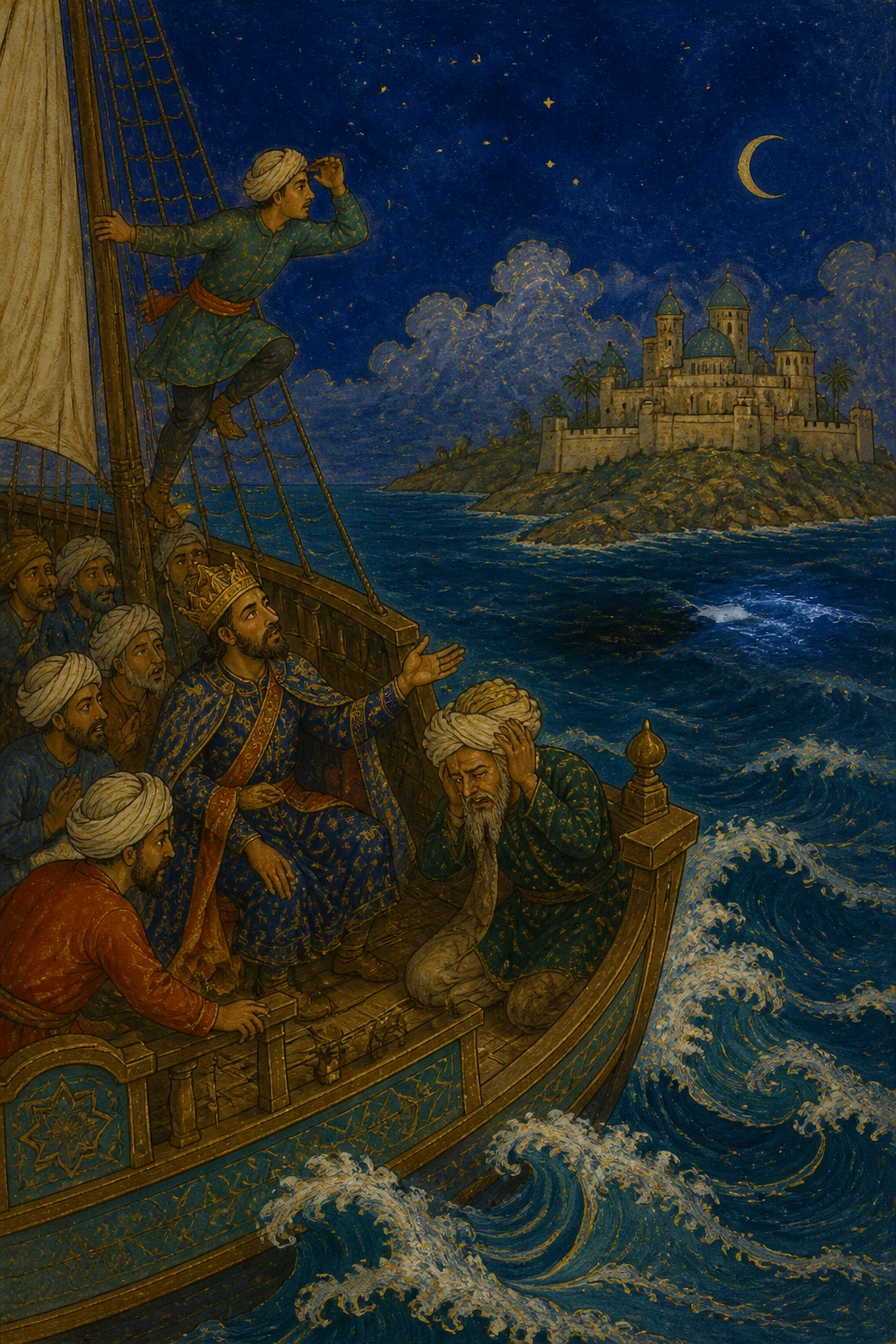
“‘High rank is won through toil; whoever seeks greatness must keep vigil through the nights. Whoever seeks pearls must dive into the sea, and so attain honour and reward. Whoever seeks greatness without labour wastes his life in pursuit of the impossible.’ At this I resolved to act. I bought merchandise, goods, and the things I needed for the journey, and brought myself to venture out to sea. I boarded a ship and travelled down to the city of Basra with a company of merchants. We sailed for days and nights, passing from island to island, from sea to sea, and from shore to shore. Wherever we stopped, we bought and sold and bartered our goods. We continued our voyage until we reached an island like one of the gardens of Paradise. The captain brought the ship alongside, dropped anchor, and put out the gangplank. Everyone aboard went ashore. They set up braziers and lit fires, each busy with something: some cooked, some washed, and some went exploring. I was among those who wandered about the island, while the passengers gathered to eat and drink and amuse themselves. While we were thus occupied, the captain stood at the ship’s side and shouted at the top of his voice, ‘Passengers, save yourselves! Hurry aboard! Make haste and leave your belongings! Run for your lives and escape destruction! This island you are standing on is no island, but a great fish that has settled in the middle of the sea. Sand has gathered upon its back until it has become like an island, and trees have been growing on it for ages. When you lit your fires, it felt the heat and began to move. Now it will plunge into the sea with you, and you will all drown. Save yourselves before you perish!’” And dawn overtook Shahrazad, and she fell silent, leaving her tale untold.
Then, when it was the five hundred and thirty-ninth night,
She said: It has reached me, O fortunate king, that when the captain shouted to the passengers, “Save yourselves before you perish, and leave your belongings!” they heard his warning and hurried aboard, abandoning their goods, possessions, cooking pots, and braziers. Some reached the ship and some did not. The island stirred and sank into the depths with everything upon it, and the roaring, surging sea closed over it. “I was among those left behind,” said Sindbad, “and went down into the sea with the others. But God Most High saved me from drowning and provided me with a large wooden tub of the kind they had been washing in. I caught hold of it and climbed into it, clinging desperately to life, and paddled with my feet as though they were oars, while the waves tossed me to right and left. The captain spread the ship’s sails and departed with those who had managed to get aboard, paying no heed to those who were drowning. I kept my eyes on the ship until it vanished from sight, and I felt certain I must perish. Night came upon me in this plight, and I remained so for a day and a night, until wind and waves carried me to the foot of a steep island where trees overhung the sea. I caught a branch of a tall tree and clung to it, almost at the point of death, then hauled myself up onto the island. I found that my legs were numb and the soles of my feet bore marks where fish had nibbled them, though in my distress and exhaustion I had felt nothing. I flung myself upon the island like a dead man and sank into unconsciousness, lost to the world. I remained so until the next day, when the sun rose over me and I awoke to find my feet swollen. Grieving over my condition, I could only drag myself along or crawl on my knees. There was abundant fruit on the island, and springs of fresh water, so I ate the fruit. I continued in this way for several days and nights until my strength revived, life returned to me, and I could move more freely. Then I began to reflect and to walk about the island, looking among the trees at the works of God Most High. From one of those trees I made myself a staff to lean upon.
“I continued in this way until one day, as I was walking along the edge of the island, I caught sight of a shape in the distance. I thought it must be a wild beast or some creature of the sea. I walked towards it, watching it closely, and found that it was a magnificent mare tethered on the seashore. When I drew near, she gave a loud neigh. I was frightened and was about to turn back when a man came out from beneath the ground, called after me, and followed me. ‘Who are you?’ he asked. ‘Where have you come from, and what has brought you here?’ I answered, ‘My lord, I am a stranger. I was aboard a ship, and I and some of the others were drowned. But God provided me with a wooden tub, which I climbed into, and it bore me along until the waves cast me upon this island.’ When he heard my words, he took me by the hand and said, ‘Come with me.’ I followed him down an underground passage into a large chamber beneath the earth. He seated me in the place of honour and brought me some food. I was hungry, and ate until I was satisfied and felt at ease. Then he asked about my circumstances and what had happened to me, and I told him my whole story from beginning to end. He marvelled at it, and when I had finished I said, ‘For God’s sake, my lord, do not take offence. I have told you the truth about my circumstances and all that has happened to me, and now I should like you to tell me who you are, why you stay in this underground chamber, and why this mare is tethered beside the sea.’ He replied, ‘Know that we are a company of men stationed at different places around this island. We are the grooms of King al-Mihrjan, and all his horses are in our care. Every month, by the light of the moon, we bring fine virgin mares and tether them about this island. Then we hide in these underground chambers, so that no one can see us. A stallion from among the horses of the sea catches the mares’ scent and comes ashore. He looks about and, seeing no one, mounts a mare and has his way with her. When he dismounts, he tries to take her away with him, but her tether prevents her from following. Then he neighs at her and strikes her with his head and hooves, crying out. When we hear him, we know he has dismounted, and we rush out shouting. Frightened of us, he returns to the sea. The mare conceives by him and bears a colt or filly worth a treasury of gold, with no equal upon the face of the earth. This is the time when the stallion comes ashore, and, God Most High willing, I shall take you with me to King al-Mihrjan.’” And dawn overtook Shahrazad, and she fell silent, leaving her tale untold.
Then, when it was the five hundred and fortieth night,
She said: It has reached me, O fortunate king, that the groom said to Sindbad the Sailor, “I shall take you with me to King al-Mihrjan and show you our country. Know that, had you not come upon us, you would have found no one else in this place. You would have died of misery without anyone knowing of you. But I shall be the means of saving your life and bringing you home.” “I prayed for him,” said Sindbad, “and thanked him for his kindness and generosity. While we were speaking, the stallion came up out of the sea, gave a mighty neigh, and mounted the mare. When he had finished with her, he dismounted and tried to take her away with him, but could not, and she kicked and neighed at him. Then the groom took up a sword and shield and came out through the doorway of the underground chamber, calling to his companions, ‘Come out against the stallion!’ and beating his sword upon his shield. A band of men came running with spears, shouting, and the stallion shied away from them and fled. He plunged into the sea like a buffalo and vanished beneath the water. Then the groom sat down for a little while, and his companions came to him, each leading a mare. Seeing me with him, they asked about me, and I told them what I had told him. They gathered round, spread out food, and invited me to eat with them, so I joined them.
“Then they rose and mounted their horses, taking me with them and setting me on a horse’s back. We travelled on until we reached the city of King al-Mihrjan. They went in to the king and told him my story, and he sent for me. They brought me into his presence, and I stood before him and saluted him. He returned my greeting, welcomed me graciously, and asked about my circumstances. I told him everything that had happened to me and all I had seen, from beginning to end. He marvelled at my adventures and said, ‘My son, by God, yours was a remarkable escape! Had you not been destined for a long life, you would never have survived such trials. But praise be to God for your deliverance!’ Then he treated me kindly, honoured me, and drew me close to him, speaking to me with warmth and affection. He appointed me an official at the seaport, charged with keeping a record of every ship that came ashore. I attended him and carried out his business, while he showed me kindness and favoured me in every way. He clothed me in fine, splendid garments, and I became a trusted intermediary with him, pleading people’s cases and helping them with their affairs. I remained with him a long time. Whenever I went down to the seashore, I would ask travelling merchants and seamen about the way to Baghdad, hoping that someone could tell me of it, so I might accompany him there and return to my own country. But no one knew it, nor knew anyone bound for it. This bewildered me, and I grew weary of my long exile. I continued in this state for some time, until one day I went to King al-Mihrjan and found a company of Indians with him. I greeted them, and they returned my greeting and welcomed me, asking about my country.” And dawn overtook Shahrazad, and she fell silent, leaving her tale untold.
Then, when it was the five hundred and forty-first night,
She said: It has reached me, O fortunate king, that Sindbad the Sailor said, “When I asked them about their country, they told me that they belonged to various peoples. Among them were the Shakiriyya, the noblest of their peoples, who neither wrong nor oppress anyone. Another group were called Brahmins, who never drink wine, but enjoy good fortune, serenity, amusement, music, and beauty, and possess horses and livestock. They also told me that the Jews were divided into seventy-two sects, which astonished me greatly. Among the islands in al-Mihrjan’s kingdom I saw one called Kabil, where tambourines and drums could be heard all night long. The islanders and travellers told us that its inhabitants were industrious and discerning people. In that sea I saw a fish two hundred cubits long, and others with faces like owls. I saw so many strange and marvellous things on that voyage that to tell you of them all would take a very long time.
“I continued to explore those islands and their sights until one day, as I stood beside the sea with my staff in my hand, as was my custom, a great ship appeared, carrying many merchants. When it reached the city’s harbour and landing place, the captain furled its sails, moored it by the shore, and put out the gangplank. The sailors began bringing all the cargo ashore, taking a long time over it, while I stood recording the goods. I asked the captain, ‘Is there anything left aboard your ship?’ He answered, ‘Yes, my lord. There are goods in the hold, but their owner was drowned at one of the islands during our voyage. His merchandise has remained with us in trust, and we intend to sell it and make a record of the price, so that we may deliver the proceeds to his family in Baghdad, the Abode of Peace.’ I asked the captain, ‘What was the name of the owner of these goods?’ He answered, ‘His name was Sindbad the Sailor, and he was drowned at sea.’ When I heard his words, I looked at him closely and recognized him. I cried out, ‘Captain, I am the owner of the goods you speak of! I am Sindbad the Sailor, who went ashore from your ship on the island with the other merchants. When the fish we were standing on began to move and you shouted to us, some managed to get aboard and the rest were drowned. I was among those who went down, but God Most High preserved me and saved me from drowning by means of a large tub of the kind the passengers used for washing. I climbed into it and paddled with my feet, while wind and waves carried me along until I reached this island. I climbed ashore, and God Most High helped me to find King al-Mihrjan’s grooms. They took me with them to this city and brought me before King al-Mihrjan. I told him my story, and he favoured me and appointed me clerk of this city’s harbour. I have prospered in his service and won his esteem. The goods you have aboard are mine, my own property.’” And dawn overtook Shahrazad, and she fell silent, leaving her tale untold.
Then, when it was the five hundred and forty-second night,
She said: It has reached me, O fortunate king, that when Sindbad the Sailor said to the captain, “The goods you have aboard are mine, my own property,” the captain replied, “There is no power and no strength save in God, the Most High, the Almighty! No one has any honesty or conscience left!” “I asked him,” said Sindbad, “‘Why do you say that, captain, when you have heard me tell my story?’ He answered, ‘Because you heard me say that I have goods whose owner was drowned, and now you want to take them without any right to them. That would be unlawful. We saw him drown, together with a great many passengers, and not one of them escaped. How can you claim to be the owner of the goods?’ I said, ‘Captain, listen to my story and consider my words, and you will see that I am telling the truth, for lying is the mark of hypocrites.’
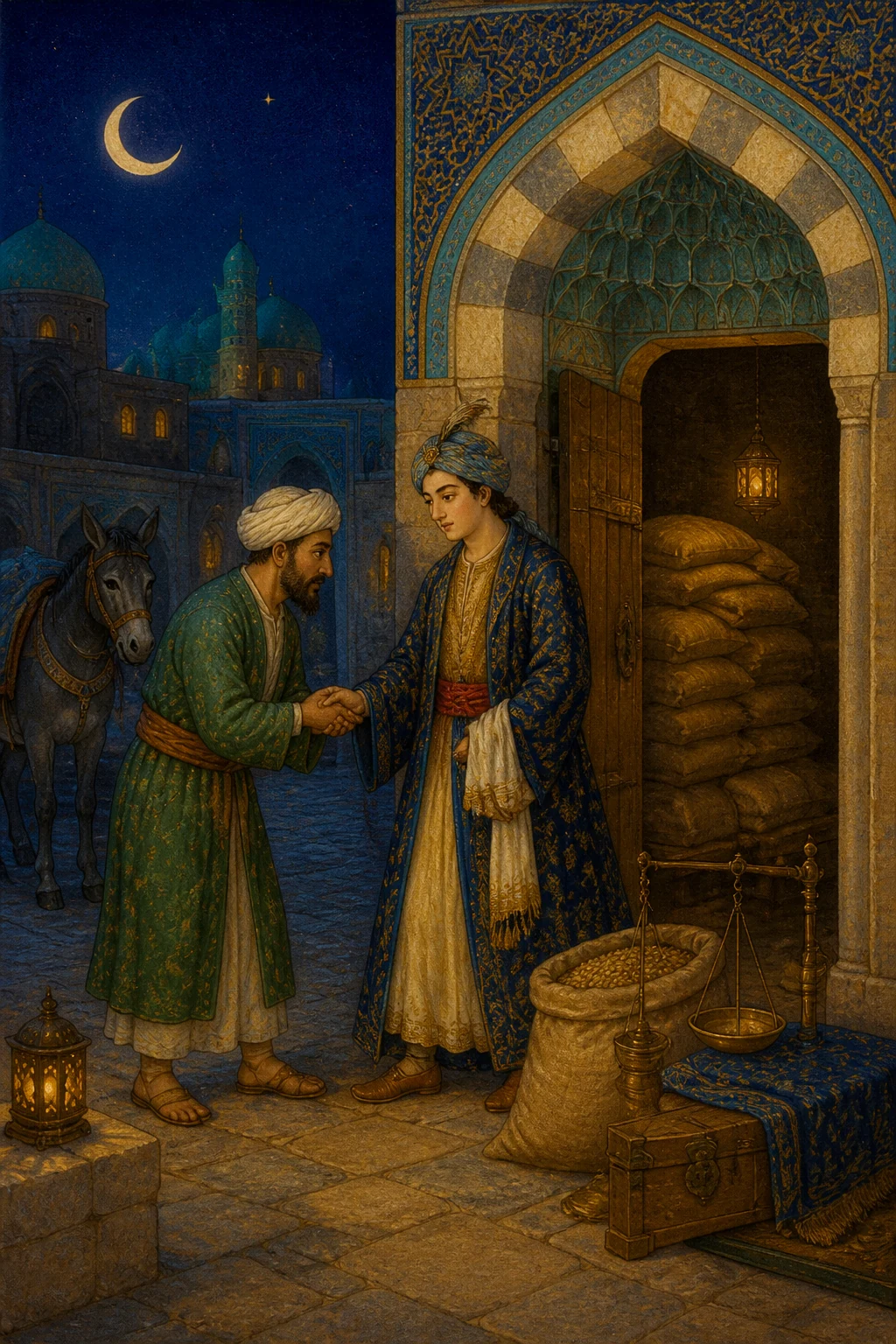
“Then I recounted to the captain everything that had happened from the time I left Baghdad with him until we reached the island where we were drowned. I reminded him of certain things that had passed between us, and at last the captain and the merchants were convinced that I spoke the truth. They recognized me and congratulated me on my deliverance, saying, ‘By God, we could never have believed that you had escaped drowning! But God has granted you a new lease of life.’ Then they gave me my goods. We found my name written upon them, and nothing was missing. I opened them and took out some precious and costly objects, which the sailors helped me carry to the king as a gift. I told him that this was the ship in which I had sailed, that all my merchandise had been restored to me intact, and that this gift came from it. The king marvelled greatly, and the truth of everything I had told him became clear to him. He grew very fond of me, honoured me still more, and gave me a great deal in return for my gift. Then I sold my cargo and merchandise at a handsome profit, and bought goods and wares from that city. When the merchants aboard the ship were ready to depart, I loaded all my possessions aboard and went to the king to thank him for his kindness and generosity. I asked his leave to return to my country and my family. He bade me farewell and gave me many of the city’s wares as a parting gift. Then I took leave of him, boarded the ship, and we sailed by the permission of God Most High. Fortune favoured us and destiny aided us, and we travelled day and night until we reached Basra in safety. We went ashore and stayed there a little while. I rejoiced in my deliverance and my return to my own country. Then I set out for Baghdad, the Abode of Peace, carrying a great quantity of valuable merchandise and goods. I came to my own quarter and entered my house, and all my family and friends came to see me. I bought servants and attendants, mamluks, concubines, and slaves, until I had a great household. I also bought houses, estates, and property, more than I had owned before. Once again I kept company with my friends and companions, living in greater abundance than in former days. I forgot all the toil, exile, hardship, and terrors I had endured on my travels, and devoted myself to pleasures and delights, fine food and exquisite drinks. Thus I continued to live. Such were the events of my first voyage, and tomorrow, God Most High willing, I shall tell you the second of my seven voyages.”
Then Sindbad the Sailor gave Sindbad the Landsman supper in his house and ordered that he be given a hundred mithqals of gold, saying, “You have cheered us with your company today.” The porter thanked him, took his gift, and went his way, pondering the things that happen to people and marvelling greatly. He slept that night in his own house, and in the morning returned to Sindbad the Sailor’s home. His host welcomed him, treated him with honour, and seated him beside him. When the rest of his companions had arrived, he set food and drink before them. Their time passed pleasantly and their spirits rose, and Sindbad the Sailor began to speak: “Know, my brothers, that I was living in the utmost pleasure and the purest happiness, as I told you yesterday.” And dawn overtook Shahrazad, and she fell silent, leaving her tale untold.
Then, when it was the five hundred and forty-third night,
She said: It has reached me, O fortunate king, that when Sindbad the Sailor’s companions had gathered round him, he said, “I was living in the utmost pleasure until one day the thought of travelling to foreign lands came into my mind. I longed to trade, to see other countries and islands, and to earn my living. I resolved upon it and took a large sum from my wealth, with which I bought merchandise and goods suitable for the voyage. I packed them and went down to the shore, where I found a fine new ship with a handsome canvas sail, a large crew, and abundant equipment. I loaded my cargo aboard with a company of merchants, and we set sail that very day. Our voyage was pleasant, and we passed from sea to sea and island to island. At every place where we anchored, we met merchants, officials, buyers, and sellers, and bought and sold and bartered our goods. We continued in this way until destiny brought us to a lovely island, thick with trees, ripe with fruit, fragrant with flowers, ringing with birdsong, and watered by clear streams. But there was neither a dwelling nor a soul to kindle a fire. The captain anchored there, and the merchants and passengers went ashore to admire its trees and birds, glorifying God, the One, the All-Subduing, and marvelling at the power of the Almighty King. I went ashore with the others and sat beside a clear spring among the trees. I had brought some food, and there I sat eating what God Most High had allotted me. The breeze was sweet and the moment peaceful, and drowsiness stole over me. I lay down to rest and fell into a deep sleep, lulled by the gentle air and fragrant scents.
“When I awoke, I could find neither human nor jinn in that place. The ship had sailed away with the passengers, and not one of the merchants or sailors had remembered me. They had left me on the island. I looked to right and left, but found no one there but myself. I was seized by an anguish beyond measure, and my heart almost burst with grief, sorrow, and distress. I had nothing in the world with me, neither food nor drink. I was utterly alone, crushed in spirit, and despaired of life. I said, ‘The pitcher does not come safely home every time. On the first occasion I escaped and found someone to take me from the island to an inhabited place. But this time—how unlikely, how very unlikely that I shall find anyone to bring me back to the lands of men!’
“Then I began to weep and lament my fate until anguish overwhelmed me. I reproached myself for what I had done, for embarking upon another journey with all its hardships, when I had been living at ease in my own home and country, happy and comfortable, with fine food, fine drink, and fine clothes, wanting neither money nor merchandise. I bitterly regretted leaving Baghdad and going to sea after all I had suffered on my first voyage, when I had come so close to death. ‘To God we belong,’ I said, ‘and to Him we shall return.’ I was almost out of my mind. At last I struggled to my feet and wandered about the island to right and left, unable to remain in one place. Then I climbed a tall tree and looked out in every direction, but saw only sky and water, trees and birds, islands and sands. As I peered more closely, I caught sight of an enormous white shape on the island. I climbed down and set off towards it, walking until I reached it. It proved to be a great white dome, immensely high and wide. I approached and walked round it, but could find no door. Its surface was so smooth that I could find no purchase to climb it. I marked the place where I stood and paced out its circumference, which measured fifty full strides. I was wondering how I might get inside when the day drew towards its close and sunset approached. Suddenly the sun disappeared, the air grew dark, and its light was hidden from me. I thought a cloud had passed over it, though it was summertime, and wondered at this. Raising my head, I looked carefully and saw a bird of monstrous size, huge of body and broad of wing, flying through the air. It was this bird that had covered the sun and hidden it from the island. My astonishment grew still greater. Then I remembered a tale…” And dawn overtook Shahrazad, and she fell silent, leaving her tale untold.
Then, when it was the five hundred and forty-fourth night,
She said: It has reached me, O fortunate king, that as Sindbad the Sailor marvelled at the bird he had seen on the island, he remembered a tale that wanderers and travellers had told him long before: on certain islands there lived a bird of immense size called the roc, which fed its young on elephants. “Then I realized,” he said, “that the dome I had seen was one of the roc’s eggs, and I marvelled at the creation of God Most High. While I stood there, the bird alighted upon the dome, covered it with its wings, stretched its legs out behind it upon the ground, and settled down to sleep. Glory be to Him who never sleeps! Then I rose and unwound my turban, folded and twisted it until it was like a rope, and fastened it about my waist. I tied myself to the bird’s feet, making the knot secure, and said to myself, ‘Perhaps it will carry me to a land of cities and settlements, which would be better than remaining on this island.’ I stayed awake all that night, afraid that if I slept it might fly off with me unawares. When dawn broke and morning appeared, the bird rose from its egg, gave a cry, and swept me up into the air. It climbed higher and higher until I thought it had reached the vault of heaven. Then it descended with me towards the earth and alighted on a high, lofty place. As soon as I reached the ground, I hurried to undo the bonds about its feet, terrified of it, though it neither knew nor sensed that I was there. Trembling, I freed my turban from its legs and moved away. Then it seized something from the ground in its talons and soared into the sky. I looked closely and saw that it had caught a monstrous serpent of enormous girth, which it carried away towards the sea. I marvelled at this. Then I walked about and found myself on high ground above a great, wide, deep valley. Beside it stood a mighty mountain, so lofty that no one could see its summit, and impossible for anyone to climb. I reproached myself for what I had done and said, ‘Would that I had stayed on the island! It was better than this wilderness, for there I could find fruit to eat and streams to drink from, while here there are neither trees nor fruit nor rivers. There is no power and no strength save in God, the Most High, the Almighty! Whenever I escape one misfortune, I fall into another still greater and more grievous.’”
Then I rose, summoned my strength, and walked through the valley. I found that its floor was strewn with diamonds, the stones used to bore through metals and precious gems, porcelain and onyx. They are hard, unyielding stones upon which neither iron nor rock can make any impression; no one can cut or break a piece from them except with lead. The whole valley was full of serpents and vipers, each as large as a palm tree, so huge that if an elephant came within reach, it could swallow it. These serpents appeared at night and hid by day for fear of the roc and the eagle, which would snatch them up and tear them apart, though I did not know why this should be. I remained in that valley, bitterly regretting what I had done, and said to myself, “By God, I have hastened my own destruction!” The day was drawing to a close, and I wandered through the valley, looking about for somewhere to spend the night. In my terror of the serpents, I forgot food and drink and every other need, thinking only of how to save myself. At last I caught sight of a cave nearby. I went up to it and found that its entrance was narrow, so I slipped inside. Seeing a large stone beside the entrance, I pushed it across the opening while I remained within. “Now that I have entered this place,” I told myself, “I am safe. When daylight comes, I shall go out and see what divine power has in store.” Then I looked about the cave and saw an enormous serpent asleep on its eggs at the far end. My flesh crept; I held my head upright and surrendered myself to fate and destiny. All night I lay awake, until dawn broke and the light appeared. Then I pushed aside the stone with which I had blocked the entrance and came out, reeling like a drunken man from sleeplessness, hunger, and fear, and walked through the valley. While I was in this state, a huge carcass suddenly fell before me, though there was no one to be seen. I was utterly astonished, and remembered a tale I had heard long before from merchants, travelers, and wanderers: that the diamond mountains were full of terrible dangers, and no one could make his way into them. The merchants who brought away the diamonds, however, used a trick to reach them. They would take a sheep, slaughter and skin it, cut its flesh into pieces, and throw them from the mountain down into the valley. The meat fell while still fresh, and some of the stones stuck to it. The merchants would leave it there until midday, when eagles and rocs descended upon the meat, seized it in their talons, and carried it to the mountaintop. Then the merchants would approach the birds and shout at them, driving them away from the meat. They would go up to it, remove the stones that clung to it, leave the flesh for the birds and wild beasts, and carry the stones home. No one could obtain diamonds except by this device. But morning overtook Shahrazad, and she fell silent, leaving her tale untold.
When it was the five hundred and forty-fifth night
She said: It has reached me, O fortunate King, that Sindbad the Sailor told his companions all that had happened to him on the diamond mountain, explaining that the merchants could obtain none of its stones except by a trick such as he had described. Then he continued: When I saw that carcass and remembered the tale, I rose and went over to it. I gathered a great many of the stones and put them in my pockets and among the folds of my clothes, going on selecting them and filling my pockets, sash, turban, and garments. While I was thus occupied, another great carcass fell nearby. I tied myself to it with my turban, lay on my back, and placed it upon my chest, holding it fast so that it stood above the ground. Presently an eagle swooped down upon the carcass, seized it in its talons, and bore it into the air with me hanging beneath it. It flew on until it reached the mountaintop, where it set the carcass down and was about to tear at it. Just then a mighty shout rang out behind the eagle, accompanied by the sound of wood being beaten against the mountain. The bird took fright and flew into the air. I untied myself from the carcass, my clothes stained with its blood, and stood beside it. The merchant who had shouted at the eagle came forward and saw me standing there. He was so alarmed and terrified at the sight of me that he said nothing, but went to the carcass and turned it over. Finding nothing on it, he gave a great cry and exclaimed, “Alas, my hopes are ruined! There is no power and no strength save in God! We seek refuge in God from Satan the accursed!” He wrung his hands in distress, saying, “Alas, what a misfortune! What can this mean?” I approached him, and he asked, “Who are you? What has brought you to this place?” I answered, “Do not be afraid or alarmed. I am a human being, and an honest one. I was a merchant, and mine is an extraordinary tale, a strange story indeed. How I came to this mountain and this valley is a marvel in itself. Have no fear: you shall have good reason to be pleased with me. I have a great many diamonds, and I shall give you enough to satisfy you. Every stone I have is finer than anything you might have obtained here, so do not be troubled or afraid.” The man thanked me, prayed for me, and began talking with me. The other merchants heard me speaking with their companion and came over, each of them having cast down his carcass. When they reached us, they greeted me, congratulated me on my escape, and took me with them. I told them my whole story, all that I had endured on my voyage, and how I had come to that valley.
Then I gave the owner of the carcass to which I had tied myself a large share of what I had brought. He was delighted with me, prayed for me, and thanked me. The merchants said, “By God, a new span of life has been written for you! No one before you has ever reached that place and escaped alive. Praise be to God for your deliverance!” They spent the night in a pleasant, safe place, and I stayed with the merchant, overjoyed at my safety, my escape from the valley of serpents, and my return to inhabited lands. At daybreak we rose and traveled across that great mountain, looking down into the valley and seeing many serpents. We continued on our way until we came to a grove on a great and beautiful island, where camphor trees grew. Each tree could shelter a hundred people beneath its shade. When someone wishes to obtain camphor, he pierces the upper part of the tree with a long implement and catches what flows down. The camphor water runs out and sets like gum; it is the honey of that tree. Afterward the tree dries up and becomes firewood. On that island there is also a kind of wild beast called the karkadan, which grazes there as cattle and buffalo graze in our country, though its body is larger than a camel’s, and it eats leeches. It is an enormous animal, with a single thick horn in the middle of its head, some ten cubits long, upon which is the likeness of a human being. There is also a kind of cattle on that island. Sailors, travelers, and those who wander through mountains and distant lands told us that this beast called the karkadan carries a great elephant upon its horn and grazes with it about the island and along the shores, scarcely aware of its burden. The elephant dies upon its horn, and the sun’s heat melts its fat, which runs down onto the karkadan’s head and into its eyes, blinding it. Then it lies down beside the shore, and the roc comes, lifts it in its talons, carries it to its young, and feeds them both the beast and what is on its horn. On that island I saw many kinds of buffalo unlike any in our country. In the valley there had been a great abundance of the diamonds I had carried away and hidden in my pockets. The merchants bartered goods and merchandise for them, carried these with their own, and gave me dirhams and dinars as well. I traveled on with them, viewing the lands of men and the wonders God had created, passing from valley to valley and city to city, buying and selling until we reached Basra. We stayed there a few days, and then I returned to Baghdad. But morning overtook Shahrazad, and she fell silent, leaving her tale untold.
When it was the five hundred and forty-sixth night
She said: It has reached me, O fortunate King, that when Sindbad the Sailor returned from his travels and entered Baghdad, the Abode of Peace, he went to his own quarter and entered his house, bringing a great many diamonds, money, possessions, and valuable merchandise. He was reunited with his family and kinsfolk, gave alms and gifts, bestowed presents upon all his relatives and friends, and began to eat the finest food, drink the best of drinks, wear handsome clothes, and enjoy company and friendship. He forgot all that he had suffered and lived in comfort, with a peaceful mind and a cheerful heart, amid amusement and delight. Everyone who heard of his return came to visit him and ask about his voyage and the lands he had seen. He told them what he had encountered and endured, and they marveled at the severity of his sufferings and congratulated him on his safe return. Such was the end of what had happened to him on his second voyage.
Then he said to them, “Tomorrow, if God Most High wills, I shall tell you of my third voyage.” When Sindbad the Sailor had finished telling his story to Sindbad the Landsman, the company marveled at it and dined with him. He ordered a hundred mithqals of gold to be given to Sindbad, who took them and went on his way, astonished at all Sindbad the Sailor had endured. At home he thanked his host and prayed for him. When morning dawned and spread its light, Sindbad the Porter rose, said the dawn prayer, and went to Sindbad the Sailor’s house as he had been bidden. He entered and wished him good morning. His host welcomed him and sat with him until the rest of his friends and companions arrived. They ate and drank, enjoying themselves in merriment and good spirits. Then Sindbad the Sailor began: The third voyage. Know, my brothers, and listen to its story, for it is stranger than the tales I have told before, though God knows best what is hidden and is most wise. In days gone by, when I returned from my second voyage, I was full of joy and gladness at my safe deliverance. I had gained great wealth, as I told you yesterday, and God had restored everything I had lost. For a time I remained in Baghdad, enjoying the utmost prosperity, peace, happiness, and contentment. Then my soul began to long for travel and new sights, and I yearned for commerce, profit, and gain. The soul is ever prone to evil, so I resolved to go, bought a great quantity of goods suited to a sea voyage, and packed them for the journey. I traveled with them from Baghdad to Basra and went down to the seashore, where I found a great ship carrying many merchants and passengers: worthy, pleasant, kindly people, pious, charitable, and upright. I embarked with them, and we set sail with the blessing of God Most High, trusting in His aid and guidance and looking forward to good fortune and a safe voyage. We sailed from sea to sea, island to island, and city to city, viewing every place we passed, buying and selling in the greatest happiness and delight. One day, as we were sailing through a surging sea of clashing waves, the captain stood at the ship’s side and looked out in every direction. Suddenly he struck his face, furled the sails, cast the anchors, tore at his beard and clothes, and gave a terrible cry. “Captain, what is the matter?” we asked. He replied, “Know, you passengers who hope for safety, that the wind has overpowered us and driven us astray in the midst of the sea. Through our ill fortune, fate has cast us upon the Mountain of the Apes. No one has ever reached this place and escaped alive, and my heart tells me that we are all doomed.”
Scarcely had the captain finished speaking when the apes came upon us, surrounding the ship on every side. They were countless, like swarming locusts, both aboard the ship and on the shore. We feared that if we killed or struck one of them, or tried to drive it away, they would kill us by sheer force of numbers, for numbers overcome courage. We remained in dread that they would plunder our goods and possessions. They were the ugliest of beasts, covered in hair like black felt, and terrifying to behold. No one could understand a word or sound they uttered. They were shy of human beings, with yellow eyes, black faces, and small bodies, each only four spans tall. They climbed up the anchor ropes and bit through them, then severed all the ship’s ropes on every side. The wind drove the vessel toward their mountain, and it grounded on their shore. They seized all the merchants and passengers and put us ashore on the island, then took the ship and everything aboard it and made off with it, leaving us behind. The ship disappeared from sight, and we had no idea where they had taken it.
As we wandered about the island, eating its fruit and greens and drinking from its streams, we caught sight of a well-built dwelling in its midst and made our way toward it. It proved to be a lofty palace, strongly built, with high walls and an open double door of ebony. We entered and found a spacious enclosure, like a great courtyard, with many high doorways around it and a broad, raised stone bench at the far end. Cooking pots hung over hearths, and many bones lay scattered about, but we saw no one. We were utterly astonished. We sat for a little while in the palace courtyard, then fell asleep, and slept from late morning until sunset. Suddenly the earth shook beneath us, and we heard a rumbling in the air. From the upper part of the palace there descended upon us a creature of enormous size, human in shape, black in color, and as tall as a great palm tree. His eyes were like two flames of fire, his tusks like a boar’s, and his vast mouth like the mouth of a well. His lips hung down upon his chest like a camel’s, his ears drooped over his shoulders like two bells, and the nails of his hands were like a lion’s claws. At the sight of him we lost all sense of ourselves. Our fear grew so great and our terror so fierce that we became like dead men from dread, anguish, and dismay. But morning overtook Shahrazad, and she fell silent, leaving her tale untold.
When it was the five hundred and forty-seventh night
She said: It has reached me, O fortunate King, that when Sindbad the Sailor and his companions saw this creature of dreadful appearance, they were overcome with fear and terror. When he reached the ground, he sat for a while upon the stone bench, then rose and came toward us. From among my fellow merchants he seized me by the arm and lifted me from the ground, feeling and turning me over in his hand, in which I was no more than a little morsel. He felt me as a butcher feels a sheep he is about to slaughter, but found me weak from suffering and wasted by the hardships of travel, with scarcely any flesh upon me. So he let me go and took another of my companions, turning and feeling him as he had me, then released him too. He went on examining us one by one until he came to the captain of our ship, a stout, thickset man, broad-shouldered and powerful. He pleased the monster, who seized him as a butcher seizes a beast for slaughter, threw him to the ground, set a foot upon his neck, and broke it. Then he brought a long spit and thrust it into his throat until it came out through his backside. He kindled a fierce fire, set the spit with the captain upon it over the flames, and kept turning him above the coals until his flesh was cooked. He lifted him from the fire, laid him before him, and tore him apart as a man tears apart a chicken, ripping off the flesh with his nails and eating it. He went on until he had eaten all the flesh and gnawed the bones, leaving nothing upon them, then threw the remaining bones to one side of the palace. He sat a little while, then stretched himself upon the stone bench and fell asleep, snoring like a sheep or a beast being slaughtered. He slept until morning, then rose and went away. Once we were certain he was gone, we spoke together, weeping over our fate. “Would that we had drowned in the sea,” we said, “or that the apes had eaten us! Either would have been better than being roasted over the coals. By God, this is a dreadful death! Yet what God wills must be, and there is no power and no strength save in God, the Most High, the Almighty. We shall die of grief, with no one knowing what has become of us. There is no escape from this place.”
Then we rose and went out into the island to look for somewhere to hide or a way to flee, for any death seemed easy to us if only our flesh need not be roasted in the fire. We found nowhere to conceal ourselves, and evening overtook us. In our great fear we returned to the palace and had scarcely sat down when the earth shook beneath us. The black giant approached, came up to us, and began turning us over and feeling us one by one as before, until he found one who pleased him. He seized him and did to him what he had done to the captain on the first day, roasting him and eating him upon the stone bench. All that night he slept, snoring like a beast under the knife. At daybreak he rose and went away, leaving us as before. We gathered together and spoke among ourselves. “By God,” we said, “it would be better to throw ourselves into the sea and drown than to be burned to death. This is a hideous way to die.” One of us said, “Listen to me. Let us devise a trick against him, rid ourselves of his menace, and deliver the Muslims from his violence and oppression.” I said, “Listen, my brothers. If we are determined to kill him, let us first move some of this timber and carry away some of this firewood to build ourselves a raft like a boat. After that we can devise a means of killing him, board the raft, and put to sea for whatever place God may will. We can wait here until a ship passes and embark upon it; but if we cannot kill him, we shall take to the sea. Even if we drown, we shall be spared roasting in the fire and slaughter. If we escape, well and good; if we drown, we shall die as martyrs.” They all replied, “By God, that is sound advice and a wise course!” We agreed upon it and set to work, carrying timber out of the palace and building a raft. We moored it beside the shore, put some provisions aboard, and returned to the palace.
When evening came, the earth shook beneath us, and the black giant entered, like a vicious dog. He turned us over and felt us one by one, then took one of us and did to him what he had done to the others. After eating him, he lay down upon the stone bench, and his snoring was like thunder. We rose, took two iron spits from those standing nearby, and laid them in the fierce fire until they glowed red like burning coals. Gripping them firmly, we carried them over to the black giant as he lay asleep and snoring, set their points against his eyes, and leaned upon them together with all our strength and determination. We drove them into his eyes as he slept, destroying his sight. He gave a tremendous cry that struck terror into our hearts, sprang from the stone bench with all his strength, and began searching for us. We fled to right and left, and he could not see us, for he was blind. Our terror of him was so great that at that moment we were certain of death and despaired of escape. Then he groped his way to the door and went out, shouting, while we cowered in dread and the earth shook beneath us at the force of his cries. When he had left the palace, we followed him out. He went about searching for us, then returned with a female larger and more hideous than himself. At the sight of him and his still more dreadful companion, our fear knew no bounds. When they caught sight of us, we hurried to the raft we had built, untied it, climbed aboard, and pushed it out to sea. Each of them carried a huge rock, and they began hurling rocks at us until most of our company had been killed. Only three remained: myself and two others. But morning overtook Shahrazad, and she fell silent, leaving her tale untold.
When it was the five hundred and forty-eighth night
She said: It has reached me, O fortunate King, that when Sindbad the Sailor and his companions boarded the raft, the black giant and his mate pelted them with rocks, killing all but three of them. The raft carried the survivors to an island. He continued: We walked until the end of the day, and night came upon us in this plight. We slept a little, then awoke to find an enormous serpent, huge of body and vast of belly, coiled about us. It made for one of our companions and swallowed him as far as his shoulders, then gulped down the rest of him. We heard his ribs breaking inside its belly, and it went away. We were astonished beyond measure and grieved for our companion, while our fear for ourselves grew desperate. “By God, what a strange fate!” we said. “Each death is more dreadful than the last. We rejoiced at our escape from the black giant, but our joy was cut short! There is no power and no strength save in God. By God, we have escaped the giant and drowning, but how shall we escape this accursed scourge?” We rose and wandered about the island, eating its fruit and drinking from its streams, until evening. Then we found a great, tall tree, climbed into it, and settled down to sleep. I climbed to its highest branches. When night fell and darkness gathered, the serpent came, looking to right and left, and made for the tree in which we were perched. It climbed until it reached my companion and swallowed him up to the shoulders, coiling about him against the tree. I heard his bones breaking inside its belly, and then it swallowed him whole before my very eyes. The serpent came down from the tree and went away, while I remained among the branches for the rest of the night. When day broke and the light appeared, I climbed down, more dead than alive from fear and terror. I wanted to throw myself into the sea and be done with the world, but I could not bear to surrender my life, for life is precious. So I tied a broad piece of wood crosswise beneath my feet, another along my left side, another along my right, and another over my belly. Above my head I fastened a long, broad piece crosswise, like the one beneath my feet, until I was enclosed by wood on every side. I bound it all very securely and lay down upon the ground inside it, surrounded by the timbers as though within a little chamber.
When night fell, the serpent came as usual, saw me, and approached, but could not swallow me in that condition, with timber surrounding me on every side. It circled me, unable to reach me, while I watched with my own eyes, almost dead from fright. The serpent kept drawing away and returning, but whenever it tried to reach me and swallow me, the timbers bound about me prevented it. It continued in this fashion from sunset until dawn broke, the light appeared, and the sun rose. Then it went away, furious and frustrated beyond measure. I stretched out my hand and freed myself from the timbers, scarcely alive after all I had endured from that serpent. Then I rose and walked through the island until I reached its far end. Chancing to look toward the sea, I saw a ship far out upon the deep. I took a large branch from a tree and waved it toward them, shouting. When they saw me, they said, “We must find out what that is. Perhaps it is a human being.” They drew nearer, heard my cries, came to me, and took me aboard. They asked about my circumstances, and I told them everything that had happened to me, from beginning to end, and all the hardships I had endured. They were utterly amazed. Then they gave me clothes of their own to cover my nakedness, brought me food, and let me eat my fill. They gave me cool, sweet water to drink, and my heart revived, my spirits eased, and a great comfort came over me. God Most High had brought me back to life after death. I praised Him for His abundant favors and gave Him thanks. My courage returned after I had been certain of destruction, until it seemed to me that everything I was experiencing must be a dream. We sailed on, favored by the wind through the permission of God Most High, until we came in sight of an island called Salahat, where the captain brought the ship to a halt. But morning overtook Shahrazad, and she fell silent, leaving her tale untold.
When it was the five hundred and forty-ninth night
She said: It has reached me, O fortunate King, that the ship aboard which Sindbad the Sailor had embarked anchored at an island. All the merchants and passengers went ashore, taking out their goods to buy and sell. Sindbad the Sailor continued: The master of the ship turned to me and said, “Listen to me. You are a poor stranger, and you have told us of the many terrors you have endured. I wish to do you a service that will help you reach your own country, so that you may remember me in your prayers.” “Yes,” I answered, “and you shall indeed have my prayers.” He said, “Know that there was a traveler with us whom we lost. We do not know whether he is alive or dead, and we have heard no news of him. I wish to entrust his cargo to you, so that you may sell it on this island and take care of it. We shall give you something in return for your trouble and service, and keep what remains until we return to Baghdad. There we shall inquire after his family and give them the remaining goods and the proceeds of what has been sold. Will you take charge of it, go ashore with it, and sell it like the other merchants?” I replied, “I hear and obey, my lord. The kindness and generosity are yours.” I prayed for him and thanked him, whereupon he ordered the porters and sailors to carry the merchandise ashore and hand it over to me. The ship’s clerk asked, “Captain, whose is this cargo the sailors and porters are taking out? Under which merchant’s name shall I enter it?” He replied, “Enter it under the name of Sindbad the Sailor, who was with us and was drowned at the island. We have heard no news of him. We wish this stranger to sell the goods and keep the proceeds, and we shall give him a portion in return for his trouble and his work in selling them. We shall carry the rest with us until we return to Baghdad. If we find him, we shall give it to him; if not, we shall hand it over to his family in Baghdad.” The clerk said, “Your words are good, and your judgment is sound.”
When I heard the captain say that the cargo was in my name, I said to myself, “By God, I am Sindbad the Sailor, and I was among those who were lost at the island!” But I kept my composure and waited until the merchants had gone ashore and gathered to talk over their buying and selling. Then I approached the master of the ship and said, “My lord, do you know what became of the owner of the cargo you have entrusted to me to sell?” He answered, “I know nothing of his fate, but he was a man from Baghdad named Sindbad the Sailor. We anchored at one of the islands, where many of our people were drowned, and he disappeared among them. We have heard nothing of him to this day.” At that I cried out, “Good captain, know that I am Sindbad the Sailor! I was not drowned. When you anchored at the island and the merchants and passengers went ashore, I went with them, taking some food to eat beside the shore. I found it pleasant to sit there, and drowsiness overtook me. I fell fast asleep, and when I awoke, I found neither the ship nor anyone beside me. This money is mine, and these goods are mine. All the merchants who gather diamonds saw me on the diamond mountain and can testify that I am Sindbad the Sailor, for I told them my story and what had happened to me aboard your ship. I told them that you had forgotten me and left me asleep on the island, and that I had awoken to find no one there, after which all those things befell me.” When the merchants and passengers heard my words, they gathered around me. Some believed me, while others thought I was lying.
While we were thus engaged, one of the merchants, hearing me mention the diamond valley, rose and came forward. “My friends,” he said, “listen to me. When I told you of the strangest thing I had seen in my travels, I described how we threw carcasses into the diamond valley. I cast mine down with the others, as I always did, and a man came up clinging to it. You would not believe me, but said I was lying.” “Yes,” they answered, “you told us that story, and we did not believe you.” The merchant said, “This is the man who clung to my carcass. He gave me some precious diamonds of unrivaled quality and rewarded me with far more than my carcass would ever have brought me. I traveled with him as far as Basra, after which he took leave of us and went to his own country, while we returned to ours. This is the very man. He told us that his name was Sindbad the Sailor and explained how the ship had gone away and left him on the island. Know that he has come among us now only so that you may believe what I told you. All these goods belong to him, for he described them when we first met him, and the truth of his words has now become clear.” When the captain heard the merchant’s account, he rose to his feet, came over to me, and studied me closely for a while. Then he asked, “What marks are on your goods?” I answered, “The marks on my goods are such and such.” I also reminded him of something that had passed between us when I boarded his ship at Basra. Then he knew for certain that I was Sindbad the Sailor. He embraced me, greeted me, and congratulated me on my deliverance, saying, “By God, my lord, your story is marvelous and your adventures strange! But praise be to God, who has reunited us and restored your goods and money to you.” But morning overtook Shahrazad, and she fell silent, leaving her tale untold.
When it was the five hundred and fiftieth night
She said: It has reached me, O fortunate King, that when the captain and merchants were certain that the man before them was indeed Sindbad the Sailor, the captain said to him, “Praise be to God, who has restored your goods and money to you!” He continued: Then I managed my merchandise as I saw fit, and made a very great profit from it on that voyage. I was overjoyed, congratulating myself upon my deliverance and the recovery of my property. We continued buying and selling among the islands until we reached the land of Sind, where we also traded. In that sea I saw wonders and marvels beyond counting. Among them were a fish shaped like a cow and creatures shaped like donkeys. I saw birds that emerged from seashells, laid their eggs and hatched their young upon the surface of the water, and never came out of the sea onto dry land. After that we continued our voyage by the permission of God Most High, favored by wind and weather, until we reached Basra. I stayed there a few days, then returned to Baghdad, went to my own quarter, entered my house, and greeted my family, companions, and friends. I rejoiced in my safety and my return to my country, my family, my city, and my home. I gave alms and gifts, clothed widows and orphans, and gathered my friends and loved ones around me. I passed my days in eating and drinking, amusement and music, enjoying the finest food and drink, company and friendship. I forgot all that had befallen me and the hardships and terrors I had endured. On that voyage I had gained wealth beyond reckoning. Such were the strangest things I saw on that journey. Tomorrow, if God Most High wills, come to me and I shall tell you the story of my fourth voyage, for it is stranger than these others.
Then Sindbad the Sailor ordered a hundred mithqals of gold to be given to him, as was his custom, and bade them spread the table. They did so, and the company dined, marveling at the story and all that had happened in it. After supper they went their separate ways. Sindbad the Porter took the gold his host had ordered for him and departed, astonished at what he had heard from Sindbad the Sailor. He spent the night at home, and when morning dawned and spread its light, he rose, said the dawn prayer, and walked to Sindbad the Sailor’s house. He entered and greeted him, and his host received him with joy and gladness and seated him beside him until the rest of his friends arrived. Food was brought, and they ate and drank and enjoyed themselves. Then he began to speak and told them the story of his fourth voyage.
Sindbad the Sailor said: Know, my brothers, that when I returned to Baghdad and was reunited with my friends and family, I lived in the greatest happiness, pleasure, and ease. My abundant gains made me forget all I had endured, and I plunged into merrymaking and music and the company of loved ones and friends. Yet while I was enjoying the sweetest of lives, my wicked soul began urging me to travel to foreign lands. I longed to mingle with other peoples, to trade and make a profit. So I resolved upon the venture, bought valuable goods suitable for a sea voyage, and packed a larger cargo than usual. I traveled from Baghdad to Basra, loaded my goods aboard a ship, and joined a company of the leading merchants of Basra. We set out, and with the blessing of Almighty God our ship sailed over the roaring sea and its clashing waves. Our voyage went well, and for many days and nights we passed from island to island and sea to sea, until one day contrary winds arose. The captain cast anchor and brought the ship to a halt in the open sea, fearing she would founder. While we were praying and beseeching Almighty God, a violent gale burst upon us, tearing the sail to shreds. The people were plunged into the sea, together with all their cargo, possessions, and money, and I went down among the rest. I swam for half a day and had given myself up for lost when Almighty God brought within my reach a plank from the ship. I climbed onto it with a number of merchants. But morning overtook Shahrazad, and she fell silent, leaving her permitted tale untold.
When it was the five hundred and fifty-first night
She said: It has reached me, O fortunate King, that after Sindbad the Sailor’s ship had sunk and he had climbed onto a plank with a number of merchants, he said: We huddled together and stayed astride that plank, kicking our feet in the sea while the waves and wind helped us along. We remained like this for a day and a night. Late the next morning, a wind rose against us, the sea grew wild, and the waves and gusts became so fierce that the water cast us onto an island. We were like dead men from sleeplessness, exhaustion, cold, hunger, fear, and thirst. We walked along the edges of the island and found plants growing in abundance, so we ate enough to keep ourselves alive and sustain us, then spent the night beside the shore.
When morning came and its light shone forth, we rose and wandered about the island to right and left. In the distance we made out a building and walked toward it until we stood at its gate. While we were standing there, a band of naked men came out. Without speaking a word, they seized us and took us to their king. He ordered us to sit, and we sat down. They brought us food we did not recognize and had never seen the like of in our lives. My stomach recoiled from it, and unlike my companions I ate none. My abstaining from that food was a mercy from Almighty God, by which I have lived until this day. Once my companions had eaten, their minds became bewildered, and they began to eat like madmen, their whole condition changed. Then the men brought coconut oil, gave it to them to drink, and rubbed them with it. When my companions drank the oil, their eyes rolled in their heads, and they devoured the food in a manner utterly unlike their usual eating. I was bewildered by their plight and grieved for them, while fear for myself among these naked men filled me with anguish. Observing them closely, I realized they were Magians, and the king of their city was a ghoul. Anyone who reached their country, or whom they saw or encountered in the valleys or on the roads, they brought before their king. They fed him that food and anointed him with the oil, so that his belly would expand and he could eat prodigiously, while his mind grew clouded and his reason vanished until he became like an idiot. They then gave him more and more of the food and oil until he grew fat and stout, whereupon they slaughtered and roasted him and served him to their king. As for the king’s people, they ate human flesh neither roasted nor cooked.
When I saw this, I became deeply distressed for myself and my companions. Their minds were so utterly bewildered that they no longer knew what was being done to them. They were handed over to a man who took them out every day to graze about the island like cattle. As for me, fear and hunger made me weak and sickly, and my flesh shriveled upon my bones. When they saw me in this state, they left me alone and forgot me; not one of them remembered me or gave me a thought. At last, one day I contrived to escape from that place and walked far away across the island. I saw a herdsman sitting on a raised spot amid the sea. Looking closely, I recognized the man to whom my companions had been entrusted to graze, and with him were many others like them. When he saw me, he knew that I still possessed my reason and had suffered none of what had befallen my companions. He beckoned to me from afar and said, “Turn back and take the path on your right. It will lead you to the king’s highway.” I turned back as he directed, found a path on my right, and followed it. Sometimes I ran in terror, and sometimes I walked slowly until I recovered my breath. I went on until I was beyond the sight of the man who had shown me the way, and neither of us could see the other. The sun set and darkness fell. I sat down to rest and wished to sleep, but that night fear, hunger, and exhaustion kept sleep from me.
At midnight I rose and walked on through the island until day broke and morning’s light shone forth, and the sun rose over the hills and plains. I was weary, hungry, and thirsty, so I ate the grasses and plants growing on the island until I was full and my strength returned. Then I rose and continued walking. Thus I went on by day and night, eating plants whenever I grew hungry, for seven days and seven nights. On the morning of the eighth day, I happened to glance into the distance and saw a dark shape. I walked toward it and did not reach it until after sunset. Still some way off, I looked closely, my heart fearful after all I had already suffered, and saw that it was a company of men gathering peppercorns. When I approached and they caught sight of me, they hurried over and surrounded me on every side. “Who are you?” they asked. “Where have you come from?” I answered, “Good people, know that I am a poor stranger.” Then I told them my whole story, all the terrors and hardships that had befallen me, and everything I had endured. But morning overtook Shahrazad, and she fell silent, leaving her permitted tale untold.
When it was the five hundred and fifty-second night
She said: It has reached me, O fortunate King, that when Sindbad the Sailor saw the men gathering pepper on the island and they asked about his circumstances, he told them all that had happened to him and all the hardships he had endured. They said, “By God, this is a marvelous tale! But how did you escape the black men? How did you pass through their midst on this island? There are so many of them, and they eat human beings. No one escapes them, and no one can pass through their country.” So I told them what had happened to me among those people, how they had taken my companions and fed them the food, while I had eaten none. They congratulated me on my escape and marveled at all that had befallen me. Then they bade me sit with them until they had finished their work and brought me some good food. I was hungry and ate, then rested among them for a while. Afterward they took me aboard a ship and brought me to their island and their homes. They presented me to their king, and I greeted him. He welcomed me, treated me generously, and asked about my circumstances. I told him my story and everything that had happened to me from the day I left Baghdad until I came before him. He and all who were present in his court were greatly astonished by my tale and my adventures. Then he bade me sit beside him, and I sat. He ordered food to be brought, and when it came I ate my fill, washed my hands, and gave thanks and praise to Almighty God for His bounty.
Then I left the king and went to look about his city. It was a flourishing place, rich in people and wealth, with plentiful food, markets, merchandise, sellers, and buyers. I was delighted to have reached it, and my mind was at ease. I grew familiar with its people, and both they and their king held me in greater honor than even the foremost men of the kingdom. I noticed that everyone, high and low alike, rode fine, handsome horses without saddles. This astonished me, and I said to the king, “Why, my lord, do you not ride upon a saddle? It gives the rider greater comfort and a firmer seat.” “What is a saddle like?” he asked. “We have never seen such a thing in our lives, nor ridden upon one.” I said, “Will you permit me to make you a saddle, so that you may ride upon it and discover its merits?” “Do so,” he replied. I asked him to have some wood brought to me, and he ordered that I be supplied with everything I requested. Then I called for a skillful carpenter, sat beside him, and taught him the craft of making a saddle and how to shape it. I took wool, teased it out, and made felt from it. Then I had leather brought, covered the saddle with it, and polished it. I fitted the straps and fastened its girth. After that I summoned a blacksmith and described how stirrups were made. He forged a splendid pair, which I filed smooth and whitened with tin. I added silk fringes, then brought one of the king’s finest horses, secured the saddle upon its back, hung the stirrups, fitted it with a bridle, and led it before the king. He admired it greatly, was delighted with it, and thanked me. When he mounted, the saddle gave him immense pleasure, and he rewarded me handsomely for my work. Seeing the saddle I had made, his vizier asked me for one like it, and I made him its equal. Then the great men of state and the holders of office began asking me for saddles, and I made them. I taught the carpenter to make saddles and the blacksmith to make stirrups, and together we produced saddles and stirrups and sold them to nobles and dignitaries. In this way I amassed a great fortune and rose high in their esteem. They became exceedingly fond of me, and I enjoyed great standing with the king and his court, the city’s leading men, and the officers of state. One day I was sitting with the king, surrounded by every happiness and honor.
While I sat there, the king said to me, “Know that you have become honored and cherished among us, and are now one of us. We cannot bear to part with you or allow you to leave our city. I have a wish, and I ask you to obey me in it and not refuse.” I said, “What do you wish of me, O King? I shall not refuse you, for you have shown me kindness, favor, and generosity, and, praise be to God, I have become one of your servants.” He said, “I wish to marry you to a woman of our people, a beautiful, charming, graceful wife, possessed of wealth and loveliness. You will settle among us, and I shall lodge you near me in my palace. Do not oppose me or reject my proposal.” When I heard the king’s words, I was overcome with bashfulness and remained silent, too embarrassed to answer. “Why do you not reply, my son?” he asked. I said, “My lord, yours is the command, O King of the Age.” At once he sent for the judge and witnesses, and then and there married me to a woman of noble rank and lofty lineage, wealthy and generous, of distinguished birth and exquisite beauty, who owned houses, estates, and lands. But morning overtook Shahrazad, and she fell silent, leaving her permitted tale untold.
When it was the five hundred and fifty-third night
She said: It has reached me, O fortunate King, that after the king had married Sindbad the Sailor to a noble lady, Sindbad said: He then gave me a fine, spacious house of my own, furnished me with servants and attendants, and allotted them provisions and wages. I lived in the greatest comfort, happiness, and contentment, forgetting all the toil, hardship, and suffering I had endured. I said to myself, “When I travel home, I shall take her with me.” Yet whatever is decreed for a man must come to pass, and no one knows what awaits him. I loved her, and she loved me dearly. We lived in harmony, enjoying the sweetest life and the greatest abundance. We continued in this way for some time, until Almighty God took the wife of a neighbor who was a friend of mine. I went to console him for her death and found him in a dreadful state, full of grief and anguish. I offered him comfort and sympathy, saying, “Do not grieve for your wife. God will make good your loss with a better woman, and may you live long, if Almighty God wills.” He wept bitterly and said, “My friend, how can I marry another? How can God replace her with a better wife, when I have only one day left to live?” I said, “Brother, come to your senses. Do not foretell your own death. You are well and in good health.” My friend answered, “By your life, tomorrow you will lose me, and never see me again as long as you live.” “How can that be?” I asked. He said, “Today they will bury my wife, and they will bury me alive in the grave with her. Such is the custom in our country. When a woman dies, her husband is buried alive with her, and when a man dies, his wife is buried alive with him, so that neither may enjoy life after the other.” I said, “By God, this is a dreadful custom, and no one could bear it.”
While we were talking, most of the people of the city arrived to offer my friend condolences for his wife’s death and his own. They began preparing her for burial according to their custom. They brought a coffin, placed the woman in it, and carried her out of the city, with her husband walking beside them. They came to a place on the side of a mountain by the sea, advanced to a certain spot, and lifted a great stone. Beneath it appeared a stone rim like the mouth of a well. They cast the woman into it, and I saw that it was a vast pit beneath the mountain. Then they brought her husband, tied a rope beneath his chest, and lowered him into the pit. They sent down with him a large jug of fresh water and seven loaves of bread for provisions. Once he was below, he freed himself from the rope, and they drew it up, covered the opening with the stone as before, and went their way, leaving my friend beside his wife in the pit. I said to myself, “By God, this death is worse than the first.” Then I went to their king and said, “My lord, how is it that in your country you bury the living with the dead?” He answered, “Know that this is the custom of our land. When a man dies, we bury his wife with him, and when a woman dies, we bury her husband alive with her, so that we do not part them in life or in death. We inherited this custom from our forefathers.” I said, “O King of the Age, if a stranger like myself were to lose his wife among you, would you do to him what you have done to this man?” “Yes,” he replied. “We would bury him with her and do just as you have seen.” When I heard these words, my heart nearly burst with grief and anguish for myself. My wits deserted me, and I became terrified lest my wife die before me and they bury me alive with her. Then I consoled myself, saying, “Perhaps I shall die before her. No one knows who will go first and who will follow.” I busied myself with various matters to distract my thoughts, but only a short time afterward my wife fell ill. She lingered a few days and died. Most of the people gathered to offer condolences to me and her family, and the king himself came to console me according to their custom.
Then they brought a woman to wash her body, and dressed her in her finest clothes, ornaments, necklaces, and precious jewels. When they had arrayed my wife, they laid her in the coffin, carried her to the mountain, lifted the stone from the mouth of the pit, and cast her down. All my friends and my wife’s family came forward to bid me farewell for the last time, while I cried out among them, “I am a stranger! I cannot endure your custom!” But they would not hear me or pay any heed to my words. They seized me and bound me by force, tied seven loaves of bread and some fresh water to me according to their custom, and lowered me into the well. It proved to be a great cavern beneath the mountain. “Untie yourself from the ropes,” they called. I refused, so they threw the ropes down upon me, covered the mouth of the well with the great stone that had lain over it, and went their way. But morning overtook Shahrazad, and she fell silent, leaving her permitted tale untold.
When it was the five hundred and fifty-fourth night
She said: It has reached me, O fortunate King, that when they had lowered Sindbad the Sailor into the cavern with his dead wife, closed its entrance, and gone their way, he said: I saw many corpses in that cavern, and its stench was foul and sickening. I reproached myself for what I had done, saying, “By God, I deserve all that befalls me and everything that happens to me.” I began to reckon the passing of night and day, living on very little. I would not eat until hunger nearly tore me apart, nor drink until my thirst grew fierce, for I feared exhausting my bread and water. I said, “There is no power and no strength save in God, the Most High, the Almighty! What possessed me to marry in this city? Whenever I think I have escaped one calamity, I fall into another more terrible still. By God, this is a wretched death! Would that I had drowned at sea or died among the mountains; either would have been better than this dreadful end.” I remained in this state, reproaching myself. I slept upon the bones of the dead and sought God’s help. So grievous was my suffering that I longed for death, but death would not come. At last hunger burned my heart and thirst set me aflame. I sat up, felt about for the bread, ate a little, and swallowed a small mouthful of water. Then I rose to my feet and began walking about the cavern. I found it broad and spacious, with deep recesses, but its floor was strewn with countless corpses and bones that had crumbled with age. I made myself a place in one corner, far from the newly dead, and slept there. My provisions dwindled until only a little remained. I ate one small meal and took one drink each day, or even less often, fearing that my food and water would run out before I died.
I continued in this way until one day, as I sat wondering what I would do when my food and water were gone, the rock shifted from its place and light streamed down upon me. “What can be happening?” I wondered. There were people standing at the mouth of the well, lowering a dead man and a living woman, who wept and cried out over her fate. They sent down a plentiful supply of food and water with her. I watched the woman, though she did not see me. When they had covered the opening with the stone and gone away, I rose, took the shinbone of a dead man in my hand, went over to her, and struck her on the crown of the head. She fell senseless to the ground. I struck her a second and a third time, and she died. Then I took her bread and what she had with her. I saw that she wore many ornaments, fine garments, necklaces, jewels, and precious metals. Taking her water and provisions, I returned to the place I had made for sleeping in the corner of the cavern. I ate sparingly, only enough to sustain me, lest the supplies run out too soon and I die of hunger and thirst. I remained in that cavern for some time, killing whoever was buried alive with the dead and taking their food and drink to keep myself alive. One day I awoke from sleep and heard something scuffling in a corner of the cavern. “What can that be?” I said. I rose and went toward it, carrying a dead man’s shinbone. When it sensed me, it fled. It was a wild beast, and I followed it toward the far end of the cavern. There I glimpsed a light from a small opening, like a star, now appearing, now hidden. I went toward it, and as I drew nearer the light grew clearer and broader. Then I realized that this was a hole in the cavern leading to the open air. I said to myself, “There must be a way out here, either another mouth like the one through which they lowered me, or some passage through the rock.”
I considered the matter for a while, then walked toward the light. It proved to be a hole in the far side of the mountain, dug by wild beasts. They entered through it, ate their fill of the dead, and went out again. When I saw it, my soul grew calm, my heart found ease, and I felt certain of life after death. It was as though I were dreaming. I struggled through the hole and found myself beside the salt sea, high on a great mountain that stood between two stretches of sea and separated the island from the city, inaccessible to anyone. I praised and thanked Almighty God, rejoiced exceedingly, and took heart. Then I returned through the opening to the cavern and carried out all the food and water I had saved. I took some clothes from the dead and changed out of those I was wearing. I also gathered a great quantity of their necklaces and jewels, strings of pearls, and ornaments of silver and gold set with all manner of gems and precious stones. I bundled them in my clothes and the garments of the dead, carried them through the hole to the outer slope of the mountain, and stood beside the sea. Every day I went down into the cavern and came out again. Whenever anyone was buried there, I took their provisions and water and killed them, whether man or woman. Then I emerged through the hole and sat beside the sea, waiting for Almighty God to send deliverance in the shape of a passing ship. Whatever jewelry I found in the cavern I carried out and tied in the garments of the dead. I continued in this way for some time. But morning overtook Shahrazad, and she fell silent, leaving her permitted tale untold.
When it was the five hundred and fifty-fifth night
She said: It has reached me, O fortunate King, that Sindbad the Sailor carried out of the cavern whatever ornaments and other valuables he found there, and spent his days beside the sea. He said: One day, while I sat on the shore reflecting on my plight, a ship passed over the roaring sea and its clashing waves. I took a white garment from among the clothes of the dead, tied it to a staff, and ran along the shore, waving it at them. At last someone glanced my way and saw me on the mountainside. They drew near, heard my cries, and sent a boat with some of the ship’s company. When they approached, they asked, “Who are you? Why are you sitting in this place? How did you reach this mountain? Never in our lives have we seen anyone come here.” I said, “I am a merchant. The ship I was aboard sank, and I climbed onto a plank with my belongings. By God’s help, and through my own efforts and skill, I managed after great hardship to reach this place with my goods.” They took me into the boat and loaded aboard everything I had brought from the cavern, bundled in clothes and shrouds. Then they rowed me back and brought me and my goods aboard the ship before the captain. He said, “Man, how did you reach this place? This is a great mountain, with a great city behind it. All my life I have sailed these waters and passed this mountain, yet I have never seen anything upon it but wild beasts and birds.” I said, “I am a merchant. I was aboard a large ship that was wrecked, and all my goods went into the sea, including these fabrics and clothes you see. I put them on a large plank from the ship, and Providence and good fortune helped me reach the mountain. Since then I have been waiting for someone to pass and take me away.” I told them nothing of what had happened to me in the city or in the cavern, fearing there might be someone from that city aboard.
Then I brought out a considerable sum from my wealth and said to the ship’s master, “My lord, you are the means of my deliverance from this mountain. Accept this from me in return for the kindness you have shown me.” But he would not take it. “We take nothing from anyone,” he said. “Whenever we find a castaway on a shore or an island, we take him aboard, feed him, and give him water. If he is naked, we clothe him. When we reach a safe port, we give him something of our own as a gift. We do him these kindnesses and favors for the sake of Almighty God.” I prayed that he might live long. We continued sailing from island to island and sea to sea, while I hoped for a safe return and rejoiced in my escape. Whenever I remembered my confinement in the cavern with my wife, my reason nearly left me. At last, by God’s power, we reached Basra safely. I went ashore and stayed there a few days, then traveled to Baghdad. I returned to my quarter, entered my house, and met my family and friends, asking after them all. They rejoiced in my safe return and congratulated me. I stored all the goods I had brought in my storerooms, gave alms and gifts, and clothed orphans and widows. I lived in the greatest happiness and delight, returning to my former life of companionship, friendship, the company of my brothers, music, and merrymaking. Such were the strangest things that happened to me on my fourth voyage. But now, my brother, dine with me and take your customary gift. Come back tomorrow, and I shall tell you what befell me on my fifth voyage, for it was stranger and more marvelous than all that came before.”
Then he ordered a hundred mithqals of gold to be given to him, and the table was spread. The company dined and went their way, marveling greatly, for each tale was more astonishing than the last. Sindbad the Porter returned to his home and passed the night in the greatest happiness and contentment, full of wonder. When morning came and its light shone forth, Sindbad the Landsman rose, performed the dawn prayer, and walked to the house of Sindbad the Sailor. He entered and wished him good morning. The sailor welcomed him and bade him sit beside him until the rest of his friends arrived. They ate and drank, enjoyed themselves, made merry, and talked together. Then Sindbad the Sailor began to speak. But morning overtook Shahrazad, and she fell silent, leaving her permitted tale untold.
When it was the five hundred and fifty-sixth night
She said: It has reached me, O fortunate King, that Sindbad the Sailor began to relate what had happened to him in the fifth tale, saying: Know, my brothers, that when I returned from my fourth voyage, I plunged into merrymaking, music, and pleasure. So delighted was I with my gains, profits, and riches that I forgot everything I had encountered, all that had happened to me, and all I had suffered. Then my soul urged me to travel again and see foreign lands and islands. I rose and resolved upon it at once, bought valuable merchandise suitable for a sea voyage, packed my cargo, and left Baghdad for Basra. Walking along the waterfront, I saw a large, handsome, high-sided ship. She pleased me, so I bought her. Her equipment was new. I hired a captain and sailors, set my slaves and servants to oversee her, and loaded my goods aboard. A number of merchants came to me, put their cargo aboard, and paid me their passage. We set sail in the greatest happiness and delight, looking forward to safety and profit. We traveled from island to island and sea to sea, exploring the islands and countries and going ashore to buy and sell.
We continued in this way until one day we reached an island without a single inhabitant, barren and deserted. On it stood an enormous white dome. We went ashore to look at it, and it proved to be a great roc’s egg. When the merchants approached and examined it, not knowing it was a roc’s egg, they struck it with stones and broke it. A great deal of liquid poured out, and a young roc appeared within. They dragged it from the egg, slaughtered it, and took a great quantity of meat. I was aboard the ship and knew nothing of this, nor had they told me what they were doing. Then one of the passengers said to me, “Sir, come and look at this egg we took for a dome.” I rose to look and found the merchants striking the egg. I shouted at them, “Do not do this! The roc will come, smash our ship, and destroy us!” But they would not listen. While they were thus occupied, the sun vanished from our sight, daylight darkened, and something like a cloud spread above us, casting the air into shadow. We raised our heads to see what had come between us and the sun and saw the wings of a roc blotting out the sunlight and darkening the sky. The roc had returned, and when it saw its broken egg, it cried out at us. Its mate came, and together they circled above the ship, shrieking at us with voices louder than thunder. I shouted to the captain and sailors, “Push off! Seek safety before we perish!” The captain hurried, the merchants scrambled aboard, the ship was cast loose, and we sailed away from the island.
When the rocs saw us put out to sea, they disappeared for a while. We sailed on as fast as we could, seeking to escape them and leave their country behind. Suddenly they came after us, each carrying an enormous boulder from the mountain in its talons. The first roc dropped its rock upon us, but the captain swerved the ship, and the boulder missed by only a little. It plunged into the sea beside the hull, and the force of its fall tossed the ship up and down. So mighty was the impact that we caught sight of the seabed. Then the roc’s mate dropped its boulder, which was smaller than the first. As fate had decreed, it struck the stern, shattered it, and smashed the rudder into twenty pieces. Everything aboard sank into the sea. I struggled to save myself, for life is sweet, and Almighty God brought a plank from the ship within my reach. I clutched it, climbed upon it, and paddled with my feet, while the wind and waves helped me along. The ship had sunk near an island in the midst of the sea, and by Almighty God’s leave, fate cast me upon it. I crawled ashore at my last gasp, like a dead man after all the exhaustion, hardship, hunger, and thirst I had suffered. I lay on the beach for a while until my strength returned and my heart grew calm. Then I walked about the island and found it like one of the gardens of Paradise, with flourishing trees, flowing rivers, and singing birds praising Him to whom belong glory and everlasting life. There were abundant trees and fruits and flowers of every kind. I ate of the fruit until I was full and drank from the rivers until my thirst was quenched, then gave thanks and praise to Almighty God. But morning overtook Shahrazad, and she fell silent, leaving her permitted tale untold.
When it was the five hundred and fifty-seventh night
She said: It has reached me, O fortunate King, that when Sindbad the Sailor escaped drowning and came ashore on the island, ate of its fruits, drank from its streams, and praised and thanked God, he continued: I remained there on the island until evening fell and night drew on, scarcely more alive than dead from all the exhaustion and terror I had endured. I heard not a sound on that island and saw not a soul, and lay there until morning. Then I rose and walked among the trees, where I saw a watercourse fed by a flowing spring, and beside it a pleasant-looking old man. He wore a loincloth of leaves, and I said to myself, “Perhaps this old man has reached the island after being wrecked at sea.” I approached and greeted him. He returned my greeting with a gesture but did not speak. “Old man,” I asked, “what brings you to sit in this place?” He shook his head sorrowfully and motioned with his hand, meaning that I should carry him on my neck from where he sat to the other side of the watercourse. I said to myself, “I shall do him this kindness and carry him where he wishes to go. Perhaps I shall earn a reward for it.” So I went up to him, lifted him onto my shoulders, and carried him to the spot he had indicated. “Climb down gently,” I told him. But he would not get off my shoulders; instead, he wound his legs about my neck. I looked at them and saw that they were as black and rough as buffalo hide. Terrified, I tried to throw him off, but he clamped his legs around my neck and strangled me until the world went black before my eyes. I lost consciousness and fell to the ground like a dead man. Then he lifted his legs and struck me on the back and shoulders, causing me such pain that I struggled to my feet with him still astride my shoulders. Exhausted as I was, he motioned me among the trees toward the choicest fruit, and whenever I disobeyed, he struck me with his feet more cruelly than any whip. He kept pointing wherever he wished to go, and I carried him there; if I lagged or slowed my pace, he beat me. I was like a captive in his hands. We went deep into the island among the trees, and he urinated and defecated on my shoulders, never dismounting by night or day. When he wished to sleep, he wound his legs around my neck and slept a little, then woke and struck me, so that I sprang up and hurried along with him. I dared not disobey him, so dreadful was the suffering he inflicted on me, and I reproached myself for having taken pity on him and carried him. I remained in this condition, worn down by the severest toil, and said to myself, “I did this creature a kindness, and it has turned to evil against me. By God, never again in all my life shall I do anyone a good turn!” So great were my weariness and misery that at every moment, at every hour, I begged Almighty God for death.
I continued in this plight for some time, until one day I carried him to a place on the island where I found many gourds, some of them dried. I took a large dry one, cut an opening in the top, cleaned it out, and carried it to a grapevine. I filled it with grapes, stopped up the opening, set it in the sun, and left it for several days until its contents had become strong wine. Each day I drank some to help me bear my toil with that rebellious devil, and whenever I grew tipsy, my spirits rose. One day he saw me drinking and motioned with his hand, asking what it was. “It is something pleasant,” I told him, “that strengthens the heart and gladdens the spirit.” Then I ran with him and danced among the trees. The wine filled me with delight, and I clapped and sang and made merry. When he saw me in this state, he signed for me to hand him the gourd so that he too might drink. Afraid of him, I gave it to him. He drank all that remained and threw the gourd to the ground. Joy seized him, and he began to sway upon my shoulders. Then he grew drunk, so utterly drunk that all his limbs and muscles relaxed, and he reeled upon my back. When I knew that he was drunk and no longer aware of his surroundings, I reached for his legs, unwound them from my neck, bent down, and flung him to the ground. But morning overtook Shahrazad, and she fell silent, leaving her tale untold.
When it was the five hundred and fifty-eighth night,
She said: It has reached me, O fortunate King, that when Sindbad the Sailor threw the devil from his shoulders to the ground, he continued: I could scarcely believe that I had freed myself and escaped my dreadful plight. Then, fearing that he might wake from his drunken stupor and harm me, I took a great rock from among the trees, went up to him as he slept, and struck him on the head, crushing flesh and blood together and killing him. May God have no mercy on him! After that I walked about the island with a light heart, and returned to the place where I had first come ashore. For some time I lived on the island’s fruits and drank from its streams, watching for a ship to pass. One day I was sitting and thinking over all that had happened to me, saying to myself, “I wonder whether God will preserve me and let me return to my country and be reunited with my family and friends.” Just then a ship appeared upon the wild, surging sea. It sailed on until it anchored off the island, and its passengers came ashore. I walked toward them, and when they saw me they all hurried to meet me and gathered around, asking how I fared and what had brought me to that island. I told them my story and all that had befallen me. They were astonished beyond measure and said, “The man who rode on your shoulders is called the Old Man of the Sea. No one who has fallen into his clutches has ever escaped him except you. Praise be to God for your deliverance!”
Then they brought me food, and I ate my fill. They gave me clothes to cover my nakedness and took me aboard their ship. We sailed for days and nights, until destiny brought us to a city of lofty buildings, all its houses overlooking the sea. It was called the City of the Apes. At nightfall, its inhabitants would come out through the gates facing the sea, climb into boats and ships, and spend the night offshore, for fear that the apes would descend upon them from the mountains during the night. I went ashore to look about the city, and the ship sailed without my knowing it. I regretted having landed there, and remembered my companions and what had happened to me with the apes on my earlier voyages. I sat down in sorrow and wept. Then a man of the city approached me and said, “Sir, you seem to be a stranger here.” “Yes,” I replied, “I am a stranger and a poor unfortunate. I was aboard a ship that anchored off this city and came ashore to see the sights, but when I returned, I could no longer find it.” “Come with us,” he said, “and get into the boat. If you remain in the city at night, the apes will kill you.” “I hear and obey,” I answered. At once I rose and joined them in the boat. They pushed off from shore and rowed about a mile out to sea, where they spent the night, and I with them.
In the morning they brought the boat back to the city, went ashore, and each set off about his business. This was their custom every night, and anyone who stayed behind in the city after dark was attacked and killed by the apes. By day the apes went outside the city to eat the fruit in the orchards and sleep in the mountains until evening, when they returned to the city. This city lies in the remotest lands of the Sudan. Among the strangest things that befell me there was this: one of the men with whom I had spent the night in the boat said to me, “Sir, you are a stranger in this country. Have you a trade you can work at?” “No, by God, my brother,” I answered. “I have no trade and know no craft. I am a merchant, a man of wealth and means. I owned a ship laden with much merchandise and treasure, but it was wrecked at sea and everything aboard was lost. I myself escaped drowning only by God’s leave, for He provided me with a plank, which I rode to safety.” At this the man rose and brought me a cotton bag. “Take this bag,” he said, “and fill it with pebbles from the city. Then go out with some of the townsmen. I shall put you in their company and ask them to look after you. Do as they do, and perhaps you may earn something to help you on your journey home.” He took me outside the city, where I picked up small stones and filled the bag. Just then a party of men came out of the city, and he entrusted me to them, saying, “This man is a stranger. Take him with you and teach him how to gather, so that he may earn a living, and the merit and reward will be yours.” “We hear and obey,” they replied. They welcomed me and took me along. Each carried a bag like mine, filled with pebbles.
We walked until we came to a broad valley filled with tall trees that no man could climb. There were many apes in the valley, and when they saw us they fled and climbed into the trees. The men began pelting them with the stones from their bags, and the apes plucked fruit from the trees and threw it at them. I looked at the fruit they were throwing and saw that it was coconuts. When I understood what the men were doing, I chose a great tree full of apes, went up to it, and began stoning them. They plucked coconuts and hurled them at me, and I gathered them just as the others did. Before I had emptied my bag of stones, I had collected a great quantity. When the men had finished, they gathered all they had collected, and each took as much as he could carry. We returned to the city before the day was out. I went to the friend who had placed me in their company, gave him everything I had gathered, and thanked him for his kindness. “Take these,” he said, “sell them, and use the money.” Then he gave me the key to a storeroom in his house and said, “Put the coconuts you have left in here. Go out with the men every day, as you did today. Sort out the poorer ones from what you bring back, sell them, and use the money for your needs. Keep the rest here, and perhaps you will gather enough to help you on your journey.” “May Almighty God reward you,” I answered. I did as he had advised. Each day I filled my bag with stones, went out with the men, and did as they did. They urged one another to look after me and showed me the trees with the most fruit.
I continued in this way for some time, until I had amassed a great store of fine coconuts. I sold a large quantity and accumulated a good sum of money, and began buying whatever caught my eye and pleased me. My life became agreeable, and I grew in favor throughout the city. I lived thus for a while, until one day, as I stood by the sea, a ship came to the city and anchored offshore. Aboard were merchants with goods, and they began buying and selling, bartering for coconuts and other things. I went to my friend and told him of the ship’s arrival and my wish to return to my country. “The choice is yours,” he said. I bade him farewell and thanked him for his kindness, then went to the ship, met the captain, and paid for my passage. I loaded my coconuts and other goods aboard, and we set sail. But morning overtook Shahrazad, and she fell silent, leaving her tale untold.
When it was the five hundred and fifty-ninth night,
She said: It has reached me, O fortunate King, that when Sindbad the Sailor boarded the ship at the City of the Apes with his coconuts and other goods, and paid the captain for his passage, he continued: We sailed that very day, and journeyed from island to island and sea to sea. At every island where we anchored, I sold or bartered some of my coconuts, and God restored to me more than I had lost. We passed an island where cinnamon and pepper grew. Some people told us that they had seen a large leaf above each cluster of pepper, shading it and sheltering it from the rain. When the rain ceased, the leaf turned away from the cluster and hung down beside it. On that island I bartered coconuts for a great quantity of pepper and cinnamon. We passed the island of al-Usrat, where Qamari aloeswood grows, and then another island, five days’ journey in length, where Chinese aloeswood grows, which is dearer than Qamari. The inhabitants of that island were worse in conduct and religion than those of the island of Qamari aloeswood, for they loved debauchery and wine-drinking and knew neither the call to prayer nor the observance of prayer itself. After that we came to the pearl fisheries, where I gave the divers some coconuts and said, “Dive on my luck and fortune.” They dived into those waters and brought up a great many large and precious pearls. “Sir,” they told me, “by God, yours is a fortunate lot!” I took aboard everything they had brought up for me, and we sailed onward with Almighty God’s blessing until we reached Basra. I went ashore and stayed there a little while, then journeyed to Baghdad. I entered my quarter and came to my house, where I greeted my family and friends, and they congratulated me on my safe return. I put away all my goods and possessions, clothed orphans and widows, gave alms and gifts, and bestowed presents on my family, friends, and loved ones. God had restored to me four times what I had lost. My great profits and gains made me forget all that had happened and all the hardships I had endured, and I returned to my former life of fellowship and good company. Such were the strangest things that befell me on my fifth voyage. But now eat your supper, and come tomorrow, when I shall tell you what happened on my sixth voyage, for it was stranger still.
Then the table was spread, and they ate supper. When they had finished, Sindbad ordered that the porter be given a hundred mithqals of gold. He took them and departed, marveling at all he had heard. Sindbad the Porter passed the night at home, and when morning came he rose, performed the dawn prayer, and made his way to Sindbad the Sailor’s house. He entered, and his host bade him sit beside him. They talked until the rest of the company arrived. Then they conversed, the table was spread, and they ate and drank, enjoying themselves and making merry. Sindbad the Sailor began the story of his sixth voyage, saying: Know, my brothers, my dear friends and companions, that after I returned from my fifth voyage, pleasure, merriment, ease, and delight made me forget all I had suffered. I lived in the greatest joy and happiness, and continued so until one day, as I sat contented and exceedingly cheerful, a party of merchants came to visit me, bearing the marks of travel. At once I remembered the days of my own homecomings, my joy at seeing my family, friends, and loved ones, and my happiness at returning to my country. My soul began to long for travel and trade, and I resolved to set out again. I bought precious and splendid merchandise suited to a sea voyage, packed my bales, and traveled from Baghdad to Basra. There I found a great ship carrying merchants and men of standing with valuable goods. I loaded my bales aboard with theirs, and we sailed safely from Basra. But morning overtook Shahrazad, and she fell silent, leaving her tale untold.
When it was the five hundred and sixtieth night,
She said: It has reached me, O fortunate King, that when Sindbad the Sailor prepared his bales, loaded them aboard ship at Basra, and set sail, he continued: We traveled from place to place and city to city, buying and selling and seeing the lands of other peoples. Fortune favored us, our voyage went well, and we prospered in our trade. Then one day, as we sailed along, the captain suddenly cried out, flung down his turban, struck his face, plucked at his beard, and collapsed in the bottom of the ship in an agony of grief and despair. All the merchants and passengers gathered around him and asked, “Captain, what is the matter?” “Know, my friends,” he answered, “that our ship has lost its way. We have left the sea we were sailing and entered another whose courses we do not know. Unless God provides some means of escape from it, we shall all perish. Pray to Almighty God to deliver us from this plight.”
Then the captain got to his feet and climbed the mast, meaning to loose the sails, but the wind bore down upon the ship and drove her stern-first until her rudder broke near a towering mountain. The captain came down from the mast and said, “There is no power and no might save in God, the Most High, the Almighty! No one can avert what is decreed. By God, we have fallen into terrible danger, and there is no escape or deliverance left to us.” All the passengers wept for themselves and bade one another farewell, knowing their lives were at an end. Their hope failed them. The ship struck the mountain and broke apart, her planks scattering and everything aboard sinking into the sea. The merchants were thrown into the water. Some drowned, while others clung to the mountain and climbed ashore. I was among those who reached it. There lay a great island, with many wrecked ships beside it and abundant provisions along its shore, cast up from vessels that had foundered and whose passengers had drowned. The goods and wealth thrown up by the sea along its edges were beyond all imagining. I climbed onto the island and walked about. In its midst I saw a flowing stream of fresh water emerging from beneath one end of the mountain and disappearing beneath it again on the other side. The passengers climbed over the mountain to the far end of the island and scattered about, so bewildered by the heaps of goods and wealth along the shore that they seemed to have lost their senses.
In the bed of that stream I saw great quantities of precious stones and minerals, rubies and large pearls fit for kings, lying like pebbles in the watercourses of the fields. The whole bed glittered with the minerals and other treasures it contained. We also found much of the finest Chinese and Qamari aloeswood on the island. There was a spring of raw ambergris, which the fierce heat of the sun melted like wax, so that it flowed down the sides of the spring and spread along the shore. Sea creatures came up and swallowed it, then returned to the water. It grew hot in their bellies, and they cast it from their mouths into the sea, where it hardened on the surface. Its color and nature then changed, and the waves threw it ashore, where travelers and merchants who knew its worth gathered it to sell. As for the pure raw ambergris that had not been swallowed, it flowed down the sides of the spring and hardened on the ground. When the sun shone upon it, it melted and filled the whole valley with a fragrance like musk; when the sun withdrew, it hardened again. No one could reach the place where this raw ambergris lay, or find a path to it, for the mountain surrounded the island, and no one could scale it. We wandered about, looking at the riches Almighty God had created there, bewildered by our plight and by all that we saw, and filled with dread. We gathered a small store of provisions on the shore and husbanded it carefully, eating only one meal every day or two, for fear that our food would run out and we should die in misery from hunger and terror. Whenever one of us died, we washed him and shrouded him in garments and cloth cast ashore by the sea. Many of us died, until only a few remained. We grew weak with sickness in our bellies from the sea, and before long all my friends and companions died, one after another. We buried each as he died, and at last I was left alone on the island, with only a little food remaining from what had once been a plentiful store. I wept for myself and said, “Would that I had died before my companions, so that they might have washed and buried me! There is no power and no might save in God, the Most High, the Almighty!” But morning overtook Shahrazad, and she fell silent, leaving her tale untold.
When it was the five hundred and sixty-first night,
She said: It has reached me, O fortunate King, that when Sindbad the Sailor had buried all his companions and was left alone on the island, he continued: I remained there a little longer, then rose and dug myself a deep grave at the edge of the island. I said to myself, “When I grow weak and know that death has come for me, I shall lie down in this grave and die in it. The wind will blow sand over me and cover me, and so I shall be buried.” I began reproaching myself for my foolishness in leaving my country and my city to travel abroad after all I had suffered on my first, second, third, fourth, and fifth voyages. On every voyage I had endured horrors and hardships worse and more dreadful than those before. Each time I could scarcely believe that I had escaped alive, and vowed never again to sail the sea or return to it. I had no need of money, for I possessed great wealth, more than I could ever exhaust; I could not spend even half of it in the rest of my life. I had enough and to spare. Then I reflected and said to myself, “By God, this river must have a beginning and an end. There must be some place where it comes out into an inhabited country. The wisest course would be to build a little raft, just large enough for me to sit upon, launch it on the river, and sail away. If I find a way out, I shall escape and be saved by Almighty God’s leave; and if I find none, it is better to die in this river than in this place.” I lamented my lot, then rose and set to work. I gathered pieces of Chinese and Qamari aloeswood from the island and bound them together on the shore with ropes from the wrecked ships. I brought planks of equal length from those vessels and laid them over the wood, making my raft as wide as the river, or a little narrower, and lashing it firmly and securely. I took aboard some of the minerals, jewels, and treasures, the great pearls that lay like pebbles, and other things found on the island, as well as some fine, pure raw ambergris. I placed everything I had gathered upon the raft, together with all my remaining provisions. Then I launched it on the river and fitted a piece of wood on either side to serve as an oar, following the words of a poet:
Depart from any place where you are wronged, and leave the house to mourn the one who built it. You will find another land to take its place, but never will you find another self. Do not despair at what the nights may bring, for every calamity will have its end. He whose death is destined in one land will never die upon another soil. Send no messenger upon a vital errand, for none will serve your interests like yourself. I sailed down the river on that raft, wondering what my fate would be, until I reached the place where the river passed beneath the mountain. I guided the raft inside and found myself in utter darkness. The current carried me farther beneath the mountain into a narrow passage, where the sides of the raft scraped the banks and my head brushed the roof above the water. I could not turn back, and reproached myself for what I had done. “If this passage grows too narrow for the raft,” I said, “it will scarcely be able to get through, nor can it return, and I shall surely perish miserably here.” The channel was so cramped that I lay flat on my face upon the raft. On I went, unable to distinguish night from day in the darkness beneath the mountain, terrified that I would die. I continued down the river, which widened in some places and narrowed in others. The profound darkness wearied me terribly, until at last, overcome by distress, I grew drowsy and fell asleep where I lay. The raft carried me onward as I slept, knowing nothing of what passed. Then I awoke and found myself in daylight. I opened my eyes upon a spacious landscape. My raft was moored to an island, and around me stood a company of Indians and Abyssinians. When they saw me rise, they came toward me and spoke in their own language, but I could not understand them. I thought I must be dreaming, and that this was a vision born of the anguish and misery I had endured. When they spoke and I neither understood nor answered, one of them came forward and addressed me in Arabic: “Peace be upon you, our brother. Who are you? Where have you come from, and what brings you to this place? We are farmers and tillers of the fields. We came to water our crops and found you asleep upon this raft, so we caught it and moored it here until you should wake in your own time. Tell us what has brought you here.” “For God’s sake, sir,” I answered, “bring me something to eat, for I am hungry. Afterward, ask me whatever you wish.” He hurried away and brought me food. I ate my fill and rested; my terror subsided, and as my hunger was appeased, my spirit returned to me. I praised Almighty God in all circumstances and rejoiced at having escaped the river and reached these people. Then I told them everything that had happened to me from beginning to end, and all I had suffered in that narrow river. But morning overtook Shahrazad, and she fell silent, leaving her tale untold.
When it was the five hundred and sixty-second night,
She said: It has reached me, O fortunate King, that when Sindbad the Sailor came ashore from his raft on the island, found a company of Indians and Abyssinians, and recovered from his exhaustion, they asked him his story, and he told it to them. Then they spoke among themselves and said, “We must take him to our king so that he may tell him what has happened.” He continued: They took me with them and carried along my raft with all its wealth and riches, jewels, minerals, and precious objects. They brought me before their king and told him what had happened. He greeted me warmly, welcomed me, and asked how I fared and what had befallen me. I told him my whole story, all that I had encountered from beginning to end. He marveled greatly and congratulated me on my deliverance. Then I rose, took a large quantity of minerals, jewels, aloeswood, and raw ambergris from the raft, and offered them to the king as a gift. He accepted them, treated me with the greatest honor, and lodged me in a place near him. I became friends with the best and most eminent of his people, who held me in great esteem. I was constantly at the king’s palace. Travelers who came to the island asked me about my country, and I told them; likewise, I asked them about their countries, and they answered me. One day the king asked about my homeland and the rule of the caliph in Baghdad. I told him of the justice of his judgments, and he marveled at his conduct. “By God,” he said, “the caliph’s ways are wise and his deeds commendable. You have made me love him, and I wish to prepare a gift and send it to him with you.” “I hear and obey, my lord,” I replied. “I shall deliver it to him and tell him that you are his sincere friend.”
I remained with that king for some time, living in the greatest comfort, honor, and esteem. One day, as I sat in the palace, I heard that a party of men from the city had fitted out a ship in which they intended to sail toward Basra. I said to myself, “Nothing could suit me better than to travel with these men.” At once I went to the king, kissed his hand, and told him that I wished to sail with them in the ship they had prepared, for I longed for my family and my homeland. “The choice is yours,” the king replied. “If you wish to remain with us, you will be most welcome, for we have come to delight in your company.” “By God, my lord,” I answered, “you have overwhelmed me with kindness and generosity, but I yearn for my family, my country, and my children.” When he heard this, he summoned the merchants who had fitted out the ship and commended me to their care. He bestowed many gifts upon me, paid my passage, and entrusted me with a magnificent gift for the Caliph Harun al-Rashid in Baghdad.
Then I bade farewell to the king and to all the friends I had been accustomed to visit, and boarded the ship with the merchants. We sailed with fair winds and a favorable passage, placing our trust in God, glorified and exalted be He. We journeyed from sea to sea and island to island until, by Almighty God’s leave, we reached Basra safely. I disembarked and stayed there for several days and nights, until I had made my preparations and loaded my baggage. Then I set out for Baghdad, the Abode of Peace. I went before the Caliph Harun al-Rashid, presented the gift, and told him all that had happened to me. Afterward I put away all my wealth and goods and returned to my quarter, where my family and friends came to welcome me. I distributed presents among all my family and gave alms and gifts. Some time later the caliph sent for me and asked about the gift: why it had been sent, and where it had come from. “Commander of the Faithful,” I answered, “by God, I know neither the name of the city it came from nor the road that leads there. But when the ship I was aboard was wrecked, I reached an island, built myself a raft, and launched it on a river that flowed through the island.” I told him what had happened on my voyage, how I had escaped from that river and reached the city, what had befallen me there, and why the gift had been sent with me. The caliph was astonished beyond measure and ordered the chroniclers to write down my story and place it in his treasury, so that all who read it might take heed. He treated me with the greatest honor, and I remained in Baghdad, living as I had before. I forgot everything that had happened and all I had suffered from beginning to end, and continued in a life of pleasure, diversion, and merriment. Such, my brothers, were the events of my sixth voyage. Tomorrow, if Almighty God wills, I shall tell you the story of my seventh, for it was stranger and more wondrous than all the others. Then he ordered the table to be spread, and they supped with him. Sindbad the Sailor commanded that Sindbad the Porter be given a hundred mithqals of gold. He took them and went on his way, and the company departed, marveling greatly at what they had heard. But morning overtook Shahrazad, and she fell silent, leaving her tale untold.
When it was the five hundred and sixty-third night,
She said: It has reached me, O fortunate King, that when Sindbad the Sailor had told the story of his sixth voyage and everyone had gone his way, Sindbad the Landsman spent the night at home. Then he performed the dawn prayer and came to Sindbad the Sailor’s house. The rest of the company arrived, and when they were all assembled, Sindbad the Sailor began the story of his seventh voyage, saying: Know, my friends, that when I returned from my sixth voyage and resumed my former life of ease, delight, diversion, and merriment, I remained for some time in unbroken happiness by night and day. I had gained much wealth and made great profits, and my soul began to long to see other lands, sail the seas, mingle with merchants, and hear their news. I resolved to set out, packed bales of splendid merchandise for the sea voyage, and carried them from Baghdad to Basra. There I found a ship ready to sail, with a company of great merchants aboard. I embarked with them and enjoyed their company, and we set out in safety and good health. The wind favored us until we reached a city called the City of China, full of joy and happiness, talking together of travel and trade.
While we were in this plight, a tempestuous wind suddenly struck us from the ship’s bow, and heavy rain poured down upon us until we and our cargo were drenched. We covered the goods with felt and sackcloth, fearing that the rain would spoil them, and began praying to Almighty God and beseeching Him to deliver us from the calamity that had befallen us. Then the captain rose, tightened his belt, tucked up his clothes, and climbed the mast. He looked to right and left, then turned toward those aboard, slapped his face, and tore at his beard. “Captain,” we cried, “what is the matter?” He answered, “Pray to Almighty God to save you from the peril into which we have fallen. Weep for yourselves and bid one another farewell. Know that the wind has overpowered us and cast us into the farthest seas of the world.” Then the captain climbed down from the mast, opened his chest, and took out a cotton bag. He untied it, drew out some earth resembling ashes, moistened it with water, waited a little, and then smelled it. Next he took a small book from the chest and read in it, then said to us, “Know, passengers, that this book contains a strange account, declaring that no one who reaches this land ever escapes it, but must perish. This land is called the Region of Kings, and here is the tomb of our lord Solomon, son of David, peace be upon them both. It is inhabited by serpents of monstrous size and terrifying appearance, and whenever a ship reaches this region, a great whale rises from the sea and swallows it with all that it contains.”
When we heard these words from the captain, we were utterly astonished at his tale. Before he had finished speaking, the ship began to rise out of the water and sink again, and we heard a tremendous cry like crashing thunder. Terror seized us, and we became like dead men, certain that our doom had come. Then a whale approached the ship, like a towering mountain. At the sight of it we were stricken with fear, wept bitterly for ourselves, and prepared for death, gazing in wonder at its monstrous form. Suddenly another whale came toward us, greater and larger than anything we had ever seen. We bade one another farewell, weeping for our lives, when a third whale appeared, larger than the two that had come before it. We no longer knew or understood anything, so bewildered were our minds by terror and dread. The three whales began circling the ship, and the third lunged forward to swallow it with everything aboard. Just then a mighty wind arose, lifting the ship and casting it upon a great reef, where it broke apart. All its planks were scattered, and the cargo, the merchants, and the passengers sank into the sea. I stripped off all my clothes but a single garment and swam a little way until I reached one of the ship’s planks and clung to it. Then I climbed astride it, and the waves and winds tossed me over the water as I held fast, the billows lifting me and plunging me down. In the utmost misery, fear, hunger, and thirst, I began reproaching myself for what I had done, having exchanged comfort for suffering. “Sindbad the Sailor,” I said to myself, “you have never repented! Every time you endure hardship and toil, yet you will not give up voyaging by sea. And if you do repent, your repentance is false. Endure whatever comes to you, for you deserve everything that befalls you.” And dawn overtook Shahrazad, and she fell silent, leaving her tale untold.
When it was the five hundred and sixty-fourth night
She said: It has reached me, O fortunate King, that when Sindbad the Sailor was shipwrecked in the sea and had climbed onto a wooden plank, he said to himself, “I deserve everything that happens to me. All this has been ordained for me by Almighty God, that I may turn away from my greed. It is my greed that has brought this suffering upon me, for I already possess abundant wealth.” Then he continued: At last I came to my senses and said, “On this voyage I have sincerely repented before Almighty God of travelling, and for the rest of my life I shall never speak of it or even think of it again.” I kept weeping and beseeching Almighty God, recalling the comfort and happiness, the pleasures, merriment, and contentment I had once enjoyed. I remained in this plight through the first day and the second, until I came ashore on a great island with many trees and rivers. I ate the fruit of those trees and drank the water of those rivers until I revived, my spirit returned, my courage grew, and my heart was eased. Then I walked about the island, and on its farther side I found a great river of fresh water, flowing with a powerful current. I remembered the raft I had made before and said to myself, “I must make another like it. Perhaps I may escape this predicament. If it saves me, I shall have gained my wish, and I shall repent before Almighty God of travelling. If I perish, my heart will be relieved of toil and suffering.”
So I rose and gathered timber from those trees, which were of the finest sandalwood, such as could nowhere be equalled, though I did not know what wood it was. When I had gathered the timber, I contrived to twist branches and plants from the island into ropes and bound the raft together with them, saying, “If I am saved, it will be by God’s grace.” Then I boarded the raft and sailed down the river until I passed beyond the island and left it far behind. I drifted on for a first day, a second, and a third after leaving the island, lying asleep. All that time I ate nothing, though whenever I was thirsty I drank from the river. From exhaustion, hunger, and fear, I became like a dazed fledgling. At last the raft brought me to a lofty mountain beneath which the river flowed. When I saw this, I feared that I would be trapped in a narrow passage like the one I had encountered on the earlier river. I tried to stop the raft and climb ashore at the mountainside, but the water overpowered me and swept the raft, with me upon it, beneath the mountain. Seeing this, I felt certain I was doomed, and said, “There is no power and no strength save in God, the Most High, the Almighty.”
The raft travelled only a short distance before emerging into an open space, a great valley where the water roared with a sound like thunder and rushed along as swiftly as the wind. I clutched the raft with both hands, afraid of falling off, while the waves tossed me to right and left in the midst of that place. The raft kept descending with the water flowing through the valley, and I could neither stop it nor steer it toward the shore, until it brought me alongside a city of magnificent appearance, beautifully built and filled with people. When they saw me on the raft, drifting down the middle of the river with the current, they cast nets and ropes onto it and hauled it out of the river to dry land. I collapsed among them like a dead man from hunger, sleeplessness, and fear. An elderly man of venerable appearance came forward from the crowd and welcomed me. He threw many fine garments over me, with which I covered my nakedness, then took me to the bathhouse and brought me refreshing drinks and sweet perfumes. When we had left the baths, he took me into his house, where his household welcomed me joyfully. He seated me in a pleasant room and had a splendid meal prepared for me. I ate my fill and praised Almighty God for my deliverance. Afterward his serving boys brought me warm water, and I washed my hands; his serving girls brought silk towels, with which I dried my hands and wiped my mouth. The old man then rose at once and set aside a private room for me in a wing of his house, ordering his servants, male and female, to attend me and see to all my needs. They cared for me continually, and I remained for three days in his guest quarters, enjoying fine food and drink and sweet fragrances, until my strength returned, my fear subsided, my heart grew calm, and my spirit found rest.
On the fourth day the old man came to me and said, “My son, you have gladdened us with your company, and praise be to God for your safety. Will you come with me to the seashore and visit the market, where you may sell your merchandise and receive its price? Perhaps you can buy something with which to trade.” I was silent for a moment, thinking, “Where have I any merchandise? What does he mean by this?” Then the old man said, “My son, do not trouble yourself or brood over it. Come with me to the market. If we find someone who offers a price that pleases you, I shall collect it on your behalf. If no satisfactory offer is made, I shall keep the goods in my warehouses until the trading season comes.” I considered my situation and said to myself, “Go along with him, and see what this merchandise may be.” Then I told him, “I hear and obey, my venerable uncle. Whatever you do will be blessed, and I could not oppose you in anything.” I went with him to the market and found that he had dismantled the raft on which I had arrived, which was made of sandalwood, and had set a crier to auction it. And dawn overtook Shahrazad, and she fell silent, leaving her tale untold.
When it was the five hundred and sixty-fifth night
She said: It has reached me, O fortunate King, that when Sindbad the Sailor went with the old man to the seashore and saw his sandalwood raft dismantled and the broker auctioning it, the merchants came and opened the bidding. They bid against one another until the price reached a thousand dinars, and then they offered no more. The old man turned to me and said, “Listen, my son. This is what your merchandise fetches at this time of year. Will you sell it for this price, or will you wait while I store it in my warehouses until the season when its value rises, and then sell it for you?” I replied, “My lord, the decision is yours. Do as you wish.” He said, “My son, will you sell me this timber for a hundred gold dinars more than the merchants have offered?” “Yes,” I answered. “I sell it to you and acknowledge receipt of the price.” He then ordered his servants to carry the wood to his warehouses, and I returned with him to his house. We sat down, and he counted out the whole price of the timber for me. He brought bags and put the money into them, secured it under an iron lock, and gave me the key. Some days and nights later, the old man said, “My son, I have a proposal to make to you, and I hope you will consent.” “What is it?” I asked. He replied, “Know that I am now an old man and have no son, but I have a young daughter, graceful in appearance, possessed of much wealth and beauty. I wish to give her to you in marriage, so that you may settle with her in our country. Then I shall make over to you all that I have and everything I own, for I am old, and you shall take my place.” I remained silent and said nothing. “My son,” he continued, “agree to what I ask, for I desire only your good. If you consent, I shall marry you to my daughter, and you will be as my own son. Everything in my hands and all that I own will become yours. If you wish to trade and travel to your own country, no one will prevent you. Your wealth is at your disposal: do with it whatever you wish and choose.” I answered, “By God, my venerable uncle, you have become like a father to me. I have suffered so many terrors that I no longer have judgment or understanding left. The decision is yours in all that you wish.”
Then the old man ordered his servants to bring the judge and the witnesses. They brought them, and he married me to his daughter, giving us a magnificent feast and a great wedding celebration before bringing me to her. I found her exquisitely lovely, with a graceful, well-proportioned figure. She wore many kinds of ornaments and splendid robes, precious metals, goldwork, necklaces, and costly jewels, worth millions in gold, beyond anyone’s reckoning. When I went in to her, she delighted me, and love sprang up between us. I lived with her for some time in the greatest happiness and contentment. Then her father passed into the mercy of Almighty God. We prepared his body and buried him, and I took possession of his wealth. All his servants became mine and attended me under my authority. The merchants appointed me to his position, for he had been their chief, and none of them had undertaken anything without his knowledge and permission. He had been their elder, and now I stood in his place. As I came to know the people of that city, I discovered that every month they underwent a change: wings appeared upon them, and they flew into the heights of heaven. No one remained behind in the city but the women and children. I said to myself, “When the beginning of the month comes, I shall ask one of them. Perhaps they will carry me with them wherever they go.”
When the beginning of that month came, their colours changed and their forms were transformed. I approached one of them and said, “By God, carry me with you, so that I may see the sights and return with you.” He replied, “That cannot be.” But I kept pressing him until he granted my request. I joined them and clung to him, and he flew up into the air with me. I had told no one in my household, nor any of my servants or friends. The man continued flying with me upon his shoulders until he bore me high into the heavens, where I heard the angels glorifying God beneath the vault of the celestial spheres. Astonished, I said, “Glory be to God, and praise be to God!” Before I had finished my praise, a fire burst from heaven and nearly burned them all. They descended together, cast me upon a lofty mountain, and departed in a fury, abandoning me there. Alone upon that mountain, I reproached myself for what I had done. “There is no power and no strength save in God, the Most High, the Almighty,” I said. “Whenever I escape one calamity, I fall into another worse than the first!” I remained on the mountain, not knowing where to go, when two youths approached, each as beautiful as the moon, each carrying a golden staff upon which he leaned. I went up to them and greeted them, and they returned my greeting. “By God,” I asked, “who are you, and what brings you here?” They answered, “We are servants of Almighty God.” Then they gave me a staff of red gold that they had with them and went on their way, leaving me alone. I walked along the mountaintop, leaning on the staff and pondering the mystery of those two youths. Suddenly a serpent emerged from beneath the mountain with a man in its mouth, swallowed up to just below his navel. He was crying, “Whoever rescues me, may God rescue him from every hardship!” I went up to the serpent and struck its head with the golden staff, and it cast the man from its mouth. And dawn overtook Shahrazad, and she fell silent, leaving her tale untold.
When it was the five hundred and sixty-sixth night
She said: It has reached me, O fortunate King, that when Sindbad the Sailor struck the serpent with the golden staff in his hand and it cast the man from its mouth, he continued: The man approached me and said, “Since you have delivered me from this serpent, I shall never leave you. You are now my companion on this mountain.” “You are welcome,” I replied. We walked on across the mountain, and presently a company of people came toward us. Looking at them, I saw among them the man who had carried me on his shoulders and flown with me. I went up to him, apologized, and spoke gently to him, saying, “My friend, this is not how friends treat one another!” The man replied, “You were the one who nearly destroyed us by glorifying God upon my back.” “Do not hold it against me,” I said. “I knew nothing of this matter. But henceforth I shall not utter a word.” He agreed to take me with him, on condition that I neither mention God nor glorify Him while on his back. Then he carried me and flew with me as before, until he brought me to my house. My wife received me, greeted me, and congratulated me on my safe return. “Beware of going out with these people again,” she said, “and do not associate with them. They are brothers of devils and know nothing of the remembrance of Almighty God.” I asked her, “How did your father stand with them?” She replied, “My father was not one of them and never did as they do. Now that he is dead, I think you should sell everything we possess, buy merchandise with the proceeds, and travel to your own country and family. I shall go with you, for now that my mother and father are gone, I have no wish to remain in this city.” So I began selling the old man’s possessions, one thing after another, while watching for someone who would be leaving the city, so that I might travel with him.
While I was thus occupied, a group of people in the city wished to travel but could find no ship. They bought timber and built themselves a large vessel, and I booked passage with them and paid the full fare. Then I brought my wife and all our belongings aboard, leaving the estates and houses behind. We set sail and journeyed on over the sea, from island to island and from sea to sea, with favourable winds, until we reached the city of Basra in safety. I did not stay there, but hired another vessel, transferred everything I had to it, and set out for Baghdad. I entered my own quarter and came to my house, where I met my family, my friends, and those I loved, and stored all the merchandise I had brought in my warehouses. My family had reckoned the length of my absence on that last voyage and found it to be twenty-seven years, so that they had given up all hope of me. When I returned and told them everything that had happened to me and all I had undergone, they were utterly astonished and congratulated me on my safe return. Then I repented before Almighty God of travelling by land or sea, after the long ordeal of that final voyage, which ended all my voyages and extinguished my desire for them. I thanked God, glorified and exalted be He, and praised and extolled Him for restoring me to my family, my country, and my home. “Consider, then, Sindbad the Landsman, all that befell me, all that I endured, and how my fortunes turned.” Sindbad the Landsman said to Sindbad the Sailor, “By God, do not hold against me what I said of you.” They continued to live in friendship and affection, amid abundant pleasure, joy, and contentment, until there came to them the Destroyer of Delights, the Sunderer of Companions, the Despoiler of Palaces and Filler of Graves: the cup of death. Glory be to the Living One who never dies.