Prevod
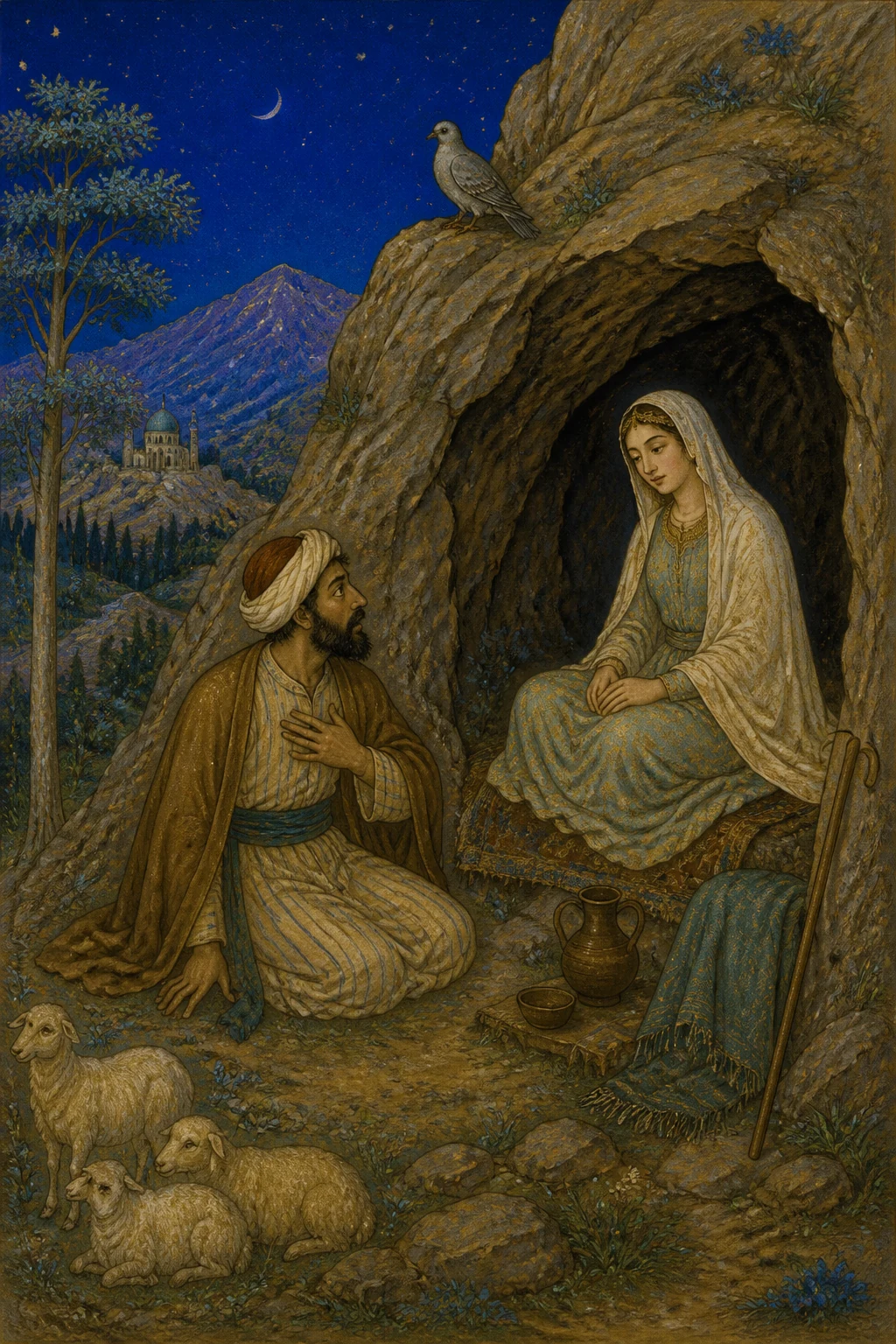
It is related that among the Children of Israel there was a man of exceptional virtue, who devoted himself to the worship of his Lord, renounced the world, and banished it from his heart. He had a wife who supported him in his way of life and obeyed him at all times. They earned their living by making trays and fans, working the whole day through. At the end of the day, the man would take what they had made and walk through the lanes and streets, seeking someone to buy it. They fasted continually, and one day, having risen fasting as usual, they spent the day at their work. When evening approached, the man went out as was his custom, carrying what they had made and looking for a buyer. He passed the door of a wealthy man of rank who lived in luxury. Now the craftsman had a radiant face and a handsome form, and when the mistress of the house saw him, she fell in love with him and her heart inclined passionately toward him. Her husband was away, so she called her maid and said, “Perhaps you can find some way to bring that man in to us.” The maid went out and called him back from his way, saying that she wished to buy what he carried. But morning overtook Shahrazad, and she fell silent, leaving her tale untold.
When it was the four hundred and sixty-ninth night
She said: It has reached me, O fortunate King, that the maid went out to the man and called to him, saying, “Come in, for my mistress wishes to buy some of the things you carry, after she has examined them and seen them for herself.” The man supposed that she spoke the truth and saw no harm in it, so he entered and sat down as she directed him. She locked the door upon him, and her mistress came out of her chamber, caught him by his robes, and drew him inside, saying, “How much longer must this go on? I long to be alone with you, and my patience is exhausted with yearning for you. This room is fragrant with incense, the food is ready, and the master of the house is away tonight. I have given myself to you. Kings, chieftains, and wealthy men have long sought my favors, but I have paid no heed to any of them.” She went on at length, while the man kept his eyes fixed on the ground, out of shame before Almighty God and fear of His grievous punishment. As the poet said:
Many a grave sin has tempted me, with nothing but shame to stand between me and its doing. Shame was the remedy for it; but once shame is gone, there is no remedy. The teller continued: The man hoped to free himself from her, but could find no way. At last he said, “There is something I need from you.” “What is it?” she asked. He replied, “I need pure water to take to the highest place in your house, where I may attend to a matter and wash away an impurity I cannot disclose to you.” She said, “The house is spacious, with secluded corners and hidden recesses, and the privy is ready.” He answered, “I wish only to go up high.” So she said to her maid, “Take him up to the uppermost pavilion of the house.” The maid led him to its highest point, handed him a vessel of water, and went down again. The man performed his ablutions and prayed two rak‘ahs, then looked down at the ground, intending to cast himself upon it. Seeing how far below it lay, he feared that he would reach it only to be dashed to pieces. But then he reflected on disobedience to Almighty God and His punishment, and it seemed a small thing to sacrifice his life and shed his blood. He said, “My God and my Master, You see what has befallen me, and my plight is not hidden from You. Truly, You have power over all things.” His very condition seemed to recite these verses:
My heart and inmost thoughts turn toward You; the secret of all secrets lies open to Your knowledge. When I speak, it is You I call upon, and in my silence, it is toward You I gesture. O You who have no second, to You has come this bewildered lover, poor and needy. I cherish a hope my trust assures me You will fulfill, and my heart, as You know, flutters within me. To give up one’s life is the hardest trial of all, yet if You decree it, it is easy. And if You graciously grant me deliverance, You, O my hope, have the power to do so. Then the man cast himself from the top of the pavilion, but God sent an angel who bore him upon his wing and set him safely on the ground without the least harm. Once he stood upon the earth, he praised God, the Mighty and Glorious, for the protection He had bestowed upon him and the mercy He had shown him, then went home to his wife empty-handed. He had been long absent, and when he entered with nothing, she asked what had delayed him, what had become of the goods he had taken out, and how he had returned with nothing at all. He told her of the temptation that had beset him, and how he had thrown himself from that height and God had saved him. His wife said, “Praise be to God, who turned temptation away from you and spared you that ordeal.” Then she added, “Husband, our neighbors are accustomed to seeing us light our oven every night. If they see no fire tonight, they will know that we have nothing. One way of thanking God is to conceal our poverty, continue our fast through this night after the day just past, and spend the night in prayer to Almighty God.” So she went to the oven, filled it with wood, and lit it to mislead the neighboring women, reciting these verses:
I shall conceal the longing and sorrow within me, and kindle my fire to deceive my neighbors. I am content with the judgment my Master has decreed; perhaps He will see my humility before Him and be pleased with me. But morning overtook Shahrazad, and she fell silent, leaving her tale untold.
When it was the four hundred and seventieth night
She said: It has reached me, O fortunate King, that when the woman had kindled the fire to mislead the neighbors, she and her husband rose, performed their ablutions, and stood in prayer. Just then a neighboring woman asked leave to take a light from their oven. They said to her, “Help yourself to the oven.” When she approached it to take some fire, she called out, “Come quickly, good woman, and save your bread before it burns!” The man’s wife said to him, “Did you hear what that woman is saying?” He replied, “Go and see.” She rose and went to the oven, and there it was, filled with fine white bread. She took out the loaves and came in to her husband, thanking God, the Mighty and Glorious, for His abundant goodness and immense bounty. They ate the bread, drank some water, and praised Almighty God. Then the woman said to her husband, “Come, let us pray to Almighty God. Perhaps He will graciously grant us something to spare us the struggle for a livelihood and the toil of labor, and help us worship and obey Him.” “Yes,” he said. So the man prayed to his Lord, and his wife said amen to his prayer. Suddenly the ceiling opened, and a ruby descended, lighting the whole house with its radiance. They redoubled their thanks and praises, rejoicing greatly in the ruby, and prayed as long as Almighty God willed. Toward the end of the night they slept, and the woman dreamed that she had entered Paradise. There she saw many pulpits set in rows and seats arrayed, and asked, “What are these pulpits, and what are these seats?” She was told, “These are the pulpits of the prophets, and these are the seats of the righteous and the devout.” She asked, “And where is the seat of my husband, so-and-so?” “Here it is,” she was told. She looked at it and saw a gap in its side. “What is this gap?” she asked. She was told, “It is the place of the ruby that descended to you through the ceiling of your house.” She awoke weeping, grieved that her husband’s seat among the seats of the righteous should be diminished. She said, “Husband, pray to your Lord to return this ruby to its place. To endure hunger and poverty for a few short days is easier than to leave a gap in your seat among the virtuous.” So the man prayed to his Lord, and the ruby flew up toward the ceiling as they watched. They continued in their poverty and worship until they met God, the Mighty and Glorious.