Prevod
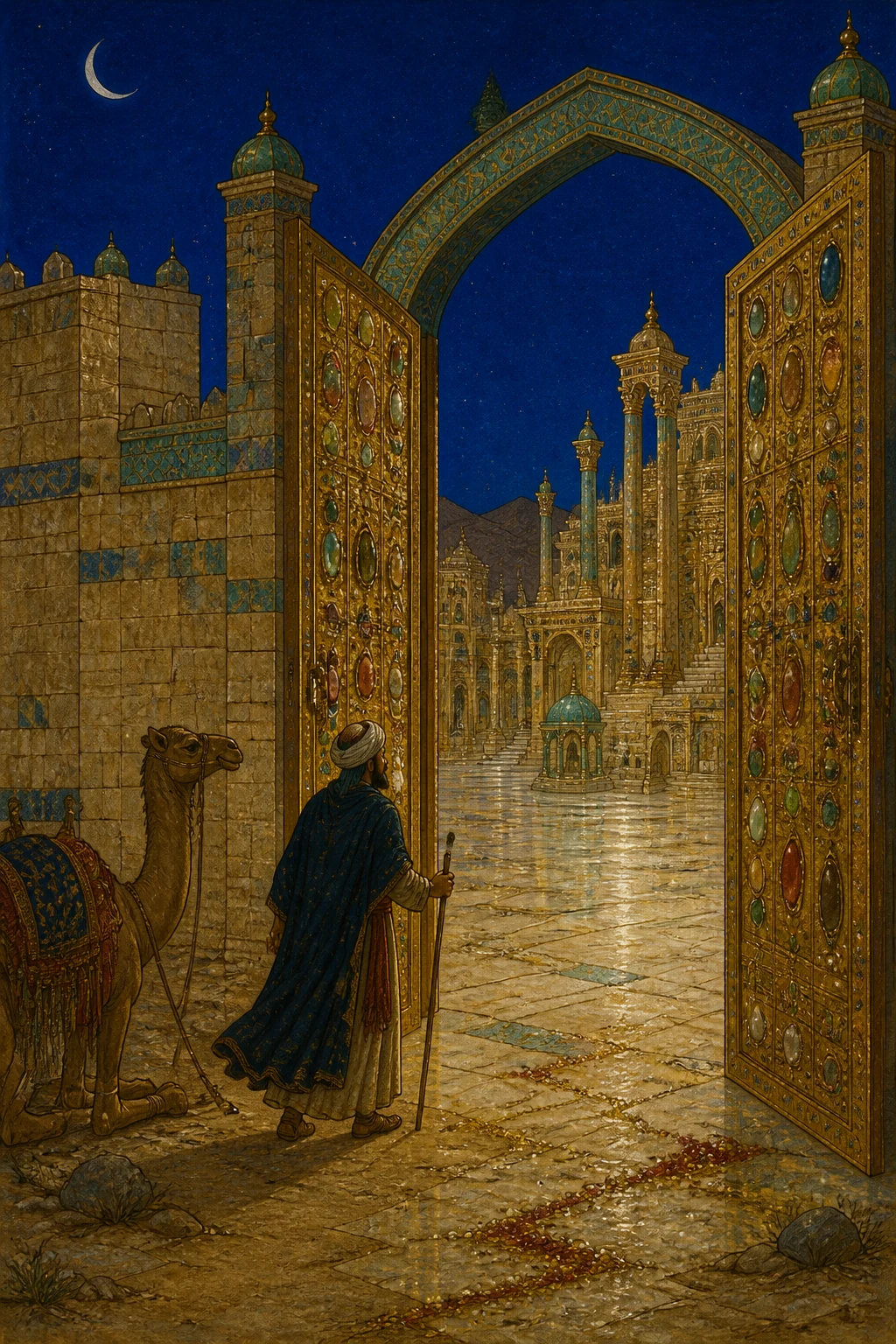
It has reached me, O fortunate King, that there was a town called Lubta, a royal seat in the land of the Romans, in which stood a palace that was always kept locked. Whenever a king died and another Roman king succeeded him, the new king would add a sturdy lock to its door, until twenty-four locks had gathered upon it, one from each king. Then a man who was not of the royal house came to the throne, and he wished to open those locks and see what lay within the palace. The great officers of the kingdom sought to prevent him, reproaching and rebuking him, but he refused to heed them and said, “That palace must be opened.” They offered him all the precious wealth and treasures they possessed if he would leave it unopened, but he would not relent. And dawn overtook Shahrazad, and she fell silent, leaving her tale untold.
Then, when it was the two hundred and seventy-second night,
She said: It has reached me, O fortunate King, that the people of the kingdom offered that king all the wealth and treasures they possessed if he would leave the palace unopened, but he would not abandon his purpose. He removed the locks and opened the door, and within he found pictures of Arabs mounted on their horses and camels, wearing turbans with flowing ends, with swords slung about them and long lances in their hands. He also found a document, which he took up and read. Written in it were these words: “When this door is opened, a people of the Arabs, having the appearance shown in this picture, will conquer this region. Beware, then, beware of opening it!” That city was in al-Andalus, and Tariq ibn Ziyad conquered it that very year, during the caliphate of al-Walid ibn Abd al-Malik of the House of Umayya. He put that king to a most hideous death, plundered his lands, carried off their women and boys into captivity, and seized their wealth. There he found vast treasures, including more than a hundred and seventy crowns of pearls and rubies. He found precious stones, and a hall so spacious that horsemen could charge through it with their lances, and gold and silver vessels beyond all description. There too he found the table that had belonged to Solomon son of David, the Prophet of God, peace be upon them both. It was said to be made of green emerald, and this table remains to this day in the city of Rome. Its vessels were of gold, and its dishes of chrysolite and precious gems. He also found the Psalms, written in Greek script upon sheets of gold set with jewels, and a book describing the virtues of stones and plants, cities and villages, talismans, and the alchemical arts of gold and silver. He found another book explaining the craft of making rubies and other gems, the compounding of poisons and antidotes, and the forms and features of the earth, the seas, the countries, and the mines. He found a great chamber filled with an elixir of which a single dirham’s weight would turn a thousand dirhams of silver into pure gold. There too he found a wondrous great round mirror, fashioned from various substances for Solomon son of David, the Prophet of God, peace be upon them both: whoever looked into it could see the seven climes plainly before his eyes. And he found a hall containing scarlet rubies beyond all description. All this he sent to al-Walid ibn Abd al-Malik, and the Arabs spread throughout the cities of that land, which is among the greatest of countries.