Prevod
It is also told that Harun al-Rashid was seated one day upon the throne of the caliphate when a young eunuch entered bearing a crown of red gold, studded with pearls and precious stones and set with rubies and other jewels beyond all price. The man kissed the ground before the Caliph and said, “Commander of the Faithful, Lady Zubayda…” But morning overtook Shahrazad, and she fell silent, leaving her tale untold.
Her sister said to her, “How lovely your story is, how delightful, how sweet and pleasing!” She replied, “Yet what is this beside what I shall tell you tomorrow night, if I live and the king spares me!” And the king said to himself, “By Allah, I will not kill her until I have heard the rest of her tale.”
When it was the three hundredth night,
Her sister said, “Sister, finish your story for us.” She replied, “Gladly and with all my heart, if the king permits.” The king said, “Tell your tale, Shahrazad.” She said: It has reached me, O fortunate King, that the servant said to the Caliph, “Lady Zubayda kisses the ground before you and says: You know that she has had this crown made, but it needs a large jewel for its summit. She has searched her treasures and found no jewel large enough to suit her purpose.” The Caliph said to his chamberlains and deputies, “Search for a large jewel such as Zubayda desires.” They searched but found nothing to suit her, and reported this to the Caliph. He was troubled and said, “How can I be Caliph and king of the earth, yet be unable to procure a jewel? Woe to you! Ask the merchants.” They questioned the merchants, who told them, “Our lord the Caliph will find such a jewel only with a man of Basra called Abu Muhammad the Lazy.” They informed the Caliph, and he ordered his vizier Ja‘far to send a letter to Emir Muhammad al-Zubaydi, governor of Basra, instructing him to make ready Abu Muhammad the Lazy and bring him before the Commander of the Faithful. The vizier wrote a letter to this effect and sent it with Masrur.
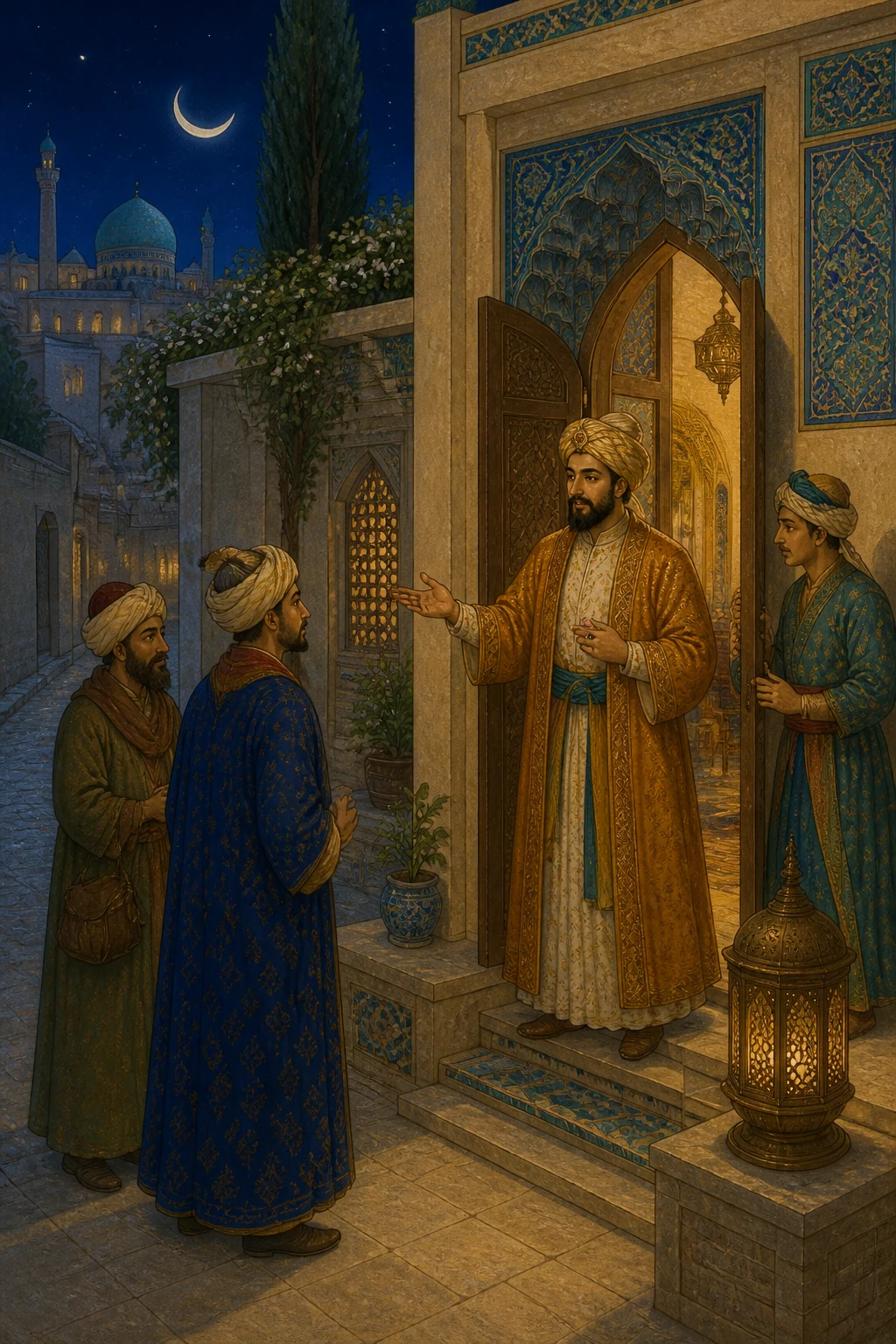
Masrur took the letter to the city of Basra and went before Emir Muhammad al-Zubaydi, who was delighted to see him and received him with the utmost honor. He then read him the letter from the Commander of the Faithful, Harun al-Rashid, and the emir replied, “I hear and obey.” He sent Masrur with a party of his followers to Abu Muhammad the Lazy. They went to his house and knocked at the door, and one of the servants came out. Masrur said to him, “Tell your master that the Commander of the Faithful summons him.” The servant went in and told him, and Abu Muhammad came out to find Masrur, the Caliph’s chamberlain, with the followers of Emir Muhammad al-Zubaydi. He kissed the ground before him and said, “I hear and obey the Commander of the Faithful. But pray, come inside.” They said, “We can do so only briefly, for the Commander of the Faithful has ordered us to make haste and awaits your arrival.” He replied, “Bear with me a little while I make my preparations.” After much entreaty they entered the house with him, and in the entrance hall they saw curtains of blue brocade embroidered with red gold. Abu Muhammad the Lazy then ordered some of his servants to accompany Masrur to the bathhouse within his home. They did so, and Masrur found its walls and marblework marvelous to behold, adorned with gold and silver, while its water was mingled with rosewater. The servants attended Masrur and his companions with the greatest care and served them to perfection. When they came out of the bath, they dressed them in robes of brocade woven with gold. Masrur and his companions then went in and found Abu Muhammad the Lazy seated in his palace, with curtains of gold-woven brocade set with pearls and jewels hanging above his head. The palace was furnished with cushions embroidered in red gold, and he sat upon a mattress laid on a jewel-studded couch.
When Masrur entered, Abu Muhammad welcomed him warmly and seated him at his side, then ordered the meal to be brought. At the sight of it Masrur said, “By Allah, I have never seen such a table even in the presence of the Commander of the Faithful.” It held every sort of food, all served on gilded porcelain dishes. Masrur said, “We ate and drank and made merry until the end of the day, and then he gave each of us five thousand dinars.” On the second day they dressed them in green robes embroidered with gold and treated them with the greatest honor. Then Masrur said to him, “We dare not remain any longer, for fear of the Caliph.” Abu Muhammad the Lazy replied, “My lord, bear with us until tomorrow, so that we may make ready and set out with you.” They stayed that day and passed the night there. In the morning the servants saddled a mule for Abu Muhammad the Lazy with a saddle of gold set with every kind of pearl and jewel. Masrur said to himself, “I wonder whether, when Abu Muhammad appears before the Caliph in such splendor, he will ask him how he came by all this wealth.” Then they took leave of Abu Muhammad al-Zubaydi and set out from Basra, traveling on until they reached Baghdad. They entered the Caliph’s presence and stood before him, and he ordered Abu Muhammad to sit. He sat down and said courteously, “Commander of the Faithful, I have brought a gift as a token of my service. Have I your permission to present it?” Al-Rashid said, “Certainly.” Abu Muhammad called for a chest, opened it, and brought out rare treasures, among them trees of gold whose leaves were white emeralds and whose fruits were red and yellow rubies and white pearls. The Caliph marveled at them. Then Abu Muhammad had a second chest brought and took from it a tent of brocade adorned with pearls, rubies, emeralds, chrysolites, and all manner of precious stones. Its poles were of fresh Indian aloeswood, and its skirts were studded with green emeralds. It bore images of every kind of animal, bird, and wild beast, all encrusted with jewels, rubies, emeralds, chrysolites, spinels, and every sort of precious mineral.
When al-Rashid saw this, he was overjoyed. Then Abu Muhammad the Lazy said, “Commander of the Faithful, do not think that I brought you this from fear of anything or in hope of any reward. I am but a common man, and I judged these things fit for none but the Commander of the Faithful. If you permit me, I shall show you something of what I can do.” Al-Rashid said, “Do as you please, so that we may see.” He replied, “I hear and obey.” Then he moved his lips and beckoned to the battlements of the palace, and they inclined toward him. He gestured to them again, and they returned to their places. Then he made a sign with his eye, and chambers with locked doors appeared before him. He spoke to them, and the voices of birds answered him. Al-Rashid was utterly astonished and said, “How did you come by all this, when you are known only as Abu Muhammad the Lazy? I have been told that your father was a barber who worked in a bathhouse and left you nothing.” He replied, “Commander of the Faithful, hear my story.” But morning overtook Shahrazad, and she fell silent, leaving her tale untold.
When it was the three hundred and first night,
She said: It has reached me, O fortunate King, that Abu Muhammad the Lazy said to the Caliph, “Commander of the Faithful, hear my story, for it is wondrous and strange. Were it written with needles upon the inner corners of the eyes, it would be a lesson to all who take heed.” Al-Rashid said, “Tell me your story, Abu Muhammad, and let me hear it.” He said, “Know, Commander of the Faithful—may Allah preserve your glory and power—that what people tell you is true: I am known as the Lazy, and my father left me no money. He was indeed just as you have said, a barber in a bathhouse, and in my youth I was the laziest creature on the face of the earth. So great was my laziness that if I lay asleep in hot weather and the sun fell upon me, I was too lazy to rise and move from the sunshine into the shade. I continued thus for fifteen years. Then my father passed into the mercy of Allah Most High, leaving me nothing. My mother worked in other people’s houses and brought me food and drink while I lay upon my side. One day she came in carrying five silver dirhams and said, ‘My son, I hear that Sheikh Abu al-Muzaffar intends to travel to China.’ Now this sheikh loved the poor and was a charitable man. My mother said, ‘My son, take these five dirhams and come with me to him. We shall ask him to buy you something with them in China, and perhaps, by the grace of Allah Most High, you may make a profit.’ I was too lazy to get up and go with her, so she swore by Allah that unless I rose and accompanied her, she would neither feed me nor give me drink nor come near me, but would leave me to die of hunger and thirst.
“When I heard her words, Commander of the Faithful, I knew that she would do as she said, knowing my laziness as she did. So I said to her, ‘Sit me up.’ She sat me up, with tears streaming from my eyes, and I said, ‘Bring me my shoes.’ She brought them, and I said, ‘Put them on my feet.’ She put them on, and I said, ‘Lift me up off the ground.’ She did so, and I said, ‘Support me so that I can walk.’ She supported me, and I walked on, stumbling over the skirts of my robe, until we reached the seashore. We greeted the sheikh, and I said, ‘Uncle, are you Abu al-Muzaffar?’ He replied, ‘At your service.’ I said, ‘Take these dirhams and buy me something with them in China. Perhaps Allah will grant me a profit on it.’ Sheikh Abu al-Muzaffar said to his companions, ‘Do you know this young man?’ They replied, ‘Yes, he is known as Abu Muhammad the Lazy. We have never seen him leave his house until this moment.’ Sheikh Abu al-Muzaffar said, ‘My son, give me the dirhams, with the blessing of Allah Most High.’ He took the coins from me, saying, ‘In the name of Allah.’ Then I returned home with my mother, and Sheikh Abu al-Muzaffar set out on his journey with a party of merchants. They traveled on until they reached China, where the sheikh bought and sold. When he and his companions had completed their business, they set off homeward. After they had sailed for three days, the sheikh said to his companions, ‘Stop the ship.’ The merchants asked, ‘What do you need?’ He replied, ‘You must know that I forgot the errand entrusted to me by Abu Muhammad the Lazy. Let us return and buy him something useful with his money.’ They said, ‘We beg you by Allah Most High not to turn us back. We have already traveled a great distance and suffered terrible dangers and hardships.’ He replied, ‘We must return.’ They said, ‘Take from us many times the profit those five dirhams would have earned, but do not turn us back.’ He agreed, and they collected a considerable sum for him. They sailed on until they came in sight of an island with many inhabitants and anchored there. The merchants went ashore to buy merchandise: minerals, jewels, pearls, and other goods.
“Then Abu al-Muzaffar saw a man sitting with many monkeys before him. Among them was one whose fur had been plucked out. Whenever their owner looked away, the other monkeys seized this plucked monkey, beat it, and hurled it at their master. He would rise and beat them, bind them, and punish them for it. This made all the monkeys furious with the plucked one, and they beat it again. When Sheikh Abu al-Muzaffar saw the creature, his heart ached for it and he took pity on it. He said to its owner, ‘Will you sell me this monkey?’ The man replied, ‘Make an offer.’ He said, ‘I have five dirhams belonging to an orphan boy. Will you sell it to me for that?’ He replied, ‘It is yours. May Allah bless you in it.’ The sheikh took the monkey and paid him the dirhams. His slaves brought it aboard and tied it up in the ship. Then they weighed anchor and sailed to another island, where they anchored. The divers went down to search for minerals, pearls, jewels, and other things, the merchants paying them for their dives. When the monkey saw what they were doing, it untied itself, sprang from the ship, and dived with them. Abu al-Muzaffar said, ‘There is no power and no might save in Allah, the Most High, the Almighty! The monkey is lost to us. Such is the luck of the poor fellow for whom we bought it!’ They gave up hope of the monkey, but then a party of divers surfaced, and there it was among them, holding precious jewels in its hands. It threw them down before Abu al-Muzaffar, who marveled and said, ‘There is some great mystery in this monkey.’ They weighed anchor and sailed on until they reached an island called the Island of the Zanj, whose inhabitants were black people who ate human flesh. When the islanders saw them, they put out in boats, came alongside, and seized everyone aboard. They bound their arms and brought them before their king, who ordered a number of the merchants slaughtered. They killed them and ate their flesh, while the remaining merchants spent the night imprisoned in the deepest distress. During the night the monkey went to Abu al-Muzaffar and loosened his bonds. When the merchants saw that he was free, they said, ‘May Allah grant us deliverance through your hands, Abu al-Muzaffar!’ He replied, ‘Know that, by the will of Allah Most High, it was none but this monkey that freed me.’” But morning overtook Shahrazad, and she fell silent, leaving her tale untold.
When it was the three hundred and second night,
She said: It has reached me, O fortunate King, that Abu al-Muzaffar said, “‘By the will of Allah Most High, it was none but this monkey that freed me, and I have pledged it a thousand dinars.’ The merchants said, ‘We too will each give it a thousand dinars if it sets us free.’ The monkey went to them and began untying them one after another, until it had freed them all. They went to the ship and boarded her, finding her unharmed and nothing missing. Then they weighed anchor and set sail. Abu al-Muzaffar said, ‘Merchants, fulfill the promise you made to the monkey.’ They replied, ‘We hear and obey.’ Each paid him a thousand dinars, and Abu al-Muzaffar added a thousand dinars from his own money, so that the monkey amassed a great fortune. They sailed on until they reached Basra, where their friends met them as they disembarked. Abu al-Muzaffar asked, ‘Where is Abu Muhammad the Lazy?’ The news reached my mother, and while I lay asleep she came to me and said, ‘My son, Sheikh Abu al-Muzaffar has returned and is here in the city. Get up, go and greet him, and ask what he has brought you. Perhaps Allah Most High has granted you some good fortune.’ I said to her, ‘Lift me off the ground and support me so that I can go out and walk to the seashore.’ Then I walked on, stumbling over the skirts of my robe, until I reached Sheikh Abu al-Muzaffar. When he saw me, he said, ‘Welcome to the man whose dirhams, by the will of Allah Most High, brought deliverance to me and these merchants!’ Then he said, ‘Take this monkey, which I bought for you, and bring it home. I shall come to you there.’ I took the monkey and went off, saying to myself, ‘By Allah, what a splendid piece of merchandise!’ When I entered my house, I said to my mother, ‘Whenever I sleep, you order me to get up and trade. Look with your own eyes at the merchandise I have gained!’ Then I sat down.
“While I was sitting there, Abu al-Muzaffar’s slaves came to me and asked, ‘Are you Abu Muhammad the Lazy?’ I replied, ‘Yes.’ Then Abu al-Muzaffar himself appeared behind them. I rose and kissed his hands, and he said, ‘Come with me to my house.’ I replied, ‘I hear and obey.’ I went with him until we entered his house, where he ordered his slaves to bring the money. When they had brought it, he said, ‘My son, Allah has granted you this fortune as the profit on your five dirhams.’ They lifted the money in chests onto their heads, and he gave me the keys, saying, ‘Walk ahead of the slaves to your house, for all this money is yours.’ I returned to my mother, who rejoiced and said, ‘My son, Allah has blessed you with this great wealth. Give up your laziness now. Go down to the market, buy and sell.’ So I abandoned my laziness and opened a shop in the market. The monkey sat beside me on my cushion; when I ate, it ate with me, and when I drank, it drank with me. Every morning it would disappear until noon, then return with a purse containing a thousand dinars, set it beside me, and sit down. It continued thus for some time, until I had amassed a great fortune. I bought estates and houses, Commander of the Faithful, planted gardens, and purchased mamluks, slaves, and serving girls. One day, as I sat with the monkey beside me on the cushion, it began looking to right and left. I said to myself, ‘What can be the matter with it?’ Then Allah gave the monkey the power of eloquent speech, and it said, ‘Abu Muhammad!’ When I heard it speak, I was terribly frightened, but it said, ‘Do not be afraid. I shall tell you what I am. I am a marid of the jinn, and I came to you because of your poverty. Today you do not even know the extent of your wealth. Now I have a favor to ask of you, and it will be to your own advantage.’ I asked, ‘What is it?’ It said, ‘I wish to marry you to a girl as lovely as the full moon.’ I said, ‘How can that be?’ It replied, ‘Tomorrow, put on your finest clothes, mount your mule with the golden saddle, and go to the fodder merchants’ market. Ask for the Sharif’s shop, sit with him, and say, “I have come as a suitor for your daughter’s hand.” If he tells you, “You have neither wealth, standing, nor lineage,” give him a thousand dinars. If he says, “Give me more,” add to the sum and tempt him with money.’ I replied, ‘I hear and obey. Tomorrow I shall do so, if Allah Most High wills.’” Abu Muhammad continued, “When morning came, I dressed in my finest clothes, mounted the mule with the golden saddle, and went to the fodder merchants’ market. I asked for the Sharif’s shop and found him sitting there. I dismounted, greeted him, and sat beside him.” But morning overtook Shahrazad, and she fell silent, leaving her tale untold.
When it was the three hundred and third night,
She said: It has reached me, O fortunate King, that Abu Muhammad the Lazy said, “I dismounted, greeted him, and sat beside him. I had ten slaves and mamluks with me. The Sharif said, ‘Perhaps there is something we may have the pleasure of doing for you?’ I replied, ‘Yes, I have a request to make of you.’ He asked, ‘What is your request?’ I said, ‘I have come as a suitor for your daughter’s hand.’ He replied, ‘You have neither wealth, standing, nor lineage.’ I brought out a purse containing a thousand dinars of red gold and said, ‘Here are my standing and my lineage. The Prophet, Allah bless him and grant him peace, said, “Wealth is a noble pedigree.” And how well the poet put it:
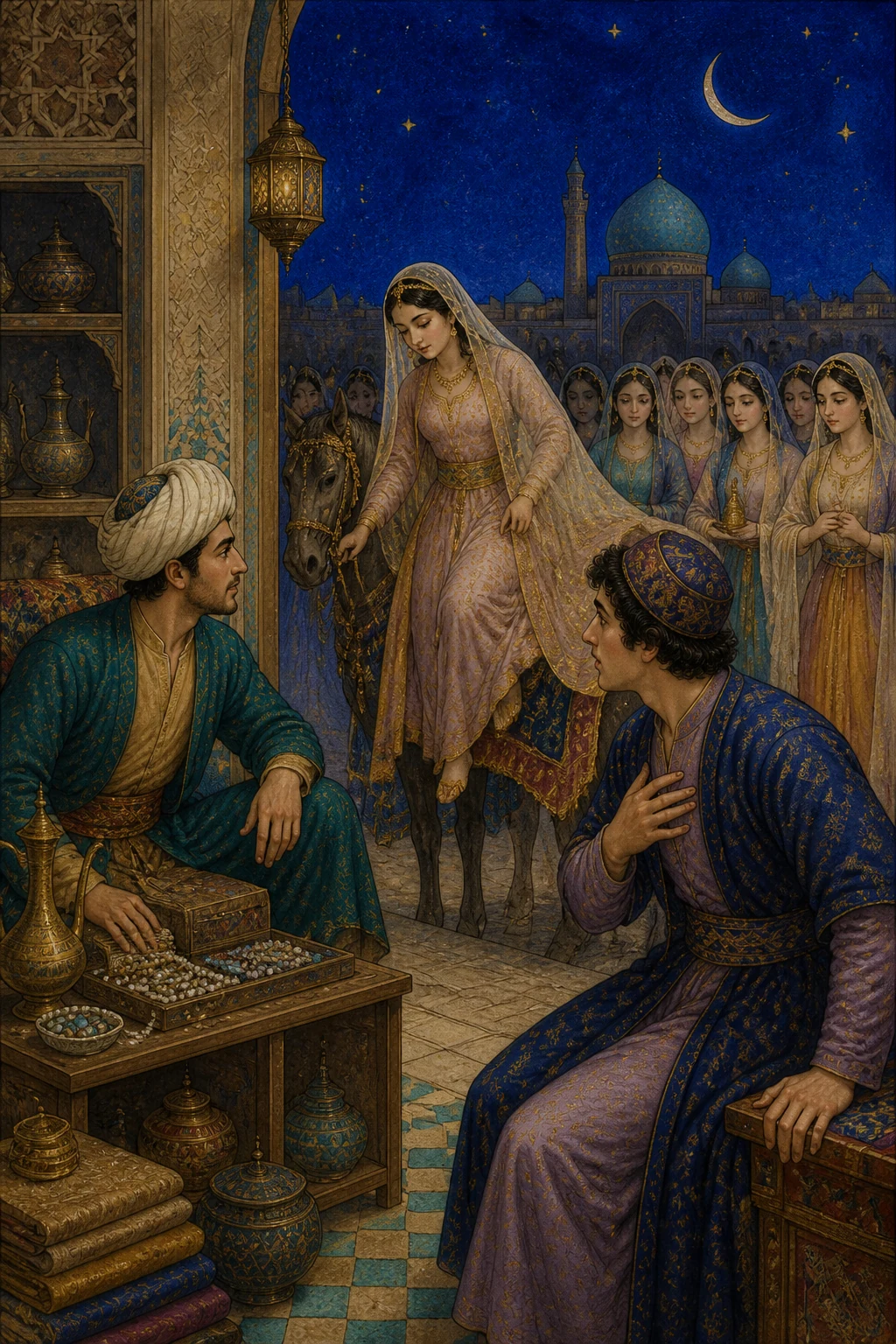
“‘The man who owns two dirhams finds his lips have learned all kinds of eloquence. His fellows draw near and listen as he speaks, and you see him strutting proudly among men. But for the coins in which he takes such pride, you would find him the most wretched of them all. When a rich man speaks in error, they say, “You speak the truth; there is no fault in what you say.” But when a poor man tells the truth, they say, “You lie,” and set his words at naught. In every place, money clothes a man in dignity and grace: it is a tongue for him who seeks eloquence, a weapon for him who wishes to fight.’ When the Sharif heard my words and understood the verse I had recited, he lowered his head toward the ground for a while, then raised it and said, ‘If you insist, I require another three thousand dinars.’ I replied, ‘I hear and obey.’ I sent one of my mamluks home, and he brought the sum requested. When the Sharif saw the money delivered to him, he rose from his shop and said to his servants, ‘Close it.’ Then he invited his friends from the market to his house, had my marriage contract with his daughter drawn up, and said, ‘In ten days I shall bring you to her.’ I went home rejoicing and, when I was alone with the monkey, told it what had happened. It said, ‘You have done well.’ As the day appointed by the Sharif drew near, the monkey said to me, ‘I have a favor to ask of you. If you grant it, you may ask of me whatever you please.’ I said, ‘What is your request?’ It replied, ‘At the far end of the hall where you will join the Sharif’s daughter stands a storeroom. On its door is a brass ring, and beneath the ring are the keys. Take them and open the door. You will find an iron chest, with four talismanic banners at its corners. In their midst is a basin full of money, with eleven snakes beside it. In the basin is a white cock with a divided comb, tied up. A knife lies beside the chest. Take the knife and slaughter the cock, cut down the banners, and overturn the chest. Then go out to your bride and take her maidenhead. That is the favor I ask of you.’ I replied, ‘I hear and obey.’ Then I went to the Sharif’s house and entered the hall, where I saw the storeroom the monkey had described. When I was alone with my bride, I marveled at her loveliness, her beauty, her figure, and her graceful proportions, for no tongue could describe her charms. I was filled with joy at the sight of her.
“At midnight, when the bride had fallen asleep, I rose, took the keys, and opened the storeroom. I picked up the knife and slaughtered the cock, cast down the banners, and overturned the chest. The girl awoke and saw that the storeroom stood open and the cock had been killed. She cried, ‘There is no power and no might save in Allah, the Most High, the Almighty! The marid has me!’ Scarcely had she finished speaking when the marid enveloped the house and snatched away the bride. An outcry arose, and the Sharif came in, beating his face. He said, ‘Abu Muhammad, what have you done to us? Is this how you repay us? I placed that talisman in the storeroom to protect my daughter from this accursed creature. For six years he has sought to carry her off, but could not. You have no place among us now. Go your way.’ I left the Sharif’s house and returned home, where I searched for the monkey but could find neither it nor any trace of it. Then I knew that it was the marid who had carried off my wife, and that it had tricked me into destroying the talisman and the cock that prevented it from taking her. In my remorse I tore my clothes and beat my face, and the whole earth seemed too narrow to contain me. I left at once and made for the wilderness, walking on until evening fell, with no idea where to go. While I was lost in thought, two snakes approached, one brown and the other white, fighting each other. I picked up a stone and struck the brown snake dead, for it was attacking the white one. The white snake went away and disappeared for a while, then returned with ten white snakes. They came to the dead snake and tore it to pieces until nothing remained but its head, then went their way. Exhausted, I lay down where I was. As I lay there pondering my plight, I heard an unseen voice reciting these two verses:
“‘Let destiny run with loosened reins, and never pass the night with a troubled mind. Between the closing of an eye and its opening, Allah changes one condition to another.’ When I heard this, Commander of the Faithful, I was overcome by anguish and thoughts beyond all measure. Then I heard a voice behind me reciting these lines:
“‘O Muslim, with the Quran before you, rejoice: through it, safety has come to you. Fear not the snares that Satan lays, for we are a people whose religion is faith.’ I said to the speaker, ‘By Him whom you worship, tell me who you are!’ Then the unseen speaker took human form and said, ‘Do not be afraid. Your kindness has reached us. We are a people of the believing jinn. If you have any need, tell us, so that we may have the pleasure of fulfilling it.’ I replied, ‘My need is great, for a grievous calamity has befallen me. Who has ever suffered a misfortune like mine?’ He said, ‘Perhaps you are Abu Muhammad the Lazy?’ I replied, ‘Yes.’ He said, ‘Abu Muhammad, I am the brother of the white snake whose enemy you killed. We are four siblings, born of the same father and mother, and all of us are grateful for your kindness. Know that the creature who took the form of a monkey and deceived you is one of the rebellious marids of the jinn. Had he not contrived this trick, he could never have carried her off. For a long time he had wished to take her, but the talisman prevented him. Had it remained intact, he could never have reached her. But do not despair over this affair. We shall bring you to her and kill the marid, for your kindness will not go unrewarded among us.’ Then he gave a mighty shout.” But morning overtook Shahrazad, and she fell silent, leaving her tale untold.
When it was the three hundred and fourth night,
She said: It has reached me, O fortunate King, that the ifrit said, “‘Your kindness will not go unrewarded among us.’ Then he gave a mighty shout in a terrible voice, and a company appeared before him. He asked them about the monkey, and one of them said, ‘I know where he dwells.’ He asked, ‘Where does he dwell?’ The other replied, ‘In the City of Brass, upon which the sun never rises.’ He said, ‘Abu Muhammad, take one of our slaves. He will carry you upon his back and tell you how to rescue the girl. Know that this slave is one of the rebellious marids. When he carries you, do not utter the name of Allah, for he will flee from beneath you, and you will fall to your death.’ I replied, ‘I hear and obey.’ I took one of their slaves, who bent down and said, ‘Mount.’ I climbed onto his back, and he flew with me through the air until the world vanished from sight. I saw the stars like firmly rooted mountains and heard the angels in heaven praising Allah. All the while the marid talked to me, showed me wonders, and distracted me from the remembrance of Allah Most High.
“While I was thus occupied, a figure approached me, dressed in green, with flowing locks and a radiant face, holding a spear from which sparks flew. He said, ‘Abu Muhammad, say, “There is no god but Allah, and Muhammad is the Messenger of Allah,” or I shall strike you with this spear.’ My heart had been torn by my silence and my failure to remember Allah Most High, so I said, ‘There is no god but Allah, and Muhammad is the Messenger of Allah.’ The figure struck the marid with his spear, and it dissolved into ashes. I fell from its back and plunged toward the earth, until I landed in a raging sea of clashing waves. There was a ship with five sailors aboard, and when they saw me they came and took me into their vessel. They spoke to me in words I did not understand, and I gestured that I could not understand their language. They sailed until the end of the day, then cast a net, caught a fish, roasted it, and gave me some to eat. They continued sailing until they brought me to their city, where they took me before their king. I kissed the ground, and he bestowed a robe of honor upon me. This king knew Arabic, and he said, ‘I have appointed you one of my attendants.’ I asked him, ‘What is the name of this city?’ He replied, ‘Its name is Hanad, and it is in the land of China.’ The king entrusted me to the city’s vizier and ordered him to show me its sights. In former times the people of that city had been unbelievers, and Allah Most High had turned them to stone. I wandered through it and saw nothing more abundant than its trees and fruits. I remained there for a month. Then I came to a river and sat on its bank. While I was sitting there, a horseman approached and asked, ‘Are you Abu Muhammad the Lazy?’ I replied, ‘Yes.’ He said, ‘Do not be afraid, for your kindness has reached us.’ I asked him, ‘Who are you?’ He said, ‘I am the snake’s brother, and you are near the place where the girl you seek is held.’ Then he took off his clothes and dressed me in them, saying, ‘Do not be afraid. The slave who perished beneath you was one of our servants.’ The horseman seated me behind him and rode with me into a wilderness. Then he said, ‘Dismount and walk between these two mountains until you see the City of Brass. Keep your distance and do not enter it until I return and tell you what to do.’ I replied, ‘I hear and obey.’ I dismounted and walked until I reached the city. I saw that its walls were of brass and began to circle them, hoping to find a gate, but found none.
“As I was walking around it, the snake’s brother came to me and gave me an enchanted sword so that no one could see me. Then he went his way. He had been gone only a short while when a great clamor arose, and I saw a multitude of creatures whose eyes were in their breasts. When they saw me, they asked, ‘Who are you, and what has cast you into this place?’ I told them what had happened, and they said, ‘The girl you speak of is with the marid in this city, but we do not know what he has done with her. We are the snake’s brothers.’ Then they said, ‘Go to that spring, see where its water flows into the city, and follow it. It will bring you inside.’ I did so, following the water into an underground passage. When I emerged, I found myself in the middle of the city. There I saw the girl seated upon a golden couch beneath a curtain of brocade. Around the curtain was a garden of golden trees whose fruits were precious jewels: rubies, chrysolites, pearls, and coral. When the girl saw me, she recognized me and greeted me first, saying, ‘My lord, who brought you to this place?’ I told her what had happened, and she said, ‘Know that this accursed creature, out of his great love for me, has told me what can harm him and what can benefit him. He has told me that in this city there is a talisman by which, if he wished, he could destroy everyone here. Whatever he commands the ifrits, they obey, and this talisman is in a pillar.’ I asked, ‘Where is the pillar?’ She told me where it stood. I asked, ‘What is the talisman?’ She replied, ‘It is the image of an eagle, bearing an inscription I cannot read. Take it in your hands, fetch a brazier of live coals, and cast some musk into it. Smoke will rise and draw the ifrits to you. When you do this, every one of them will appear before you, without exception, and obey your commands. Whatever you tell them, they will do. Rise, then, and do this with the blessing of Allah Most High.’ I replied, ‘I hear and obey.’ I rose, went to the pillar, and did everything she had told me. The ifrits came and stood before me, saying, ‘At your service, master. Whatever you command us, we shall do.’ I said, ‘Bind the marid who brought this girl from her home.’ They replied, ‘We hear and obey.’ They went to the marid, bound him tightly, then returned and said, ‘We have done as you commanded.’ I ordered them to withdraw, then went back to the girl and told her what had happened. I said, ‘My wife, will you come with me?’ She replied, ‘Yes.’ I brought her out through the underground passage by which I had entered, and we walked until we reached the people who had guided me.” But morning overtook Shahrazad, and she fell silent, leaving her tale untold.
When it was the three hundred and fifth night,
She said: It has reached me, O fortunate King, that he said, “We walked until we reached the people who had guided me to her. Then I said, ‘Show me a road that will take me to my own country.’ They showed me the way and accompanied me to the seashore, where they put us aboard a ship. A favorable wind arose, and the ship carried us to Basra. When the girl entered her father’s house, her family saw her and were overjoyed. Then I burned musk before the eagle, and the ifrits came to me from every quarter, saying, ‘At your service! What would you have us do?’ I ordered them to bring all the money, minerals, and jewels in the City of Brass to my house in Basra, and they did so. Then I commanded them to bring the monkey, and they brought him humbled and abject. I said to him, ‘Accursed creature, why did you betray me?’ Then I ordered them to put him into a brass bottle. They thrust him into a narrow bottle of brass and sealed it over him with lead. My wife and I settled down to a life of happiness and delight. Now, Commander of the Faithful, I possess such precious treasures, wondrous jewels, and great wealth that no reckoning can encompass them and no measure contain them. If you desire money or anything else, I shall order the jinn to bring it to you at once. All this is by the grace of Allah Most High.” The Commander of the Faithful was utterly astonished. Then, in return for his gift, he bestowed upon him gifts from the caliphal treasury and showered him with favors befitting his station.