Prevod
She said: It has reached me, O fortunate king, that Khalid praised and glorified God, then delivered an eloquent marriage sermon and said to the young man, “I hereby give you in marriage this maiden, so-and-so, here present, with her consent and approval and her father’s permission, for this sum of ten thousand dirhams.” The young man replied, “I accept this marriage from you.” Then Khalid ordered the money to be borne in procession on trays to the young man’s house, and the people departed rejoicing. Never had I seen a day more wondrous than that one: it began in tears and trouble and ended in joy and delight.
It is also told that when Harun al-Rashid had Ja‘far al-Barmaki crucified, he ordered that anyone who mourned his death or composed an elegy for him should likewise be crucified, and so the people refrained. Now there was a Bedouin living in a distant wilderness who came every year to Ja‘far al-Barmaki with a poem. Ja‘far would reward him with a thousand dinars, which he would take home and spend on his family until the end of the year. The Bedouin came with his poem as usual, only to find Ja‘far hanging on the cross. He went to the place where he hung, made his camel kneel, and wept bitterly, overcome with grief. He recited his poem and then fell asleep. In his dream he saw Ja‘far al-Barmaki, who said to him, “You have wearied yourself to come to us, and found us as you have seen. But go to Basra and ask for a merchant there named so-and-so. Say to him, ‘Ja‘far al-Barmaki sends you his greetings and bids you give me a thousand dinars, with the bean as a token.’”
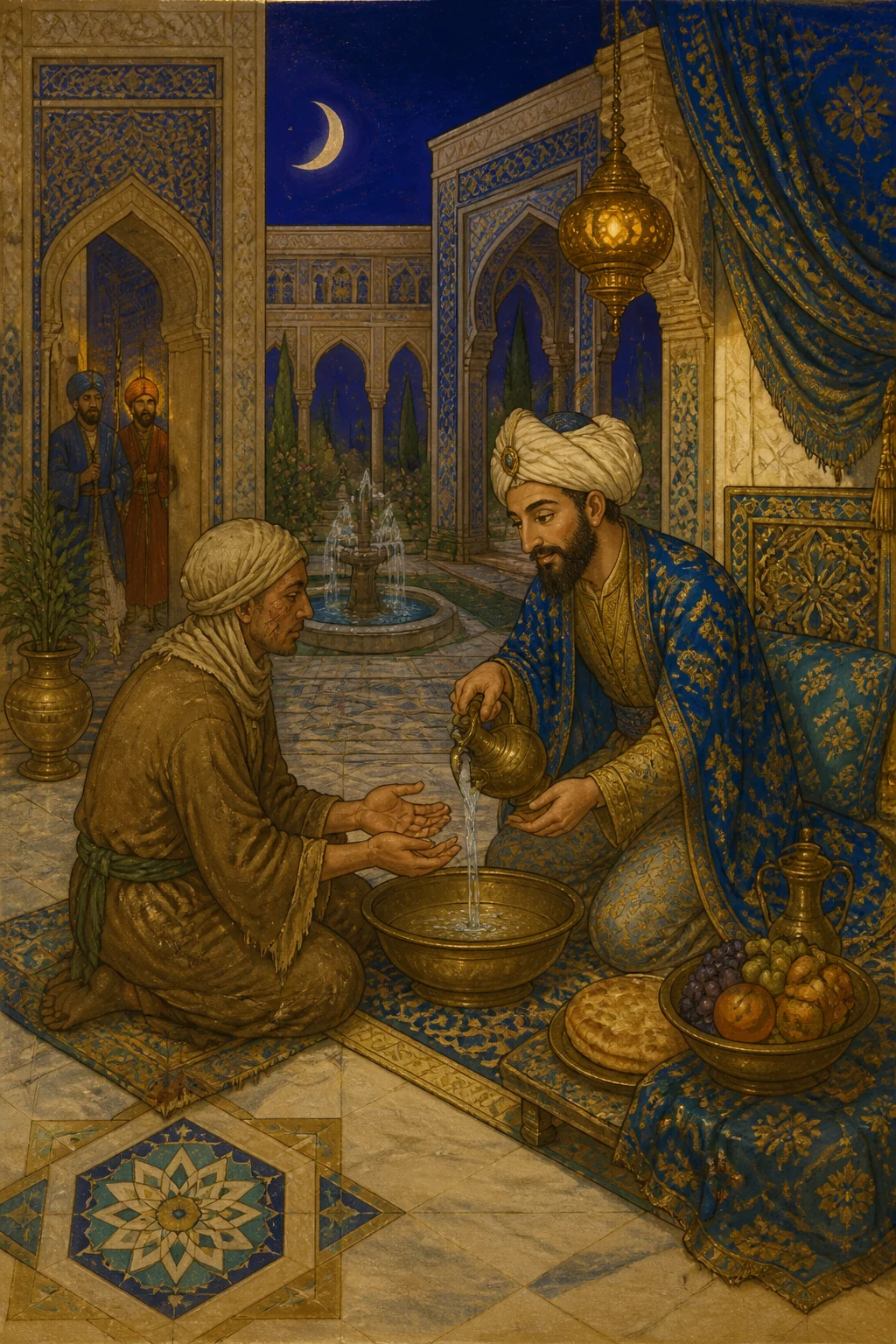
When the Bedouin awoke, he set out for Basra, sought out the merchant, and met with him, delivering the message Ja‘far had given him in the dream. The merchant wept so bitterly that he nearly died. Then he welcomed the Bedouin with great honor, seated him beside him, and lodged him hospitably. The Bedouin remained his honored guest for three days, and when he was ready to leave, the merchant gave him fifteen hundred dinars, saying, “The thousand are what I was bidden to give you, and the five hundred are a gift from me. You shall also have a thousand dinars every year.” As he was leaving, the Bedouin said to the merchant, “By God, tell me the story of the bean, so that I may know what lies behind it.” The merchant replied, “In my early days I was a poor man, going through the streets of Baghdad selling hot beans to earn a living. One cold, rainy day I went out with nothing on my body to shield me from the cold. Now I shivered violently, now I stumbled into the rainwater, in such a wretched state that the sight of me would make the skin creep. That day Ja‘far was sitting in his palace overlooking the street, with his intimates and favorite concubines about him. His eye fell upon me, and he took pity on my plight and sent one of his attendants to fetch me. When I was brought before him, he said, ‘Sell the beans you have to my company.’ So I began to measure them out with a measure I carried, and everyone who took a measure of beans filled it with gold, until all my beans were gone and not a thing remained in the basket. I gathered together the gold I had received, and Ja‘far asked me, ‘Have you any beans left?’ ‘I do not know,’ I replied. Then I searched the basket and found only a single bean. Ja‘far took it from me and split it in two, keeping one half and giving the other to one of his favorites. ‘How much will you pay for this half-bean?’ he asked her. ‘Twice the amount of this gold,’ she replied. I was bewildered and said to myself, ‘This is impossible!’ While I stood there marveling, the lady ordered one of her maidservants to bring twice as much gold as I had collected. Then Ja‘far said, ‘And I shall buy the half I have taken for twice the whole sum.’ He then said to me, ‘Take the price of your beans,’ and ordered one of his servants to gather all the money and put it in my basket. I took it and went away. Then I came to Basra and traded with the money I had, and God prospered me—to Him be all praise and thanks. So if I give you a thousand dinars every year out of what Ja‘far bestowed on me, it will do me no harm.” Behold, then, Ja‘far’s noble generosity, and the praise he earned both in life and after death. May God Most High have mercy upon him.