Prevod
The Christian said, “Know, O King of the Age, that when I came to these lands I brought merchandise with me, and destiny detained me among you. I was born in Egypt, and am one of its Copts, and there I was brought up. My father was a broker, and when I came of age he died, so I took his place. One day, as I was sitting at my business, a young man of extraordinary beauty came riding by on a donkey, dressed in the finest clothes. When he saw me, he greeted me, and I rose to show him respect. He took out a kerchief containing a little sesame and asked, ‘What is an ardabb of this worth?’ I told him, ‘A hundred dirhams.’ He said, ‘Take the porters and measurers and go to the Khan al-Jawali at Bab al-Nasr. You will find me there.’ He gave me the sesame in the kerchief that held the sample, then left me and went away. I made the rounds of the buyers until the price reached a hundred and twenty dirhams an ardabb. Then I took four porters with me and went to him, and found him waiting. When he saw me, he went to the storeroom and opened it. We measured its contents, which came to fifty ardabbs in all. The young man said, ‘You shall have ten dirhams on each ardabb as your brokerage. Collect the money and keep it with you. The price is five thousand dirhams: five hundred are yours, leaving four thousand five hundred for me. When I have finished selling the contents of my warehouses, I will come and collect it.’ I said, ‘As you wish.’ Then I kissed his hands and went away, having earned a thousand dirhams that day. He stayed away for a month, then came and asked, ‘Where is the money?’ I said, ‘Here it is, ready for you.’ He said, ‘Keep it until I come to take it.’ I waited for him, but he stayed away another month. Then he came and asked, ‘Where is the money?’ I rose, greeted him, and said, ‘Will you eat something with us?’ He declined and said, ‘Keep the money until I go and come back to collect it.’ Then he left. I rose and brought out the money for him, and sat waiting, but he stayed away another month. When he came, he said, ‘I will take it from you after today.’ Again he left, and again I brought out the money and sat waiting, but he stayed away a month. I said to myself, ‘This young man is generosity itself.’ At the end of the month he came in splendid clothes, like the moon on the night of its fullness, looking as though he had just left the bathhouse. His face was like the moon, his cheek rosy, his brow radiant, and his beauty spot like a little disc of ambergris. Of such beauty the poet said:
‘The full moon and the sun have met within one sign, rising in perfect beauty and good fortune. Their loveliness kindles longing in all who gaze: how wondrous, when the herald of delight calls! In beauty and grace they surpass all others and reach perfection; to them the soul has flown, to them the heart has hastened. Blessed be God, whose creatures are a marvel! The Lord Most High fashions His creation as He wills.’ When I saw him, I kissed his hands and prayed for him, then said, ‘My master, will you not take your money?’ He said, ‘Give me time to finish my affairs, and then I will take it.’ He went away, and I said to myself, ‘By God, when he comes again I shall entertain him, for I have profited by his money and made a great deal from it.’ At the end of the year he came wearing a suit finer than the first. I urged him on oath to dismount and be my guest. He said, ‘On condition that whatever you spend comes from my money in your keeping.’ ‘Agreed,’ I said. I seated him and went down to prepare suitable food and drink and all else that was needed. I set it before him and said, ‘In the name of God.’ He drew up to the table, put out his left hand, and ate with me, which astonished me. When we had finished, he washed his hand and I gave him something to dry it with. We sat talking, and I said, ‘My master, relieve my perplexity: why did you eat with your left hand? Is there something painful in your right?’ When he heard my words, he recited these two verses:
‘My friend, do not ask what burning anguish lies within my heart, lest hidden sickness show itself. Not willingly did I forsake Salma to seek another in her place, but necessity has laws of its own.’ Then he drew his arm from his sleeve, and there it was, severed at the wrist, with no hand. I was amazed, and he said, ‘Do not marvel, nor think it strange that I ate with you using my left hand. The reason my right hand was cut off is stranger still.’ I asked, ‘And what was the reason?’ He said, ‘Know that I am from Baghdad, and my father was one of its leading men. When I came of age, I heard travellers, wayfarers, and merchants speaking of Egypt, and their words remained in my mind until my father died. Then I took a great deal of money and laid in a stock of cloth from Baghdad and Mosul, along with other precious wares. I packed it all and set out from Baghdad. God ordained my safe arrival in this city of yours.’ Then he wept and recited these verses:
‘A man born blind may escape a pit into which the clear-sighted falls. An ignorant man may escape a word that brings a learned scholar to ruin. The believer struggles for his daily bread, while the wicked unbeliever prospers. Man has no power over what he does: his deeds are ordained by the Almighty.’ When he had finished his verses, he said, ‘I entered Cairo and lodged with my cloth at Khan Surur. I untied my bales and had them brought inside, then gave the servant some dirhams to buy us something to eat, and slept a little. When I rose, I went to Bayn al-Qasrayn, then returned and spent the night. In the morning I opened a bale of cloth and said to myself, “I shall walk through some of the markets and see how things stand.” I took some cloth, gave it to one of my servants to carry, and set out until I reached the Qaysariyya of Jirjis. The brokers, who had heard of my arrival, came to meet me. They took my cloth and offered it for sale, but the bids did not cover its cost. The chief broker said, “My master, I know a way for you to profit. Do as the other merchants do: sell your wares on credit for a fixed term, with a scribe, a witness, and a money changer to oversee it, and collect a portion of the proceeds every Thursday and Monday. You can turn each dirham into two, and meanwhile enjoy the sights of Cairo and its Nile.” I said, “That is sound advice.”
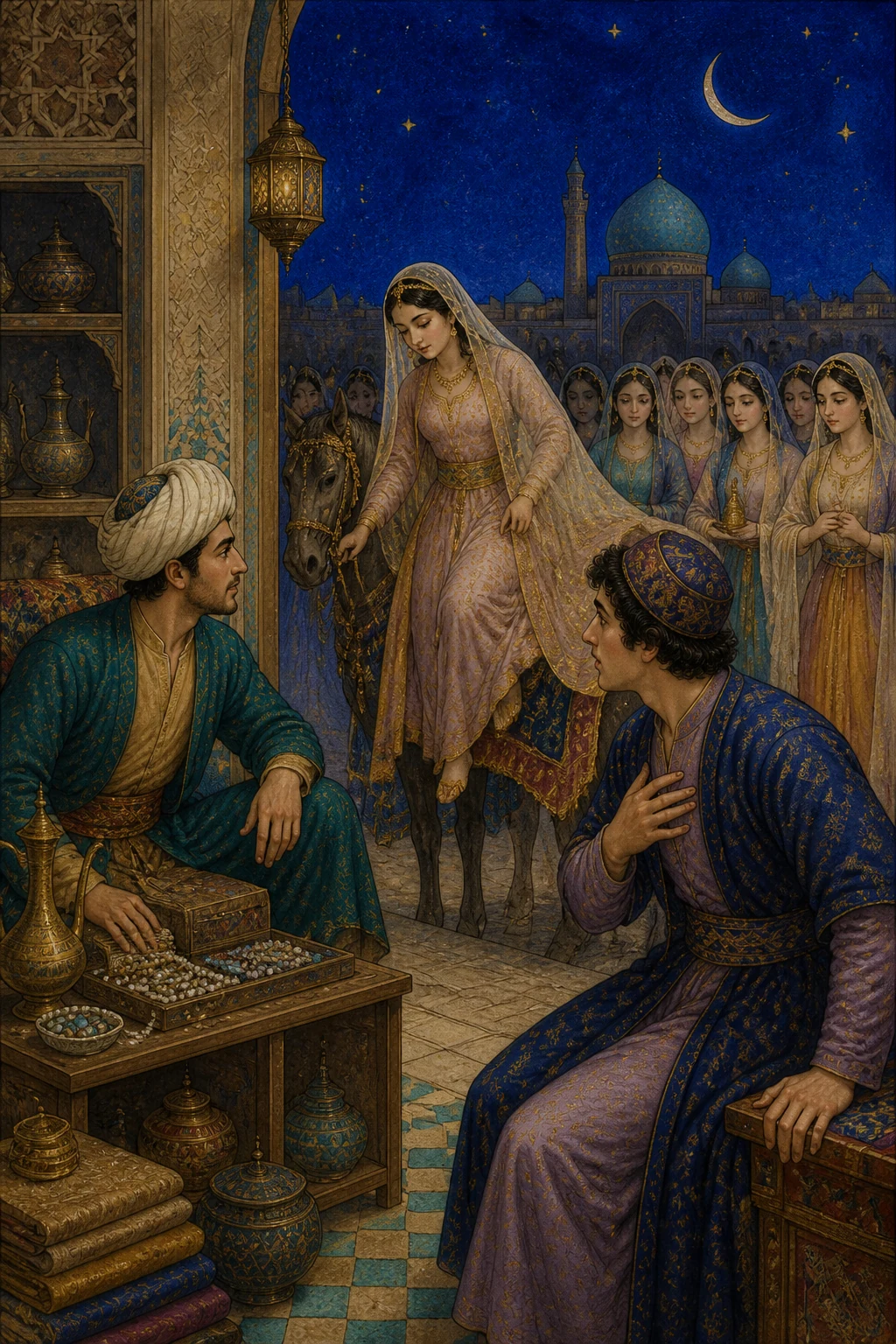
‘I took the brokers with me to the khan, and they carried the cloth to the Qaysariyya. I sold it to the merchants, drew up a bond against them, and handed it to the money changer, taking his written acknowledgment in return. Then I went back to the khan. For some days I lived at ease, beginning each day with a cup of wine and having lamb and sweetmeats brought to me. When the month in which payment fell due arrived, I would sit at the merchants’ shops every Thursday and Monday, while the money changer and the scribe went round collecting the money and brought it to me. One day I went to the bathhouse, then returned to my quarters in the khan. I broke my fast with a cup of wine, slept, and woke again. Then I ate a chicken, perfumed myself, and went to the shop of a merchant called Badr al-Din al-Bustani. He welcomed me, and we sat talking for a while in his shop. While we were there, a woman came and sat beside me. Her headband was set at a jaunty angle, and the fragrance of perfume wafted from her. Her beauty and loveliness robbed me of my senses. She lifted her outer veil, and I caught sight of her dark eyes. Then she greeted Badr al-Din, who returned her greeting, rose, and talked with her. When I heard her voice, love for her took firm hold of my heart. She asked Badr al-Din, “Have you a dress-length of cloth woven with pure gold?” He brought one out, and she said, “May I take it away and send you the price?” The merchant replied, “That is not possible, my lady, for here is the owner of the cloth, and an instalment is due to him from me.” She said, “Shame on you! Am I not accustomed to taking lengths of cloth from you for large sums, allowing you more profit than you ask, and sending you the money afterward?” He said, “Yes, but today I must have the money.” She flung the dress-length against his chest and said, “Your kind have no respect for anyone!” Then she rose to leave, and I thought my soul was departing with her. I stood and said, “My lady, grant me the kindness of a glance, and turn your gracious steps back here.” She returned, smiling, and said, “For your sake I have come back.” She sat opposite me on the shop bench, and I asked Badr al-Din, “What is the price of this dress-length to you?” He said, “Eleven hundred dirhams.” I said, “You shall have a hundred dirhams’ profit. Bring me a sheet of paper and I will write you an acknowledgment for the price.” I took the cloth from him, wrote him a note in my own hand, and gave her the dress-length, saying, “Take it, and my soul with it. If you wish, bring me its price here in the market; if you wish, accept it as my gift.” She said, “May God reward you, grant you my wealth, and make you my husband!”
‘God answered her prayer. I said, “My lady, let this dress-length be yours, and another like it as well; only let me see your face.” She lifted her veil, and that one glimpse left me with a thousand pangs of longing. My heart clung to her in love, and I could no longer command my senses. Then she lowered her veil, took the cloth, and said, “My master, do not make me miss you.” She left, and I remained in the market until after the afternoon prayer, distracted and wholly in love’s power. So strong was my passion that, when I was about to rise, I asked the merchant about her. He said, “She is a wealthy woman, the daughter of an emir who died and left her a great fortune.” I took my leave of him and returned to the khan. Supper was brought, but I thought of her and could eat nothing. I lay down, but sleep would not come, and I remained awake until morning. Then I rose, changed into another suit, drank a cup of wine, ate a little breakfast, and went to the merchant’s shop. I greeted him and sat with him. The young woman came, dressed more splendidly than before and accompanied by a maid. She sat down and greeted me, but not Badr al-Din, and said in eloquent words, sweeter and more delightful than any I had ever heard, “Send someone with me to collect the twelve hundred dirhams for the dress-length.” I said, “Why such haste?” She replied, “May we never lose you!” Then she handed me the money. I sat talking with her and made a sign to her. She understood that I wished to possess her, and rose hurriedly, drawing away from me, while my heart remained bound to her.
‘I followed her out of the market, and a maid came up to me and said, “My master, come and speak to my mistress.” Astonished, I said, “No one knows me here.” The maid replied, “How quickly you have forgotten her! My mistress who was at that merchant’s shop today.” I walked with her to the money changers’ quarter. When the lady saw me, she drew me aside and said, “My beloved, you have filled my thoughts, and love for you has taken hold of my heart. Since the hour I saw you, neither sleep nor food nor drink has brought me pleasure.” I said, “My suffering is many times greater. My condition speaks without complaint.” She asked, “My beloved, shall I come to you, or will you come to me?” I said, “I am a stranger here, with no lodging but the khan. If you would be so kind as to receive me in your house, my happiness would be complete.” She said, “Yes, but tonight is Friday eve, and nothing can be done. Come tomorrow after prayers. Say your prayers, mount your donkey, and ask for al-Habbaniyya. When you arrive, ask for the house of Barakat al-Naqib, known as Abu Shama. I live there. Do not be late, for I shall be waiting for you.”
‘I was overjoyed. We parted, and I went back to my khan and lay awake the whole night. I could scarcely believe it when dawn broke. I rose, changed my clothes, scented and perfumed myself, and took fifty dinars tied in a kerchief. I walked from Khan Masrur to Bab Zuwayla, where I hired a donkey and said to its owner, “Take me to al-Habbaniyya.” He set off at once, and in no time stopped at a lane called Darb al-Munqari. I said, “Go into the lane and ask for the Naqib’s house.” He went away briefly, then returned and said, “Dismount.” I said, “Walk ahead and show me the house.” He led me to the dwelling, and I told him, “Come here tomorrow to take me back.” The donkey driver said, “In God’s name.” I gave him a quarter of a gold dinar, which he took, and he departed. I knocked at the door, and two young girls came out, virgins with budding breasts, each like a moon. They said, “Come in. Our mistress is waiting for you. She has not slept all night for longing for you.” I entered a hall enclosed by seven doors, with windows all around overlooking a garden filled with every kind of fruit, flowing streams, and singing birds. Its walls were so brilliantly white and polished that a man could see his face in them. The ceiling was fashioned in gilded honeycomb vaulting, and bands of lapis-blue inscriptions ran around the walls, filled with fine descriptions and radiant to the eye. The floor was paved with veined marble, and in its centre stood a fountain with pearls and jewels at its corners. Around it were coloured silk carpets and cushions. I entered and sat down.’ Dawn overtook Shahrazad, and she fell silent, leaving her tale untold.
When it was the twenty-sixth night,
She said, “It has reached me, O fortunate King, that the young merchant said to the Christian, ‘I had scarcely entered and sat down when the young woman appeared, wearing a crown studded with pearls and jewels, her skin adorned with intricate painted designs. When she saw me, she smiled, embraced me, drew me to her breast, and pressed her mouth to mine, sucking my tongue as I did hers. She said, “Have you truly come to me, or is this a dream?” I said, “I am your slave.” She replied, “Welcome, a thousand welcomes! By God, since the day I saw you, sleep has brought me no pleasure and food no delight.” I said, “It has been the same with me.” We sat talking, while I kept my head lowered shyly toward the ground. Before long she had a meal set before me of the choicest dishes: roast meats, delicate pastries, and stuffed chickens. We ate together until we had had enough, then a basin and ewer were brought and I washed my hand. We scented ourselves with rosewater mingled with musk, and sat talking. She recited these two verses:
‘“Had we known of your coming, we would have spread the core of our hearts and the dark of our eyes beneath your feet. We would have laid down our cheeks to welcome you, and made your pathway over our eyelids.” She told me what she had suffered, and I told her what I had endured. My love for her grew ever stronger, and all wealth became a trifle to me. We played and teased one another, embracing and kissing, until night fell. Then the maids brought food and wine, and everything was ready for our delight. We drank until midnight, then lay down and slept together until morning. Never in my life had I known a night like it. When morning came, I rose and slipped the kerchief containing the dinars beneath her bedding, then bade her farewell and went out. She wept and said, “My master, when shall I see this lovely face again?” I said, “I will be with you at supper.” Outside I found the donkey driver who had brought me the day before waiting at the door. I rode with him to Khan Masrur, dismounted, and gave him half a dinar, saying, “Come back at sunset.” “On my head be it,” he said. I went into the khan and ate breakfast, then went out to collect payment for my cloth. When I returned, I had a lamb roasted for her and bought sweetmeats. I summoned a porter, described the house to him, paid his fee, and went back to my business until sunset. The donkey driver came, and I took fifty dinars, tied them in a kerchief, and went to her. I entered to find that they had wiped the marble, polished the brass, filled the lamps, lit the candles, served the food, and clarified the wine. When she saw me, she threw her arms around my neck and said, “How I have missed you!” Then the tables were set before us, and we ate our fill. The maids cleared away the food and brought the wine. We drank and kissed and enjoyed one another until midnight, then slept until morning. I rose, gave her the fifty dinars as before, and left. I found the donkey driver waiting and rode back to the khan. After sleeping an hour, I rose and arranged supper: walnuts and almonds over rice cooked so that each grain stood separate, fried taro, and other dishes. I bought fruit, sweetmeats to eat with wine, and fragrant flowers, and sent them ahead. Then I went to my lodgings, took fifty dinars in a kerchief, and rode the donkey to the house as usual. We ate and drank and slept until morning. When I rose, I left her the kerchief and rode back to the khan as before. I continued in this way for some time, until one morning I awoke without a single dirham or dinar to my name. I said to myself, “This is the devil’s doing,” and recited these verses:
‘“Poverty quenches a young man’s radiance, as the sun grows pale at its setting. If he is absent, no one speaks of him; if he is present, he receives no share. He slips through the markets unnoticed, and in the wilderness weeps streaming tears. By God, a man afflicted with poverty is a stranger even among his own.” Then I walked until I reached Bayn al-Qasrayn, and kept on until I came to Bab Zuwayla. There I found a great throng, so dense that the gateway was blocked. As fate decreed, I saw a soldier and was pressed against him against my will. My hand touched his pocket, and I felt a purse inside it. I reached for the purse and drew it out. The soldier felt his pocket grow lighter, put in his hand, and found nothing. He turned toward me, raised his mace, and struck me on the head, knocking me to the ground. People gathered around us and seized his horse’s bridle, saying, “Would you strike this young man such a blow merely because of the crush?” The soldier shouted, “He is a thief, a robber!” I came to my senses and heard people saying, “This is a fine-looking young man. He has taken nothing.” Some believed him and others did not, and the clamour grew. The people pulled me away and tried to free me from him. But fate decreed that at that very moment the governor and some officials should come through the gate. Finding the crowd gathered around me and the soldier, the governor asked, “What has happened?” The soldier said, “By God, my lord, this man is a thief. I had a blue purse in my pocket containing twenty dinars, and he took it while I was in the crowd.” The governor asked, “Was anyone with you?” The soldier said, “No.” The governor shouted to the officer, “Seize him and search him!” He caught hold of me, and my disgrace was laid bare. The governor ordered, “Strip him of everything he is wearing.” When they stripped me, they found the purse in my clothes. The governor took it, opened it, and counted the money: there were twenty dinars, just as the soldier had said. In anger he shouted to his men, “Bring him forward!” They brought me before him, and he said, “Young man, speak the truth. Did you steal this purse?” I lowered my head and thought, “If I deny stealing it, they have already found it in my clothes; and if I confess, I shall be in misery.” Then I raised my head and said, “Yes, I took it.” The governor was astonished to hear this. He summoned witnesses, who came and witnessed my confession, all there at Bab Zuwayla. Then he ordered the executioner to cut off my hand, and he cut off my right hand. The soldier’s heart softened, and he pleaded that my life should be spared. The governor left me and went on his way. The people gathered around me and gave me a cup of wine, while the soldier handed me the purse and said, “You are a fine young man, and should not be a thief.” I took it from him and recited these verses:
‘“By God, I was no thief, O trustworthy brother, nor was I a robber, O best of men. But the sudden blows of fortune struck me down, increasing my anguish, my troubled thoughts, and my destitution. It was not I who shot: God shot an arrow that sent the crown of kingship flying from my head.” After giving me the purse, the soldier left. I wrapped my arm in a rag, tucked it inside my robe, and went away, my condition altered and my face pale from what had happened. Unsteady on my feet, I made my way to the house and threw myself on the bed. The young woman saw my changed colour and asked, “What ails you? Why do you look so different?” I said, “My head hurts, and I am not well.” She was distressed and deeply troubled for my sake. “Do not burn my heart, my master,” she said. “Sit up, raise your head, and tell me what happened to you today. I can see that your face has a story to tell.” I said, “Spare me any talk.” She wept and said, “It is as though you have had all you wanted of us, for you are not yourself.” She kept weeping and speaking to me, but I did not answer. When night came, she brought me food, but I refused it, afraid that she would see me eating with my left hand. I said, “I have no appetite just now.” She said, “Tell me what happened to you today. Why do I see you so troubled, so broken in heart and spirit?” I replied, “I shall tell you presently, when I can.” She brought me wine and said, “Here, this will ease your sorrow. You must drink and tell me your story.” I said, “If I must, give me drink with your own hand.” She filled a cup and I drank it; then she filled it again and handed it to me. I took it with my left hand, and a tear escaped my eye. I recited these verses:
‘“When God wills a thing for a man possessed of reason, hearing, and sight, He deafens his ears, blinds his heart, and plucks out his reason as a hair is plucked. Then, when His decree has been fulfilled upon him, He restores his reason and his sight.” When I had finished my verses, I took the cup in my left hand and wept. Seeing my tears, she gave a loud cry and said, “Why are you weeping? You have burned my heart! And why did you take the cup with your left hand?” I said, “I have a boil on my right.” She said, “Show it to me, so that I may lance it.” I said, “This is no time to lance it. Do not weary me; I will not show it now.” Then I drank the cup, and she kept giving me wine until drunkenness overcame me and I fell asleep where I lay. She saw that my hand was gone, searched my clothes, and found the purse of gold. Such grief came over her as none had ever known, and she remained in anguish for my sake until morning. When I woke, I found that she had prepared boiled fowl and set it before me: four chickens in all. She gave me a cup of wine, and I ate and drank. Then I put down the purse and made to leave. She asked, “Where are you going?” I said, “To such and such a place, to ease a little of the sorrow in my heart.” She said, “Do not go. Sit down.” I sat, and she said, “Has your love for me brought you to this, that you have spent all your wealth on me and lost your hand? I call you to witness, and God is witness, that I shall never leave you. You will see that I speak the truth. Perhaps God has answered my prayer that you should marry me.” She sent for the witnesses, and when they came she said, “Draw up my marriage contract with this young man, and bear witness that I have received the dowry.” They drew up our contract. Then she said, “Bear witness that all the money in this chest, and all the male and female slaves I possess, belong to this young man.” They witnessed her declaration, and I accepted the gift. After receiving their fee, they departed.
‘Then she took me by the hand, led me to a storeroom, and opened a great chest. “Look at what is in this chest,” she said. I looked, and found it full of kerchiefs. She said, “This is the money I took from you. Whenever you gave me a kerchief containing fifty dinars, I wrapped it up and put it in this chest. Take your money: God has restored it to you, and today you are held in honour. It was on my account that this fate befell you and you lost your right hand. I cannot repay you; even if I gave my life, it would be little enough, and I should still be in your debt.” Then she said, “Take possession of your money.” I did so, and transferred the contents of her chest to mine, adding her wealth to the money I had given her. My heart rejoiced and my sorrow vanished. I rose, kissed her, and drank with her until we were merry. She said, “You have given all your money and your hand for love of me. How can I repay you? By God, if I gave my life for love of you, it would be little enough. I could never fulfil what I owe you.”
‘Then she made over to me by legal deed everything she owned: her clothes, her jewellery, and her estates. That night, after I had told her what had happened to me, she went to sleep weighed down with grief for my sake. I spent the night with her, and we continued together in this way for less than a month before weakness overcame her and her illness grew worse. Within fifty days she had passed into the next world. I prepared her for burial, laid her in the earth, arranged recitations of the whole Qur’an for her, and gave a great sum in charity on her behalf. When I returned from the burial ground, I found that she had left much wealth, estates, and property. Among these were the sesame warehouses, one of which held the sesame I sold you. The reason I have been too occupied to come to you all this time is that I have been selling the contents of the other warehouses, and even now I have not finished collecting the payments. Since I have eaten your food, I ask that you do not refuse what I am about to say: I give you the money for the sesame that is in your keeping. Such is the reason I eat with my left hand.’ I said to him, ‘You have shown me great kindness and generosity.’ He said, ‘You must travel with me to my own country. I have bought merchandise from Cairo and Alexandria. Will you accompany me?’ I said, ‘Yes,’ and we agreed to set out at the beginning of the month. I sold everything I possessed and bought merchandise with the proceeds. Then the young man and I travelled to this country of yours. He sold his goods, bought others from your country in their place, and returned to Egypt. As for me, it was my lot to remain here until tonight, when this befell me far from home. This, O King of the Age, is stranger than the story of the hunchback.” The king said, “You shall all be hanged!” Dawn overtook Shahrazad, and she fell silent, leaving her tale untold.
When it was the twenty-seventh night,
She said, “It has reached me, O fortunate King, that when the King of China said, ‘You shall all be hanged,’ the steward stepped forward and said, ‘If you permit me, I shall tell you something that happened to me not long ago, before I found this hunchback. If it is stranger than his story, spare our lives.’ The king said, ‘Let us hear what you have to tell.’”