Prevod
She said: It has reached me, O fortunate king, that in ancient times there lived a king named Shahraman, who had armies, servants, and retainers. But he had grown old, his bones had weakened, and he had been blessed with no child. He brooded over this and grew sorrowful and troubled, until he complained to one of his viziers, saying, “I fear that when I die the kingdom will be lost, for I have no son to rule it after me.” The vizier replied, “Perhaps God will bring about some change. Put your trust in God, O king, perform your ablutions and pray two bowings, then lie with your wife. Perhaps you will attain your desire.” So he lay with his wife, and she conceived that very hour. When her months were complete, she bore a son like the full moon unveiled on a murky night. He named him Qamar al-Zaman and rejoiced exceedingly in him. They adorned the city for seven days; drums were beaten, glad tidings came pouring in, and wet nurses and nursemaids took the child in their care. He was brought up in splendor and tenderness until he reached the age of fifteen, surpassing all others in beauty, grace, stature, and proportion. His father loved him so dearly that he could not bear to be parted from him by night or day. King Shahraman spoke to one of his viziers of his boundless love for his son, saying, “O vizier, I fear for my son Qamar al-Zaman from the blows of fate and the calamities of time, and I wish to marry him while I am still alive.” The vizier replied, “Know, O king, that marriage is among the noble customs, and there is no harm in marrying your son during your lifetime.” Thereupon King Shahraman said, “Bring me my son Qamar al-Zaman.” The prince came and bowed his head toward the ground out of modesty before his father, who said to him, “Qamar al-Zaman, know that I wish to marry you and rejoice in you while I am still alive.” He replied, “Know, Father, that I have no desire for marriage, nor does my soul incline toward women, for I have found books filled with accounts of their cunning, and verses of revelation have spoken of their wiles. As the poet said:
“If you ask me of women, I am well versed in their ways, a physician who knows them: when a man’s head turns gray or his wealth dwindles away, he has no share in their affection.” And another said:
“Disobey women: that is obedience well bestowed. They hold a man back from perfection in his virtues, though he seek learning for a thousand years.” When he had finished reciting, he said, “Father, marriage is something I shall never undertake, even if I am made to drink the cup of death.” When Sultan Shahraman heard these words from his son, the light in his face turned to darkness, and he grieved bitterly that his son Qamar al-Zaman would not obey him. But morning overtook Shahrazad, and she fell silent, leaving her tale untold.
Then, when it was the one hundred and seventy-first night,
She said: It has reached me, O fortunate king, that when King Shahraman heard these words from his son, the light in his face turned to darkness, and he grieved that his son Qamar al-Zaman would not obey him. Yet so great was his love for him that he did not raise the matter again or provoke his anger. Instead, he showed him favor, honored him, and treated him with every kindness that might win affection in the heart. All the while, Qamar al-Zaman grew daily in beauty and loveliness, charm and grace. King Shahraman bore patiently with his son for a whole year, until the prince had attained perfect eloquence and comeliness. All the world was ravished by his beauty, and every passing breeze told of his charm. He became a temptation to lovers and a garden to yearning hearts. His speech was sweet, and his face put the full moon to shame. Graceful in stature and proportion, charming and coy, he was like a branch of the ban tree or a slender cane of bamboo. His cheek could stand in place of anemones, and his figure in place of the ban tree’s bough. Exquisite in all his ways, he was as the poet described him:
“He appeared, and they said, ‘Blessed be God! Exalted is He who fashioned and formed him!’ He is king over all the beautiful, and all have become his subjects. Melted honey lies upon his tongue, and pearls are strung between his lips. Perfect in beauty, peerless and alone, he has bewildered all creation with his loveliness. Beauty has written upon his cheek: ‘I bear witness that none is fair but he.’” When another year had passed for Qamar al-Zaman, son of King Shahraman, his father summoned him and said, “My son, will you not listen to me?” Qamar al-Zaman fell to the ground before his father in awe and modesty, and said, “Father, how could I fail to listen to you, when God has commanded me to obey you and not oppose you?” King Shahraman said, “Know, my son, that I wish to marry you and rejoice in you while I am alive, and to establish you as sultan over my kingdom before I die.” When Qamar al-Zaman heard these words from his father, he lowered his head for a while, then raised it and said, “Father, this is something I shall never do, even if I am made to drink the cup of death. I know that God has enjoined obedience to you upon me, but I beseech you by God, do not burden me with marriage, nor imagine that I shall marry as long as I live. I have read the books of the ancients and the moderns, and learned of all the misfortunes and calamities that befell them through women’s seductions, their endless cunning, and the disasters they bring. How well the poet said:
“He whom wanton women plot against will find no escape, though he build a thousand fortresses made strong with lead. His buildings will not avail him, nor his ramparts save him. Women betray all men, near and far: their fingertips stained with henna, their tresses braided, their eyelids darkened with kohl, they make men swallow choking grief.” And how well another said:
“Women, though called chaste, are carrion tossed by circling vultures. At night her secrets and her talk are yours; tomorrow her leg and wrist belong to another. She is like an inn where you lodge and leave at dawn, and after you a stranger comes to dwell.” When King Shahraman heard these words from his son Qamar al-Zaman and understood his poetry and verse, he made no reply, so great was his love for him. Rather, he increased his favors and honors toward him, and the gathering broke up at once. After it had dispersed, King Shahraman summoned his vizier and spoke with him privately, saying, “O vizier…” But morning overtook Shahrazad, and she fell silent, leaving her tale untold.
Then, when it was the one hundred and seventy-second night,
She said: It has reached me, O fortunate king, that King Shahraman summoned his vizier and spoke with him privately, saying, “O vizier, tell me what I am to do about my son Qamar al-Zaman. I consulted you about marrying him before making him sultan, and you advised me to do so. You also advised me to speak to him of marriage, but when I did, he defied me. Now advise me as you think best.” The vizier replied, “What I advise now, O king, is that you bear patiently with him for another year. Then, when you wish to speak to him of marriage, do not do so in private, but address him on a day of public audience, when all the emirs and viziers are present and all the troops stand before you. Once they are assembled, send for your son Qamar al-Zaman and have him brought in. When he comes, speak to him of marriage before all the emirs and viziers, the chamberlains and deputies, the officers of state, the troops, and the men of power. He will feel ashamed before them and will not dare oppose you in their presence.” When King Shahraman heard these words from his vizier, he rejoiced exceedingly, approved his counsel, and bestowed a splendid robe of honor upon him. King Shahraman bore patiently with his son Qamar al-Zaman for a year, and every passing day the prince grew in beauty and loveliness, radiance and perfection, until he was nearly twenty years old. God had clothed him in the robes of beauty and crowned him with the crown of perfection. His gaze bewitched more powerfully than Harut, and the languor of his glances led men further astray than any false god. His cheeks glowed red, and his eyelids scorned the keenest sword. His radiant brow resembled the shining moon, while the blackness of his hair was like a murky night. His waist was finer than the cord of a purse, and his buttocks heavier than dunes of sand. His swaying form stirred the anguish of desire, and his waist complained of the weight of his hips. His charms bewildered all creation, as one poet said of him:
“I swear by his cheek and his smiling mouth, and the arrows he has feathered with his magic; by his supple sides and piercing glance, his shining brow and raven hair; by the eyebrow that has banished sleep from his lover and tyrannized over him with commands and prohibitions; by the scorpions of his temple-locks, sent forth to slay lovers through estrangement; by the roses of his cheeks and the myrtle of his first beard, the carnelian of his lips and the pearls of his mouth; by his fragrant breath and the clear stream flowing in his mouth that puts pure wine and its pressing to shame; by his quivering buttocks, whether he moves or rests, and the slenderness of his waist; by his generous hand and truthful tongue, his noble birth and lofty rank: musk is but the residue of his beauty spot, and perfume borrows its fragrance from his scent. Even the radiant sun falls short of him, and the crescent moon seems to me a clipping from his nail.” Thus King Shahraman followed the vizier’s counsel and waited another year, until a festival day arrived. But morning overtook Shahrazad, and she fell silent, leaving her tale untold.
Then, when it was the one hundred and seventy-third night,
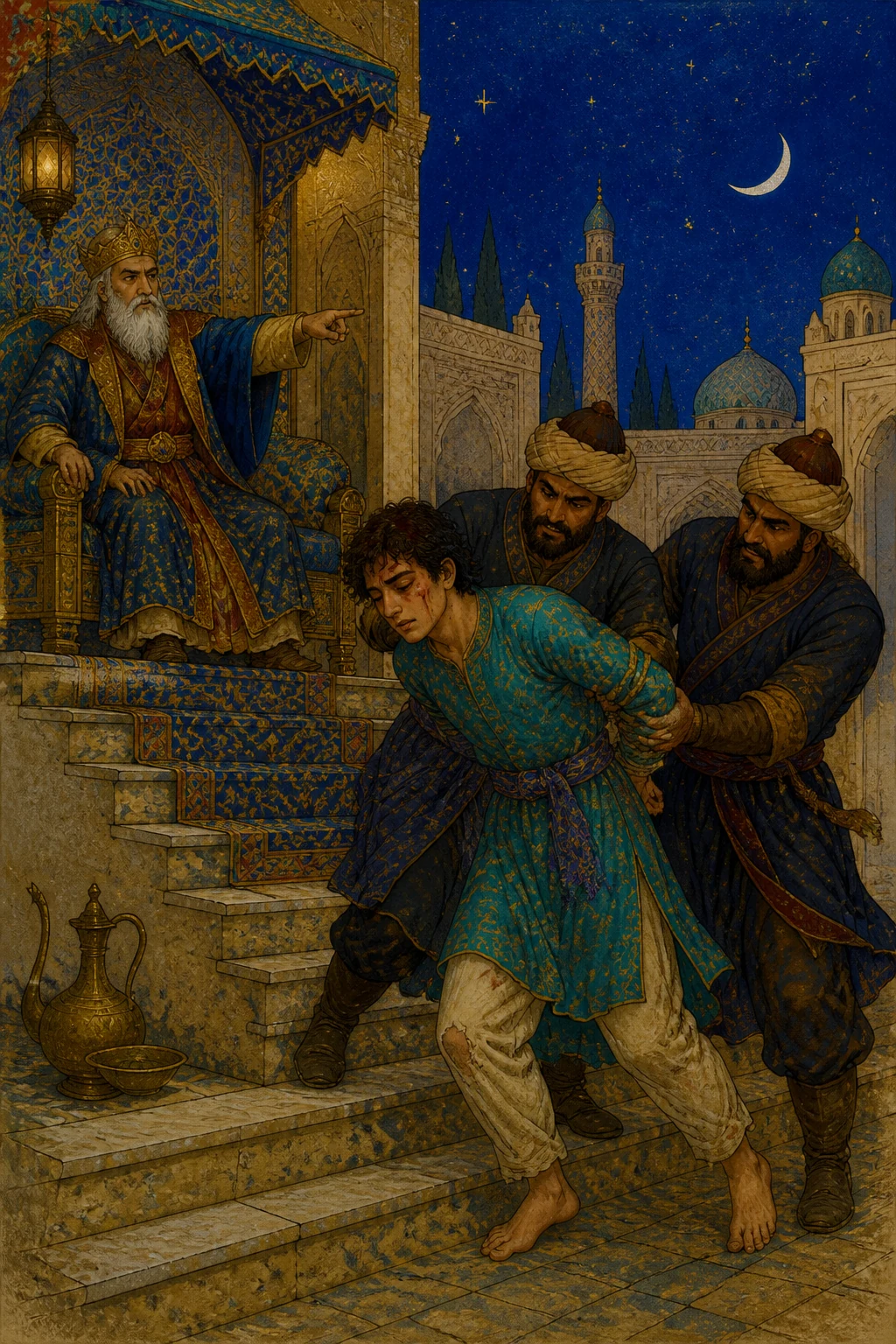
She said: It has reached me, O fortunate king, that King Shahraman followed the vizier’s counsel and waited another year, until a festival day arrived. The royal court was fully assembled with emirs, viziers, chamberlains, officers of state, troops, and men of power. Then the king sent for his son Qamar al-Zaman. When he came, he kissed the ground before him three times, then stood before his father with his hands clasped behind his back. His father said, “Know, my son, that I have brought you before this assembly, with all the troops present before us, only to give you a command which you must not disobey: you are to marry. I long to wed you to the daughter of a king and rejoice in you before I die.” When Qamar al-Zaman heard these words from his father, he bowed his head toward the ground for a while, then raised it to face him. At that moment the madness of youth and the folly of boyhood seized him, and he said, “As for me, I shall never marry, even if I am made to drink cups of death. As for you, you are an old man with little sense. Have you not asked me twice before this day about marriage, and have I not refused you?” Then Qamar al-Zaman unclasped his hands and rolled up his sleeves before his father in a fury. His father was mortified and ashamed that this should happen before his officers of state and the troops assembled for the festival. Then King Shahraman’s royal pride rose within him. He shouted at his son, terrifying him, and called to the mamluks, ordering them to seize him. They seized him, and he ordered them to bind his arms, which they did. Then they brought him before the king, his head bowed in fear and dread, his face and brow beaded with sweat, overwhelmed by shame and embarrassment. His father cursed and reviled him, saying, “Woe to you, you bastard, bred in wickedness! Is this how you answer me before my troops and armies? Plainly no one has ever taught you manners.” But morning overtook Shahrazad, and she fell silent, leaving her tale untold.
Then, when it was the one hundred and seventy-fourth night,
She said: It has reached me, O fortunate king, that King Shahraman said to his son Qamar al-Zaman, “Plainly no one has ever taught you manners. Do you not know that such behavior would be disgraceful even in a common man?” Then the king ordered the mamluks to unbind his arms and imprison him in one of the citadel’s towers. The household attendants went into the chamber in the tower, swept it, wiped its paving stones, and set up a bed for Qamar al-Zaman. They laid a mattress and a leather cover upon it, and provided him with a pillow, a large lantern, and a candle, for the place was dark even by day. Then the mamluks brought Qamar al-Zaman into the chamber and stationed a eunuch at its door. Qamar al-Zaman climbed onto the bed, broken in spirit and sorrowful at heart. He reproached himself and regretted his conduct toward his father, now that regret could do him no good. “May God confound marriage, girls, and treacherous women!” he said. “Would that I had listened to my father and married! Had I done so, it would have been better for me than this prison.”
Such was the case with Qamar al-Zaman. As for his father, he remained upon his royal throne for the rest of the day until sunset, then withdrew with the vizier and said, “Know, O vizier, that you are the cause of everything that has happened between my son and me, for it was you who gave me this advice. What do you advise me now?” The vizier replied, “O king, leave your son in prison for fifteen days, then summon him before you and command him to marry. He will certainly not disobey you.” But morning overtook Shahrazad, and she fell silent, leaving her tale untold.
Then, when it was the one hundred and seventy-fifth night,
She said: It has reached me, O fortunate king, that the vizier said to King Shahraman, “Leave your son in prison for fifteen days, then summon him before you and command him to marry. He will certainly not disobey you.” The king accepted the vizier’s advice and went to bed that night with his heart troubled for his son. He loved him exceedingly, for he had no other child. Indeed, every night King Shahraman could not fall asleep until he had placed his arm beneath Qamar al-Zaman’s neck. That night he lay distraught on his account, tossing from side to side as though he lay upon glowing coals. Anxious thoughts beset him, and he did not sleep the whole night long. His eyes streamed with tears, and he recited the poet’s words:
“My night has grown long while the slanderers sleep. Enough for you to know: my heart is terrified by parting. As sorrow lengthens my night, I cry, ‘O light of dawn, will you never return?’” And the words of another:
“When I saw the star’s eye drowsing, and the Pole Star sunk in slumber, and the Daughters of the Bier unveiled in mourning, I knew for certain that their dawn had died.” Such was the case with King Shahraman. As for Qamar al-Zaman, when night came the eunuch brought him the lantern, lit a candle and set it in a candlestick, then brought him some food. He ate a little and began reproaching himself for his ill manners toward his father, King Shahraman. “Did you not know,” he said to himself, “that the son of Adam is held hostage by his tongue, and that it is a man’s tongue that brings him to destruction?” He continued to reproach and blame himself until tears overcame him and his wounded heart burned within him. Bitterly regretting the words he had spoken to the king, he recited these two verses:
“A youth may die from a slip of his tongue, though a stumble of the foot does not kill a man. A slip of the mouth may bring him to his death, while a stumble of the foot heals in time.” When Qamar al-Zaman had finished eating, he asked to wash his hands. He washed away the traces of the meal, performed his ablutions, said the sunset and night prayers, and sat down… But morning overtook Shahrazad, and she fell silent, leaving her tale untold.
Then, when it was the one hundred and seventy-sixth night,
She said: It has reached me, O fortunate king, that Qamar al-Zaman, son of King Shahraman, said the sunset and night prayers, then sat upon the bed reading the Quran. He recited al-Baqarah, Al Imran, Ya Sin, al-Rahman, Tabarak al-Mulk, and the two surahs of refuge. He ended with supplication, sought refuge in God, and lay down to sleep upon a mattress of double-faced satin from Ma‘din, stuffed with ostrich down. When he was ready for sleep, he stripped off his clothes and removed his trousers, lying down in a fine wax-finished shirt, with a blue kerchief from Merv upon his head. That night Qamar al-Zaman was like the full moon on the fourteenth night. He covered himself with a silken sheet and slept, with the lantern burning at his feet and the candle burning at his head. He slept on through the first third of the night, unaware of what lay hidden for him in the unseen and what the Knower of all secrets had decreed for him. Now it happened that the chamber and the tower were ancient and had stood abandoned for many years. In that chamber was a Roman well inhabited by a female jinni, one of the descendants of Iblis the accursed. Her name was Maymunah, daughter of al-Damriyat, one of the famous kings of the jinn. But morning overtook Shahrazad, and she fell silent, leaving her tale untold.
Then, when it was the one hundred and seventy-seventh night,
She said: It has reached me, O fortunate king, that the name of that female jinni was Maymunah, daughter of al-Damriyat, one of the famous kings of the jinn. When Qamar al-Zaman had slept through the first third of the night, the ifritah rose from the Roman well, intending to ascend to heaven and eavesdrop. When she reached the top of the well, she saw a light shining in the tower, contrary to its usual state. She had dwelt in that place for many long years, and said to herself, “I have never known anything like this here.” She marveled exceedingly, and it occurred to her that there must be some reason for it. So she approached the light and found that it came from the chamber. She entered, finding the eunuch asleep at its door. Inside, she saw a bed set up, with the form of a sleeping human upon it, a candle burning at his head and a lantern burning at his feet. The ifritah Maymunah wondered at this light. Little by little she drew nearer, lowered her wings, and alighted upon the bed. She drew the sheet away from his face and gazed at him, remaining for a long while spellbound by his beauty and loveliness. She found that the radiance of his face outshone the candle, and his countenance glittered with light. His eyes were beguiling, his pupils black, his cheeks rosy, his eyelids languorous, his eyebrows arched, and his fragrant musk wafted abroad. As the poet said:
“I kissed him, and the eyes that are my temptation grew darker, and his cheeks flushed red. O heart, if those who blame us claim his equal can be found in beauty, say, ‘Then bring him forth!’” When the ifritah Maymunah, daughter of al-Damriyat, saw him, she glorified God and said, “Blessed be God, the best of creators!” For this ifritah was one of the believing jinn. She remained for a while gazing at Qamar al-Zaman’s face, proclaiming the oneness of God and admiring the beauty and loveliness with which he had been blessed. She said to herself, “By God, I shall not harm him, nor allow anyone to hurt him. I shall shield him from every evil, for this lovely face deserves only to be gazed upon while one glorifies God. But how could his family hold him so cheaply that they have forgotten him in this ruined place? If one of our rebellious spirits were to come upon him now, it would destroy him.” Then the ifritah bent over him and kissed him between the eyes. Afterward she drew the sheet over his face and covered him, spread her wings, and flew toward the sky. She rose out of the chamber and continued ascending through the air until she neared the lowest heaven. Suddenly she heard the beating of wings in flight. She headed toward the sound, and when she drew near, she found an ifrit called Dahnash. She swooped upon him like a sparrowhawk. When Dahnash became aware of her and recognized Maymunah, daughter of the king of the jinn, he was afraid, and his limbs trembled. He begged for her protection, saying, “I adjure you by the Most Great Name and the most noble talisman engraved upon Solomon’s seal: be gentle with me and do not harm me.” When Maymunah heard these words from Dahnash, her heart softened toward him, and she said, “You have bound me with a mighty oath. Yet I shall not release you until you tell me where you have come from at this hour.” He replied, “My lady, know that I have come from the farthest reaches of China, from its inner islands. I shall tell you of a marvel I saw tonight. If you find my words true, let me go my way, and write out with your own hand this very hour that I am your freedman, so that none of the companies of flying jinn, whether of the upper air, the lower regions, or the deep, may molest me.” Maymunah said, “What have you seen tonight, Dahnash? Tell me, and do not lie in the hope of escaping my hands. I swear by the inscription engraved upon the bezel of the seal of Solomon son of David—peace be upon them both—that if your words are not true, I shall pluck out your feathers with my own hands, tear your skin, and break your bones.” The ifrit Dahnash, son of Shamhurish the Flyer, replied, “If my words are not true, do with me as you please, my lady.” But morning overtook Shahrazad, and she fell silent, leaving her tale untold.
Then, when it was the one hundred and seventy-eighth night,
She said: It has reached me, O fortunate king, that Dahnash said, “Tonight I came from the inner islands of China, the lands of King al-Ghayur, lord of the islands, the seas, and the seven palaces. There I saw a daughter of that king, more beautiful than any God has created in her time. I do not know how to describe her to you; my tongue cannot do her justice. Still, I shall tell you something of her qualities, by way of giving you some notion. Her hair is like the nights of estrangement and separation, and her face like the days of union. Well did the poet describe her who said:
“One night she loosened three tresses of her hair, and showed me four nights together. She turned her face toward the moon in heaven, and showed me two moons at once.” Her nose is like the edge of a polished sword, her cheekbones glow like purple wine, and her cheeks are like anemones. Her lips are coral and carnelian, and her saliva sweeter than nectar: its taste quenches the torment of burning desire. Her tongue is guided by abundant wit and a ready answer. Her breast is a temptation to all who behold it: glory be to Him who created and fashioned it! To that breast are joined two rounded upper arms, as the love-distraught poet said:
“Two arms that, were they not held fast by bracelets, would flow from her sleeves like streams.” She has two breasts like ivory caskets, from whose radiance the twin moons draw their light. Her belly has folds like the pleats of Egyptian linen, ending in a waist slender as a figment of fancy, above a rump like a dune of sand, which pulls her down when she rises and wakes her when she sleeps. As one who described it said:
“Her haunches are suspended from a slender waist, and that rump is unjust to her and me: it makes me stand when I think of it, and makes her sit when she means to rise.” That rump is borne by two thighs like pillars of pearl, and nothing, I think, gives them strength to bear it but the blessing of the sheikh between them. As for her other qualities, no portrayer or describer could number them. All this is supported by two dainty feet, the handiwork of the Almighty Judge, and I marvel how they bear what is above them.” But morning overtook Shahrazad, and she fell silent, leaving her tale untold.
Then, when it was the one hundred and seventy-ninth night,
She said: It has reached me, O fortunate king, that the ifrit Dahnash, son of Shamhurish, said to the ifritah Maymunah, “As for what lies beyond, I have left it undescribed, for words fall short of it and gestures cannot convey it. The girl’s father is a mighty king, a horseman fierce in the charge, who crosses the seas of distant lands by night and day, fearing neither death nor loss. He is unjust and oppressive, a ruthless conqueror, the master of armies and troops, provinces and islands, cities and dwellings. His name is King al-Ghayur, lord of the islands, the seas, and the seven palaces. He loved this daughter whom I have described to you exceedingly. Out of his love for her, he gathered the wealth of all the kings and with it built her seven palaces, each of a different substance. The first palace was of crystal, the second of marble, the third of Chinese iron, the fourth of onyx and precious stones, the fifth of silver, the sixth of gold, and the seventh of jewels. He filled the seven palaces with every kind of splendid furnishing, vessels of gold and silver, and all the equipment that kings might require. He bade his daughter dwell in each palace for part of the year, then move to another. Her name is Queen Budur.
“When her beauty became famous and word of her spread through the lands, all the kings sent to her father to ask for her hand. He sought to persuade her to marry, but she disliked the idea and said to him, ‘Father, I have no wish whatsoever to marry. I am a sovereign lady and a queen: I rule over others, and I do not want a man to rule over me.’ The more she refused marriage, the more eagerly her suitors desired her. Then all the kings of the inner islands of China sent her father gifts and rarities, and wrote to him concerning her marriage. Her father repeatedly raised the matter with her, but she opposed him and grew angry, saying, ‘Father, if you mention marriage to me once more, I shall take a sword, set its hilt upon the ground and its point against my belly, and lean upon it until it comes out through my back. I shall kill myself.’ When her father heard these words, the light in his face turned to darkness, and his heart burned with anguish for her. He feared that she would kill herself, and was at a loss what to do about her and the kings who had asked him for her hand. He said to her, ‘If you insist on refusing marriage, then you must cease going about freely.’ He confined her to a chamber and secluded her there, setting ten elderly women stewards to guard her. He forbade her to visit the seven palaces and made a show of being angry with her. He sent letters to all the kings, informing them that she had been stricken with madness. She has now been secluded for a year.
“And I, my lady,” the ifrit Dahnash continued, “go to her every night to look upon her and feast my eyes upon her face. I kiss her between the eyes while she sleeps, and out of my love for her I neither harm nor possess her. Her beauty is so surpassing that everyone who sees her would guard her jealously even from himself. I beseech you, my lady, to return with me and behold her beauty and loveliness, her stature and proportion. After that, if you wish to punish me or take me captive, do so, for yours is the command and yours the prohibition.” Then the ifrit Dahnash bowed his head toward the ground and lowered his wings. The ifritah Maymunah laughed at his words, spat in his face, and said, “What is this girl you speak of? She is nothing but a hole for piss. What would you do if you saw my beloved? By God, accursed one, I thought you had some marvel or strange news to tell me! Tonight I saw a human being whom, if you beheld him even in a dream, you would be struck senseless and begin to drool.” Dahnash said, “What is the story of this youth?” She replied, “Know, Dahnash, that the same thing has happened to this youth as happened to the beloved you described. His father repeatedly commanded him to marry, but he refused. When he defied his father, his father grew angry and imprisoned him in the tower where I live. Tonight I came up and saw him.” Dahnash said, “My lady, show me this youth, so that I may see whether he is more beautiful than my beloved Queen Budur. For I do not believe that anyone like my beloved exists in this age.” The ifritah replied, “You lie, accursed one, most ill-omened of rebellious spirits and vilest of devils! I know for certain that my beloved has no equal in these lands.” But morning overtook Shahrazad, and she fell silent, leaving her tale untold.
Then, when it was the one hundred and eightieth night,
She said: It has reached me, O fortunate king, that the ifritah Maymunah said to the ifrit Dahnash, “I know for certain that my beloved has no equal in these lands. Are you mad, to compare your beloved with mine?” He replied, “I beseech you by God, my lady, come with me and see my beloved, and I shall return with you to see yours.” Maymunah said, “We must indeed settle this, accursed one, for you are a cunning devil. But I shall not go with you, nor shall you come with me, unless we make a wager. If your beloved, whom you love and praise so extravagantly, proves more beautiful than my beloved, whom I love and praise, I shall owe you the stake. But if my beloved proves more beautiful, you shall owe it to me.” The ifrit Dahnash replied, “My lady, I accept your condition and agree to it. Come with me to the islands.” Maymunah said, “My beloved’s dwelling is nearer than yours. He is here beneath us. Come down with me so that we may look upon him, and afterward we shall go to yours.” Dahnash replied, “To hear is to obey.” Then they descended and alighted within the tower chamber. Maymunah stationed Dahnash beside the bed, reached out her hand, and lifted the sheet from the face of Qamar al-Zaman, son of King Shahraman. His face shone forth, radiant, gleaming, and splendid. Maymunah gazed at him, then immediately turned to Dahnash and said, “Look, accursed one, and do not be an utter fool! We are women, and he has bewitched us.” Dahnash turned toward him and continued studying him for a while. Then he shook his head and said to Maymunah, “By God, my lady, you may well be excused. Yet one thing remains: a female is not the same as a male. By God, this beloved of yours resembles my beloved more closely than anyone in beauty and loveliness, radiance and perfection. The two might have been cast alike in the same mold of beauty.”
When Maymunah heard these words from Dahnash, the light in her face turned to darkness. She struck him so hard upon the head with her wing that the blow nearly killed him, and said, “I swear by the light of His glorious countenance, you shall go this very moment, accursed one, and bring the beloved you love so dearly here at once. We shall lay the two together and look at them sleeping side by side, and it will become clear which is fairer. If you do not do as I command this instant, accursed one, I shall burn you with my fire, pelt you with the sparks of my fury, tear you to pieces in the wilderness, and make you a warning to those who stay at home and those who travel by night.” Dahnash replied, “My lady, I undertake to do it. Yet I know that my beloved is more beautiful and sweeter.” Then the ifrit Dahnash flew off at once, and Maymunah flew with him to keep watch over him. They were gone for an hour, then returned together carrying the girl. She wore a fine Venetian shirt with two bands of gold, adorned with exquisite embroidery. At the ends of its sleeves these verses were inscribed:
“Three things kept her from visiting us, for fear of the watcher and the furious envier: the radiance of her brow, the whisper of her jewels, and the fragrant ambergris enfolded in her form. Suppose she hides her brow beneath the length of her sleeve and takes her jewels off—what can she do about her fragrant sweat?” Then they descended with the girl and laid her down. But morning overtook Shahrazad, and she fell silent, leaving her tale untold.
Then, when it was the one hundred and eighty-first night,
She said: It has reached me, O fortunate king, that the ifrit and the ifritah descended with the girl and laid her beside the youth. They uncovered both their faces, and the two resembled each other so closely that they might have been twins, or a brother and sister without equals. They were a temptation even to the devout, as the eloquent poet said of them:
“O heart, do not love just one beauty, to waver between coy pride and meek submission. Love all the beautiful, and you will find that when one turns away, another comes toward you.” Dahnash and Maymunah stood gazing at them. Dahnash said, “My beloved is more beautiful.” Maymunah replied, “No, mine is more beautiful. Woe to you, Dahnash! Are you blind? Can you not see his beauty and loveliness, his stature and proportion? Listen to what I say of my beloved, and if you truly love the one you adore, say of her the like of what I say of him.” Then Maymunah kissed Qamar al-Zaman many times and recited this poem:
What have I to do with the scolder who chides me so harshly for loving you? How can I forget, when you are a slender, swaying bough? Yours is a dark-lashed eye that breathes its enchantment, from which chaste love can find no escape. Its Turkish glances do to the heart what no polished, keen-edged blade can do. You have burdened me with the weight of passion, though I am too frail to bear even my shirt. My longing for you is as you know it; my anguish comes naturally, while love for any other would be feigned. Had my heart been like yours, I would not have passed the night with my body wasted as slender as your waist. Alas for a moon whom all mankind describes as possessing every charm and every beauty! My reprovers asked, “Who is this whose love makes you so sorrowful?” I answered, “Describe whom you will.” O cruel heart of his, learn tenderness from his swaying figure: perhaps you too may soften and incline. My prince of beauty, yours is a glance that assaults me, and a brow that grants no justice. He lied who thought all beauty was bestowed on Joseph: how many Josephs dwell within your beauty! The jinn fear me when I confront them, yet when I meet you my heart trembles. In awe of you I struggle to turn away, yet all the while I strive, I yearn toward you. Your hair is black, your brow radiant, your eyes bright against their dark pupils, your figure slender. When Dahnash heard Maymunah’s verses about her beloved, he was delighted beyond measure and filled with wonder. Then dawn overtook Shahrazad, and she fell silent, leaving her tale untold.
When it was the one hundred and eighty-second night
She said: It has reached me, O fortunate King, that when Dahnash heard Maymunah’s verses about her beloved, he was delighted beyond measure and said, “You have recited these tender verses to me about the one you love, though your thoughts are taken up with him. As for me, I shall do my best to recite such poetry as comes to mind.” Then Dahnash went up to his beloved Budur, kissed her between the eyes, and looked from the she-demon Maymunah to his beloved Budur. Beside himself with emotion, he began to recite this poem:
Their dwellings by the valley’s bank lie desolate; I am left slain by love, and distant lies the valley. I grew drunk on the wine of passion, and the fountain of my tears danced to the camel-driver’s song. I strive to find my happiness in union, as well I may, for happiness lies in Suad’s full moons. I know not which of three to complain of; I have counted them, so listen to my reckoning: her glance, the swordsman; her stature, the spearman; or her temple-locks, the maker of mail. When I had asked after her of everyone I met, whether townsman or nomad, she said, “I am within your heart. Turn your eyes toward it and you will see me.” I answered, “But where is my heart?”
When he had finished his verses, the she-demon said, “Well done, Dahnash! But which of these two is more beautiful?” “My beloved Budur is more beautiful than your beloved,” he replied. “You lie, accursed one!” she said. “My beloved is more beautiful than yours.” They went on contradicting each other until Maymunah shouted at Dahnash and made to seize him. He humbled himself before her, softened his speech, and said, “Do not be offended by the truth. Set aside both your claim and mine, for each of us declares our own beloved the more beautiful. Let us disregard what either of us says and seek someone to judge fairly between us, and abide by his decision.” “So be it,” said Maymunah. Then she stamped her foot on the ground, and up from the earth rose a one-eyed, mangy demon, with eyes slit lengthwise in his face, seven horns on his head, and four locks of hair trailing to the ground. His hands were like those of a qutrub, his claws like a lion’s, his legs like an elephant’s, and his hooves like a donkey’s. When the demon emerged and saw Maymunah, he kissed the ground before her, folded his arms, and said, “What is your wish, my lady, daughter of the king?” “Qashqash,” she said, “I wish you to judge between me and this accursed Dahnash.” Then she told him the story from beginning to end. The demon Qashqash looked at the young man’s face and the maiden’s, and saw them sleeping in one another’s arms, each with a wrist beneath the other’s neck. They resembled each other in beauty and were equal in charm. The mighty demon Qashqash gazed at them in wonder at their loveliness. After studying the young man and maiden at length, he turned to Maymunah and Dahnash and recited these verses:
Visit the one you love and heed no envious tongue: the envious never lend their aid to love. The Merciful has made no fairer sight than two lovers lying on a single bed, embracing, clothed in the robes of contentment, each pillowed on a wrist and forearm. If in your lifetime you find one true companion, that is all you need: live for that one alone. When hearts are joined in love, those who oppose them merely hammer at cold iron. O you who blame lovers for their love, can a stricken heart be set to rights? O Lord, O Merciful, grant us a good ending before we die, though it be for a single day. Then the demon Qashqash turned to Maymunah and Dahnash and said, “By God, neither is more beautiful or less beautiful than the other. They are as alike as any two people can be in beauty and loveliness, radiance and perfection; only their being male and female distinguishes them. But I have another way to judge: let us awaken each without the other’s knowledge, and whichever burns more fiercely for the other is the lesser in beauty.” “An excellent suggestion,” said Maymunah. “I agree to it.” “And so do I,” said Dahnash. At that, Dahnash changed into a flea and bit Qamar al-Zaman. Then dawn overtook Shahrazad, and she fell silent, leaving her tale untold.
When it was the one hundred and eighty-third night
She said: It has reached me, O fortunate King, that Dahnash changed into a flea and bit Qamar al-Zaman on a tender spot on his neck. Qamar al-Zaman reached up and scratched the bite, so fiercely did it burn. As he shifted onto his side, he found someone sleeping beside him, with breath sweeter than musk and a body softer than butter. He was astonished beyond measure, and at once sat up and looked at the person lying beside him. He found a maiden like a radiant pearl, or a finely built dome, tall and perfectly proportioned, with swelling breasts and rosy cheeks, as one of those who described her said:
She appeared, a moon; she swayed, a willow bough; she breathed ambergris and gazed, a gazelle. It is as though sorrow were in love with my heart, for the moment she leaves me, it finds its union. When Qamar al-Zaman saw Lady Budur, daughter of King al-Ghayur, and beheld her beauty as she lay sleeping at his side, he found that she wore a Venetian shirt but no drawers. On her head was a golden cap studded with jewels, and about her neck a necklace of precious stones beyond the means of any king. His wits were dazzled by the sight. As he gazed on her beauty, his natural ardor stirred, and God kindled in him the desire for intercourse. He said to himself, “What God wills comes to pass, and what He does not will cannot be.” Then he turned her over with his hand once more and opened the neck of her shirt, revealing her belly. He looked at it and at her breasts, and his love and desire increased. He tried to wake her, but she would not wake, for Dahnash had deepened her sleep. Qamar al-Zaman shook and stirred her, saying, “My beloved, wake and see who I am. I am Qamar al-Zaman.” But she did not wake or move her head. He pondered her presence for a while, then said to himself, “If my guess is right, this is the maiden my father wishes me to marry, though I have refused for three years. God willing, when morning comes I shall say to my father, ‘Marry me to her.’” Then dawn overtook Shahrazad, and she fell silent, leaving her tale untold.
When it was the one hundred and eighty-fourth night
She said: It has reached me, O fortunate King, that Qamar al-Zaman said to himself, “God willing, when morning comes I shall tell my father, ‘Marry me to her.’ I will not let noon pass before I enjoy union with her and feast my eyes on her beauty.” Then Qamar al-Zaman leaned toward Budur to kiss her. Maymunah the jinniyah trembled with embarrassment, while the demon Dahnash soared with joy. But when Qamar al-Zaman was about to kiss her on the mouth, shame before God overcame him. He turned his face away and said to himself, “I must be patient. Perhaps, after my father grew angry and imprisoned me here, he brought this bride to me and ordered her to sleep beside me to test me. He may have instructed her not to wake if I tried to rouse her, and told her, ‘Whatever Qamar al-Zaman does to you, report it to me.’ Perhaps my father is hiding somewhere, watching me unseen and observing everything I do to this maiden. Then in the morning he will reproach me and say, ‘How can you claim you have no desire to marry, when you kissed and embraced that maiden?’ I shall restrain myself, so that my father will have nothing to hold against me. From this moment I will neither touch her nor look at her. But I will take something of hers as a token to keep, a remembrance of her, so that there may be a sign between us.” Then Qamar al-Zaman lifted the maiden’s hand and took the ring from her little finger. It was worth a great sum, for its stone was a precious jewel, and around its band were engraved these verses:
Do not think I have forgotten the vows I made you, however long you turn away from me. My lords, be generous and show me kindness, that I may kiss your lips and cheeks. By God, I shall never leave you, however far beyond love’s bounds you stray. Qamar al-Zaman slipped the ring from Princess Budur’s little finger and put it on his own, then turned his back to her and slept. Maymunah the jinniyah rejoiced at the sight and said to Dahnash and Qashqash, “Have you seen my beloved Qamar al-Zaman, and how chastely he has behaved toward this maiden? This is one of his perfect qualities. See how he beheld this maiden and her loveliness, yet neither embraced her nor caressed her with his hand, but turned his back to her and fell asleep.” They answered, “We have seen the perfection of his conduct.” Then Maymunah changed herself into a flea and crept into the clothes of Budur, Dahnash’s beloved. She crawled up her leg and thigh, went four fingerbreadths below her navel, and bit her. Budur opened her eyes and sat upright. She saw a young man sleeping beside her, breathing deeply in his sleep. His cheeks were like anemones, his glances put the lovely houris to shame, his mouth was like Solomon’s seal, and his saliva was sweet to taste and more beneficial than any antidote, as one of those who described him said:
My heart has forgotten Zaynab and Nawar for a rose of a cheek above the myrtle of a beard. I have fallen in love with a gazelle in a short tunic, and have no wish to love a woman wearing bracelets. My companion in company and in solitude alike is unlike the companion shut within my house. O you who blame me for forsaking Hind and Zaynab, my excuse is clear as morning to a traveler by night. Would you have me be the captive of a captive, guarded within a fortress or behind a wall? When Princess Budur beheld Qamar al-Zaman, she was seized by passion, longing, and love. Then dawn overtook Shahrazad, and she fell silent, leaving her tale untold.
When it was the one hundred and eighty-fifth night
She said: It has reached me, O fortunate King, that when Princess Budur beheld Qamar al-Zaman, she was seized by passion, longing, and love. She said to herself, “What a disgrace! This is a strange young man whom I do not know. Why is he lying beside me in the same bed?” Then she gazed at him, studying his grace and charm, his beauty and loveliness, and said, “By God, he is a young man as fair as the moon! My very heart is almost torn apart with longing for him and adoration of his beauty. How ashamed I am before him! By God, had I known that this was the young man who asked my father for my hand, I would never have refused him. I would have married him and delighted in his beauty.”
Then Princess Budur looked at Qamar al-Zaman’s face and said, “My lord, beloved of my heart, light of my eyes, wake from your sleep and delight in my beauty.” She stirred him with her hand, but Maymunah the jinniyah cast sleep over him and weighed down his head with her wing, so that Qamar al-Zaman did not wake. Princess Budur shook him with both hands and said, “By my life, do as I ask! Wake from your sleep, gaze upon the narcissus and the greenery, delight in my belly and navel, and fondle me and sport with me from now until morning. Rise, my lord, lean against the pillow, and do not sleep.” Qamar al-Zaman gave her no answer and spoke no word, but slept deeply. Princess Budur said, “Why are you so proud of your beauty and loveliness, your grace and charm? You are handsome, but I am beautiful too. Why do you behave like this? Have they taught you to spurn me, or has my wretched old father forbidden you to speak to me tonight?” Qamar al-Zaman opened his eyes, and her love for him grew still stronger. God cast his love into her heart, and she gave him a glance that brought a thousand pangs in its wake. Her heart throbbed, her inward parts fluttered, and her limbs trembled. She said to Qamar al-Zaman, “My lord, speak to me! My darling, talk to me! My beloved, answer me and tell me your name, for you have stolen my wits.”
All this while Qamar al-Zaman was sunk in sleep and did not answer her a word. Princess Budur sighed and said, “Why are you so conceited?” Then she shook him and kissed his hand, and saw her ring on his little finger. She gave a gasp, followed by a coquettish sigh, and said, “Ah, ah! By God, you are my beloved, and you love me! It seems you turn away only to tease me. You came to me while I was asleep, and I do not know what you did with me. But I will not take my ring from your little finger.” Then she opened the neck of his shirt, bent over him, and kissed his neck. She searched for something to take from him, but found nothing. Seeing that he wore no drawers, she reached beneath the hem of his shirt and felt his legs. Her hand slipped over the smoothness of his body and fell upon his member. Her heart was rent and her breast trembled, for women’s desire is stronger than men’s, and she was overcome with shame. Then she took his ring from his finger and put it on her own in place of hers. She kissed him on the lips and kissed his palms, leaving no part of him unkissed. After that she drew him to her breast and embraced him, put one hand beneath his neck and the other beneath his armpit, and fell asleep beside him. Then dawn overtook Shahrazad, and she fell silent, leaving her tale untold.
When it was the one hundred and eighty-sixth night
She said: It has reached me, O fortunate King, that Princess Budur fell asleep beside Qamar al-Zaman, after all that had passed. When Maymunah saw this, she rejoiced exceedingly and said to Dahnash, “Have you seen, accursed one, how your beloved behaved in her infatuation with mine? And how proudly and coyly my beloved behaved? There can be no doubt that mine is more beautiful than yours. But I forgive you.” Then she wrote him a deed of release, turned to Qashqash, and said, “Go with him, carry his beloved, and help him return her to her own place, for the night is spent, and I have missed what I set out to do.” Dahnash and Qashqash approached Princess Budur, slipped beneath her, lifted her up, and flew away with her. They brought her back to her own place and laid her in her bed. Maymunah remained alone, gazing at Qamar al-Zaman as he slept, until only a little of the night remained; then she went her way.
At the break of dawn Qamar al-Zaman awoke and looked to right and left, but found no maiden beside him. He said to himself, “What is this? It seems my father wishes to make me eager to marry the maiden who was here, and has secretly taken her away to increase my desire for marriage.” Then he shouted to the servant sleeping at the door, “Get up, you accursed wretch!” The servant rose, still dazed with sleep, and brought him the basin and ewer. Qamar al-Zaman got up, went to the privy, relieved himself, and came out. He performed his ablutions, prayed the dawn prayer, and sat praising God. Then he looked at the servant and found him standing before him, waiting to serve him. “Wretch, Sawab!” he said. “Who came here and took the maiden from my side while I was asleep?” “My lord, what maiden?” asked the servant. “The maiden who slept beside me last night,” said Qamar al-Zaman. Alarmed by his words, the servant said, “There was no maiden with you, nor anyone else. How could a maiden have entered when I was sleeping behind the locked door? By God, my lord, neither man nor woman came in to you.” “You lie, you wretched slave!” said Qamar al-Zaman. “Have you too grown so bold that you deceive me and refuse to tell me where the maiden who slept with me last night has gone, or who took her away?” The eunuch, thoroughly frightened, said, “By God, my lord, I saw neither maiden nor youth.” Qamar al-Zaman grew angry at the servant’s words and said, “They have taught you to deceive me, accursed one! Come here.” The servant approached, and Qamar al-Zaman seized him by the collar and dashed him to the ground so hard that he broke wind. Then Qamar al-Zaman knelt on him, kicked him, and throttled him until he fainted. After that he tied him to the well rope and lowered him into the well until he reached the water, then let him drop into it. It was winter, and bitterly cold. The servant plunged into the water; Qamar al-Zaman hauled him up and lowered him again. He kept plunging the servant into the water and pulling him out, while the man begged for help, screamed, and cried out. Qamar al-Zaman said, “By God, accursed one, I will not pull you out of this well until you tell me about this maiden and who took her away while I was asleep.” Then dawn overtook Shahrazad, and she fell silent, leaving her tale untold.
When it was the one hundred and eighty-seventh night
She said: It has reached me, O fortunate King, that the servant said to Qamar al-Zaman, “Save me from the well, my lord, and I will tell you the truth.” He hauled him out of the well, almost insensible from all he had suffered: drowning and plunging, cold, beating, and torment. He shook like a reed in a gale, his teeth chattered, and his clothes were soaked with water. When the servant found himself on solid ground, he said, “Let me go, my lord, to take off my clothes, wring them out, spread them in the sun, and put on others. Then I will return at once and tell you all about that maiden and relate her story.” Qamar al-Zaman said, “By God, wretched slave, had you not looked death in the face, you would never have confessed the truth. Go and do what you must, then return quickly and tell me the maiden’s story.”
The servant went out, scarcely believing he had escaped, and ran without stopping until he came before King Shahriman, Qamar al-Zaman’s father. He found the vizier beside him, and they were discussing Qamar al-Zaman. He heard the king say to the vizier, “I did not sleep last night for anxiety over my son Qamar al-Zaman. I fear some harm may befall him in that ancient tower. Nothing good has come of imprisoning him.” The vizier replied, “Do not fear for him. By God, no harm will come to him. Leave him imprisoned for a month, until his temper softens.” While they were speaking, the servant entered in that state and said, “Our lord the Sultan, your son has gone mad! He has done all this to me, and said, ‘A maiden spent last night with me, then slipped away secretly. Tell me about her.’ But I know nothing of this maiden.” When Sultan Shahriman heard these words about his son Qamar al-Zaman, he cried, “Alas, my son!” He became furiously angry with the vizier, who had brought these troubles about, and said, “Go and find out what has happened to my son Qamar al-Zaman.” The vizier went out, stumbling over the skirts of his robe in his fear of the king, and accompanied the servant to the tower. The sun had risen by then. He entered and found Qamar al-Zaman seated on the bed, reading the Quran. The vizier greeted him, sat beside him, and said, “My lord, this wretched slave has brought us news that has troubled and distressed us, and the king is greatly upset.” Qamar al-Zaman said, “Vizier, what has he told you about me to trouble my father? In truth, he has troubled no one but me.” The vizier replied, “He came to us in a dreadful state and said something of which you are surely innocent. He told us a lie that should never be spoken of you. May your youth, your sound mind, and your eloquent tongue remain unharmed! Far be it from you to do anything unseemly.” “What did this wretched slave say?” asked Qamar al-Zaman. The vizier answered, “He told us that you had gone mad and said to him, ‘A maiden was with me last night.’ Did you say this to the servant?” When Qamar al-Zaman heard these words, he became furiously angry and said to the vizier, “Now it is clear to me that you taught the servant to behave as he did.” Then dawn overtook Shahrazad, and she fell silent, leaving her tale untold.
When it was the one hundred and eighty-eighth night
She said: It has reached me, O fortunate King, that Qamar al-Zaman, son of King Shahriman, said to the vizier, “Now it is clear to me that you taught the servant to behave as he did, and forbade him to tell me about the maiden who slept beside me last night. You, Vizier, have more sense than the servant, so tell me at once where the beautiful maiden who slept in my arms last night has gone. You were the ones who sent her to me and ordered her to spend the night in my embrace. I slept with her until morning, but when I woke, I could not find her. Where is she now?” The vizier said, “My lord Qamar al-Zaman, may God’s name protect you! By God, we sent no one to you last night. You slept alone, with the door locked upon you and the servant sleeping behind it. No maiden or anyone else came to you. Come to your senses, my lord, and do not trouble your mind.” Angered by his words, Qamar al-Zaman said, “Vizier, that maiden is my beloved: the beauty with black eyes and rosy cheeks whom I embraced last night.”
The vizier marveled at Qamar al-Zaman’s words and said, “Did you see this maiden last night with your own eyes, while awake, or was it in a dream?” Qamar al-Zaman replied, “You wretched old man! Do you think I saw her with my ears? I saw her with my own eyes while awake, turned her over with my own hands, and stayed awake with her for half the night, gazing on her beauty and loveliness, her grace and charm. But you had instructed her not to speak to me, so she pretended to sleep. I slept beside her until morning, then woke to find her gone.” The vizier said, “My lord Qamar al-Zaman, perhaps you saw this in your sleep. It may have been a confused dream, or a fancy brought on by eating different foods, or a whispering of wicked devils.” Qamar al-Zaman said, “You wretched old man! How dare you mock me too, saying it may have been a confused dream, when the servant has already admitted the truth about that maiden and told me, ‘I shall return at once and tell you her story’?”
Then Qamar al-Zaman rose immediately, went up to the vizier, and seized his beard. It was a long beard, and Qamar al-Zaman wound it around his hand and tugged at it, dragging him from the bed and throwing him to the floor. The vizier felt his soul was being torn from him, so fiercely was his beard pulled. Qamar al-Zaman went on kicking the vizier and slapping the back of his neck until he almost killed him. The vizier said to himself, “If the servant saved himself from this mad youth with a lie, I have still more reason to do the same. I too must escape with a lie, or he will kill me. I shall lie and save my life, for there is no doubt that he is mad.” Then the vizier turned to Qamar al-Zaman and said, “My lord, do not blame me. Your father ordered me to conceal the maiden’s story from you. I am worn out and exhausted by this beating, for I have grown old and no longer have the strength to endure it. Give me a little respite, and I will tell you about the maiden.” At that Qamar al-Zaman stopped beating him and said, “Why would you tell me nothing about her until you had been beaten and humiliated? Get up, you wretched old man, and tell me her story.” The vizier said, “Are you asking about the maiden with the lovely face and graceful figure?” “Yes,” said Qamar al-Zaman. “Tell me, Vizier, who brought her here and laid her beside me? And where is she now, so that I may go to her myself? If my father King Shahriman has done all this and tested me with that lovely maiden in order to make me marry her, then I consent to marry her. He has surely done all this, inflamed my heart with love for her, and then hidden her from me only because I refused to marry. Now I consent to marriage—yes, I consent! Tell my father so, Vizier, and urge him to marry me to this maiden, for I want no other, and my heart loves her alone. Go quickly to my father, advise him to hasten my marriage, and return to me at once.” Scarcely believing he had escaped Qamar al-Zaman, the vizier left the tower and ran until he came before King Shahriman. Then dawn overtook Shahrazad, and she fell silent, leaving her tale untold.
When it was the one hundred and eighty-ninth night
She said: It has reached me, O fortunate King, that the vizier ran from the tower until he came before King Shahriman. When he entered, the king said, “Vizier, why do I see you in such confusion? Who has done you harm, that you come here in terror?” He answered, “I have brought you good tidings.” “What good tidings?” asked the king. “Know that your son Qamar al-Zaman has gone mad,” he replied. When the king heard the vizier’s words, the light turned to darkness before his eyes, and he said, “Vizier, explain to me the nature of my son’s madness.” “I hear and obey,” said the vizier. Then he told him what his son had done. The king said, “Receive good tidings in your turn, Vizier! As a reward for announcing my son’s madness, I grant you the loss of your head and the end of all your blessings, you most ill-omened of viziers and vilest of ministers! I know that you are the cause of my son’s madness, with your counsel and the wretched advice you have given me from first to last. By God, if my son suffers any harm or madness, I will nail you to the dome and make you taste calamity!” Then the king rose to his feet, took the vizier with him, and entered the tower where Qamar al-Zaman was confined. When they reached him, Qamar al-Zaman rose before his father, came quickly down from the bed where he had been sitting, and kissed his hands. Then he stepped back, lowered his head toward the ground, and stood before his father with folded arms. He remained so for a while, then raised his head to his father. Tears sprang from his eyes and flowed down his cheeks, and he recited the poet’s words:
If in the past I have sinned against you and done a thing unworthy, I repent of what I did; your pardon embraces the wrongdoer who comes seeking forgiveness. At that the king rose, embraced his son Qamar al-Zaman, kissed him between the eyes, and seated him beside him on the bed. Then he turned an angry eye upon the vizier and said, “You dog of viziers! How can you say such things about my son Qamar al-Zaman and fill my heart with fear for him?” Then he turned to his son and said, “My son, what day is this?” He answered, “Father, today is Saturday, tomorrow is Sunday, then comes Monday, then Tuesday, then Wednesday, then Thursday, then Friday.” The king said, “My son Qamar al-Zaman, praise be to God for your well-being! What is the Arabic name of the month we are in?” He answered, “It is called Dhu al-Qadah. After it comes Dhu al-Hijjah, then Muharram, then Safar, then Rabi al-Awwal, then Rabi al-Thani, then Jumada al-Ula, then Jumada al-Thaniyah, then Rajab, then Shaban, then Ramadan, then Shawwal.” The king rejoiced exceedingly at this, spat in the vizier’s face, and said, “You wicked old man! How can you claim that my son Qamar al-Zaman has gone mad, when you are the only madman here?” The vizier shook his head and was about to speak, but then thought it better to wait a little and see what would happen.
Then the king said to his son, “My son, what was this you said to the servant and the vizier, when you told them, ‘I slept with a beautiful maiden last night’? What is the story of this maiden you mentioned?” Qamar al-Zaman laughed at his father’s words and said, “Father, know that I can no longer bear being mocked. Do not add so much as another word, for my patience with what you are doing to me is exhausted. Know, Father, that I consent to marry, but on condition that you marry me to the maiden who slept beside me last night. I am certain that you sent her to me and made me long for her, then sent for her before dawn and took her away.” The king said, “May God’s name protect you, my son! May your mind be safe from madness!” Then dawn overtook Shahrazad, and she fell silent, leaving her tale untold.
When it was the one hundred and ninetieth night
She said: It has reached me, O fortunate King, that King Shahriman said to his son Qamar al-Zaman, “May God’s name protect you, my son! May your mind be safe from madness! Who is this maiden you claim I sent to you last night, then sent to fetch away before morning? By God, my son, I know nothing of this affair. I beg you, by God, tell me whether it was a confused dream or a fancy brought on by food. You spent last night with your mind troubled by marriage and haunted by the mention of it. May God curse marriage and the hour it was proposed, and curse whoever advised it! No doubt your temper was disturbed by the thought of marriage, and you dreamed that a beautiful maiden was embracing you, but imagined you had seen her while awake. All this, my son, is a confused dream.” Qamar al-Zaman said, “Leave off such talk, and swear to me by God, the Creator, the All-Knowing, the breaker of tyrants and destroyer of Persian kings, that you know nothing of the maiden or where she is.” The king said, “By Almighty God, the God of Moses and Abraham, I know nothing of it. Perhaps it was a confused dream you saw in your sleep.” Qamar al-Zaman said to his father, “I will give you proof that this happened while I was awake.” Then dawn overtook Shahrazad, and she fell silent, leaving her tale untold.
When it was the one hundred and ninety-first night
She said: It has reached me, O fortunate King, that Qamar al-Zaman said to his father, “I shall give you an example to show that this happened while I was awake. Tell me: has anyone ever dreamed that he was fighting a fierce battle, then awakened to find a bloodstained sword in his hand?” His father answered, “No, by Allah, my son, that has never happened.” Qamar al-Zaman said, “Then let me tell you what happened to me. Last night it seemed that I awoke at midnight and found a girl asleep beside me, of my own height and resembling me in appearance. I embraced her and held her in my arms, took her ring and put it on my finger, then removed my own ring and put it on hers. But I refrained from approaching her out of respect for you, thinking that you had sent her and hidden somewhere to see what I would do. That was why I was too ashamed before you to kiss her on the mouth. It occurred to me that you were testing me with her to make me willing to marry. Then, when I awoke at dawn, I found no trace of the girl and could learn nothing of her, and what happened between me, the servant, and the vizier happened. How can this affair be false when the ring is real? Were it not for the ring, I should have thought it a dream. Here is her ring on my little finger this very moment. Look at it, O King, and tell me what it is worth.” Then Qamar al-Zaman handed the ring to his father, who took it and turned it over before looking at his son and saying, “There is some great story behind this ring, some momentous tale. What happened to you last night with that girl is a mystery, and I do not know how this stranger came among us. No one but the vizier has brought all this about. By Allah, my son, be patient. Perhaps Allah will deliver you from this distress and grant you great relief, as the poet said:
“Perhaps time may yet draw back its reins and bring good tidings, for time resents what stays unchanged. My hopes may prosper, my desires be fulfilled, and after these events, new things may come to pass.” “My son, I am now certain that you are not mad, but none save Allah can unravel your affair.” Qamar al-Zaman said to his father, “By Allah, Father, search for this girl for me and hasten to bring her here, or I shall die of grief.” Then Qamar al-Zaman gave voice to his longing, turned to his father, and recited these two verses:
“If your promise of union is a lie, then join your yearning lover in his dreams, or visit him there. They said, ‘How can a phantom visit the eyelids of a youth to whom sleep is forbidden and denied?’”
After reciting these verses, Qamar al-Zaman turned to his father in mingled submission and reproach, poured forth his tears, and recited these lines… But morning overtook Shahrazad, and she fell silent, leaving her tale untold.
When it was the hundred and ninety-second night,
She said: It has reached me, O fortunate King, that Qamar al-Zaman poured forth his tears and recited these verses: “Beware her glance, for it is sorcery; none struck by her eyes escapes alive. Do not be deceived by the softness of her speech: wine too steals over the mind. So delicate is she that, should a rose brush her cheek, she would weep, and swords would flash from her eyes. If a breeze passed over her land, even in a dream, it would wander forever fragrant from that land. Her necklaces complain of the jingling of her jeweled girdle, while the bracelets on her wrists have fallen silent. When her anklet longs to kiss her earring, the secrets of her body are revealed to loving eyes. I have a censor who will not excuse my love for her, yet what use are eyes without insight? Censor, may Allah rebuke you! You are unjust: toward beauty such as this all eyes must turn.” When he had finished his poem, the vizier said to the king, “O King of the Age, how long will you remain secluded from your troops beside your son Qamar al-Zaman? The order of your kingdom may fall into ruin through your absence from the officers of state. When a wise man’s body is afflicted with several diseases, he must begin by treating the most serious. My advice is that you move your son from this place to the palace overlooking the sea within the royal precincts, and remain there with him. Set aside two days each week for ceremonial audiences and the council: Thursday and Monday. On those days let the emirs and viziers, chamberlains and deputies, officers of state, grandees of the kingdom, men of power, and the rest of the soldiers and subjects come before you and lay their affairs before you. Attend to their needs, judge between them, transact your business with them, and issue your commands and prohibitions. Spend the rest of the week with your son Qamar al-Zaman, and continue thus until Allah brings relief to you both. O King, never think yourself safe from the calamities of time and the sudden blows of fate, for the wise man is always watchful. How well the poet said:
“You thought well of the days when they dealt kindly with you, and never feared the evils fate might bring. The nights were peaceful, and you trusted them; yet in the clearest nights, trouble arises. O people, whoever finds time favoring him should make caution his counsel.” When the sultan heard the vizier’s words, he saw that they were sound advice and served his interests. They made an impression on him, and he feared that the order of his kingdom might be disturbed. He rose at once and ordered that his son be moved from that place to the palace overlooking the sea within the royal precincts. It was reached by a causeway twenty cubits wide running out through the sea, and all around it were windows looking over the water. Its floors were paved with colored marble, and its ceiling was painted in the finest pigments of every hue and adorned with gold and lapis lazuli. They spread silken carpets there for Qamar al-Zaman, hung the walls with brocade, and let down curtains crowned with jewels. Qamar al-Zaman entered the palace, but the violence of his love kept him sleepless. His thoughts were troubled, his face grew yellow, and his body wasted away. His father, King Shahriman, sat at his head, grieving over him. Every Monday and Thursday the king gave leave for all who wished to enter that palace: emirs and viziers, chamberlains and deputies, officers of state, and all the soldiers and subjects. They came before him, performed their duties of attendance, and stayed with him until the end of the day, then went their ways. Afterward the king returned to his son Qamar al-Zaman and never left him by night or day. Thus he continued for many days and nights.
Such was the case of Qamar al-Zaman, son of King Shahriman. As for Princess Budur, daughter of King al-Ghayur, lord of the islands and the seven palaces, when the jinn carried her home and laid her in her bed, only three hours of the night remained. Dawn broke, and she awoke and sat up, looking to right and left, but could not see the beloved who had lain in her arms. Her heart trembled, her reason faltered, and she uttered a piercing cry. All her maids, nurses, and housekeepers awoke and hurried in. Their chief approached her and said, “My lady, what has befallen you?” She answered, “You ill-omened old woman, where is my beloved, the handsome youth who lay in my arms last night? Tell me where he has gone.” When the housekeeper heard these words, the light turned to darkness before her eyes, and she was terribly afraid of her mistress’s wrath. “My lady Budur,” she said, “what is this shameful talk?” Lady Budur replied, “Woe to you, you ill-omened old woman! Where is my beloved, the handsome youth with the radiant face, black eyes, and meeting eyebrows, who spent the night with me from evening until near dawn?” She answered, “By Allah, I saw no youth or anyone else. For Allah’s sake, my lady, do not carry your jest so far, or we shall lose our lives. If this jest should reach your father, who will save us from his hands?” But morning overtook Shahrazad, and she fell silent, leaving her tale untold.
When it was the hundred and ninety-third night,
She said: It has reached me, O fortunate King, that the housekeeper said to Lady Budur, “For Allah’s sake, do not carry your jest so far. If it should reach your father, who will save us from his hands?” Princess Budur replied, “There was a youth here with me last night, one of the most beautiful of men.” The housekeeper said, “May your reason be preserved! No one spent the night with you.” Then Budur looked at her hand and found Qamar al-Zaman’s ring on her finger, while her own was gone. She said to the housekeeper, “Woe to you, traitress! Do you lie to me and say that no one spent the night with me, swearing falsely by Allah?” The housekeeper answered, “By Allah, I have neither lied to you nor sworn falsely.” Lady Budur flew into a rage, drew a sword that lay beside her, and struck the housekeeper dead. At this the servants, maids, and concubines cried out, then ran to her father and told him of her condition. The king came at once to his daughter, Lady Budur, and said, “My daughter, what has happened to you?” She replied, “Father, where is the youth who slept beside me last night?” Her reason left her, and she began darting her eyes to right and left, then tore her gown down to the hem. When her father saw what she was doing, he ordered the maids and servants to seize her. They took hold of her, bound her, placed an iron chain about her neck, and fastened her to the window of the palace.
Such was the case of Princess Budur. As for her father, King al-Ghayur, when he saw what had befallen his daughter, Lady Budur, the world closed in upon him, for he loved her and could not bear her plight. He summoned astrologers, physicians, and learned scholars and said to them, “Whoever cures my daughter of her affliction shall marry her, and I shall give him half my kingdom. But whoever fails to cure her, I shall strike off his head and hang it over the gate of her palace.” Thereafter, whenever a man went in to her and failed to cure her, the king had his head cut off and hung over the palace gate. He continued until forty heads had been cut off on her account. Then he sought out all the other physicians, but everyone shrank from approaching her. All the physicians were powerless to cure her, and her case baffled men of science and learning. Meanwhile, Lady Budur’s longing and passion grew ever stronger, and love and distraction wore her away. She shed tears and recited these verses:
“My love for you, O my moon, is a creditor that will not relent; your remembrance is my companion in the darkness of night. I pass the night with a flame within my ribs whose heat rivals the fires of Hell. I am afflicted with excessive longing and burning desire, and bitter is the torment they inflict.” Then she recited:
“My greetings to my loved ones, wherever they may dwell, for toward my beloved I yearn to go. My greetings to you—not the greeting of farewell, but greetings beyond number, ever increasing. I love you, and I love the land where you abide, yet I am far from all that I desire.” When Lady Budur had finished reciting these verses, she wept until her eyelids were sore and her cheeks withered. She remained in this condition for three years. She had a foster-brother named Marzawan, who had traveled to the farthest lands and been absent throughout that time. His love for her exceeded a brother’s love. When he returned, he went to his mother and asked her about his sister, Lady Budur. She said, “My son, your sister has gone mad. For three years she has had an iron chain about her neck, and the physicians have been unable to cure her.” When Marzawan heard this, he said, “I must go in to her. Perhaps I can discover what ails her and find a cure.” His mother answered, “You must indeed see her, but wait until tomorrow, so that I may devise a way for you.”
Then his mother went on foot to Lady Budur’s palace, met the eunuch who guarded the door, and gave him a present. She said, “I have a daughter who grew up with Lady Budur, and I have since married her off. Ever since this misfortune befell your mistress, my daughter’s heart has been full of concern for her. I ask you to be so kind as to let my daughter visit her for an hour, just to see her, then return the way she came without anyone knowing.” The eunuch answered, “That can only be done at night. After the sultan has come to see his daughter and left, you and your daughter may enter.” The old woman kissed the eunuch’s hand and returned home. When evening came the following night, she rose at once, took her son Marzawan, dressed him in women’s clothes, and led him by the hand into the palace. She brought him to the eunuch after the sultan had left his daughter. When the eunuch saw her, he stood up and said, “Go in, but do not stay long.” The old woman entered with her son Marzawan. He saw Lady Budur in that condition and greeted her after his mother had taken off his women’s garments. Marzawan brought out the books he had with him and lit a candle. Lady Budur looked at him, recognized him, and said, “My brother, you went away on your travels, and no news of you reached us.” He replied, “That is true, but Allah brought me home safely. I meant to travel again, and nothing kept me from doing so but the news I heard of you. My heart burned for you, and I have come in the hope of discovering your illness and finding a cure.” She said, “My brother, do you think that what has befallen me is madness?” Then she gestured toward him and recited these two verses:
“They said, ‘You have gone mad over the one you love.’ I answered, ‘Only the mad know the sweetness of life. Yes, I am mad! Then bring me the one who drove me mad, if he can cure my madness, and do not blame me.’” Marzawan knew then that she was in love, and said to her, “Tell me your story and what happened to you. Perhaps Allah will show me a way to deliver you.” But morning overtook Shahrazad, and she fell silent, leaving her tale untold.
When it was the hundred and ninety-fourth night,
She said: It has reached me, O fortunate King, that Marzawan said to Lady Budur, “Perhaps Allah will show me a way to deliver you.” Lady Budur replied, “My brother, listen to my story. One night I awoke in the last third of the night and sat up. Beside me I saw a youth more handsome than any other, whose beauty no tongue could describe, slender as a willow bough or a stem of bamboo. I thought my father had ordered him to do this to test me, for he had urged me to marry when kings sought my hand, and I had refused. This suspicion kept me from waking him, and I feared that if I embraced him he might tell my father. When morning came, I found his ring on my hand in place of my own. That is my story. My brother, my heart has been bound to him ever since I saw him. Such is my love and passion that I have not tasted sleep. I do nothing but shed abundant tears and recite verses night and day.” Then her tears flowed, and she recited these lines:
“Can any pleasure delight me now that I have loved, when that gazelle makes hearts his pasture? Lovers’ blood is of no account to him, and in his love the weary soul dissolves. I am jealous for him even of my own gaze and thoughts, so that one part of me keeps watch upon another. His eyelids loose deadly arrows that strike deep within our hearts. Shall I see him before I die, if any share of happiness remains for me in this world? I hide his secret, but my tears betray what is within me, and the watcher learns it. He is near, yet union with him is far from me; he is far, yet his remembrance is always near.” Then Lady Budur said to Marzawan, “See, my brother, what you can do for me in this affliction.” Marzawan bowed his head toward the ground for a while, marveling and not knowing what to do. Then he raised his head and said, “Everything that happened to you is true. The story of this youth has baffled my mind, but I shall travel through every land and search for your cure. Perhaps Allah will grant it through my hands. Be patient, and do not despair.” Then Marzawan took leave of her, praying that she might remain steadfast, and went out while she recited these verses:
“Though you are far away, your image walks within my heart with the steps of a welcome visitor. My wishes bring you close to my heart—but what is lightning beside the swiftness of the mind’s eye? Do not stay far away, for you are the light of my eyes; when you are absent, no light adorns them.” Marzawan walked to his mother’s house and slept there that night. In the morning he prepared for his journey and set out, traveling from city to city and island to island for a whole month. Then he entered a city called al-Tayrab, where he sought news among the people, hoping to find a cure for Princess Budur. In every city he had entered or passed through, he had heard that Princess Budur, daughter of King al-Ghayur, had gone mad. He kept gathering news until he reached al-Tayrab, where he heard that Qamar al-Zaman, son of King Shahriman, was ill and afflicted with melancholy and madness. When Marzawan heard of him, he asked some of the townspeople about his country and the seat of his throne. They told him, “The Islands of Khalidan. They are a full month’s journey from here by sea, but six months by land.” Marzawan boarded a ship bound for the Islands of Khalidan, which was ready to sail. A favorable wind bore them onward for a month, until the city came into view. When they drew near and had almost reached the shore, a tempest struck them, bringing down the yardarm. The sails fell into the sea, and the ship capsized with everyone aboard. But morning overtook Shahrazad, and she fell silent, leaving her tale untold.
When it was the hundred and ninety-fifth night,
She said: It has reached me, O fortunate King, that the ship capsized with everyone aboard, and each man struggled to save himself. As for Marzawan, the force of the current swept him away until it brought him beneath the king’s palace where Qamar al-Zaman lay. As fate had decreed, the emirs and viziers were assembled there in attendance. King Shahriman sat with his son Qamar al-Zaman’s head in his lap, while a servant fanned him. Qamar al-Zaman had neither eaten nor drunk nor spoken for two days. The vizier stood at his feet, near the window overlooking the sea. Raising his eyes, he saw Marzawan at the point of drowning in the current, with scarcely a breath left in him. The vizier’s heart was moved to pity. He drew close to the sultan, bent his head toward him, and said, “I ask your leave to go down to the palace courtyard and open its gate, so that I may rescue a man who is about to drown in the sea and bring him from distress to safety. Perhaps, for this deed, Allah will deliver your son from his affliction.” The sultan replied, “Everything that has befallen my son is your doing. If you bring this drowning man up here, he may learn our affairs and see my son in this condition, then gloat over my misfortune. But I swear by Allah, if this man comes up, sees my son, and goes out to speak to anyone of our secrets, I shall cut off your head before his. For you, vizier, are the cause of everything that has befallen us, from first to last. Do as you see fit.” The vizier rose, opened the courtyard gate, and went twenty paces down the causeway. Then he stepped into the sea and saw Marzawan on the verge of death. He stretched out his hand, seized him by the hair, and dragged him out. Marzawan emerged from the sea all but lifeless, his belly full of water and his eyes bulging. The vizier waited over him until life returned to him, then removed his clothes, dressed him in others, and wound about his head a turban belonging to one of his attendants. But morning overtook Shahrazad, and she fell silent, leaving her tale untold.
When it was the hundred and ninety-sixth night,
She said: It has reached me, O fortunate King, that after the vizier had done this for Marzawan, he said to him, “Know that I have saved you from drowning, so do not become the cause of my death and your own.” Marzawan asked, “How could that be?” The vizier replied, “You are about to go upstairs and pass among emirs and viziers, all of whom are silent on account of Qamar al-Zaman, the sultan’s son.” When Marzawan heard Qamar al-Zaman’s name, he recognized it, for he had heard of him in other lands. He asked, “Who is Qamar al-Zaman?” The vizier answered, “He is the son of Sultan Shahriman. He lies sick upon his bed, unable to find rest, knowing neither night nor day. His body is so wasted that he is close to leaving life and joining the dead. His days are spent in burning, his nights in torment. We have despaired of his life and are certain of his death. Beware of lingering over him with your eyes, or looking anywhere but at the spot where you set your feet, or both your life and mine will be lost.” Marzawan said, “For Allah’s sake, tell me what has brought this youth you describe to such a state.” The vizier replied, “I know no cause, save that three years ago his father was urging him to marry, and he refused. Then one morning he claimed that, while he was asleep, he had found beside him a girl of surpassing beauty, whose loveliness bewildered the mind and defied description. He told us that he had taken a ring from her finger and put it on his own, and placed his ring on hers. We do not know the truth behind this affair. So, for Allah’s sake, my son, come up with me into the palace, do not look at the king’s son, and afterward go your way, for the sultan’s heart is full of anger against me.” Marzawan said to himself, “By Allah, this is the very man I seek!” Then he followed the vizier until they reached the palace. The vizier sat down at Qamar al-Zaman’s feet, but Marzawan went straight forward and stood before Qamar al-Zaman, gazing at him. The vizier nearly died of fright. He kept looking at Marzawan and signaling for him to leave, but Marzawan pretended not to notice and continued to look at Qamar al-Zaman, knowing that he was the one he sought. But morning overtook Shahrazad, and she fell silent, leaving her tale untold.
When it was the hundred and ninety-seventh night,
She said: It has reached me, O fortunate King, that when Marzawan looked at Qamar al-Zaman and knew that he was the one he sought, he said, “Glory be to Allah, who made his stature like hers, his cheek like hers, and his complexion like hers!” Qamar al-Zaman opened his eyes and listened intently. When Marzawan saw that he was attending to his words, he recited these verses:
“I see you stirred with yearning, full of sorrow and song, delighting to speak of beauty. Has love struck you, or have arrows pierced you? For this is surely the manner of one wounded by a shaft. Come, pour me cups of wine and sing to me of Sulayma and al-Rabab, and take your pleasure. I am jealous of the clothes that clasp her graceful form when she wears them over her tender body. I envy the cups that kiss her lips when she sets them where kisses belong, against her mouth. Do not suppose a sharp sword slew me: it was her glances that shot their arrows at me. When we met, I found her fingertips dyed red, as though with the juice of dragon’s blood. She spoke, kindling the fire of longing in my breast, as one who makes no secret of her love: ‘Wait! This is no dye with which I stained my hands; do not accuse me falsely or unjustly. But when I saw you sleeping, my hand and forearm and wrist lay bare. On the day of parting I wept blood and wiped it with my hands, and so my fingertips were drenched in blood.’ Had I wept for longing before she wept, I might have eased my soul before regret. But she wept first, and her tears stirred mine, so I said, ‘The honor belongs to the one who came before.’ Do not reproach me for loving her, for by love itself, I suffer greatly for her sake. I weep for one whose face gives beauty its adornment, who has no equal among Arab or foreigner. Hers are Luqman’s wisdom, Joseph’s beauty, David’s voice, and Mary’s chastity. Mine are Jacob’s grief, Jonah’s anguish, Job’s affliction, and Adam’s story. Do not kill her if I die of longing for her; rather, ask her how she came to deem my blood lawful.” When Marzawan recited this poem, it fell upon Qamar al-Zaman’s heart like coolness and peace. But morning overtook Shahrazad, and she fell silent, leaving her tale untold.
When it was the hundred and ninety-eighth night,
She said: It has reached me, O fortunate King, that when Marzawan recited this poem, it fell upon Qamar al-Zaman’s heart like coolness and peace. His tongue stirred in his mouth, and he gestured with his hand to the sultan, saying, “Let this young man sit beside me.” When the sultan heard these words from his son Qamar al-Zaman, he rejoiced exceedingly, though he had been angry with the young man and had secretly resolved to have his head cut off. The king rose, seated Marzawan beside his son, and turned to him, asking, “What country are you from?” He answered, “From the Inner Islands, from the lands of King al-Ghayur, lord of the islands, the seas, and the seven palaces.” King Shahriman said, “May relief come through your hands to my son Qamar al-Zaman.” Then Marzawan turned to Qamar al-Zaman and whispered in his ear, “Take heart, be at ease, and let your eyes be comforted. As for the girl for whose sake you have come to this state, do not ask what she is suffering for yours. You concealed your affair and wasted away, while she revealed hers and was thought mad. Now she is imprisoned in the most wretched condition, with an iron collar about her neck. If Allah Most High wills it, the cure of you both shall come through my hands.” When Qamar al-Zaman heard these words, his spirit returned and he revived. He signaled to his father to sit him up. The king, overjoyed, raised his son, then sent out all the viziers and emirs. Qamar al-Zaman reclined between two cushions, and the king ordered the palace to be perfumed with saffron. Then he commanded that the city be decorated and said to Marzawan, “By Allah, my son, yours is a blessed arrival!” He honored him most generously and called for food to be brought for him. They served it, and he ate, with Qamar al-Zaman eating beside him. Marzawan spent that night with him, and the king, in his joy, stayed with them both. But morning overtook Shahrazad, and she fell silent, leaving her tale untold.
When it was the hundred and ninety-ninth night,
She said: It has reached me, O fortunate King, that Sultan Shahriman spent that night with them, so great was his joy at his son’s recovery. In the morning Marzawan began telling Qamar al-Zaman the story. “Know,” he said, “that I am acquainted with the girl you met. Her name is Lady Budur, daughter of King al-Ghayur.” Then he told him everything that had happened to Lady Budur, from beginning to end, and described the greatness of her love for him. He said, “Everything that happened between you and your father happened between her and hers. Beyond all doubt, you are her beloved and she is yours. So take heart and strengthen your resolve. I shall bring you to her and unite you both, doing for you as a poet has said:
“When a beloved turns away from a yearning lover and persists in cold disdain, I bring the two together, as though I were the pin that joins the blades of shears.” Marzawan continued to encourage Qamar al-Zaman until he ate and drank, his spirit returned, and he recovered from his affliction. Marzawan kept talking with him, keeping him company, comforting him, and reciting poetry to him, until at last he went to the bathhouse. His father ordered the city to be decorated in celebration. But morning overtook Shahrazad, and she fell silent, leaving her tale untold.
When it was the two hundredth night,
She said: It has reached me, O fortunate King, that when King Shahriman’s son Qamar al-Zaman went to the bathhouse, the king ordered the city to be decorated in his joy. He bestowed robes of honor, gave alms, and released the prisoners. Then Marzawan said to Qamar al-Zaman, “Know that I left Lady Budur for this very purpose. The reason for my journey was to deliver her from her affliction. All that remains is to devise a way for us to go to her, for your father cannot bear to be parted from you. Tomorrow, ask your father’s permission to go hunting in the wilderness. Take saddlebags full of money, ride a fine horse, and bring a spare mount. I shall do the same. Tell your father, ‘I wish to ride out into the wilderness, hunt, and enjoy the open country. I shall spend only one night there, so do not trouble your heart on my account.’” Qamar al-Zaman was delighted by Marzawan’s words. He went to his father and asked leave to go hunting, saying what Marzawan had instructed him to say. His father granted him leave and said, “Spend no more than one night away, and return tomorrow. You know that life has no sweetness for me without you, and I can scarcely believe that you have been delivered from your affliction.” Then King Shahriman recited these two verses to his son:
“Though I possessed every blessing, though the world were mine and the empire of the Persian kings, all that would weigh less with me than a gnat’s wing if my eyes could not behold you.” Then the king made preparations for his son Qamar al-Zaman and Marzawan. He ordered six horses to be readied for them, a swift camel for the money, and another camel to carry water and provisions. Qamar al-Zaman would allow no attendants to accompany him. His father bade him farewell, pressed him to his breast, and said, “I ask you by Allah, do not be absent from me for more than one night. That night, sleep will be forbidden to me.” And he recited:
“Your company is my sweetest bliss; enduring your absence is my bitterest pain. May I be your ransom! If loving you is my sin, then mine is a mighty sin indeed. Does longing burn in you as it does in me, while I endure its fires like the torment of Hell?” Then Qamar al-Zaman and Marzawan set out on two horses, taking with them the swift camel laden with money and the camel carrying water and provisions, and headed into the wilderness. But morning overtook Shahrazad, and she fell silent, leaving her tale untold.
When it was the two hundred and first night,
She said: It has reached me, O fortunate King, that when Qamar al-Zaman and Marzawan headed into the wilderness, they rode throughout the first day until evening. Then they dismounted, ate and drank, fed their beasts, and rested for an hour before mounting and riding on. They continued traveling for three days. On the fourth day they came in sight of a broad tract of wooded land and halted there. Marzawan took a camel and a horse, slaughtered them, cut their flesh into pieces, and hacked apart their bones. Then he took Qamar al-Zaman’s shirt and trousers, tore them into pieces, and stained them with the horse’s blood. He took Qamar al-Zaman’s outer robe as well, ripped it, smeared it with blood, and cast it at a fork in the road. Then they ate, drank, and resumed their journey. Qamar al-Zaman asked him why he had done this, and Marzawan replied, “Know that when you have been absent from your father, King Shahriman, for one night and do not return the next, he will mount and follow our trail until he comes to this blood I have spilled. He will see your clothes torn and bloody and think that brigands or wild beasts have attacked you. Then he will give up hope of finding you and return to the city. By this stratagem we shall achieve what we desire.” Qamar al-Zaman said, “You have done well.” Then they traveled for many days and nights, while Qamar al-Zaman wept continually, until at last he rejoiced at drawing near his beloved’s country and recited these verses:
Will you spurn a lover who has not forgotten you for an hour, and turn away from him whom once you so desired? May I be denied your favor if I have betrayed you in love, and punished with estrangement if I speak falsely. I have done no wrong to deserve your coldness; and if I have sinned, I come repentant. Among the wonders of these days is that you should forsake me—yet the days never cease to show us wonders. When Qamar al-Zaman had finished his verses, the islands of King Ghayyur came into view. He rejoiced exceedingly and thanked Marzawan for what he had done. Then dawn overtook Shahrazad, and she fell silent, leaving her tale untold.
When it was the two hundred and second night
She said: It has reached me, O fortunate King, that when the islands of King Ghayyur came into view, Qamar al-Zaman rejoiced exceedingly and thanked Marzawan for what he had done. Then they entered the city, and Marzawan lodged him in a khan, where they rested from their journey for three days. Afterward, he took Qamar al-Zaman to the bathhouse and dressed him in merchants’ clothes. He had a geomancer’s sand tray made for him of gold, furnished him with the necessary instruments, and had a golden astrolabe made for him. Then Marzawan said, “Rise, my lord, and stand beneath the king’s palace, crying, ‘I am the reckoner, the scribe, the astrologer! Who seeks my services?’ When the king hears you, he will send for you and take you to his daughter, your beloved. At the sight of you, her madness will leave her, and her father, rejoicing in her recovery, will give her to you in marriage and share his kingdom with you, for he has bound himself to this promise.” Qamar al-Zaman accepted Marzawan’s advice. He left the khan wearing his new attire and carrying the instruments we have mentioned, and walked until he stood beneath King Ghayyur’s palace. There he cried, “I am the scribe, the reckoner, the astrologer! I write charms, fashion potent amulets, make calculations, and trace with my pens the paths to your desires. Who seeks my services?” When the townspeople heard these words, having seen neither a reckoner nor an astrologer for some time, they gathered around him and gazed at him, marveling at his handsome face and radiant youth. “For God’s sake, our lord,” they said, “do not do this to yourself in the hope of marrying King Ghayyur’s daughter. Look with your own eyes at these hanging heads! Their owners were all put to death for this same cause, and their ambition brought them to ruin.” Qamar al-Zaman paid no heed to their words, but raised his voice and cried, “I am a scribe and a reckoner! I bring the seeker close to his desire!” The people pressed in around him. Then dawn overtook Shahrazad, and she fell silent, leaving her tale untold.
When it was the two hundred and third night
She said: It has reached me, O fortunate King, that the people warned Qamar al-Zaman, but he would not listen to them. Instead, he raised his voice and cried, “I am the scribe and the reckoner! I bring the seeker close to his desire!” They all grew angry with him and said, “You are nothing but a foolish, obstinate youth! Have pity on your tender years, your youth, your beauty and grace!” But Qamar al-Zaman shouted, “I am the astrologer and the reckoner! Who seeks my services?” While the people were trying to dissuade him, King Ghayyur heard the shouting and the clamor of the crowd and said to his vizier, “Go down and bring us this astrologer.” The vizier went down and fetched Qamar al-Zaman. When he came before the king, he kissed the ground at his feet and recited these two verses:
Eight qualities of glory have you gathered in yourself; may Time forever serve you through them: your faith and piety, your nobility and bounty, your eloquence and wisdom, your might and victory. When King Ghayyur looked at him, he seated him beside him, turned to him, and said, “My son, for God’s sake, do not pretend to be an astrologer or submit yourself to my condition. I have bound myself to behead anyone who goes in to my daughter and fails to cure her of her affliction, and to give her in marriage to whoever cures her. Do not let your beauty and grace, your fine figure and bearing, deceive you. By God, by God, if you do not cure her, I shall strike off your head!” Qamar al-Zaman replied, “I accept your condition.” King Ghayyur had the judges witness his agreement, then entrusted him to the eunuch, saying, “Take this man to Lady Budur.” The eunuch took him by the hand and led him along the passage, but Qamar al-Zaman hurried ahead of him. “Woe to you!” the eunuch said. “Do not be so eager for your own destruction! By God, I have never seen an astrologer hasten to his death as you do. You have no idea what calamities lie before you!” Qamar al-Zaman turned his face away from the eunuch. Then dawn overtook Shahrazad, and she fell silent, leaving her tale untold.
When it was the two hundred and fourth night
She said: It has reached me, O fortunate King, that Qamar al-Zaman turned his face away from the eunuch and recited these verses: I know the qualities of your beauty, yet am ignorant and bewildered, not knowing what to say. If I call you a sun—your beauty has never set upon me, whereas suns, I know, must set. Your charms are so perfect that the eloquent fail to describe them, and every speaker is confounded. Then the eunuch brought Qamar al-Zaman to a halt behind the curtain over the doorway. Qamar al-Zaman said to him, “Which would you prefer: that I treat your mistress and cure her from here, or that I go within the curtain and cure her there?” The eunuch marveled at his words and answered, “If you cure her from here, it will be all the more to your credit.” Qamar al-Zaman sat down behind the curtain, took out his inkwell and pen, and wrote these words on a sheet of paper: “For one whom estrangement has tormented, faithfulness is the remedy. Affliction belongs to him who has despaired of life and knows his death is near, whose sorrowing heart has neither helper nor friend, whose sleepless eyes find no ally against grief. His days are spent in flame, his nights in torment; his body is wasted with emaciation, and no messenger has come from his beloved. Thus he writes.” Then he wrote these verses:
I write with a heart consumed by thoughts of you, and wounded eyelids that weep my blood. The fire of longing and sorrow has clothed my body in a garment of wasting, and within it I lie broken. I complained to you of love when love had brought me harm and left no room in me for patience. Be generous, then; have mercy and compassion, for love is tearing my heart apart. Beneath the verses he wrote these rhymed words: “Hearts are healed by meeting the beloved. He whose beloved forsakes him has God for his physician. Whichever of us has betrayed the other, may that one never attain their desire. Nothing is more gracious than a faithful lover coming to a beloved who has turned away.” Then he signed: “From the wandering, distracted lover, bewildered by passion, whom longing and love have robbed of rest, the captive of yearning and desire, Qamar al-Zaman son of Shahraman, to the peerless one of her age, the choicest of the lovely houris, Lady Budur, daughter of King Ghayyur. Know that I am sleepless by night and bewildered by day, ever more wasted and sick, ever more deeply in love. My sighs are many and my tears abundant. I am love’s captive, slain by longing, bound to passion and companion to sickness. I am the sleepless one whose eyes find no repose, the enthralled lover whose tears never cease. The fire of my heart cannot be quenched, nor can the flame of my longing be concealed.” In the margin of the letter he wrote this lovely verse:
Peace from the treasuries of my Lord’s grace upon her who holds my soul and heart. He also wrote: Grant me a word of yours; perhaps through it you may show me mercy, or my heart may find repose. Such are my passion and longing for you that I make light of all I suffer, though it is my humiliation. May God preserve those whose dwelling lies far from me; wherever I have been, I have guarded their secret. Now Time has shown me favor and cast me in the dust before my beloved’s threshold. I saw Budur beside me in the bed; in that hour my moon shone brightly in the light of her sun. After Qamar al-Zaman had sealed the letter, he wrote these verses on its cover:
Ask my letter what my pen has written: its lines will tell you of my longing and my pain. My hand writes while tears stream from my eyes; through my sickness, longing itself complains to the paper. My tears keep falling on the page; when tears are spent, I shall follow them with blood. Then he also wrote:
I send your ring, which I exchanged on the day of our union; send me mine in return. He had placed Lady Budur’s ring inside the folded letter, and now he handed it to the eunuch. Then dawn overtook Shahrazad, and she fell silent, leaving her tale untold.
When it was the two hundred and fifth night
She said: It has reached me, O fortunate King, that when Qamar al-Zaman had placed the ring inside the letter, he handed it to the eunuch, who took it in to Lady Budur. She received it from his hand and opened it, finding her very own ring. Then she read the letter, and when she understood its meaning, she knew that her beloved was Qamar al-Zaman and that he was standing behind the curtain. She was beside herself with joy; her heart opened and filled with gladness, and in her delight she recited these verses:
Long have I grieved over our separation, and tears have overflowed my eyes. I vowed that if Time reunited us, my tongue would never speak of parting again. Joy rushed upon me with such force that its very excess made me weep. O eyes, tears have become your nature: you weep in happiness and in sorrow. When Lady Budur had finished her verses, she rose at once, braced her feet against the wall, and strained with all her strength against the iron collar until she broke it from her neck. She snapped the chains, came out from behind the curtain, and flung herself upon Qamar al-Zaman. She kissed him on the mouth as pigeons bill and embraced him in the ardor of her love. “My lord,” she said, “is this waking or a dream? Has God indeed blessed us by bringing us together?” Then she praised God and thanked Him for reuniting them after she had despaired. When the eunuch saw her in this state, he ran to King Ghayyur, kissed the ground before him, and said, “My lord, know that this astrologer is the most learned of all astrologers! He cured your daughter while standing behind the curtain, without even going in to her.” “Is this news true?” the king asked. “My lord,” replied the eunuch, “come and see how she has broken her iron chains and come out to kiss and embrace the astrologer!” King Ghayyur rose and went in to his daughter. When she saw him, she stood up, covered her head, and recited these two verses:
I do not love the siwak tooth-stick, for when I name it I say, “Other than you.” But I love the arak tree, for when I name it I say, “I see you.” Her father rejoiced in her recovery and kissed her between the eyes, for he loved her dearly. Then King Ghayyur turned to Qamar al-Zaman and asked about his circumstances, saying, “What country do you come from?” Qamar al-Zaman told him his story and informed him that his father was King Shahraman. He related the whole tale from beginning to end, telling him everything that had happened between him and the princess, and how he had taken the ring from her finger and put his own upon it. King Ghayyur marveled and said, “Your story must be recorded in books and read after you, generation upon generation.” At once he summoned the judges and witnesses and had the marriage contract drawn up between Lady Budur and Qamar al-Zaman. He ordered the city to be decorated for seven days. Banquets were spread, the city and all the soldiers put on their finery, and glad tidings abounded. Qamar al-Zaman went in to Lady Budur, rejoicing in her recovery and their marriage, while she praised God for having made her fall in love with a handsome young prince. Then she was displayed before him in her bridal finery; they resembled one another in beauty and grace, in charm and loveliness. Qamar al-Zaman slept with her that night and fulfilled his desire, while she delighted in his beauty, and they lay in one another’s arms until morning. On the second day the king held a feast, gathering all the people of the inner and outer islands and spreading banquets before them. The feasting continued for a whole month. Afterward, Qamar al-Zaman remembered his father and saw him in a dream, saying, “My son, is this how you treat me?” In the dream he recited these two verses:
The full moon of the darkness has dismayed me by turning away, and charged my eyelids with watching over its stars. Be gentle, O my aching heart: perhaps he will return to me. Be patient, O my soul, with the burns he has dealt you. Having seen his father reproaching him in the dream, Qamar al-Zaman awoke sorrowful and told his wife about it. Then dawn overtook Shahrazad, and she fell silent, leaving her tale untold.
When it was the two hundred and sixth night
She said: It has reached me, O fortunate King, that after Qamar al-Zaman saw his father reproaching him in a dream, he awoke sorrowful and told his wife, Lady Budur. She went with him to her father, and they told him what had happened and asked his leave to depart. He gave Qamar al-Zaman permission to go, whereupon Lady Budur said, “Father, I cannot bear to be parted from him.” “Travel with him,” her father replied. He allowed her to stay with her husband for a full year, after which she was to return to visit her father once every year. She kissed her father’s hand, as did Qamar al-Zaman. Then King Ghayyur began preparing his daughter and her husband for their journey. He provided their traveling equipment, brought out horses and riding camels, furnished his daughter with a litter, loaded mules and camels for them, and supplied everything they would need along the way. On the day of departure, King Ghayyur bade Qamar al-Zaman farewell, bestowed upon him a splendid robe of gold studded with jewels, presented him with a treasury of money, and charged him to care for his daughter Budur. He accompanied them to the outskirts of his island realm, then took leave of Qamar al-Zaman and went in to his daughter in her litter. He embraced her, weeping, and recited these two verses:
O you who seek patience in parting, the lover’s delight is an embrace. Wait a little: treachery is Time’s nature, and companionship ends in separation. Then he left his daughter and came to her husband, Qamar al-Zaman, kissing him and bidding him farewell. After giving them leave to depart, he parted from them and returned to his islands with his army. Qamar al-Zaman, his wife Lady Budur, and their attendants traveled on through the first day, the second, the third, and the fourth, and continued their journey for a month. At last they halted in a broad meadow rich in pasture and pitched their tents there. They ate, drank, and rested, and Lady Budur fell asleep. Qamar al-Zaman went in to her and found her sleeping in an apricot-colored silk shift through which everything could be seen, with a golden, jewel-studded headdress upon her head. The breeze had lifted her shift above her navel to her breasts, revealing a belly whiter than snow, each fold of which could hold an ounce of ben oil. His love and passion grew stronger, and he recited these two verses:
If I were asked, while the breath of heat blazed fierce and fire raged in my heart and breast, “Do you wish to see your beloved, or to drink a draught of cool, clear water?” I would answer, “My beloved.” Qamar al-Zaman put his hand to the waistband of her drawers, drew out the cord, and untied it, for desire had stirred in him. Then he saw a stone as red as dragon’s blood tied to the cord, with names engraved upon it in two lines of writing he could not read. He wondered at this and said to himself, “If this stone were not of great importance to her, she would not have tied it so securely to the waistband of her drawers and hidden it in her most intimate place, never to be parted from it. What does she do with it? What secret does it hold?” He took it and went out of the tent to examine it in the light. Then dawn overtook Shahrazad, and she fell silent, leaving her tale untold.
When it was the two hundred and seventh night
She said: It has reached me, O fortunate King, that when he took the stone out to examine it in the light, he began turning it over and studying it. Suddenly a bird swooped down, snatched it from his hand, flew off with it, and alighted on the ground. Fearing for the stone, Qamar al-Zaman ran after the bird, which kept moving just as fast as he ran. He pursued it from valley to valley and hill to hill until night fell and darkness thickened. The bird settled for the night in a tall tree, and Qamar al-Zaman stood beneath it, bewildered, weak with hunger and exhaustion, and believing himself lost. He wanted to return, but no longer knew the way he had come. Darkness closed around him, and he said, “There is no power and no might save in God, the Most High, the Almighty.” Then he slept until morning beneath the tree in which the bird was perched. When he awoke, he found that the bird too had awakened and flown down from the tree. Qamar al-Zaman followed it, and it flew only a little way at a time, keeping pace with his steps. He smiled and said, “How extraordinary! Yesterday this bird flew as fast as I could run, and today it knows that I am too weary to run, so it flies only as fast as I can walk. This is a wonder indeed! Still, I must follow it. It will lead me either to life or to death, and I shall follow wherever it goes, for in any case it can settle only in an inhabited country.” So Qamar al-Zaman walked beneath the bird, which roosted in a tree each night. He followed it for ten days, sustaining himself on the plants of the earth and drinking from the rivers. At the end of those ten days, he came in sight of a populous city. The bird darted into it like a flash of lightning and vanished from his sight; he could not tell where it had gone. Qamar al-Zaman marveled and said, “Praise be to God, who has kept me safe until I reached this city.” He sat down beside the water, washed his hands, feet, and face, and rested a while. Remembering his former ease and reflecting on his present exile, hunger, and weariness, he recited:
I concealed the suffering he caused me, yet it has come to light, and sleep has given way to wakefulness in my eyes. When thoughts had worn my heart away, I cried, “O Time, spare nothing of me; leave nothing behind!” Had the sovereign of love dealt justly with me, sleep would not have been banished from my eyes. O my lords, be gentle with a lover sick with longing; have compassion on one once honored among his people, now brought low. Those who blamed me for loving you persisted, but I would not obey them; I stopped my ears and made myself deaf to their words. They said, “You have fallen for a slender beauty.” I answered, “I chose my beloved from among them all, and left the rest.” When Qamar al-Zaman had finished his verses and rested, he entered the city gate. Then dawn overtook Shahrazad, and she fell silent, leaving her tale untold.
When it was the two hundred and eighth night
She said: It has reached me, O fortunate King, that when Qamar al-Zaman had finished his verses and rested, he entered the city gate, not knowing where to turn. He walked the whole length of the city, having entered through the landward gate, and continued until he came out through the sea gate, without encountering any of its inhabitants. The city stood beside the sea. After leaving by the sea gate, he walked on until he reached the city’s orchards. Making his way among the trees, he came to a garden and stood at its gate. The gardener came out, welcomed him, and said, “Praise be to God that you have escaped the people of this city unharmed! Come into this garden quickly, before any of them sees you.” Qamar al-Zaman entered, utterly bewildered, and asked the gardener, “What is the matter with the people of this city? What is their story?” He replied, “Know that all the people of this city are Magians. For God’s sake, tell me how you reached this place and what brought you into our country.” Qamar al-Zaman told him everything that had happened, and the gardener marveled exceedingly. “Know, my son,” he said, “that the lands of Islam are far from here: four months’ journey by sea separates us from them, or a whole year by land. There is a ship here that sails once a year with merchandise to the nearest Muslim lands. It goes from here to the sea of the Ebony Islands, and from there to the Islands of Khaldan, whose king is called Sultan Shahraman.” Qamar al-Zaman reflected for a while and realized that his best course was to remain in the garden with the gardener and work for him as a sharecropper. “Will you take me on as a sharecropper in this garden?” he asked. “Gladly and willingly,” replied the gardener. He taught him how to channel the water among the trees, and Qamar al-Zaman began directing the water and cutting down weeds with a hoe. The gardener dressed him in a short blue bisht that reached to his knees, and he watered the trees, weeping copious tears and reciting verses night and day about his beloved Budur. Among them were these:
You made us a promise—why did you not keep it? You gave us your word—why did you not act upon it? We stayed awake at love’s command while you slept; the wakeful and the sleepers are not alike. We had agreed to conceal our love, but the slanderer tempted you: he spoke, and you spoke in turn. O my beloved, whether in anger or contentment, whatever may happen, you alone are my desire. My tormented heart is in another’s keeping; would that its keeper pitied my state and showed me mercy! Not every eye is wounded as mine is, nor every heart enslaved by love as mine. You wronged me, then said, “It is love that is unjust.” You spoke the truth; so the story goes—you spoke the truth. Ask a lover who will never break his pledge, though fire should blaze within his breast. If my adversary in love is also my judge, to whom can I complain of that adversary? To whom can I appeal against injustice? Were it not for my neediness in love and my longing, I would have no heart so utterly enthralled. Such was the case of Qamar al-Zaman, son of King Shahraman. As for his wife, Lady Budur, daughter of King Ghayyur, when she awoke she looked for her husband, Qamar al-Zaman, but could not find him. Seeing her drawers untied, she felt for the knot and found it undone and the stone missing. She said to herself, “How strange! Where is my beloved? It seems he has taken the stone and gone away, not knowing the secret it holds. Where can he have gone? Some extraordinary thing must have caused his departure, for he cannot bear to leave me for an hour. God curse the stone and the hour it came to me!” Lady Budur thought the matter over and said to herself, “If I go out to the attendants and tell them my husband is missing, they may covet me. I must find a way to deceive them.” She put on Qamar al-Zaman’s clothes and a turban like his, veiled the lower part of her face, and placed a slave girl in her litter. Then she came out of her tent and called to the servants. They brought her the horse, and she mounted and ordered the baggage to be loaded. They loaded it and set out, while she concealed her identity. Since she resembled Qamar al-Zaman, no one doubted that she was Qamar al-Zaman himself. She and her attendants traveled for many days and nights until they came in sight of a city overlooking the salt sea. She halted outside it and had her tents pitched there to rest. Then she asked about the city and was told, “This is the City of Ebony. Its ruler is King Armanus, and he has a daughter named Hayat al-Nufus.” Then dawn overtook Shahrazad, and she fell silent, leaving her tale untold.
When it was the two hundred and ninth night
She said: It has reached me, O fortunate King, that when Lady Budur halted outside the City of Ebony to rest, King Armanus sent a messenger to discover the identity of the king encamped beyond the city. When the messenger reached them and made inquiries, they told him that this was a king’s son who had lost his way and was bound for the Islands of Khaldan and King Shahraman. The messenger returned to King Armanus and told him the news. On hearing it, the king went out with the dignitaries of his realm to meet the traveler. When he reached the tents, Lady Budur dismounted, as did King Armanus, and they greeted one another. He took her into his city and brought her up to his palace, where he ordered banquets and tables of food to be spread. Then he had Lady Budur lodged in the guesthouse, where she stayed for three days. Afterward, King Armanus came to visit her. That day she had been to the bathhouse and uncovered a face like the moon at its fullest; everyone who saw her was captivated, losing all restraint at the sight. She was wearing a robe of silk embroidered with gold and studded with jewels when King Armanus approached her and said, “My son, I have become an old and feeble man, and in all my life I have been blessed with no child but one daughter, who resembles you in figure, beauty, and grace. I am no longer able to rule. Would you be willing, my son, to remain in my land and dwell in my country? I would give you my daughter in marriage and bestow a kingdom upon you.” Lady Budur lowered her head, and her brow grew moist with embarrassment. She said to herself, “What am I to do, when I am a woman? If I refuse him and depart, he may send an army after me to kill me; but if I obey him, I may be exposed. I have lost my beloved Qamar al-Zaman and have no news of him. There is no escape for me but to agree to his wishes and remain with him until God brings to pass what He has ordained.”
Then Lady Budur raised her head and declared her willing obedience to the king. He rejoiced and ordered the herald to proclaim festivities and decorations throughout the Ebony Islands. He assembled the chamberlains, deputies, emirs, viziers, dignitaries of his realm, and judges of his city, abdicated the throne, and invested Lady Budur with the sovereignty, clothing her in royal robes. All the emirs came before Lady Budur, never doubting that she was a young man, and every one of them who looked at her wet his drawers at the excess of her beauty. When Queen Budur had assumed the throne and the drums had sounded the glad tidings, King Armanus began preparing his daughter Hayat al-Nufus for marriage. A few days later, Lady Budur was brought to Hayat al-Nufus. They were like two full moons joined together, or two suns risen at once. The doors were closed upon them and the curtains lowered, after candles had been lit and their bed prepared. Lady Budur sat with Lady Hayat al-Nufus, but remembered her beloved Qamar al-Zaman and was overcome with grief. She shed tears and recited these verses:
O you who have departed, leaving my heart ever more troubled, your absence has left scarcely a breath in my body. Once I had eyes that complained of sleeplessness, but tears have melted them away—would that sleeplessness alone had remained! When you departed, your lover stayed behind; but ask him what he has suffered in separation. Were it not for my eyelids and their overflowing tears, the whole earth would blaze with the fire of my anguish. To God I complain of beloved ones I have lost, who had no mercy on my longing or my unrest. I have no fault in their eyes except my love for them; in love, some are fortunate and some wretched. When Lady Budur had finished her recitation, she sat beside Lady Hayat al-Nufus and kissed her on the mouth. Then she rose at once, performed her ablutions, and continued praying until Lady Hayat al-Nufus fell asleep. Lady Budur then joined her in bed, turned her back to her, and lay thus until morning. At daybreak the king and his wife came in to their daughter and asked how she had fared. She told them what had happened and repeated the verses she had heard.
Such was the case of Hayat al-Nufus and her parents. As for Queen Budur, she went out and sat upon the royal throne. The emirs, dignitaries of state, chiefs, and troops came before her to congratulate her on her accession. They kissed the ground before her and prayed for her. She turned to them with a smile, bestowed robes of honor upon them, and increased the emirs’ estates. The army and the people loved her and prayed that her reign might endure, all believing her to be a man. She issued commands and prohibitions, ruled with justice, released the prisoners, and abolished the tolls. She remained in the council chamber until nightfall, then went to the apartments prepared for her, where she found Lady Hayat al-Nufus seated. She sat beside her, patted her on the back, treated her tenderly, kissed her between the eyes, and recited these verses:
My tears have made my secret public, and the wasting of my body proclaims my love. I hide my passion, but the pain of separation reveals it; my condition is no secret to the slanderers. O you who have left our dwelling, you have left my body sick for you and my soul worn away. You dwell in the depths of my heart, while tears flow from my eyes and my gaze is stained with blood. Forever would I ransom the absent with my life; my longing for them is plain to see. My eyes are wounded with love for them; they have forsaken sleep, and their tears fall without cease. My enemies thought I could steel myself against him. How far from the truth! My ears pay no heed to them. Their hopes of me have failed: only through Qamar al-Zaman shall I attain my desires. He unites virtues that no one before him possessed in ages past. His generosity and forgiveness have made mankind forget the bounty of Ibn Za’ida and the forbearance of Mu‘awiya. Were it not that I would speak too long—and verse falls short of encompassing your beauty—I would leave no rhyme unused. Then Queen Budur rose, wiped away her tears, performed her ablutions, and prayed. She continued praying until sleep overcame Lady Hayat al-Nufus. When she was asleep, Queen Budur came and lay beside her until morning. Then she rose, performed the dawn prayer, and sat upon the royal throne, issuing commands and prohibitions and ruling with justice.
Such was her case. As for King Armanus, he went in to his daughter and asked how she had fared. She told him everything that had happened and recited the verses Queen Budur had spoken. “Father,” she said, “I have never seen anyone more sensible or modest than my husband, but he does nothing but weep and sigh.” Her father replied, “My daughter, be patient with him. Only this third night remains. If he does not consummate the marriage and take your maidenhead, we shall decide what to do with him. I shall strip him of the kingdom and banish him from our land.” He and his daughter agreed upon this, and he kept his purpose to himself. Then dawn overtook Shahrazad, and she fell silent, leaving her tale untold.
When it was the two hundred and tenth night
She said: It has reached me, O fortunate King, that King Armanus and his daughter agreed upon these words, and he kept his purpose to himself. When night came, Queen Budur rose from the royal throne and went to the palace. She entered the apartments prepared for her and saw the candles burning and Lady Hayat al-Nufus seated there. She remembered her husband and all that had passed between them in that brief time, and she wept, sighing again and again, and recited these verses:
“I swear, my tales have filled the heavens, shining like the sun over Dhat al-Ghada. His gesture spoke, yet its meaning baffled me; thus my longing only grows and never ends. Since loving him, I have hated patient endurance: have you ever seen a lover hate what love demands? His languid glances charged with deadly force, for a glance is deadliest when it seems most languid. He let his locks fall and lowered his veil, and I beheld beauty in black and white. My sickness and my cure are in his hands: only the one who caused love’s sickness can heal it. His sash is mad with love for his slender waist, while his hips, in jealous rivalry, refuse to rise. His forelock against his shining brow is like a pitch-black night held back by radiant dawn.” When she had finished reciting, she wished to rise for prayer, but Hayat al-Nufus caught hold of her hem and said, “My lord, have you no shame before my father, after all his kindness to you, that you should leave me untouched until now?” Hearing this, she sat down again and said, “My beloved, what are you saying?” “I am saying that I have never seen anyone as vain as you. Must everyone who is handsome be so enamored of his own beauty? But I say this not to make you desire me; I say it because I fear for you. King Armanus has resolved that, unless you consummate your marriage with me tonight and take my virginity, he will strip you of the kingdom tomorrow and banish you from his lands. His anger may even grow so great that he kills you. My lord, I have taken pity on you and given you my counsel; the decision is yours.” When Queen Budur heard these words, she bowed her head toward the ground, bewildered, and said to herself, “If I disobey him, I shall perish; if I obey him, I shall be exposed. Yet at this moment I am queen of all the Ebony Islands, and they lie under my rule. Nowhere but here shall Qamar al-Zaman and I be reunited, for he has no way home except through the Ebony Islands. I entrust my affairs to God, the best of all who order our destinies.” Then Queen Budur said to Hayat al-Nufus, “My beloved, it is against my will that I have left you alone and kept away from you.” She told her everything from beginning to end, showed her her body, and said, “I implore you by God to conceal my plight and keep my secret until God reunites me with my beloved Qamar al-Zaman. After that, let come what may.” Dawn overtook Shahrazad, and she ceased her permitted tale.
When it was the two hundred and eleventh night,
She said: It has reached me, O fortunate king, that when Lady Budur told Hayat al-Nufus her story and charged her to keep it secret, she was utterly astonished. Her heart softened toward her, and she prayed that she might be reunited with her beloved Qamar al-Zaman. “My sister,” she said, “have no fear or alarm. Be patient until God brings His decree to pass.” Then Hayat al-Nufus recited these two verses:
“Your secret is locked in a house within me; its key is lost, its door is sealed. Only the trustworthy can keep a secret, and with the best of people secrets remain concealed.” When she had finished her verses, she said, “My sister, noble hearts are the tombs of secrets, and I shall never betray yours.” Then they played together, embraced, and slept until shortly before the call to prayer. Hayat al-Nufus rose, took a hen and slaughtered it, smeared herself with its blood, pulled off her drawers, and cried out. Her household came in, and the slave girls trilled for joy. Her mother entered, asked how she fared, and remained with her until evening. As for Queen Budur, when morning came she rose, went to the bath, washed, and said the dawn prayer. Then she went to the hall of judgment, seated herself on the royal throne, and judged the people’s affairs. When King Armanus heard the trilling cries, he asked what had happened and was told that his daughter’s virginity had been taken. He rejoiced, his heart eased and his spirits lifted, and he gave feast after feast. Thus they continued for some time.
Such was their case. As for King Shahriman, after his son had gone out hunting with Marzawan, as already related, he waited until nightfall, but his son did not return. Distraught, he lay sleepless that night, tormented by anxiety and burning with grief. He could scarcely wait for dawn to break; then he waited for his son until noon, but still he did not come. His heart felt the pang of separation and burned with fear for his son. He wept until his clothes were soaked with tears, and from a broken heart recited:
“I always censured those in love, until I tasted both its sweetness and its bitterness. I drank its bitter cup in painful draughts, and humbled myself before its slaves and freeborn alike. Time vowed that it would part our company, and now Time has fulfilled its vow.” When he had finished his verses, he wiped away his tears and ordered his army to depart and press on with all speed upon the long journey. All the soldiers mounted, and the sultan rode out, his heart burning for his son Qamar al-Zaman and filled with sorrow. He divided his army into six companies, sending them right and left, forward and back, and told them, “We shall meet tomorrow at the crossroads.” The troops scattered as he had commanded, and the horsemen traveled on through the remainder of the day until night fell, then all through the night until noon, when they reached a place where four roads met. They could not tell which road the prince had taken. Then they saw scraps of torn clothing, pieces of flesh, and traces of blood still on the ground, with shreds of cloth and flesh scattered here and there. When King Shahriman saw this, he gave a terrible cry from the depths of his heart. “Alas, my son!” he cried, striking his face, tearing his beard, and rending his clothes. Certain that his son was dead, he wept and wailed all the more, and his soldiers wept with him. All were convinced that Qamar al-Zaman had perished, and they cast dust upon their heads. Night overtook them as they wept and lamented until they were near death themselves. The king’s heart burned in the flame of his sighs, and he recited these verses:
“Do not reproach the sorrowful for his sorrow; the anguish of longing is burden enough. He weeps from boundless grief and pain, and his love tells you of the fires within him. O Sa‘d, who will help a lover whose wasting grief has sworn never to let tears leave his eyes? He reveals his longing for a radiant moon, whose light outshone all its companions. On the day of departure, Death gave him a brimming cup to drink, and he went far from his homeland. He left his home and traveled from us toward decay, without a farewell from his brothers. He struck me with distance and estrangement, with rejection and the torment of separation. He left us and departed in the morning, when his Lord bestowed His gardens upon him.” When he had finished reciting, he returned with his armies to his city. Dawn overtook Shahrazad, and she ceased her permitted tale.
When it was the two hundred and twelfth night,
She said: It has reached me, O fortunate king, that when King Shahriman had finished his verses, he returned with his armies to his city, certain that his son had perished, believing that either a wild beast or a highwayman had attacked and slain him. He proclaimed throughout the Islands of Khalidan that everyone should wear black in mourning for his son Qamar al-Zaman. He built a house for him and called it the House of Sorrows. Every Thursday and Monday he judged the affairs of his soldiers and subjects; for the rest of the week he withdrew to the House of Sorrows, where he lamented his son and mourned him in verse. Among the verses he recited were these:
“The day you draw near me is the day of wishes fulfilled; the day you turn away is the day of death. Though I pass the night in terror, threatened with destruction, union with you is sweeter to me than safety.” And these:
“I would give my life for those who have departed: their going wounded hearts, laid them waste, and ravaged them. Let joy complete its waiting period, for after their departure I have divorced delight three times.” Such was the case of King Shahriman. As for Queen Budur, daughter of King al-Ghayur, she had become sovereign of the Ebony Islands, and people pointed her out, saying, “There is King Armanus’s son-in-law.” Every night she slept beside Lady Hayat al-Nufus, lamenting the loneliness of separation from her husband Qamar al-Zaman, describing his beauty and loveliness, and longing to be reunited with him, if only in a dream.
Such was the case of Queen Budur. As for Qamar al-Zaman, he remained for some time with the gardener in the orchard, weeping night and day, sighing and reciting verses about the days of happiness and delight. The gardener would tell him, “At the end of the year, the ships sail for the lands of the Muslims.” Qamar al-Zaman continued in this state until one day he saw people gathering together and wondered why. The gardener came in and said, “My son, leave off work today, and do not turn the water toward the trees. This is a festival day, when people visit one another. Rest, and keep an eye on the garden, for I mean to find you a ship. There is only a little time left before I can send you to the lands of the Muslims.” Then the gardener went out, leaving Qamar al-Zaman alone. His heart broke, his tears flowed, and he wept until he fainted. When he recovered, he rose and walked about the orchard, brooding on what fate had done to him and on his long estrangement and separation, his mind distraught. He stumbled and fell on his face, striking his forehead against a tree root, so that his blood flowed and mingled with his tears. He wiped away the blood, dried his tears, bound his forehead with a rag, and rose to wander through the orchard in a daze. Looking up, he saw two birds fighting in a tree. One overcame the other and pecked at its neck until it severed its head from its body. Then it took the head and flew away, while the dead bird fell to the ground before Qamar al-Zaman. As he stood there, two large birds swooped down upon it. One stood at its head and the other at its tail; they lowered their wings over it, stretched their necks toward it, and wept. At the sight of the two birds weeping for their companion, Qamar al-Zaman wept for his separation from his wife. Dawn overtook Shahrazad, and she ceased her permitted tale.
When it was the two hundred and thirteenth night,
She said: It has reached me, O fortunate king, that King Qamar al-Zaman wept for his separation from his wife when he saw the two birds weeping for their companion. Then he watched as they dug a hole, buried the slain bird in it, and flew up into the air. They were gone for a while, then returned with the bird that had killed it. They brought it down upon the dead bird’s grave, pinned it beneath them, and killed it. They split open its belly, pulled out its entrails, and poured its blood over the grave of the slain bird. Then they scattered its flesh, tore its skin, and pulled out what was in its belly, strewing it in different places. All this happened as Qamar al-Zaman watched in astonishment. Glancing toward the spot where they had killed the bird, he saw something gleaming. He approached and found that it was the bird’s crop. He picked it up and opened it, and inside he found the jewel that had caused his separation from his wife. When he saw and recognized it, he fell to the ground in a swoon of joy. On recovering, he said to himself, “This is a good omen, glad tidings that I shall be reunited with my beloved.” He gazed at it, passed it over his eyes, and tied it to his arm, rejoicing at the promise of good fortune. Then he rose and walked about looking for the gardener. He kept searching until nightfall, but the man did not come. Qamar al-Zaman spent the night in his lodging until morning, then rose to his work. He girded himself with a rope of palm fiber, took his hoe and basket, and set to digging in the orchard. Coming to a carob tree, he struck at its root with the hoe, and the blow rang out. He cleared away the earth where he had struck, found a trapdoor, and opened it. Dawn overtook Shahrazad, and she ceased her permitted tale.
When it was the two hundred and fourteenth night,
She said: It has reached me, O fortunate king, that when Qamar al-Zaman opened the trapdoor, he found an entrance and went down through it. There he discovered an ancient hall dating from the days of Thamud and ‘Ad. It was spacious and filled with red gold. “Hardship has passed,” he said to himself, “and joy and happiness have come.” Then Qamar al-Zaman climbed back up into the orchard, replaced the trapdoor as it had been, and returned to tending the garden and directing water to the trees. He continued until the end of the day, when the gardener came and said, “My son, rejoice at the news of your return home! The merchants have made ready to travel, and in three days the ship will sail for the City of Ebony, the first of the Muslim cities. Once you reach it, you must travel overland for six months to arrive at the Islands of Khalidan and King Shahriman.” Qamar al-Zaman rejoiced, kissed the gardener’s hand, and said, “My father, just as you have brought me good news, I too have good news for you.” He told him about the hall, and the gardener was delighted. “My son,” he said, “I have spent eighty years in this orchard without discovering anything, while you have been with me less than a year and have found this treasure. It is your appointed provision, the means of ending your ill fortune, and a help toward reaching your family and being reunited with the one you love.” “We must divide it between us,” said Qamar al-Zaman.
Then he took the gardener down into the hall and showed him the gold, which lay in twenty great jars. He took ten, and the gardener took ten. The gardener said, “My son, fill some jars with the little ‘asafiri olives that grow in this orchard. They are found nowhere outside our country, and merchants carry them to every land. Put the gold into the jars, lay olives over it, seal them, and take them aboard the ship.” At once Qamar al-Zaman rose and filled fifty jars, putting the gold inside and covering it with olives before sealing them. He placed the jewel in one of the jars as well. Then he sat talking with the gardener, certain that he would soon be reunited with his loved ones and return to his family. He said to himself, “When I reach the Ebony Island, I shall travel on to my father’s country and inquire after my beloved Budur. I wonder, has she returned to her own land, or gone to my father’s country, or has some misfortune befallen her on the road?” Qamar al-Zaman sat waiting for the days to pass, and told the gardener the story of the birds and what had happened between them. The gardener marveled at it. Then they slept until morning. The gardener awoke feeling ill and remained so for two days. On the third day his sickness grew so severe that they despaired of his life, and Qamar al-Zaman grieved for him. While matters stood thus, the captain and his sailors arrived and asked after the gardener. Qamar al-Zaman told them of his illness, and they said, “Where is the young man who wishes to sail with us to the Ebony Island?” “He is your servant standing before you,” answered Qamar al-Zaman. He asked them to carry the jars to the ship, and they did so. “Make haste,” they told him, “for the wind is fair.” “I hear and obey,” he replied. He took his provisions aboard, then returned to bid the gardener farewell, only to find him at the point of death. He sat at his head until he died, then closed his eyes, prepared his body for burial, and laid him in the earth. Afterward he went to the ship, but found that she had spread her sails and departed. She continued cleaving the sea until she vanished from sight. Qamar al-Zaman stood stunned and bewildered, then returned to the orchard in grief and anguish, casting dust upon his head. Dawn overtook Shahrazad, and she ceased her permitted tale.
When it was the two hundred and fifteenth night,
She said: It has reached me, O fortunate king, that after the ship had sailed, Qamar al-Zaman returned to the orchard in grief and anguish. He rented it from its owner and hired a man to help him water the trees. Then he went to the trapdoor, descended into the hall, and packed the remaining gold into fifty jars, covering it with olives. He inquired about the ship and was told that she sailed only once a year. His distress increased, and he grieved over what had befallen him, above all the loss of Lady Budur’s jewel. He wept night and day and recited verses.
Such was the case of Qamar al-Zaman. As for the ship, the wind favored her, and she reached the Ebony Island. By the decree of destiny, Queen Budur was sitting at a window when she saw the ship anchoring off the shore. Her heart fluttered. She mounted and rode with the emirs and chamberlains to the coast, where she halted beside the ship as its goods were being carried to the warehouses. She summoned the captain and asked what he had brought. “O king,” he replied, “in this ship I have medicinal herbs, powders, eye salves, ointments, oils, riches, fine fabrics, and precious merchandise, more than camels and mules could carry. I have perfumes and spices of every kind, caravan-borne aloeswood, tamarind, and ‘asafiri olives rarely found in these lands.” She felt a craving for the olives and asked the captain, “How many olives have you?” “Fifty full jars,” he said, “but their owner did not come with us. Let the king take as many as he desires.” “Bring them ashore so that I may see them,” she said. The captain called to the sailors, and they brought up the fifty jars. She opened one, looked inside, and said, “I shall take all fifty jars and pay you whatever they are worth.” “In our country they are worth very little,” said the captain, “but their owner was left behind, and he is a poor man.” “What is their price?” she asked. “A thousand dirhams,” he replied. “I shall take them for a thousand dirhams,” she said, and ordered them carried to the palace.
When night came, she had one of the jars brought in and uncovered it. No one was in the room but herself and Hayat al-Nufus. She set a dish before her and poured some of the jar’s contents into it, and a heap of red gold fell onto the dish. “Why, this is gold!” she said to Lady Hayat al-Nufus. She examined all the jars and found them full of gold; all the olives together would have filled only one jar. Searching through the gold, she found the jewel. She took it up and examined it, recognizing the very jewel that had been tied into the waistband of her drawers and that Qamar al-Zaman had taken. Once she was certain, she cried out for joy and fell in a swoon. Dawn overtook Shahrazad, and she ceased her permitted tale.
When it was the two hundred and sixteenth night,
She said: It has reached me, O fortunate king, that when Queen Budur saw the jewel, she cried out for joy and fell in a swoon. On recovering, she said to herself, “This jewel was the cause of my separation from my beloved Qamar al-Zaman, but now it brings glad tidings.” She told Lady Hayat al-Nufus that its discovery promised their reunion. In the morning she seated herself on the royal throne and summoned the ship’s captain. When he came, he kissed the ground before her. “Where did you leave the owner of these olives?” she asked. “O king of the age,” he replied, “we left him in the land of the Magians, where he tends an orchard.” “Unless you bring him to me,” she said, “you cannot imagine the harm that will befall you and your ship.” Then she ordered the merchants’ warehouses sealed and told them, “The owner of these olives owes me money; I have a debt to collect from him. Unless he comes, I shall kill you all and seize your merchandise.” They crowded around the captain, promising to pay the hire of his ship if he would make the return voyage. “Deliver us from this tyrant!” they said. The captain went down to his ship and unfurled her sails, and God granted him a safe passage until he reached the island by night. He went up to the orchard. Qamar al-Zaman had found the night long; remembering his beloved, he sat in the orchard weeping over all that had befallen him. The captain knocked at his door, and when Qamar al-Zaman opened it and came out, the sailors seized him and carried him down to the ship. They spread the sails and departed. They traveled for days and nights, while Qamar al-Zaman had no idea what had brought this about. When he asked the reason, they told him, “You are indebted to the king of the Ebony Islands, King Armanus’s son-in-law. You stole his money, you wretch!” “By God,” he said, “I have never in my life entered that country, nor do I know it!”
They sailed on with him until the Ebony Islands came into view, then brought him before Lady Budur. The moment she saw him, she recognized him and said, “Leave him with the servants, so that they may take him to the bath.” She released the merchants and bestowed upon the captain a robe of honor worth ten thousand dinars. Then she went in to Hayat al-Nufus and told her what had happened. “Keep this news secret,” she said, “until I have achieved my purpose and done something that will be recorded in histories and read after our time to kings and subjects alike.” As she had ordered, they took Qamar al-Zaman to the bath and dressed him in royal garments. When he emerged, he was like a swaying bough of the moringa tree, or a star whose rising put the sun and moon to shame, and his spirits revived. He made his way to her and entered the palace. At the sight of him she restrained her heart until her purpose should be fulfilled. She bestowed upon him slaves, servants, camels, and mules, and gave him a treasury of wealth. She continued raising Qamar al-Zaman from rank to rank until she made him treasurer and entrusted the royal wealth to him. She showed him favor, brought him close to her, and made his standing known to the emirs, so that they all came to love him. Every day Queen Budur increased his allowances, while Qamar al-Zaman could not understand why she honored him so greatly. With so much wealth at his disposal, he began giving gifts generously. He attended King Armanus until he too grew to love him, as did the emirs, the courtiers, and the common people, who came to swear by his life. All the while Qamar al-Zaman marveled at Queen Budur’s favor and said to himself, “By God, there must be some reason for this affection. Perhaps this king showers such excessive honors upon me for some wicked purpose. I must ask his permission to leave his country.”
So he went to Queen Budur and said, “O king, you have honored me beyond measure. Complete your kindness by allowing me to depart, and take back everything you have bestowed upon me.” Queen Budur smiled and said, “What has made you wish to travel and brave its dangers, when you enjoy the greatest honors and ever-increasing favors?” Qamar al-Zaman replied, “O king, if this favor has no cause, it is a wonder of wonders, especially since you have granted me ranks that should belong to worthy elders, although I am still very young.” Queen Budur said, “The reason is that I love you for your surpassing beauty and exquisite loveliness. If you grant me what I desire of you, I shall increase your honors, gifts, and favors, and make you my vizier despite your youth, just as the people made me their sultan at this age. There is nothing strange these days in young people holding authority. How well the poet said:
“‘Our age seems to belong to the people of Lot: it has a passion for putting the young in front.’” When Qamar al-Zaman heard this, he was ashamed, and his cheeks turned red as fire. “I have no need of honors that lead to forbidden acts,” he said. “I would rather live poor in money and rich in honor and virtue.” Queen Budur replied, “I am not deceived by this piety of yours, born of pride and coyness. How well the poet said:
“‘I reminded him of his promise of union, and he said, “How long will you go on with this painful talk?” I showed him a dinar, and he recited, “Where can one flee from fate’s irrevocable decree?”’”
When Qamar al-Zaman heard these words and understood the verse, he said, “O king, I am not accustomed to such acts, nor have I the strength to bear such burdens. They would be too much for someone older than I; how, then, could I bear them at my tender age?” Queen Budur smiled at his words and said, “This is truly astonishing! How readily error appears amid sound reasoning. If you are so young, why should you fear forbidden acts and the committing of sins, when you have not yet reached the age of accountability? A child is neither held to account nor reproached for a fault. Your own argument has bound you, and the sentence of union has been passed upon you. Show no further reluctance or aversion: God’s command is a destiny decreed. I have more reason than you to fear falling into error. How aptly the poet said:
“‘My cock is large, and the young lad says to me, “Thrust it into my depths and be a hero!” I answered, “That is not permitted.” He said, “By my ruling it is,” so I fucked him in obedience to his authority.’” When Qamar al-Zaman heard this, the brightness of his face turned to gloom. “O king,” he said, “you have women and beautiful slave girls unequaled in this age. Could you not be content with them instead of me? Turn to whichever of them you wish, and leave me alone.” She answered, “What you say is true, but they cannot soothe the pain and torment of my love for you. When temperament and nature are corrupted, they listen obediently to everything but sound advice. Leave off arguing, and hear what the poet said:
“‘Do you not see the market with its fruits arrayed? Some people favor figs, and others sycamore figs.’ And another said: ‘Her anklets are silent, while her jeweled sash rattles: the one has all it needs, the other complains of want. In her ignorance, she wishes me to forget you for her beauty; but after faith, I would never consent to unbelief. By the down upon your cheeks, which puts her braids to shame, I shall grant no excuse to the woman who would distract me from you.’ And another said:
“‘O you whose beauty is beyond compare, loving you is my religion, the creed I choose above all others. For your sake I have abandoned women, until people now declare that I have become a monk.’ And another said:
“‘My heart forgot Zaynab and Nawar for the rose of a cheek above the myrtle of its down. I have fallen in love with a gazelle in a tunic, and have no taste for loving one who wears bracelets. He is my companion both in company and in seclusion, unlike a companion confined within my home. O you who blame me for abandoning Hind and Zaynab, when my excuse has shone as plainly as the spreading dawn: would you have me become the captive of a captive, shut away or hidden behind a wall?’ And another said:
“‘Do not compare a beardless youth to a woman, nor heed the slanderer who calls it wickedness. There is a difference between a woman whose face kisses a foot, and a gazelle who kisses the ground.’ And another said:
“‘May I be your ransom! We chose you deliberately, because you neither menstruate nor lay eggs. Had we inclined to union with fair women, our offspring would have crowded this spacious land.’ And another said:
“‘Angry in her coyness, she said to me, after inviting me to something that never came to pass, “Unless you fuck me as a man fucks his wife, do not blame me if you wake a cuckold. Your cock is so soft it might be made of wax: the more my palm rubs it, the limper it grows.”’ And another said:
“‘When I turned away from mounting her, she said, “You utter fool, sunk in ignorance! You would not accept a kiss for your face from my front; now we shall turn you toward a direction you approve.”’ And another said:
“‘She offered a tender cunt, but I said, “I have never fucked.” She turned away, saying, “He is turned from it who is turned away! Fucking from the front has been abandoned in this age.” She turned around and showed me an opening like molten silver. “Well done, my lady, well done! May I never mourn your loss! Well done, you whose breadth exceeds the conquests of our lord the king!”’ And another said:
“‘People seek forgiveness with their hands, while these women seek it with their feet. What a righteous deed it is, which God raises downward!’” When Qamar al-Zaman heard these verses and realized there was no escape from what she wanted, he said, “O king of the age, if it must be, then promise me that you will do this to me only once, even if that does nothing to cure your corrupted nature. Afterward, never ask it of me again. Perhaps God will mend what has been spoiled in me.” She said, “I promise you this, hoping that God will accept our repentance and in His bounty erase our grievous sins. The spheres of His forgiveness are not too narrow to encompass us, wipe away our great transgressions, and bring us out of the darkness of error into the light of guidance. How beautifully the poet said:
“‘People have imagined something of us, and some have fixed it firmly in their hearts and minds. Come, let us make their suspicion true, relieve them for once of the sin of misjudging us, and then repent.’” Then she gave him solemn promises and pledges, swearing by the Necessarily Existent One that this act would take place between them only once in their lives, even if her passion for him should drive her to death and ruin. On this condition he rose and accompanied her to her private chamber, to quench the fires of her longing, saying, “There is no power and no strength save in God, the Most High, the Almighty. Such is the decree of the Mighty, the All-Knowing.” Then he loosened his drawers in deepest shame, his eyes streaming with tears of fear. She smiled, drew him up beside her onto the bed, and said, “After tonight you shall see nothing to displease you.” She leaned over him with kisses and embraces, twining her legs about his. Then she said, “Reach your hand between my thighs to the familiar thing; perhaps it will rise from prostration and stand upright.” He wept and said, “I know nothing of such things.” “By my life,” she said, “do as I have told you.” He stretched out his hand, his heart heaving with sighs, and found her thigh softer than butter and smoother than silk. He delighted in touching it, and moved his hand in every direction until it reached a mound rich in blessings and stirrings. He said to himself, “Perhaps this king is a hermaphrodite, neither male nor female.” Then he said, “O king, I have found no member such as men possess. What has prompted you to behave like this?” Queen Budur laughed until she fell back upon the bed. “My beloved,” she said, “how quickly you have forgotten the nights we spent together!” She revealed who she was, and he recognized his wife, Queen Budur, daughter of King al-Ghayur, lord of the islands and seas. He embraced her and she embraced him; he kissed her and she kissed him. Then they lay down upon the bed of reunion and recited to one another the poet’s words:
When a tender inclination, born of his graceful form, called him to union with me in unbroken affection, and watered his hard heart with its gentleness, he yielded after much resistance and disdain. Fearing the reproachers would see him if he appeared, he came equipped against discovery. His slender waist complained of rounded hips that loaded his walking feet with a burden fit for sturdy camels. He wore the keen sword of his glances at his side, and clothed himself in night as in a coat of mail. His fragrance heralded his happy coming, and I flew forth like a bird released from its cage. I spread my cheek upon the road beneath his sandal, and its dust, like healing kohl, cured my ailing eyes. Embracing him, I raised the banners of reunion and loosed the stubborn knot of my ill fortune. I held a feast to which delight responded, free of every taint of grief. The full moon dotted the wine’s smiling mouth with stars—the bubbles dancing on its surface. Within the sanctuary of its pleasure I devoted myself to that indulgence of which the sinner repents. By the verses of morning brightness written on his face, I swear I did not forget the chapter of sincere devotion. Then Queen Budur told Qamar al-Zaman everything that had happened to her, from beginning to end, and he likewise told her all that had befallen him. Afterward he began to reproach her, saying, “What made you treat me as you did tonight?” She replied, “Do not blame me. I meant only to tease you and increase our merriment and delight.” When morning dawned and its light shone bright, Queen Budur sent for King Armanus, the father of Queen Hayat al-Nufus, and revealed the truth about herself: that she was Qamar al-Zaman’s wife. She told him their story and the reason for their separation, assuring him that his daughter Hayat al-Nufus remained a virgin, untouched. When King Armanus, lord of the Ebony Islands, heard the story of Queen Budur, daughter of King al-Ghayur, he was utterly astonished and ordered it to be written in letters of gold. Then he turned to Qamar al-Zaman and said, “Prince, will you become my son-in-law and marry my daughter Hayat al-Nufus?” He replied, “First I must consult Queen Budur, for her kindness to me is beyond all reckoning.” When he consulted her, she said, “An excellent proposal! Marry her, and I shall be her handmaid, for she has shown me kindness and generosity and done me favors for which I am deeply grateful. Besides, we are in her country, and her father has overwhelmed us with his bounty.” When Qamar al-Zaman saw that Queen Budur favored the marriage and felt no jealousy toward Hayat al-Nufus, he agreed with her upon it. But morning overtook Shahrazad, and she fell silent, leaving her tale untold.
When it was the two hundred and seventeenth night
She said: It has reached me, O fortunate King, that Qamar al-Zaman agreed upon this matter with his wife Queen Budur, and told King Armanus that she welcomed the marriage and would be a handmaid to Hayat al-Nufus. When King Armanus heard these words from Qamar al-Zaman, he rejoiced exceedingly. He went out and seated himself upon his royal throne, summoned all the viziers, emirs, chamberlains, and officers of state, and told them the story of Qamar al-Zaman and his wife Queen Budur from beginning to end. He announced that he wished to marry his daughter Hayat al-Nufus to Qamar al-Zaman and make him sultan over them in place of his wife Queen Budur. They all replied, “Since Qamar al-Zaman is the husband of Queen Budur, who ruled us before him, and whom we believed to be our King Armanus’s son-in-law, we all gladly accept him as our sultan. We shall be his servants and never depart from obedience to him.” King Armanus was delighted. He summoned the judges, witnesses, and chief officers of state, and had the marriage contract drawn up between Qamar al-Zaman and his daughter Queen Hayat al-Nufus. Then he held festivities and magnificent banquets, bestowed splendid robes of honor upon all the emirs and commanders of the army, gave alms to the poor and needy, and released all the prisoners. Everyone rejoiced at King Qamar al-Zaman’s accession and prayed that his glory, prosperity, happiness, and honor might endure.
Once Qamar al-Zaman became their sultan, he abolished the tolls, freed those who remained in prison, and governed his people justly. He lived with his two wives in happiness and delight, harmony and joy, spending alternate nights with each. Thus he continued for some time, his cares and sorrows dispelled, until he forgot his father King Shahriman and the honor and power he had enjoyed at his court. In time God Most High granted him two sons by his wives, like two radiant moons. The elder, born to Queen Budur, was named King al-Amjad; the younger, born to Queen Hayat al-Nufus, was named King al-As‘ad. Al-As‘ad was more beautiful than his brother al-Amjad. They were brought up in honor and indulgence, refinement and virtue, and learned calligraphy, statecraft, and horsemanship, until they attained the highest accomplishments and the utmost grace and beauty. Women were captivated by them. By the time they were about seventeen, they were inseparable: they ate together and drank together, never parting for a single hour or moment, and everyone envied their affection. When they reached manhood and attained maturity, their father would appoint them to sit in judgment by turns whenever he traveled, each ruling among the people for one day. Now, by irrevocable destiny and inescapable decree, love for al-As‘ad, the son of Hayat al-Nufus, entered the heart of his father’s wife Queen Budur, while love for al-Amjad, the son of Queen Budur, entered the heart of his father’s wife Hayat al-Nufus. Each woman began to fondle her fellow wife’s son, kissing him and clasping him to her breast. When his own mother saw this, she supposed it arose from tenderness and a mother’s love for children. Passion took firm hold of the two women’s hearts, and they became infatuated with the youths. Whenever her fellow wife’s son came into her presence, each would embrace him and wish that he might never leave her. As their waiting dragged on and they found no way to attain their desire, they refused food and drink and forsook the sweetness of sleep. Then the king went out hunting and fowling, ordering his sons to sit in judgment in his stead, each for a day, as was their custom. But morning overtook Shahrazad, and she fell silent, leaving her tale untold.
When it was the two hundred and eighteenth night
She said: It has reached me, O fortunate King, that the king went out hunting and fowling, ordering his sons to sit in judgment in his stead, each for a day, as was their custom. On the first day al-Amjad, the son of Queen Budur, took his seat. He issued commands and prohibitions, appointed and dismissed, granted and withheld. Queen Hayat al-Nufus, the mother of al-As‘ad, wrote him a letter to move his heart, declaring her attachment and passion for him, laying bare her feelings and telling him that she desired his embrace. She took a sheet of paper and wrote these rhymed words: “From a wretched lover, sorrowful and forsaken, whose youth has wasted away in love of you, and whose torment for your sake has been long. Were I to describe my enduring sorrow, the anguish I suffer, the passion in my heart, my tears and moans, the breaking of my grieving heart, the unbroken succession of sorrows and cares, and all I endure of separation, desolation, and burning pain, the account would fill a lengthy book, and no reckoning could encompass it. Earth and sky have grown too narrow for me, and in none but you have I hope or expectation. I stand upon the brink of death and suffer the terrors of losing you. My burning grows fiercer, and so does the pain of estrangement and separation. Were I to describe my longing, there would not be paper enough.” Then she wrote these two verses:
Were I to tell of all the burning pain I bear, of sickness, passion, and unrest, there would remain on earth no paper and no pen, no ink, nor any leaf on which to write. Then Queen Hayat al-Nufus wrapped the letter in a piece of costly silk steeped in musk and perfume, and placed with it her braids, whose price would consume a fortune. She wrapped everything in a handkerchief, gave it to the servant, and ordered him to deliver it to King al-Amjad. But morning overtook Shahrazad, and she fell silent, leaving her tale untold.
When it was the two hundred and nineteenth night
She said: It has reached me, O fortunate King, that she gave the letter to the servant and ordered him to deliver it to King al-Amjad. The servant set out, knowing nothing of what lay hidden for him in the unseen, while He who knows all hidden things orders affairs as He wills. When the servant entered King al-Amjad’s presence, he kissed the ground before him, handed him the handkerchief, and delivered the message. King al-Amjad took the handkerchief and opened it. Finding the letter, he unfolded and read it. When he understood its meaning, he knew that his father’s wife harbored treachery in her eyes and had betrayed his father King Qamar al-Zaman in her heart. He flew into a terrible rage, denounced women for their deeds, and said, “God curse faithless women, deficient in reason and religion!” Then he drew his sword and said to the servant, “Woe to you, wicked slave! Do you carry a treacherous letter from your master’s wife? By God, there is no good in you, black of skin and black of record, ugly of face and base of nature!” He struck the servant’s neck with his sword and severed his head from his body. Then he folded up the handkerchief with its contents, put it in his pocket, and went in to his mother. He told her what had happened, reviling and abusing her, and said, “Each of you is fouler than the next! By Almighty God, were I not afraid of offending my father Qamar al-Zaman and my brother King al-As‘ad, I would go in to her and cut off her head as I cut off her servant’s!”
Then he left his mother Queen Budur in a towering rage. When his father’s wife Queen Hayat al-Nufus learned what he had done to her servant, she cursed him, called down evil upon him, and secretly plotted against him. King al-Amjad passed that night exhausted by anger, distress, and brooding, finding no pleasure in food, drink, or sleep. When morning came, his brother King al-As‘ad went out and took his father King Qamar al-Zaman’s seat to judge among the people. His mother Hayat al-Nufus had fallen ill from what she had heard of King al-Amjad’s killing of the servant. As King al-As‘ad sat in judgment that day, he ruled justly, appointed and dismissed, commanded and forbade, gave gifts and bestowed favors, remaining in the judgment hall until nearly midafternoon. Meanwhile Queen Budur, the mother of King al-Amjad, sent for a cunning old woman and revealed what was in her heart. She took a sheet of paper to write a letter to King al-As‘ad, her husband’s son, complaining of her great love and passion for him. She wrote these rhymed words: “From one consumed by passion and longing, to the fairest of men in character and form, who marvels at his own beauty and exults in his charm, who turns away from those who seek his love and disdains the nearness of one humbled and abased; to him who shuns her and wearies of her, King al-As‘ad, possessed of surpassing loveliness and exquisite beauty, a moon-bright face, a radiant brow, and dazzling splendor. This is my letter to him whose love has melted my body and torn my flesh and bones apart. Know that my patience is exhausted and I am bewildered by my plight. Longing and sleeplessness torment me; patience and slumber have forsaken me; sorrow and wakefulness cling to me. Passion and love, wasting and sickness, have brought me low. May my soul be your ransom! If the death of your lover pleases you, may God preserve you and protect you from all harm.” After these rhymed words she wrote the following verses:
Time has decreed that I must love you, you whose beauty shines like the full moon. You have gathered all grace and eloquence to yourself, and yours is a radiance no other creature shares. You have been content to be my tormentor; will you not bestow on me the charity of a glance? Blessed is he who dies of love for you: there is no good in one who neither loves nor knows desire. Then she also wrote these verses:
To you, As‘ad, I complain of passion’s flames: have pity on a woman burning with desire. How long must longing toss me in its hands, with love and brooding, sleeplessness and weariness? At times I drown in a sea, at times I cry out against the fire within my heart: is this not strange, O object of my hopes? You who blame me, cease your blame and seek escape from love, for tears are streaming from my eyes. How often, desperate with separation, have I cried, “Alas, my ruin!” Yet neither woe nor ruin brought relief. Your rejection has made me ill beyond endurance: you are the healer, so grant me the remedy I need. You who reproach me, stop, and beware, lest love’s disease bring you to destruction too. Then Queen Budur scented the letter with fragrant musk and wrapped it in her braids, which were made of Iraqi silk, their tassels formed of rods of green emerald set with pearls and jewels. She handed it to the old woman and ordered her to give it to King al-As‘ad, the son of her husband King Qamar al-Zaman. The old woman went to oblige her and entered King al-As‘ad’s presence that very hour. He was alone when she came in. She gave him the letter and what accompanied it, then stood for a while awaiting his reply. King al-As‘ad read the letter and understood its contents. He wrapped it in the braids, put it in his pocket, and flew into a rage beyond all measure, cursing faithless women.
Then he rose, drew his sword from its sheath, and struck the old woman’s neck, severing her head from her body. Afterward he went to his mother Hayat al-Nufus and found her lying ill in bed because of what had happened between her and King al-Amjad. King al-As‘ad reviled and cursed her, then left her and met his brother King al-Amjad. He told him everything that had happened with Queen Budur and how he had killed the old woman who brought her letter. Then he said, “By God, brother, were it not for my regard for you, I would go to her this very moment and strike her head from her shoulders.” His brother King al-Amjad replied, “By God, brother, yesterday, when I sat upon the royal throne, the very same thing happened to me as has happened to you today. Your mother sent me a letter containing words just like these.” He told him all that had happened with his mother Queen Hayat al-Nufus, and said, “By God, brother, were it not for my regard for you, I would have gone to her and done to her what I did to the servant.”
They spent the rest of the night talking and cursing faithless women. Then they agreed to conceal the matter, lest their father King Qamar al-Zaman hear of it and kill the two women. They remained troubled until morning. When morning came, the king returned from the hunt with his army and went up to his palace. He dismissed the emirs to their homes and entered the palace, where he found both his wives lying in bed, exceedingly weak. They had devised a plot against their sons and agreed to bring about their deaths, for they had disgraced themselves before the youths and feared falling under their power. When the king saw them in this condition, he asked, “What is the matter with you?” They rose, kissed his hands, and turned the whole affair about, saying, “Know, O King, that your two sons, whom you have reared in luxury, have betrayed you with your wives and brought dishonor upon you.” When Qamar al-Zaman heard these words from his wives, the light before his eyes turned to darkness. He became so furious that his reason deserted him, and he said, “Explain this matter to me.” Queen Budur said, “Know, O King of the Age, that for some days your son al-As‘ad, the son of Hayat al-Nufus, has been sending me messages and letters, trying to seduce me into adultery. I forbade him, but he would not desist. When you went away, he burst in upon me drunk, with his sword in his hand. I feared that if I resisted he would kill me, as he had killed my servant, and he took his pleasure of me by force. If you do not obtain justice for me, O King, I shall kill myself with my own hand, for after this foul deed I have no wish to live in the world.” Hayat al-Nufus told him the same story as her fellow wife Budur. But morning overtook Shahrazad, and she fell silent, leaving her tale untold.
When it was the two hundred and twentieth night
She said: It has reached me, O fortunate King, that Queen Hayat al-Nufus told her husband King Qamar al-Zaman the same story as Queen Budur, saying, “I too suffered the same thing at the hands of your son al-Amjad.” Then she began to weep and wail, saying, “If you do not obtain justice for me, I shall tell my father King Armanus.” Both women wept bitterly before their husband King Qamar al-Zaman. When the king saw his two wives weeping and heard their words, he believed them true and flew into a rage beyond all measure. He rose, intending to rush upon his two sons and kill them, but his father-in-law King Armanus met him. He had come in at that very moment to greet him, having learned of his return from the hunt. Seeing him with his sword drawn and blood dripping from his nostrils in the violence of his anger, he asked what troubled him. Qamar al-Zaman told him everything that had happened with his sons al-Amjad and al-As‘ad, then said, “I am going to them now to kill them in the most hideous manner and mutilate them most horribly.” His father-in-law King Armanus, who was also enraged against them, replied, “You do well, my son. May God grant no blessing to them, nor to sons who treat their father so. But, my son, as the proverb says, ‘He who takes no thought for the outcome will find no friend in Time.’ They are your sons, after all. You should not kill them with your own hand and drink the bitterness of their deaths, only to repent afterward when repentance can do you no good. Instead, send them with one of your mamluks to kill them in the wilderness, out of your sight.”
When King Qamar al-Zaman heard these words from his father-in-law King Armanus, he thought them sound. He sheathed his sword, returned to his royal throne, and summoned his treasurer, an old man well versed in affairs and the changes of fortune. He said to him, “Go to my sons al-Amjad and al-As‘ad, bind their arms firmly behind them, place them in two chests, and load them onto a mule. Then mount your horse, take them into the heart of the wilderness, and slaughter them. Fill two bottles with their blood and bring them to me at once.” The treasurer replied, “I hear and obey.” He rose immediately and went in search of al-Amjad and al-As‘ad. He met them coming along a passage of the palace, dressed in their finest clothes, on their way to greet their father King Qamar al-Zaman and congratulate him on his safe return from the hunt. When the treasurer saw them, he seized them and said, “My sons, know that I am a servant under orders, and your father has given me a command. Will you submit to it?” They answered, “Yes.” The treasurer came forward, bound their arms, placed them in two chests, loaded them onto a mule, and took them out of the city. He traveled with them through the wilderness until nearly noon, when he brought them to a desolate and lonely place. Dismounting from his horse, he unloaded the two chests from the mule’s back, opened them, and brought out al-Amjad and al-As‘ad. Looking at their loveliness and beauty, he wept bitterly. Then he drew his sword and said, “By God, my masters, it grieves me to do you such harm, but I am blameless in this matter, for I am a servant under orders. Your father King Qamar al-Zaman has commanded me to strike off your heads.” They replied, “O Emir, do as the king has ordered. We shall patiently endure what God, the Mighty and Glorious, has decreed for us, and we absolve you of all guilt for our blood.” Then they embraced and bade each other farewell. Al-As‘ad said to the treasurer, “By God, uncle, do not make me taste the bitterness of my brother’s death or drink the anguish of losing him. Kill me before him, for that will be easier for me.” Al-Amjad made the same plea, begging the treasurer to kill him before his brother, and saying, “My brother is younger than I am. Do not make me suffer the agony of his loss.” Both wept beyond all measure, and the treasurer wept at their tears. But morning overtook Shahrazad, and she fell silent, leaving her tale untold.
When it was the two hundred and twenty-first night
She said: It has reached me, O fortunate King, that the treasurer wept at their tears. Then the brothers embraced and bade each other farewell, and one said to the other, “All this comes from the scheming of those two faithless women, my mother and yours. This is the reward for what I did concerning your mother and what you did concerning mine. There is no power and no strength save in God, the Most High, the Almighty. We belong to God, and to Him we return.” Then al-As‘ad embraced his brother, heaved deep sighs, and recited these verses:
O You to whom we bring our grief, in whom we seek refuge, You are our provision against all that may befall. I have no recourse but to knock upon Your door; if I am turned away, at what other door shall I knock? O You whose treasuries of bounty lie within the word “Be,” show me Your favor, for all goodness rests with You. When al-Amjad heard his brother weeping, he too wept, clasped him to his breast, and recited these two verses:
O You whose favors to me are so many, whose gifts increase beyond all counting, never has any calamity of time befallen me but I have found You there, taking me by the hand. Then al-Amjad said to the treasurer, “I implore you by the One, the All-Subduing, the Sovereign who veils our faults, kill me before my brother al-As‘ad, so that the fire in my heart may be quenched. Do not leave it burning.” Al-As‘ad wept and said, “No one shall be killed first but me.” Al-Amjad said, “The best thing is for you to embrace me and me to embrace you, so that the sword may fall upon us and kill us both at once.” When the two embraced face to face and clung to each other, the treasurer bound them together with ropes, weeping as he did so. Then he drew his sword and said, “By God, my masters, it grieves me to kill you. Have you any wish I may fulfill, any last request I may carry out, or any message I may deliver?” Al-Amjad replied, “We have no wish. As for a last request, I ask you to place my brother al-As‘ad beneath me and me above him, so that the blow may fall on me first. When you have finished killing us and return to the king, if he asks, ‘What did you hear them say before they died?’ tell him, ‘Your sons send you their greetings and say: You do not know whether they are innocent or guilty, yet you have killed them without establishing their guilt or examining their case.’” Then he recited these two verses:
Women are devils created for our torment: I seek refuge in God from the wiles of devils. They are the root of the afflictions that have appeared among mankind, in worldly life and in religion. Then al-Amjad said, “We ask nothing of you except that you repeat to him these two verses you have heard.” But morning overtook Shahrazad, and she fell silent, leaving her tale untold.
When it was the two hundred and twenty-second night
She said: It has reached me, O fortunate King, that al-Amjad said to the treasurer, “We ask nothing of you except that you repeat to him these two verses you have heard. And I implore you by God to bear with us while I recite two more verses to my brother.” Then he wept bitterly and said:
In the kings who passed away before us there are lessons for our eyes. How many have already traveled down this road, both great and small! When the treasurer heard these words from al-Amjad, he wept so bitterly that his beard was soaked. As for al-As‘ad, his eyes brimmed with tears, and he recited these verses:
Time robs us first of the living, then of every trace: why weep for shapes and forms? What ails the nights? May God lift us from their stumblings, and may the hand of change betray them! They kindled their malice against Ibn al-Zubayr, respecting neither his refuge in the Sacred House nor at the Stone. Would that, when they ransomed ‘Amr with Kharija, they had ransomed ‘Ali with whomever they chose of mankind! Then he drenched his cheeks with streaming tears and recited these verses:
Nights and days are fashioned for deceit, and filled with cunning and guile. To them the mirage of every wasteland is the cool freshness of teeth, and the terror of every darkness is kohl for the eyes. My offense against Time—let it despise its own nature—is like the offense of death when a warrior hangs back. Then he heaved deep sighs and recited these verses:
O seeker of this base world, it is a snare of destruction and a dwelling place of sorrow. A house that makes you laugh today will make you weep tomorrow: a curse upon such a house! Its raids never cease, nor can its captive be ransomed, however great the price. How many a man has gloried in its delusions until he grew defiant and overstepped all bounds! Then it turned its shield against him, drove its blades deep into him, and struck to take revenge. Know that its calamities come suddenly, though the years stretch long and the march of destiny seems slow. Guard your life from passing uselessly within it, squandered without provision for what comes after. Sever the bonds of love and longing for it, and you will find guidance and peace within your soul. When al-As‘ad finished his verses, he embraced his brother al-Amjad until they seemed a single person. The treasurer drew his sword and was about to strike them when his horse suddenly bolted into the wilderness. It was worth a thousand dinars and bore a magnificent saddle worth a great sum. He threw down the sword and went after his horse. But morning overtook Shahrazad, and she fell silent, leaving her tale untold.
When it was the two hundred and twenty-third night
She said: It has reached me, O fortunate King, that the treasurer went after his horse with his heart aflame. He kept running behind it, trying to catch it, until it entered a forest, and he followed it in. The horse plunged into the heart of the forest and struck the earth with its hooves, sending the dust billowing and swirling upward. It snorted and blew, neighed and roared. In that forest there was a lion, fearsome and hideous, with eyes that cast sparks, a grim face, and a shape that struck terror into the soul. The treasurer turned and saw the lion making toward him. He could find no escape from its claws, and he had no sword. He said to himself, “There is no power and no strength save in God, the Most High, the Almighty. This distress has come upon me only because of the wrong against al-Amjad and al-As‘ad. This journey has been ill-omened from the start.” Meanwhile the heat grew fierce upon al-Amjad and al-As‘ad. They became so thirsty that their tongues hung out, and they cried for help, but no one came. They said, “Would that we had been killed and spared this! We do not know where the horse has bolted, taking the treasurer after it and leaving us bound. If only he would come and kill us, it would be easier than enduring this torment.” Al-As‘ad said, “Brother, be patient. God, glorified and exalted, will surely send us relief. The horse bolted only through God’s kindness to us. Nothing is harming us now but thirst.”
Then he shook himself and twisted from side to side until his bonds came loose. He rose and untied his brother, then took the emir’s sword and said, “By God, we shall not leave this place until we discover what has become of him.” They began to follow the tracks, which led them to the forest. They said to each other, “The horse and the treasurer have gone no farther than this forest.” Al-As‘ad said to his brother, “Stay here while I go in and look.” Al-Amjad replied, “I will not let you enter alone. We shall go in together. If we survive, we survive together, and if we perish, we perish together.” They both entered and found that the lion had attacked the treasurer, who lay beneath it like a sparrow, praying fervently to God and gesturing toward heaven. When al-Amjad saw him, he took the sword, rushed upon the lion, and struck it between the eyes, killing it. The lion fell sprawling on the ground, and the treasurer rose, astonished at what had happened. Seeing al-Amjad and al-As‘ad, his master’s sons, standing before him, he threw himself at their feet and said, “By God, my masters, it would be wrong for me to cast you away by killing you. May the man who kills you never prosper! I would ransom you with my own life.” But morning overtook Shahrazad, and she fell silent, leaving her tale untold.
When it was the two hundred and twenty-fourth night
She said: It has reached me, O fortunate King, that the treasurer said to al-Amjad and al-As‘ad, “I would ransom you with my own life.” Then he rose at once, embraced them, and asked how they had freed themselves and come there. They told him that they had grown thirsty, that one of them had slipped his bonds and freed the other through the purity of their intentions, and that they had followed the tracks until they reached him. When he heard their account, he thanked them for what they had done and went out with them to the edge of the forest. Once there, they said, “Uncle, do as our father commanded you.” He replied, “God forbid that I should harm you! But here is what I intend: I shall take off your clothes and dress you in mine, fill the two bottles with the lion’s blood, and return to the king and tell him I have killed you. As for you, wander through the lands, for God’s earth is wide. Know, my masters, that it grieves me to part from you.” Then the treasurer and the two youths all wept. They took off their clothes, and he dressed them in his own. He bundled each youth’s garments separately and filled the two bottles with the lion’s blood. Placing the two bundles before him on the horse’s back, he bade them farewell and set out for the city. He traveled on until he entered the king’s presence and kissed the ground before him. The king saw that his face was altered by what had happened with the lion, but supposed it was from killing his sons. He was pleased and asked, “Have you finished the task?” The treasurer replied, “Yes, our lord.” Then he handed him the two bundles containing the clothes and the two bottles filled with blood. The king asked, “How did you find them? Did they leave you any last request?” He replied, “I found them patiently enduring what had befallen them, looking to God for their reward. They said to me, ‘Our father is blameless; give him our greetings.’ They also said, ‘We absolve you of our deaths and of our blood, but we charge you to repeat these two verses to him:
Women are devils created for our torment: I seek refuge in God from the wiles of devils. They are the root of the afflictions that have appeared among mankind, in worldly life and in religion.’” When the king heard these words from the treasurer, he bowed his head toward the ground for a long while. He knew that his sons’ words indicated that they had been put to death unjustly. Then he reflected upon the cunning of women and their treacherous schemes, took the two bundles, opened them, and began turning over his sons’ clothes and weeping. But morning overtook Shahrazad, and she fell silent, leaving her tale untold.
When it was the two hundred and twenty-fifth night
She said: It has reached me, O fortunate King, that when King Qamar al-Zaman opened the two bundles, he began turning over his sons’ clothes and weeping. As he unfolded the garments of his son al-As‘ad, he found in his pocket a letter in the handwriting of his wife Budur, together with her braids. He opened the letter, read it, and understood its meaning, and knew that his son al-As‘ad had been wronged. When he searched al-Amjad’s clothes, he found in his pocket a letter in the handwriting of his wife Hayat al-Nufus, with her braids inside it. He unfolded and read it, and knew that he too had been wronged. He struck his hands together and said, “There is no power and no strength save in God, the Most High, the Almighty! I have killed my sons unjustly!” Then he began slapping his face and crying, “Alas, my sons! Alas, my endless sorrow!” He ordered two tombs to be built in a chamber, which he named the House of Sorrows, and had his sons’ names inscribed upon the tombs. Then he threw himself upon al-Amjad’s tomb and wept, moaned, and lamented, reciting these verses:
O moon that has vanished beneath the earth, for whom the radiant stars have wept! O slender bough, whose graceful swaying no other form has matched for watching eyes! Jealous of all who looked on you, I kept even my own eyes from you; now I shall not see you until the life to come. My sleepless eyes are drowned in tears—who will comfort eyes condemned to wake? Then he flung himself upon al-As‘ad’s grave and wept, moaning and lamenting, shedding streams of tears, and recited these verses:
I longed to share your death with you, but God decreed otherwise than I desired. You have darkened all between my eyes and heaven, and washed the very blackness from my eyes. The tears I weep shall never fail: my heart supplies their endless flow. How bitter to behold you in a place where the base and noble lie alike! When the king had finished his verses, he forsook his loved ones and companions and shut himself away in the room he had named the House of Sorrows. There he wept for his sons, having abandoned his wives, his companions, and his friends.
Such was his case. As for al-Amjad and al-As‘ad, they continued through the wilderness, eating the plants of the earth and drinking rainwater, for a whole month, until they reached a mountain of black flint whose end was nowhere to be seen. At that mountain the road forked: one path cut through its middle, while the other climbed toward its summit. They took the upper path and followed it for five days, yet saw no end to it. They were utterly worn out, for they were unused to walking, whether in the mountains or elsewhere. Despairing of ever reaching its end, they turned back and took the road through the mountain’s middle. And dawn overtook Shahrazad, and she fell silent, leaving her tale untold.
When the two hundred and twenty-sixth night came,
She said: It has reached me, O fortunate king, that when al-Amjad and al-As‘ad, the sons of King Qamar al-Zaman, turned back from the path that climbed the mountain and took the road through its middle, they walked along it all that day until nightfall. Al-As‘ad was exhausted by the journey and said to his brother, “Brother, I can walk no farther. I have grown terribly weak.” Al-Amjad replied, “Brother, take heart. Perhaps God will bring us relief.” They walked on for another hour into the night, until al-As‘ad was weary beyond endurance. “Brother,” he said, “I am exhausted and can walk no more.” Then he fell to the ground and wept. Al-Amjad lifted him and carried him, walking for a while, then sitting down to rest, until dawn broke and his brother had recovered somewhat. Together they climbed higher up the mountain and found a spring of running water, with a pomegranate tree and a prayer niche beside it. They could scarcely believe their eyes. They sat beside the spring, drank its water, ate pomegranates from the tree, and slept there until sunrise. Then they rose, bathed in the spring, ate more of the pomegranates, and slept until the afternoon. They wished to resume their journey, but al-As‘ad could not walk, for his feet were swollen. So they remained there three days until they had rested, then traveled on over the mountain for several days. They were suffering from thirst when at last a city appeared in the distance. Rejoicing, they walked toward it, and as they drew near they thanked God Most High. Al-Amjad said to al-As‘ad, “Brother, sit here while I go into the city to see what sort of place it is and inquire about its people, so that we may learn where we are in God’s wide earth and what lands we have crossed in traversing this mountain. Had we not taken the road through its middle, we should not have reached this city in a whole year. Praise be to God for our deliverance!” Al-As‘ad replied, “By God, brother, I alone shall go into the city. I would give my life for yours. If you leave me and go down out of my sight, anxious thoughts about you will overwhelm me; I cannot bear to be parted from you.” Al-Amjad said, “Go, then, but do not be long.”
Al-As‘ad went down the mountain, taking some dinars with him and leaving his brother to wait for him. He walked along the foot of the mountain until he entered the city and made his way through its lanes. On the road he met a man, an aged sheikh, far advanced in years, whose beard descended to his breast in two parted locks. He carried a staff, wore sumptuous clothes, and had a large red turban on his head. Al-As‘ad marveled at his dress and appearance, approached him, and greeted him. “Which way is the market, sir?” he asked. Hearing his words, the old man smiled at him and said, “My son, you seem to be a stranger.” “Yes, uncle,” al-As‘ad replied, “I am a stranger.” And dawn overtook Shahrazad, and she fell silent, leaving her tale untold.
When the two hundred and twenty-seventh night came,
She said: It has reached me, O fortunate king, that the old man who met al-As‘ad smiled at him and said, “My son, you seem to be a stranger.” “Yes,” al-As‘ad replied, “I am a stranger.” The old man said, “Your presence brings joy to our land, my son, though your absence leaves your own people desolate. What do you want from the market?” Al-As‘ad answered, “Uncle, I have a brother whom I left on the mountain. We are travelers from a distant country and have been on our journey for three months. When we caught sight of this city, I came here to buy food and take it back to my brother, so that we might have something to sustain us.” The old man said, “My son, be of good cheer. I have prepared a feast and have many guests, and I have gathered the finest food and all that the heart could desire. Will you come home with me? I shall give you whatever you need without taking payment and tell you about this city. Praise be to God, my son, that you met me and no one else!” Al-As‘ad said, “Show me the kindness that befits you, but make haste, for my brother is waiting and worrying about me.” The old man took al-As‘ad by the hand and led him back into a narrow lane, smiling at him and saying, “Glory be to Him who has saved you from the people of this city!” He continued until they entered a spacious house containing a hall where forty elderly sheikhs sat in a circle. In their midst a fire burned, and the old men sat about it, worshipping it and prostrating themselves before it. At the sight, al-As‘ad shuddered, not knowing what to make of them.
Then the old man said to the company, “O elders of the Fire, what a blessed day this is!” He called out, “Ghadban!” A black slave appeared, with a scowling face, a flattened nose, a crooked frame, and a fearsome appearance. The old man signaled to him, and he bound al-As‘ad fast. Then the sheikh said, “Take him down to the underground chamber and leave him there. Tell the slave girl appointed to the task to torment him night and day.” The slave took him down to the chamber and handed him over to the girl. She undertook his torment, giving him one loaf at the beginning of the day and another at the beginning of the night, with a jug of brackish water in the morning and another in the evening. The old men said to one another, “When the Festival of Fire comes, we shall slaughter him upon the mountain and offer him as a sacrifice to the Fire.” Then the girl went down to him and beat him mercilessly until blood streamed from his limbs and he lost consciousness. She set a loaf and a jug of brackish water by his head and went away, leaving him there. Al-As‘ad came to his senses at midnight and found himself bound and aching from the blows. He wept bitterly, remembering the honor and happiness, the royal dignity and power he had once enjoyed. And dawn overtook Shahrazad, and she fell silent, leaving her tale untold.
When the two hundred and twenty-eighth night came,
She said: It has reached me, O fortunate king, that when al-As‘ad found himself bound and aching from the blows, he remembered the honor and happiness, the royal dignity and power he had once enjoyed. He wept and heaved deep sighs, then recited these verses:
Stop at the traces of our dwelling and ask for news of us; do not suppose we live there as we did before. Scattering Time has torn us all apart, yet still our envious foes have not had their fill of us. A heartless woman plies the lash upon me, her breast filled with hatred of me. Perhaps God will yet reunite us, and drive our enemies away with chastisement. When al-As‘ad had finished his verses, he reached beside his head and found a loaf and a jug of brackish water. He ate a little to keep himself alive and drank a little water, but remained awake until morning because of the swarms of bedbugs and lice. At daybreak the girl came down and stripped off his clothes. They were soaked in blood and stuck to his skin, so that his skin came away with his shirt. He screamed and groaned, saying, “My Lord, if this is pleasing to You, grant me more of it. Lord, You are not unmindful of the one who has wronged me: exact my due from him.” Then he sighed deeply and recited these verses:
Turn away from anxious care and leave your affairs to fate. Many a thing that angers you will bring contentment in the end. The narrow way may widen, and open spaces may grow strait. God does whatever He wills, so do not set yourself against Him. Rejoice in relief soon to come, through which you will forget the past. When he had finished his verses, the girl fell upon him with blows until he fainted. She tossed him a loaf and a jug of brackish water, then went upstairs and left him alone, desolate and sorrowful, with blood streaming from his limbs. Bound in iron and far from those he loved, he remembered his brother and his former glory. And dawn overtook Shahrazad, and she fell silent, leaving her tale untold.
When the two hundred and twenty-ninth night came,
She said: It has reached me, O fortunate king, that al-As‘ad remembered his brother and his former glory. He yearned and wept, moaned and lamented, shed floods of tears, and recited these verses: O Time, relent! How cruelly you wrong me, how often, morning and evening, you carry off those I love! Is it not time to pity my long exile, to soften, you whose heart is stone? You have grieved my loved ones and made all my foes rejoice at the calamities you have wrought. My enemy’s heart has found its cure in the sight of my exile, my longing, and my solitude. Was it not enough that anguish had befallen me, that I was parted from my loved ones and my eyes were sore with weeping? Must I also be afflicted with this cramped prison, where I have no companion but the hand I bite in grief, and tears that pour like rain from clouds, and a burning thirst of longing whose fire will not die, and melancholy, yearning, memories, regret, and sigh upon deep sigh? I struggle with desire and wasting grief, caught in a passion that will neither let me rise nor rest. I have found no tender, merciful soul to take pity on me and visit me from time to time. Is there no true and loving friend to pity my sickness and my long sleeplessness, to whom I might complain of all the sorrow I endure while my eyes stay wakeful and know no rest? My nights drag on in torment, for I burn in the blazing fire of care. Bedbugs and fleas have drunk my blood as men drink wine from the hand of a supple youth with dusky lips. My body among the lice has become like an orphan’s wealth in the hands of a faithless judge. I dwell in a prison three cubits wide, fettered and shackled. My wine is my tears, my minstrel is my chain, my fruit is anxious thought, and my cares draw forth my sighs. When he had finished his verse and lamentation, he yearned and wept, moaned and complained, remembering his former life and the separation from his brother that had befallen him.
Such was his case. As for his brother al-Amjad, he waited for al-As‘ad until midday, but he did not return. His heart fluttered with dread, the pain of separation grew unbearable, and his tears flowed in streams. And dawn overtook Shahrazad, and she fell silent, leaving her tale untold.
When the two hundred and thirtieth night came,
She said: It has reached me, O fortunate king, that al-Amjad waited for his brother al-As‘ad until midday, but he did not return. His heart fluttered with dread, the pain of separation grew unbearable, and his tears flowed in streams. “Alas!” he cried. “How greatly I feared this parting!” Then he descended the mountain with tears running down his cheeks and entered the city. He walked until he reached the market, where he asked the people the city’s name and who its inhabitants were. They told him, “This is called the City of the Magians. Its people worship fire instead of the Almighty King.” Then he asked about the City of Ebony, and they said, “It lies a year’s journey from us by land and six months by sea. Its king is called Armanus. He has now married his daughter to a king and set him on the throne in his place. That king is called Qamar al-Zaman, a man of justice and kindness, generosity and good faith.” When al-Amjad heard his father’s name, he yearned and wept, moaned and lamented, not knowing where to turn. He bought something to eat and went to a secluded place, where he sat down and tried to eat. But he remembered his brother and wept, eating only enough to keep himself alive. Then he rose and walked through the city, seeking news of his brother. He found a Muslim tailor in his shop and sat with him, telling him his story. The tailor said, “If he has fallen into the hands of one of the Magians, it will be hard indeed for you to see him again. Yet perhaps God will reunite you.” Then he asked, “Brother, would you care to lodge with me?” “Yes,” al-Amjad replied. The tailor was delighted, and al-Amjad stayed with him for some days. The tailor consoled him, encouraged him to be patient, and taught him to sew until he became skilled at the craft. One day al-Amjad went to the seashore and washed his clothes, then entered the bathhouse and put on clean garments. Afterward he went out to stroll through the city. On his way he met a woman of exquisite beauty and perfectly proportioned form, without equal in loveliness. When she saw him, she raised the veil from her face, beckoned with her brows and eyes, cast him flirtatious glances, and recited these verses:
I saw you coming and lowered my eyes, as though, O slender one, you were the very sun. You are the fairest ever to appear, and today you are fairer than you were yesterday. If beauty were divided into five portions, Joseph would have one, or part of one, and all the rest would belong to you alone. May every soul be sacrificed for yours! When al-Amjad heard her words, his heart found ease in her presence and every limb yearned toward her. Passion took hold of him, and he gestured to her and recited these verses:
The roses of her cheeks are guarded by the thorns of spears—who dares dream of plucking them? Stretch out no hand toward them: wars have been waged for no more than the glances we cast. Tell her who wronged us and bewitched us that, had she been just, she would have bewitched us more. Your veil only makes your face more tempting; for beauty such as yours, I think unveiling is the safer guard. The sun cannot be gazed upon, yet clad in a thin cloud it may be seen. The slender beauty is protected by her people; ask the guardians of the camp why they have barred our way. If they intend my death, let them lay aside their grudges and leave us alone together. Were they to meet me in combat, they could be no deadlier than the glance of that beauty with the mole when she appeared before us. When she heard al-Amjad’s verses, she sighed deeply, beckoned to him, and recited these lines:
You are the one who turned away, not I; grant me union, since mine is the faithful heart. O you whose radiant brow brings forth the dawn, whose dark locks make the night a place of rest! With your idol’s beauty you enslaved me and bewitched me, stirring in me passions long ago. No wonder love’s fire burns my heart: fire is the just reward of those who worship idols. Would you sell one like me for nothing, without a price? If sell you must, then take your payment. When al-Amjad heard her words, he asked, “Will you come to my house, or shall I come to yours?” She lowered her head bashfully toward the ground and recited the words of the Most High: “Men are the guardians of women, because God has favored some above others.” Al-Amjad understood her meaning. And dawn overtook Shahrazad, and she fell silent, leaving her tale untold.
When the two hundred and thirty-first night came,
She said: It has reached me, O fortunate king, that al-Amjad understood the woman’s hint and knew that she wished to accompany him wherever he went. He therefore undertook to provide a place, but was ashamed to take her to the tailor with whom he lodged. He walked ahead and she followed, and he led her from lane to lane and from place to place until the young woman grew tired. “My lord,” she asked, “where is your house?” “Just ahead,” he replied. “Only a little farther.” Then he turned with her into a pleasant lane and walked along it, with her behind him, until he reached the end and found it was a blind alley. “There is no power and no strength save in God, the Most High, the Almighty,” he said. Looking about, he saw at the head of the alley a large door with a stone bench on either side, but it was locked. Al-Amjad sat on one bench and the woman on the other. “My lord,” she asked, “what are you waiting for?” He lowered his head for a while, then raised it and said, “I am waiting for my slave, who has the key. I told him to prepare food and drink and wine for us while I went to the bath.” Then he thought, “Perhaps if I delay her long enough, she will go her way and leave me here.” When she had waited a long time, she said, “My lord, the slave is keeping us waiting while we sit in this alley.” Then she rose, took a stone, and went toward the lock. Al-Amjad said, “Do not be hasty. Wait until the slave comes.” But she paid no heed. She struck the lock with the stone, breaking it in two, and the door swung open. “Whatever possessed you to do that?” he asked. “My lord, what harm is done?” she replied. “Is this not your house?” “Yes,” he said, “but there was no need to break the lock.”
The young woman entered the house, while al-Amjad stood bewildered, afraid of its owners and not knowing what to do. She said to him, “Why do you not come in, my lord, light of my eyes and life of my heart?” “Gladly,” he replied, “but my slave is very late, and I do not know whether he has done anything I ordered.” Then he went in with her, deeply troubled by his fear of the owners. Inside he found a handsome hall with four facing recesses, cupboards, and curtained alcoves furnished with silk and brocade. In the middle was an eight-sided fountain, around which stood dishes inlaid with jewels and filled with fruit and fragrant flowers. Beside it were vessels of wine and a candlestick with a candle set in it. The room was filled with costly fabrics, with chests and chairs set about it. On each chair lay a bundle, and upon each bundle a purse full of dinars. The house proclaimed its owner’s prosperity, for its floors were paved with marble. At this sight al-Amjad was beside himself. “I am a dead man,” he thought. “We belong to God, and to Him we shall return.” As for the young woman, the sight of the place delighted her beyond measure. “By God, my lord,” she said, “your slave has neglected nothing. He has cleaned the room, cooked the food, and prepared the fruit. I have come at the happiest of moments!” Al-Amjad scarcely heeded her, so preoccupied was he with fear of the owner. “My lord,” she said, “why are you standing there like that?” Then she gave a gasp, planted a kiss on him that cracked like a nutshell, and said, “My lord, if you have arranged to meet another woman, I shall gird myself and wait upon her.” Al-Amjad laughed, though his heart was full of vexation, then stepped up and sat down, breathing heavily. “What a wretched death awaits me when the owner comes!” he thought. The young woman sat beside him, laughing and sporting, while he remained anxious and frowning, turning a thousand fears over in his mind. “The owner of this hall is bound to come,” he thought. “What shall I tell him? He will certainly kill me.”
Then the young woman rose, tucked up her sleeves, took a low table, and spread the meal upon it. She began to eat, saying, “Eat, my lord.” Al-Amjad came forward, but had no appetite and kept looking toward the door. When she had eaten her fill, she removed the table, brought forward the fruit dish, and began to nibble. Then she brought the wine, opened the jar, filled a cup, and handed it to al-Amjad. He took it, thinking, “Alas, alas, what will happen when the owner comes and finds me here?” He kept his eyes fixed on the entrance passage, the cup in his hand. While he sat thus, the owner arrived. He was a mamluk and one of the city’s great men, for he was the king’s master of the stables. He had set aside this hall for his own pleasure, to refresh his spirits and enjoy private company with whomever he chose. That day he had sent for a young man he loved and had prepared the place for him. This mamluk’s name was Bahadur, and he was openhanded, generous, charitable, and kind. When he drew near the hall … And dawn overtook Shahrazad, and she fell silent, leaving her tale untold.
When the two hundred and thirty-second night came,
She said: It has reached me, O fortunate king, that when Bahadur, the owner of the hall, approached it, he found the door open. He entered quietly and peered inside. There he saw al-Amjad and the young woman, with the fruit dish and wine vessels before them. At that moment al-Amjad was holding the cup and looking toward the door. When his eyes met the owner’s, his face turned yellow and he began to tremble. Seeing his pallor and distress, Bahadur put a finger to his lips, meaning, “Be silent, and come here.” Al-Amjad set down the cup and rose. “Where are you going?” the young woman asked. He nodded and gestured that he wished to relieve himself, then went barefoot into the passage. When he saw Bahadur, he knew him for the owner. He hurried to him, kissed his hands, and said, “For God’s sake, my lord, hear what I have to say before you harm me.” Then he told him his story from beginning to end, explaining why he had left his country and kingdom, and that he had not entered the hall of his own free will: it was the young woman who had broken the lock, opened the door, and done all these things. When Bahadur heard al-Amjad’s account and learned that he was a king’s son, his heart softened and he pitied him. “Listen to me, Amjad,” he said. “Obey me, and I guarantee your safety from everything you fear. But if you disobey me, I shall kill you.” Al-Amjad replied, “Command me as you please. I shall never disobey you, for your generosity has delivered me.”
Bahadur said, “Go back into the hall, sit where you were, and be at ease. I shall come in to you. My name is Bahadur. When I enter, curse me and scold me, and say, ‘Why have you stayed away so late?’ Accept no excuse from me, but rise and beat me. If you spare me out of pity, I shall take your life. Go in, then, and enjoy yourself. Whatever you ask of me, you shall find ready before you at once. Spend this night as you please, and tomorrow go your way. I do this in honor of your being a stranger, for I love strangers and hold it my duty to welcome them.” Al-Amjad kissed his hand and went inside, the color returning to his cheeks. As soon as he entered, he said to the young woman, “My lady, your presence graces this place. This is a blessed night.” “What a change in you,” she replied, “now that you have begun to treat me so pleasantly!” Al-Amjad said, “By God, my lady, I thought my slave Bahadur had stolen some jeweled necklaces of mine, each worth ten thousand dinars. Just now, when I went out, I was thinking about them. I searched and found them where they belonged. But I do not know why the slave is so late, and I shall certainly punish him.”
The young woman was reassured by his words, and they laughed, drank, and made merry, continuing in their pleasure until nearly sunset. Then Bahadur entered, having changed his clothes, girded his waist, and put on shoes of the kind worn by mamluks. He greeted them, kissed the ground, folded his hands, and stood with bowed head like a man confessing his fault. Al-Amjad looked at him angrily and said, “Why are you so late, you most wretched of slaves?” “My lord,” he replied, “I was busy washing my clothes and did not know you were here. Our appointed time was nightfall, not daytime.” Al-Amjad shouted, “You lie, you most wretched of slaves! By God, you shall be beaten.” Then he rose, laid Bahadur flat on the floor, took a stick, and struck him lightly. But the young woman sprang up, snatched the stick from his hand, and rained painful blows upon Bahadur until his tears flowed and he cried out for help, grinding his teeth. Al-Amjad shouted at her, “Do not do that!” But she said, “Let me vent my anger on him.” At last al-Amjad snatched the stick from her hand and pushed her away. Bahadur rose, wiped the tears from his face, and waited upon them for a while. Then he swept the hall and lit the lamps. Whenever he came in or went out, the young woman cursed and abused him, until al-Amjad grew angry with her and said, “For the sake of God Most High, leave my slave alone. He is not accustomed to such treatment.”
They continued eating and drinking, with Bahadur waiting on them until midnight. Exhausted by the service and the beating, he lay down in the middle of the hall and fell asleep, snoring. The young woman grew drunk and said to al-Amjad, “Get up, take that sword hanging there, and cut off this slave’s head. If you do not, I shall bring about your death.” Al-Amjad said, “Whatever has put it into your head to kill my slave?” She replied, “Our pleasure will not be complete until he is dead. If you will not rise, I shall rise and kill him myself.” “For God’s sake,” al-Amjad said, “do no such thing.” “It must be done,” she answered. She took the sword, drew it, and made to kill him. Al-Amjad thought, “This man has treated us kindly, shielded us, and shown us every generosity. He has even made himself my slave. How can we repay him with death? Never shall that happen!” Then he said to the young woman, “If my slave must be killed, I have a greater right to kill him than you.” He took the sword from her hand, raised his arm, and struck her neck, severing her head from her body. Her head fell upon the owner of the house, waking him. He sat up, opened his eyes, and saw al-Amjad standing with the bloodstained sword in his hand. Then he looked at the young woman and saw that she was dead. He asked what had happened, and al-Amjad told him her story, saying, “She would have nothing but your death, and this is her reward.” Bahadur rose, kissed al-Amjad’s head, and said, “My lord, I wish you had spared her. Now there is nothing for it but to carry her out before dawn.”
Bahadur girded his waist, wrapped the young woman in a cloak, put her in a large sack, and lifted it. He said to al-Amjad, “You are a stranger and know no one here. Remain where you are and wait for me until sunrise. If I return, I shall certainly do you much good and strive to discover news of your brother. But if the sun rises and I have not come back, know that I am doomed. Peace be with you. This house is yours, with all the money and goods it contains.” Then he shouldered the sack and left the hall, passing through the markets toward the seashore, intending to throw her into the water. When he was close to the sea, he turned and found the governor and his officers surrounding him. They were astonished to recognize him. They opened the sack and found a murdered woman inside, so they seized him and kept him in irons until morning. Then they brought him and the sack before the king and told him what had happened. At the sight the king flew into a terrible rage. “Wretch!” he said. “So this is what you do: murder people, throw them into the sea, and take all they possess! How many have you murdered before this?” Bahadur bowed his head. And dawn overtook Shahrazad, and she fell silent, leaving her tale untold.
When the two hundred and thirty-third night came,
She said: It has reached me, O fortunate king, that Bahadur bowed his head before the king. The king shouted at him, “Wretch! Who killed this young woman?” “My lord,” he answered, “I killed her. There is no power and no strength save in God, the Most High, the Almighty.” The king grew angry and ordered him hanged. At his command the executioner took Bahadur away, while the governor went down with a herald who called through the city’s lanes for the people to come and witness the execution of Bahadur, the king’s master of the stables. They paraded him through the streets and markets.
Such was Bahadur’s case. As for al-Amjad, when day broke and the sun rose high without Bahadur’s returning, he said, “There is no power and no strength save in God, the Most High, the Almighty. What can have happened to him?” While he was pondering, he heard the herald calling the people to witness Bahadur’s hanging at midday. Al-Amjad wept and said, “We belong to God, and to Him we shall return. He means to sacrifice his life for me, when it was I who killed her! By God, this shall never be.” He left the hall, locked it, and made his way through the city until he reached Bahadur. Standing before the governor, he said, “My lord, do not kill Bahadur. He is innocent. By God, no one killed her but I.” When the governor heard this, he took both him and Bahadur before the king and reported what al-Amjad had said. The king looked at al-Amjad and asked, “Did you kill the young woman?” “Yes,” he replied. “Then tell me why you killed her,” said the king, “and speak the truth.” Al-Amjad answered, “O king, a wondrous and extraordinary tale has befallen me. Were it written with needles upon the inner corners of the eyes, it would be a lesson to all who take heed.” Then he told the king his story, recounting all that had happened to him and his brother from beginning to end. The king was utterly astonished and said, “I see that you are blameless. Young man, would you become my vizier?” “I hear and obey,” he replied. The king bestowed splendid robes of honor upon him and Bahadur, gave al-Amjad a fine house, servants, and attendants, supplied everything he needed, and assigned him a salary and regular provisions. He also commanded him to search for his brother al-As‘ad. Al-Amjad took his seat as vizier, governing justly, appointing and dismissing, receiving and bestowing. He sent a herald through the city’s lanes to call for news of his brother al-As‘ad. For several days the herald cried through the streets and markets, but no word of him was heard and no trace of him was found.
Such was al-Amjad’s case. As for al-As‘ad, the Magians continued to torment him night and day, morning and evening, for an entire year. When the Magians’ festival drew near, Bahram the Magian prepared to travel and fitted out a ship. And dawn overtook Shahrazad, and she fell silent, leaving her tale untold.
When the two hundred and thirty-fourth night came,
She said: It has reached me, O fortunate king, that Bahram the Magian fitted out a ship for the voyage. Then he put al-As‘ad into a chest, locked it upon him, and carried it aboard. At the very hour when Bahram was having the chest containing al-As‘ad moved, al-Amjad, by fate and destiny, was standing looking out over the sea. He saw the baggage being carried aboard, and his heart fluttered. He ordered his servants to bring his horse, mounted, and rode to the shore with a company of his men. He halted beside the Magian’s ship and ordered his followers to go aboard and search it. The men searched the entire ship but found nothing. They came back and told al-Amjad, who mounted and returned home. When he reached his residence and entered the palace, his heart was heavy. Looking about the house, he saw two lines written on a wall, these verses:
Beloved ones, though you are absent from my sight, you have never left my heart or thoughts. Yet you have left me sick with longing, denied my eyelids sleep, and slept yourselves. When al-Amjad read them, he remembered his brother and wept.
Such was his plight. As for Bahram the Magian, he boarded the ship, shouted to the sailors, and ordered them to make haste and unfurl the sails. They did so and put to sea, sailing for days and nights. Every other day he brought As‘ad out, gave him a little food, and let him drink a little water. At last they drew near the Mountain of Fire, but a wind sprang up and the sea grew rough, driving the ship off course. They took a route other than the one they intended and came to a city built on the seashore, with a citadel whose windows overlooked the sea. The city was ruled by a woman called Queen Marjanah. The captain said to Bahram, “My lord, we have lost our way, and must put into this city to rest. After that, God will do as He wills.” Bahram replied, “Your counsel is good. Do as you think best.” The captain asked, “If the queen sends to question us, what answer shall we give her?” Bahram said, “We have this Muslim with us. We shall dress him as a slave and bring him out with us. When the queen sees him, she will suppose him to be a slave, and I shall tell her, ‘I am a slave merchant, buying and selling slaves. I had many, but I have sold them all, and only this one remains.’” The captain said, “That is well said.”
They reached the city, lowered their sails, cast anchor, and brought the ship to a halt. Presently Queen Marjanah came down to them with her troops. She stood beside the ship and called for the captain, who came up to her and kissed the ground before her. “What have you aboard this ship of yours?” she asked. “And who is with you?” He replied, “O Queen of the Age, I have with me a merchant who deals in slaves.” “Bring him before me,” she said. Bahram came up, with As‘ad walking behind him in the guise of a slave. When Bahram reached her, he kissed the ground before her, and she asked, “What is your occupation?” “I am a slave merchant,” he replied. She looked at As‘ad, supposing him to be a slave, and asked him, “What is your name?” Tears choked him as he answered, “My name is As‘ad.” Her heart softened toward him, and she asked, “Can you write?” “Yes,” he said. She handed him an inkwell, a pen, and a sheet of paper, saying, “Write something for me to see.” He wrote these two verses:
What can a servant do, O you who look upon him, when fate rules him in all things? He cast him bound into the sea, then said, “Beware, beware of getting wet!” When she read the paper, she pitied him and said to Bahram, “Sell me this slave.” He replied, “My lady, I cannot sell him, for I have sold all my slaves, and have none left but him.” Queen Marjanah said, “I must have him from you, whether by purchase or as a gift.” “I will neither sell him nor give him away,” he answered. So she seized As‘ad and took him up to the citadel. Then she sent word to Bahram: “If you do not sail from our country this very night, I shall seize all your goods and destroy your ship.” When the message reached him, he was deeply distressed and said, “This is an ill-fated voyage.” He rose and made his preparations, gathered everything he needed, and waited for nightfall to depart. “Make ready,” he told the sailors, “fill your waterskins, and set sail with us in the last hours of the night.” So the sailors set about their tasks.
Such was their case. As for Queen Marjanah, she took As‘ad into the citadel, opened the windows overlooking the sea, and ordered her maidservants to bring food. They set it before them, and the two ate. Then she ordered them to bring wine. But morning overtook Shahrazad, and she fell silent, leaving her tale untold.
When it was the two hundred and thirty-fifth night
She said: It has reached me, O fortunate King, that Queen Marjanah ordered her maidservants to bring wine, and they brought it. She drank with As‘ad, and God—glorified and exalted be He—put love for him into her heart. She kept filling the cup and giving him to drink until he lost his senses. He rose to relieve himself and went down from the hall. Seeing an open door, he passed through it and wandered on until he came to a great garden filled with every kind of fruit and flower. He sat beneath a tree and relieved himself, then went over to the fountain in the garden and lay on his back with his clothes unfastened. The breeze played over him, and he fell asleep; and night came upon him.
Such was his case. As for Bahram, when night fell he shouted to the sailors, “Unfurl your sails and take us out to sea.” They replied, “We hear and obey, but bear with us until we fill our waterskins, and then we shall set sail.” The sailors went ashore with the skins and made their way around the citadel, but found only the garden walls. They climbed over them, dropped into the garden, and followed the footprints leading to the fountain. When they reached it, they found As‘ad lying on his back. They recognized him and rejoiced. After filling their waterskins, they picked him up, climbed back over the wall, and hurried with him to Bahram the Magian. “Good news!” they cried. “Your wish is fulfilled and your heart may rejoice! Your drums are beating and your pipes are playing, for we have found the captive whom Queen Marjanah took from you by force, and brought him back with us.” Then they cast him down before him. At the sight of As‘ad, Bahram’s heart soared with joy, and his breast filled with delight. He bestowed robes of honor on the sailors and ordered them to unfurl the sails at once. They did so and set off for the Mountain of Fire, sailing on until morning.
Such was their case. As for Queen Marjanah, after As‘ad left her, she waited for him for a while, but he did not return. She rose and looked for him, but could not find him. She had candles lit and ordered her maidservants to search, then went down herself. Seeing the garden door open, she knew that he had gone in. She entered the garden and found his slipper beside the fountain, but though she searched everywhere, she could find no trace of him. She continued searching every corner of the garden until morning, then asked about the ship. They told her, “It sailed when a third of the night had passed.” She knew then that they had taken him with them. She was sorely grieved and flew into a terrible rage. At once she ordered ten great ships to be fitted out and prepared for battle. She boarded one of the ten, and her troops embarked with her, splendidly equipped with weapons and armor. They unfurled the sails, and she said to the captains, “If you overtake the Magian’s ship, I shall reward you with robes of honor and riches. But if you fail to catch it, I shall put every last one of you to death.” The sailors were filled with both fear and hope. They sailed all that day and night, and through the second day and the third. On the fourth day, Bahram the Magian’s ship came into sight, and before the day was over they had surrounded it. At that moment Bahram had brought As‘ad out and was beating and tormenting him. As‘ad cried for help and begged for protection, but found no one to help or protect him, and the cruel blows caused him great pain. While Bahram was torturing him, he happened to look up and saw the ships surrounding his vessel as the white of the eye surrounds its pupil. Certain now that he was doomed, he groaned and said, “Woe to you, As‘ad! All this is your doing!” Then he seized him by the hand and ordered the sailors to throw him into the sea, saying, “By God, I shall kill you before I die!” The sailors lifted him by his hands and feet and flung him into the midst of the sea. But God—glorified and exalted be He—willed that he should be saved, for his appointed span had not yet run its course. He sank, then rose to the surface and struck out with his hands and feet, until God eased his plight and deliverance came. The waves swept him far from the Magian’s ship and carried him to shore. He climbed out, scarcely able to believe that he had escaped. Once on dry land, he took off his clothes, wrung them out, and spread them to dry. Then he sat naked, weeping over the misfortunes and captivity he had suffered, and recited these two verses:
My God, my patience and my resource are spent; my heart is straitened, and every lifeline severed. To whom can a poor wretch complain but to his Lord, O Lord of all lords? When he had finished his verses, he rose and put on his clothes, not knowing which way to turn or where to go. He ate the plants of the earth and the fruit of the trees, and drank from the rivers. He traveled by night and day until a city came into view. Rejoicing, he quickened his steps toward it, but evening overtook him as he arrived. And morning overtook Shahrazad, and she fell silent, leaving her tale untold.
When it was the two hundred and thirty-sixth night
She said: It has reached me, O fortunate King, that when As‘ad reached the city, evening had fallen and its gate was locked. This was the very city where he had been held captive, and where his brother Amjad was the king’s vizier. When As‘ad found the gate shut, he turned toward the graveyard. There he found a tomb without a door, entered it, and lay down to sleep with his face tucked into the breast of his robe. Now, when Queen Marjanah had reached Bahram the Magian with her ships, he had wrecked them by his cunning and sorcery and returned safely toward his own city. He had set off at once, full of joy. As he passed the graveyard, fate decreed that he should go ashore from his ship and walk among the graves. He saw the open tomb where As‘ad lay and said in wonder, “I must look inside this tomb.” He peered in and saw As‘ad asleep, his head tucked into his robe. Looking closely at his face, he recognized him and said, “Are you still alive?” Then he seized him and took him home. In his house was an underground chamber set aside for torturing Muslims, and he had a daughter named Bustan. He fastened heavy fetters about As‘ad’s ankles, lowered him into that chamber, and charged his daughter to torment him night and day until he died. Then he gave him a cruel beating, locked the chamber, and handed the keys to his daughter.
His daughter Bustan went down to beat him, but found a young man of graceful bearing and handsome looks, with arched eyebrows and eyes dark as though lined with kohl. Love for him fell into her heart, and she asked, “What is your name?” “My name is As‘ad,” he replied. “May you be happy, and happy be your days,” she said. “You do not deserve such torment. I know that you have been wronged.” She began to comfort him with gentle words and released him from his fetters. Then she asked him about Islam, and he told her that it was the true and upright faith, and that our lord Muhammad had been granted dazzling miracles and manifest signs. He told her that fire could harm but could not benefit, and explained to her the foundations of Islam. She accepted his words, and love of the faith entered her heart. God Most High mingled love for As‘ad with her very soul; she pronounced the two testimonies of faith and became one of the blessed. She brought him food and drink, talked with him, and prayed beside him. She prepared nourishing chicken broths for him until he grew strong, his ailments left him, and he regained his former health. One day Bahram’s daughter left As‘ad and stood at the door, where she heard a crier proclaiming, “Whoever has in his keeping a handsome young man of such-and-such a description and brings him forward shall have whatever riches he asks. But whoever conceals him and denies having him shall be hanged at his own door, his property shall be plundered, and his blood shall be forfeit.” As‘ad had told Bustan, Bahram’s daughter, all that had happened to him, and when she heard the proclamation, she knew that he was the man they sought. She went in and told him the news. He came out and made his way to the vizier’s house. When he caught sight of the vizier, he said, “By God, this vizier is my brother Amjad!” He went up into the palace, with the girl following behind him. At the sight of his brother, he threw himself upon him; Amjad recognized him and flung his arms around him. They embraced, and the attendants gathered about them. As‘ad and Amjad both fainted and lay senseless for a while. When they recovered, Amjad took his brother up to the sultan and told him his story, whereupon the sultan ordered Bahram’s house to be plundered. But morning overtook Shahrazad, and she fell silent, leaving her tale untold.
When it was the two hundred and thirty-seventh night
She said: It has reached me, O fortunate King, that the sultan ordered Amjad to plunder Bahram’s house. The vizier sent a company of men, who went there and pillaged it, then brought Bahram’s daughter before the vizier, who received her with honor. As‘ad told his brother of all the torments he had suffered and of the kindness Bahram’s daughter had shown him, and Amjad honored her still more. Then Amjad related to As‘ad everything that had happened to him with the young woman, how he had escaped hanging, and how he had become vizier. Each told the other of the anguish he had endured at being parted from his brother. Then the sultan had the Magian brought before him and ordered him to be beheaded. Bahram said, “O most mighty King, are you resolved to put me to death?” “Yes,” he replied. “Bear with me a little, O King,” said Bahram. He bowed his head toward the ground, then raised it, pronounced the testimony of faith, and embraced Islam at the sultan’s hands. They rejoiced at his conversion, and Amjad and As‘ad told him all that had happened to them. He said, “My lords, make ready for the journey, and I shall travel with you.” They rejoiced at this and at his conversion, and wept bitterly. Bahram said, “My lords, do not weep. In the end you shall be reunited with your own, just as Ni‘mah and Nu‘m were reunited.” They asked him, “And what happened to Ni‘mah and Nu‘m?”