Prevod
He said, “The strangest thing that befell me in my youth was this. I was living in Damascus in Syria, where I had learned a profession and was practicing it. One day, as I was at my work, a slave came to me from the household of the lord of Damascus. I went out to him and accompanied him to his master’s house. On entering, I saw at the far end of the great hall a couch of marble overlaid with plates of gold, and on it lay a sick man, a youth more handsome than any to be seen in his day. I sat down at his head and prayed for his recovery. He signaled to me with his eyes, and I said, ‘My lord, give me your hand.’ He held out his left hand, which astonished me. ‘God above!’ I thought. ‘Here is a handsome young man from a great household, yet he has no manners. How extraordinary!’ Then I examined his joints and wrote him a prescription. I continued to visit him for ten days, until he recovered and went to the bath to wash. The lord bestowed a fine robe of honor on me and appointed me a physician at the hospital in Damascus. When I accompanied the young man into the bath, which had been cleared of everyone else for our use, a servant brought in fresh clothes and took away those he had removed after undressing. It was then that I saw his right hand had been cruelly cut off. The sight astonished and saddened me, and when I looked at his body, I found it covered with the marks of lashes. My wonder only increased. The young man looked at me and said, ‘O physician of the age, do not marvel at my condition. When we leave the bath, I shall tell you my story.’
“When we had left the bath, returned to the house, eaten, and rested, the young man said, ‘Would you like to enjoy the view from the upper room?’ ‘Yes,’ I replied. He ordered the slaves to carry the bedding upstairs, roast a lamb, and bring us fruit. They did as he commanded and brought the fruit, which we ate, though he ate with his left hand. Then I said to him, ‘Tell me your story.’ He replied, ‘O physician of the age, listen to the tale of what befell me. Know that I am a native of Mosul. My father’s father died leaving ten sons, of whom my father was the eldest. They all grew up and married, but my father alone was blessed with a child—myself. His nine brothers had no children. So I grew up among my uncles, who took the greatest delight in me. When I had grown to manhood, I was one day with my father in the mosque of Mosul. It was a Friday, and after we had offered the Friday prayers, all the other worshippers left, while my father and my uncles remained, talking of the wonders of distant lands and the marvels of their cities. At last they spoke of Egypt, and one of my uncles said, “Travelers say there is nothing on the face of the earth more beautiful than Egypt and its Nile. How well the poet spoke of that land and its river in these two verses:
“‘“For God’s sake, tell the Nile from me: the waters of Euphrates have not quenched my thirst. O heart, how many a Buthayna have you left behind there! Yet I trust you will bear your longing with noble patience.” Then they began to describe Egypt and its Nile. By the time they had finished, all these descriptions had filled my thoughts with Egypt. They dispersed, each returning to his own house, but that night my longing for the place kept me from sleep, and I could take no pleasure in food or drink. A few days later, my uncles prepared to set out for Egypt. I wept and begged my father to let me go with them, until at last he furnished me with goods to trade and sent me along. “Do not let him enter Egypt,” he told them. “Leave him in Damascus to sell his merchandise there.” I bade my father farewell, and we left Mosul. We traveled until we reached Aleppo, where we stayed for several days, then continued on to Damascus. There we found a city of trees and rivers, fruit and birds, like a paradise containing every kind of fruit. We lodged at one of the khans, and my uncles remained there buying and selling. They sold my goods too, and every dirham brought a profit of five. I was delighted with my gains. Then my uncles left me and went on to Egypt. After their departure, I rented a dwelling so beautifully built that words could not describe it, for two dinars a month. There I indulged myself in fine food and drink until I had spent the money I had with me. One day, as I was sitting at the door, a young woman approached, dressed in clothes finer than any I had ever seen. I invited her in, and she did not hesitate, but stepped straight through the doorway. I was overjoyed at my good fortune in gaining her company. She closed the door upon us, unveiled her face, and took off her outer wrap. I found her wondrously beautiful, and love for her took possession of my heart. I rose and brought a tray of the choicest food and fruit, with everything else the occasion required. We ate and amused ourselves, then drank until we were drunk. I spent a most delightful night in her arms until morning. Afterward, I offered her ten dinars, but she swore she would take no money from me. “My beloved,” she said, “expect me in three days’ time, at sunset. I shall come to you, and you must use these dinars to prepare another entertainment like this.” She gave me ten dinars of her own, bade me farewell, and departed, carrying my wits away with her.
“‘When the three days had passed, she came wearing richer embroidery, jewels, and garments than before. I had prepared a fitting entertainment before her arrival, and we ate, drank, and slept together as before until morning. Then she gave me ten dinars and promised to return in three days. I made suitable preparations, and three days later she appeared in clothes finer than those she had worn on either of her earlier visits. Then she said to me, “My lord, am I beautiful?” “Yes, by God,” I answered. “Will you allow me,” she said, “to bring a girl younger and more beautiful than I am, so that she may amuse herself with us and we may all laugh together? She has asked to accompany me and spend the night with us, so that we may enjoy ourselves.” Then she gave me twenty dinars and said, “Make more generous preparations for the girl I shall bring with me.” She bade me farewell and left.
“‘On the fourth day, I prepared a fitting entertainment as usual. After sunset she arrived with another woman wrapped in a mantle. They came in and sat down, and I joyfully lit the candles. My visitor greeted me with delight. Then the two rose and took off their outer garments, and the newcomer unveiled her face. I saw that she was like the full moon; never had I beheld anyone more beautiful. I rose and served them food and drink. We ate and drank, and I began to kiss the new girl, filling her cup and drinking with her. Inwardly, the first woman grew jealous. Then she said, “By God, this girl is beautiful! Is she not lovelier than I?” “Yes, by God,” I replied. “I should like you to sleep with her,” she said. “On my head and my eyes,” I answered. She rose and made a bed for us, and I lay down with the new girl and slept beside her until morning. When I awoke, I found my hand stained with blood. I opened my eyes and saw that the sun had risen, then tried to wake the girl, but her head rolled away from her body. I concluded that the other woman had done this out of jealousy.
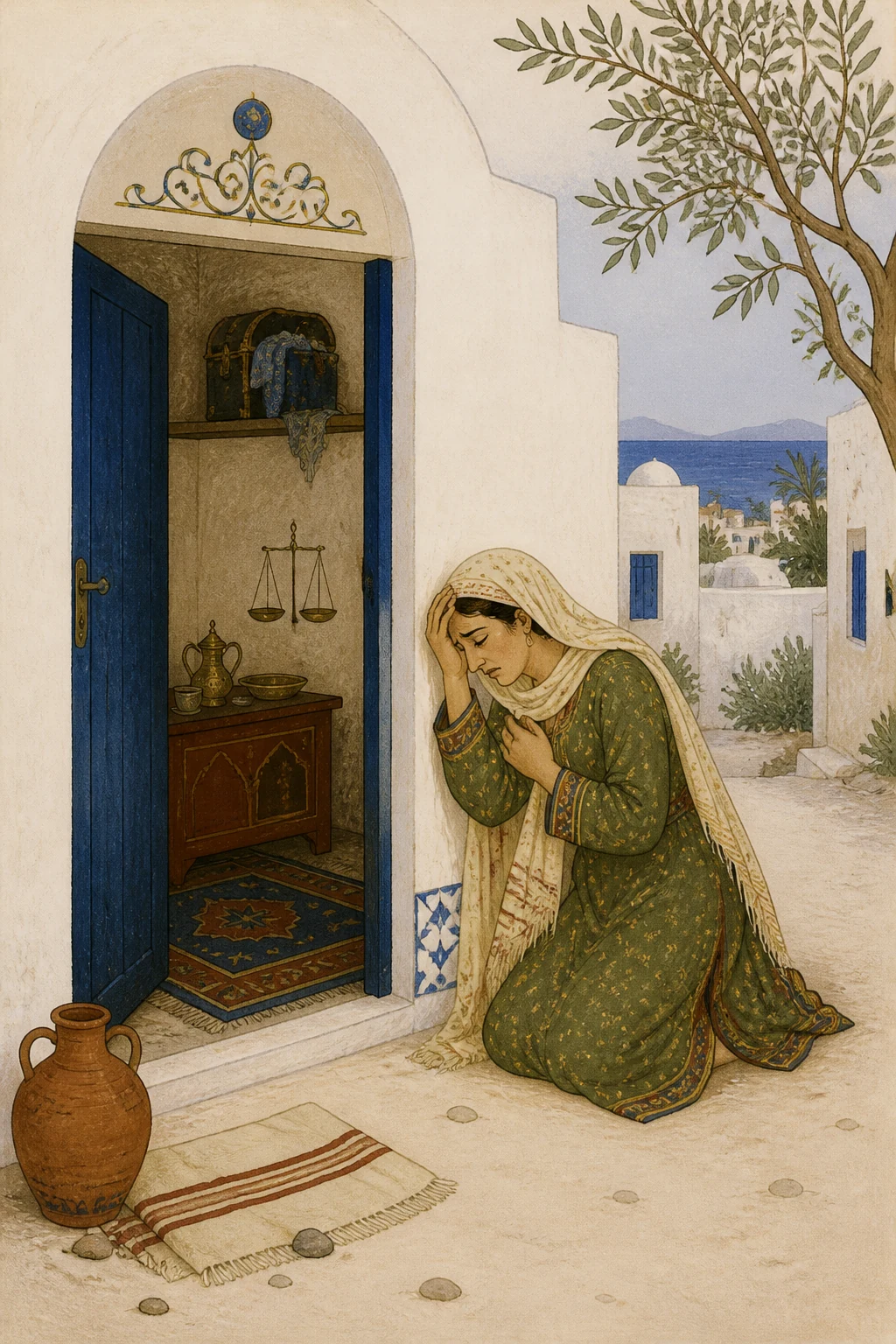
“‘For a while I considered what to do. Then I rose, took off my clothes, and dug a hole in the floor. I laid the girl in it, covered her with earth, and replaced the marble slabs as they had been. Then I dressed, took what remained of my money, and left. I went to the owner of the house, paid him a year’s rent, and said, “I am going to join my uncles in Egypt.” I traveled to Egypt and found my uncles, who were delighted to see me. They had finished selling their merchandise. “What has brought you here?” they asked. “I longed to see you,” I told them, “and I feared I might spend all my money.” I stayed with them for a year, enjoying the sights of Egypt and its Nile, and drawing on what remained of my money for food, drink, and other expenses. When the time came for my uncles to leave, I hid from them. “Perhaps he has gone ahead of us and returned to Damascus,” they said, and set off. I then came out of hiding and remained in Egypt for three years, spending until nothing was left of my money. Each year, meanwhile, I sent the owner of the house his rent. At the end of the three years I grew despondent, with nothing left but enough for a year’s rent. I traveled back to Damascus and returned to the house, whose owner was delighted to see me. I went inside, wiped away the blood of the murdered girl, and lifted the pillow. Beneath it I found the necklace she had worn around her neck. I took it up, gazed at it, and wept for a while. I remained there for two days, and on the third I went to the bath and changed my clothes, though I had not a dirham to my name. One day I went to the market, and Satan whispered to me, so that fate might take its course. I took the jeweled necklace to the market and handed it to a broker. He rose to greet me and seated me beside him, then waited until the market was crowded. Without my knowledge, he quietly offered the necklace for sale, and the bidding for it reached two thousand dinars. Then he came back and said, “This necklace is made of brass, worked in the Frankish fashion, and it has fetched a bid of a thousand dirhams.” “Yes,” I said, “we had it made to play a trick on a woman. My wife inherited it from her, and now we wish to sell it. Go and collect the thousand dirhams.”’” And dawn overtook Shahrazad, and she fell silent, leaving her tale untold.
Then came the twenty-eighth night.
She said, “It has reached me, O fortunate King, that when the young man told the broker, ‘Collect the thousand dirhams,’ the broker realized that something was amiss. He took the necklace to the chief of the market and handed it to him. The chief took it to the governor and said, ‘This necklace was stolen from me, and we have found the thief dressed as a merchant’s son.’ The young man continued: ‘Before I knew it, the officers of the law had surrounded me. They seized me and took me to the governor, who questioned me about the necklace. I told him what I had told the broker, but he laughed and said, “That is not the truth.” In an instant, his men stripped off my clothes and lashed me all over my body. The blows burned so fiercely that I cried, “I stole it!” For I thought, “Better to say I stole it than to tell them that its owner lies murdered in my house, and have them put me to death for her.” When I confessed to stealing it, they cut off my hand and plunged the stump into boiling oil. I fainted, and they gave me wine until I revived. Then I took my severed hand and returned to the house. Its owner said, “Now that this has happened to you, you must leave the house and find somewhere else, for you are suspected of wrongdoing.” “My lord,” I pleaded, “give me two or three days to find another place.” “Very well,” he said, and went away, leaving me alone. I sat weeping and saying to myself, “How can I return to my family with my hand cut off? The man who cut it off did not know I was innocent. Perhaps God will yet bring about a change in my fortunes.”
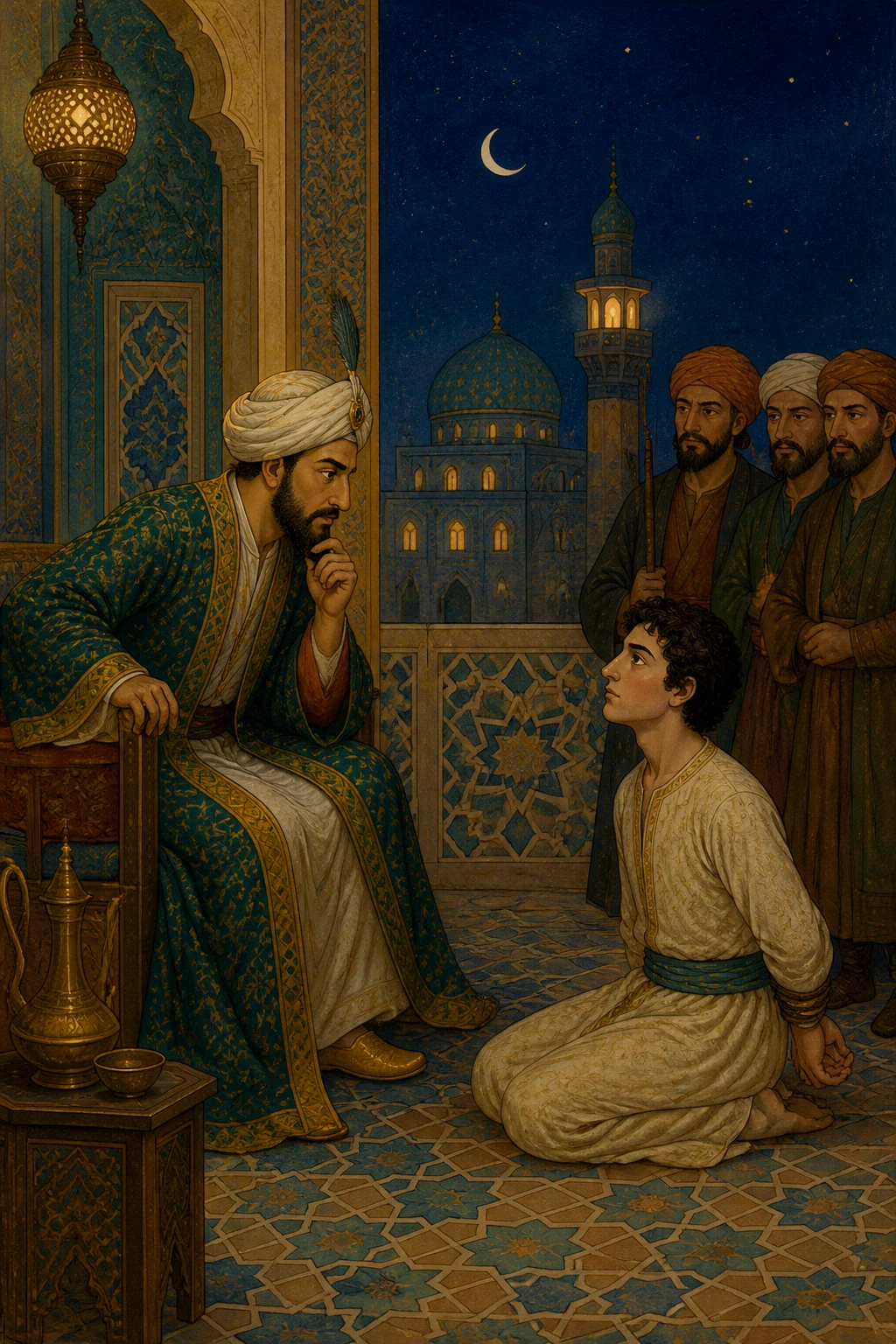
“‘I wept bitterly, and after the owner of the house had left me, such sorrow overcame me that I lay distraught for two days. On the third day, without warning, he came back with some officers and the chief of the market, who had accused me of stealing the necklace. I went out to them and asked, “What is the matter?” They gave me no time to speak, but bound my arms behind my back, put a chain around my neck, and said, “The necklace you had has proved to belong to the lord of Damascus, its vizier and ruler. It disappeared from his house three years ago, along with his daughter.” At these words, my whole body trembled. “They will certainly kill me,” I thought. “By God, I must tell the lord my story. Then he may kill me or pardon me as he chooses.” When we reached him, I was brought before him. On seeing me, he said, “Is this the man who stole the necklace and took it to the market to sell? You have cut off his hand unjustly.” Then he ordered the chief of the market to be imprisoned and said to him, “Pay this man compensation for his hand, or I shall hang you and confiscate all your wealth.” He shouted to his attendants, who seized the man and dragged him away. The lord and I were left alone, after my neck had been freed from its iron collar and my bonds loosened at his command.
“‘Then the lord looked at me and said, “My son, tell me truthfully how this necklace came into your hands.” “My lord,” I replied, “I shall tell you the truth.” I related everything that had happened between me and the first young woman: how she had brought the second to me, and how she had killed her out of jealousy. I told him the whole story. When he heard it, he shook his head, covered his face with his handkerchief, and wept for a while. Then he turned to me and said, “Know, my son, that the elder girl was my daughter. I kept her closely guarded, and when she came of age I sent her to Egypt to marry her cousin. He died, and she returned to me, having learned debauchery from the young men of Egypt. She visited you four times, and then brought you her younger sister. They were full sisters, and dearly loved each other. When the elder had embarked upon this affair, she confided her secret to her sister, who asked my permission to go with her. The elder returned alone. When I questioned her about her sister, I found her weeping for her, and she said, ‘I do not know what has become of her.’ Later, she secretly told her mother the whole story of how she had killed her sister, and her mother told me in confidence. She went on weeping and saying, ‘By God, I shall weep for her until I die.’ What you say is true, my son, for I knew of it before you told me. Consider all that has happened. Now I ask you not to refuse what I am about to propose: I wish to marry you to my youngest daughter. She is their half sister, and a virgin. I shall ask no dowry of you, and shall provide you both with an allowance. You shall remain here with me as my son.” “Let it be as you wish, my lord,” I answered. “How could I ever hope for such good fortune?” The lord at once sent a courier to fetch the money my father had left me, and today I live in the greatest comfort.’ I marveled at his story and stayed with him for three days. He gave me a great deal of money, and I left him and traveled until I reached this city of yours. Life here pleased me, and then there befell me the affair with the hunchback that you know.”
The King of China said, “This is no more marvelous than the story of the hunchback. I must hang you all, especially the tailor, who is the root of all this mischief.” Then he said, “Tailor, if you can tell me something more astonishing than the hunchback’s story, I shall pardon you all your offenses.”