Prevod
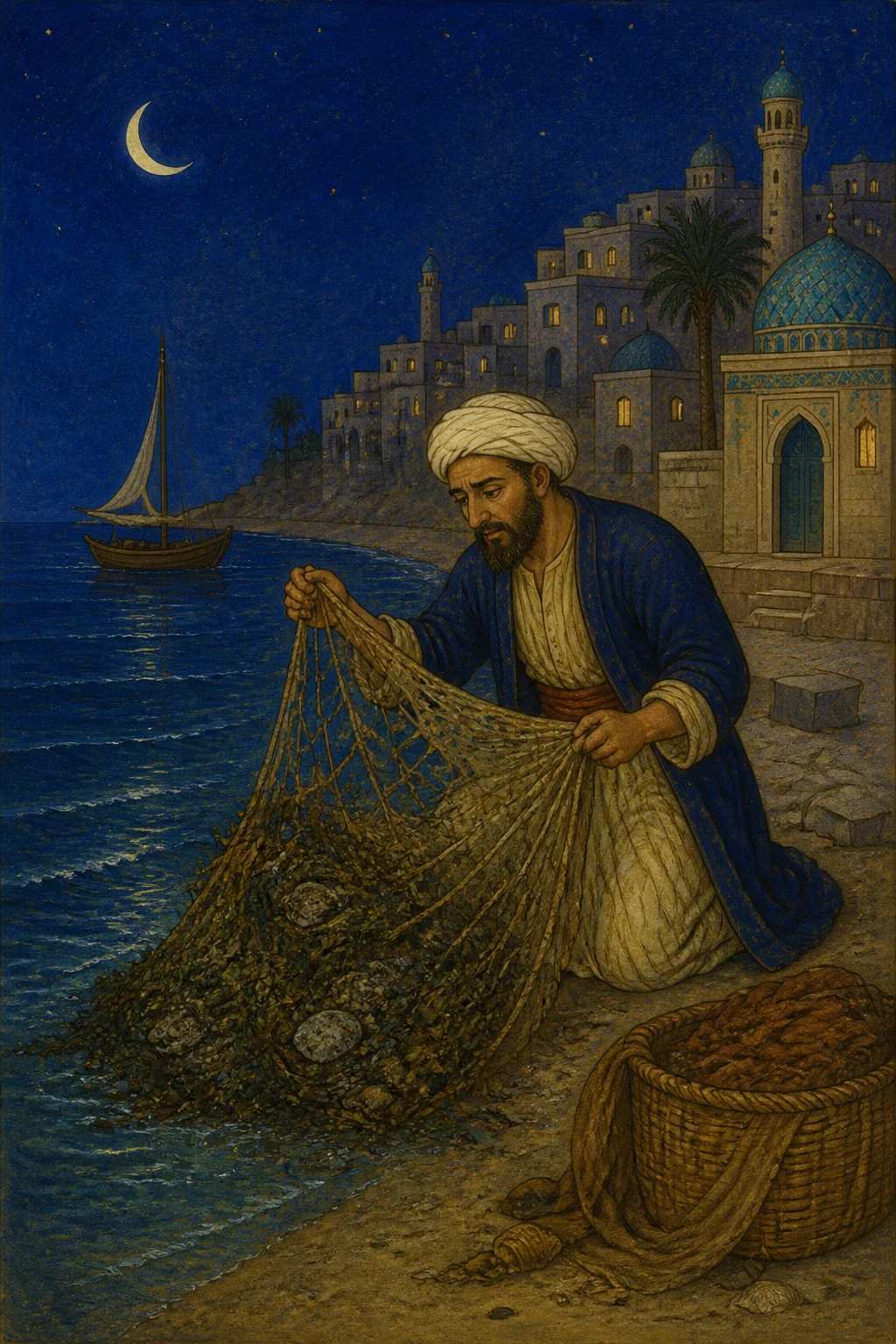
Then one night he said to Ja‘far, “I wish to go down into the city tonight and inquire into the conduct of the governors in office. Any man against whom a complaint is made, we shall dismiss.” Ja‘far replied, “I hear and obey.” So the Caliph went down with Ja‘far and Masrur, and they walked through the city and its markets. Passing an alley, they saw an old man carrying a net and a basket on his head, with a staff in his hand. He was walking slowly and reciting these verses:
“They tell me, ‘Among men, your learning makes you shine like a moonlit night.’ I say, ‘Spare me your praise: learning is nothing without the means to live. Were they to offer me in pledge, with all my learning, all my books and inkwell, for a single day’s sustenance, they would find no one to accept the pledge until the end of time. As for the poor man, his lot and his life—how bitter they are! In summer he cannot earn his bread; in winter he must warm himself over a brazier. Dogs follow him wherever he walks, and every scoundrel drives him away. If he complains of his plight to anyone and explains his troubles, no one will excuse him. Every poor man has become a laughingstock: lead the poor man to his grave.” When the Caliph heard his verses, he said to Ja‘far, “Look at this poor man, and consider his poetry: it speaks plainly of his need.” Then the Caliph went up to him and asked, “Old man, what is your trade?” He replied, “My lord, I am a fisherman, and I have a family. I left my house at noon, and from then until now God has granted me nothing with which to feed my children. I have come to loathe my life and wish for death.” The Caliph said, “Will you return with us to the river, stand on the bank of the Tigris, and cast your net on my luck? Whatever you bring up, I will buy from you for a hundred dinars.” The man rejoiced at these words and said, “With the greatest pleasure, I will return with you.” So the fisherman went back to the river, cast his net, and waited. Then he pulled the line and drew the net toward him, and in it came up a locked chest, heavy in weight. When the Caliph saw it, he felt it and found it heavy, so he gave the fisherman a hundred dinars, and the man went on his way. Masrur and Ja‘far carried the chest back to the palace with the Caliph. Candles were lit, and the chest was set before him. Ja‘far and Masrur stepped forward and broke it open. Inside they found a palm-leaf basket sewn shut with red wool. They cut the stitching and saw a piece of carpet within. Lifting it, they found a sheet beneath it; and when they lifted the sheet, they found a young woman, lovely as a bar of silver, murdered and cut to pieces. At the sight of her, tears ran down the Caliph’s cheeks. He turned to Ja‘far and said, “You dog of a vizier! Are people to be murdered in my reign and thrown into the river, leaving me answerable for their blood? By God, I shall avenge this young woman upon her murderer and put him to death!” Then he said to Ja‘far, “By my descent from the Abbasid caliphs, unless you bring me her murderer so that I may exact justice for her, I shall have you and forty of your cousins hanged at my palace gate.” The Caliph was furious, and Ja‘far said, “Grant me three days.” “You have them,” he replied. Ja‘far left his presence and walked through the city in sorrow, saying to himself, “How am I to discover who killed this young woman and bring him before the Caliph? If I bring him someone else, I shall be answerable for his blood. I do not know what to do!”
Ja‘far stayed in his house for three days. On the fourth day the Caliph sent for him, and when he stood before him, he asked, “Where is the young woman’s murderer?” Ja‘far replied, “Commander of the Faithful, do I know the unseen, that I should know who killed her?” The Caliph flew into a rage and ordered him to be hanged at the palace gate. He commanded a herald to proclaim through the streets of Baghdad, “Whoever wishes to witness the hanging of Ja‘far al-Barmaki, the Caliph’s vizier, and his cousins at the palace gate, let him come and look!” People poured out of every quarter to see Ja‘far and his cousins hanged, though they did not know the reason. The Caliph ordered the gallows erected, and when they were ready, the condemned men were made to stand beneath them while the executioners awaited his permission. The crowd wept for Ja‘far and his cousins. While they were thus gathered, a handsome young man in clean clothes came hurrying through the people until he stood before the vizier. “May you be spared this fate, lord of princes and refuge of the poor!” he said. “I am the man who murdered the woman you found in the chest. Put me to death for her and exact her vengeance upon me.” When Ja‘far heard the young man’s words and his confession, he rejoiced at his own deliverance but grieved for the youth.
While they were speaking, an old man came pushing his way swiftly through the crowd until he reached Ja‘far and the young man. He greeted them both and said, “Vizier, do not believe what this young man says. None but I killed the young woman. Exact her vengeance upon me.” The youth said, “Vizier, this is a senile old man who does not know what he is saying. I am the one who killed her, so exact her vengeance upon me.” The old man said, “My son, you are young and still desire the world, while I am old and have had my fill of it. Let me ransom you, the vizier, and his cousins with my life. None but I killed the young woman, so I beg you, by God, make haste to put me to death.”
Ja‘far marveled at what he saw, then took the young man and the old man and brought them before the Caliph. “Commander of the Faithful,” he said, “the young woman’s murderer is here.” “Where is he?” asked the Caliph. Ja‘far replied, “This young man says, ‘I am the murderer,’ while this old man contradicts him and says, ‘No, I am the murderer.’” The Caliph looked at the old man and the youth and asked, “Which of you killed this young woman?” The youth said, “None but I killed her.” And the old man said, “None but I killed her.” The Caliph said to Ja‘far, “Take them both and hang them.” Ja‘far replied, “If there is only one murderer, to kill the other would be an injustice.” Then the young man said, “By Him who raised the heavens and spread out the earth, I am the one who killed the young woman, and here is the proof.” He described what the Caliph had found, and the Caliph became certain that the youth was her murderer. In astonishment he asked, “Why did you kill this young woman unjustly? And why have you confessed without being beaten, saying, ‘Exact her vengeance upon me’?”
The young man replied, “Know, Commander of the Faithful, that this young woman was my wife and my cousin. This old man is her father and my uncle. I married her when she was a virgin, and God blessed me with three sons by her. She loved me and cared for me, and I had never seen anything amiss in her conduct. At the beginning of this month she fell gravely ill, and I brought physicians to attend her until she began to recover. I wished to take her to the bathhouse, but she said, ‘There is something I want before I go to the bath, for I have a craving for it.’ I asked, ‘What is it?’ She replied, ‘I long for an apple, to smell it and take a bite of it.’ I went out into the city at once and searched for apples, willing to pay even a dinar apiece, but could find none. I spent that night troubled, and when morning came, I left my house and went round the orchards one by one, but found none there either. I happened upon an elderly gardener and asked him about apples. He said, ‘My son, they are scarcely to be found, for they are out of season. There are none except in the Commander of the Faithful’s garden at Basra, where the gardener keeps them for the Caliph.’ I returned to my wife, and my love for her drove me to make ready for the journey. I traveled night and day for fifteen days, going and returning, and brought her three apples which I had bought from the gardener in Basra for three dinars. I went in and gave them to her, but she took no pleasure in them and merely laid them beside her, for her fever had grown worse. She remained weak for ten days, and after that she recovered. Then I left the house and went to my shop, where I sat buying and selling. As I was sitting there at midday, a black slave passed by with an apple in his hand, tossing it about. I asked him, ‘Where did you get that apple, so that I may get one like it?’ He laughed and said, ‘I got it from my sweetheart. I had been away, and when I returned, I found her ill, with three apples beside her. She told me, “My cuckold of a husband traveled all the way to Basra for them and bought them for three dinars.” So I took this apple from her.’
“When I heard the slave’s words, Commander of the Faithful, the world went black before my eyes. I shut my shop and went home, out of my mind with rage. I could not find the third apple, so I asked her, ‘Where is the third one?’ She replied, ‘I do not know. I have no idea where it has gone.’ This convinced me that the slave had spoken the truth. I rose, took a knife, knelt on her chest, and cut her throat. Then I cut off her head and limbs, hurriedly put her into the basket, covered her with the sheet, and laid the piece of carpet over her. I lowered her into the chest and locked it, loaded it onto my mule, and threw it into the Tigris with my own hands. So I beg you, by God, Commander of the Faithful, make haste to put me to death in vengeance for her, for I fear her claim against me on the Day of Resurrection. After I had thrown her into the Tigris, without anyone knowing of it, I returned home and found my eldest son crying. He knew nothing of what I had done to his mother. I asked him, ‘Why are you crying?’ He replied, ‘I took one of the apples that were beside my mother and went down into the alley to play with my brothers. A tall black slave snatched it from me and asked, “Where did you get this?” I told him, “My father traveled to Basra and brought it back for my mother, who is ill. He bought three apples for three dinars.” But he took it from me, beat me, and went away with it. I was afraid my mother would beat me because of the apple.’
“When I heard the boy’s words, I knew that the slave had made up his lies about my cousin, and I realized that she had been killed unjustly. I wept bitterly, and then this old man, my uncle and her father, arrived. I told him what had happened, and he sat beside me and wept. We went on weeping until midnight, and we held mourning for her for five days. To this day we have never ceased grieving over her death. So by the sanctity of your forefathers, make haste to put me to death and exact her vengeance upon me.” When the Caliph heard the young man’s story, he marveled and said, “By God, I will put none but that wicked slave to death.” And dawn overtook Shahrazad, and she fell silent, leaving her tale untold.
When it was the nineteenth night
She said: It has reached me, O fortunate King, that the Caliph swore he would put none but the slave to death, for the young man was to be excused. Then the Caliph turned to Ja‘far and said, “Bring me that wicked slave who caused this affair. If you do not bring him, you shall be put to death in his place.” Ja‘far went down weeping and saying, “Where am I to find him? The pitcher does not come away unbroken every time. I have no means of solving this matter. He who delivered me the first time will deliver me the second. By God, I shall not leave my house for three days, and God, exalted be He, will do as He wills.” He stayed in his house for three days. On the fourth day he summoned the judge, made his will, and bade farewell to his children in tears. Then the Caliph’s messenger arrived and said, “The Commander of the Faithful is in the fiercest of rages. He has sent me to you and sworn that this day shall not pass without your being put to death unless you bring him the slave.”
When Ja‘far heard these words, he wept, and his children wept with him. Having finished his farewells, he went to say goodbye to his little daughter, whom he loved more than all his other children. He clasped her to his breast and wept at the thought of parting from her. Then he felt something round in her pocket and asked, “What have you in your pocket?” She replied, “Father, it is an apple our slave Rayhan brought. I have had it for four days. He would not give it to me until he had taken two dinars from me.” When Ja‘far heard of the slave and the apple, he rejoiced and cried, “O You whose deliverance is near!” He ordered the slave to be brought, and when he appeared, asked him, “Where did this apple come from?” He replied, “My lord, five days ago I was walking along and turned into one of the city’s alleys, where I saw some children playing. One of them had this apple, so I snatched it from him and struck him. He cried and said, ‘It belongs to my mother. She is ill, and she asked my father for apples, so he traveled to Basra and brought her three apples for three dinars. I took this one to play with.’ He went on crying, but I paid no heed to him. I took the apple and brought it here, and my little mistress bought it for two dinars.” When Ja‘far heard this story, he marveled that his own slave had caused all the trouble and the young woman’s death. He ordered the slave imprisoned and rejoiced at his own deliverance. Then he recited these two verses:
“If a slave should bring calamity upon you, to grant him his desire may cost your life. Servants you may find in plenty, but you will find no other life than your own.” Then he seized the slave and brought him before the Caliph, who ordered that this tale be recorded and spread among the people. Ja‘far said to him, “Do not marvel at this story, Commander of the Faithful, for it is no more wonderful than the tale of the vizier Nur al-Din and his brother Shams al-Din.” The Caliph asked, “What tale could be more wonderful than this?” Ja‘far replied, “Commander of the Faithful, I will tell it to you only on condition that you spare my slave from death.” The Caliph said, “I grant you his life.”