Waltey
Abdulah z morja in Abdulah s kopnega
Tisoč in ena noč · arabska pripovedna tradicijaO besedilu
Abdulah z morja in Abdulah s kopnega
- Vir
- Tisoč in ena noč
- Avtor
- arabska pripovedna tradicija
- Jezik branja
- English
- Jezik izvirnika
- Arabic
- Čas branja
- 42 min branja
- Obseg
- 34 strani
- Naslov izvirnika
- حكاية عبد الله البحري وعبد الله البرِّي - الليالي ٩٤٠ إلى ٩٤٦
O izvirniku
Tisoč in ena noč
Zgodbe v zgodbah, polne trgovcev, dvorov, preoblek in nočnih zapletov. Bralni jezik je English, izvirnik pa prihaja iz vira Tisoč in ena noč v jeziku Arabic.
Besedilo
Abdulah z morja in Abdulah s kopnega
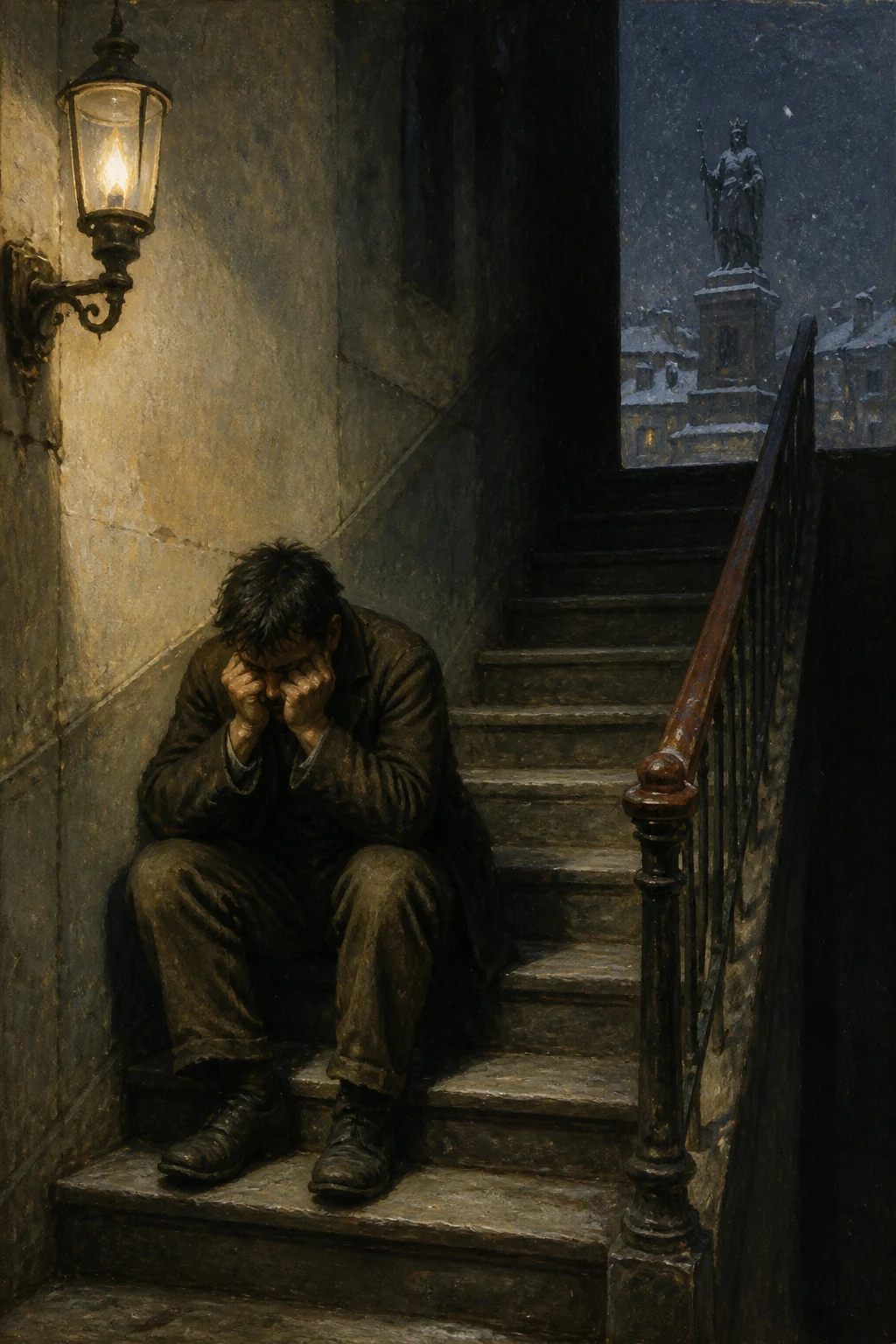
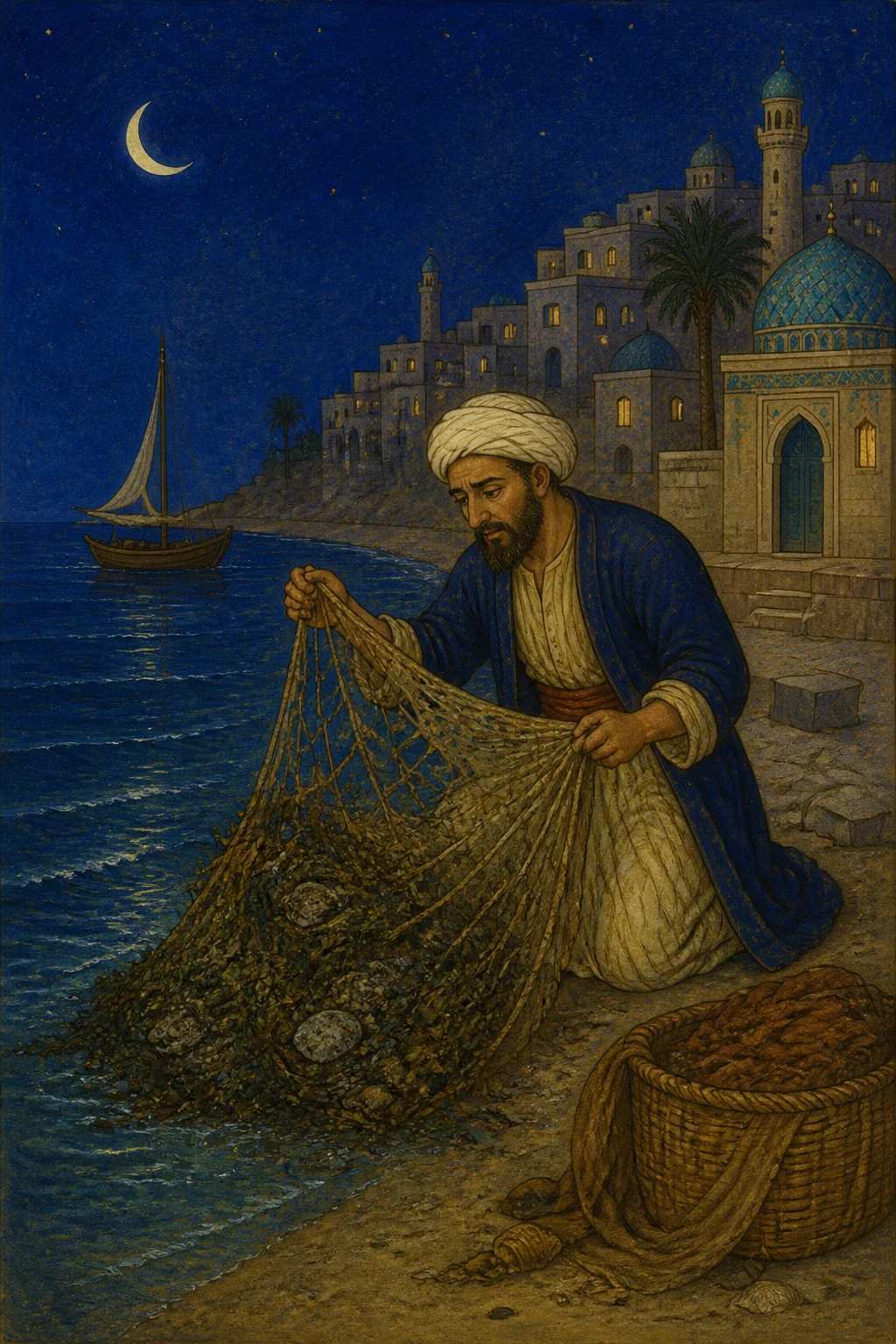
It is also told that there was once a fisherman named Abdullah, who had a large family: nine children and their mother. He was very poor and owned nothing but his net. Every day he would go down to the sea to fish. If he caught only a little, he sold it and spent the money on his children according to what God had granted him; if he caught a great deal, he would cook a good meal and buy fruit, and go on spending until he had nothing left, saying to himself, “Tomorrow’s provision will come tomorrow.” Then his wife gave birth, bringing their number to ten, and that day the man had nothing at all. His wife said to him, “My husband, find me something to sustain me.” He replied, “Here I go to the sea, with Almighty God’s blessing, to fish today on the luck of this newborn child, and we shall see what fortune he brings.” “Put your trust in God,” she said. So he took his net and went down to the sea, where he cast it on the little child’s luck, saying, “O God, let his livelihood come easily, not with hardship, and let it be plentiful, not scant.” He waited a while and then drew it in, but it came up full of rubbish, sand, pebbles, and weeds, without a single fish, great or small. He cast it a second time, waited, and drew it in, but found no fish. He cast it a third, a fourth, and a fifth time, yet still no fish came up. Then he moved to another place, seeking his livelihood from Almighty God, and continued in this way until the end of the day without catching so much as a minnow. He wondered to himself and said, “Can Almighty God have created this newborn child without providing for him? That can never be, for He who made the mouths has undertaken to feed them. Almighty God is generous, the Giver of all sustenance.” Then he took up his net and returned, brokenhearted and anxious for his family, whom he had left without food, especially his wife, who had just given birth. As he walked, he kept saying to himself, “What am I to do? What shall I tell the children tonight?” At last he came to a baker’s oven, where he saw a crowd. It was a time of high prices, and in those days people had very little food. They were holding out their coins to the baker, who could attend to none of them because of the press of people. The fisherman stood watching and breathing in the smell of hot bread, and hunger made him long for it. The baker caught sight of him and called, “Come here, fisherman!” He went up to him, and the baker asked, “Do you want some bread?” He said nothing. “Speak, and do not be ashamed,” said the baker. “God is generous. If you have no money, I will give you bread and wait until better days come.” The fisherman said, “Master, I have no money, but give me enough bread for my family and keep this net as a pledge until tomorrow.” “Poor man,” said the baker, “this net is your shop and the source of your livelihood. If you pawn it, what will you fish with? Just tell me how much you need.” “Ten silver half-dirhams’ worth,” he replied. The baker gave him bread worth ten half-dirhams, then handed him ten silver half-dirhams as well, saying, “Take these ten and cook yourself a meal. That will make twenty silver half-dirhams you owe me. Tomorrow bring me fish to that value. If you catch nothing, come and take your bread and another ten half-dirhams. I will wait until better days come.” But dawn overtook Shahrazad, and she fell silent, leaving her tale untold.
When it was the nine hundred and forty-first night
She said: It has reached me, O fortunate King, that the baker said to the fisherman, “Take what you need, and I will wait until better days come. Then bring me fish to the value of what you owe me.” The fisherman said, “May Almighty God reward you and repay you with every blessing for what you have done for me.” He took the bread and the ten silver half-dirhams and went away rejoicing. He bought what he could and went in to his wife, whom he found sitting and comforting the children as they wept with hunger, saying, “Your father will be here any moment with something for you to eat.” When he came in, he set the bread before them, and they ate. He told his wife what had happened, and she said, “God is generous.” The next day he took his net and left his house, saying, “O Lord, I ask You to grant me enough today to let me hold my head high before the baker.” When he reached the sea, he began casting his net and drawing it in, but no fish came up. He continued until the end of the day and caught nothing. He returned in great distress. The way to his house led past the baker’s oven, and he said to himself, “How am I to get home? I shall hurry past so the baker does not see me.” When he reached the oven, he saw a crowd and quickened his pace, ashamed to let the baker see him. But the baker caught sight of him and called out, “Fisherman! Come and take your bread and your money. You have forgotten them.” “No, by God, I have not forgotten,” he replied. “I was only ashamed to face you, for I caught no fish today.” “Do not be ashamed,” said the baker. “Did I not tell you to take your time until better days come?” He gave him the bread and the ten half-dirhams, and the fisherman went home and told his wife what had happened. She said, “God is generous. God willing, better days will come, and you will repay him.” This went on for forty days. Every day he went to the sea from sunrise to sunset and returned without fish, then took bread and money from the baker. Not once did the baker mention the fish or neglect him as others might have done, but always gave him the ten half-dirhams and the bread. Whenever the fisherman said, “Brother, let us settle my account,” he would reply, “Go your way. This is no time for reckoning. When better days come, I will reckon with you.” Then the fisherman would pray for him and leave with thanks. On the forty-first day he said to his wife, “I mean to cut up this net and be done with such a life.” “Why?” she asked. He replied, “It seems that my livelihood from the sea has come to an end. How long must this go on? By God, I am consumed with shame before the baker. I shall go to the sea no more, so that I need not pass his oven, for there is no other road for me. Whenever I pass him, he calls me over and gives me bread and ten half-dirhams. How long am I to go on borrowing from him?” She said, “Praise be to Almighty God, who has inclined his heart toward you so that he gives you food. What is there in that to resent?” He replied, “I owe him a great deal of money now, and he is bound to demand his due.” His wife asked, “Has he spoken harshly to you?” “No,” he said. “He will not even reckon with me, but says, ‘Wait until better days come.’” “Then if he asks for his money,” she said, “tell him, ‘Wait until the better days that you and I are hoping for.’” He asked, “When will these better days we hope for come?” “God is generous,” she replied. “You speak truly,” he said.
Then he took his net and made for the sea, saying, “O Lord, grant me even one fish to give the baker as a present.” He cast the net into the sea and drew it in, finding it heavy. He struggled with it until he was utterly exhausted, and when at last he hauled it out, he found a dead donkey in it, bloated and stinking. His heart sickened. He freed it from the net and said, “There is no power and no might save in God, the Most High, the Almighty! I am worn out with telling this woman that there is no livelihood left for me in the sea and asking her to let me give up this trade, while she keeps saying, ‘God is generous; better days will come.’ Is this dead donkey the good fortune she means?” Deeply distressed, he moved to another place to escape the donkey’s stench. He took his net, cast it, and waited an hour. Then he drew it in and found it heavy, and struggled with it until blood ran from his palms. When he brought it up, he saw a human figure inside it. He thought it must be one of the ifrits of the lord Solomon, whom he had imprisoned in brass vessels and thrown into the sea: the vessel must have broken with the passing years, releasing the ifrit, who had then come up in his net. He fled, crying, “Mercy! Mercy, O ifrit of Solomon!” But the man called to him from inside the net, “Come back, fisherman! Do not run away from me. I am a human being like you. Set me free, and I will reward you.” Hearing these words, the fisherman took heart and approached him, saying, “Are you not an ifrit of the jinn?” “No,” he answered. “I am a human being who believes in God and His Messenger.” “Who threw you into the sea?” asked the fisherman. He replied, “I am one of the children of the sea. I was going about my business when you cast your net over me. We are a people obedient to God’s decrees and compassionate toward His creatures. Were it not that I fear to be counted among the disobedient, I would have torn your net, but I accepted what God had ordained for me. If you release me, you will be my master and I your captive. Will you set me free for the sake of Almighty God, make a covenant with me, and become my friend? I will come to this place every day, and you shall come to meet me, bringing a gift of the fruits of the land. You have grapes, figs, melons, peaches, pomegranates, and other fruits, and whatever you bring me I will gladly accept. We have coral, pearls, chrysolites, emeralds, rubies, and precious stones. I will fill the basket in which you bring me fruit with treasures from the sea. What do you say to this, brother?” The fisherman replied, “Let the Fatiha seal this agreement between us.” Each recited the Fatiha, and the fisherman freed him from the net. Then he asked, “What is your name?” “My name is Abdullah of the Sea,” he replied. “If you come to this place and do not see me, call out, ‘Where are you, Abdullah of the Sea?’ and I will be with you at once.” But dawn overtook Shahrazad, and she fell silent, leaving her tale untold.
When it was the nine hundred and forty-second night
She said: It has reached me, O fortunate King, that Abdullah of the Sea said to him, “If you come to this place and do not see me, call out, ‘Where are you, Abdullah of the Sea?’ and I will be with you at once. And what is your name?” The fisherman answered, “My name is Abdullah.” “Then you are Abdullah of the Land, and I am Abdullah of the Sea,” he said. “Wait here while I go and bring you a gift.” “I hear and obey,” replied the fisherman. Abdullah of the Sea went off into the water, and Abdullah of the Land regretted having freed him from the net. He said to himself, “How do I know he will return? He only tricked me into letting him go. If I had kept him, I could have exhibited him to the people of the city, taken money from everyone, and brought him into the houses of the great!” He began to rue his release, saying to himself, “Your catch has slipped through your fingers!” While he was lamenting his escape, Abdullah of the Sea returned with his hands full of pearls, coral, emeralds, rubies, and precious stones. “Take these, brother,” he said, “and forgive me: I had no basket to fill for you.” Abdullah of the Land rejoiced and took the jewels from him. Abdullah of the Sea said, “Come to this place every day before sunrise.” Then he bade him farewell and went back into the sea. The fisherman entered the city in high spirits and walked on until he reached the baker’s oven. “Brother,” he said, “better days have come to us, so let us settle my account.” The baker replied, “There is no need for reckoning. If you have anything, give it to me; if not, take your bread and your money and go your way until better days come.” “My friend,” said the fisherman, “good fortune has come to me from God’s bounty. I owe you a great deal, but take this.” He scooped up a handful of pearls, coral, rubies, and precious stones, amounting to half of all he had, and gave them to the baker. Then he said, “Give me some money to spend today until I can sell these treasures.” The baker gave him all the money he had at hand and every loaf in his breadbasket. Delighted with the jewels, he said to the fisherman, “I am your slave and servant.” He loaded all the bread he had onto his head and followed him home, where he gave it to the fisherman’s wife and children. Then he went to the market and brought back meat, vegetables, and every kind of fruit. Leaving his oven, he spent the whole day serving Abdullah of the Land and attending to his needs. The fisherman said, “Brother, you have worn yourself out!” The baker replied, “It is my duty, for I have become your servant, and your kindness has overwhelmed me.” “It was you who showed me kindness in hardship and dearth,” said the fisherman. The baker stayed with him that night, sharing good food, and became the fisherman’s close friend. The fisherman told his wife of his adventure with Abdullah of the Sea, and she rejoiced and said, “Keep your secret, lest the rulers gain power over you.” He replied, “Even if I keep my secret from everyone else, I will not keep it from the baker.”
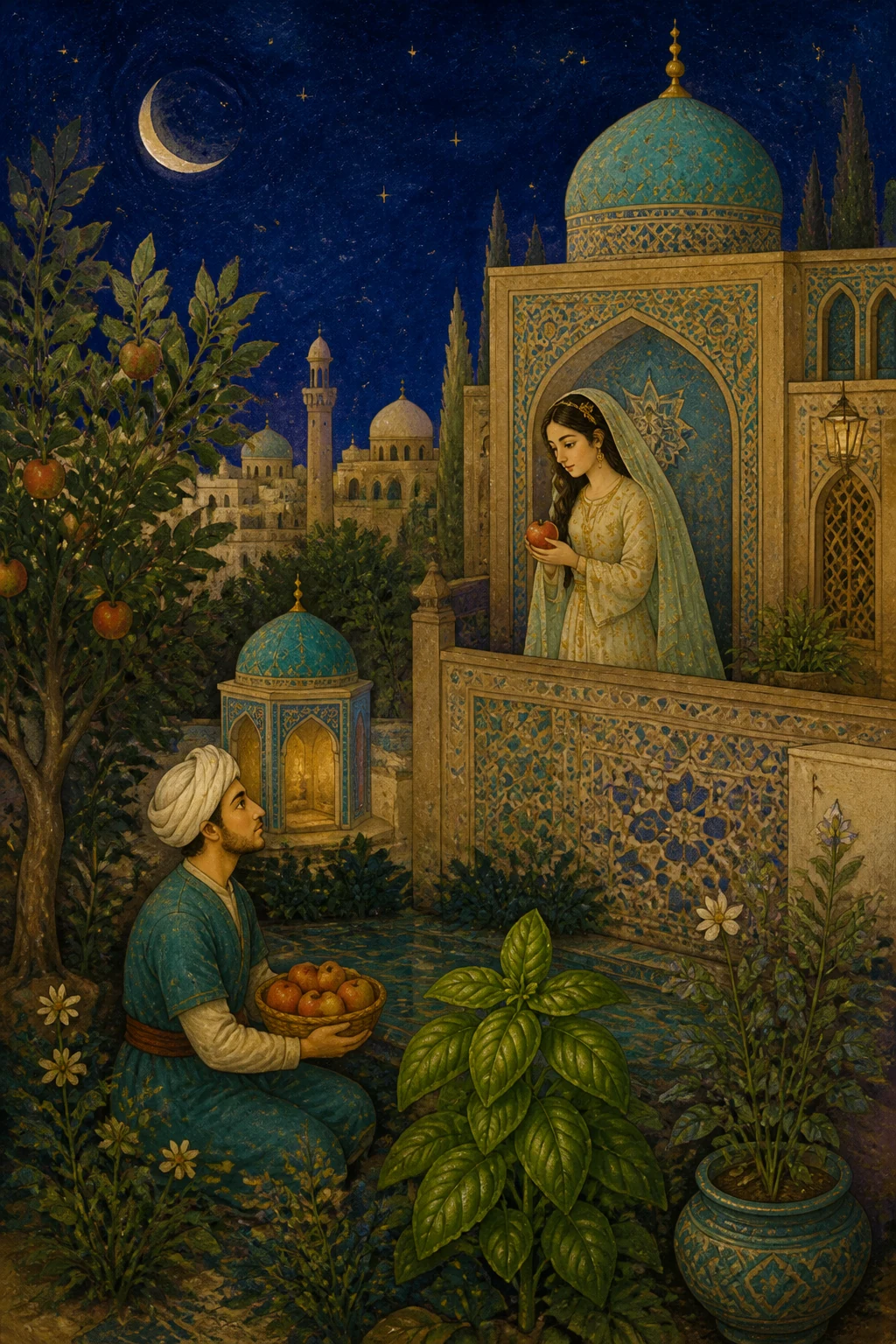
The next morning, having filled a basket with every kind of fruit the evening before, he took it up before sunrise and went down to the sea. He set it on the shore and called, “Where are you, Abdullah of the Sea?” At once came the answer, “Here I am!” His friend came out to him, and he gave him the fruit. Abdullah of the Sea took it, went down into the water, and dived beneath the surface. He was gone for an hour, then emerged with the basket full of every kind of precious stone and jewel. Abdullah of the Land lifted it onto his head and went away. When he reached the baker’s oven, the baker said, “My master, I have baked forty twisted sweet loaves for you and sent them to your house. Now I am baking the fine white bread. As soon as it is ready, I shall take it to the house, then go and fetch you vegetables and meat.” The fisherman gave him three handfuls from the basket and went home. There he set down the basket and chose one fine gem of each kind. He went to the jewel market, stopped at the shop of its chief, and said, “Buy these jewels from me.” “Show them to me,” said the chief. He showed them, and the man asked, “Have you any more of these?” “I have a whole basketful,” he replied. “Where is your house?” “In such-and-such a quarter,” he told him. The chief took the jewels from him and said to his men, “Seize him! This is the thief who stole the possessions of the queen, the sultan’s wife.” Then he ordered them to beat him, and they beat him and bound his arms behind his back. The chief and all the people of the jewel market set off with him, crying, “We have caught the thief!” Some said, “It can only have been this villain who stole so-and-so’s property.” Others said, “He is the one who stole everything from so-and-so’s house.” One said this and another that, while he remained silent, answering none of them and saying not a word, until they brought him before the king. The chief said, “O King of the Age, when the queen’s necklace was stolen, you sent to inform us and charged us to catch the culprit. I exerted myself beyond all others and have caught him for you. Here he stands before you, and these are the jewels we recovered from him.” The king said to the eunuch, “Take these treasures and show them to the queen. Ask her, ‘Are these the possessions you lost?’” The eunuch took them and brought them before the queen. When she saw them, she marveled and sent word to the king, saying, “I have found my necklace in my own rooms. These are not my belongings, but these jewels are finer than those in my necklace. Do not wrong the man.” But dawn overtook Shahrazad, and she fell silent, leaving her tale untold.
When it was the nine hundred and forty-third night
She said: It has reached me, O fortunate King, that the king’s wife sent word to him, saying, “These are not my belongings, but these jewels are finer than those in my necklace. Do not wrong the man. If he wishes to sell them, buy them for your daughter Umm al-Suud, so that we may make her a necklace.” When the eunuch returned and told the king what the queen had said, he cursed the chief of the jewelers and all his company with the curse of Ad and Thamud. They said, “O King of the Age, we knew this man to be a poor fisherman, and thought such wealth beyond him, so we supposed that he had stolen it.” The king said, “You wretches! Do you begrudge a believer his good fortune? Why did you not ask him? Perhaps Almighty God had provided for him from a source he never expected! How could you call him a thief and disgrace him before everyone? Get out, and may God withhold His blessing from you!” They went out in fear.
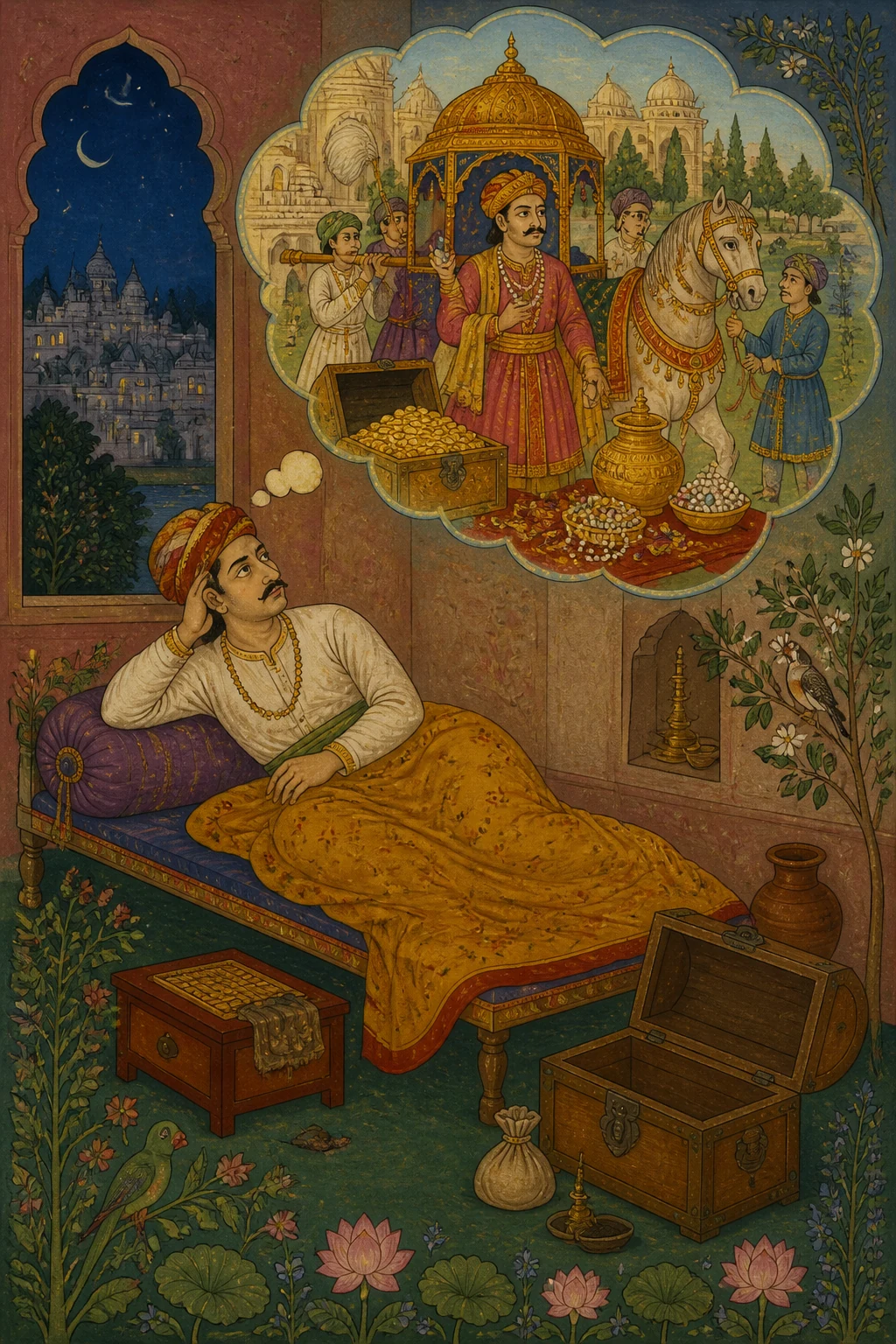
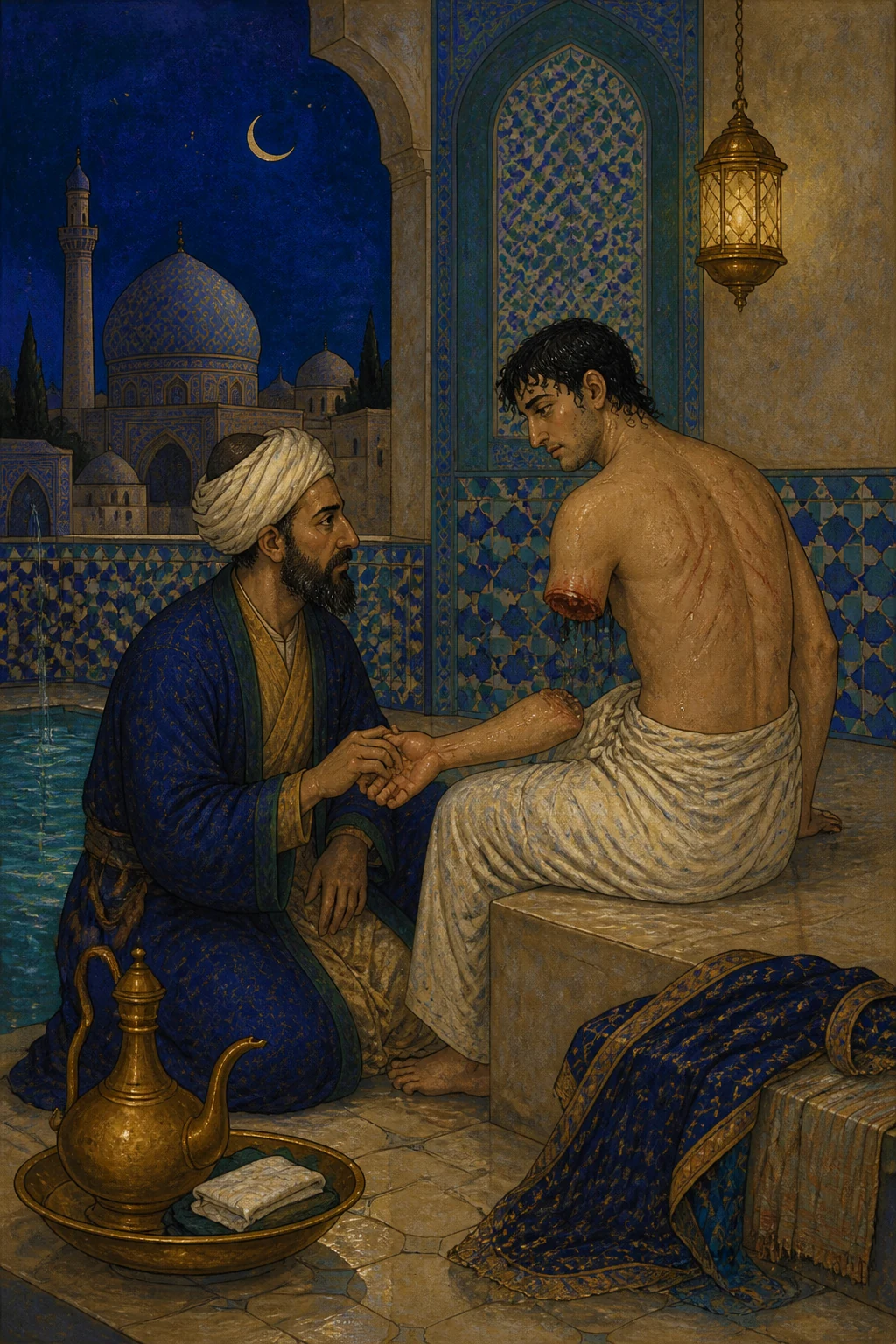
So much for them. As for the king, he said, “My good man, may God bless you in what He has bestowed upon you. You are safe, but tell me truthfully: where did you get these jewels? I am a king, yet I possess nothing like them.” The fisherman replied, “O King of the Age, I have a whole basketful of them, and this is how it happened.” He told him of his friendship with Abdullah of the Sea, saying, “We have made a covenant that every day I shall fill the basket with fruit for him, and he shall fill it with these jewels for me.” The king said, “My good man, this is your allotted fortune, but wealth needs rank to protect it. For now I can keep others from oppressing you, but I may be deposed or die, and another take my place. Out of love of worldly riches and greed, he would kill you. I therefore wish to marry you to my daughter and make you my vizier, and appoint you to succeed me as king, so that no one will covet what is yours after my death.” Then the king said, “Take this man to the bathhouse.” They took him, washed his body, dressed him in royal garments, and brought him before the king, who appointed him his vizier. He sent messengers, the ceremonial band, and all the wives of the great men to the fisherman’s house. They dressed his wife and children in clothes fit for royalty and seated her in a litter. All the great men’s wives, the soldiers, the messengers, and the ceremonial band walked before her, and they brought her to the king’s palace with the little child in her arms. They took her older children in to the king, who honored them, took them on his lap, and seated them beside him. They were nine boys. The king himself had no offspring save his daughter, who was called Umm al-Suud. The queen honored the wife of Abdullah of the Land, bestowed favors upon her, and made her her own vizier. The king ordered the marriage contract to be drawn up between Abdullah of the Land and his daughter, making all the jewels and precious stones the fisherman possessed her bridal gift. The celebrations began, and the king ordered a proclamation that the city should be decorated for his daughter’s wedding. The next day, after Abdullah had gone in to the king’s daughter and taken her maidenhood, the king looked out of a window and saw him carrying a basket full of fruit on his head. “What is that you have with you, my son-in-law?” he asked. “And where are you going?” “To my friend Abdullah of the Sea,” he replied. The king said, “My son-in-law, this is no time to go visiting your friend!” Abdullah answered, “I fear that if I fail to keep our appointment, he will think me a liar and say, ‘The world has distracted you from me.’” “You are right,” said the king. “Go to your friend, and may God help you.” He walked through the city on his way to his friend. By now the people knew him, and he heard them saying, “There goes the king’s son-in-law to exchange fruit for jewels.” Anyone who did not know him would call, “How much a pound, my good man? Come and sell me some.” He would reply, “Wait until I come back to you,” unwilling to offend anyone. Then he went and met Abdullah of the Sea, gave him the fruit, and received jewels in exchange.
He continued in this way, but every day he passed the baker’s oven he found it closed. This went on for ten days. Seeing no sign of the baker and finding his oven always closed, he said to himself, “How strange! Where can the baker have gone?” Then he asked a neighbor, “Brother, where is your neighbor the baker? What has God brought upon him?” The man replied, “My lord, he is ill and does not leave his house.” “Where is his house?” he asked. “In such-and-such a quarter,” the neighbor told him. He went there and asked after him. When he knocked at the door, the baker looked out of the window and saw his friend the fisherman with a full basket on his head. He came down and opened the door, and the fisherman flung himself upon him and embraced him, saying, “How are you, my friend? Every day I pass your oven and find it closed. I asked your neighbor, and he told me you were ill, so I inquired where you lived in order to visit you.” The baker said, “May God reward you with every blessing on my behalf. I am not ill, but I heard that the king had seized you because someone had lied to him and accused you of being a thief. I was afraid, so I closed the oven and hid myself.” “That is indeed what happened,” said the fisherman. Then he told him his story and what had passed between him, the king, and the chief of the jewel market, saying, “The king has married me to his daughter and made me his vizier.” Then he added, “Take everything in this basket as your share, and have no fear.” Having reassured him, he left and went to the king with the empty basket. The king said, “My son-in-law, it seems you did not meet your companion Abdullah of the Sea today.” He answered, “I went to him, but I gave what he gave me to my friend the baker, for he has done me a kindness.” “Who is this baker?” asked the king. “He is a good and generous man,” Abdullah replied. “In my days of poverty, such-and-such passed between us. He never neglected me for a single day or wounded my feelings.” The king asked, “What is his name?” “His name is Abdullah the Baker,” he replied. “My name is Abdullah of the Land, and my friend is called Abdullah of the Sea.” The king said, “And my name is Abdullah. All the servants of God are brothers. Send for your friend the baker and bring him here, so that we may make him vizier of the left.” So he sent for him, and when the baker came before the king, he clothed him in a vizier’s robes and appointed him vizier of the left, making Abdullah of the Land vizier of the right. But dawn overtook Shahrazad, and she fell silent, leaving her tale untold.
When it was the nine hundred and forty-fourth night
She said: It has reached me, O fortunate King, that the king made his son-in-law Abdullah of the Land vizier of the right, and Abdullah the Baker vizier of the left. Abdullah continued in this way for a whole year, taking the basket full of fruit every day and returning with it full of jewels and precious stones. When the fruit in the orchards was gone, he began taking raisins, almonds, hazelnuts, walnuts, figs, and other such things. Whatever he brought, his friend accepted it and returned the basket full of jewels as usual. One day he brought the basket filled with nuts and dried fruit as was his custom. His friend took it, and Abdullah of the Land sat on the shore while Abdullah of the Sea sat in the water close by. They began talking together and exchanging stories until their conversation turned to burial grounds. Abdullah of the Sea said, “Brother, people say that the Prophet, God bless him and grant him peace, is buried among you on land. Do you know his tomb?” “Yes,” he replied. “Where is it?” “In a city called Tayba,” he said. “Do the people of the land visit him?” “Yes.” He said, “Blessed are you people of the land, who can visit this noble Prophet, so compassionate and merciful! Whoever visits him becomes worthy of his intercession. Have you visited him yourself, brother?” “No,” he answered, “for I was poor and could not afford the expenses of the journey. I have only become wealthy since I met you and you bestowed this bounty upon me. But now I am bound to visit him after making the pilgrimage to God’s Sacred House. Nothing has kept me from it except my love for you, for I cannot bear to be parted from you for a single day.” His friend said, “Would you put love of me before visiting the tomb of Muhammad, God bless him and grant him peace, who will intercede for you on the day you are brought before God, save you from the Fire, and gain you entry to Paradise through his intercession? Would you forsake a visit to your Prophet Muhammad’s tomb, God bless him and grant him peace, for love of this world?” “No, by God,” he replied. “Visiting him comes before everything with me, but I ask your leave to make the visit this year.” His friend said, “I give you leave to visit him. When you stand at his tomb, convey my greetings to him. I have something to entrust to you, so come into the sea with me. I will take you to my city, bring you into my house, entertain you, and give you the trust to place upon the Prophet’s tomb, God bless him and grant him peace. Say to him, ‘O Messenger of God, Abdullah of the Sea sends you his greetings and offers you this gift, hoping for your intercession to save him from the Fire.’” Abdullah of the Land said, “Brother, you were created in the water, and the water is your home. It does not harm you. But if you come out onto the land, do you suffer any harm?” “Yes,” he replied. “My body dries, the breezes of the land blow upon me, and I die.” “It is the same with me,” he said. “I was created on land, and the land is my home. If I enter the sea, the water will fill my belly and choke me, and I shall die.” His friend replied, “Do not fear that. I will bring you an ointment to rub over your body, and the water will do you no harm, even if you spend the rest of your life wandering through the sea. You may sleep and wake in the sea, and nothing will harm you.” “If that is so, there is no difficulty,” he said. “Bring me the ointment so that I may try it.” “So I shall,” his friend replied. Then he took the basket, went down into the sea, and disappeared for a little while. He returned with some fat like beef fat, yellow as gold and sweet-smelling. Abdullah of the Land asked, “What is this, brother?” He replied, “This is fat from the liver of a kind of fish called the dandan. It is the largest of all fish and our fiercest enemy. It is bigger than the largest beast you have on land. If it saw a camel or an elephant, it would swallow it.” “Brother,” he asked, “what does this monstrous creature eat?” “It eats the creatures of the sea,” he replied. “Have you not heard the saying, ‘Like the fish of the sea, the strong devour the weak’?” “You are right,” he said. “But are there many of these dandans in your sea?” “We have so many that Almighty God alone can count them,” he replied. Abdullah of the Land said, “I fear that if I go down with you, one of these creatures will come upon me and eat me.” Abdullah of the Sea answered, “Have no fear. The moment it sees you, it will recognize you as a son of Adam and flee in terror. Nothing in the sea frightens it as much as a son of Adam, for if it eats one, it dies that very instant. The fat of a son of Adam is a deadly poison to this creature. Indeed, we obtain its liver fat only because of the sons of Adam: when a man falls into the sea and drowns, his appearance changes, and his flesh may be torn. The dandan eats him, mistaking him for a sea creature, and dies. We find it dead, take the fat from its liver, and anoint our bodies with it as we travel through the sea. Wherever a son of Adam may be, if there are a hundred or two hundred or a thousand or more of these creatures nearby and they hear him cry out, they all die at once from that single cry.” But dawn overtook Shahrazad, and she fell silent, leaving her tale untold.
When it was the nine hundred and forty-fifth night
She said: It has reached me, O fortunate King, that Abdullah of the Sea said to Abdullah of the Land, “If a thousand or more of these creatures hear a single cry from a son of Adam, they die at once, unable to stir from where they are.” Abdullah of the Land said, “I put my trust in God.” Then he took off his clothes, dug a hole in the shore, and buried them. After that, he rubbed the ointment over his body from the crown of his head to the soles of his feet. He entered the water, dived beneath it, and opened his eyes, and the water did him no harm. He walked to the right and left, then found that he could rise whenever he wished or descend to the seabed. He saw the water of the sea arching over him like a tent, yet it did him no harm. Abdullah of the Sea asked, “What do you think, brother?” “All is well, brother,” he answered. “You spoke truly: the water has not harmed me.” “Follow me,” said his friend. He followed him, and they went from place to place, while he saw mountains of water ahead of him and to his right and left. He gazed at them and at the different kinds of fish playing in the sea, some large and some small. Some creatures resembled buffaloes, some cattle, some dogs, and some human beings. Every kind they approached fled at the sight of Abdullah of the Land. He asked his friend, “Brother, why does every creature we approach flee from us?” “For fear of you,” he replied, “for all that God has created fears the son of Adam.” He continued marveling at the wonders of the sea until they reached a high mountain. As Abdullah of the Land walked beside it, he was startled by a mighty cry. Turning, he saw a black creature, as large as a camel or larger, rushing down upon him from the mountain and bellowing. “What is that, brother?” he asked. Abdullah of the Sea replied, “That is the dandan! It is coming after me and means to eat me. Shout at it, brother, before it reaches us and snatches me up and eats me!” Abdullah of the Land shouted, and at once it fell dead. Seeing it dead, he said, “Glory and praise be to God! I struck it with neither sword nor knife! How can a creature of such enormous size fail to endure my cry, and die of it instead?” Abdullah of the Sea replied, “Do not be astonished. By God, brother, even if there were a thousand or two thousand of these creatures, they could not endure the cry of a son of Adam.”
Then they walked on to a city, where they found that all the inhabitants were maidens, with not a male among them. Abdullah of the Land asked, “Brother, what is this city, and who are these maidens?” His friend replied, “This is the City of Maidens, for its inhabitants are maidens of the sea.” “Are there any males among them?” he asked. “No.” “Then how do they conceive and bear children without males?” He replied, “The king of the sea banishes them to this city. They neither conceive nor bear children. Whenever he is angry with one of the maidens of the sea, he sends her here, and she cannot leave. If she does, whatever sea creature sees her will devour her. But in the other cities there are both men and women.” “Are there cities in the sea besides this one?” he asked. “Many,” his friend replied. “And do you have a sultan ruling over you in the sea?” “Yes.” “Brother,” he said, “I have seen many wonders in the sea.” “What wonders have you seen yet?” his friend replied. “Have you not heard the saying, ‘The wonders of the sea are greater than the wonders of the land’?” “You speak truly,” he answered. Then he gazed at the maidens and saw that they had faces like moons and hair like women’s hair, but their hands and feet were on their bellies, and they had tails like those of fish. After showing him the inhabitants of that city, his friend led him out and walked ahead of him to another city. He found it crowded with creatures, male and female, shaped like the maidens and likewise possessing tails. But they had no buying or selling as the people of the land did, and they wore no clothes: all were naked, with their private parts exposed. He said, “Brother, I see that both males and females have their private parts uncovered!” His friend replied, “That is because the people of the sea have no cloth.” “Brother,” he asked, “what do they do when they marry?” He answered, “They do not marry. Any male who takes a fancy to a female satisfies his desire with her.” “That is forbidden!” he said. “Why does he not ask for her hand, give her a bridal gift, hold a wedding feast, and marry her in a manner pleasing to God and His Messenger?” His friend replied, “We are not all of one faith. Among us are Muslims who profess the oneness of God, Christians, Jews, and others. It is the Muslims in particular among us who marry.” He said, “You are naked and have no buying or selling, so what bridal gifts do you give your women? Do you give them jewels and precious stones?” His friend replied, “Jewels are only stones and have no value among us. When one of us wishes to marry, they require him to catch an agreed quantity of certain kinds of fish: a thousand, two thousand, more or less, according to what he and the bride’s father agree upon. When he has brought what is required, the bridegroom’s family and the bride’s family gather and eat the wedding feast. Then they take him in to his wife. After that he catches fish and feeds her, and if he is unable, she catches fish and feeds him.” He asked, “And if they commit adultery with one another, what happens then?” His friend replied, “If the offense is proved against a female, they banish her to the City of Maidens. If she is pregnant by adultery, they leave her until she gives birth. If she bears a girl, they banish the child with her, and she is called ‘an adulteress, daughter of an adulteress,’ and remains a maiden until she dies. If the child is male, they take him to the king, the sultan of the sea, and he kills him.” Abdullah of the Land marveled at this.
Then Abdullah the Merman took him to another city, and then another, and so on, until he had shown him eighty cities. In each city he saw people unlike the inhabitants of any other. He said, “Brother, are there still more cities in the sea?” The merman replied, “What have you seen of the cities of the sea and their wonders? By the noble Prophet, the compassionate and merciful, if I were to spend a thousand years showing you a thousand cities every day, and in every city a thousand marvels, I would not have shown you one twenty-fourth part of the cities of the sea and their wonders. I have shown you nothing beyond our own lands and dwellings.” Abdullah said, “Brother, if that is so, what I have seen is enough for me. I am weary of eating fish. I have spent eighty days in your company, and morning and evening you have fed me nothing but fresh fish, neither roasted nor cooked.” The merman asked, “What is this roasting and cooking?” Abdullah the Landsman replied, “We roast fish over a fire, or cook it, preparing it in many different ways and making all sorts of dishes from it.” The merman said, “And where are we to get fire? We know nothing of roasting or cooking or anything of the kind.” The landsman said, “We fry it in olive oil or sesame oil.” The merman replied, “Where are we to get olive oil or sesame oil? Here in the sea we know nothing of these things you speak of.” “True,” said the landsman. “But, brother, you have shown me many cities and have not shown me your own.” He replied, “As for my city, we passed it some distance back. It lies near the shore from which we came. I left it behind and brought you here only because I wished to show you the cities of the sea.” Abdullah said, “What I have seen is enough. Now I wish you to show me your city.” “So be it,” he replied. Then he took him back to his city, and when they reached it, he said, “This is my city.” Abdullah found it smaller than the cities he had visited. He entered it with Abdullah the Merman, and they went on until they came to a cave. The merman said, “This is my house. All the houses in this city are like it: caves, large and small, in the mountains. Indeed, all the cities of the sea are built in this fashion. Whoever wishes to have a house made goes to the king and says, ‘I wish to make myself a home in such-and-such a place.’ The king sends with him a company of fish called the Peckers, and fixes their wages at a certain quantity of fish. They have beaks that can shatter solid rock. They go to the mountain the owner has chosen and peck out a house in it, while he catches fish for them and feeds them until the cave is finished. Then they depart, and the owner moves in. All the people of the sea live in this way. Fish alone serves them for trade, and they are all fish themselves.” Then he said, “Come in.” Abdullah entered, and the merman called, “Daughter!” At once his daughter came to him. Her face was round as the moon, her hair long and thick, her eyes darkly outlined, and her waist slender; but she was naked and had a tail. When she saw Abdullah the Landsman with her father, she said, “Father, what is this tailless creature you have brought with you?” He replied, “Daughter, this is my friend from the land, from whom I used to bring you the fruits of the earth. Come and greet him.” She came forward and greeted him in fluent, eloquent speech. Her father said, “Bring food for our guest, whose arrival has brought a blessing upon us.” She brought him two great fish, each as big as a sheep, and the merman said, “Eat.” Hunger compelled him to eat, though he was sick of fish, for they had nothing else. Before long Abdullah the Merman’s wife arrived, a beautiful woman, accompanied by two boys. One of them held a small fish in his hand and was crunching it as a man might crunch a cucumber. When she saw Abdullah the Landsman with her husband, she said, “What is this tailless creature?” The two boys, their sister, and their mother came up and began looking at Abdullah’s backside, saying, “Yes, by Allah, he has no tail!” And they laughed at him. Abdullah the Landsman said, “Brother, did you bring me here to make me a laughingstock for your wife and children?” But morning overtook Shahrazad, and she fell silent, leaving her tale untold.
When the nine hundred and forty-sixth night had come
She said: It has reached me, O fortunate King, that Abdullah the Landsman said to Abdullah the Merman, “Brother, did you bring me here to make me a laughingstock for your wife and children?” Abdullah the Merman replied, “Forgive me, brother. We have no tailless people among us, and if one is found, the sultan has him brought before him to laugh at him. But, brother, do not take these little children and this woman to task; their understanding is limited.” Then Abdullah the Merman shouted at his family, “Be quiet!” They were frightened and fell silent, and he set about soothing his friend. While he was speaking with him, ten men came up, great, powerful, and stern, and said, “Abdullah, word has reached the king that you have with you one of the tailless creatures of the land.” He replied, “Yes, this is the man. He is my friend and has come as my guest, and I wish to take him back to the land.” They said, “We cannot leave without him. If you have anything to say, get up, bring him with you, and appear before the king. Whatever you would say to us, say to the king.” Abdullah the Merman said, “Brother, you see how matters stand: we cannot disobey the king. Come with me to him, and I shall do my best to secure your release, if Allah wills. Do not be afraid. As soon as he sees you, he will know that you are one of the people of the land, and when he knows that, he is sure to treat you with honour and send you back.” Abdullah the Landsman replied, “I leave it to your judgment. I put my trust in Allah and will go with you.” So he took him along until they came before the king. When the king saw him, he laughed and said, “Welcome to the tailless one!” Everyone around the king began laughing at him and saying, “Yes, by Allah, he has no tail!” Abdullah the Merman stepped forward and explained his circumstances to the king, saying, “This is a man of the land and a friend of mine. He cannot live among us, for he does not like fish unless it is fried or cooked. I ask that you grant me leave to return him to the land.” The king replied, “If that is so, he cannot live here. You have my leave to return him to his own country, once we have entertained him.” Then the king said, “Bring refreshments.” They brought fish of every shape and colour, and Abdullah ate in obedience to the king’s command. Then the king said to him, “Ask a favour of me.” Abdullah the Landsman replied, “I ask that you give me jewels.” The king said, “Take him to the treasury of jewels, and let him choose whatever he needs.” His friend took him there, and he chose as much as he wished. Then the merman brought him back to his city, took out a purse, and said, “Take this as a trust, and deliver it to the tomb of the Prophet, may Allah bless him and grant him peace.” He took it without knowing what it contained. Then the merman set out with him to escort him to the land. On the way Abdullah saw singing and merrymaking, and a feast of fish spread out, with people eating and singing in great delight. Abdullah the Landsman asked Abdullah the Merman, “Why are these people so joyful? Are they celebrating a wedding?” The merman replied, “No, it is not a wedding. Someone among them has died.” Abdullah said, “When someone dies among you, you rejoice, sing, and feast?” “Yes,” he replied. “And what do you people of the land do?” The landsman said, “When someone dies among us, we grieve and weep for him, and the women slap their faces and tear the necks of their garments in sorrow for the dead.” Abdullah the Merman stared wide-eyed at Abdullah the Landsman and said, “Give me back what I entrusted to you!” Abdullah handed it over. Then the merman brought him ashore and said, “I have severed our friendship and affection. After this day, you shall not see me, nor I you.” Abdullah asked, “Why do you say this?” He replied, “Are you people of the land not entrusted to yourselves by Allah?” “Yes,” said the landsman. The merman said, “Yet you cannot bear that Allah should reclaim what He entrusted to you, but weep over it! How, then, can I entrust you with an offering for the Prophet, may Allah bless him and grant him peace? When a child is born among you, you rejoice, though Allah places the soul within it only as a trust. When He takes it back, how can you find it so grievous, and weep and mourn? We have no need of your company.” Then he left him and returned to the sea.
Abdullah the Landsman put on his clothes, took his jewels, and made his way to the king, who welcomed him eagerly and rejoiced to see him. “How are you, my son-in-law?” he asked. “What has kept you away from me all this time?” Abdullah told him his story and described the wonders he had seen in the sea, and the king marvelled at them. Then he told him what Abdullah the Merman had said, and the king asked, “Was it you who erred in telling him this?” For some time afterward Abdullah continued to go to the seashore and call out to Abdullah the Merman, but he neither answered nor came to him. At last Abdullah the Landsman gave up hope of seeing him. He and the king, his father-in-law, and their families lived in the greatest happiness, doing good deeds, until there came to them the Destroyer of Delights and the Sunderer of Companions, and they all died. Glory be to the Ever-Living who never dies, Lord of dominion and sovereignty, who has power over all things and is gracious to His servants and aware of all their ways.
Izvirnik
حكاية عبد الله البحري وعبد الله البرِّي - الليالي ٩٤٠ إلى ٩٤٦
Naslednje strani prikazujejo izvirno besedilo za primerjavo.
فلما كانت الليلة ٩٤٠
ومما يُحكَى أيضًا أنه كان رجلٌ صيَّاد اسمه عبد الله، وكان كثيرَ العيال، وله تسعة أولاد وأمهم، وكان فقيرًا جدًّا لا يملك إلا الشبكة، وكان يروح كلَّ يومٍ إلى البحر ليصطاد، فإذا اصطاد قليلًا يبيعه وينفقه على أولاده بقدر ما رزقه الله، وإنِ اصطاد كثيرًا يطبخ طبخةً طيبةً ويأخذ فاكهةً، ولم يزل يصرفه حتى لا يبقى معه شيء ويقول في نفسه: رزق غدٍ يأتي في غدٍ. فلما وضعَتْ زوجته صاروا عشرة أشخاص، وكان الرجل في ذلك اليوم لا يملك شيئًا أبدًا، فقالت له زوجته: يا سيدي، انظر لي شيئًا أتقوَّت به. فقال لها: ها أنا سارح على بركة الله تعالى إلى البحر في هذا اليوم على بخت هذا المولود الجديد، حتى ننظر سعده. فقالت له: توكَّلْ على الله. فأخذ الشبكة وتوجَّهَ إلى البحر، ثم إنه رمى الشبكة على بخت ذلك الطفل الصغير وقال: اللهم اجعل رزقَه يسيرًا غير عسير، وكثيرًا غير قليل. وصبر عليها مدةً ثم سحبها، فخرجَتْ ممتلئة عفشًا ورملًا وحصًى وحشيشًا، ولم يَرَ فيها شيئًا من السمك لا كثيرًا ولا قليلًا، فرماها ثاني مرة وصبر عليها، ثم سحبها فلم يَرَ فيها سمكًا، فرمى ثالثًا ورابعًا وخامسًا فلم يطلع فيها سمك، فانتقَلَ إلى مكانٍ آخَر وجعل يطلب رزقه من الله تعالى، ولم يزل على هذه الحالة إلى آخِر النهار، فلم يصطد ولا صِيرة، فعتجَّبَ في نفسه وقال: هل هذا المولود خلقه الله تعالى من غير رزقٍ؟ فهذا لا يكون أبدًا؛ لأن الذي شقَّ الأشداق تكفَّلَ لها بالأرزاق، فالله تعالى كريم رزَّاق. ثم إنه حمل الشبكة ورجع مكسورَ الخاطر وقلبه مشغول بعياله، فإنه تركهم بغير أكل ولا سيما زوجته نفساء، وما زال يمشي وهو يقول في نفسه: كيف العمل؟ وماذا أقول للأولاد في هذه الليلة؟ ثم إنه وصل قدام فرن خبَّاز، فرأى عليه زحمة، وكان الوقت وقت غلاء، وفي تلك الأيام لا يوجد عند الناس من المئونة إلا قليل، والناس يعرضون الفلوس على الخباز وهو لا ينتبه لأحدٍ منهم من كثرة الزحام، فوقف ينظر ويشمُّ رائحةَ العيش السخن، فصارت نفسه تشتهيه من الجوع، فنظر إليه الخبَّاز وصاح عليه وقال: تعال يا صياد. فتقدَّمَ إليه، فقال له: أتريد عيشًا؟ فسكَتَ، فقال له: تكلَّمْ ولا تستحِ فالله كريم، إن لم يكن معك دراهم فأنا أعطيك وأصبر عليك حتى يجيئَكَ الخيرُ. فقال له: يا معلم، ما معي دراهم، لكن أعطني عيشًا كفايةَ عيالي وارهن عندك هذه الشبكة إلى غدٍ. فقال له: يا مسكين، إن هذه الشبكة دكانك وباب رزقك، فإذا رهنتها بأي شيء تصطاد؟ فأخبرني بالقدر الذي يكفيك. قال: بعشرة أنصاف فضة. فأعطاه خبزًا بعشرة أنصاف، ثم أعطاه عشرة أنصاف فضة وقال له: خُذْ هذه العشرة أنصاف واطبخ لك بها طبخة، فيبقى عندك عشرون نصفَ فضة، وفي غدٍ هات لي بها سمكًا، وإنْ لم يحصل لك شيء تعالَ خذ عيشك وعشرة أنصاف، وأنا أصبر عليك حتى يأتيك الخير. وأدرك شهرزاد الصباح، فسكتَتْ عن الكلام المباح.
فلما كانت الليلة ٩٤١
قالت: بلغني أيها الملك السعيد، أن الخباز قال للصياد: خذ ما تحتاج إليه وأنا أصبر عليك حتى يأتيك الخير، وبعد ذلك هات بما أستحقه عندك سمكًا. فقال له: آجرك الله تعالى وجزاك عني كل خير. ثم أخذ العيشَ والعشرة أنصاف فضة وراح مسرورًا، واشترى له ما تيسَّرَ ودخل على زوجته، فرآها قاعدة تأخذ بخاطر الأولاد وهم يبكون من الجوع وتقول لهم: في هذا الوقت يأتي أبوكم بما تأكلونه. فلما دخل عليهم حطَّ لهم العيش، فأكلوا وأخبر زوجته بما حصل له، فقالت له: الله كريم. وفي ثاني يوم حمل شبكته وخرج من داره وهو يقول: أسألك يا رب أن ترزقني في هذا اليوم بما يبيِّض وجهي مع الخباز. فلما وصل إلى البحر صار يطرح الشبكة ويجذبها، فلم يخرج فيها سمك، ولم يزل كذلك إلى آخِر النهار ولم يحصل شيء، فرجع وهو في غمٍّ عظيمٍ، وكان طريق بيته على فرن الخباز، فقال في نفسه: من أين أروح إلى داري؟ ولكنْ أُسرِع خطاي حتى لا يراني الخباز. فلما وصل إلى فرن الخباز رأى زحمة، فأسرَعَ في المشي من حيائه من الخباز حتى لا يراه، وإذا بالخباز وقع بصره عليه فصاح وقال: يا صياد، تعال خذ عيشك ومصروفك، فإنك نسيت. قال: لا والله ما نسيت، وإنما استحيتُ منك، فإني لم أصطد سمكًا في هذا اليوم. فقال له: لا تستحِ، أَمَا قلتُ لك على مهلك حتى يأتيك الخير؟ ثم أعطاه العيش والعشرة أنصاف وراح إلى زوجته وأخبرها بالخبر، فقالت له: الله كريم، إن شاء الله يأتيك الخير وتوفيه حقَّه. ولم يزل على هذه الحالة مدة أربعين يومًا، وهو في كل يوم يروح إلى البحر من طلوع الشمس إلى غروبها ويرجع بلا سمك، ويأخذ عيشًا ومصروفًا من الخباز، ولم يذكر له السمكَ يومًا من الأيام ولم يهمله مثل الناس، بل يعطيه العشرة أنصاف والعيش، وكلما يقول له: يا أخي حاسبني. يقول له: رُحْ ما هذا وقت الحساب حتى يأتيك الخير فأحاسبك. فيدعو له ويذهب من عنده شاكرًا له، وفي اليوم الحادي والأربعين قال لامرأته: مرادي أن أقطع هذه الشبكة وأرتاح من هذه المعيشة. فقالت له: لأي شيء؟ قال لها: كأنَّ رزقي انقطَعَ من البحر، فإلى متى هذا الحال؟ والله إني ذبت حياءً من الخباز، فأنا ما بقيتُ أروح إلى البحر حتى لا أجوز على فرنه، فإنه ليس لي طريق إلا على فرنه، وكلما جزتُ عليه يناديني ويعطيني العيشَ والعشرة أنصاف، وإلى متى وأنا أتداين منه؟ قالت له: الحمد لله تعالى الذي عطف قلبه عليك فيعطيك القوت، وأي شيء تكره من هذا؟ قال: بقي له قدر عظيم من الدراهم، ولا بد أنه يطلب حقَّه. قالت له زوجته: هل آذاك بكلامٍ؟ قال: لا، ولم يرضَ أن يحاسبني ويقول لي: حتى يأتيك الخير. قالت: فإذا طالَبَكَ قُلْ له: حتى يأتي الخير الذي نرتجيه أنا وأنت. فقال لها: متى يجيء الخير الذي نرتجيه؟ قالت له: الله كريم. قال: صدقتِ.
ثم حمل شبكته وتوجَّهَ إلى البحر وهو يقول: يا رب ارزقني ولو بسمكة واحدة حتى أهديها إلى الخباز. ثم إنه رمى الشبكة في البحر ثم سحبها فوجدها ثقيلة، فما زال يعالج فيها حتى تعب تعبًا شديدًا، فلما أخرَجَها رأى فيها حمارًا ميتًا منفوخًا ورائحته كريهة، فسئمت نفسه، ثم خلَّصه من الشبكة وقال: لا حول ولا قوة إلا بالله العلي العظيم، قد عجزتُ وأنا أقول لهذه المرأة ما بقي لي رزق في البحر، دعيني أترك هذه الصنعة، وهي تقول لي الله كريم سيأتيك الخير، فهل هذا الحمار الميت هو الخير؟ ثم إنه حصل له غمٌّ شديدٌ، وتوجَّهَ إلى مكانٍ آخَر ليبعد عن رائحة الحمار، وأخذ الشبكة ورماها وصبر عليها ساعة زمانية، ثم جذبها فرآها ثقيلة، فلم يزل يعالج فيها حتى خرج الدم من كفَّيْه، فلما أخرج الشبكة رأى فيها آدميًّا، فظنَّ أنه عفريت من عفاريت السيد سليمان الذين كان يحبسهم في قماقم النحاس ويرميهم في البحر، فلما انكسَرَ القمقم من طول السنين خرج منه ذلك العفريت وطلع في الشبكة، فهرب منه وصار يقول: الأمان الأمان يا عفريت سليمان. فصاح عليه الآدمي من داخل الشبكة وقال: تعال يا صياد لا تهرب مني، فإني آدمي مثلك، فخلِّصني لتنال أجري. فلما سمع كلامه الصياد اطمأنَّ قلبه وجاءه، وقال له: ما أنت عفريت من الجن؟ قال: لا، إنما أنا إنسيٌّ مؤمن بالله ورسوله. قال له: ومَن رماك في البحر؟ قال له: أنا من أولاد البحر، كنت دائرًا فرميْتَ عليَّ الشبكةَ، ونحن أقوام مطيعون لأحكام الله، ونشفق على خلق الله تعالى، ولولا أني أخاف وأخشى أن أكون من العاصين لَقطعتُ شبكتك، ولكن رضيتُ بما قدَّرَ الله عليَّ، وأنت إذا خلَّصْتَني تصير مالكًا لي، وأنا أصير أسيرك، فهل لك أن تعتقني ابتغاءَ وجهِ الله تعالى، وتعاهدني وتبقى صاحبي؟ أجيئك كل يوم في هذا المكان وأنت تأتيني وتجيء لي معك بهدية من ثمار البر، فإن عندكم عنبًا وتينًا وبطيخًا وخوخًا ورمَّانًا وغير ذلك، وكل شيء تجيء به إليَّ مقبول منك، ونحن عندنا مرجان ولؤلؤ وزبرجد وزمرد وياقوت وجواهر، فأنا أملأ لك المشنة التي تجيء لي فيها بالفاكهة معادن من جواهر البحر، فما تقول يا أخي في هذا الكلام؟ قال له الصياد: الفاتحة بيني وبينك على هذا الكلام. فقرأ كلٌّ منهما الفاتحةَ وخلَّصه من الشبكة، ثم قال له الصياد: ما اسمك؟ قال: اسمي عبد الله البحري، فإذا أتيتَ إلى هذا المكان ولم ترني فنادِ وقُلْ: أين أنت يا عبد الله يا بحري؟ فأكون عندك في الحال. وأدرك شهرزاد الصباح، فسكتَتْ عن الكلام المباح.
فلما كانت الليلة ٩٤٢
قالت: بلغني أيها الملك السعيد، أن عبد الله البحري قال له: إذا أتيتَ إلى هذا المكان ولم تَرَني فنادِ وقل: أين أنت يا عبد الله يا بحري؟ فأكون عندك في الحال. وأنت ما اسمك؟ فقال الصياد: اسمي عبد الله. قال: أنت عبد الله البري وأنا عبد الله البحري، فقف هنا حتى أروح وآتيك بهدية. فقال له: سمعًا وطاعة. فراح عبد الله البحري في البحر، فعند ذلك ندم عبد الله البري على كونه خلَّصه من الشبكة، وقال في نفسه: من أين أعرف أنه يرجع إليَّ؟ وإنما هو ضحك عليَّ حتى خلَّصته، ولو أبقيتُه كنتُ أفرِّج عليه الناس في المدينة وآخذ عليه الدراهم من جميع الناس وأدخل به بيوت الأكابر! فصار يتندَّم على إطلاقه ويقول لنفسه: راح صيدُك من يدك! فبينما هو يتأسَّف على خلاصه من يده، وإذا بعبد الله البحري رجع إليه ويداه مملوءتان لؤلؤًا ومرجانًا وزمردًا وياقوتًا وجواهرَ، وقال له: خُذْ يا أخي، ولا تؤاخذني؛ فإنه ما عندي مشنَّة كنت أملؤها لك. فعند ذلك فَرِح عبد الله البري وأخذ منه الجواهر وقال له: كل يوم تأتي إلى هذا المكان قبل طلوع الشمس. ثم ودَّعه وانصرف ودخل البحر. وأما الصياد فإنه دخل المدينة وهو فرحان، ولم يزل ماشيًا حتى وصل إلى فرن الخباز، وقال له: يا أخي، قد أتانا الخير فحاسبني. قال له: ما يحتاج إلى حساب، إن كان معك شيء فأعطِني، وإن لم يكن معك شيء فخذ عيشك ومصروفك ورُحْ إلى أن يأتيك الخير. فقال له: يا صاحبي، قد أتاني الخير من فيض الله، وقد بقي لك عندي جملة كثيرة، ولكن خذ هذا. وكَبَش له كبشة من لؤلؤ ومرجان وياقوت وجواهر، وكانت تلك الكبشة نصف ما معه، فأعطاها للخباز وقال له: أعطِني شيئًا من المعاملة أصرفه في هذا اليوم حتى أبيع هذه المعادن. فأعطاه كل ما كان تحت يده من الدراهم وجميع ما في المشنَّة التي كانت عنده من الخبز. وفرح الخباز بتلك المعادن وقال للصياد: أنا عبدك وخدَّامك. وحمل جميع العيش الذي عنده على رأسه ومشى خلفه إلى البيت، فأعطى العيش لزوجته وأولاده، ثم راح إلى السوق وجاء باللحم والخضار وسائر أصناف الفاكهة، وترك الفرن وأقام طول ذلك اليوم وهو يتعاطى خدمة عبد الله البري ويقضي له مصالحه. فقال له الصياد: يا أخي، أتعبتَ نفسك! قال له الخباز: هذا واجب عليَّ؛ لأني صرت خدَّامك، وإحسانك قد غمرني. فقال له: أنت صاحب الإحسان عليَّ في الضيق والغلاء. وبات معه تلك الليلة على أكل طيِّب. ثم إن الخباز صار صديقًا للصياد، وأخبر زوجته بوقعته مع عبد الله البحري، ففرحت وقالت له: اكتُمْ سرَّك لئلا تتسلَّط عليك الحكَّام. فقال لها: إن كتمتُ سرِّي عن جميع الناس فلا أكتمه عن الخباز.
ثم إنه أصبح في ثاني يوم وكان قد ملأ مشنة فاكهة من سائر الأصناف في وقت المساء، ثم حملها قبل الشمس وتوجَّه إلى البحر، وحطَّها على جنب الشاطئ، وقال: أين أنت يا عبد الله يا بحري؟ وإذا به يقول له: لبيك! وخرج إليه، فقدَّم له الفاكهة، فحملها ونزل بها وغطس في البحر، وغاب ساعة زمانية، ثم خرج ومعه المشنة ملآنة من جميع أصناف المعادن والجواهر، فحملها عبد الله البري على رأسه وذهب بها، فلما وصل إلى فرن الخباز قال له: يا سيدي، قد خبزتُ لك أربعين كفَّ شريك وأرسلتها إلى بيتك، وها أنا أخبز العيش الخاص، فمتى خلص أوصله إلى البيت وأروح لأجيء لك بالخضار واللحم. فكبش له من المشنة ثلاث كبشات، وأعطاه إياها وتوجَّه إلى البيت وحطَّ المشنة، وأخذ من كل صنف من أصناف الجواهر جوهرة نفيسة، ثم ذهب إلى سوق الجواهر ووقف على دكان شيخ السوق وقال: اشترِ مني هذه الجواهر. فقال له: أرِني إياها. فأراه إياها، فقال له: هل عندك غير هذا؟ قال: عندي مشنة ممتلئة. قال: أين بيتك؟ قال له: في الحارة الفلانية. فأخذ منه الجواهر وقال لأتباعه: أمسكوه؛ فإنه هو الحرامي الذي سرق مصالح الملكة زوجة السلطان. ثم أمرهم أن يضربوه، فضربوه وكتَّفوه، وقام الشيخ هو وجميع أهل سوق الجواهر وصاروا يقولون: مسكنا الحرامي. وبعضهم يقول: ما سرق متاع فلان إلا هذا الخبيث. وبعضهم يقول: ما سرق جميع ما في بيت فلان إلا هو. وبعضهم يقول كذا، وبعضهم يقول كذا. كل ذلك وهو ساكت ولم يردَّ على أحد منهم جوابًا، ولم يُبْدِ له خطابًا، حتى أوقفوه قدام الملك، فقال الشيخ: يا ملك الزمان، لما سُرِق عقد الملكة أرسلتَ أعلمتنا وطلبت منا وقوع الغريم، فاجتهدت أنا من دون الناس وأوقعت لك الغريم، وها هو بين يديك، وهذه الجواهر خلَّصناها من يده. فقال الملك للطواشي: خذ هذه المعادن وأرِها للملكة، وقل لها: هل هذا متاعك الذي ضاع من عندك؟ فأخذها الطواشي ودخل بها قدام الملكة، فلما رأتها تعجَّبتْ منها وأرسلتْ تقول للملك: إني رأيت عقدي في مكاني، وهذا ما هو متاعي، ولكن هذه الجواهر أحسن من جواهر عقدي، فلا تظلم الرجل. وأدرك شهرزاد الصباح، فسكتَتْ عن الكلام المباح.
فلما كانت الليلة ٩٤٣
قالت: بلغني أيها الملك السعيد، أن زوجة الملك لما أرسلت تقول له: هذا ما هو متاعي، ولكن هذه الجواهر أحسن من جواهر عقدي، فلا تظلم الرجل، وإن كان يبيعها فاشترِها منه لبنتك أم السعود؛ لنضعها لها في عقد. فلما رجع الطواشي وأخبر الملك بما قالته الملكة، لعن شيخَ الجوهرية هو وجماعته لعنةَ عاد وثمود، فقالوا: يا ملك الزمان، إنَّا كنا نعرف أن هذا الرجل صياد فقير، فاستكثرنا ذلك عليه، وقد ظننا أنه سرقها. فقال: يا قبحاء، أتستكثرون النعمةَ على مؤمن؟! فلأي شيء لم تسألوه؟ ربما رزَقَه الله تعالى بها من حيث لا يحاسب! فكيف تجعلونه حراميًّا وتفضحونه بين العالم؟ اخرجوا، لا باركَ الله فيكم! فخرجوا وهم خائفون.
هذا ما كان من أمرهم، وأما ما كان من أمر الملك، فإنه قال: يا رجل، بارَكَ الله لك فيما أنعم به عليك، وعليك الأمان، ولكن أخبرني بالصحيح، من أين لك هذه الجواهر؟ فإني ملك ولا يوجد عندي مثلها. فقال: يا ملك الزمان، أنا عندي مشنَّة ممتلئة منها، وهو أن الأمر كذا وكذا. وأخبره بصحبته لعبد الله البحري، وقال له: إنه قد صار بيني وبينه عهد على أنني كل يوم أملأ له المشنة فاكهة وهو يملؤها لي من هذه الجواهر. فقال له: يا رجل، هذا نصيبك، ولكن المال يحتاج إلى الجاه، فأنا أدفع عنك تسلُّط الناس عليك في هذه الأيام، ولكن ربما عُزِلتُ أو متُّ وتولَّى غيري، فإنه يقتلك من أجل حب الدنيا والطمع، فمرادي أن أزوِّجك ابنتي وأجعلك وزيري، وأُوصِي لك بالمُلك من بعدي حتى لا يطمع فيك أحد بعد موتي. ثم إن الملك قال: خذوا هذا الرجل وأدخلوه الحمَّام. فأخذوه وغسلوا جسده وألبسوه ثيابًا من ثياب الملوك، وأخرجوه قدام الملك فجعله وزيرًا له، وأرسل السعاة وأصحاب النوبة وجميع نساء الأكابر إلى بيته، فألبَسوا زوجته ملابس نساء الملوك هي وأولادها، وأركبوها في تختروان، ومشت قدامها جميع نساء الأكابر والعساكر والسعاة وأصحاب النوبة، وأتوا بها إلى بيت الملك والطفل الصغير في حضنها، وأدخلوا أولادها الكبار على الملك، فأكرمهم وأخذهم على حِجره، وأجلسهم في جانبه، وهم تسعة أولاد ذكور. وكان الملك معدوم الذُّرِّية، ما رُزق غير تلك البنت التي اسمها أم السعود. أما الملكة فإنها أكرمت زوجة عبد الله البري، وأنعمت عليها وجعلتها وزيرة عندها، وأمر الملك بكتب كتاب عبد الله البري على ابنته، وجعل مهرها جميع ما كان عنده من الجواهر والمعادن. وفتحوا باب الفرح، وأمر الملك أن يُنادَى بزينة المدينة من أجل فرح ابنته. وفي اليوم الثاني بعد أن دخل على بنت الملك وأزال بكارتها، طلَّ الملك من الشباك فرأى عبد الله حاملًا على رأسه مشنَّة ممتلئة فاكهة، فقال له: ما هذا الذي معك يا نسيبي؟ وإلى أين تذهب؟ فقال: إلى صاحبي عبد الله البحري. فقال له: يا نسيبي، ما هذا وقت الرواح إلى صاحبك! فقال: أخاف أن أُخلف معه الميعاد فيَعُدَّني كذَّابًا ويقول لي: إن الدنيا ألهتْك عني. قال: صدقتَ، رُحْ إلى صاحبك، أعانك الله. فمشى في البلد وهو متوجِّه إلى صاحبه، وكانت الناس قد عرفته، فصار يسمع الناس يقولون: هذا نسيب الملك رايح يبدل الأثمار بالجواهر. والذي يكون جاهلًا به ولا يعرفه يقول: يا رجل، بكم الرطل؟ تَعالَ بِعني. فيقول له: انتظرني حتى أرجع إليك. ولا يغمُّ أحدًا. ثم راح واجتمع بعبد الله البحري وأعطاه الفاكهة، وأبدلها له بالجواهر.
ولم يزل على هذه الحالة، وفي كل يوم يمر على فرن الخباز فيراه مقفولًا، ودام على ذلك مدة عشرة أيام، فلما لم يَرَ الخباز ورأى فرنه مقفولًا قال في نفسه: إن هذا شيء عجيب! يا تُرَى أين راح الخباز؟! ثم إنه سأل جاره فقال له: يا أخي، أين جارك الخباز؟ فما فعل الله به؟ قال: يا سيدي، إنه مريض لا يخرج من بيته. قال له: أين بيته؟ قال له: في الحارة الفلانية. فعمد إليه وسأل عنه، فلما طرق الباب طلَّ الخباز من الطاقة فرأى صاحبه الصياد وعلى رأسه مشنَّة ممتلئة، فنزل إليه وفتح له الباب ورمى روحه عليه، وعانقه وقال له: كيف حالك يا صاحبي؟ فإني كلَّ يوم أمرُّ على الفرن فأراه مقفولًا، ثم سألتُ جارك فأخبرني أنك مريض، فسألت عن البيت لأجل أن أراك. فقال له الخباز: جزاك الله عني كل خير، فليس بي مرض، وإنما بلغني أن الملك أخذك لأن بعض الناس كذب عليه وادَّعى أنك حرامي، فخفتُ أنا وقفلتُ الفرن واختفيت. قال: صدقتَ. ثم إنه أخبره بقصته وما وقع له مع الملك وشيخ سوق الجواهر، وقال: إن الملك قد زوَّجني ابنته وجعلني وزيره. ثم قال له: خذ ما في هذه المشنة نصيبك، ولا تخَف. ثم خرج من عنده بعد أن أذهَبَ عنه الخوف، وراح إلى الملك بالمشنة فارغة، فقال له الملك: يا نسيبي، كأنك ما اجتمعت برفيقك عبد الله البحري في هذا اليوم! فقال: رحتُ، والذي أعطاه لي أعطيته إلى صاحبي الخبَّاز؛ فإنَّ له عليَّ جميلًا. قال: مَن يكون هذا الخباز؟ قال: إنه رجل صاحب معروف، وجرى لي معه في أيام الفقر ما هو كذا وكذا، ولم يهملني يومًا ولا كسر خاطري. قال الملك: ما اسمه؟ قال: اسمه عبد الله الخباز، وأنا اسمي عبد الله البري، وصاحبي اسمه عبد الله البحري. قال الملك: وأنا اسمي عبد الله، وعَبيد الله كلهم إخوان، فأرسِلْ إلى صاحبك الخبَّاز هاتِه لنجعله وزير مَيْسرة. فأرسَلَ إليه، فلما حضر بين يدَي الملك ألبسه بدلة وزير وجعله وزير المَيْسرة، وجعل عبد الله البري وزير المَيْمنة. وأدرك شهرزاد الصباح، فسكتَتْ عن الكلام المباح.
فلما كانت الليلة ٩٤٤
قالت: بلغني أيها الملك السعيد، أن الملك جعل عبد الله البري نسيبه وزير المَيْمنة وعبد الله الخبَّاز وزير المَيْسرة، واستمر عبد الله على تلك الحالة سنةً كاملة، وهو في كل يوم يأخذ المشنَّة ممتلئة فاكهة ويرجع بها ممتلئة جواهر ومعادن، ولما فرغت الفواكه من البساتين صار يأخذ زبيبًا ولوزًا وبندقًا وجوزًا وتينًا وغير ذلك، وجميع ما يأخذه له يقبله منه ويرد له المشنة ممتلئةً جواهرَ على عادته، فاتفق يومًا من الأيام أنه أخذ المشنة ممتلئة نقلًا على عادته، فأخذها منه وجلس عبد الله البري على الشاطئ وجلس عبد الله البحري في الماء قرب الشاطئ، وصارا يتحدثان مع بعضهما، ويتداولان الكلام بينهما، حتى انجرَّا إلى ذكر المقابر، فقال البحري: يا أخي، إنهم يقولون إن النبي ﷺ مدفون عندكم في البر، فهل تعرف قبره؟ قال: نعم. قال له: في أي مكان هو؟ قال له: في مدينةٍ يُقال لها طيبة. قال: وهل تزوره الناس أهل البر؟ قال: نعم. قال: هنيئًا لكم يا أهل البر بزيارة هذا النبي الكريم الرءوف الرحيم، الذي مَن زاره استوجب شفاعته. وهل أنت زرته يا أخي؟ قال: لا؛ لأني كنت فقيرًا ولا أجد ما أنفقه في الطريق، وما استغنيت إلا من حين عرفتك وتصدَّقتَ عليَّ بهذا الخير، ولكن قد وجبت عليَّ زيارته بعد أن أحجَّ بيت الله الحرام، وما منعني عن ذلك إلا محبتك؛ فإني لا أقدر أن أفارقك يومًا واحدًا. فقال له: وهل تُقدِّم محبتي على زيارة قبر محمد ﷺ الذي يشفع فيك يومَ العرض على الله، وينجِّيك من النار وتدخل الجنة بشفاعته؟ وهل من أجل حب الدنيا تترك زيارة قبر نبيِّك محمد ﷺ ؟ فقال: لا والله، إن زيارته مقدَّمة عندي على كل شيء، ولكن أريد منك إجازة أن أزوره في هذا العام. قال: أعطيك الإجازة بزيارته، وإذا وقفتَ على قبره فأَقْرِئه مني السلام، وعندي أمانة، فادخل معي في البحر حتى آخذك إلى مدينتي وأُدخِلك بيتي وأضيِّفك وأعطيك الأمانة لتضعها على قبر النبي ﷺ ، وقل له: يا رسول الله، إن عبد الله البحري يُقرِئك السلام، وقد أهدى إليك هذه الهدية، وهو يرجو منك الشفاعة من النار. فقال له البري: يا أخي، أنت خُلِقت في الماء، ومسكنك الماء، وهو لا يضرك، فهل إذا خرجتَ منه إلى البر يحصل لك ضرر؟ قال: نعم، ينشف بدني، وتهب عليَّ نسمات البر فأموت. قال له: وأنا كذلك، خُلِقت في البر، ومسكني البر، فإذا دخلتُ البحر يدخل الماء في جوفي ويخنقني فأموت. قال له: لا تخَفْ من ذلك؛ فإني آتيك بدهنٍ تدهن به جسمك، فلا يضرك الماء ولو كنتَ تقضي بقية عمرك وأنت دائر في البحر، وتنام وتقوم في البحر ولا يضرك شيء. قال: إذا كان الأمر كذلك فلا بأس، هاتِ لي الدهان حتى أجرِّبه. قال: وهو كذلك. ثم أخذ المشنة ونزل في البحر وغاب قليلًا، ثم رجع ومعه شحم مثل شحم البقر، لونه أصفر كلون الذهب، ورائحته زكية، فقال له عبد الله البري: ما هذا يا أخي؟ فقال له: هذا شحمُ كبدِ صنفٍ من أصناف السمك يُقال له الدندان، وهو أعظم أصناف السمك خِلْقة، وهو أشد أعدائنا علينا، وصورته أكبر صورة توجد عندكم من دواب البر، ولو رأى الجَمَل أو الفيل لَابتلَعَه. فقال له: يا أخي، وما يأكل هذا المشئوم؟ فقال له: يأكل من دواب البحر، أَمَا سمعت أنه يقال في المثل: مثل سمك البحر القوي يأكل الضعيف؟! قال: صدقتَ، ولكن هل عندكم من هذا الدندان في البحر كثير؟ قال: عندنا شيء لا يحصيه إلا الله تعالى. قال عبد الله البري: إني أخاف إذا نزلت معك أن يصادفني هذا النوع فيأكلني. قال له عبد الله البحري: لا تخَفْ؛ فإنه متى رآك عرف أنك ابن آدم فيخاف منك ويهرب، ولا يخاف من أحد في البحر مثل ما يخاف من ابن آدم؛ لأنه متى أكل ابن آدم مات من وقته وساعته؛ فإن شحم ابن آدم سمٌّ قاتل لهذا النوع، ونحن ما نجمع شحم كبده إلا من أجل ابن آدم إذا وقع في البحر غريقًا، فإنه تتغيَّر صورته وربما تمزَّق لحمه فيأكله الدندان لظنِّه أنه من حيوان البحر فيموت، فنعثر به ميتًا فنأخذ شحم كبده وندهن به أجسامنا وندور في البحر، فأي مكان كان فيه ابن آدم إذا كان فيه مائة أو مائتان أو ألف أو أكثر من ذلك النوع وسمعوا صيحة ابن آدم، فإن الجميع يموتون لوقتهم من صيحته مرةً واحدة. وأدرك شهرزاد الصباح، فسكتَتْ عن الكلام المباح.
فلما كانت الليلة ٩٤٥
قالت: بلغني أيها الملك السعيد، أن عبد الله البحري قال لعبد الله البري: وإذا سمع ألف من هذا النوع أو أكثر من ابن آدم صيحةً واحدة يموتون لوقتهم ولا يقدر أحدٌ منهم أن ينتقل من مكانه. فقال عبد الله البري: توكَّلت على الله. ثم قلع ما كان عليه من الملبوس، وحفر في شاطئ البحر ودفن ثيابه، وبعد ذلك دهن جسمه من فرقه إلى قدمه بهذا الدهن، ثم نزل في الماء وغطس وفتح عينيه فلم يضره الماء، فمشى يمينًا وشمالًا، ثم جعل إن شاء يعلو وإن شاء ينزل إلى القرار، ورأى ماء البحر مخيمًا عليه مثل الخيمة ولا يضره، فقال له عبد الله البحري: ماذا ترى يا أخي؟ قال له: أرى خيرًا يا أخي، وقد صدقتَ فيما قلت؛ فإن الماء ما ضرني. قال له: اتبعني. فتبعه، وما زالا يمشيان من مكان إلى مكان وهو يرى أمامه وعن يمينه وعن شماله جبالًا من الماء، فصار يتفرج عليها وعلى أصناف السمك وهي تلعب في البحر، البعض كبير والبعض صغير، وفيه شيء يشبه الجاموس، وشيء يشبه البقر، وشيء يشبه الكلاب، وشيء يشبه الآدميين، وكل نوع قرب منه يهرب حين يرى عبد الله البري، فقال للبحري: يا أخي، ما لي أرى كل نوع قربنا منه يهرب منَّا؟ فقال له: مخافةً منك؛ لأن جميع ما خلقه الله يخاف من ابن آدم. وما زال يتفرَّج على عجائب البحر حتى وصلا إلى جبل عالٍ، فمشى عبد الله البري بجانب ذلك الجبل، فلم يشعر إلا وصيحة عظيمة، فالتفت فرأى شيئًا أسود منحدرًا عليه من ذلك الجبل، وهو قدر الجمل أو أكبر، وصار يصيح، فقال له: ما هذا يا أخي؟ قال له البحري: هذا الدندان؛ فإنه نازل في طلبي، مراده أن يأكلني، فَصِحْ عليه يا أخي قبل أن يصل إلينا فيخطفني ويأكلني. فصاح عليه عبد الله البري وإذا هو وقع ميتًا، فلما رآه ميتًا قال: سبحان الله وبحمده، أنا لا ضربته بسيف ولا بسكين! كيف هذه العَظَمة التي فيها هذا المخلوق ولم يحمل صيحتي، بل مات؟ فقال له عبد الله البحري: لا تعجب، فوالله يا أخي، لو كان من هذا النوع ألف أو ألفان لم يحملوا صيحة ابن آدم.
ثم مشيا إلى مدينة فرأيا أهلها جميعًا بنات وليس فيهن ذكور، فقال: يا أخي، ما هذه المدينة؟ وما هذه البنات؟ فقال له: هذه مدينة البنات؛ لأن أهلها من بنات البحر. قال: هل فيهن ذكور؟ قال: لا. قال: وكيف يحبلنَ ويَلِدنَ من غير ذكور؟! قال: إن ملك البحر ينفيهن إلى هذه المدينة، وهن لا يحبلن ولا يَلِدنَ، وإنما كل واحدة غضب عليها من بنات البحر يرسلها إلى هذه المدينة ولا تقدر أن تخرج منها، فإن خرجتْ منها فإن كل ما رآها من دوابِّ البحر يأكلها، وأما غير هذه المدينة ففيه رجال وبنات. قال له: هل في البحر مدن غير هذه المدينة؟ قال له: كثير. قال: وهل عليكم سلطان في البحر؟ قال له: نعم. قال له: يا أخي، إني رأيت في البحر عجائب كثيرة. قال له: وأي شيء رأيتَ من العجائب؟ أَمَا سمعتَ صاحب المثل يقول: عجائب البحر أكثر من عجائب البر؟! قال: صدقتَ. ثم إنه صار يتفرَّج على هذه البنات، فرأى لهن وجوهًا مثل الأقمار، وشعورًا مثل شعور النساء، ولكنْ لهن أيادٍ وأرجل في بطونهن، ولهن أذناب مثل أذناب السمك، ثم إنه فرَّجه على أهل تلك المدينة، وخرج به ومشى قدامه إلى مدينة أخرى، فرآها ممتلئةً خلائق؛ إناثًا وذكورًا، صورهم مثل صور البنات ولهم أذناب، ولكن ليس عندهم بيع ولا شراء مثل أهل البر، وليسوا لابسين، بل الكل عرايا مكشوفو العورة، فقال له: يا أخي، إني أرى الإناث والذكور مكشوفي العورة! فقال له: لأن أهل البحر لا قماش عندهم. فقال له: يا أخي، كيف يصنعون إذا تزوَّجوا؟ فقال له: هم لا يتزوَّجون، بل كلُّ مَن أعجبَتْه أنثى يقضي مرادَه منها. قال له: إن هذا شيء حرام! ولأي شيء لا يخطبها ويمهرها ويقيم لها فرَحًا ويتزوَّجها بما يرضي الله ورسوله؟! قال له: ليس كلنا مِلَّة واحدة، فإنَّ فينا مسلمين موحِّدين، وفينا نصارى ويهودًا وغير ذلك، والذي يتزوَّج منا خصوص المسلمين. فقال: أنتم عريانون ولا عندكم بيع ولا شراء، فأي شيء يكون مهر نسائكم؟ هل تعطونهن جواهر ومعادن؟ قال له: إن الجواهر أحجار ليس لها عندنا قيمة، وإنما الذي يريد أن يتزوَّج يجعلون عليه شيئًا معلومًا من أصناف السمك يصطاده قدر ألف أو ألفين أو أكثر أو أقل بحسب ما يحصل عليه الاتفاق بينه وبين أبي الزوجة. فلمَّا يُحضِر المطلوبَ يجتمع أهل العريس وأهل العروسة ويأكلون الوليمة، ثم يُدخِلونه على زوجته، وبعد ذلك يصطاد من السمك ويُطعِمها، وإذا عجز تصطاد هي وتُطعِمه. قال: وإن زنا بعضهم ببعض كيف يكون الحال؟ قال: إن الذي يثبت عليه هذا الأمر، إنْ كانت أنثى ينفوها إلى مدينة البنات، فإذا كانت حاملًا من الزنا فإنهم يتركونها إلى أن تَلِد، فإن ولدتْ بنتًا ينفوها معها وتُسمَّى زانية بنت زانية، ولم تزل بنتًا حتى تموت، وإن كان المولود ذكرًا فإنهم يأخذونه إلى الملك سلطان البحر فيقتله. فتعجَّب عبد الله البري من ذلك.
ثم إن عبد الله البحري أخذه إلى مدينة أخرى وبعدها أخرى وهكذا، وما زال يفرِّجه حتى فرَّجه على ثمانين مدينة، وكل مدينة يرى أهلها لا يشبهون أهل غيرها من المدن، فقال له: يا أخي، هل بقي في البحر مدائن؟ قال: وأي شيء رأيت من مدائن البحر وعجائبه؟ وحق النبي الكريم الرءوف الرحيم لو كنتُ فرَّجتك ألف عام كل يوم على ألف مدينة، وأريتك في كل مدينة ألف أعجوبة، ما أريتك قيراطًا من أربعة وعشرين قيراطًا من مدائن البحر وعجائبه، وإنما فرَّجتك على ديارنا وأرضنا لا غير. فقال له: يا أخي، حيث كان الأمر كذلك يكفيني ما تفرَّجت عليه، فإني سئمتُ من أكل السمك، ومضى لي في صحبتك ثمانون يومًا، وأنت لا تُطعِمني صباحًا ومساءً إلا سمكًا طريًّا، لا مشويًّا ولا مطبوخًا. فقال له: أي شيء يكون المطبوخ والمشوي؟ قال له عبد الله البري: نحن نشوي السمك في النار ونطبخه ونجعله أصنافًا ونصنع منه أنواعًا كثيرة. فقال له البحري: ومن أين تأتي لنا النار؟ فنحن لا نعرف المشوي ولا المطبوخ ولا غير ذلك. فقال له البري: نحن نقليه بالزيت والشيرج. فقال له البحري: ومن أين لنا الزيت والشيرج ونحن في هذا البحر لا نعرف شيئًا مما ذكرته؟ قال: صدقت، ولكن يا أخي قد فرَّجتني على مدائن كثيرة ولم تفرِّجني على مدينتك. قال له: أما مدينتي فإننا فُتناها بمسافة، وهي قريبة من البر الذي أتينا منه، وإنما تركتُ مدينتي وجئت بك إلى هنا لأني قصدتُ أن أفرِّجك على مدائن البحر. قال له: يكفيني ما تفرَّجت عليه، ومرادي أن تفرِّجني على مدينتك. قال له: وهو كذلك. ثم رجع به إلى مدينته، فلما وصل إليها قال له: هذه مدينتي. فرآها مدينة صغيرة عن المدائن التي تفرَّج عليها، ثم دخل المدينة ومعه عبد الله البحري إلى أن وصل إلى مغارة. قال له: هذا بيتي، وكل بيوت هذه المدينة كذلك؛ مغارات كبار وصغار في الجبال، وكذلك جميع مدائن البحر على هذه الصفة، فإن كل مَن أراد أن يُصنَع له بيت يروح إلى الملك ويقول له: مرادي أن أتخذ بيتًا في المكان الفلاني. فيرسل الملك معه طائفة من السمك يُسمَّون النَّقَّارين، ويجعل كراهم شيئًا معلومًا من السمك، ولهم مناقير تفتِّت الحجر الجلمود، فيأتون إلى الجبل الذي أراده صاحب البيت وينقرون فيه البيت، وصاحب البيت يصطاد لهم من السمك ويلقِّمهم حتى تتم المغارة، فيذهبون وصاحب البيت يسكنه. وجميع أهل البحر على هذه الحالة، لا يتعاملون مع بعضهم إلا بالسمك، وكلهم سمك. ثم قال له: ادخل. فدخل، فقال عبد الله البحري: يا بنتي. وإذا ببنته أقبلتْ عليه ولها وجه مدوَّر مثل القمر، ولها شعر طويل ثقيل وطَرْف كحيل وخَصْر نحيل، لكنها عريانة ولها ذَنَب، فلما رأت عبد الله البري مع أبيها قالت له: يا أبي، ما هذا الأزعر الذي جئتَ به معك؟ فقال لها: يا بنتي، هذا صاحبي البري الذي كنتُ أجيء لك من عنده بالفاكهة البرية، تعالَي سلِّمي عليه. فتقدَّمتْ وسلَّمتْ عليه بلسان فصيح وكلام بليغ، فقال لها أبوها: هاتي زادًا لضيفنا الذي حلَّت علينا بقدومه البركة. فجاءت له بسمكتين كبيرتين، كل واحدة منهما مثل الخروف، فقال له: كُلْ. فأكل غصبًا عنه من الجوع؛ لأنه سئم من أكل السمك وليس عندهم شيء غير السمك. فما مضى حصة إلا وامرأة عبد الله البحري أقبلت، وهي جميلة الصورة ومعها ولدان، ولد في يده فرخ سمك يقرش فيه كما يقرش الإنسان في الخيارة. فلما رأت عبد الله البري مع زوجها قالت: أي شيء هذا الأزعر؟ وتقدَّم الولدان وأختهما وأمهم وصاروا ينظرون إلى دُبُر عبد الله البري ويقولون: إي والله، إنه أزعر! ويضحكون عليه. فقال له عبد الله البري: يا أخي، هل أنت جئتَ بي لتجعلني سخريةً لأولادك وزوجتك؟! وأدرك شهرزاد الصباح، فسكتَتْ عن الكلام المباح.
فلما كانت الليلة ٩٤٦
قالت: بلغني أيها الملك السعيد، أن عبد الله البري قال لعبد الله البحري: يا أخي، هل أنت جئتَ بي لتجعلني سخريةً لأولادك وزوجتك؟! فقال له عبد الله البحري: العفو يا أخي؛ فإن الذي لا ذَنَبَ له غير موجود عندنا، وإذا وُجِد واحد من غير ذَنَب يأخذه السلطان ليضحك عليه، ولكن يا أخي لا تُؤاخِذ هؤلاء الأولاد الصِّغار والمرأة، فإن عقولهم ناقصة. ثم صرخ عبد الله البحري على عياله وقال لهم: اسكتوا. فخافوا وسكتوا، وجعل يأخذ بخاطره. فبينما هو يتحدث معه، وإذا بعشرة أشخاص كبار شداد غلاظ أقبلوا عليه وقالوا: يا عبد الله، إنه بلغ الملك أن عندك أزعرَ من زُعْر البر. فقال لهم: نعم، وهو هذا الرجل، فإنه صاحبي أتاني ضيفًا، ومرادي أن أُرجِعَه إلى البر. قالوا له: إننا لا نقدر أن نروح إلا به، فإن كان مرادك كلامًا فقم وخذه واحضر به قدام الملك، والذي تقوله لنا قُلْه للملِك. فقال عبد الله البحري: يا أخي، العذر واضح، ولا يمكننا مخالَفة الملِك، ولكن امضِ معي للملِك وأنا أسعى في خلاصك منه إن شاء الله، ولا تخَفْ؛ فإنه متى رآك عرف أنك من أولاد البر، ومتى علم أنك برِّي فلا بد أنه يكرمك ويردُّك إلى البر. فقال عبد الله البري: الرأي رأيك، فأنا أتوكَّل على الله وأمشي معك. ثم أخذه ومضى به إلى أن وصل إلى الملِك، فلما رآه الملِك ضحك وقال: مرحبًا بالأزعر. وصار كل مَن كان حول الملك يضحك عليه ويقول: إي والله، إنه أزعر! فتقدَّم عبد الله البحري إلى الملك وأخبره بأحواله، وقال له: هذا من أولاد البر وصاحبي، وهو لا يعيش بيننا؛ لأنه لا يحب أكل السمك إلا مقليًّا أو مطبوخًا، والمراد أنك تأذن لي في أن أردَّه إلى البر. فقال له الملك: حيث كان الأمر كذلك، لا يعيش عندنا، فقد أذنتُ لك في أن تردَّه إلى مكانه بعد الضيافة. ثم إن الملك قال: هاتوا الضيافة. فأتوا له بسمك أشكالًا وألوانًا، فأكل امتثالًا لأمر الملك، ثم قال له الملك: تمنَّ عليَّ. فقال عبد الله البري: أتمنَّى أن تعطيني جواهر. فقال: خذوه إلى دار الجوهر ودعوه ينقِّي ما يحتاج إليه. فأخذه صاحبه إلى دار الجوهر ونقَّى على قدر ما أراد، ثم رجع به إلى مدينته وأخرَجَ له صرَّة وقال له: خذ هذه أمانة أوصِلها إلى قبر النبي ﷺ . فأخذها وهو لا يعلم ما فيها، ثم خرج معه ليوصله إلى البر، فرأى في طريقه غناءً وفرحًا وسماطًا ممدودًا من السمك، والناس يأكلون ويغنون وهم في فرح عظيم، فقال عبد الله البري لعبد الله البحري: ما لهؤلاء الناس في فرح عظيم؟ هل عندهم عُرس؟ فقال البحري: ليس عندهم عُرس، وإنما مات عندهم ميت. فقال له: أنتم إذا مات عندكم ميت تفرحون له وتغنون وتأكلون؟! قال: نعم. وأنتم يا أهل البر ماذا تفعلون؟ قال البري: إذا مات عندنا ميت نحزن عليه ونبكي، والنساء يلطمْنَ وجوهَهنَّ ويشققْنَ جيوبَهنَّ حزنًا على مَن مات. فحملق عبد الله البحري عينيه في عبد الله البري وقال له: هاتِ الأمانة! فأعطاها له، ثم أخرَجَه إلى البر وقال: قد قطعتُ صحبتَك وودَّك، فبعد هذا اليوم لا تراني ولا أراك. فقال له: لماذا هذا الكلام؟ فقال له: أَمَا أنتم يا أهل البر أمانةُ الله؟ فقال البري: نعم. قال: لا يهون عليكم أن الله يأخذ أمانته، بل تبكون عليها! وكيف أعطيك أمانة النبي ﷺ ؟ وأنتم إذا أتاكم المولود تفرحون به مع أن الله يضع فيه الروح أمانة، فإذا أخذها كيف تصعب عليكم وتبكون وتحزنون؟ فما لنا في رفقتكم حاجة. ثم تركه وراح إلى البحر.
ثم إن عبد الله البري لبس حوائجه وأخذ جواهره وتوجَّه إلى الملك، فتلقَّاه باشتياق وفرح به وقال له: كيف أنت يا نسيبي؟ وما سبب غيابك عني هذه المدة؟ فأخبره بقصته وما رآه من العجائب في البحر، فتعجَّب الملك من ذلك، ثم أخبره بما قاله عبد الله البحري، فقال له: هل أنت الذي أخطأت في خبرك بهذا الخبر؟ ثم إنه استمر مدة من الزمان وهو يروح إلى جانب البحر ويصيح على عبد الله البحري، فلم يرد عليه، ولم يأتِ إليه، فقطع عبد الله البري الرجاء منه، وأقام هو والملك نسيبه وأهلهما في أسرِّ حال وحسن أعمال حتى أتاهم هادم اللذات ومفرِّق الجماعات وماتوا جميعًا. فسبحان الحي الذي لا يموت، ذي المُلْك والمَلَكوت، وهو على كل شيء قدير، وبعباده لطيف خبير.
Nadaljuj z branjem