Prevod
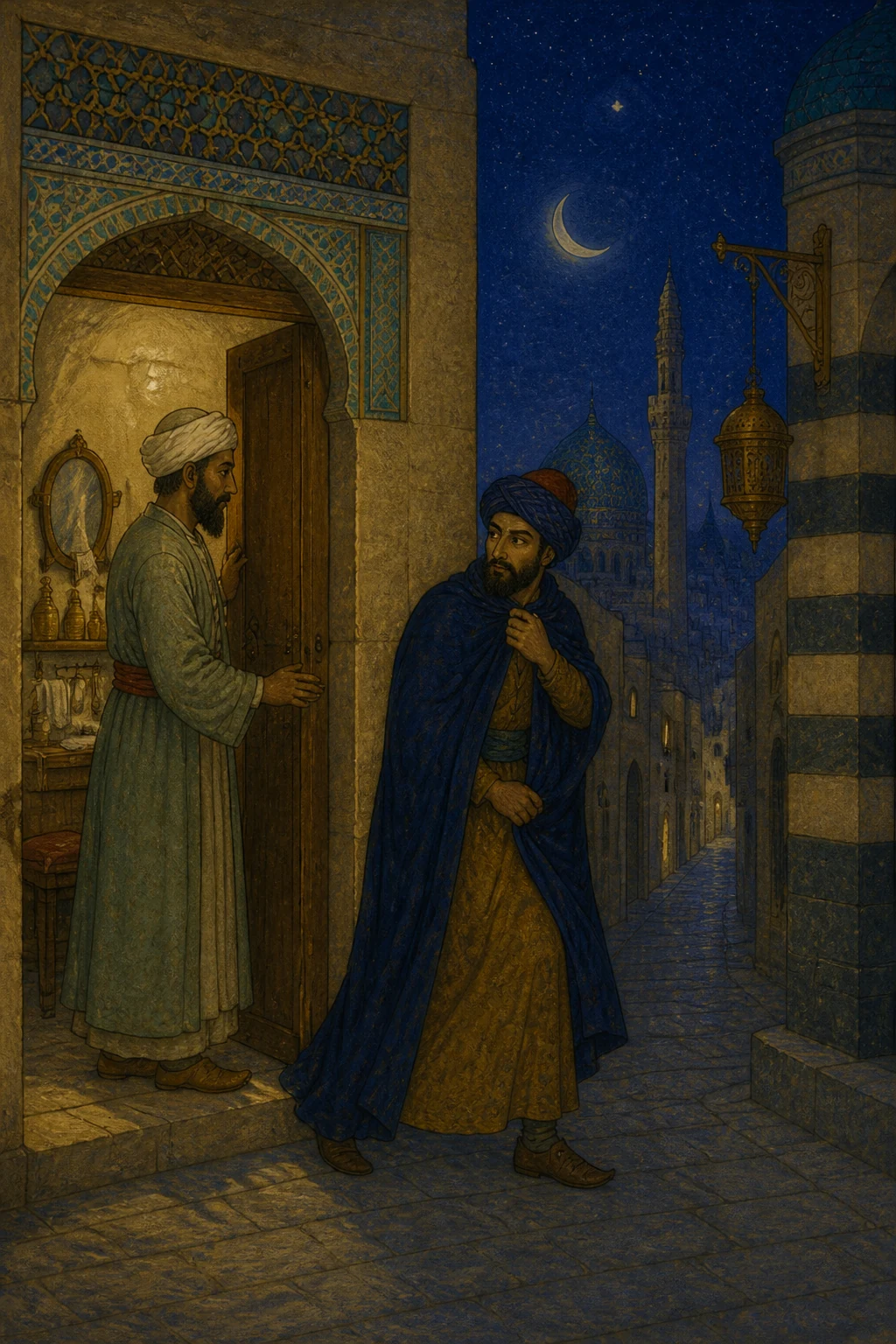
It is also related, O fortunate King, that the Commander of the Faithful, Muawiyah, was sitting one day in a chamber of his in Damascus, with windows open on all four sides to admit the breeze from every direction. It was a day of fierce heat, without a breath of wind, and noon had come, bringing the scorching heat to its height. As he sat looking out, he caught sight of a man walking barefoot, hopping from foot to foot as the burning earth seared his soles. He studied him and said to his companions, “Has God, glorified and exalted be He, created anyone more wretched than a man obliged to go abroad at such a time and such an hour as this?” One of them said, “Perhaps he is coming to see the Commander of the Faithful.” Muawiyah replied, “By God, if he is coming to me, I shall give him generously; and if he has suffered an injustice, I shall uphold his cause. Boy, stand at the door, and if this Bedouin asks to see me, do not deny him entrance.” The servant went out and met the Bedouin. “What do you want?” he asked. “I wish to see the Commander of the Faithful,” the man replied. “Come in,” said the servant. So he entered and greeted him. But morning overtook Shahrazad, and she fell silent, leaving her tale untold.
When it was the six hundred and ninety-second night
She said: It has reached me, O fortunate King, that when the servant gave the Bedouin leave to enter, he went in and greeted the Commander of the Faithful. Muawiyah asked him, “Of what tribe are you?” “Of the Banu Taym,” he replied. “And what has brought you here at this hour?” “I have come to lay a grievance before you and seek your protection.” “Against whom?” “Against Marwan ibn al-Hakam, your governor.” Then he began to recite:
“Muawiyah, lord of bounty, clemency, and grace, of generosity, learning, wisdom, and noble birth! I have come to you with every road on earth closed before me. O my deliverer, do not dash my hope of justice! Grant me redress against the tyrant who has visited upon me a fate beside which death would have been easy. He stole Suad from me and made himself my adversary; he dealt unjustly, denied me justice, and robbed me of my wife. He would have killed me, but my appointed death delayed: I had not yet consumed the sustenance allotted to my life.” When Muawiyah heard his verses, with fire seeming to blaze from his mouth, he said, “Welcome, brother of the Arabs! Tell me your story and explain your case.” The man said, “O Commander of the Faithful, I had a wife whom I loved and cherished dearly, and I lived contented and at peace. I owned a herd of camels, from which I earned my livelihood. Then a year of drought struck us, destroying hoofed beast and camel alike, until I had nothing left. When my means dwindled, my wealth vanished, and my fortunes were ruined, I became despised, a burden even to those who had once been eager to visit me. When her father learned of my misery and the evil turn my affairs had taken, he took her from me, disowned me, drove me away, and treated me harshly. So I went to your governor, Marwan ibn al-Hakam, hoping for his support. He summoned her father and questioned him about my case, but the man said, ‘I have never known him.’ I said, ‘May God prosper the governor! If you would summon the woman and ask her about her father’s words, the truth would become clear.’ He sent for her, and she was brought before him. But when she stood in his presence, he was captivated by her. He became my adversary and denied my claim, showed me his anger, and sent me to prison. I felt as though I had fallen from the sky and the wind had swept me to some far-off place. Then he said to her father, ‘Will you marry her to me for a thousand dinars and ten thousand dirhams? I guarantee to free her from this Bedouin.’ Her father coveted the payment and agreed. Marwan had me brought before him and glared at me like an angry lion. ‘Bedouin,’ he said, ‘divorce Suad.’ ‘I will not divorce her,’ I replied. Then he set a band of his servants upon me, and they tormented me with every kind of torture, until I could find no escape but to divorce her. This I did. He sent me back to prison, where I remained until her waiting period was over. Then he married her and released me. Now I have come to you in hope, seeking your protection and taking refuge with you.” And he recited these verses:
“Within my heart a fire burns, and ever fiercer grows its flame. My body wastes with sickness that leaves the physician at a loss. Within my breast are glowing coals, and from those coals the sparks fly forth. My eyes pour down their tears in an unceasing flood. None can bring me deliverance but my Lord and the Commander.” Then he began to tremble, his teeth chattered, and he fell unconscious, writhing like a snake struck down. When Muawiyah heard his tale and his verses, he said, “Ibn al-Hakam has transgressed the bounds of religion, committed injustice, and dared to violate the sanctity of Muslim households.” But morning overtook Shahrazad, and she fell silent, leaving her tale untold.
When it was the six hundred and ninety-third night
She said: It has reached me, O fortunate King, that when the Commander of the Faithful, Muawiyah, heard the Bedouin’s words, he said, “Ibn al-Hakam has transgressed the bounds of religion, committed injustice, and dared to violate the sanctity of Muslim households.” Then he said, “Bedouin, you have brought me a tale the like of which I have never heard.” He called for ink and paper and wrote to Marwan ibn al-Hakam: “Word has reached me that, in your dealings with your subjects, you have transgressed the bounds of religion. A governor ought to turn his eyes away from the objects of his desire and restrain his soul from its pleasures.” He went on to write at length, but I have abridged his words. Among them were these verses:
“Woe to you! You have been entrusted with an office you cannot comprehend. Ask God’s forgiveness for the deeds of an adulterer! The poor young man has come to us in tears, complaining of separation and sorrow. I swear to God an oath I shall not break—nay, may I be stripped of my religion and my faith if I fail to keep it: should you disobey the orders I have written, I shall make you meat for my eagles. Divorce Suad and send her here without delay, duly provided for the journey, with al-Kumayt and Nasr ibn Dhubyan.” Then he folded the letter, stamped it with his seal, and summoned al-Kumayt and Nasr ibn Dhubyan, whom he employed on important missions because of their trustworthiness. They took the letter and travelled to Medina, where they entered Marwan ibn al-Hakam’s presence, greeted him, delivered the letter, and told him what had happened. Marwan read it and wept. Then he went to Suad and told her the news. Since he could not disobey Muawiyah, he divorced her in the presence of al-Kumayt and Nasr ibn Dhubyan, and furnished them for the journey, with Suad to accompany them. Then Marwan wrote a letter to Muawiyah, saying:
“Do not be hasty, Commander of the Faithful: your sworn command shall be fulfilled with gentleness and grace. I did nothing unlawful when her beauty pleased me; why, then, should I be called a traitor and adulterer? Soon there shall come to you a sun whose like the Caliph has never seen among humankind or jinn.” He sealed the letter and gave it to the two messengers, who journeyed until they reached Muawiyah and delivered it to him. He read it and said, “He has obeyed well, and has been lavish in his praise of the woman.” Then he ordered her to be brought before him. When he saw her, he beheld a woman whose beauty and loveliness, stature and graceful proportions he had never seen equalled. He spoke to her and found her eloquent of tongue and clear in expression. “Bring me the Bedouin,” he said. They brought him, in a pitiable state from the blows fortune had dealt him. Muawiyah said, “Bedouin, could you find consolation for losing her if I gave you in her place full-breasted slave girls and virgins as lovely as moons, with a thousand dinars for each, and assigned you from the treasury a yearly allowance sufficient to keep you in comfort and free from want?” When the Bedouin heard Muawiyah’s words, he gave such a gasp that Muawiyah thought he had died. “What is the matter with you?” Muawiyah asked. He replied, “Misery and wretchedness! I sought refuge in your justice from the tyranny of Ibn al-Hakam; in whom am I to seek refuge from yours?” And he recited these verses:
“O King, may God preserve you! Do not make me one who flees the burning ground only to seek shelter in the fire. Restore Suad to a bewildered, grieving man whose mornings and evenings pass in sorrow and remembrance. Loose my bonds, and do not begrudge her to me: if you grant her back, I shall not be ungrateful.” Then he said, “By God, O Commander of the Faithful, even if you gave me all the dominion bestowed upon you as Caliph, I would not take it in exchange for Suad.” And he recited this verse:
“My heart will have no love but Suad; my love for her has become my drink and sustenance.” Muawiyah said, “You acknowledge that you divorced her, and Marwan acknowledges that he divorced her. We shall give her the choice. If she chooses another man, we shall marry her to him; and if she chooses you, we shall restore her to you.” “Do so,” he replied. Then Muawiyah said, “What do you say, Suad? Whom do you prefer: the Commander of the Faithful, with his rank and glory, his palaces, his power, his wealth, and all you have seen in his possession; or Marwan ibn al-Hakam, with his harshness and generosity; or this Bedouin, with his hunger and poverty?” She recited these two verses:
“This man, though he lives in hunger and hardship, is dearer to me than my kin and my neighbours, than the wearer of the crown or Marwan his governor, than any possessor of silver or gold.” Then she said, “By God, O Commander of the Faithful, I will not forsake him for the blows of fortune or the treachery of time. His is a companionship of old that cannot be forgotten, and a love that will never fade. Who has more right than I to endure hardship beside him, as I once shared his ease and happiness?” Muawiyah marvelled at her wisdom, her love, and her fidelity. He ordered ten thousand dirhams to be given to her, then handed her over to the Bedouin, who took his wife and departed.