Prevod
Know, O fortunate king, that there has reached me, concerning the lover, the beloved, and the go-between, and the marvels and wonders that befell them, a tale that drives care from the heart and brings solace even to grief such as Jacob’s. In bygone days, beyond the mountains of Isfahan, there stood a city called the Green City. Its king was named King Sulayman, a man of generosity and kindness, justice and security, virtue and munificence. Caravans journeyed to him from every quarter, and his fame spread through all lands and countries. For many long years he ruled his kingdom in glory and peace, yet he had neither children nor wives. He had a vizier who resembled him in generosity and lavish giving. One day he sent for this vizier, brought him before him, and said, “My vizier, my heart is heavy, my patience exhausted, and my endurance failing, for I have neither wife nor child. This is not the way of kings, who rule over prince and pauper alike: they rejoice in the children born to them, through whom their numbers and their strength increase. The Prophet, God bless him and grant him peace, has said, ‘Marry and multiply, for on the Day of Resurrection I shall boast of your numbers before the nations.’ What counsel have you, my vizier? Advise me sincerely as to what I should do.”
When the vizier heard these words, tears streamed from his eyes, and he said, “Far be it from me, O king of the age, to speak of matters that belong to the Merciful alone! Would you have me enter the Fire through the wrath of the Almighty King?” The king replied, “Know, my vizier, that when a king buys a slave girl, he knows neither her family’s standing nor her lineage. He cannot tell whether her origins are base, that he might avoid her, or noble, that he might take her as a concubine. If he lies with her, she may conceive by him, and the child may prove a hypocrite, a tyrant, and a shedder of blood. She is like salt earth: whatever seed is sown in it grows ill and takes no firm root. Such a child will incur his Lord’s displeasure, neither doing what He commands nor avoiding what He forbids. I shall never bring this upon myself by buying a slave girl. Rather, I wish you to seek for me the hand of a king’s daughter whose lineage is known and whose beauty is renowned. If you can direct me to a daughter of the Muslim kings who is noble in birth and devout in faith, I will ask for her hand and marry her before witnesses, thus winning the approval of the Lord of all mankind.” The vizier said, “God has fulfilled your need and granted your desire.” “How so?” asked the king. He replied, “Know, O king, that I have heard that King Zahr Shah, lord of the White Land, has a daughter of surpassing beauty, beyond the power of words to describe. None in this age is her equal, for she is perfection itself: graceful in stature, with kohl-dark eyes, long hair, a slender waist, and ample hips. Approaching, she bewitches; retreating, she slays. She captivates both heart and eye, as the poet said of her:
‘So slender, her figure puts the willow bough to shame; neither sun nor moon can match her face. Her saliva is honey mingled with wine, but the teeth within her mouth are pearls. Straight and graceful as a houri of Paradise, she has a lovely face and eyes of dazzling black and white. How many has she slain, who died of longing! The road to loving her is fraught with fear and danger. If I live, she is my desire, and I shall speak of her at will; if I die without her, what good has life done me?’ When the vizier had finished describing the maiden, he said to King Sulayman Shah, “My counsel, O king, is that you send to her father a discerning envoy, well versed in affairs and schooled in the changes of fortune, who may skillfully ask for her hand on your behalf. Nowhere, near or far, is there another like her. You will be blessed with her lovely face, and the Glorious Lord will be pleased with you, for it is related that the Prophet, God bless him and grant him peace, said, ‘There is no monasticism in Islam.’” At this the king was filled with joy; his heart opened and his spirits rose, and grief and sorrow left him. Turning to the vizier, he said, “Know, my vizier, that none but you shall undertake this task, for your wisdom and refinement are beyond compare. Go home, settle your affairs, and make ready to leave tomorrow. Ask for the hand of this maiden, with whom you have filled my thoughts, and do not return without her.” “I hear and obey,” he replied.
The vizier went home and called for gifts fit for kings: precious jewels, rare treasures, and other things light to carry but costly in value, together with Arabian horses, coats of mail such as David made, and chests of money beyond all description. These were loaded upon mules and camels, and the vizier set out with a hundred mamluks, a hundred male slaves, and a hundred slave girls, banners and standards unfurled above his head. The king charged him to return within a few days. After his departure, King Sulayman Shah was as though upon burning coals, consumed with love for her night and day. Meanwhile the vizier traveled by night and day, crossing wildernesses and deserts, until he was within a day’s journey of the city he sought. He then encamped beside a river, summoned one of his trusted attendants, and ordered him to hasten to King Zahr Shah and announce his coming. “I hear and obey,” the man replied, and hurried to the city. As it happened, King Zahr Shah was sitting in one of the pleasure gardens outside the city gate when the messenger arrived. Seeing him enter and recognizing him as a stranger, he ordered that he be brought before him. The messenger announced the approach of the vizier of the supreme king, Sulayman Shah, lord of the Green Land and the mountains of Isfahan. King Zahr Shah rejoiced, welcomed the messenger, and took him to his palace, where he asked, “Where did you leave the vizier?” “I left him at the beginning of the day beside such-and-such a river,” he replied. “Tomorrow he will arrive and present himself before you. May God preserve His blessings upon you and have mercy on your parents.” Zahr Shah ordered one of his viziers to take the foremost of his intimates, chamberlains, deputies, and officers of state and go out to meet the visitor, in honor of King Sulayman Shah, whose authority prevailed throughout the land.
Such was the case with King Zahr Shah. As for the vizier, he remained in his camp until midnight, then set out toward the city. When morning broke and the sun shone upon hill and plain, he suddenly found King Zahr Shah’s vizier, chamberlains, officers of state, and favored courtiers coming to meet him several leagues outside the city. Certain now that his mission would succeed, he greeted those who had come to receive him. They rode before him until they reached the king’s palace, then led him through its gates as far as the seventh vestibule, beyond which no one might ride, for it lay close to the king’s presence. The vizier dismounted and walked on until he reached a lofty hall. At its upper end stood a marble throne inlaid with pearls and jewels, supported on four legs of ivory. Upon it lay a cushion of green satin embroidered with red gold, and above it rose a canopy studded with pearls and gems. King Zahr Shah sat upon the throne, his officers of state standing in attendance. When the vizier entered and stood before him, he steadied his heart, loosened his tongue, displayed the eloquence of viziers, and spoke with the grace of an orator. And dawn overtook Shahrazad, and she fell silent, leaving her tale untold.
When it was the hundred and eighth night
She said: It has reached me, O fortunate king, that when King Sulayman Shah’s vizier entered the presence of King Zahr Shah, he steadied his heart, loosened his tongue, displayed the eloquence of viziers, and spoke with the grace of an orator. Turning courteously toward the king, he recited these verses:
“He came toward us, swaying in his gauzy robes, bestowing bounty upon the fruit and him who plucks it. He rose on high—what use are charms, incantations, or magic against the glances of those eyes? Tell those who blame me, ‘Do not reproach me, for never, while time endures, shall I turn from loving him.’ Even my heart betrayed me and remained faithful to him; sleep too desired him and wearied of me. O heart, you alone have found compassion: stay beside him, though you have left me desolate. Nothing delights my ears to hear save the praises I gather of Zahr Shah: a king for whom, if you spent your whole life upon a single glimpse of his face, you would be richly rewarded. And if you choose a worthy prayer for him, you will find none who does not join it or say amen. O people of this king, whoever passes him by and sets his hopes upon another has no true faith!” When the vizier had finished his verses, King Zahr Shah drew him near and honored him greatly. He seated him at his side, smiled upon him, and favored him with gracious words. They remained thus until morning, when a feast was set out in the hall, and all ate their fill. Then the food was removed, and everyone withdrew except the king’s intimates. Seeing that the company had dispersed, the vizier rose, praised the king, and kissed the ground before him. Then he said, “O mighty king and exalted lord, I have journeyed here and come before you on a matter that promises you benefit, prosperity, and success. I come as an envoy to seek the hand of your daughter, noble in birth and lineage, on behalf of King Sulayman Shah, master of justice and security, virtue and kindness, king of the Green Land and the mountains of Isfahan. He has sent you many gifts and abundant rarities, and desires to be joined to you by marriage. Do you, in turn, desire this alliance?” He fell silent, awaiting the reply. When King Zahr Shah heard these words, he rose to his feet and humbly kissed the ground. Those present marveled at the king’s submission to an envoy, and their minds were filled with astonishment. Then the king praised the Lord of Majesty and Honor and, still standing, said, “O exalted vizier and honored lord, hear what I say: we count ourselves among King Sulayman Shah’s subjects. We would be honored to enter his family and would vie for such a privilege. My daughter is but one of his handmaids. This is my greatest desire, that he may be my support and refuge.” He then summoned the judges and witnesses, who attested that King Sulayman Shah had empowered his vizier to act for him in marriage, while King Zahr Shah joyfully undertook his daughter’s marriage contract.
The judges duly concluded the marriage and prayed for the couple’s happiness and prosperity. Then the vizier rose and brought forward the gifts he had carried, the precious rarities and offerings, and presented them all to King Zahr Shah. The king began preparing his daughter for her journey and lavishing honors upon the vizier. His banquets embraced high and low alike, and for two months he kept up the wedding celebrations, neglecting nothing that might delight the heart or please the eye. When all the bride required was ready, he ordered tents to be taken out and pitched beyond the city. They packed the fabrics into chests and made ready the Byzantine slave girls and Turkish serving maids. He sent with the bride rare treasures and precious jewels, and had a litter made for her of red gold, set with pearls and gems, assigning ten mules to carry it on the journey. The litter was like a royal chamber, its occupant like one of the lovely houris, and her curtained shelter like a palace of Paradise. They bundled up the treasures and riches and loaded them upon mules and camels. King Zahr Shah accompanied them for three leagues, then bade farewell to his daughter, the vizier, and his company, and returned to his own land in happiness and peace. The vizier set out with the king’s daughter, journeying on through stage after stage of wilderness. And dawn overtook Shahrazad, and she fell silent, leaving her tale untold.
When it was the hundred and ninth night
She said: It has reached me, O fortunate king, that the vizier set out with the king’s daughter, journeying on through stage after stage of wilderness and pressing forward night and day, until he was three days from his own country. He then sent a messenger to King Sulayman Shah to announce the bride’s approach. The messenger hurried on until he reached the king and gave him the news. King Sulayman Shah rejoiced, bestowed a robe of honor upon him, and ordered his troops to go out in a splendid procession to welcome the bride and her companions with due ceremony. They were to wear their finest array and unfurl banners above their heads. They obeyed his command, and a herald proclaimed throughout the city that no secluded maiden, no honored freewoman, and no bent old woman was to remain behind: all must come out to welcome the bride. So they all went to meet her, and the most distinguished among them hastened to attend her. They agreed to bring her to the king’s palace by night, while the officers of state arranged to decorate the road and stand along it as she passed, with servants leading the way, slave girls before her, and the robe of honor her father had given her upon her shoulders. As she approached, the troops surrounded her on the right and left, and her litter continued toward the palace. Not a soul remained who had not come out to see her. Drums beat, lances danced, trumpets rang, perfumes filled the air, banners fluttered, and horses raced, until they reached the palace gate. The pages brought the litter forward to the entrance, and the place shone with her splendor, every corner bright with the jewels that adorned her.
When night came, the servants opened the doors of the pavilion and took their stations around the entrance. The bride approached among her slave girls like the moon among the stars, or a peerless jewel among a string of pearls. She entered the bridal chamber, where they had set up a marble couch inlaid with pearls and gems, and seated herself upon it. The king came in to her, and God planted love for her in his heart. He took her maidenhead, and the anxiety and anguish he had suffered left him. He remained with her for about a month, and she conceived by him on the very first night. At the month’s end he came out, sat upon the throne of his kingdom, and ruled his subjects justly until her months were fulfilled. On the last night of the ninth month, labor pains came upon her shortly before dawn. She seated herself upon the birthing chair, and God made the birth easy for her. She bore a boy upon whom the signs of good fortune already shone. When the king heard of the child, he rejoiced exceedingly and gave the bearer of the news a great sum of money. In his delight he went to the boy, kissed him between the eyes, and marveled at his dazzling beauty. In him the poet’s words were fulfilled:
“God has bestowed a star upon sovereignty, for time has never failed to bring forth heroes. At his rising, spearheads and thrones rejoiced, assemblies, armies, and blades. Do not mount him upon a woman’s breast, for he will find a horse’s back an easier seat. Wean him from milk, for he will find his enemies’ blood a sweeter drink.” The midwives took the newborn, cut his cord, and darkened his eyes with kohl. They named him Taj al-Muluk Kharan. He suckled at the breast of indulgence and was reared in the lap of good fortune. Days followed days and years passed until he was seven years old. Then King Sulayman Shah summoned scholars and sages and commanded them to teach his son writing, wisdom, and letters. They continued for several years, until he had learned all that was required. When he had mastered everything the king desired, his father took him from the jurists and teachers and appointed an instructor to teach him horsemanship and the arts of war. His training continued until he was fourteen years old, and whenever he went out on any business, all who saw him were captivated. And dawn overtook Shahrazad, and she fell silent, leaving her tale untold.
When it was the hundred and tenth night
She said: It has reached me, O fortunate king, that when Taj al-Muluk Kharan, son of King Sulayman Shah, had mastered horsemanship and surpassed the men of his age, his beauty was so great that whenever he went out on any business, all who saw him were captivated. They composed verses about him, and people of noble standing cast off restraint for love of him, so dazzling was the beauty he possessed. As the poet said of him:
“I embraced him and grew drunk upon his sweet fragrance, a tender bough nourished by the breeze. Drunk, though he had tasted no wine, he was intoxicated by the wine of his own lips. All beauty became his captive, and thus he took all hearts captive too. By God, the thought of forgetting him has never crossed my mind, nor shall it while I live, nor even after. If I live, I live in love with him; if I die of passion and yearning for him, how sweet a death!” When he reached eighteen, the first dark down crept over his rosy cheek, adorned with a mole like a speck of ambergris. He ravished minds and eyes alike, as the poet said of him:
“He has become Joseph’s successor in beauty; all lovers tremble when he appears. Turn aside with me and look at him, and you will see upon his cheek the black banner of his sovereignty.” And another poet said:
“Of all the things there are to see, your eyes have never beheld a lovelier sight than the dark down upon a rosy cheek beneath a jet-black eye.” And another said:
“I marvel at the mole that worships fire forever upon your cheek, yet is not burned, though it is an unbeliever. Stranger still, the messenger in your glance proves his truth with signs, though he is a sorcerer. That cheek has darkened not with growing down, but from the many bitter hearts broken over it.” And another said:
“I marvel that people ask in what land the Water of Life flows, when I see it in the mouth of a graceful gazelle, sweet-lipped, with dark down above it. And among the wonders is that Moses meets al-Khidr there, questioning him without patience.” As he reached manhood, his beauty only increased. Taj al-Muluk Kharan gathered friends and companions, and everyone who drew near him hoped that he would become sultan after his father’s death and make him one of his emirs. He became devoted to hunting and the chase, scarcely resting from it for an hour. His father, King Sulayman Shah, forbade him this pursuit, fearing for him the perils of the wilderness and its wild beasts, but he would not listen. One day he told his servants, “Take fodder enough for ten days.” They obeyed, and he rode out with his followers to hunt. They traveled through the wilderness for four days until they came in sight of a green country, where wild animals grazed among flourishing trees and flowing springs. Taj al-Muluk said to his followers, “Set the nets here and cast their circle wide. We shall gather at the head of the ring, in such-and-such a place.” They obeyed, setting the nets in a broad circle, within which many kinds of wild beasts and gazelles were gathered. At last the animals raised a clamor and scattered before the horses. He loosed the hounds, hunting leopards, and falcons upon them, and the hunters shot arrows into the beasts’ vital parts. Before they reached the far end of the circle, they had taken a great number, while the rest escaped. Then Taj al-Muluk dismounted beside the water, had the game brought before him, and divided it. He set aside the choicest beasts for his father, Sulayman Shah, and sent them to him, distributed some among his officers of state, and spent the night in that place.
When morning came, a great caravan approached, made up of slaves, pages, and merchants, and encamped beside the water and greenery. Seeing them, Taj al-Muluk said to one of his companions, “Bring me news of these people, and ask why they have halted here.” The messenger went to them and said, “Tell us who you are, and be swift with your answer.” They replied, “We are merchants, and we have halted to rest, for our destination is far off. We have camped here because we feel secure under King Sulayman Shah and his son, knowing that anyone who alights in his land enjoys safety and peace. We have precious fabrics with us, brought especially for his son Taj al-Muluk.” The messenger returned to the prince and told him the truth of the matter, reporting what he had heard from the merchants. The prince said, “If they have brought anything for me, I will neither enter the city nor leave this place until I have inspected it.” He mounted his horse and rode off, his mamluks following him, until he came to the caravan. The merchants rose to greet him and prayed for his victory and prosperity, and for the continuance of his glory and bounty. A tent of red satin, adorned with pearls and gems, had been pitched for him. Upon a silken carpet they placed a royal seat whose back was embellished with emeralds. Taj al-Muluk seated himself, and the mamluks stood in attendance. He sent for the merchants and ordered them to bring everything they had. They came before him with their wares, and he inspected them all, took what suited him, and paid them in full. Then he mounted and was about to leave when he happened to glance toward the caravan and saw a handsome young man, neatly dressed and graceful in manner, with a radiant brow and a face like the moon. Yet his beauty had faded, and separation from those he loved had cast a pallor over him. And dawn overtook Shahrazad, and she fell silent, leaving her tale untold.
When it was the hundred and eleventh night
She said: It has reached me, O fortunate king, that Taj al-Muluk happened to glance toward the caravan and saw a handsome young man, neatly dressed and graceful in manner. Yet his beauty had faded, and separation from those he loved had cast a pallor over him. His sighs and sobs increased, and tears streamed from his eyes as he recited these verses:
“Long has our parting lasted, and grief and fear endure; tears pour from my eyes, my friend. I bade farewell to my heart on the day we parted, and now I am alone, with neither heart nor hope. My companion, stand with me while I bid farewell to her whose very speech can heal sickness and pain.” When the young man had finished his verses, he wept for a while and then fainted, while Taj al-Muluk watched him, marveling at his condition. When he recovered, he lifted his eyes with a deadly glance and recited:
“Beware her gaze, for it is sorcery; none whom her eyes strike down escapes alive. Those black eyes, languid though they are, can cleave bright, keen-edged swords. Do not yield to the softness of her speech, for strong wine too steals the wits. So delicate are her limbs that silk would draw blood if it touched her body—you may see for yourself. Far is the distance between her anklet and her throat; what is the sweetest fragrance beside her perfume?” Then he gave a great sob and fainted. Seeing him in this state, Taj al-Muluk was bewildered and walked over to him. When the young man recovered and saw the prince standing over him, he sprang to his feet and kissed the ground before him. Taj al-Muluk asked, “Why did you not show us your merchandise?” He replied, “My lord, there is nothing among my goods worthy of Your Highness.” “You must show me what you have and tell me your story,” said the prince, “for I see that your eyes are full of tears and your heart is sorrowful. If you have been wronged, we will right your wrong; if you are in debt, we will pay it. My heart burned for you when I saw you.” Taj al-Muluk then ordered two chairs to be set out. They placed for him a chair of ivory and ebony, interlaced with gold and silk, and spread a silken carpet. He sat upon the chair, told the young man to sit upon the carpet, and said, “Show me your merchandise.” The young man replied, “My lord, do not speak of that, for my wares are not suitable for you.” Taj al-Muluk said, “It must be done.” He ordered some of his pages to fetch them, and they brought them against the young man’s will. At the sight of them his tears flowed, and he wept, moaned, and lamented, heaving deep sighs and reciting these verses:
“By the coquetry and kohl of your eyes, by the softness and sway of your figure, by the wine and honey of your mouth, by the tenderness and fickleness of your nature: a visit from your phantom, O my hope, is sweeter to me than safety to a trembling man.” Then the young man opened his wares and displayed them to Taj al-Muluk, piece by piece and length by length. Among them he brought out a length of satin woven with gold, worth two thousand dinars. As he unfolded it, a piece of cloth fell from within. He snatched it up and thrust it beneath his thigh, beside himself with distress, and recited:
“When will my tormented heart find healing through you, when the Pleiades are nearer than union with you? Distance and estrangement, yearning and anguish, delay and promises postponed—these consume my life. Union does not revive me, nor separation kill me; distance does not bring me nearer, nor do you draw close. There is no fairness in you, no mercy, no help from you, and no escape from you. In loving you, all roads have narrowed about me, and I do not know which way to turn.” Taj al-Muluk was greatly astonished by his verses, though he did not know their cause. When the young man took the cloth and put it beneath his thigh, he asked, “What is that piece of cloth?” “My lord,” he replied, “you have no need of it.” The prince said, “Show it to me.” He answered, “My lord, it was only because of this that I held back from displaying my wares to you, for I cannot bear that you should look upon it.” And dawn overtook Shahrazad, and she fell silent, leaving her tale untold.
When it was the hundred and twelfth night
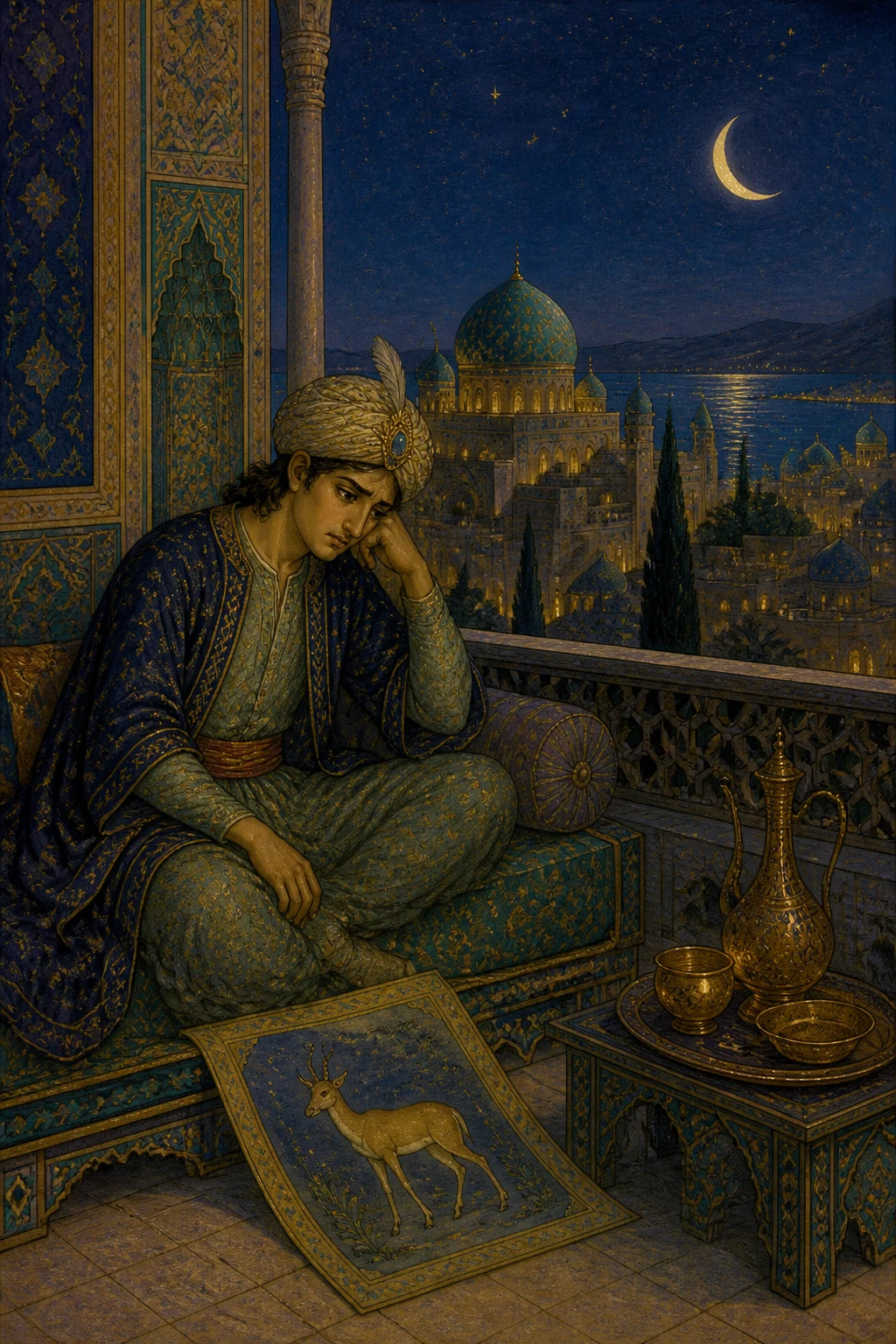
She said: It has reached me, O fortunate king, that the young man said to Taj al-Muluk, “It was only because of this that I held back from displaying my wares to you, for I cannot bear that you should look upon it.” Taj al-Muluk replied, “I must see it.” He pressed him and grew angry, so the young man drew it from beneath his knee, weeping, moaning, and lamenting. With many sighs he recited these verses:
“Do not reproach him, for reproach wounds him. I have spoken truth, but he will not hear it. I entrust to God a moon of mine in the valley, among the dwellings, rising from the heaven of a buttoned robe. I bade him farewell, wishing rather that life’s sweetness should forsake me than that I should forsake him. How often, on the morning of parting, he pleaded with me, while his tears and mine poured down! I will not lie before God: the garment of my endurance is torn by separation from him, yet still I patch it. My side finds no rest upon a bed, nor, since I left, does his. Time has reached between us with a cruel left hand, denying me my share of happiness and denying him his. It poured out unmixed sorrow when it filled the cup from which he drank what I must drink.” When he had finished his verses, Taj al-Muluk said, “I see that all is not well with you. Tell me why you weep at the sight of this cloth.” At the mention of the cloth, the young man sighed and said, “My lord, strange is my story and wondrous my affair with this cloth, its owner, and the woman who made these pictured figures.” Then he spread out the cloth. Upon it was the figure of a gazelle embroidered in silk and embellished with red gold, and facing it was another gazelle worked in silver, with a collar of red gold about its neck and three rods of peridot. When Taj al-Muluk saw it and admired its exquisite workmanship, he said, “Glory be to God, who taught man what he did not know!” His heart was now caught by the young man’s story, and he said, “Tell me your tale with the woman to whom this gazelle belongs.”