Waltey
Zgodba o Aliju Šaru in Zumurud
Tisoč in ena noč · arabska pripovedna tradicijaO besedilu
Zgodba o Aliju Šaru in Zumurud
- Vir
- Tisoč in ena noč
- Avtor
- arabska pripovedna tradicija
- Jezik branja
- English
- Jezik izvirnika
- Arabic
- Čas branja
- 71 min branja
- Obseg
- 57 strani
- Naslov izvirnika
- حكاية علي شار وزمرد - الليالي ٣٠٨ إلى ٣٢٧
O izvirniku
Tisoč in ena noč
Zgodbe v zgodbah, polne trgovcev, dvorov, preoblek in nočnih zapletov. Bralni jezik je English, izvirnik pa prihaja iz vira Tisoč in ena noč v jeziku Arabic.
Besedilo
Zgodba o Aliju Šaru in Zumurud
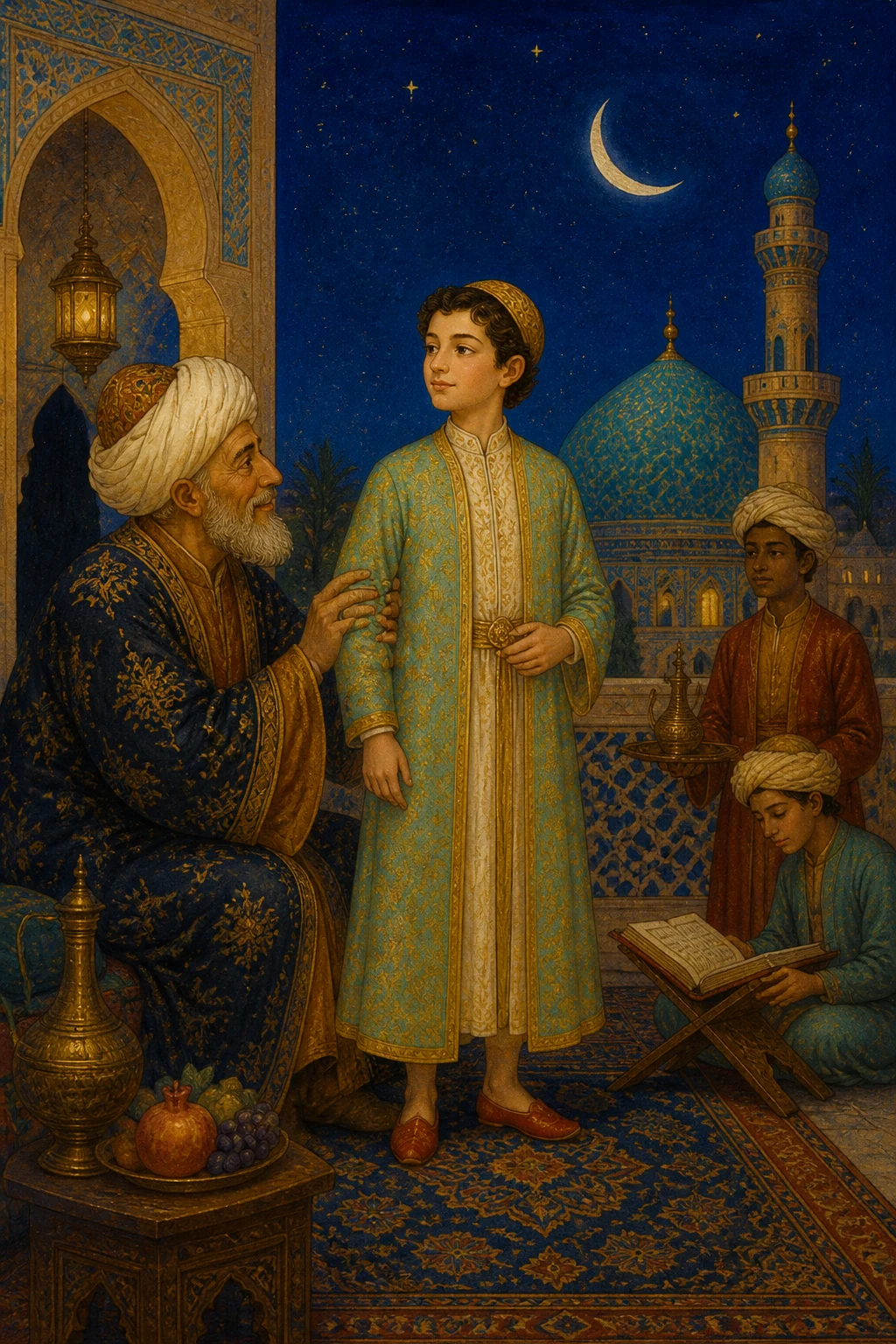
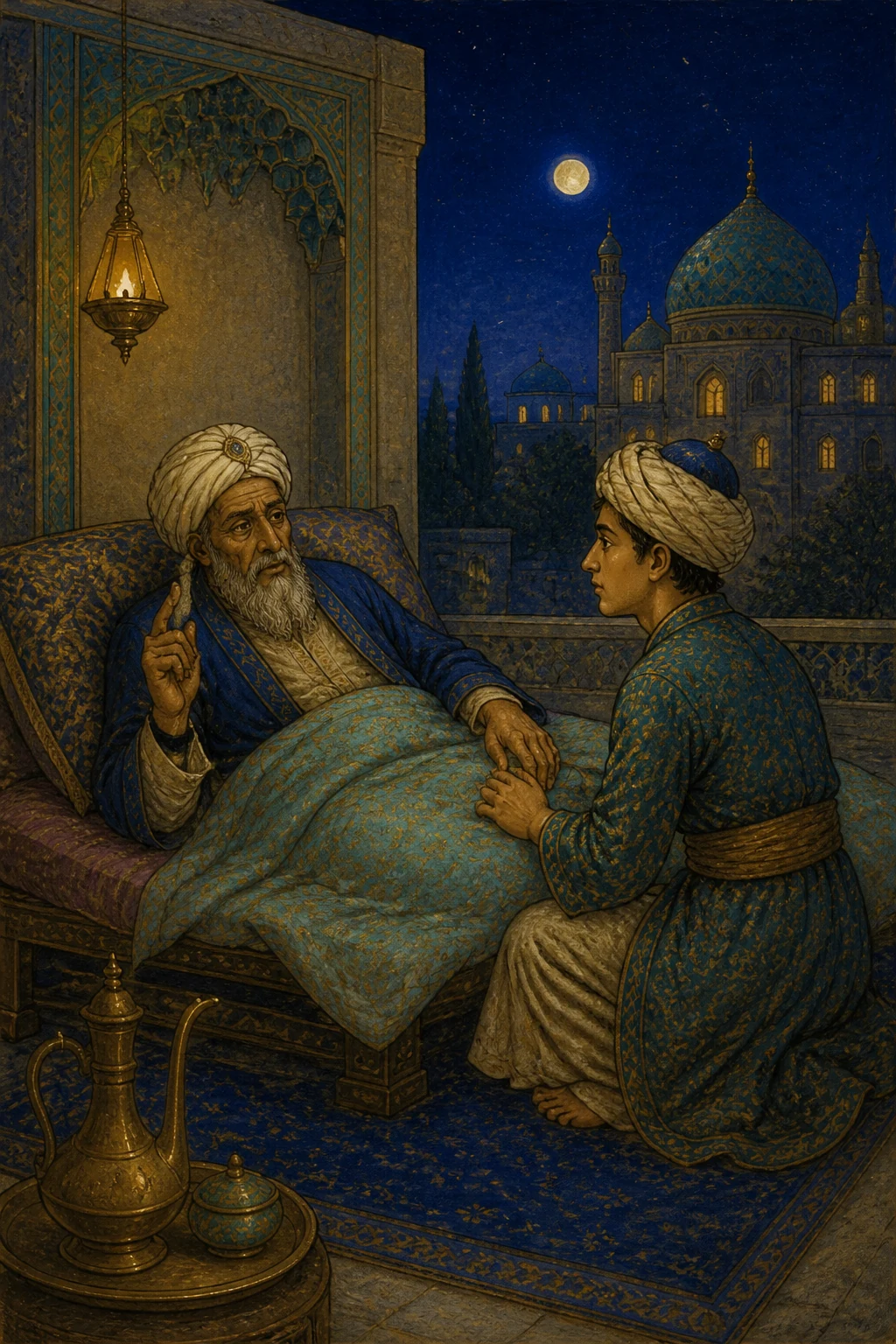
It is told that in ancient times, in ages long gone, there lived in the land of Khurasan a merchant named Majd al-Din. He possessed great wealth, slaves, mamluks, and serving boys, yet he had reached the age of sixty without being blessed with a child. At last God Most High granted him a son, whom he named Ali. As the boy grew, he became as fair as the moon on the night of its fullness. When he reached manhood and attained every perfection, his father fell ill with the sickness that was to end his life. He summoned his son and said, “My son, the hour of death draws near, and I wish to leave you some counsel.” “What is it, Father?” he asked. His father replied, “My counsel is that you keep company with no one and avoid whatever brings harm and misery. Beware of an evil companion, for he is like a blacksmith: if his fire does not burn you, his smoke will hurt you. How well the poet said:
‘In your time there is none whose affection you may hope for, no friend who stays faithful when fortune betrays. Live alone, then, and lean upon no one: I have given you counsel enough in these words.’ And another said:
‘People are a hidden sickness; never put your trust in them. Within them lie deceit and cunning, if you could only see.’ And another said: ‘Meeting people brings no benefit beyond the babble of idle talk. So meet with them as little as you can, unless to gain knowledge or improve your lot.’ And another said:
‘If a wise man has put people to the test, I have tasted them through and through. I found their affection nothing but deceit, and their piety nothing but hypocrisy.’” The son said, “Father, I hear and obey. What else should I do?” He replied, “Do good whenever you can. Persevere in kindness to others, and seize every chance to bestow a favor, for a request cannot be granted at every hour. How well the poet said:
‘Not at every hour and season does the chance for kindness come. Whenever you can, hasten to it, lest the chance should pass beyond your reach.’” He said, “I hear and obey.” And dawn overtook Shahrazad, and she fell silent, leaving her tale untold.
When it was the three hundred and ninth night,
She said: It has reached me, O fortunate King, that the youth said to his father, “I hear and obey. What else?” He replied, “My son, be mindful of God, and He will watch over you. Guard your wealth and do not squander it, for if you squander it you will be forced to beg of the meanest of men. Know that a man’s worth is what his right hand possesses. How well the poet said:
‘When my wealth is scant, no friend will keep me company; when my wealth increases, all men are my friends. How many an enemy has befriended me for money, and how many a friend has turned against me when it was gone!’” He asked, “What else?” His father said, “My son, take counsel from those older than yourself, and do not rush into anything you wish to undertake. Show mercy to those beneath you, and those above you will show you mercy. Wrong no one, lest God set over you someone who will wrong you. How well the poet said:
‘Join another’s judgment to your own and seek advice, for the sound course will not escape two minds. A single mirror shows a man his face; with two together he may see the back of his head.’ And another said:
‘Be patient; do not rush into what you wish to do. Show mercy to others, and you will encounter mercy. There is no hand but God’s hand is above it, and no oppressor but shall be tried by one more oppressive.’ And another said:
‘Do not act unjustly when you have the power, for the unjust stand on the brink of vengeance. Your eyes may sleep while the wronged lie awake, calling down curses on you—and God’s eye never sleeps.’ Beware, too, of drinking wine, for it is the root of every evil. It takes away the reason and debases the drinker. How well the poet said:
‘By God, wine shall never cloud my mind while my soul inhabits my body and my tongue can speak plainly. Never shall I yearn for wine cooled by the north wind, nor choose any drinking companion but one who is sober.’ This is my counsel to you: keep it ever before your eyes. God will watch over you in my stead.” Then he fainted and lay silent for a while. When he recovered, he begged God’s forgiveness, pronounced the testimony of faith, and passed into the mercy of God Most High. His son wept and lamented him, then set about preparing him for burial as duty required. Great and humble alike walked in his funeral procession, while reciters read the Quran around his bier. His son left no duty toward him unfulfilled. They prayed over him, laid him in the earth, and inscribed these two verses upon his grave:
‘You were fashioned from dust and became a living man, and were taught eloquence in speech. You returned to dust and became dead, as though you had never departed from the dust.’ His son Ali Shar grieved deeply for him and held the mourning observances customary among people of distinction. He continued to mourn his father until, a short time afterward, his mother too died. He did for her all that he had done for his father, then took his place in the shop, buying and selling and keeping company with none of God’s creatures, in obedience to his father’s counsel. He continued thus for a year. After that year, however, the sons of whores wormed their way into his company and befriended him, until he joined them in corruption and turned aside from the path of righteousness. He drank cup after cup of wine and spent his days and nights seeking out beauties. He said to himself, “My father amassed this wealth for me. If I do not spend it, for whom should I leave it? By God, I shall do just as the poet said:
‘If all your life you keep on gathering and hoarding, when will you enjoy what you have gained and stored?’” Ali Shar went on scattering his money by night and day until he had exhausted it all and fallen into poverty. His circumstances grew wretched and his mind was troubled. He sold the shop, his properties, and everything else; then he sold even the clothes from his back, keeping only a single suit for himself. When the drunkenness passed and reflection came, he was overcome with remorse. One day he sat from morning until late afternoon without breaking his fast, and said to himself, “I shall go around to those on whom I used to spend my money. Perhaps one of them will feed me today.” He visited them all, but whenever he knocked at a man’s door, the fellow denied being at home and hid from him. At last hunger burned within him, and he went to the merchants’ market. And dawn overtook Shahrazad, and she fell silent, leaving her tale untold.
When it was the three hundred and tenth night,
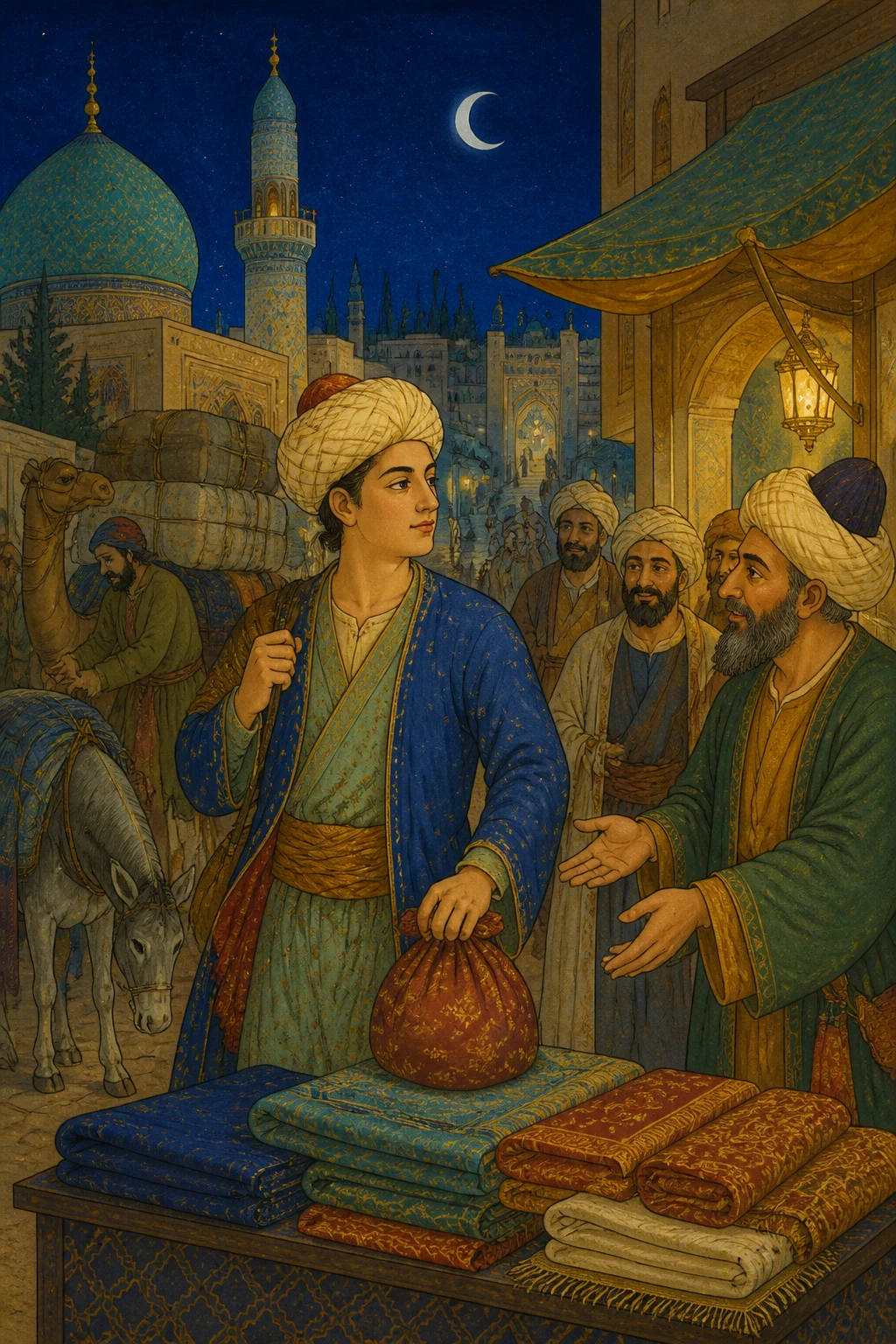
She said: It has reached me, O fortunate King, that hunger burned within Ali Shar, and he went to the merchants’ market. There he found a great press of people gathered in a circle. He said to himself, “I wonder why all these people are gathered here. By God, I shall not leave this place until I have seen what is happening.” He went forward and found a slave girl five spans tall, with a shapely figure, rosy cheeks, and firm breasts. In beauty and loveliness, splendor and perfection, she surpassed all the people of her time. As one who described her said:
‘She was fashioned as she herself would wish, perfected in beauty’s mold, neither tall nor short. Beauty itself is enamored of her form, while aloofness, pride, and modesty contend with her. Her face is the full moon, her figure a slender bough, her breath musk; no mortal is her equal. It is as though she were cast from the liquid essence of a pearl, and every part of her beauty holds a moon.’ The girl’s name was Zumurrud. When Ali Shar saw her, he marveled at her beauty and loveliness, and said, “By God, I shall not stir until I see what price this girl fetches and learn who buys her.” He took his place among the merchants, who supposed that he intended to buy, knowing how wealthy he had been from the fortune inherited from his parents. The broker stood beside the girl and cried, “Merchants! Men of wealth! Who will open the bidding for this girl, mistress of moons, this radiant pearl, Zumurrud the cat’s-eye emerald, the seeker’s desire and the suitor’s delight? Open the bidding: no blame or reproach falls on the first bidder!” One merchant said, “Five hundred dinars from me.” Another said, “And ten more.” An old man named Rashid al-Din, who was blue-eyed and ugly, said, “And a hundred.” Another said, “And ten more.” The old man said, “A thousand dinars.” The merchants held their tongues and fell silent. The broker consulted her master, who said, “I have sworn to sell her only to someone she chooses. Ask her.” So the broker went to her and said, “Mistress of moons, this merchant wishes to buy you.” She looked at him and found him as we have described, then said to the broker, “I will not be sold to an old man whom age has brought to such a sorry state. God bless the poet who said:
‘One day I asked her for a kiss; she saw my gray hair, though I was a man of wealth and comfort. She turned away and shunned me, saying, “No, by Him who created man from nothing! I have no desire for the whiteness of old age. Shall my mouth be stuffed with cotton while I am still alive?”’
When the broker heard her words, he said, “By God, you are justified. You are worth ten thousand dinars.” He told her master that she would not accept the old man, and he said, “Ask her about someone else.” Another man stepped forward and said, “I offer what the old man she rejected offered.” She looked at the man and saw that his beard was dyed. “What disgrace and deceit!” she said. “He has blackened the face of old age!” She went on exclaiming in astonishment, then recited these verses:
‘I saw what I saw of that fellow: a nape, by God, fit to be slapped with shoes; a beard where mosquitoes have room to roam, and a horn bent crooked by the tug of ropes. You who are bewitched by my cheeks and figure, go on, falsify the impossible without a care! Do you stain the white of age with disgrace, hoping by trickery to hide what has appeared? You go out with one beard and come back with another, concealing the work of the makers of illusions.’ And how well the poet said:
‘She said, “I see you have dyed your gray hair.” I told her, “I hid it from you, O my hearing and my sight.” She burst out laughing, then said, “How strange! Deceit has spread so far that now it reaches even the hair!”’” When the broker heard her verses, he said, “By God, you speak the truth.” The merchant asked, “What did she say?” He repeated the verses, and the man knew that he had only himself to blame and gave up trying to buy her. Another merchant stepped forward and said, “Ask whether she will accept me at the price you have heard.” The broker asked her, and she looked at him and found that he had only one eye. She said, “This man is one-eyed, and the poet has said of such a man:
‘Never take a one-eyed man for a companion; beware of his wickedness and lies. Had there been any good in a one-eyed man, God would not have put blindness in his eye.’” The broker said to her, “Will you be sold to that merchant?” She looked at him and saw that he was short, with a beard hanging down to his navel. She said, “He is the one of whom the poet said:
‘I have a friend who has a beard that God has grown to no purpose. It is like one of winter’s nights: long, dark, and cold.’” The broker said, “My lady, look among those present and tell me who pleases you, so that I may sell you to him.” She looked around the circle of merchants, studying them one by one, until her gaze fell upon Ali Shar. And dawn overtook Shahrazad, and she fell silent, leaving her tale untold.
When it was the three hundred and eleventh night,
She said: It has reached me, O fortunate King, that when the girl’s gaze fell upon Ali Shar, she gave him a look that brought a thousand sighs of longing in its wake, and her heart became attached to him. For he was wonderfully handsome and gentler than the north wind. She said, “Broker, I will be sold to none but this master of mine, with his lovely face and graceful figure, of whom one poet said:
‘They displayed your lovely face, then blamed the man it bewitched. Had they wished to keep me safe, they would have veiled your beauty.’ None but he shall possess me, for his cheeks are smooth, his lips yield the nectar of Salsabil, and his saliva heals the sick. His charms bewilder poets and prose writers alike, as the poet said:
‘His saliva is wine, his breath is musk, and his mouth is camphor. Ridwan drove him from his abode, fearing that the houris would be bewitched. People reproach him for his pride, but the full moon may be as proud as it pleases.’ He has curling hair, rosy cheeks, and an enchanting glance, of which the poet said:
‘A young gazelle has promised me union; my heart is troubled and my eye waits. His eyelids have guaranteed the truth of his promise, but how can they honor a pledge when they are so languidly broken?’ And another said:
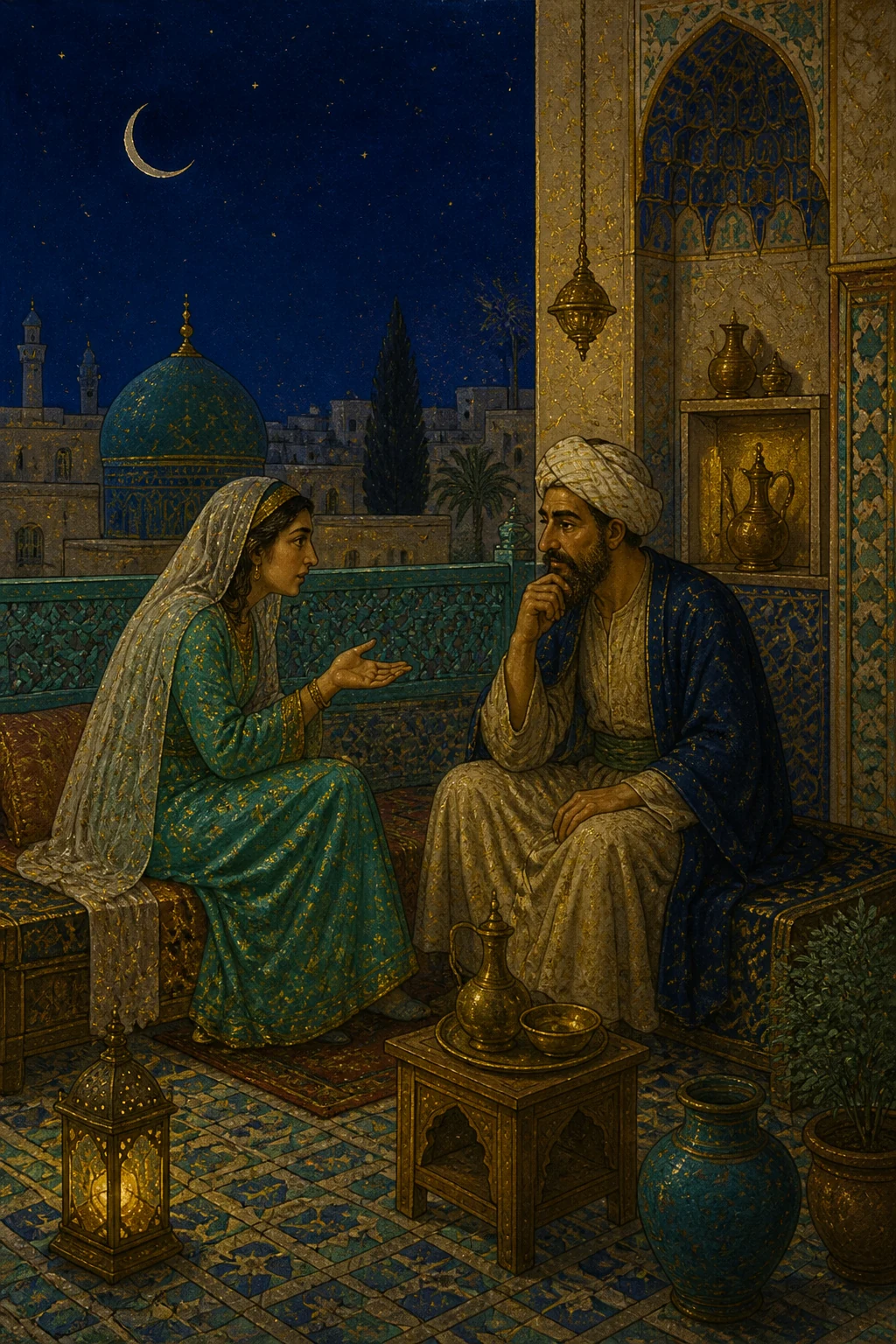
‘They said, “The line of a beard has appeared on his cheek. How can you love him now that he is bearded?” I answered, “Cease your reproaches and say no more. If that is truly a written line, then it is a forgery! The gardens of Eden lie in the fruit of his cheeks: the proof is that his lips are Kawthar.”’” When the broker heard the verses she recited in praise of Ali Shar’s charms, he marveled at her eloquence and radiant beauty. Her owner said, “Do not marvel at her loveliness, which puts the daylight sun to shame, nor at her store of tender poetry. Besides all that, she recites the glorious Quran in its seven readings, relates the noble traditions according to authentic accounts, and writes in the seven styles of calligraphy. She knows branches of learning unknown even to the most learned scholar, and her hands are better than gold and silver: she makes silk curtains and sells them, earning fifty dinars for each one, and she completes a curtain in eight days.” The broker said, “How fortunate the man who has her in his house and makes her one of his hidden treasures!” Her master then said, “Sell her to whomever she desires.” The broker returned to Ali Shar, kissed his hands, and said, “My lord, buy this girl, for she has chosen you.” He described her qualities and accomplishments, then said, “Joy be yours if you buy her! The One who never withholds His bounty has bestowed her on you.” Ali Shar lowered his head toward the ground for a while, laughing inwardly at himself. “I have not even broken my fast yet,” he thought, “but I am ashamed to tell the merchants that I have no money to buy her.” The girl saw him bow his head and said to the broker, “Take me by the hand and lead me to him, so that I may offer myself and persuade him to take me. I will be sold to none but him.” The broker took her and stood her before Ali Shar, saying, “What do you think, my lord?” He made no reply. The girl said, “My lord and beloved of my heart, why will you not buy me? Buy me for whatever price you please, and I shall be the cause of your good fortune.” He raised his head and said, “Must a man be forced to buy? You are expensive at a thousand dinars.” She said, “My lord, buy me for nine hundred.” “No,” he said. “For eight hundred.” “No.” She went on lowering the price until she said, “For a hundred dinars.” He replied, “I do not have a full hundred.” She laughed and asked, “How much short of a hundred are you?” He said, “I have neither a hundred nor anything else. By God, I possess neither white silver nor red gold, neither dirham nor dinar. Find yourself another buyer.” When she learned that he had nothing, she said, “Take me by the hand and lead me into a side alley, as though you mean to kiss me.” He did so, and she drew from her pocket a purse containing a thousand dinars. “Weigh out nine hundred of these for my price,” she said, “and keep the hundred with you for our needs.” He did as she instructed, bought her for nine hundred dinars, paid her price from the purse, and took her home. When she reached the house, she found it bare and empty, without furnishings or utensils. She gave him a thousand dinars and said, “Go to the market and spend three hundred dinars on furnishings and utensils for the house.” He did so. Then she said, “Buy us food and drink.” And dawn overtook Shahrazad, and she fell silent, leaving her tale untold.
When it was the three hundred and twelfth night,
She said: It has reached me, O fortunate King, that the girl said to him, “Buy us food and drink for three dinars.” He did so. Then she said, “Buy us a piece of silk large enough for a curtain, along with gold and silver thread and silk thread in seven colors.” He did as she asked. She furnished the house, lit the candles, and sat down to eat and drink with him. Afterward they went to bed and fulfilled their desires with one another, then passed the night in each other’s arms behind the curtains. They were as the poet said:
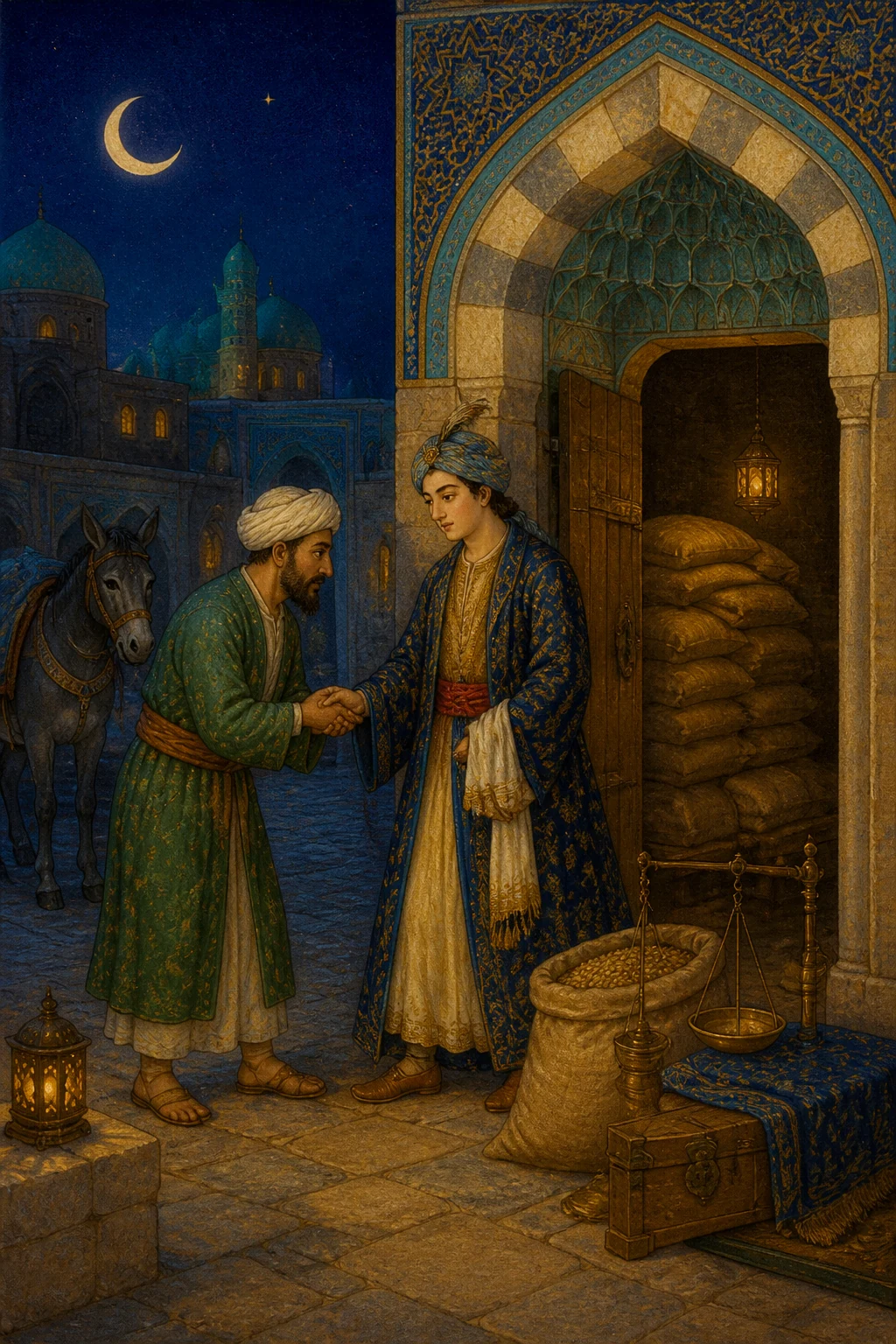
‘Visit the one you love and heed no envious talk: the envious never lend a hand to love. I saw you in a dream lying beside me, and kissed the sweetest coolness from your lips. All that I saw was true and certain, and I shall attain it despite the envious. No eyes have ever seen a fairer sight than two lovers upon a single bed, embracing, clothed in mutual contentment, each pillowed on the other’s wrist and arm. When hearts are joined in harmony, the world beats upon cold iron. You who reproach lovers for their love, can you set right a heart undone? If time grants you one true companion, that is all you need: live for that one alone.’ They remained in each other’s arms until morning, and love for each took root in the other’s heart. Then she took the curtain, embroidered it with colored silk, and adorned it with gold and silver thread. She made a band of birds upon it and worked wild beasts around its border, leaving no beast in the world without its likeness there. She spent eight days working on it. When it was finished, she trimmed and smoothed it, then gave it to her master, saying, “Take this to the market and sell it to a merchant for fifty dinars. Beware of selling it to a passing stranger, for that would cause us to be parted. We have enemies who never cease watching for us.” He said, “I hear and obey.” He took it to the market and sold it to a merchant as she had instructed. Then he bought the cloth, silk thread, and gold and silver thread as before, along with the food they needed. He brought everything to her and handed her the money that remained. Every eight days she gave him a curtain, which he sold for fifty dinars, and they continued in this way for a whole year. At the end of the year, he took a curtain to the market as usual and gave it to the broker. A Christian approached and offered sixty dinars for it. The offer was refused, but he kept raising his bid until it reached a hundred dinars, and he bribed the broker with ten dinars. The broker returned to Ali Shar, told him the price, and used all his cunning to persuade him to sell the curtain to the Christian for that sum. “My lord,” he said, “have no fear of this Christian. No harm will come to you from him.” The merchants pressed him too, and he sold it to the Christian, though his heart was full of dread. He took the money and set off for home, only to find the Christian walking behind him. “Christian,” he said, “why are you following me?” He replied, “My lord, I have an errand at the far end of the alley. May God never leave you in need.” Ali Shar had scarcely reached his house when the Christian caught up with him. “You accursed fellow,” he said, “why do you follow me wherever I go?” He replied, “My lord, give me a drink of water, for I am thirsty, and God Most High will reward you.” Ali Shar said to himself, “This man is one of the protected people and has asked me for a drink of water. By God, I shall not turn him away.” And dawn overtook Shahrazad, and she fell silent, leaving her tale untold.
When it was the three hundred and thirteenth night,
She said: It has reached me, O fortunate King, that Ali Shar said to himself, “This man is one of the protected people and has asked me for a drink of water. By God, I shall not turn him away.” He entered the house and took a jug of water. His slave girl Zumurrud saw him and said, “My beloved, have you sold the curtain?” “Yes,” he said. “To a merchant or to a passing stranger? My heart has felt that we shall be parted.” “I sold it only to a merchant.” She said, “Tell me the truth, so that I may take steps to save myself. And why have you taken that jug of water?” He replied, “To give the broker a drink.” She said, “There is no power and no strength save in God, the Most High, the Almighty.” Then she recited these two verses:
‘You who seek our parting, wait: do not let an embrace deceive you. Wait, for treachery is the way of time, and the end of companionship is parting.’ He went out with the jug and found that the Christian had come into the entrance hall. “Have you come this far, you dog?” he said. “How dare you enter my house without permission?” The man replied, “My lord, there is no difference between the doorway and the entrance hall. I shall not move from this spot except to leave. Yours are grace and kindness, generosity and favor.” He took the jug, drank its contents, and handed it back to Ali Shar. Ali Shar took it and waited for him to rise, but he did not. “Why do you not get up and go your way?” he asked. The man said, “My lord, do not be one of those who do a kindness and then reproach the recipient for it, nor one of those of whom the poet said:
‘Gone are those who, when you stood at their doors, met your needs with the noblest generosity. Now, when you stand at other men’s doors, they hold even a drink of water against you.’” Then he said, “My lord, I have drunk, but I would like you to feed me whatever there is in the house, even a crust or a piece of dry bread and an onion.” Ali Shar said, “Get up and stop arguing. There is nothing in the house.” He replied, “My lord, if there is nothing in the house, take these hundred dinars and bring us something from the market, even a single loaf, so that there may be bread and salt between us.” Ali Shar said to himself, “This Christian is mad. I shall take his hundred dinars and bring him something worth two dirhams, and have the laugh of him.” The Christian said, “My lord, I want only something to drive away hunger, even a dry loaf and an onion. The best provision is what keeps hunger at bay, not sumptuous food. How well the poet said:
‘Hunger can be driven off with a dry loaf: alas for my grand pretensions and anxious fancies! Death is most just, dealing evenhandedly with the caliph and the wretched pauper.’” Ali Shar said, “Wait here while I lock the inner room and bring you something from the market.” “I hear and obey,” the man replied. Ali Shar went out, locked the inner room, secured the lock on the door, and took the key with him. He went to the market and bought fried cheese, white honey, bananas, and bread, then brought them back. When the Christian saw the food, he said, “My lord, this is a great deal, enough for ten men, and I am alone. Perhaps you will eat with me.” “Eat by yourself,” he replied, “for I have had my fill.” The man said, “My lord, the wise have said, ‘He who does not eat with his guest is a bastard.’” When Ali Shar heard these words from the Christian, he sat down and ate a little with him. He was about to withdraw his hand … And dawn overtook Shahrazad, and she fell silent, leaving her tale untold.
When it was the three hundred and fourteenth night,
She said: It has reached me, O fortunate King, that Ali Shar sat down and ate a little with him. When he was about to withdraw his hand, the Christian took a banana, peeled it, and split it in two. In one half he put refined henbane mixed with opium, a single dirham’s weight of which would bring down an elephant. Then he dipped that half of the banana in honey and said, “My lord, by your faith, you must take this.” Ali Shar was ashamed to make him break his oath, so he took it and swallowed it. Scarcely had it settled in his stomach when his head overtook his feet, and he lay as though he had been asleep for a year. When the Christian saw this, he sprang to his feet like a ravening, mangy wolf, took the key to the inner room, and left him lying there. He ran to his brother and told him what had happened. Now this Christian’s brother was the decrepit old man who had wished to buy Zumurrud for a thousand dinars, whom she had rejected and mocked in verse. Inwardly he was an unbeliever, though outwardly he professed Islam and called himself Rashid al-Din. When she had mocked and rejected him, he complained to his Christian brother, the man who had contrived to take her from her master Ali Shar, whose name was Barsum. Barsum had told him, “Do not grieve over this. I shall devise a way to get her for you without a dirham or a dinar.” For he was a cunning, deceitful, wicked priest, and he went on scheming and plotting until he carried out the trick we have described. He took the key, went to his brother, and told him what had happened. His brother mounted his mule, took his servants, and went with him to Ali Shar’s house, carrying a purse containing a thousand dinars to give the governor should he encounter him. He opened the inner room, and the men with him rushed in upon Zumurrud and seized her by force, threatening to kill her if she spoke. They left the house as it was and took nothing from it. Ali Shar they left sleeping in the entrance hall, shutting the door on him and putting the key to the inner room beside him. The Christian took her to his palace and placed her among his slave girls and concubines. “You hussy,” he said, “I am the old man you rejected and mocked, and now I have taken you without a dirham or a dinar.” Her eyes filled with tears, and she said, “May God requite you, wicked old man, for parting me from my master.” He replied, “You hussy, you lovesick wench, you shall see what torments I have in store for you. By the Messiah and the Virgin, unless you obey me and embrace my religion, I shall torture you in every way.” She said, “By God, even if you cut my flesh to pieces, I will not abandon Islam. Perhaps God Most High will grant relief soon, for He has power to do whatever He wills. The wise have said, ‘Better affliction in the body than affliction in the faith.’” At this he shouted to the servants and slave girls, “Throw her down!” They threw her down, and he beat her savagely. She cried for help, but none came. Then she ceased calling for help and began to say, “God is sufficient for me; He alone suffices.” At last her breath failed and her moaning grew faint. When he had satisfied his rage against her, he told the servants, “Drag her away by her feet, throw her into the kitchen, and give her nothing to eat.” The accursed man passed the night, and in the morning he sent for her and beat her again, then ordered the servants to throw her back where she had been. They did so. When the pain of the beating had eased, she said, “There is no god but God, and Muhammad is the Messenger of God. God is sufficient for me, and He is the best guardian.” Then she called for help upon our lord Muhammad, God bless him and grant him peace. And dawn overtook Shahrazad, and she fell silent, leaving her tale untold.
When it was the three hundred and fifteenth night,
She said: It has reached me, O fortunate King, that Zumurrud called for help upon the Prophet, God bless him and grant him peace. Such was her case. As for Ali Shar, he remained asleep until the following day. Then the drug cleared from his head, and he opened his eyes and cried, “Zumurrud!” No one answered. He entered the inner room and found it deserted, with his beloved far beyond his reach. He knew that all this had befallen him through the Christian. He yearned and wept, moaned and lamented, and shed streams of tears, reciting these verses:
‘O anguish, spare me nothing; leave nothing of me! Here is my heart between suffering and peril. My lords, have mercy on a slave brought low beneath love’s law, a man once rich among his people, now impoverished. What can an archer do when enemies surround him, and, as he would loose his arrow, the bowstring snaps? When sorrows crowd upon a youth and pile one upon another, where can he flee from fate?
How often I feared the breaking of our union! Yet when destiny descends, the eyes are blind.’ When he had finished his verses, he heaved deep sighs and recited these as well:
‘She left her forms upon the sandy reaches of the sanctuary, and the grieving heart yearned longingly for her dwelling. She turned toward the old abodes, stirred by a home whose traces had faded and fallen apart. She stood and questioned it, and the echo returned her answer: “There is no road to reunion.” It was as though a flash of lightning had gleamed over the sanctuary and passed, never to show its radiance to you again.’ He repented when repentance could no longer avail him. Weeping and tearing his clothes, he took two stones in his hands and wandered around the city, beating his breast with them and crying, “Zumurrud!” Children gathered around him, shouting, “Madman! Madman!” Everyone who knew him wept for him and said, “This is so-and-so. What has happened to him?” He continued in this state until the end of the day. When night fell, he slept in an alley until morning, then rose and wandered around the city with his stones until evening. Afterward he returned to his house to spend the night. His neighbor, a good-hearted old woman, saw him and said, “My son, may you be well! When did you lose your reason?” He answered her with these two verses:
‘They said, “You have gone mad for the one you love.” I told them, “Who but the mad can taste the sweetness of life? Leave my madness be and bring me the one who drove me mad. If he can cure my madness, do not reproach me.”’ The old woman knew then that he was a lover parted from his beloved. She said, “There is no power and no strength save in God, the Most High, the Almighty. My son, I would like you to tell me the story of your misfortune. Perhaps God will enable me to help you, if He wills.” He told her everything that had happened to him with Barsum the Christian, brother of the priest who called himself Rashid al-Din. When she had heard it all, she said, “My son, you have every excuse.” Then tears flowed from her eyes, and she recited these two verses:
‘The torment lovers suffer in this world is enough for them. By God, may Hell not torment them afterward! For they have perished of love, concealing it and remaining chaste; to this the tradition bears witness.’ When she had finished her verses, she said, “My son, go now and buy a basket like those the jewelers use. Buy bracelets, rings, earrings, and ornaments suitable for women, and do not stint the money. Put them all in the basket and bring it to me. I shall carry it on my head in the guise of a peddler and go from house to house searching for her, until I discover news of her, God Most High willing.” Ali Shar rejoiced at her words and kissed her hand, then hurried off and brought her what she had requested. When everything was before her, she rose, put on a patched robe, draped a honey-colored mantle over her head, took a staff in her hand, and lifted the basket. She went about the lanes and houses, roaming from place to place, quarter to quarter, and street to street, until God Most High guided her to the palace of the accursed Christian Rashid al-Din. She heard moaning within and knocked at the door. And dawn overtook Shahrazad, and she fell silent, leaving her tale untold.
When it was the three hundred and sixteenth night,
She said: It has reached me, O fortunate king, that when the old woman heard moaning from within the house, she knocked at the door. A slave girl came down, opened it, and greeted her. The old woman said, “I have these little wares to sell. Is there anyone here who would buy something?” “Yes,” replied the girl. Then she brought her into the house and seated her. The slave girls gathered around, and each chose something from her stock. The old woman spoke kindly to them and was easy with them over the prices, so they were delighted by her generosity and gentle speech. All the while she was looking about for the woman who had been moaning. At last her glance fell upon her; she continued to favor the girls and treat them kindly, while looking more closely, until she recognized Zumurrud lying there. She wept and said, “My children, why is this young woman in such a state?” The girls told her the whole story, adding, “We have no choice in this matter. Our master ordered us to do it, and he is away traveling now.” She said, “My children, I have a favor to ask of you. Untie this poor creature until you learn that your master is coming, then bind her as before. Thus you will earn a reward from the Lord of All Worlds.” “We hear and obey,” they answered. They untied her and gave her food and drink. Then the old woman said, “Would that I had broken my leg rather than entered this house of yours!” After that she went over to Zumurrud and said, “May you be well, my daughter. God will bring you relief.” Then she told her that she had come from her master, Ali Shar, and arranged that the following night Zumurrud should be ready and listen carefully for a sound. She said, “Your master will come beneath the raised platform outside the palace and whistle to you. When you hear him, whistle back, then lower yourself to him from the window by a rope, and he will take you away.” Zumurrud thanked her, and the old woman left and went to Ali Shar. She told him what she had done and said, “Tomorrow night, at midnight, go to such-and-such a street. The accursed man’s house is there, and you will recognize it by these signs. Stand beneath his palace and whistle. She will lower herself to you, so take her and go wherever you please.” He thanked her, then shed abundant tears and recited these verses:
“Keep the reproachers from their idle talk: my heart is tormented, my body wasted and worn. My tears recount a chain of tales, sound in their source, though broken and obscure in their transmission. You whose mind is free of my sorrow and my longing, spare yourself the trouble of asking how I fare. One sweet of lip, slender and graceful, has stolen my heart with honeyed mouth and supple form. Since you departed, my heart has known no rest, my eyes no sleep, and all my hopes of patience have been vain. You left me a prisoner of longing, grieving, tossed between the envious and those who blame. As for forgetting, it is a thing I do not know; no one but you has ever crossed my mind.” When he had finished his poem, he sighed, shed tears, and recited these two verses:
“God bless the bearer of the news that you are coming: he has brought the sweetest tidings ears could hear. If he would take a cast-off garment as his gift, I would give him my heart, torn at the hour of farewell.” Then he waited until night had fallen and the appointed hour arrived. He went to the street his neighbor had described, saw the palace, and recognized it. He sat on a raised stone bench beneath it, but sleep overcame him, and he slept—glory be to Him who never sleeps! For so long had his anguish kept him wakeful that he was like a drunken man. And while he lay sleeping… Dawn overtook Shahrazad, and she fell silent, leaving her tale untold.
When it was the three hundred and seventeenth night
She said: It has reached me, O fortunate king, that while he lay sleeping, a thief went out that night to the outskirts of the city in search of something to steal. Fate brought him beneath the Christian’s palace. He went around it but could find no way to climb up, and continued circling until he reached the stone bench. There he saw Ali Shar asleep and took his turban. Scarcely had he done so when Zumurrud looked out. Seeing him standing in the darkness, she took him for her master and whistled. The thief whistled back, and she lowered herself to him by the rope, bringing with her a saddlebag full of gold. At the sight of it the thief said to himself, “This is a strange business indeed, with some stranger cause behind it.” Then he took up the saddlebag, hoisted her onto his shoulders, and sped away with them like a flash of lightning. She said, “The old woman told me you had grown weak on my account, yet here you are, stronger than a horse!” He made no answer. She felt his face and found a beard like a bathhouse broom, as though he were a pig that had swallowed feathers and their down had sprouted from his throat. Terrified, she said, “What are you?” He answered, “You whore, I am the rogue Jawan the Kurd, of Ahmad al-Danaf’s band. There are forty of us, and tonight every one of them will have his wicked way with you, from nightfall until morning.” When she heard this, she wept and struck her face. She knew that fate had overcome her and that she had no recourse but to entrust herself to Almighty God. So she endured and submitted to His decree, saying, “There is no god but God! Whenever we escape one sorrow, we fall into another greater than the first.” Now the reason Jawan had come to that place was that he had said to Ahmad al-Danaf, “My gallant fellow, I have been to this city before, and I know a cave outside it large enough to hold forty people. I want to go ahead of you and put my mother in that cave, then return to the city and steal something on the strength of your good fortune. I shall keep it in your name until you arrive, and that day you shall feast at my expense.” Ahmad had said, “Do as you wish.” So he had gone ahead of them to that place and left his mother in the cave. On coming out, he had found a soldier asleep with a horse tethered beside him. He slit his throat, took his clothes, horse, and weapons, and hid them in the cave with his mother, tethering the horse there. Then he returned to the city and walked until he reached the Christian’s palace, where he did what has already been related: he took Ali Shar’s turban and carried off his slave girl Zumurrud. He kept running with her until he set her down beside his mother and said, “Keep watch over her until I return to you early tomorrow morning.” Then he went away. Dawn overtook Shahrazad, and she fell silent, leaving her tale untold.
When it was the three hundred and eighteenth night
She said: It has reached me, O fortunate king, that Jawan the Kurd said to his mother, “Keep watch over her until I return to you early tomorrow morning.” Then he went away. Zumurrud said to herself, “Why am I neglecting to save myself by some trick? How can I wait until these forty men come and take their turns with me until they leave me like a ship sunk in the sea?” Then she turned to the old woman, Jawan the Kurd’s mother, and said, “Aunt, why do we not go outside the cave, so that I may pick the lice from your hair in the sunshine?” “Yes, by God, my daughter,” she answered. “It is a long time since I have been to the bathhouse, for these pigs keep dragging me from place to place.” She went out with her, and Zumurrud began picking through her hair and killing the lice, until the old woman grew so comfortable that she fell asleep. Then Zumurrud rose, put on the clothes of the soldier Jawan the Kurd had murdered, buckled his sword about her waist, and wound his turban around her head, until she looked like a man. She mounted the horse, took the saddlebag of gold, and said, “O You who graciously veil our faults, conceal me, for the sake of Muhammad, God bless him and grant him peace!” Then she said to herself, “If I go to the city, one of the soldier’s people may see me, and that will bode me no good.” So she turned away from the city and rode into the empty wilderness. For ten days she traveled on with the saddlebag and the horse, eating the plants of the earth and feeding her horse on them, and drinking from the rivers. On the eleventh day she approached a fine and peaceful city, firmly established in prosperity. Winter and its cold had departed, and spring had come with its blossoms and roses. Its flowers flourished, its rivers flowed, and its birds sang.
When she reached the city and drew near its gate, she found the troops, the emirs, and the leading townspeople gathered there. Astonished at the sight, she said to herself, “All the people of this city are assembled. There must be some reason for it.” She rode toward them, and as she approached, the soldiers hurried to meet her, dismounted, and kissed the ground before her, saying, “God grant you victory, our lord the sultan!” The dignitaries formed ranks before her, and the soldiers began putting the people in order, crying, “God grant you victory and make your coming a blessing to the Muslims, O sultan of all the world! God uphold you, king of the age, peerless one of our time!” Zumurrud said to them, “What is this, people of the city?” The chamberlain answered, “He who is never grudging with His gifts has bestowed His bounty upon you and made you sultan of this city, with authority over the lives of all who dwell in it. Know that when our king dies leaving no son, it is the custom of this city for the troops to go outside the walls and wait three days. Whoever then comes along the road by which you have come, they make their sultan. Praise be to God, who has brought us a handsome son of the Turks! Even had someone less worthy than you appeared, he would have become sultan.” Now Zumurrud was prudent in all she did, so she said, “Do not suppose that I am the son of common Turks. I come of a noble family, but I quarreled with my kin, left them, and went away. Look at this saddlebag of gold I have brought beneath me, so that I may give alms to the poor and needy along my way.” They prayed for her and rejoiced exceedingly, and Zumurrud too was delighted with them. Then she said to herself, “Now that I have attained this position…” Dawn overtook Shahrazad, and she fell silent, leaving her tale untold.
When it was the three hundred and nineteenth night
She said: It has reached me, O fortunate king, that Zumurrud said to herself, “Now that I have attained this position, perhaps God will reunite me with my master here. He has power to do whatever He wills.” Then she rode on, and the troops accompanied her into the city. They dismounted before her and escorted her into the palace. She alighted, and the emirs and grandees supported her beneath the arms until they seated her on the throne. They all kissed the ground before her. Once seated, she ordered the treasuries opened, and when this was done she distributed money among all the troops. They prayed that her reign might endure, and the people and all the inhabitants of the land obeyed her. For some time she continued thus, issuing commands and prohibitions, and her generosity and virtue inspired great awe in the people’s hearts. She abolished oppressive tolls, released the prisoners, and redressed injustices, so that everyone loved her. Whenever she remembered her master, she wept and prayed that God would reunite them. One night she thought of him and of the days she had spent with him, and, shedding tears, recited these two verses:
“My longing for you is ever renewed with time; tears have wounded my eyes, and still they flow. Whenever I weep, I weep from the pain of love: separation bears heavily upon the lover.” When she had finished her verses, she wiped away her tears, went up into the palace, and entered the harem. She assigned separate quarters to the slave girls and concubines and fixed their allowances and provisions, claiming that she wished to remain alone in a place devoted to worship. She began fasting and praying, until the emirs said, “This sultan is deeply devout.” She kept no servants about her except two young eunuchs to attend to her needs. She had occupied the royal throne for a year without hearing any news of her master or finding any trace of him, and this distressed her. When her anxiety grew severe, she summoned the viziers and chamberlains and ordered them to bring engineers and builders and have a square laid out below the palace, a parasang in length and a parasang in breadth. They carried out her orders with all speed, and the square was made just as she wished. When it was finished, she went down into it. A great pavilion was erected for her there, and chairs were arranged for the emirs. She ordered a banquet of every kind of sumptuous food to be spread in the square, and they did as she commanded. Then she told the officers of state to eat, and they ate. Afterward she said to the emirs, “When the new month begins, I want you to do this again and proclaim throughout the city that no one is to open his shop. All must attend and eat at the king’s table. Anyone who disobeys shall be hanged at his own door.” When the new month began, they did as she had ordered, and they continued this custom until the first month of the second year. Then she went down to the square, and the herald proclaimed, “O people, one and all! Whoever opens his shop, warehouse, or house shall be hanged at once at his own door. You must all come and eat at the king’s table!” When the proclamation was over and the feast laid out, the people came in crowds. She ordered them to sit at the table and eat their fill of all the dishes. They sat and ate as she had commanded, while she sat upon the royal throne watching them. Each person seated at the feast said to himself, “The king is looking at no one but me.” They went on eating, and the emirs said to them, “Eat without embarrassment, for this pleases the king.” They ate until they were satisfied, then went away praying for the king. They said to one another, “Never in our lives have we seen a sultan who loves the poor as this sultan does.” They prayed that he might live long, and she returned to her palace. Dawn overtook Shahrazad, and she fell silent, leaving her tale untold.
When it was the three hundred and twentieth night
She said: It has reached me, O fortunate king, that Queen Zumurrud returned to her palace, pleased with what she had arranged, and said to herself, “God willing, this will lead me to news of my master Ali Shar.” When the second month began, she held the feast as usual. The table was spread, and Zumurrud went down and sat upon her throne, ordering the people to sit and eat. As she sat at the head of the table and the people took their places, group after group and one by one, her eye fell upon Barsum the Christian, who had bought the curtain from her master. She recognized him and said, “This is the beginning of relief and the fulfillment of my hopes.” Barsum came forward and sat down with the others to eat. He saw a dish of sweet rice sprinkled with sugar some distance away, pushed toward it, reached out, and drew it in front of him. A man beside him said, “Why do you not eat what is in front of you? Have you no shame, reaching for something so far away? Are you not embarrassed?” Barsum answered, “I will eat nothing but this.” “Eat, then,” said the man, “and may God give you no enjoyment of it!” A hashish smoker said, “Leave him to eat it, so that I too may share it with him.” The man replied, “You most ill-omened of hashish smokers, this is not food for the likes of you. It is food for emirs. Leave it, so that it may go back to those it belongs to, and they may eat it.” Barsum ignored him, took a mouthful, and put it into his mouth. He was about to take a second when the queen, who had been watching him, called to some soldiers and said, “Bring me that man with the dish of sweet rice before him. Do not let him eat the mouthful in his hand; knock it away.” Four soldiers came, knocked the food from his hand, dragged him face-down along the ground, and stood him before Zumurrud. The people stopped eating and said to one another, “By God, he has done wrong, for he would not eat the food of his own kind.” One said, “I am content with this kishk in front of me.” The hashish smoker said, “Praise be to God, who kept me from eating any of that sweet rice! I was waiting for him to settle the dish before him and enjoy it, and then I was going to share it with him. Now look what has happened to him!” The people said to one another, “Wait and see what becomes of him.” When he was brought before Queen Zumurrud, she said, “Woe to you, blue-eyed fellow! What is your name, and why have you come to our country?” The accursed man, who was wearing a white turban, concealed his name and said, “O king, my name is Ali, my trade is weaving, and I have come to this city to do business.” Zumurrud said, “Bring me a geomancer’s sandboard and a brass stylus.” They brought what she asked for at once. She took the sandboard and stylus, cast a geomantic figure, and drew a shape resembling a monkey. Then she raised her head, studied Barsum for a while, and said, “You dog, how dare you lie to kings? Are you not a Christian named Barsum, and have you not come in search of something? Tell me the truth, or, by the majesty of the Lord, I shall strike off your head!” The Christian stammered, and the emirs and all those present said, “This king understands geomancy! Glory be to Him who bestowed this gift upon him!” Then she shouted at the Christian, “Tell me the truth, or I shall destroy you!” He said, “Mercy, king of the age! Your divination is true, for this wretch is indeed a Christian.” Dawn overtook Shahrazad, and she fell silent, leaving her tale untold.
When it was the three hundred and twenty-first night
She said: It has reached me, O fortunate king, that the Christian said, “Mercy, king of the age! Your divination is true, for this wretch is indeed a Christian.” The emirs and everyone else present marveled at the accuracy of the king’s geomancy and said, “There is no astrologer in the world to equal this king!” Then the queen ordered that the Christian be flayed, his skin stuffed with straw and hung at the entrance to the square, and a pit dug outside the city, in which his flesh and bones were to be burned and covered with filth and refuse. “We hear and obey,” they said, and carried out all her commands. When the people saw what had befallen the Christian, they said, “He has received his deserts. What an ill-fated mouthful that was for him!” One of them said, “May this wretch’s wife be divorced if I ever eat sweet rice again!” The hashish smoker said, “Praise be to God, who spared me what befell this man by keeping me from eating that rice!” Then all the people departed, having sworn never to sit beside the sweet rice in the Christian’s place. When the third month came, they spread the feast as usual and filled it with dishes. The queen sat upon the throne, and the soldiers stood in their accustomed places, fearful of her might. The townspeople entered as usual, gathered around the table, and looked at the place where the dish stood. One said to another, “Hajj Khalaf!” “At your service, Hajj Khalid,” he answered. “Keep clear of the sweet rice,” said the first, “and beware of eating it. If you do, you will find yourself hanged.”
Then they sat around the table to eat. While they were eating and Queen Zumurrud sat watching, she happened to glance toward a man hurrying in from the city gate. She looked closely and recognized Jawan the Kurd, the thief who had killed the soldier. The reason for his coming was this: after leaving his mother, he had gone to his companions and told them, “I made a fine haul last night. I killed a soldier and took his horse, and that same night I came by a saddlebag full of gold and a girl worth more than all the gold in it. I left everything in the cave with my mother.” They were delighted and set off for the cave toward the end of the day. Jawan the Kurd went in first, with the others behind him, intending to bring them what he had promised, but he found the place empty. He asked his mother what had happened, and she told him the whole story. He bit his hands in remorse and said, “By God, I shall search for that harlot and drag her from wherever she may be, even if she is hidden in a pistachio shell, and I shall satisfy my fury upon her!” He went out in search of her and wandered from country to country until he reached Queen Zumurrud’s city. When he entered, he found no one about, so he asked some women looking out of their windows. They told him that on the first day of every month the sultan spread a feast, and everyone went to eat there. They directed him to the square where the feast was laid, and he hurried there. He could find no empty seat except beside the dish already mentioned, so he sat down with it before him and reached toward it. The people cried out, “Brother, what are you about to do?” He answered, “I mean to eat from this dish until I am full.” One said, “If you eat from it, you will find yourself hanged.” “Be quiet,” he replied, “and say no such thing!” Then he reached out and pulled the dish toward him. The hashish smoker already mentioned was sitting beside him, but when he saw him draw the dish near, he fled his place, all the hashish fumes driven from his head. He sat some distance away and said, “I want nothing to do with that dish!” Then Jawan the Kurd stretched out his hand, shaped like a crow’s foot, and scooped up the rice, drawing it out shaped like a camel’s hoof. Dawn overtook Shahrazad, and she fell silent, leaving her tale untold.
When it was the three hundred and twenty-second night
She said: It has reached me, O fortunate king, that Jawan the Kurd drew his hand from the dish shaped like a camel’s hoof, rolled the mouthful in his palm until it was as large as a big bitter orange, and tossed it swiftly into his mouth. It went down his throat with a crack like thunder, leaving the bottom of the dish bare where he had scooped it up. The man beside him said, “Praise be to God, who did not make me food before you, for you have dug a crater in the dish with a single mouthful!” The hashish smoker said, “Let him eat, for I can already picture him hanging.” Then he turned to him and said, “Eat, and may God give you no enjoyment of it!” Jawan reached for a second mouthful and was about to roll it in his hand like the first when the queen called to some soldiers, “Bring that man here quickly, and do not let him eat the mouthful in his hand!” The soldiers rushed upon him as he bent over the dish, seized him, and brought him before Queen Zumurrud. The people gloated over him and said to one another, “He deserves it. We warned him, but he would not listen. Death is appointed for whoever sits in that place, and that rice brings misfortune to everyone who eats it.”
Then Queen Zumurrud said to him, “What is your name, what is your trade, and why have you come to our city?” He replied, “Our lord the sultan, my name is Uthman, and I am a gardener. I have come to this city because I am searching for something I have lost.” The queen said, “Bring me the sandboard.” They brought it before her, and she took the stylus and cast a geomantic figure. She studied it for a while, then raised her head and said, “Woe to you, villain! How dare you lie to kings? These figures tell me that your name is Jawan the Kurd, and your trade is robbery: you take people’s wealth unlawfully and slay those whom God has forbidden anyone to kill except by right.” Then she shouted, “You pig, tell me the truth about yourself, or I shall cut off your head!” When he heard her words, his face turned yellow and his teeth chattered. Thinking he might escape by telling the truth, he said, “You have spoken truly, O king. But from this moment I repent at your hands and turn back to Almighty God.” The queen answered, “It is not lawful for me to leave a scourge in the path of the Muslims.” Then she said to some of her attendants, “Take him and flay him, and do to him as you did to his like last month.” They carried out her orders. When the hashish smoker saw the soldiers seize the man, he turned his back on the rice dish and said, “It is forbidden for me ever to face you again!” When they had finished eating, the people dispersed and went their ways. The queen went up to her palace and gave the mamluks leave to depart.
When the fourth month began, they went down to the square as usual and brought the food. The people sat waiting for permission to eat. Then the queen came and seated herself upon the throne, looking over them. She saw that the place beside the rice dish was empty, though it could hold four people, and wondered at this. As her gaze wandered, she caught sight of someone hurrying in through the entrance to the square. He hurried on until he reached the table, where he found no empty place except beside the dish, and sat down there. She looked closely and recognized the accursed Christian who called himself Rashid al-Din. She said to herself, “How blessed is this feast, which has caught this unbeliever in its snares!” There was a strange reason for his coming, for when he returned from his travels… Dawn overtook Shahrazad, and she fell silent, leaving her tale untold.
When it was the three hundred and twenty-third night
She said: It has reached me, O fortunate king, that when the accursed man who called himself Rashid al-Din returned from his travels, his household told him that Zumurrud had disappeared with a saddlebag of money. At this news he tore his clothes, struck his face, and plucked out his beard. He sent his brother Barsum to search for her in other lands. When no news of him came for a long time, he set out himself to search the countries for both his brother and Zumurrud. Fate brought him to Zumurrud’s city, which he entered on the first day of the month. Walking through its streets, he found them empty and the shops shut. He saw women at the windows and asked some of them what was happening. They said, “On the first day of every month the king gives a feast for everyone. All the people eat there, and no one may stay in his house or shop.” They directed him to the square. When he entered it, he found the people crowded around the food, with no empty place except beside the familiar rice dish. He sat there and stretched out his hand to eat. The queen called to some soldiers, “Bring me the man sitting beside the rice dish!” Knowing what to do from past occasions, they seized him and stood him before Queen Zumurrud. She said, “Woe to you! What is your name, what is your trade, and why have you come to our city?” He answered, “King of the age, my name is Rustam, and I have no trade, for I am a poor dervish.” She said to her attendants, “Bring me a sandboard and the brass stylus.” They brought them as usual. She took the stylus, traced a geomantic figure upon the board, and studied it for a while. Then she raised her head toward him and said, “You dog, how dare you lie to kings? Your name is Rashid al-Din the Christian, and your trade is to ensnare the slave girls of Muslims by tricks and carry them off. Outwardly you are a Muslim, but inwardly a Christian. Speak the truth, or I shall strike off your head!” He stammered, then said, “You have spoken truly, king of the age.” She ordered him stretched out and given a hundred lashes on each foot and a thousand on his body, after which he was to be flayed and his skin stuffed with chaff. Then a pit was to be dug outside the city and his body burned in it, and afterward they were to heap filth and refuse over him. They did as she commanded. Then she gave the people permission to eat, and they ate. When they had finished and gone their ways, Queen Zumurrud went up to her palace and said, “Praise be to God, who has eased my heart of those who harmed me!” Then she gave thanks to the Creator of earth and heaven and recited these verses:
“They held power and grew overbearing in their rule; a little while, and it was as though their rule had never been. Had they dealt justly, justice would have been theirs; but they oppressed, and time brought calamities and trials upon them. Now their very plight proclaims to them: ‘This is for that; lay no blame upon time.’” When she had finished her verses, her master Ali Shar came to mind, and she wept abundant tears. Then she recovered her composure and said to herself, “Perhaps God, who has given me power over my enemies, will favor me with the return of those I love.” And she sought forgiveness from God, the Almighty and Glorious. Dawn overtook Shahrazad, and she fell silent, leaving her tale untold.
When it was the three hundred and twenty-fourth night
She said: It has reached me, O fortunate king, that the queen sought forgiveness from God, the Almighty and Glorious, and said, “Perhaps God will soon reunite me with my beloved Ali Shar. He has power to do whatever He wills, and He is gracious to His servants and knows them well.” Then she praised God, continued to seek His forgiveness, and submitted to the decrees of fate. Certain that every beginning must have an end, she recited the poet’s words:
“Be easy in your heart, for the destinies of all things lie in the hand of God. Whoever fears them cannot harm you, nor can what He ordains fall short of reaching you.” And the words of another:
“Let the days pass, and pass they will; do not enter the houses of sorrow. Many a thing hard to attain is brought near by the hour of deliverance.” And another’s words: “Be forbearing when tried by anger, and patient when calamity comes upon you. For the nights of time are heavy with child and bring forth every wondrous thing.” And the words of another:
“Be patient, for patience holds a good which, if you knew it, would ease your soul and still your cries of pain. Know that if you do not bear with noble patience, you must bear against your will what the Pen has written.” When she had finished her verses, she passed another full month judging between the people and issuing commands by day, while at night she wept and sobbed over her separation from her master Ali Shar. When the new month began, she ordered the feast spread in the square as usual and took her seat above the people, who waited for permission to eat. The place beside the rice dish remained empty. She sat at the head of the table, keeping her eyes on the entrance to the square so that she could see everyone who came in. In her heart she prayed, “O You who restored Joseph to Jacob and lifted affliction from Job, favor me by restoring my master Ali Shar through Your power and majesty! You have power over all things, Lord of All Worlds, Guide of the lost, Hearer of voices, Answerer of prayers. Answer me, Lord of All Worlds!” Scarcely had she finished her prayer when someone entered the square, his figure like a willow bough, though his body was thin and his face pale. He was a most handsome young man, endowed with perfect understanding and manners. On entering, he found no empty place except beside the rice dish, so he sat there. When Zumurrud saw him, her heart fluttered. She looked intently and realized that he was her master Ali Shar. She almost cried out for joy, but restrained herself, fearing to expose herself before the people. Her whole being trembled and her heart raced, yet she concealed her feelings. Now the reason for Ali Shar’s coming was this: after he had fallen asleep upon the stone bench, and Zumurrud had come down and been carried off by Jawan the Kurd, he awoke to find his head bare. He knew that someone had robbed him of his turban as he slept, and uttered the words that bring no shame upon the speaker: “We belong to God, and to Him we shall return.” Then he went back to the old woman who had told him where Zumurrud was and knocked at her door. She came out, and he wept before her until he fell unconscious. When he recovered, he told her everything that had happened. She blamed and scolded him for what he had done, saying, “You have brought your misfortune and calamity upon yourself!” She went on reproaching him until blood poured from his nostrils and he fell unconscious again. When he came out of his swoon… Dawn overtook Shahrazad, and she fell silent, leaving her tale untold.
When it was the three hundred and twenty-fifth night
She said: It has reached me, O fortunate king, that when Ali Shar came out of his swoon, he saw the old woman weeping for him and shedding tears. In his anguish he recited these two verses: “How bitter is parting to those who love, and how sweet reunion to lovers! May God reunite every loving pair and watch over me, for I am at death’s door.” She grieved for him and said, “Stay here while I discover what has happened. I shall return quickly.” “I hear and obey,” he answered. Then she left him and was gone until midday. When she returned, she said, “Ali, I fear you will die of grief, for you will never see your beloved again except upon the Bridge of Judgment. When the people of the palace rose this morning, they found the window overlooking the garden torn from its frame, and Zumurrud gone, together with a saddlebag of the Christian’s money. When I arrived there, I found the governor and his men standing at the palace gate. There is no strength and no power save in God, the Most High, the Almighty!” When Ali Shar heard her words, the light in his face gave way to darkness. He despaired of life and felt certain of death. He wept until he fell unconscious, and when he recovered, love and separation had so afflicted him that he became gravely ill and took to his house. For a whole year the old woman kept bringing him physicians, giving him medicinal draughts, and preparing broths for him, until life returned to him. Then he remembered all that had passed and recited these verses:
Grief crowds upon me, while those I love are scattered; tears race down my cheeks, and my heart burns. Passion weighs ever more heavily on one who knows no rest, worn thin by love and longing and distress. O Lord, if anything can bring me relief, bestow it on me while a breath of life remains! When the second year of his sorrow began, the old woman said to him, “My son, this gloom and grief will not bring your beloved back to you. Rise, take heart, and search for her from land to land; perhaps you will hear some news of her.” She went on encouraging and strengthening him until she roused his spirits. She took him to the bathhouse, gave him wine to drink and chicken to eat, and tended him in this way every day for a month, until he regained his strength and set out. He journeyed on until he reached Zumurrud’s city, where he entered the square, sat down at the feast, and stretched out his hand to eat. The people pitied him and said, “Young man, do not eat from that dish, for whoever eats from it comes to harm.” He replied, “Let me eat from it, and let them do with me what they will. Perhaps I shall find rest from this weary life.” He ate his first mouthful, and Zumurrud was about to have him brought before her when it occurred to her that he was hungry. “It would be better,” she thought, “to let him eat his fill.” So he ate while the crowd stared at him, waiting to see what would happen. When he had eaten his fill, she said to some of the eunuchs, “Go to that young man eating the rice and bring him here gently. Tell him, ‘Come speak with the king, who has a simple question for you to answer.’” “We hear and obey,” they replied. They went over and stood beside him, saying, “Sir, be so good as to come and speak with the king, and have no fear.” “I hear and obey,” he answered, and went with the eunuchs. But dawn overtook Shahrazad, and she fell silent, leaving her tale untold.
When it was the three hundred and twenty-sixth night
She said: It has reached me, O fortunate King, that Ali Shar said, “I hear and obey,” and went with the eunuchs. The people said to one another, “There is no might and no power save in God, the Most High, the Almighty! What do you suppose the king will do to him?” Some said, “He means him nothing but good. Had he wished to harm him, he would not have let him eat his fill.” When Ali Shar stood before Zumurrud, he greeted her and kissed the ground at her feet. She returned his greeting, received him with honor, and asked, “What is your name? What is your trade? And what has brought you to this city?” He replied, “O King, my name is Ali Shar. I am the son of a merchant, and my homeland is Khurasan. I have come to this city in search of a slave girl I lost, who was dearer to me than my hearing and my sight. Since I lost her, my very soul has hung in suspense. That is my story.” Then he wept until he fainted. She ordered them to sprinkle rosewater on his face, and they did so until he revived. When he had recovered from his swoon, she said, “Bring me the sand tray and the brass stylus.” They brought them, and she took the stylus, traced figures in the sand, and studied them for a while. Then she said, “You have spoken the truth. May God soon reunite you with her, so do not be troubled.” She ordered the chamberlain to take him to the bathhouse, dress him in a fine suit of royal clothes, mount him on one of the king’s own horses, and bring him to the palace at the day’s end. “I hear and obey,” said the chamberlain, and led him away. The people said to one another, “Why has the sultan shown this young man such kindness?” Some said, “Did I not tell you he would do him no harm? He is a handsome youth, and when the king waited for him to eat his fill, I knew it.” Each had something to say, and then they dispersed and went their ways. Zumurrud could scarcely wait for night to fall so that she might be alone with her heart’s beloved. When night came, she retired to her bedchamber, pretending to be overcome with sleep. It was not her custom to have anyone sleep in her room except two young servants who attended her. Once she had settled there, she sent for her beloved Ali Shar. She sat upon the bed, with candles burning at her head and feet and golden hanging lamps gleaming about the chamber. When the people heard that she had sent for him, they marveled, and each formed his own suspicions and had something to say. Some declared, “The king has certainly fallen in love with this young man. Tomorrow he will make him commander of the army.” When they brought him into her presence, he kissed the ground before her and prayed for her. “I must tease him a little,” she thought, “and not let him know who I am.” Then she said, “Ali, have you been to the bathhouse?” “Yes, my lord,” he replied. “Go and eat some of this chicken and meat, and drink some of this sweet cordial and wine, for you are weary. Then come here.” “I hear and obey,” he answered, and did as she had commanded. When he had finished eating and drinking, she said, “Climb onto the bed beside me and massage me.” He began to knead her feet and calves and found them softer than silk. “Move your hands higher,” she said. “Forgive me, my lord,” he replied, “but I will not go beyond the knee.” She said, “Would you disobey me and make this an ill-fated night for yourself?” But dawn overtook Shahrazad, and she fell silent, leaving her tale untold.
When it was the three hundred and twenty-seventh night
She said: It has reached me, O fortunate King, that Zumurrud said to her master Ali Shar, “Would you disobey me and make this an ill-fated night for yourself? You had better obey me. I shall make you my beloved and appoint you one of my emirs.” Ali Shar replied, “O King of the Age, in what am I to obey you?” She said, “Untie your trousers and lie facedown.” He answered, “This is something I have never done in all my life. If you force me to it, I shall plead my case against you before God on the Day of Resurrection. Take back everything you have given me and let me leave your city.” Then he wept and sobbed. She said, “Untie your trousers and lie facedown, or I shall strike off your head.” He obeyed, and she climbed onto his back. He felt something soft, softer than silk and more yielding than butter, and thought, “This king is better than any woman.” She remained on his back a little while, then rolled off onto the floor. “Praise be to God!” said Ali Shar. “It seems his cock did not rise.” She said, “Ali, it is the nature of my cock not to rise unless it is rubbed by hand. Get up and rub it with your hand until it rises, or I shall kill you.” Then she lay on her back, took his hand, and placed it on her sex. He found a vulva softer than silk, white, plump, and full, as hot as the bathhouse or the heart of a lover consumed by passion. Ali Shar thought, “The king has a cunt! This is the wonder of wonders!” Desire seized him, and his cock grew fully erect. When she saw this, she laughed aloud and said, “My master, after all this, do you still not know me?” “Who are you, O King?” he asked. She replied, “I am your slave girl Zumurrud.” When he knew her, he kissed and embraced her, then sprang upon her like a lion upon a ewe. He made certain beyond all doubt that she was his slave girl, sheathed his shaft in her scabbard, and remained the doorkeeper at her gate and the prayer leader at her niche, while with him she bowed and prostrated herself, stood and sat. But she followed her praises with wanton cries and motions, until the eunuchs heard her and came to peer from behind the curtains. They found the king lying down with Ali Shar above, thrusting and heaving while she moaned and sighed with pleasure. The eunuchs said, “Those are no man’s cries of pleasure. Perhaps this king is a woman!” But they kept the matter to themselves and revealed it to no one.
In the morning, Zumurrud sent for all the troops and officers of state. When they had assembled, she said, “I wish to travel to this man’s homeland. Choose a deputy to govern you until I return.” They answered that they heard and obeyed. Then she began preparing for the journey, gathering provisions, money, supplies, gifts, camels, and mules. She set out from the city and traveled on until she reached Ali Shar’s homeland. He entered his house, gave alms, bestowed gifts, and dealt generously with all. She bore him children, and they lived in the greatest happiness until there came to them the Destroyer of Pleasures and the Sunderer of Companions. Glory be to Him who endures and never passes away, and praise be to God in every circumstance.
Izvirnik
حكاية علي شار وزمرد - الليالي ٣٠٨ إلى ٣٢٧
Naslednje strani prikazujejo izvirno besedilo za primerjavo.
فلما كانت الليلة ٣٠٨
وحُكِي أنه كان في قديم الزمان، وسالف العصر والأوان، تاجر من التجار في بلاد خراسان اسمه مجد الدين، وله مال كثير، وعبيد ومماليك وغلمان، إلا أنه بلغ من العمر ستين سنة، ولم يُرزَق ولدًا، وبعد ذلك رزقه الله تعالى ولدًا فسمَّاه عليًّا. فلما نشأ ذلك الغلام صار كالبدر ليلة التمام، ولما بلغ مبلغ الرجال، وحاز صفات الكمال، ضعف والده بمرض الموت، فدعا بولده وقال له: يا ولدي، إنه قد قرب وقت المنية، وأريد أن أوصيك وصية. فقال له: وما هي يا والدي؟ فقال له: أوصيك أنك لا تعاشِر أحدًا من الناس، وتجتنب ما يجلب الضرَّ والبأس، وإياك وجليس السوء، فإنه كالحدَّاد إن لم تحرقك ناره يضرك دخانه، وما أحسن قول الشاعر:
مَا فِي زَمَانِكَ مَنْ تَرْجُو مَوَدَّتَهُ وَلَا صَدِيقٌ إِذَا خَانَ الزَّمَانُ وَفَى
فَعِشْ فَرِيدًا وَلَا تَرْكَنْ إِلَى أَحَدٍ هَا قَدْ نَصَحْتُكَ فِيمَا قُلْتُهُ وَكَفَى
وقول الآخر:
النَّاسُ دَاءٌ دَفِينٌ لَا تَرْكُنَنَّ إِلَيْهِمْ
فِيهِمْ خِدَاعٌ وَمَكْرٌ لَوِ اطَّلَعْتَ عَلَيْهِمْ
وقول الآخر:
لِقَاءُ النَّاسِ لَيْسَ يُفِيدُ شَيْئًا سِوَى الْهَذَيَانِ مِنْ قِيلٍ وَقَالِ
فَأَقْلِلْ مِنْ لِقَاءِ النَّاسِ إِلَّا لِأَخْذِ الْعِلْمِ أَوْ إِصْلَاحِ حَالِ
وقول الآخر:
إِذَا مَا النَّاسُ جَرَّبَهُمْ لَبِيبٌ فَإِنِّي قَدْ أَكَلْتُهُمُ ذَوَاقَا
فَلَمْ أَرَ وُدَّهُمْ إِلَّا خِدَاعًا وَلَمْ أَرَ دِينَهُمْ إِلَّا نِفَاقَا
فقال: يا أبي، سمعتُ وأطعتُ، ثم ماذا أفعل؟ فقال: افعل الخير إذا قدرتَ عليه، ودُمْ على صنع الجميل مع الناس، واغتنم بذل المعروف، فما في كل وقت ينجح الطلب، وما أحسن قول الشاعر:
لَيْسَ فِي كُلِّ سَاعَةٍ وَأَوَانِ تَتَأَتَّى صَنَائِعُ الْإِحْسَانِ
فَإِذَا أَمْكَنَتْكَ بَادِرْ إِلَيْهَا حَذَرًا مِنْ تَعَذُّرِ الْإِمْكَانِ
فقال: سمعت وأطعت. وأدرك شهرزاد الصباح فسكتَتْ عن الكلام المباح.
فلما كانت الليلة ٣٠٩
قالت: بلغني أيها الملك السعيد، أن الصبي قال لأبيه: سمعت وأطعت، ثم ماذا؟ قال: يا ولدي، احفظ الله يحفظك، وصن مالك ولا تفرِّط فيه، فإنك إن فرَّطت فيه تحتَجْ إلى أقل الناس، واعلم أن قيمة المرء ما ملكت يمينه، وما أحسن قول الشاعر:
إِنْ قَلَّ مَالِي فَلَا خِلٌّ يُصَاحِبُنِي أَوْ زَادَ مَالِي فَكُلُّ النَّاسِ خِلَّانِي
فَكَمْ عَدُوٍّ لِأَجْلِ الْمَالِ صَاحَبَنِي وَكَمْ صَدِيقٍ لِفَقْدِ الْمَالِ عَادَانِي
فقال: ثم ماذا؟ قال: يا ولدي، شاور مَن هو أكبر منك سنًّا، ولا تعجل في الأمر الذي تريده، وارحم مَن هو دونك يرحمك مَن هو فوقك، ولا تظلم أحدًا فيسلط الله عليك مَن يظلمك، وما أحسن قول الشاعر:
اقْرِنْ بِرَأْيِكَ رَأْيَ غَيْرِكَ وَاسْتَشِرْ فَالرَّأْيُ لَا يَخْفَى عَلَى الْإِثْنَيْنِ
فَالْمَرْءُ مِرَآةٌ تُرِيهِ وَجْهَهُ وَيَرَى قَفَاهُ بِجَمْعِ مِرْآتَيْنِ
وقول الآخَر:
تَأَنَّ وَلَا تَعْجَلْ لِأَمْرٍ تُرِيدُهُ وَكُنْ رَاحِمًا لِلنَّاسِ تُبْلَ بِرَاحِمِ
فَمَا مِنْ يَدٍ إِلَّا يَدُ اللهِ فَوْقَهَا وَلَا ظَالِمٌ إِلَّا سَيُبْلَى بِأَظْلَمِ
وقول الآخر:
لَا تَظْلِمَنَّ إِذَا مَا كُنْتَ مُقْتَدِرًا إِنَّ الظَّلُومَ عَلَى حَدٍّ مِنَ النِّقَمِ
تَنَامُ عَيْنَاكَ وَالْمَظْلُومُ مُنْتَبِهٌ يَدْعُو عَلَيْكَ وَعَيْنُ اللهِ لَمْ تَنَمْ
وإياك وشرب الخمر، فهو رأس كل شر، وشُربه مُذهِب للعقول، ويزري بصاحبه، وما أحسن قول الشاعر:
تَاللهِ لَا خَامَرَتْنِي الْخَمْرُ مَا عَلِقَتْ رُوحِي بِجِسْمِي وَأَقْوَالِي بِإِفْصَاحِي
وَلَا صَبَوْتُ إِلَى مَشْمُولَةٍ أَبَدًا يَوْمًا وَلَا اخْتَرْتُ نَدْمَانِي سِوَى الصَّاحِي
فهذه وصيتي لك فاجعلها بين عينيك، والله خليفتي عليك. ثم غشي عليه فسكت ساعة واستفاق فاستغفر الله وتشهَّد، وتوفي إلى رحمة الله تعالى؛ فبكى عليه ولده وانتحب، ثم أخذ في تجهيزه على ما يجب، ومشت في جنازته الأكابر والأصاغر، وصار القراء يقرءون حول تابوته، وما ترك ولده من حقِّه شيئًا إلا وفعله، ثم صلوا عليه وواروه في التراب، وكتبوا على قبره هذين البيتين:
خُلِقْتَ مِنَ التُّرَابِ فَصِرْتَ حَيًّا وَعُلِّمْتَ الْفَصَاحَةَ فِي الْخِطَابِ
وَعُدْتَ إِلَى التُّرَابِ فَصِرْتَ مَيْتًا كَأَنَّكَ مَا بَرِحْتَ مِنَ التُّرَابِ
وحزن عليه ولده علي شار حزنًا شديدًا، وعمل عزاءه على عادة الأعيان، واستمر حزينًا على أبيه إلى أن ماتت أمه بعده بمدة يسيرة، ففعل بوالدته مثل ما فعل بأبيه، ثم بعد ذلك جلس في الدكان يبيع ويشتري، ولا يعاشر أحدًا من خلق الله تعالى عملًا بوصية أبيه، واستمر على ذلك مدة سنة، وبعد السنة دخل عليه أولاد النساء الزواني بالحِيَل، وصاحبوه حتى مال معهم إلى الفساد، وأعرض عن طريق الرشاد، وشرب الراح بالأقداح، وإلى الملاح غدا وراح، وقال في نفسه: إن والدي جمع لي هذا المال، وأنا إن لم أتصرَّف فيه فلمَن أخلِّيه؟ والله لا أفعل إلا كما قال الشاعر:
إِنْ كُنْتَ دَهْرَكَ كُلَّهُ تَحْوِي إِلَيْكَ وَتَجْمَعُ
فَمَتَى بِمَا حَصَّلْتَهُ وَحَوَيْتَهُ تَتَمَتَّعُ
وما زال علي شار يبذل في المال آناء الليل وأطراف النهار حتى أذهَبَ ماله كله وافتقر؛ فساء حاله، وتكدَّر باله، وباع الدكان والأماكن وغيرها، ثم بعد ذلك باع ثياب بدنه، ولم يترك لنفسه غير بدلة واحدة. فلما ذهبت السكرة وجاءت الفكرة وقع في الحسرة، وقعد يومًا من الصبح إلى العصر بغير إفطار، فقال في نفسه: أنا أدور على الذين كنتُ أنفق مالي عليهم، لعل أحدًا منهم يُطعِمني في هذا اليوم. فدار عليهم جميعًا، وكلما طرق باب أحد منهم ينكر نفسه ويتوارى منه حتى أحرقه الجوع، ثم ذهب إلى سوق التجار. وأدرك شهرزاد الصباح فسكتَتْ عن الكلام المباح.
فلما كانت الليلة ٣١٠
قالت: بلغني أيها الملك السعيد، أن علي شار أحرقه الجوع، فذهب إلى سوق التجار، فوجد حلقة ازدحام والناس مجتمعون فيها، فقال في نفسه: يا ترى ما سبب اجتماع هؤلاء الناس؟ والله لا أنتقل من هذا المكان حتى أتفرج على هذه الحلقة. ثم تقدَّمَ فوجد جارية خماسية معتدلة القدِّ، موردة الخد، قاعدة النهد، قد فاقت أهل زمانها في الحسن والجمال، والبهاء والكمال، كما قال فيها بعض واصفيها:
كَمَا اشْتَهَتْ خُلِقَتْ حَتَّى إِذَا كَمُلَتْ فِي قَالَبِ الْحُسْنِ لَا طُولٌ وَلَا قِصَرُ
وَالْحُسْنُ أَصْبَحَ مَشْغُوفًا بِصُورَتِهَا وَالصَّدُّ يَعْذِلُهَا وَالتِّيهُ وَالْخَفَرُ
فَالْبَدْرُ طَلْعَتُهَا وَالْغُصْنُ قَامَتُهَا وَالْمِسْكُ نَكْهَتُهَا مَا مِثْلُهَا بَشَرُ
كَأَنَّهَا أُفْرِغَتْ مِنْ مَاءِ لُؤْلُؤَةٍ فِي كُلِّ جَارِيَةٍ مِنْ حُسْنِهَا قَمَرُ
وكانت تلك الجارية اسمها زمرد، فلما نظرها علي شار تعجَّبَ من حسنها وجمالها، وقال: والله ما أبرح حتى أنظر القدر الذي يبلغه ثمن هذه الجارية، وأعرف الذي يشتريها. ثم وقف بجملة التجار فظنوا أنه يشتري، لما يعلمون من غناه بالمال الذي ورثه عن والديه، ثم إن الدلال قد وقف على رأس الجارية وقال: يا تجار، يا أرباب الأموال، مَن يفتح باب السعر في هذه الجارية سيدة الأقمار، الدرة السنية زمرد السنورية، بُغية الطالب ونزهة الراغب؟ فافتحوا الباب فليس على مَن فتحه لوم ولا عتاب. فقال بعض التجار: عليَّ بخمسمائة دينار. قال آخَر: وعشرة. فقال شيخ يُسمَّى رشيد الدين، وكان أزرق العين قبيح المنظر: ومائة. فقال آخَر: وعشرة. قال الشيخ: بألف دينار. فحبس التجار ألسنتهم وسكتوا، فشاوَرَ الدلال سيدها فقال: أنا حالف أني ما أبيعها إلا لمَن تختاره فشاوِرْها، فجاء الدلَّال إليها وقال: يا سيدة الأقمار، إن هذا التاجر يريد أن يشتريكِ. فنظرت إليه فوجدته كما ذكرنا، فقالت للدلَّال: أنا لا أُباع لشيخ أوقعه الهرم في أسوأ حال، ولله درُّ مَن قال:
سَأَلْتُهَا قُبْلَةً يَوْمًا وَقَدْ نَظَرَتْ شَيْبِي وَقَدْ كُنْتُ ذَا مَالٍ وَذَا نِعَمِ
فَأَعْرَضَتْ ثُمَّ صَدَّتْ وَهْيَ قَائِلَةٌ لَا وَالَّذِي خَلَقَ الْإِنْسَانَ مِنْ عَدَمِ
مَا كَانَ لِي فِي بَيَاضِ الشَّيْبِ مِنْ أَرَبٍ أَفِي الْحَيَاةِ يَكُونُ الْقُطْنُ حَشْوَ فَمِي؟
فلما سمع الدلَّال قولها قال لها: والله إنك معذورة، وقيمتك عشرة آلاف دينار. ثم أعلم سيدها أنها ما رضيت بذلك الشيخ، فقال: شاوِرْها في غيره. فتقدم إنسان آخر وقال: عليَّ بما أعطى فيها الشيخ الذي لم ترضَ به. فنظرت إلى ذلك الرجل فوجدَتْه مصبوغَ اللحية، فقالت: ما هذا العيب والريب، وسواد وجه الشيب. ثم أكثرَتِ التعجُّبات وأنشدت هذه الأبيات:
بَدَا لِي مِنْ فُلَانٍ مَا بَدَا لِي قَفًا وَاللهِ يُصْفَعُ بِالنِّعَالِ
وَذَقْنًا لِلْبَعُوضِ بِهَا مَجَالٌ وَقَرْنًا مَالَ مِنْ رَبْطِ الْحِبَالِ
أَيَا مَفْتُونَ فِي خَدِّي وَقَدِّي تَزَوَّرْ بِالْمُحَالِ وَلَا تُبَالِ
أَتَصْبُغُ بِالْعُيُوبِ بَيَاضَ شَيْبٍ لِتُخْفِيَ مَا بَدَا لِلْإِحْتِيَالِ
تَرُوحُ بِلِحْيَةٍ وَتَجِي بِأُخْرَى لِتُخْفِيَ فِعْلَ صُنَّاعِ الْخَيَالِ
وما أحسن قول الشاعر:
قَالَتْ أَرَاكَ خَضَبْتَ الشَّيْبَ قُلْتُ لَهَا سَتَرْتُهُ عَنْكِ يَا سَمْعِي وَيَا بَصَرِي
فَقَهْقَهَتْ ثُمَّ قَالَتْ إِنَّ ذَا عَجَبٌ تَكَاثَرَ الْغِشُّ حَتَّى صَارَ فِي الشَّعَرِ
فلما سمع الدلال شعرها قال لها: والله إنك صدقتِ. فقال التاجر: ما الذي قالت؟ فأعاد عليه الأبيات فعرف أن الحق على نفسه، وامتنع من اشترائها. فتقدَّمَ تاجر آخَر وقال: شاورها عليَّ بالثمن الذي سمعته. فشاوَرَها عليه فنظرت إليه فوجدته أعور، فقالت: هذا أعور، وقد قال فيه الشاعر:
لَا تَصْحَبِ الْأَعْوَرَ يَوْمًا وَكُنْ فِي حَذَرٍ مِنْ شَرِّهِ وَمَيْنِهِ
لَوْ كَانَ فِي الْأَعْوَرِ مِنْ خِيرَةٍ مَا أَوْجَدَ اللهُ الْعَمَى بِعَيْنِهِ
فقال لها الدلال: أتُباعي لذلك التاجر؟ فنظرت إليه فوجدته قصيرًا وذقنه سابلة سرَّته، فقالت: هذا الذي قال فيه الشاعر:
فَلِي صَدِيقٌ وَلَهُ لِحْيَةٌ أَنْبَتَهَا اللهُ بِلَا فَائِدَهْ
كَأَنَّهَا بَعْضُ لَيَالِي الشِّتَا طَوِيلَةٌ مُظْلِمَةٌ بَارِدَهْ
فقال لها الدلَّال: يا سيدتي، انظري مَن يعجبك من الحاضرين، وقولي عليه حتى أبيعك له. فنظرت إلى حلقة التجار وتفرَّستهم واحدًا بعد واحدٍ، فوقع نظرها على علي شار. وأدرك شهرزاد الصباح فسكتَتْ عن الكلام المباح.
فلما كانت الليلة ٣١١
قالت: بلغني أيها الملك السعيد، أن الجارية لما وقع نظرُها على علي شار نظرته نظرة أعقبتها ألف حسرة، وتعلَّق قلبها به؛ لأنه كان بديع الجمال، وألطف من نسيم الشمال، فقالت: يا دلَّال، أنا لا أُباع إلا لسيدي هذا، صاحب الوجه المليح والقد الرجيح، الذي قال فيه بعض واصفيه:
أَبْرَزُوا وَجْهَكَ الْجَمِيـ ـلَ وَلَامُوا مَنِ افْتَتَنْ
لَوْ أَرَادُوا صِيَانَتِي سَتَرُوا وَجْهَكَ الْحَسَنْ
فلا يملكني إلا هو؛ لأن خده أسيل، ورضابه سلسبيل، وريقه يشفي العليل، ومحاسنه تحيِّر الناظم والناثر، كما قال فيه الشاعر:
فَرِيقُهُ خَمْرٌ وَأَنْفَاسُهُ مِسْكٌ وَذَاكَ الثَّغْرُ كَافُورُ
أَخْرَجَهُ رَضْوَانُ مِنْ دَارِهِ مَخَافَةً أَنْ تُفْتَنَ الْحُورُ
يَلُومُهُ النَّاسُ عَلَى تِيهِهِ وَالْبَدْرُ مَهْمَا تَاهَ مَعْذُورُ
صاحب الشعر الأجعد، والخد المورد، واللحظ الساحر، الذي قال فيه الشاعر:
وَشَادِنٍ بِوِصَالٍ مِنْهُ وَاعَدَنِي فَالْقَلْبُ فِي قَلَقٍ وَالْعَيْنُ مُنْتَظِرَهْ
أَجْفَانُهُ ضَمِنَتْ لِي صِدْقَ مَوْعِدِهِ فَكَيْفَ تُوفِي ضَمَانًا وَهْيَ مُنْكَسِرَهْ
وقال الآخر:
قَالُوا بَدَا خَطُّ الْعِذَارِ بِخَدِّهِ كَيْفَ التَّعَشُّقُ فِيهِ وَهْوَ مُعَذَّرُ
فَأَجَبْتُهُمْ كُفُّوا الْمَلَامَةَ وَاقْصِرُوا إِنْ صَحَّ ذَاكَ الْخَطُّ فَهْوَ مُزَوَّرُ
جَنَّاتُ عَدَنٍ فِي جَنَى وَجَنَاتِهِ وَدَلِيلُهُ أَنَّ الْمَرَاشِفَ كَوْثَرُ
فلما سمع الدلَّال ما أنشدته من الأشعار في محاسن علي شار، تعجَّبَ من فصاحتها، وإشراق بهجتها، فقال له صاحبها: لا تعجب من بهجتها التي تفضح شمس النهار، ولا من حفظها لرقائق الأشعار، فإنها مع ذلك تقرأ القرآن العظيم بالسبع قراءات، وتروي الأحاديث الشريفة بصحيح الروايات، وتكتب بالسبعة أقلام، وتعرف من العلوم ما لا يعرفه العالم العلَّام، ويداها أحسن من الذهب والفضة؛ فإنها تعمل الستور الحرير وتبيعها، فتكسب في كل واحد خمسين دينارًا، وتشتغل الستر في ثمانية أيام. فقال الدلال: يا سعادة مَن تكون هذه في داره، ويجعلها من ذخائر أسراره. ثم قال له سيدها: بِعْها لكلِّ مَن أرادته. فرجع الدلال إلى علي شار وقبَّل يديه، وقال: يا سيدي، اشترِ هذه الجارية فإنها اختارتك. وذكر له صفتها وما تعرفه، وقال له: هنيئًا لك إذا اشتريتَها؛ فإنه قد أعطاك مَن لا يبخل بالعطاء. فأطرق علي شار برأسه ساعة إلى الأرض وهو يضحك على نفسه، وقال في سرِّه: إني إلى هذا الوقت من غير إفطار، ولكن أختشي من التجار أن أقول ما عندي مال أشتريها به. فنظرَتِ الجارية إلى إطراقه، وقالت للدلَّال: خذ بيدي وامضِ بي إليه حتى أعرض نفسي عليه، وأرغِّبه في أخذي؛ فإني ما أُباع إلا له. فأخذها الدلال وأوقفها قدَّام علي شار، وقال له: ما رأيك يا سيدي؟ فلم يردَّ عليه جوابًا، فقالت الجارية: يا سيدي وحبيب قلبي، ما لك لا تشتريني؟ فاشترني بما شئتَ وأكون سبب سعادتك. فرفع رأسه إليها وقال: هل الشراء بالغصب؟ أنت غالية بألف دينار. فقالت له: يا سيدي، اشترني بتسعمائة. قال: لا. قالت: بثمانمائة. قال: لا. فما زالت تنقص من الثمن إلى أن قالت له: بمائة دينار. قال: ما معي مائة كاملة. فضحكت وقالت له: كم تنقص مائتك؟ قال: ما معي لا مائة ولا غيرها، أنا والله لا أملك أبيض ولا أحمر من درهم ولا دينار، فانظري لك زبونًا غيري. فلما علمت أنه ما معه شيء قالت له: خذ بيدي على أنك تقبلني في عطفة. ففعل ذلك، فأخرجت من جيبها كيسًا فيه ألف دينار، وقالت: زِنْ منه تسعمائة في ثمني، وأبقِ المائة معك تنفعنا. ففعل ما أمرته به، واشتراها بتسعمائة دينار، ودفع ثمنها من ذلك الكيس، ومضى بها إلى الدار، فلمَّا وصلت إلى الدار وجدتها قاعًا صفصفًا لا فرشَ بها ولا أواني، فأعطته ألف دينار وقالت له: امضِ إلى السوق، واشترِ لنا بثلاثمائة دينار فرشًا وأواني للبيت. ففعل ثم قالت له: اشترِ لنا مأكولًا ومشروبًا. وأدرك شهرزاد الصباح فسكتَتْ عن الكلام المباح.
فلما كانت الليلة ٣١٢
قالت: بلغني أيها الملك السعيد، أن الجارية قالت له: اشترِ لنا مأكولًا ومشروبًا بثلاثة دنانير. ففعل ثم قالت له: اشترِ لنا خرقة حرير قدر ستر، واشترِ قصبًا أصفر وأبيض، وحريرًا ملونًا سبعة ألوان. ففعل، ثم إنها فرشت البيت، وأوقدت الشمع، وجلست تأكل وتشرب هي وإياه، وبعد ذلك قاموا إلى الفرش، وقضوا الغرض من بعضهما، ثم باتا معتنقين خلف الستائر، وكانا كما قال الشاعر:
زُرْ مَنْ تُحِبُّ وَدَعْ كَلَامَ الْحَاسِدِ لَيْسَ الْحَسُودُ عَلَى الْهَوَى بِمُسَاعِدِ
إِنِّي نَظَرْتُكَ فِي الْمَنَامِ مُضَاجِعِي وَلَثَمْتُ مِنْ شَفَتَيْكَ أَحْلَى بَارِدِ
حَقٌّ صَحِيحٌ كُلُّ مَا عَايَنْتُهُ وَلَسَوْفَ أَبْلُغُهُ بِرَغْمِ الْحَاسِدِ
لَمْ تَنْظُرِ الْعَيْنَانِ أَحْسَنَ مَنْظَرًا مِنْ عَاشِقَيْنِ عَلَى فِرَاشٍ وَاحِدِ
مُتَعَانِقَيْنِ عَلَيْهِمَا حُلَلُ الرِّضَا مُتَوَسِّدَيْنِ بِمِعْصَمٍ وَبِسَاعِدِ
وَإِذَا تَآلَفَتِ الْقُلُوبُ لِبَعْضِهَا فَالنَّاسُ تَضْرِبُ فِي حَدِيدٍ بَارِدِ
يَا مَنْ يَلُومُ عَلَى الْهَوَى أَهْلَ الْهَوَى هَلْ تَسْتَطِيعُ صَلَاحَ قَلْبٍ فَاسِدِ
وَإِذَا صَفَا لَكَ مِنْ زَمَانِكَ وَاحِدٌ فَهْوَ الْمُرَادُ وَعِشْ بِذَاكَ الْوَاحِدِ
واستمرَّا متعانقين إلى الصباح، وقد سكنت محبة كل واحد منهما في قلب صاحبه، ثم أخذت الستر وطرَّزته بالحرير الملوَّن، وزركشته بالقصب، وجعلت فيه منطقة بصور طيور، وصوَّرت في دائرها الوحوش، ولم تترك وحشًا في الدنيا إلا وصوَّرت صورته فيه، ومكثت تشتغل فيه ثمانية أيام. فلمَّا فرغ قطعته وصقلته، ثم أعطته لسيدها، وقالت له: اذهب به إلى السوق وبِعْه بخمسين دينارًا للتاجر، واحذر أن تبيعه لأحد عابر طريق؛ فإن ذلك يكون سببًا للفراق بيني وبينك؛ لأن لنا أعداء لا يغفلون عنا. فقال: سمعًا وطاعة. ثم ذهب به إلى السوق وباعه لتاجر كما أمرته، وبعد ذلك اشترى الخرقة والحرير والقصب على العادة، وما يحتاجان إليه من الطعام، وأحضر لها ذلك وأعطاها بقية الدراهم؛ فصارت كل ثمانية أيام تعطيه سترًا يبيعه بخمسين دينارًا، ومكثت على ذلك سنة كاملة، وبعد السنة راح إلى السوق بالستر على العادة وأعطاه للدلال، فعرض له نصراني فدفع له ستين دينارًا، فامتنع، فما زال يزيده حتى عمله بمائة دينار، وبَرْطَلَ الدلَّال بعشرة دنانير، فرجع الدلال إلى علي شار وأخبره بالثمن، وتحيَّلَ عليه في أن يبيع الستر للنصراني بذلك المبلغ، وقال له: يا سيدي، لا تَخَفْ من هذا النصراني، وما عليك منه بأس، وقامت التجار عليه، فباعه للنصراني وقلبه مرعوب، ثم قبض المال ومضى إلى البيت، فوجد النصراني ماشيًا خلفه، فقال له: يا نصراني، ما لك ماشيًا خلفي؟ فقال له: يا سيدي، إن لي حاجة في صدر الزقاق، الله لا يحوجك. فما وصل علي شار إلى منزله إلا والنصراني لاحقه، فقال: يا ملعون، ما لك تتبعني أينما أسير؟ فقال: يا سيدي، اسقني شربة ماء فإني عطشان، وأجرك على الله تعالى. فقال علي شار في نفسه: هذا رجل ذمي وقصدني في شربة ماء، فوالله لا أخيبه. وأدرك شهرزاد الصباح فسكتَتْ عن الكلام المباح.
فلما كانت الليلة ٣١٣
قالت: بلغني أيها الملك السعيد، أن علي شار قال في نفسه: هذا رجل ذمي، وقصدني في شربة ماء، فوالله لا أخيبه. ثم دخل البيت وأخذ كوز ماء، فرأته جاريته زمرد، فقالت له: يا حبيبي، هل بعت الستر؟ قال: نعم. قالت: لتاجر أم لعابر سبيل، فقد حس قلبي بالفراق؟ قال: ما بعته إلا لتاجر. قالت: أخبرني بحقيقة الأمر حتى أتدارك شأني، وما بالك أخذت كوز الماء؟ قال: لأسقي الدلَّال. فقالت: لا حول ولا قوة إلا بالله العلي العظيم. ثم أنشدت هذين البيتين:
يَا طَالِبًا لِلْفِرَاقِ مَهْلًا فَلَا يَغُرَّنَّكَ الْعِنَاقُ
مَهْلًا فَطَبْعُ الزَّمَانِ غَدْرٌ وَآخِرُ الصُّحْبَةِ الْفِرَاقُ
ثم خرج بالكوز فوجد النصراني داخلًا في دهليز البيت، فقال له: هل وصلت إلى هنا يا كلب؟ كيف تدخل منزلي بغير إذني؟ فقال: يا سيدي، لا فرق بين الباب والدهليز، وما بقيت أنتقل من مكاني هذا إلا للخروج، وأنت لك الفضل والإحسان، والجود والامتنان. ثم إنه تناول كوز الماء وشرب ما فيه، وبعد ذلك ناوله إلى علي شار، فأخذه وانتظره أن يقوم فما قام، فقال له: لأي شيء لم تقم وتذهب إلى حال سبيلك؟ فقال: يا مولاي، لا تكن ممَّن فعل الجميل ومَنَّ به، ولا من الذين قال فيهم الشاعر:
ذَهَبَ الَّذِينَ إِذَا وَقَفْتَ بِبَابِهِمْ كَانُوا لِقَصْدِكَ أَكْرَمَ الْكُرَمَاءِ
وَإِذَا وَقَفْتَ بِبَابِ قَوْمٍ بَعْدَهُمْ مَنُّوا عَلَيْكَ بِشَرْبَةٍ مِنْ مَاءِ
ثم قال: يا مولاي، إني قد شربت ولكن أريد منك أن تطعمني مهما كان من البيت، سواء كان كسرة أو قرقوشة وبصلة. فقال له: قم بلا مماحكة، ما في البيت شيء. فقال: يا مولاي، إن لم يكن في البيت شيء فخذ هذه المائة دينار، وَأْتِنا بشيء من السوق، ولو برغيف واحد؛ ليصير بيني وبينك خبز وملح. فقال علي شار في سره: إن هذا النصراني مجنون، فأنا آخذ منه المائة دينار وأجيء له بشيء يساوي درهمين، وأضحك عليه. فقال له النصراني: يا سيدي، إنما أريد شيئًا يطرد الجوع، ولو رغيفًا واحدًا يابسًا وبصلة، فخير الزاد ما دفع الجوع لا الطعام الفاخر، وما أحسن قول الشاعر:
الْجُوعُ يُطْرَدُ بِالرَّغِيفِ الْيَابِسِ فَعَلَى التَّعَظُّمِ حَسْرَتِي وَوَسَاوِسِي
وَالْمَوْتُ أَعْدَلُ حِينَ أَصْبَحَ مُنْصِفًا بَيْنَ الْخَلِيفَةِ وَالْفَقِيرِ الْبَائِسِ
فقال له علي شار: اصبر هنا حتى أقفل القاعة وآتيك بشيء من السوق. فقال له: سمعًا وطاعة. ثم خرج وقفل القاعة، وحطَّ على الباب كيلونًا وأخذ المفتاح معه وذهب إلى السوق، واشترى جبنًا مقليًّا، وعسلًا أبيض، وموزًا وخبزًا، وأتى به إليه، فلما نظر النصراني إلى ذلك قال: يا مولاي، هذا شيء كثير يكفي عشرة رجال وأنا وحدي، فلعلك تأكل معي. فقال له: كُل وحدك فإني شبعان. فقال له: يا مولاي، قالت الحكماء: مَن لم يأكل مع ضيفه فهو ولد زِنا. فلما سمع علي شار من النصراني هذا الكلام جلس وأكل معه شيئًا قليلًا، وأراد أن يرفع يده … وأدرك شهرزاد الصباح فسكتَتْ عن الكلام المباح.
فلما كانت الليلة ٣١٤
قالت: بلغني أيها الملك السعيد، أن علي شار جلس وأكل معه شيئًا قليلًا، وأراد أن يرفع يده، فأخذ النصراني موزة وقشَّرها وشقَّها نصفين، وجعل في نصفها بنجًا مكررًا ممزوجًا بأفيون، الدرهم منه يرمي الفيل، ثم غمس نصف الموزة في العسل وقال له: يا مولاي، وحق دينك أن تأخذ هذه. فاستحى علي شار أن يحنثه في يمينه، فأخذها منه وابتلعها، فما استقرت في بطنه حتى سبقت رأسه رجلَيْه، وصار كأنه له سنة وهو راقد. فلما رأى النصراني ذلك قام على قدميه كأنه ذئب أمعط مسلَّط، وأخذ منه مفتاح القاعة وتركه مرميًّا، وذهب يجري إلى أخيه وأخبره بالخبر، وسببُ ذلك أن أخا النصراني هو الشيخ الهرم الذي أراد أن يشتريها بألف دينار فلم ترضَ به وهجته بالشعر، وكان كافرًا في الباطن ومسلمًا في الظاهر، وسمَّى نفسه رشيد الدين، ولما هجته ولم ترضَ به شكا إلى أخيه النصراني الذي تحيَّلَ في أخذها من سيدها علي شار، وكان اسمه برسوم، فقال له: لا تحزن من هذا الأمر، فأنا أتحيَّل لك في أخذها بلا درهم ولا دينار. لأنه كان كاهنًا ماكرًا مخادعًا فاجرًا، ثم إنه لم يزل يمكر ويتحيل حتى عمل الحيلة التي ذكرناها، وأخذ المفتاح وذهب إلى أخيه وأخبره بما حصل، فركب بغلته وأخذ غلمانه، وتوجه مع أخيه إلى بيت علي شار، وأخذ معه كيسًا فيه ألف دينار، إذا صادفه الوالي فيعطيه إياه، ففتح القاعة وهجمت الرجال الذين معه على زمرد وأخذوها قهرًا، وهدَّدوها بالقتل إنْ تكلمت، وتركوا المنزل على حاله ولم يأخذوا منه شيئًا، وتركوا علي شار راقدًا في الدهليز، ثم ردُّوا الباب عليه، وتركوا مفتاح القاعة في جانبه، ومضى بها النصراني إلى قصره، ووضعها بين جواريه وسراريه، وقال لها: يا فاجرة، أنا الشيخ الذي ما رضيتِ بي وهجوتني، وقد أخذتك بلا درهم ولا دينار. فقالت له وقد ترغرغت عيناها بالدموع: حسبك الله يا شيخ السوء، حيث فرَّقْتَ بيني وبين سيدي. فقال لها: يا فاجرة يا عشاقة، سوف تنظرين ما أفعل بك من العذاب، وحق المسيح والعذراء إن لم تطاوعيني وتدخلي في ديني لَأعذِّبَنَّكِ بأنواع العذاب. فقالت له: والله لو قطعتَ لحمي قطعًا ما أفارق دين الإسلام، ولعل الله تعالى يأتي بالفرج القريب، إنه على ما يشاء قدير، وقد قالت العقلاء: مصيبة في الأبدان، ولا مصيبة في الأديان. فعند ذلك صاح على الخدم والجواري، وقال لهم: اطرحوها. فطرحوها، وما زال يضربها ضربًا عنيفًا، وصارت تستغيث فلا تُغاث، ثم أعرضت عن الاستغاثة، وصارت تقول: حسبي الله وكفى. إلى أن انقطع نفسها وخفي أنينها، فلما اشتفى قلبه منها قال للخدم: اسحبوها من رجليها، وارموها في المطبخ، ولا تطعموها شيئًا. ثم بات الملعون تلك الليلة، ولما أصبح الصباح طلبها وكرَّر عليها الضرب، وأمر الخدم أن يرموها في مكانها ففعلوا، فلما برد عليها الضرب قالت: لا إله إلا الله محمد رسول الله، حسبي الله ونعم الوكيل. ثم استغاثت بسيدنا محمد ﷺ . وأدرك شهرزاد الصباح فسكتَتْ عن الكلام المباح.
فلما كانت الليلة ٣١٥
قالت: بلغني أيها الملك السعيد، أن زمرد استغاثت بالنبي ﷺ . هذا ما كان من أمرها، وأما ما كان من أمر علي شار، فإنه لم يزل راقدًا إلى ثاني يوم، ثم طار البنج من رأسه ففتح عينيه وصاح قائلًا: يا زمرد. فلم يجِبْه أحد، فدخل القاعة فوجد الجو قفرًا، والمزار بعيدًا، فعلم أنه ما جرى عليه هذا الأمر إلا من النصراني؛ فحنَّ وبكى، وأنَّ واشتكى، وأفاض العَبَرات، وأنشد هذه الأبيات:
يَا وَجْدُ لَا تُبْقِي عَلَيَّ وَلَا تَذَرْ هَا مُهْجَتِي بَيْنَ الْمَشَقَّةِ وَالْخَطَرْ
يَا سَادَتِي رِقُّوا لِعَبْدٍ ذَلَّ فِي شَرْعِ الْهَوَى وَغَنِيِّ قَوْمٍ افْتَقَرْ
مَا حِيلَةُ الرَّامِي إِذَا الْتَفَّ الْعِدَا وَأَرَادَ رَمْيَ السَّهْمِ فَانْقَطَعَ الْوَتَرْ
وَإِذَا تَكَاثَرَتِ الْهُمُومُ عَلَى الْفَتَى وَتَرَاكَمَتْ أَيْنَ الْمَفَرُّ مِنَ الْقَدَرْ؟
وَلَكَمْ أُحَاذِرُ مِنْ تَفَرُّقِ شَمْلِنَا لَكِنْ إِذَا نَزَلَ الْقَضَا عَمِيَ الْبَصَرْ
فلما فرغ من شعره، صعَّد الزفرات وأنشد أيضًا هذه الأبيات:
خَلَعَتْ هَيَاكِلَهَا بِجَرْعَاءِ الْحِمَى فَصَبَا لِمَغْنَاهَا الْكَئِيبُ تَشَوُّقَا
وَتَلَفَّتَتْ نَحْوَ الدِّيَارِ فَشَاقَهَا رَبْعٌ عَفَتْ أَطْلَالُهُ فَتَمَزَّقَا
وَقَفَتْ تُسَائِلُهُ فَرَدَّ جَوَابَهَا رَجْعُ الصَّدَى أَنْ لَا سَبِيلَ إِلَى اللِّقَا
فَكَأَنَّهُ بَرْقٌ تَأَلَّقَ بِالْحِمَى وَمَضَى فَمَا يُبْدِي إِلَيْكَ تَأَلُّقَا
وندم حيث لا ينفعه الندم، وبكى ومزَّق أثوابه، وأخذ بيده حجرين ودار حول المدينة، وصار يدق بهما على صدره ويصيح قائلًا: يا زمرد. فدارت الصغار حوله، وقالوا: مجنون مجنون. فكان كلُّ مَن عرفه يبكي عليه ويقول: هذا فلان، ما الذي جرى له؟ ولم يزل على هذه الحالة إلى آخر النهار، فلما جنَّ عليه الليل نام في بعض الأزقَّة إلى الصباح، ثم أصبح دائرًا بالأحجار حول المدينة إلى آخر النهار، وبعد ذلك رجع إلى قاعته ليبيت فيها، فنظرته جارته، وكانت امرأة عجوزًا من أهل الخير، فقالت له: يا ولدي سلامتك، متى جُنِنت؟ فأجابها بهذين البيتين:
قَالُوا جُنِنْتَ بِمَنْ تَهْوَى فَقُلْتُ لَهُمْ مَا لَذَّةُ الْعَيْشِ إِلَّا لِلْمَجَانِينِ
دَعُوا جُنُونِي وَهَاتُوا مَنْ جُنِنْتُ بِهِ إِنْ كَانَ يَشْفِي جُنُونِي لَا تَلُومُونِي
فعلمَتْ جارته العجوز أنه عاشق مفارق، فقالت: لا حول ولا قوة إلا بالله العلي العظيم، يا ولدي، أشتهي منك أن تحكي لي خبر مصيبتك، عسى الله أن يقدرني على مساعدتك عليها بمشيئته. فحكى لها جميع ما وقع له مع برسوم النصراني أخي الكاهن الذي سمَّى نفسه رشيد الدين، فلما علمت ذلك قالت له: يا ولدي، إنك معذور. ثم أفاضت دمع العين، وأنشدت هذين البيتين:
كَفَى الْمُحِبِّينَ فِي الدُّنْيَا عَذَابُهُمُ تَاللهِ لَا عَذَّبَتْهُمْ بَعْدَهَا سَقَرُ
لِأَنَّهُمْ هَلَكُوا عِشْقًا وَقَدْ كَتَمُوا مَعَ الْعَفَافِ بِهَذَا يَشْهَدُ الْخَبَرُ
فلما فرغت من شعرها قالت له: يا ولدي، قُمِ الآن واشترِ قفصًا مثل أقفاص أهل الصاغة، واشتر أساور وخواتم وحلقانًا، وحُليًّا يصلح للنساء، ولا تبخل بالمال، وضع جميع ذلك في القفص، وهات القفص وأنا أضعه على رأسي في صورة دلَّالة، وأدور أفتش عليها في البيوت حتى أقع على خبرها إن شاء الله تعالى. ففرح علي شار بكلامها وقبَّل يدها، ثم ذهب بسرعة وأتى لها بما طلبته، فلما حضر ذلك عندها قامت ولبست مرقعة، ووضعت على رأسها إزارًا عسليًّا، وأخذت في يدها عكازًا، وحملت القفص ودارت في العُطَف والبيوت، ولم تزل دائرة من مكان إلى مكان، ومن حارة إلى حارة، ومن درب إلى درب، إلى أن دلَّها الله تعالى على قصر الملعون رشيد الدين النصراني، فسمعت من داخله أنينًا فطرقت الباب. وأدرك شهرزاد الصباح فسكتَتْ عن الكلام المباح.
فلما كانت الليلة ٣١٦
قالت: بلغني أيها الملك السعيد، أن العجوز لما سمعت من داخل البيت أنينًا طرقت الباب، فنزلت لها جارية ففتحت لها الباب وسلَّمت عليها، فقالت لها العجوز: إنَّ معي هذه الحويجات للبيع، هل عندكم مَن يشتري منها شيئًا؟ فقالت لها الجارية: نعم. ثم أدخلتها الدار وأجلستها، وجلس الجواري حولها، وأخذت كل واحدة شيئًا منها، فصارت العجوز تلاطف الجواري وتتساهل معهن في الثمن؛ ففرح بها الجواري بسبب معروفها ولين كلامها، وهي تتأمل في جهات المكان على صاحبة الأنين، فلاحت منها التفاتة إليها فحابتهم وأحسنت إليهم، وتأملت فوجدتها زمرد مطروحة فعرفتها، فبكت وقالت لهن: يا أولادي، ما بال هذه الصبية في هذا الحال؟ فحكى لها الجواري جميع القصة، وقلن لها: هذا الأمر ليس باختيارنا، ولكن سيدنا أمرنا بهذا، وهو مسافر الآن. فقالت لهم: يا أولادي، لي عندكن حاجة، وهي أنكن تحللن هذه المسكينة من الرباط إلى أن تعلمن بمجيء سيدكن فتربطنها كما كانت، وتكسبن الأجرَ من رب العالمين. فقلن لها: سمعًا وطاعة. ثم إنهن حللْنَها وأطعمْنَها وأسقيْنَها، ثم قالت العجوز: يا ليت رجلي انكسرت ولا دخلتُ لَكُنَّ منزلًا. وبعد ذلك ذهبت إلى زمرد، وقالت لها: يا بنتي سلامتك، سيفرِّج الله عنك. ثم ذكرت لها أنها جاءت من عند سيدها علي شار، وواعدتها أنها في ليلة غدٍ تكون حاضرة، وتلقي سمعها للحس، وقالت لها: إن سيدك يأتي إليك تحت مصطبة القصر ويصفِّر لك، فإذا سمعتِ ذلك فصفِّري له، وتدلي له من الطاقة بحبلٍ وهو يأخذكِ ويمضي. فشكرتها على ذلك، ثم خرجت العجوز وذهبت إلى علي شار وأعلمته، وقالت له: توجَّهْ في الليلة القابلة نصف الليل إلى الحارة الفلانية، فإن بيت الملعون هناك، وعلامته كذا وكذا، فقف تحت قصره وصفِّر، فإنها تتدلَّى إليك، فخذها وامضِ بها إلى حيث شئتَ. فشكرها على ذلك، ثم إنه أفاض العَبَرات وأنشد هذه الأبيات:
كُفَّ الْعَوَاذِلَ عَنْ قِيلٍ وَعَنْ قَالِ قَلْبِي مُعَنًّى وَجِسْمِي نَاحِلٌ بَالِ
وَلِلدُّمُوعِ أَحَادِيثٌ مُسَلْسَلَةٌ عَنِ الصَّحِيحِ بِإِعْضَالٍ وَإِرْسَالِ
يَا خَالِيَ الْبَالِ مِنْ هَمِّي وَمِنْ هِمَمِي أَقْصِرْ عَنَاكَ عَنِ التَّسْآلِ عَنْ حَالِي
عَذْبُ الْمَرَاشِفِ لَدْنُ الْقَدِّ مُعْتَدِلٌ سَبَى فُؤَادِي بِمَعْسُولٍ وَعَسَّالِ
مَا قَرَّ قَلْبِيَ مُذْ غِبْتُمْ وَلَا هَجَعَتْ عَيْنِي وَلَا نَجَعَتْ فِي الصَّبْرِ آمَالِي
تَرَكْتُمُونِي رَهِينَ الشَّوْقِ مُكْتَئِبًا مُذَبْذَبًا بَيْنَ حُسَّادٍ وَعُذَّالِ
أَمَّا السُّلُوُّ فَشَيْءٌ لَسْتُ أَعْرِفُهُ وَغَيْرُكُمْ قَطُّ لَمْ يَخْطُرْ عَلَى بَالِي
فلما فرغ من شعره تنهَّد وأفاض دمع العين، وأنشد هذين البيتين:
للهِ دَرُّ مُبَشِّرِي بِقُدُومِكُمْ فَلَقَدْ أَتَى بِلَطَائِفِ الْمَسْمُوعِ
لَوْ كَانَ يَقْنَعُ بِالْخَلِيعِ مَنَحْتُهُ قَلْبًا تَمَزَّقَ سَاعَةَ التَّوْدِيعِ
ثم إنه صبر إلى أن جنَّ الليل، وجاء وقت الميعاد، فذهب إلى تلك الحارة التي وصفتها له جارته، ورأى القصر فعرفه، وجلس على مصطبة تحته، وغلب عليه النوم فنام، وجلَّ مَن لا ينام، وكان له مدة لم يَنَمْ من الوَجْد الذي به، فصار كالسكران، فبينما هو نائم … وأدرك شهرزاد الصباح فسكتَتْ عن الكلام المباح.
فلما كانت الليلة ٣١٧
قالت: بلغني أيها الملك السعيد، أنه بينما هو نائم، وإذا بلصٍّ من اللصوص خرج تلك الليلة في أطراف المدينة ليسرق شيئًا، فرمته المقادير تحت قصر ذلك النصراني، فدار حوله فلم يجد له سبيلًا إلى الصعود إليه، فصار دائرًا حوله إلى أن وصل إلى المصطبة، فرأى علي شار نائمًا فأخذ عمامته، وبعد أن أخذها لم يشعر إلا وزمرد طلَّتْ في ذلك الوقت فرأته واقفًا في الظلام، فحسبته سيدها فصفَّرَتْ له، فصفَّرَ لها الحرامي، فتدلَّت له بالحبل وصحبتها خُرْج ملآن ذهبًا، فلما رآه اللص قال في نفسه: ما هذا إلا أمر عجيب له سبب غريب. ثم حمل الخُرْج وحملها على أكتافه، وذهب بهما مثل البرق الخاطف، فقالت له: إن العجوز أخبرتني أنك ضعيف بسببي، وها أنت أقوى من الفرس. فلم يرد عليها جوابًا، فحسست على وجهه فوجدت لحيته مثل مقشة الحمام، كأنه خنزير ابتلع ريشًا فطلع زَغَبه من حلقه، ففزعت منه وقالت له: أي شيء أنت؟ فقال لها: يا عاهرة، أنا الشاطر جوان الكردي من جماعة أحمد الدنف، ونحن أربعون شاطرًا، وكلهم في هذه الليلة يفسقون في رَحِمك من العشاء إلى الصباح. فلما سمعت كلامه بكت ولطمت على وجهها، وعلمت أن القضاء غلب عليها، وأنه لا حيلةَ لها إلا التفويض إلى الله تعالى، فصبرت وسلَّمت لحكم الله تعالى وقالت: لا إله إلا الله، كلما خلصنا من هَمٍّ وقعنا في همٍّ أكبر منه. وكان السبب في مجيء جوان إلى هذا المحل أنه قال لأحمد الدنف: يا شاطر، أنا دخلت هذه المدينة قبل الآن، وأعرف فيها غارًا خارج البلد يسع أربعين نفسًا، وأنا أريد أن أسبقكم إليه، وأُدخِل أمي في ذلك الغار، ثم أرجع إلى المدينة وأسرق منها شيئًا على بختكم، وأحفظه على اسمكم إلى أن تحضروا، فتكون ضيافتكم في ذلك النهار من عندي. فقال له أحمد: افعل ما تريد. فخرج قبلهم وسبقهم إلى ذلك المحل، ووضع أمه في ذلك الغار، ولما خرج وجد جنديًّا راقدًا وعنده فرس مربوط، فذبحه وأخذ ثيابه، وأخذ فرسه وسلاحه وثيابه وأخفاها في الغار عند أمه، وربط الحصان هناك ثم رجع إلى المدينة، ومشى حتى وصل إلى قصر النصراني، وفعل ما تقدَّم ذكره من أخذ عمامة علي شار، ومن أخذ زمرد جاريته، ولم يزل يجري بها إلى أن حطَّها عند أمه، وقال لها: احتفظي عليها إلى حين أرجع إليكِ في بُكرة النهار. ثم ذهب. وأدرك شهرزاد الصباح فسكتَتْ عن الكلام المباح.
فلما كانت الليلة ٣١٨
قالت: بلغني أيها الملك السعيد، أن جوان الكردي قال لأمه: احتفظي عليها حتى أرجع إليك في بُكرة النهار. ثم ذهب، فقالت زمرد في نفسها: وما هذه الغفلة عن خلاص روحي بالحيلة، كيف أصبر إلى أن يجيء هؤلاء الأربعون رجلًا، فيتعاقبون عليَّ حتى يجعلوني كالمركب الغريقة في البحر؟ ثم إنها التفتت إلى العجوز أم جوان الكردي وقالت لها: يا خالتي، أَمَا تقومين بنا إلى خارج الغار حتى أفلِّيك في الشمس؟ فقالت: إي والله يا بنتي، فإن لي مدة وأنا بعيدة عن الحمام؛ لأن هؤلاء الخنازير لم يزالوا دائرين بي من مكان إلى مكان. فخرجت معها فصارت تفلِّيها وتقتل القمل من رأسها إلى أن استلذَّت بذلك ورقدت، فقامت زمرد ولبست ثياب الجندي الذي قتله جوان الكردي، وشدَّت سيفه في وسطها، وتعمَّمَتْ بعمامته حتى صارت كأنها رجل، وركبت الفرس وأخذت الخُرْج الذهب معها، وقالت: يا جميل الستر، استرني بجاه محمد ﷺ . ثم إنها قالت في نفسها: إن رُحْتُ إلى البلد ربما ينظرني أحدٌ من أهل الجندي فلا يحصل لي خير. ثم أعرضَتْ عن دخول المدينة وسارت في البر الأقفر، ولم تزل سائرة بالخُرْج والفرس، وتأكل من نبات الأرض وتطعم الفرس منه، وتشرب من الأنهار مدة عشرة أيام، وفي اليوم الحادي عشر أقبلَتْ على مدينة طيبة أمينة بالخير مكينة، قد ولَّى عنها فصل الشتاء ببرده، وأقبل عليها فصل الربيع بزهره وورده، فزهت أزهارها وتدفَّقت أنهارها، وغرَّدت أطيارها.
فلما وصلت إلى المدينة وقربت من بابها، وجدت العساكر والأمراء وأكابر أهل المدينة، فتعجَّبت لما نظرتهم على هذه الحالة، وقالت في نفسها: إن أهل هذه المدينة كلهم مجتمعون، ولا بد لذلك من سبب. ثم إنها قصدتهم، فلما قربت منهم تسابق إليها العساكر وترجَّلوا وقبَّلوا الأرض بين يديها، وقالوا: الله ينصرك يا مولانا السلطان. واصطفت بين يديها المناصب، فصارت العساكر يرتبون الناس ويقولون: الله ينصرك، ويجعل قدومك مباركًا على المسلمين يا سلطان العالمين، ثبَّتَكَ الله يا ملك الزمان، يا فريد العصر والأوان. فقالت لهم زمرد: ما خبركم يا أهل هذه المدينة؟ فقال الحاجب: إنه أعطاك مَن لا يبخل بالعطاء، وجعلك سلطانًا على هذه المدينة، وحاكمًا على رقاب جميع مَن فيها، واعلم أن عادة أهل هذه المدينة إذا مات ملكهم ولم يكن له ولد، تخرج العساكر إلى ظاهر المدينة ويمكثون ثلاثة أيام، فأي إنسان جاء من طريقك التي جئتَ منها يجعلونه سلطانًا عليهم، والحمد لله الذي ساق لنا إنسانًا من أولاد الترك جميل الوجه، فلو طلع علينا أقل منك كان سلطانًا. وكانت زمرد صاحبة رأي في جميع أفعالها، فقالت: لا تحسبوا أنني من أولاد عامة الأتراك، بل أنا من أولاد الأكابر، لكنني غضبت من أهلي فخرجت من عندهم وتركتهم، وانظروا إلى هذا الخُرْج الذهب الذي جئتُ به تحتي لأتصدَّق منه على الفقراء والمساكين طول الطريق. فدعوا لها وفرحوا بها غاية الفرح، وكذلك زمرد فرحت بهم، ثم قالت في نفسها: بعد أن وصلت إلى هذا الأمر … وأدرك شهرزاد الصباح فسكتَتْ عن الكلام المباح.
فلما كانت الليلة ٣١٩
قالت: بلغني أيها الملك السعيد، أن زمرد قالت في نفسها: بعد أن وصلت إلى هذا الأمر، لعل الله يجمعني بسيدي في هذا المكان، إنه على ما يشاء قدير. ثم سارت فسار العسكر بسيرها حتى دخلوا المدينة، وترجل العسكر بين يديها حتى أدخلوها القصر، فنزلت وأخذها الأمراء والأكابر من تحت إبطَيْها حتى أجلسوها على الكرسي، وقبَّلوا الأرض جميعًا بين يديها. فلما جلست على الكرسي أمرت بفتح الخزائن ففُتِحت، وأنفقت على جميع العسكر، فدعوا لها بدوام الملك، وأطاعها العباد وسائر أهل البلاد، واستمرت على ذلك مدة من الزمان وهي تأمر وتنهى، وقد صار لها في قلوب الناس هيبة عظيمة من أجل الكرم والعفة، وأبطلت المكوس، وأطلقت مَن في الحبوس، ورفعت المظالم؛ فأحَبَّها جميع الناس، وكلما تذكرت سيدها تبكي، وتدعو الله أن يجمع بينها وبينه. واتفق أنها تذكرته في بعض الليالي، وتذكرت أيامها التي مضت لها معه، فأفاضت دمع العين، وأنشدت هذين البيتين:
شَوْقِي إِلَيْكَ عَلَى الزَّمَانِ جَدِيدُ وَالدَّمْعُ قَرَّحَ مُقْلَتِي وَيَزِيدُ
وَإِذَا بَكَيْتُ بَكَيْتُ مِنْ أَلَمِ الْجَوَى إِنَّ الْفِرَاقَ عَلَى الْمُحِبِّ شَدِيدُ
فلما فرغَتْ من شعرها مسحت دموعها، وطلعت القصر، ودخلت الحريم، وأفردت للجواري والسراري معازل، ورتَّبت لهن الرواتب والجرايات، وزعمت أنها تريد أن تجلس في مكان وحدها عاكفة على العبادة، وصارت تصوم وتصلي حتى قالت الأمراء: إن هذا السلطان له ديانة عظيمة. ثم إنها لم تدع عندها أحدًا من الخدم غير طواشيَّين صغيرين لأجل الخدمة، وجلست في تخت الملك سنة، وهي لم تسمع لسيدها خبرًا، ولم تقف له على أثر، فقلقت من ذلك، فلما اشتد قلقها دعت بالوزراء والحجَّاب وأمرتهم أن يُحضروا لها المهندسين والبنَّائين، وأن يبنوا لها تحت القصر ميدانًا طوله فرسخ، وعرضه فرسخ، ففعلوا ما أمرتهم به في أسرع وقت، فجاء الميدان على طِبق مرادها، فلما تم ذلك الميدان نزلت فيه، وضربت لها فيه قبة عظيمة، وصفَّت فيه كراسي الأمراء، وأمرت أن يمدوا سماطًا من سائر الأطعمة الفاخرة في ذلك الميدان، ففعلوا ما أمرتهم به، ثم أمرت أرباب الدولة أن يأكلوا فأكلوا، ثم قالت للأمراء: أريد إذا هلَّ الشهر الجديد أن تفعلوا هكذا، وتنادوا في المدينة أنه لا يفتح أحد دكانه، بل يحضرون جميعًا ويأكلون من سماط الملك، وكل مَن خالَفَ منهم يُشنَق على باب داره. فلما هلَّ الشهر الجديد فعلوا ما أمرَتْهم به، واستمروا على هذه العادة إلى أن هلَّ أول شهر في السنة الثانية، فنزلت إلى الميدان، ونادى المنادي: يا معاشر الناس كافة، كلُّ مَن فتح دكانه أو حاصله أو منزله شُنِق في الحال على باب مكانه، بل يجب عليكم أنكم تحضرون جميعًا لتأكلوا من سماط الملك. فلما فرغت المناداة وقد وضعوا السماط، جاءت الخلق أفواجًا، فأمرتهم بالجلوس على السماط ليأكلوا حتى يشبعوا من سائر الألوان، فجلسوا يأكلون كما أمرتهم، وجلست على كرسي المملكة تنظر إليهم، فصار كل مَن جلس على السماط يقول في نفسه: إن الملك لا ينظر إلا إليَّ. وجعلوا يأكلون، وصار الأمراء يقولون للناس: كلوا ولا تستحوا، فإن الملك يحب ذلك. فأكلوا حتى شبعوا وانصرفوا داعين للملك، وصار بعضهم يقول لبعض: عمرنا ما رأينا سلطانًا يحب الفقراء مثل هذا السلطان. ودعوا له بطول البقاء، وذهبت إلى قصرها. وأدرك شهرزاد الصباح فسكتَتْ عن الكلام المباح.
فلما كانت الليلة ٣٢٠
قالت: بلغني أيها الملك السعيد، أن الملكة زمرد ذهبت إلى قصرها وهي فرحانة بما رتبته، وقالت في نفسها: إن شاء الله تعالى بسبب ذلك أقع على خبر سيدي علي شار. ولما هلَّ الشهر الثاني فعلَتْ ذلك الأمر على جري العادة، ووضعوا السماط، ونزلت زمرد، وجلست على كرسيها، وأمرت الناس أن يجلسوا ويأكلوا. فبينما هي جالسة على رأس السماط، والناس يجلسون عليه جماعة بعد جماعة، وواحدًا بعد واحد، إذ وقعت عينها على برسوم النصراني الذي كان اشترى الستر من سيدها، فعرفته وقالت: هذا أول الفرج وبلوغ المنى. ثم إن برسوم تقدَّمَ وجلس مع الناس يأكل، فنظر إلى صحن أرز حلو مرشوش عليه سكَّر، وكان بعيدًا عنه، فزاحَمَ عليه ومدَّ يده إليه وتناوله ووضعه قدَّامه، فقال له رجل بجانبه: لِمَ لا تأكل من قدَّامك؟ أَمَا هذا عيب عليك، كيف تمد يدك إلى شيء بعيد عنك، أَمَا تستحي؟ فقال له برسوم: ما آكل إلا منه. فقال له الرجل: كُلْ لا هنَّاكَ الله به. فقال رجل حشَّاش: دعه يأكل منه حتى آكل أنا الآخر معه. فقال له الرجل: يا أنحس الحشاشين، هذا ما هو مأكولكم، وإنما هو مأكول الأمراء، فاتركوه حتى يرجع إلى أصحابه فيأكلوه. فخالَفَه برسوم وأخذ منه لقمة وحطَّها في فمه وأراد أن يأخذ الثانية، والملكة تنظر إليه، فصاحت على بعض الجند وقالت لهم: هاتوا هذا الذي قدامه الصحن الأرز الحلو، ولا تدعوه يأكل اللقمة التي في يده، بل ارموها من يده. فجاءه أربعة من العساكر وسحبوه على وجهه بعد أن رموا اللقمة من يده، وأوقفوه قدَّام زمرد، فامتنعت الناس عن الأكل، وقال بعضهم لبعض: والله إنه ظالم؛ لأنه لم يأكل من طعام أمثاله. فقال واحد: أنا قنعت بهذا الكشك الذي قدَّامي. فقال الحشاش: الحمد لله الذي منعني أن آكل من الصحن الأرز الحلو شيئًا؛ لأني كنتُ أنتظر أن يستقر قدَّامه ويتهنَّى عليه ثم آكل معه، فحصل له ما رأينا. فقالت الناس لبعضهم: اصبروا حتى ننظر ما يجري عليه. فلما قدَّموه بين يدي الملكة زمرد قالت له: ويلك من أزرق العينين! ما اسمك؟ وما سبب قدومك إلى بلادنا؟ فأنكر الملعون اسمه، وكان متعمِّمًا بعمامة بيضاء، فقال: يا ملك اسمي علي، وصنعتي حبَّاك، وجئت إلى هذه المدينة من أجل التجارة. فقالت زمرد: ائتوني بتخت رمل وقلم من نحاس. فجاءوا بما طلبته في الحال، فأخذت التخت الرمل والقلم وضربت تخت رمل، وخطَّت بالقلم صورة مثل صورة قرد، ثم بعد ذلك رفعت رأسها، وتأملت في برسوم ساعة زمانية، وقالت له: يا كلب، كيف تكذب على الملوك؟ أَمَا أنت نصراني، واسمك برسوم، وقد أتيتَ إلى حاجةٍ تفتِّش عليها؟ فاصدقني الخبر وإلا وعزة الربوبية أضرب عنقك. فتلجلج النصراني، فقال الأمراء والحاضرون: إن هذا الملك يعرف ضرب الرمل، سبحان مَن أعطاه! ثم صاحت على النصراني وقالت له: اصدقني الخبر وإلا أهلكتك. فقال النصراني: العفو يا ملك الزمان، إنك صادق في ضرب الرمل، فإن الأبعد نصراني. وأدرك شهرزاد الصباح فسكتَتْ عن الكلام المباح.
فلما كانت الليلة ٣٢١
قالت: بلغني أيها الملك السعيد، أن النصراني قال: العفو يا ملك الزمان، إنك صادق في ضرب الرمل، فإن الأبعد نصراني. فتعجب الحاضرون من الأمراء وغيرهم من إصابة الملك في ضرب الرمل، وقالوا: إن هذا الملك منجِّم ما في الدنيا مثله. ثم إن الملكة أمرت بأن يُسلَخ النصراني ويُحشَى جلده تبنًا، ويُعلَّق على باب الميدان، وأن تُحفَر حفرة في خارج البلد ويُحرَق فيها لحمه وعظمه، وتُرمَى عليه الأوساخ والأقذار، فقالوا: سمعًا وطاعة. وفعلوا جميع ما أمرتهم به، فلما نظر الخلق ما حلَّ بالنصراني قالوا: جزاؤه ما حلَّ به، فما كان أشأمها لقمة عليه! فقال واحد منهم: على البعيد الطلاق، عمري ما بقيت آكل أرزًا حلوًا. فقال الحشاش: الحمد لله الذي عافاني مما حلَّ بهذا؛ حيث حفظني من أكل ذلك الأرز. ثم خرج الناس جميعهم وقد حرموا الجلوس على الأرز الحلو في موضع ذلك النصراني. ولما كان الشهر الثالث، مدوا السماط على جري العادة، وملئُوه بالأصحن، وقعدت الملكة على الكرسي، ووقف العسكر على جري العادة وهم خائفون من سطوتها، ودخلت الناس من أهل المدينة على العادة، وداروا حول السماط، ونظروا إلى موضع الصحن، فقال واحد منهم للآخر: يا حاج خلف. قال له: لبيك يا حاج خالد. قال: تجنَّبِ الصحنَ الأرز الحلو، واحذر أن تأكل منه، فإن أكلت منه تصبح مشنوقًا.
ثم إنهم جلسوا حول السماط للأكل، فبينما هم يأكلون والملكة زمرد جالسة، إذ حانت منها التفاتة إلى رجل داخل يهرول من باب المدينة، فتأمَّلته فوجدته جوان الكردي اللص الذي قتل الجندي، وسبب مجيئه أنه كان ترك أمه ومضى إلى رفقائه، وقال لهم: إني كسبت البارحة كسبًا طيبًا وقتلت جنديًّا، وأخذت فرسه، وحصل لي في تلك الليلة خُرْج ملآن ذهبًا، وصبية قيمتها أكثر من الذهب الذي في الخُرْج، ووضعت جميع ذلك في الغار عند والدتي. ففرحوا بذلك، وتوجهوا إلى الغار في آخِر النهار، ودخل جوان الكردي قدامهم وهم خلفه، وأراد أن يأتي لهم بما قال لهم عليه، فوجد المكان قفرًا، فسأل أمه عن حقيقة الأمر فأخبرته بجميع ما جرى؛ فعضَّ على كفَّيْه ندمًا وقال: والله لأدورنَّ على هذه الفاجرة، وآخذها من المكان الذي هي فيه، ولو كانت في قشور الفستق، وأشفي غليلي منها. وخرج يفتش عليها، ولم يزل دائرًا في البلاد حتى وصل إلى مدينة الملكة زمرد. فلما دخل المدينة لم يجد فيها أحدًا، فسأل بعض النساء الناظرات من الشبابيك، فأعلمنه أن أول كل شهر يمد السلطان سماطًا، وتروح الناس وتأكل منه، ودلُّوه على الميدان الذي يُمَدُّ فيه السماط، فجاء وهو يهرول فلم يجد مكانا خاليًا يجلس فيه إلا عند الصحن المتقدِّم ذكره، فقعد وصار الصحن قدَّامه فمدَّ يده إليه، فصاحت عليه الناس وقالوا له: يا أخانا، ما تريد أن تعمل؟ قال: أريد أن آكل من هذا الصحن حتى أشبع. فقال له واحد: إن أكلت منه تصبح مشنوقًا. فقال له: اسكت، ولا تنطق بهذا الكلام. ثم مدَّ يده إلى الصحن وجرَّه قدَّامه، وكان الحشاش المتقدم ذكره جالسًا في جنبه، فلمَّا رآه جرَّ الصحن قدامه هرب من مكانه، وطارت الحشيشة من رأسه، وجلس بعيدًا وقال: أنا ما لي حاجة بهذا الصحن. ثم إن جوان الكردي مدَّ يده إلى الصحن وهي في صورة رجل الغراب، وغرف بها وأطلعها منه وهي في صورة خُفِّ الجمل. وأدرك شهرزاد الصباح فسكتَتْ عن الكلام المباح.
فلما كانت الليلة ٣٢٢
قالت: بلغني أيها الملك السعيد، أن جوان الكردي أطلع يده من الصحن وهي في صورة خُفِّ الجمل، ودوَّر اللقمة في كفه حتى صارت مثل النارنجة الكبيرة، ثم رماها في فمه بسرعة فانحدرت في حلقه ولها فرقعه مثل الرعد، وبان قعر الصحن من موضعها، فقال له مَن بجانبه: الحمد لله الذي لم يجعلني طعامًا بين يدَيْك؛ لأنك خسفت الصحن بلقمة واحدة. فقال الحشاش: دعوه يأكل فإني تخيَّلت فيه صورة المشنوق. ثم التفت إليه وقال له: كُل لا هنَّاك الله. فمدَّ يده إلى اللقمة الثانية، وأراد أن يدوِّرها في يده مثل اللقمة الأولى، وإذا بالملكة صاحت على بعض الجند وقالت لهم: هاتوا ذلك الرجل بسرعة، ولا تدعوه يأكل اللقمة التي في يده. فتجارت عليه العساكر وهو مكبٌّ على الصحن، وقبضوا عليه وأخذوه قدَّام الملكة زمرد، فشمتت الناس فيه وقالوا لبعضهم: إنه يستأهل؛ لأننا نصحناه فلم ينتصح، وهذا المكان موعود بقتل من جلس فيه، وذلك الأرز مشئوم على كل مَن يأكل منه.
ثم إن الملكة زمرد قالت له: ما اسمك؟ وما صنعتك؟ وما سبب مجيئك مدينتنا؟ قال: يا مولانا السلطان اسمي عثمان، وصنعتي خولي بستان، وسبب مجيئي إلى هذه المدينة أنني دائر أفتش على شيء ضاع مني. فقالت الملكة: عليَّ بتخت الرمل. فأحضروه بين يديها، فأخذت القلم وضربت تخت رمل، ثم تأملت فيه ساعة، وبعد ذلك رفعت رأسها وقالت له: ويلك يا خبيث! كيف تكذب على الملوك؟ هذا الرمل يخبرني أن اسمك جوان الكردي، وصنعتك أنك لص تأخذ أموال الناس بالباطل، وتقتل النفس التي حرَّمَ الله قتلها إلا بالحق. ثم صاحت عليه وقالت له: يا خنزير، اصدقني بخبرك وإلا قطعت رأسك. فلما سمع كلامها اصفرَّ لونه، واصطكت أسنانه، وظنَّ أنه إن نطق بالحق ينجو، فقال: صدقت أيها الملك، ولكنني أتوب على يديك من الآن، وأرجع إلى الله تعالى. فقالت له الملكة: لا يحل لي أن أترك آفة في طريق المسلمين. ثم قالت لبعض أتباعها: خذوه واسلخوا جلده، وافعلوا به مثل ما فعلتم بنظيره في الشهر الماضي. ففعلوا ما أمرتهم به، ولما رأى الحشاش العسكر حين قبضوا على ذلك الرجل، أدار ظهره إلى الصحن الأرز وقال: إن استقبالك بوجهي حرام. ولما فرغوا من الأكل تفرَّقوا وذهبوا إلى أماكنهم، وطلعت الملكة قصرها وأذنت للمماليك بالانصراف.
ولما هلَّ الشهر الرابع نزلوا إلى الميدان على جري العادة، وأحضروا الطعام، وجلس الناس ينتظرون الإذن، وإذا بالملكة قد أقبلت وجلست على الكرسي وهي تنظر إليهم، فوجدت موضع الصحن الأرز خاليًا وهو يسع أربع أنفس، فتعجَّبت من ذلك. فبينما هي تجول بنظرها إذ حانت منها التفاتة فنظرت إنسانًا داخلًا من باب الميدان يهرول، وما زال يهرول حتى وقف على السماط، فلم يجد مكانًا خاليًا إلا عند الصحن فجلس فيه، فتأمَّلته فوجدته الملعون النصراني الذي سمَّى نفسه رشيد الدين، فقالت في نفسها: ما أبركَ هذا الطعام الذي وقع في حبائله هذا الكافر! وكان لمجيئه سبب عجيب، وهو أنه لما رجع من سفره … وأدرك شهرزاد الصباح فسكتَتْ عن الكلام المباح.
فلما كانت الليلة ٣٢٣
قالت: بلغني أيها الملك السعيد، أن الملعون الذي سمَّى نفسه رشيد الدين لما رجع من سفره أخبره أهل بيته أن زمرد قد فُقِدت ومعها خُرْج مال، فلما سمع ذلك الخبر شقَّ أثوابه ولطم على وجهه ونتف لحيته، وأرسل أخاه برسوم يفتش عليها في البلاد؛ فلما أبطأ عليه خبره خرج هو بنفسه ليفتش على أخيه وعلى زمرد في البلاد، فرمته المقادير إلى مدينة زمرد، ودخل تلك المدينة في أول يوم من الشهر، فلما مشى في شوارعها وجدها خالية، ورأى الدكاكين مقفولة، ونظر النساء في الطيقان، فسأل بعضهن عن الحال فقلن له: إن الملك يعمل سماطًا لجميع الناس في أول كل شهر، وتأكل منه الخلق جميعًا، وما يقدر أحد أن يجلس في بيته ولا في دكانه. ودللْنَه على الميدان، فلما دخل الميدان وجد الناس مزدحمين على الطعام، ولم يجد موضعًا خاليًا إلا الموضع الذي فيه الصحن الأرز المعهود، فجلس فيه ومدَّ يده ليأكل منه، فصاحت الملكة على بعض العسكر وقالت: هاتوا الذي قعد على الصحن الأرز. فعرفوه بالعادة وقبضوا عليه، وأوقفوه قدَّام الملكة زمرد. فقالت له: ويلك! ما اسمك؟ وما صنعتك؟ وما سبب مجيئك إلى مدينتنا؟ فقال: يا ملك الزمان اسمي رستم، ولا صنعة لي؛ لأني فقير درويش. فقالت لجماعتها: هاتوا لي تخت رمل والقلم النحاس. فأتوها بما طلبته على العادة، فأخذت القلم وخطَّت به تخت رمل، ومكثت تتأمل فيه ساعة، ثم رفعت رأسها إليه وقالت: يا كلب، كيف تكذب على الملوك؟ أنت اسمك رشيد الدين النصراني، وصنعتك أنك تنصب الحِيَل لجواري المسلمين وتأخذهن، وأنت مسلم في الظاهر ونصراني في الباطن، فانطق بالحق، وإن لم تنطق بالحق فإني أضرب عنقك. فتلجلج في كلامه، ثم قال: صدقتَ يا ملك الزمان. فأمرت به أن يُمدَّ ويُضرَب على كل رجل مائة سوط، وعلى جسده ألف سوط، وبعد ذلك يُسلَخ ويُحشَى جلده ساسًا، ثم تُحفَر له حفرة في خارج المدينة ويُحرَق، وبعد ذلك يضعون عليه الأوساخ والأقذار. ففعلوا ما أمرتهم به، ثم أذنت للناس بالأكل فأكلوا. ولما فرغ الناس من الأكل وانصرفوا إلى حال سبيلهم، طلعت الملكة زمرد إلى قصرها وقالت: الحمد لله الذي أراح قلبي من الذين آذوني. ثم إنها شكرت فاطر الأرض والسموات، وأنشدت هذه الأبيات:
تَحَكَّمُوا فَاسْتَطَالُوا فِي تَحَكُّمِهِمْ وَبَعْدَ حِينٍ كَأَنَّ الْحُكْمَ لَمْ يَكُنِ
لَوْ أَنْصَفُوا أَنْصَفُوا لَكِنْ بَغَوْا فَأَتَى عَلَيْهُمُ الدَّهْرُ بِالْآفَاتِ وَالْمِحَنِ
فَأَصْبَحُوا وَلِسَانُ الْحَالِ يُنْشِدُهُمْ هَذَا بِذَاكَ وَلَا عَتْبٌ عَلَى الزَّمَنِ
ولما فرغت من شعرها خطر ببالها سيدها علي شار فبكت بالدموع الغزار، وبعد ذلك رجعت إلى عقلها وقالت في نفسها: لعل الله الذي مكنني من أعدائي يمنُّ عليَّ برجوع أحبَّائي. فاستغفرت الله عزَّ وجَلَّ. وأدرك شهرزاد الصباح فسكتَتْ عن الكلام المباح.
فلما كانت الليلة ٣٢٤
قالت: بلغني أيها الملك السعيد، أن الملكة استغفرت الله — عز وجل — وقالت: لعل الله يجمع شملي بحبيبي علي شار قريبًا، إنه على ما يشاء قدير، وبعباده لطيف خبير. ثم حمدت الله ووالت الاستغفار، وسلَّمت لمواقع الأقدار، وأيقنت أنه لا بد لكل أول من آخِر، وأنشدت قول الشاعر:
هَوِّنْ عَلَيْكَ فَإِنَّ الْأُمُورَ بِكَفِّ الْإِلَهِ مَقَادِيرُهَا
فَلَيْسَ بِمُؤذِيكَ مَنْ هَابَهَا وَلَا قَاصِرٌ عَنْكَ مَأْمُورُهَا
وقول الآخَر:
دَرِّجِ الْأَيَّامَ تَنْدَرِجِ وَبُيُوتَ الْهَمِّ لَا تَلِجِ
رُبَّ أَمْرٍ عَزَّ مَطْلَبُهُ قَرَّبَتْهُ سَاعَةُ الْفَرَجِ
وقول الآخَر:
كُنْ حَلِيمًا إِذَا بُلِيتَ بِغَيْظٍ وَصَبُورًا إِذَا أَتَتْكَ مُصِيبَةْ
فَاللَّيَالِي مِنَ الزَّمَانِ حَبَالَى مُثْقِلَاتٌ يَلِدْنَ كُلَّ عَجِيبَةْ
وقول الآخَر:
اصْبِرْ فَفِي الصَّبْرِ خَيْرٌ لَوْ عَلِمْتَ بِهِ لَطِبْتَ نَفْسًا وَلَمْ تَجْزَعْ مِنَ الْأَلَمِ
وَاعْلَمْ بِأَنَّكَ لَوْ لَمْ تَصْطَبِرْ كَرَمًا صَبَرْتَ رَغْمًا عَلَى مَا خُطَّ بِالْقَلَمِ
فلما فرغت من شعرها مكثت بعد ذلك شهرًا كاملًا، وهي بالنهار تحكم بين الناس، وتأمر وتنهى، وبالليل تبكي وتنتحب على فراق سيدها علي شار. ولما هلَّ الشهر الجديد أمرت بمد السماط في الميدان على جري العادة، وجلست فوق الناس وصاروا ينتظرون الإذن في الأكل، وكان موضع الصحن الأرز خاليًا، وجلست هي على رأس السماط، وجعلت عينها قبال باب الميدان لتنظر كلَّ مَن يدخل منه، وصارت تقول في سرِّها: يا مَن ردَّ يوسف على يعقوب، وكشف البلاء عن أيوب، امنُنْ عليَّ بردِّ سيدي علي شار بقدرتك وعظمتك، إنك على كل شيء قدير يا رب العالمين، يا هادي الضالين، يا سامع الأصوات، يا مجيب الدعوات، استجِبْ مني يا رب العالمين. فلم يتم دعاؤها إلا وشخص داخل من باب الميدان كأن قوامه غصن بان، إلا أنه نحيل البدن يلوح عليه الاصفرار، وهو أحسن ما يكون من الشباب، كامل العقل والآداب. فلما دخل لم يجد موضعًا خاليًا إلا الموضع الذي عند الصحن الأرز فجلس فيه، ولما رأته زمرد خفق قلبها فحقَّقت النظر فيه، فتبيَّنَ لها أنه سيدها علي شار، فأرادت أن تصرخ من الفرح فثبَّتت نفسها، وخشيت من الفضيحة بين الناس، ولكن تقلقلت أحشاؤها، واضطرب قلبها، فكتمت ما بها، وكان السبب في مجيء علي شار أنه لما رقد على المصطبة ونزلت زمرد وأخذها جوان الكردي، استيقظ بعد ذلك فوجد نفسه مكشوف الرأس، فعرف أن إنسانًا تعدَّى عليه وأخذ عمامته وهو نائم، فقال الكلمة التي لا يخجل قائلها، وهي: إنا لله وإنا إليه راجعون. ثم إنه رجع إلى العجوز التي كانت أخبرته بمكان زمرد، وطرق عليها الباب فخرجت إليه، فبكى بين يديها حتى وقع مغشيًّا عليه، فلما أفاق أخبرها بجميع ما حصل له، فلامته وعنَّفته على ما وقع منه، وقالت له: إن مصيبتك وداهيتك من نفسك. وما زالت تلومه حتى طفح الدم من منخرَيْه، ووقع مغشيًّا عليه، فلما أفاق من غشيته … وأدرك شهرزاد الصباح فسكتَتْ عن الكلام المباح.
فلما كانت الليلة ٣٢٥
قالت: بلغني أيها الملك السعيد، أن علي شار لما أفاق من غشيته رأى العجوز تبكي من أجله، وتفيض دمع العين، فتضجر وأنشد هذين البيتين:
مَا أَمَرَّ الْفِرَاقَ لِلْأَحْبَابِ وَأَلَذَّ الْوِصَالَ لِلْعُشَّاقِ
جَمَعَ اللهُ شَمْلَ كُلِّ مُحِبٍّ وَرَعَانِي لِأَنَّنِي فِي السِّيَاقِ
فحزنت عليه وقالت له: اقعد هنا حتى أكشف لك الخبر وأعود بسرعة. فقال: سمعًا وطاعة. ثم تركته وذهبت وغابت عنه إلى نصف النهار ثم عادت إليه وقالت: يا علي، ما أظن إلا أنك تموت بحسرتك؛ لأنك ما بقيت تنظر محبوبتك إلا على الصراط؛ وذلك أن أهل القصر لما أصبحوا وجدوا الشباك الذي يطل على البستان مخلوعًا، ووجدوا زمرد مفقودة ومعها خُرْج مال للنصراني، ولما وصلتُ هناك وجدت الوالي واقفًا على باب القصر هو وجماعته، فلا حول ولا قوة إلا بالله العلي العظيم. فلمَّا سمع علي شار منها هذا الكلام تبدَّلَ الضياء في وجهه بالظلام، ويئس من الحياة وأيقن بالوفاة، وما زال يبكي حتى وقع مغشيًّا عليه، فلما أفاق أضرَّ به العشق والفراق، ومرض مرضًا شديدًا ولزم داره، فما زالت العجوز تأتيه بالأطباء وتسقيه الأشربة وتعمل له المساليق مدة سنة كاملة حتى رُدَّتْ له روحه، فتذكَّر ما فات وأنشد هذه الأبيات:
الْهَمُّ مُجْتَمِعٌ وَالشَّمْلُ مُفْتَرِقُ وَالدَّمْعُ مُسْتَبِقٌ وَالْقَلْبُ مُحْتَرِقُ
زَادَ الْغَرَامُ عَلَى مَنْ لَا قَرَارَ لَهُ وَقَدْ ضَنَاهُ الْهَوَى وَالشَّوْقُ وَالْقَلَقُ
يَا رَبُّ إِنْ كَانَ شَيْءٌ فِيهِ لِي فَرَجٌ فَامْنُنْ عَلَيَّ بِهِ مَا دَامَ لِي رَمَقُ
ولما دخلت عليه السنة الثانية قالت له العجوز: يا ولدي، هذا الذي أنت فيه من الكآبة والحزن لا يرد عليك محبوبتك، فقُمْ وشدَّ حيلك وفتِّش عليها في البلاد، لعلك أن تقع على خبرها. ولم تزل تجلِّده وتقوِّيه حتى نشَّطته وأدخلته الحمام، وأسقته الشراب وأطعمته الدجاج، وصارت كل يوم تفعل معه كذلك مدة شهر حتى تقوَّى وسافر، ولم يزل مسافرًا إلى أن وصل إلى مدينة زمرد، ودخل الميدان وجلس على الطعام، ومد يده ليأكل فحزنت عليه الناس، وقالوا له: يا شاب، لا تأكل من هذا الصحن؛ لأن مَن أكل منه يحصل له ضرر. فقال: دعوني آكل منه، ويفعلون بي ما يريدون، لعلي أستريح من هذه الحياة المتعبة. ثم أكل أول لقمة وأرادت زمرد أن تحضره بين يديها، فخطر ببالها أنه جائع، فقالت في نفسها: المناسب أني أدعه يأكل حتى يشبع. فصار يأكل والخلق باهتة له ينتظرون الذي يجري له، فلما أكل وشبع قالت لبعض الطواشية: امضوا إلى ذلك الشاب الذي يأكل من الأرز وهاتوه برفق، وقولوا له: كلِّم الملك لسؤال لطيف وجواب. فقالوا: سمعًا وطاعة. ثم ذهبوا إليه حتى وقفوا على رأسه، وقالوا له: يا سيدي، تفضَّلْ كلِّم الملك وأنت منشرح الصدر. فقال: سمعًا وطاعة. ثم مضى مع الطواشية. وأدرك شهرزاد الصباح فسكتَتْ عن الكلام المباح.
فلما كانت الليلة ٣٢٦
قالت: بلغني أيها الملك السعيد، أن علي شار قال: سمعًا وطاعة. ثم ذهب مع الطواشية، فقال الخلق لبعضهم: لا حول ولا قوة إلا بالله العلي العظيم، يا ترى ما الذي يفعله به الملك؟ فقال بعضهم: لا يفعل به إلا خيرًا؛ لأنه لو كان يريد ضرره ما كان تركه يأكل حتى يشبع. فلما وقف قدَّام زمرد سلَّم وقبَّل الأرض بين يديها، فردَّت عليه السلام، وقابلته بالإكرام، وقالت له: ما اسمك؟ وما صنعتك؟ وما سبب مجيئك إلى هذه المدينة؟ فقال لها: يا ملك اسمي علي شار، وأنا من أولاد التجار، وبلدي خراسان، وسبب مجيئي إلى هذه المدينة التفتيش على جارية ضاعت مني، وكانت عندي أعزَّ من سمعي وبصري، فروحي متعلِّقة من حين فقدتُها، وهذه قصتي. ثم بكى حتى غشي عليه، فأمرت أن يرشوا على وجهه ماء الورد، فرشوا على وجهه ماء الورد حتى أفاق، فلما أفاق من غشيته قالت: عليَّ بتخت الرمل والقلم النحاس. فجاءوا به فأخذت القلم وضربت تخت رمل، وتأمَّلت فيه ساعة من الزمان، ثم بعد ذلك قالت له: صدقتَ في كلامك، الله يجمعك عليها قريبًا فلا تقلق. ثم أمرت الحاجب أن يمضي به إلى الحمام، ويُلبِسه بدلة حسنة من ثياب الملوك، ويركبه فرسًا من خواص خيل الملك، ويمضي به بعد ذلك إلى القصر في آخِر النهار. فقال الحاجب: سمعًا وطاعة. ثم أخذه من قدَّامها وتوجَّه به، فقال الناس لبعضهم: ما بال السلطان لاطَفَ الغلام هذه الملاطفة؟ وقال بعضهم: أَمَا قلتُ لكم إنه لا يسيئه فإن شكله حسن، ومن حين صبر عليه لما شبع عرفت ذلك. وصار كل واحد منهم يقول مقالة، ثم تفرَّق الناس إلى حال سبيلهم، وما صدقت زمرد أن الليل يقبل حتى تختلي بمحبوب قلبها. فلما أتى الليل دخلَتْ محل مبيتها، وأظهرت أنه غلب عليها النوم، ولم يكن لها عادة بأن ينام عندها أحد غير خادمين صغيرين برسم الخدمة، فلما استقرَّتْ في ذلك المحل أرسلَتْ إلى محبوبها علي شار، وقد جلست على السرير، والشمع يضيء فوق رأسها وتحت رجليها، والتعاليق الذهب مشرقة في ذلك المحل، فلما سمع الناس بإرسالها إليه تعجَّبوا من ذلك، وصار كل واحد منهم يظن ظنًّا، ويقول مقالة، وقال بعضهم: إن الملك على كل حال تعلَّقَ بهذا الغلام، وفي غدٍ يجعله قائد عسكر. فلما دخلوا به عليها قبَّلَ الأرض بين يديها ودعا لها، فقالت في نفسها: لا بد أن أمزح معه ساعة، ولا أُعلِمه بنفسي. ثم قالت: يا علي، هل ذهبت إلى الحمام؟ قال: نعم يا مولاي. قالت: قم كُلْ من هذا الدجاج واللحم، واشرب من هذا السُّكْر والشراب فإنك تعبان، وبعد ذلك تعال هنا. فقال: سمعًا وطاعة. ثم فعل ما أمرته به، ولما فرغ من الأكل والشرب قالت له: اطلع عندي على السرير وكبِّسني. فشرع يكبِّس رجليها وسيقانها فوجدها أنعم من الحرير، فقالت له: اطلع بالتكبيس إلى فوق. فقال: العفو يا مولاي، من عند الركبة ما أتعدَّى. قالت: أتخالفني فتكون ليلة مشئومة عليك؟ وأدرك شهرزاد الصباح فسكتَتْ عن الكلام المباح.
فلما كانت الليلة ٣٢٧
قالت: بلغني أيها الملك السعيد، أن زمرد قالت لسيدها علي شار: أتخالفني فتكون ليلة مشئومة عليك، بل ينبغي لك أن تطاوعني، وأنا أعملك معشوقي، وأجعلك أميرًا من أمرائي. فقال علي شار: يا ملك الزمان، ما الذي أطيعك فيه؟ قالت: حلَّ لباسك، ونَمْ على وجهك. فقال: هذا شيء عمري ما فعلته، وإن قهرتني على ذلك فإني أخاصمك فيه عند الله يوم القيامة، فخذ كل شيء أعطيتني إياه ودعني أروح من مدينتك. ثم بكى وانتحب، فقالت له: حلَّ لباسك ونَمْ على وجهك وإلا ضربتُ عنقك. ففعل، فطلعت على ظهره، فوجد شيئًا ناعمًا أنعم من الحرير، وألين من الزبد، فقال في نفسه: إن هذا الملك خير من جميع النساء. ثم إنها صبرت ساعة وهي على ظهره، وبعد ذلك انقلبت على الأرض، فقال علي شار: الحمد لله، كأن ذكره لم ينتصب. فقالت: يا علي، إن من عادة ذكري أنه لا ينتصب إلا إذا عركوه بأيديهم، فقُمْ واعركه بيدك حتى ينتصب وإلا قتلتك. ثم رقدت على ظهرها، وأخذت يده ووضعتها على فرجها، فوجد فرجًا أنعم من الحرير، وهو أبيض مربرب كبير، يحكي في السخونة حرارة الحمام أو قلب صبٍّ أضناه الغرام، فقال علي شار في نفسه: إن الملك له كس فهذا من العجب العجاب. وأدركته الشهوة فصار ذكره في غاية الانتصاب، فلما رأت منه ذلك ضحكت وقهقهت، وقالت: يا سيدي، قد حصل هذا كله وما تعرفني؟ فقال: ومَن أنت أيها الملك؟ قالت: أنا جاريتك زمرد. فلما علم ذلك قبَّلها وعانقها، وانقضَّ عليها مثل الأسد على الشاة، وتحقَّقَ أنها جاريته بلا اشتباه؛ فأغمد قضيبه في جرابها، ولم يزل بوابًا لبابها، وإمامًا لمحرابها، وهي معه في ركوع وسجود، وقيام وقعود، إلا أنها صارت تتبع التسبيحات بغنج في ضمنه حركات، حتى سمع الطواشية فجاءوا ونظروا من خلف الأستار، فوجدوا الملك راقدًا وفوقه علي شار، وهو يرصع ويرهز، وهي تشخر وتغنج. فقالت الطواشية: إن هذا الغنج ما هو غنج رجل، لعل هذا الملك امرأة! ثم كتموا أمرهم ولم يظهروه على أحد.
فلما أصبحت زمرد أرسلت إلى كامل العسكر وأرباب الدولة وأحضرتهم، وقالت لهم: أنا أريد أن أسافر إلى بلد هذا الرجل، فاختاروا لكم نائبًا يحكم بينكم حتى أحضر عندكم، فأجابوا زمرد بالسمع والطاعة، ثم شرعت في تجهيز آلة السفر من زاد وأموال وأرزاق، وتحف وجمال وبغال، وسافرَتْ من المدينة، ولم تزل مسافرة إلى أن وصلت إلى بلد علي شار، ودخل منزله، وأعطى وتصدَّقَ ووهب، ورُزِق منها الأولاد، وعاشَا في أحسن المسرات إلى أن أتاهما هادم اللذات ومفرِّق الجماعات، فسبحان الباقي بلا زوال، والحمد لله على كل حال.
Nadaljuj z branjem