Prevod
It was late in January, and a terrible snowstorm was raging; the snow flew in swirling eddies through streets and lanes. The windowpanes looked as though they had been plastered with snow on the outside; it tumbled from the roofs in heaps, and people were in full flight. They ran, they flew, they rushed into one another’s arms, clinging together for a moment and keeping their footing that long. Carriages and horses looked as though they had been dusted with powder; the servants stood with their backs to the carriages, travelling backwards into the wind, while the pedestrian kept well in the shelter of a carriage as it crept slowly through the deep snow. And when at last the storm subsided and a narrow path had been cleared along the houses, people still came to a standstill whenever they met. Neither wished to take the first step into the deep snow to let the other pass. They stood in silence until at last, as though by a wordless agreement, each sacrificed a leg and plunged it into the snowdrift.
Towards evening it grew perfectly still. The sky looked as though it had been swept clean and made higher and more transparent; the stars seemed brand-new, and some were so blue and bright—and the frost was so hard that everything creaked. No wonder the upper crust of snow was strong enough by morning to bear the sparrows. They hopped about, now on top, now down in the places that had been shovelled, but there was little food to be found, and they were bitterly cold.
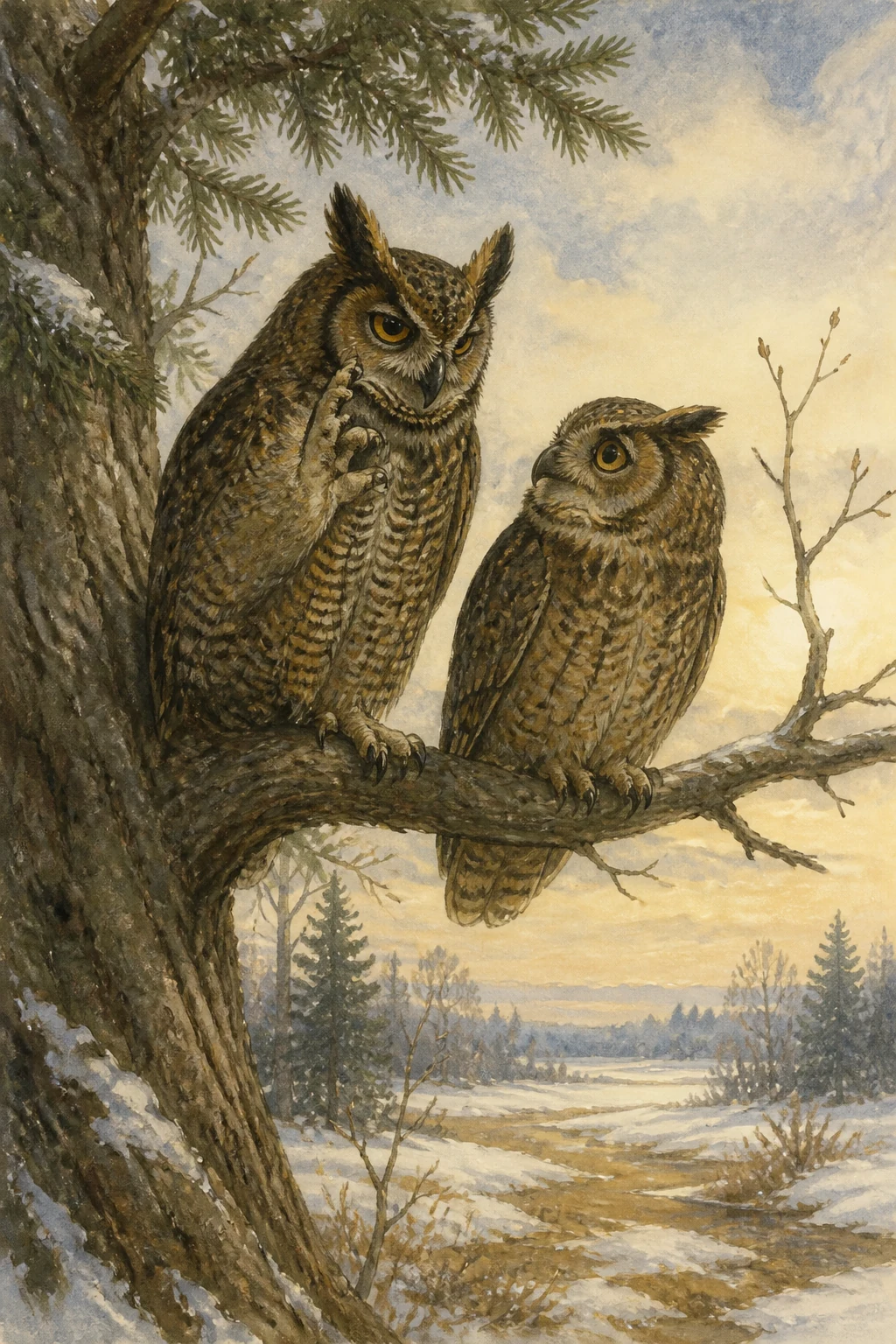
“Chirp!” said one to another. “So this is what they call the New Year! Why, it’s worse than the old one! We might just as well have kept that. I’m dissatisfied, and I have good reason to be!”
“Yes, there were the humans running about, firing shots to welcome the New Year,” said a little half-frozen sparrow. “They smashed pots against doors and were quite wild with joy because the old year was going away! And I was glad too, for I expected we should have warm days then, but nothing has come of it. The frost is much harder than before! The humans have got their reckoning of time wrong!”
“Indeed they have!” said a third, who was old and white about the head. “They have something they call an almanac, an invention of their own, and everything is supposed to go by that! But it doesn’t. When spring comes, the year begins; that is nature’s way, and that is what I go by!”
“But when will spring come?” asked the others. “It comes when the stork comes, but there’s no certainty about him, and here in town nobody knows anything about it. They know better out in the country. Shall we fly out there and wait? At least we shall be nearer spring.”
“Yes, that may be all very well!” said one who had been hopping about and chirping for a long time without really saying anything. “Here in town I have certain comforts which I’m afraid I should miss out there. Just round here, in a courtyard, there is a human family who have very sensibly thought of fastening three or four flowerpots to the wall, with the wide opening facing inwards and the bottom outwards. A hole has been cut in each bottom, large enough for me to fly in and out. My husband and I have our nest there, and all our young have flown from it. Naturally, the human family arranged it all for the pleasure of watching us; otherwise they would hardly have done it. They scatter breadcrumbs too, for their own pleasure, and so we have our food! One is quite provided for, as it were—and so I think I shall stay, and my husband will stay! Though we are very dissatisfied—but we shall stay!”
“And we shall fly out into the country to see whether spring is coming!” And off they flew. There was real winter in the country; the frost was a couple of degrees harder there than in town. The keen wind swept across the snow-covered fields. The farmer sat in his sleigh, wearing great mittens, and beat his arms about to drive the cold from them. His whip lay in his lap; the lean horses ran until they steamed, the snow creaked, and the sparrows hopped in the wheel tracks and shivered. “Chirp! When will spring come? It is so long in coming!”
“So long!” rang out across the fields from the highest hill, covered in snow. It might have been an echo they heard, but it might also have been the voice of the strange old man who sat at the very top of the snowdrift in wind and weather. He was quite white, like a peasant in a coat of white homespun, with long white hair and a white beard, very pale, and with large, clear eyes.
“Who is that old man over there?” asked the sparrows. “I know!” said an old raven sitting on the gatepost. He was condescending enough to acknowledge that we are all little birds before our Lord, and so he deigned to talk to the sparrows and explain. “I know who the old man is. He is Winter, the old man from last year. He is not dead, as the almanac says; no, indeed, he is guardian to the little prince Spring, who is coming. Yes, Winter holds command. Brr! I dare say your little bones are creaking!”
“Yes, isn’t that just what I say!” said the smallest. “That almanac is nothing but a human invention; it isn’t suited to nature! They ought to leave that to us, who are more finely made!”
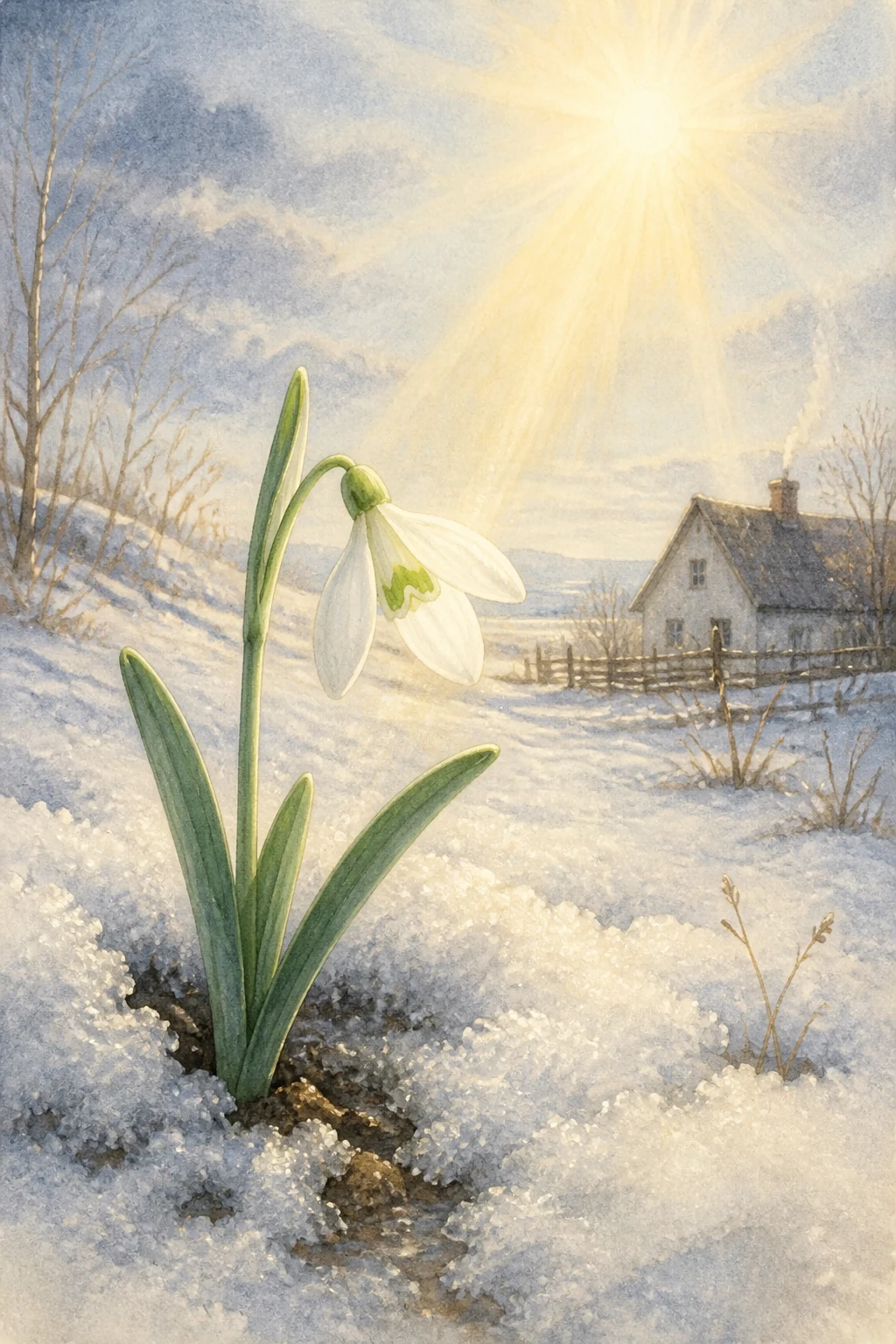
A week went by, and then almost two. The forest was black; the frozen lake lay heavy and looked like solid lead. The clouds—no, they were not clouds, but wet, icy mists—hung over the land. The great black crows flew in flocks without a cry; it was as though everything slept. A sunbeam glided across the lake, and it shone like molten tin. The snow over the fields and up on the hill no longer glittered as before, but the white figure, Winter himself, still sat there with his eyes fixed on the south. He did not notice at all that the blanket of snow seemed to be sinking into the earth, that here and there a little patch of grassy green appeared, and there the sparrows swarmed.
“Chirrup! Chirrup! Is spring coming now?” “Spring!” rang out over field and meadow and through the dark-brown woods, where the moss shone fresh and green on the tree trunks. And through the air, from the south, came the first two storks. On the back of each sat a lovely little child, a boy and a girl. They kissed the earth in greeting, and wherever they set their feet, white flowers sprang up beneath the snow. Hand in hand they went up to the old man of ice, Winter, and nestled against his breast in greeting. At that very moment all three were hidden, and the whole landscape too; a thick, wet mist, so dense and heavy, enveloped everything. A little later a breeze stirred—the wind rushed along in strong gusts and drove the mist away, and the sun shone so warmly. Winter himself had vanished; spring’s lovely children sat upon the throne of the year.
“Now that is what I call New Year!” said the sparrows. “I suppose we shall have our rights again now, and compensation for the hard winter!” Wherever the two children turned, green buds shot out on bushes and trees, the grass grew taller, and the cornfields became an ever more lovely green. And all around her the little girl scattered flowers. She had an abundance of them in her skirt; they seemed to spring up there, for it was always full, however eagerly she scattered them. In her haste she shook a whole snowfall of blossom over apple and peach trees, so that they stood in all their splendour before they had properly put out their green leaves.
And she clapped her hands, and the boy clapped his, and birds appeared from no one knew where, all twittering and singing: “Spring has come!”
It was lovely to see. Many a little old mother came out of her door into the sunshine, shook herself, and looked at the yellow flowers shining all over the meadow, just as they had in her young days. The world was young again. “It is blessed out here today!” she said.
The woods were still brownish green, bud upon bud, but the woodruff had come out, so fresh and fragrant; violets grew in abundance, and there were anemones, cowslips, and oxlips. Yes, every blade of grass was full of sap and vigour. It was truly a splendid carpet to sit upon, and there sat spring’s young couple, holding hands, singing and smiling, and growing more and more.
A gentle rain fell upon them from the sky; they did not notice it, for the raindrop and the tear of joy became one and the same drop. Bride and bridegroom kissed, and at that very instant the woods burst into leaf. When the sun rose, all the forests were green!
Hand in hand the bridal couple walked beneath the fresh canopy of leaves, where only the shafts of sunlight and the shadows brought changing shades into the green. There was a virginal purity and a refreshing fragrance in the delicate leaves! Clear and lively, river and brook rippled between the velvet-green reeds and over the many-coloured stones. “Abundance for ever and always, now and to come!” said all nature. And the cuckoo called and the lark trilled; it was lovely spring. Yet the willows wore woollen mittens about their flowers—they were so dreadfully cautious, and that is tiresome!
Days passed, and weeks passed; the warmth seemed to pour down. Waves of hot air swept through the corn, which grew yellower and yellower. The white lotus of the North spread its great green leaves over the surface of the woodland lakes, and the fish sought shade beneath them. And on the sheltered side of the wood, where the sun burned against the farmhouse wall and warmed the open roses through and through, and the cherry trees hung full of juicy, black, almost sun-hot fruit, sat summer’s lovely woman, whom we had seen as a child and as a bride. She looked towards the rising dark clouds, which towered higher and higher in mountain-like waves, blue-black and heavy. They came from three sides; more and more, like a petrified sea turned upside down, they lowered over the forest, where everything was silent, as if under a spell. Every breath of wind had dropped, every bird was still; a solemn expectancy lay over all nature. But on roads and paths people hurried along in carriages, on horseback, and on foot, seeking shelter. Suddenly there came a blaze, as though the sun had burst forth, flashing, dazzling, consuming everything, and darkness returned with a rolling crash. Water poured down in torrents; it was night and it was light, it was silence and it was thunder. The young brown-plumed reeds in the marsh swayed in long waves; the forest branches were hidden in veils of rain. Darkness came and light came, silence and thunder. Grass and corn lay as though beaten down, washed away, never to rise again. Suddenly the rain dwindled to single drops, the sun shone, and from stalk and leaf the water glittered like pearls. The birds sang, the fish leapt from the river, the gnats danced, and out on a rock amid the salt, wave-lashed sea sat Summer himself, the vigorous man with strong, full limbs and dripping hair—rejuvenated by his refreshing bath, he sat in the warm sunshine. All nature around him was rejuvenated; everything was lush, vigorous, and beautiful. It was summer, warm and lovely summer.
Sweet and delightful was the scent from the flourishing clover field, where the bees hummed around the ancient assembly place. A bramble twined about the altar stone, which, washed by the rain, shone in the sunlight. There the queen bee flew with her swarm, and they laid up wax and honey. No one saw it but Summer and his vigorous wife; for them the altar table stood spread with nature’s offering.
The evening sky glowed with a gold richer than any church dome had ever worn, and the moon shone between the evening and the morning glow. It was summertime. And weeks passed, and days passed. The harvesters’ bright scythes flashed in the cornfields; the branches of the apple tree bent beneath red and yellow fruit. The hops smelled delicious and hung in great cones, and under the hazel bushes, where the nuts hung in heavy clusters, husband and wife rested, Summer and his grave-faced woman.
“What riches!” she said. “Blessings all around, homely and good, and yet—I hardly know myself—I long for rest, for peace! I do not know the word for it! Already they are ploughing the fields again! More, always more, is what humans wish to gain! Look at the storks gathering in flocks and following the plough at a distance; the bird of Egypt that carried us through the air! Do you remember when we both came as children to these northern lands? We brought flowers, lovely sunshine, and green woods. Now the wind has dealt harshly with them; they turn brown and dark, like the trees of the south, but unlike those they bear no golden fruit!”
“Would you like to see such fruit?” said Summer. “Then rejoice!” And he raised his arm, and the leaves of the forest were coloured red and gold; a splendour of colour spread over all the woods. The rose hedge shone with fiery red hips, the elder branches hung with great, heavy clusters of blackish-brown berries, the ripe horse chestnuts fell from their dark-green husks, and deep in the woods the violets flowered a second time.
But the queen of the year grew quieter and quieter, and paler. “The wind blows cold!” she said. “The night has wet mists! I long for—the land of my childhood!” And she watched the storks fly away, every one, and stretched her hands towards them. She looked up at the nests, which stood empty; in one grew a tall-stemmed cornflower, and in another a yellow wild radish, as though the nest existed only to shelter and enclose it. And the sparrows came up there.
“Chirp! Where have the gentry gone? I suppose they can’t bear to have the wind blow on them, so they’ve left the country! A pleasant journey to them!” And the leaves of the forest grew yellower and yellower, and leaf fell upon leaf. The autumn storms roared; it was late in the season of harvest. On the fallen yellow leaves lay the queen of the year, gazing with gentle eyes towards the twinkling star, and her husband stood beside her. A gust of wind whirled through the leaves—they fell again, and she was gone, but a butterfly, the last of the year, flew through the cold air.
And the wet mists came, the icy wind, and the long, dark nights. The king of the year stood with snow-white hair, but did not know it himself; he thought it was the snowflakes falling from the clouds. A thin layer of snow lay over the green fields.
And the church bells rang at Christmastime. “The bells are ringing for a birth!” said the king of the year. “Soon the new royal pair will be born, and I shall have rest, as she has! Rest in the twinkling star!”
In the fresh green fir wood, where the snow lay, stood the Christmas angel, blessing the young trees that were to grace its festival. “Joy in the room and beneath the green branches!” said the old king of the year; the weeks had aged him into a snow-white old man. “The time of my rest draws near; the year’s young couple will now receive the crown and sceptre!”
“Yet the power is still yours!” said the Christmas angel. “Power, and not rest! Let the snow lie warm over the young grain! Learn to bear it when another is acclaimed, though you are still the ruler; learn to be forgotten and yet to live! Your hour of freedom comes when spring comes!”
“When will spring come?” asked Winter. “It comes when the stork comes!” And with white locks and a snow-white beard Winter sat, icy cold, old and bent, yet strong as the winter storm and the power of the ice, high upon the hill’s snowdrift, gazing south, just as Winter before him had sat and gazed. The ice cracked, the snow creaked, skaters swept across the shining lakes, and ravens and crows looked handsome against the white ground. Not a breath of wind stirred. And in the still air Winter clenched his fists, and the ice grew fathoms thick between the lands.
Then the sparrows came again from town and asked, “Who is that old man over there?” And the raven sat there again, or a son of his, which comes to much the same thing, and told them, “That is Winter! The old man from last year. He is not dead, as the almanac says, but guardian to the spring that is coming!”
“When spring comes,” said the sparrows, “we shall have good times and a better government! The old one was no good.” And in quiet thought Winter nodded towards the black, leafless forest, where every tree revealed the lovely shape and curve of its branches. In his winter slumber the icy mists of the clouds descended—the ruler dreamed of the days of his youth and manhood, and at dawn the whole forest stood beautiful with hoarfrost. It was Winter’s summer dream; the sunshine scattered hoarfrost from the branches.
“When will spring come?” asked the sparrows. “Spring!” sounded like an echo from the snow-covered hills. And the sun shone more and more warmly, the snow melted, and the birds twittered, “Spring is coming!”
High through the air came the first stork, and the second followed. A lovely child sat on the back of each, and they descended into the open fields and kissed the earth, and kissed the silent old man; and like Moses on the mountain, he vanished, borne away by the cloudy mist.
The story of the year was over. “That is all very true!” said the sparrows. “And very pretty too, but it isn’t according to the almanac, and so it is wrong!”